Troubleshooting Lifting Plateaus: A 4-Step Check for Technique, Sleep, Volume and Fatigue
How to break a lifting plateau: a 4-step check of technique, sleep and food, weekly volume and exercise fatigue, so you fix the real cause, not guess.
TL;DR. The short answer
- To break a lifting plateau, diagnose before you change anything: check technique consistency, then sleep and food, then weekly volume, then exercise-specific fatigue, in that order.
- A real plateau is usually 3-4 weeks or more of no progress in load, reps or quality, not one bad session. Fluctuations of a rep or two are normal.
- Volume is dose-dependent, with diminishing returns: more weekly sets tend to build more muscle, but the curve flattens, so both too little and too much can stall you.
- Short sleep evidence is mixed. Several nights of restriction can cut compound-lift force, yet one small trial found 1-2 hours less sleep did not blunt gains.
- Change one variable at a time for 3-4 weeks. If you change five things, you will never know which one worked.
Part of our complete guide: Progressive Overload Methods, Deloads and Plateaus: The Long-Term Progression Guide
Table of contents
How to break a lifting plateau comes down to one habit: diagnose first, then change one thing. Most stalled lifters skip straight to a new program (see our progressive overload, deloads and plateaus guide for the bigger picture), which fixes nothing if the real problem is sleep, sloppy depth or the wrong number of sets.
This is the master troubleshooting tool for that guide. Below is a four-step order of checks: technique, sleep and food, volume, then exercise-specific fatigue. It is a coaching framework built on the research, not a single trial’s protocol.
Is it a real plateau or just a bad few weeks?
First, define the problem. One flat session is noise. Strength moves around with sleep, stress, meals and even how hot the gym is in an Indian summer.
A working definition: no progress in load, reps or rep quality across 3-4 weeks of logged training, with similar effort. If your top set of bench is 70 kg for 7 on one day and 70 kg for 6 on another, that is not a stall. If it has been 70 kg for 6-7 reps for a month, now we are talking.
You need a log for this. Without numbers you are guessing, and gut feeling is a terrible judge of a four-week trend.
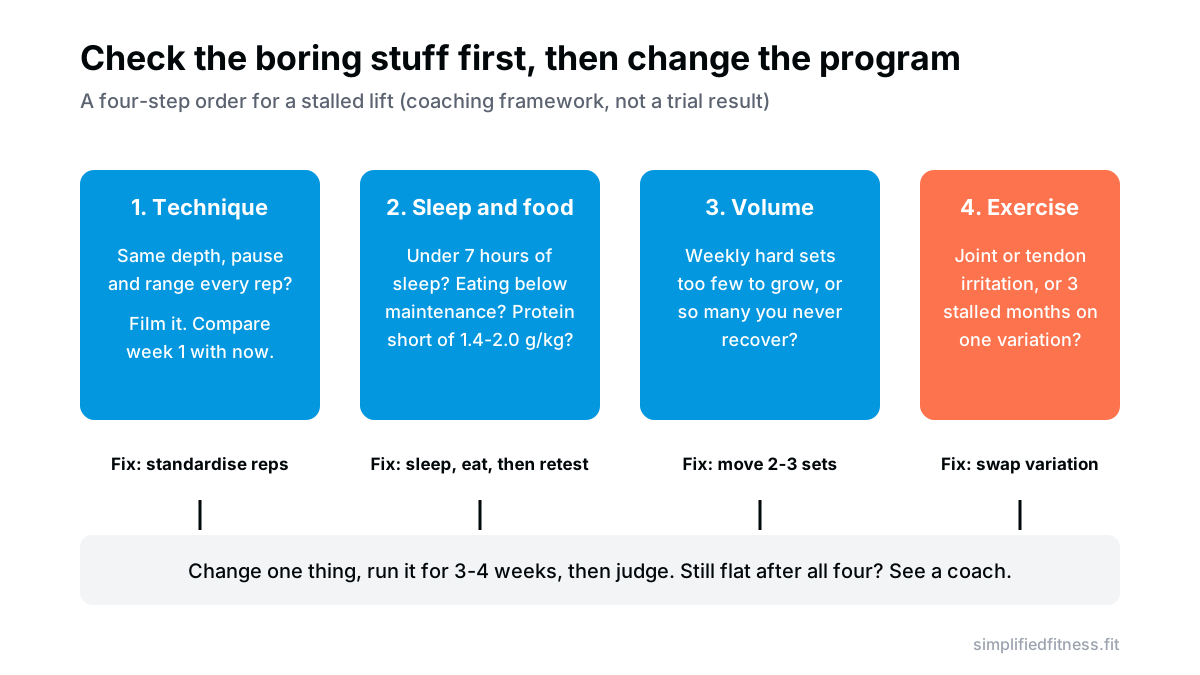
Step 1: Check technique, are your reps actually the same?
The most common hidden cause is rep drift. Your squat creeps from below parallel to just above it. Your bench starts bouncing off the chest. The number on the bar goes up, but the muscle is doing less.
In the gym, this looks like cutting range of motion the second the weight gets heavy.
Range matters for the result as well as the look. A 2021 meta-analysis of 16 studies found full range of motion training produced larger gains than partial range for strength (effect size 0.56) and lower-limb hypertrophy (effect size 0.88), while muscle architecture measures (muscle thickness, pennation angle and fascicle length) showed no clear difference between the two (Pallares et al., 2021). So if your depth has shrunk, standing back at a strict standard is a real fix, and you can read more in full vs partial range of motion.
How to audit it:
- Film your top set from the side. Do it again every 3-4 weeks.
- Pick a standard you can repeat: thighs to parallel, a one-second pause on the chest, full lockout.
- Reset the load to what you can do to that standard. Yes, that may mean 5-10 kg lighter.
Taking a step back feels like going backwards. It usually isn’t. It restarts the count on honest reps. For the technical-versus-mechanical failure distinction, see our piece on form standardization.
Step 2: Are sleep, calories and protein holding you back?
Gains are built between sessions. If recovery inputs are poor, the training stimulus has nothing to work with.
Sleep. The evidence here is mixed, so let me lay out both sides. A systematic review of 17 studies (quality rated moderate or weak) found total sleep deprivation had little effect on strength, but consecutive nights of sleep restriction could reduce force output in multi-joint lifts, not single-joint ones (Knowles et al., 2018). On the other hand, a small trial of 12 middle-aged adults (average age about 42) who habitually slept about 1-2 hours below the 7-hour recommendation found their 16-session resistance program still improved repetitions and arm muscle area, much like a group sleeping enough (Borba et al., 2024).
Why the gap? Small samples, short protocols, different lifts and different ways of measuring. The cautious takeaway is that heavy compound lifts, like squat and bench, seem most sensitive, and chronic short sleep is still a poor bet. Aim for a regular 7 or more hours. Our deeper piece is sleep and circadian timing for recovery.
Food. Two questions. Are you eating enough calories for your goal? Are you getting enough protein? The ISSN position stand says 1.4-2.0 g of protein per kg of body weight per day is sufficient for most exercising people (Jager et al., 2017). For a 70 kg lifter, that is roughly 100-140 g a day.
In an Indian vegetarian diet this takes planning. A bowl of dal gives a modest amount, 100 g of paneer more, and soya chunks, curd, eggs and whey fill the rest. Lifters on a long cut also often stall for a plain reason: a calorie deficit is not a good time to expect new personal bests. The relationship is covered in calorie deficit versus surplus for hypertrophy.
Step 3: Is your weekly volume too low or too high?
This is where most plateau advice goes wrong, because it only ever says “do more” or “do less”. Both can be right, for different people.
The evidence is dose-dependent. A meta-regression of 15 studies found each additional weekly set was associated with a 0.37% larger gain in muscle size, and that higher volume groups gained about 3.9% more than lower volume groups (Schoenfeld et al., 2017). A newer meta-regression of 67 studies and 2,058 participants confirmed that gains in size and strength rise with volume but with diminishing returns, and those returns were much more pronounced for strength (Pelland et al., 2026).
Read that carefully. More sets helps on average. It does not say more is always better for you, and the studies largely tested short blocks in mostly young participants. Your personal sweet spot is also tied to your sleep, diet and stress. The practical shape of the curve is in weekly set volume and the hypertrophy curve, and the idea of minimum and maximum recoverable volume is in volume landmarks.
How to test:
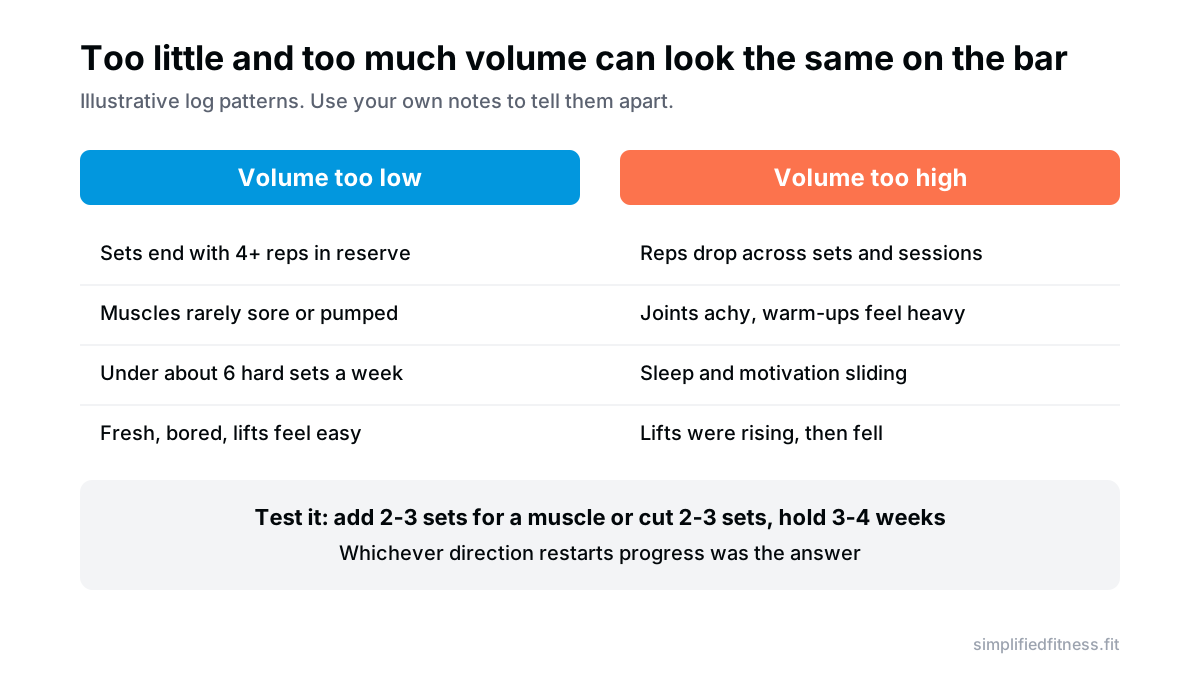
- Count your hard sets per muscle per week (sets within about 0-3 reps of failure).
- If you are under roughly 6 and feel fresh, add 2-3 sets to the stalled muscle.
- If you are well above 15-20, your reps are falling across sessions and you feel beaten up, cut 2-3 sets.
- Hold the change for 3-4 weeks. Do not touch anything else.
Use the training volume calculator to tally it. If you suspect you are doing too many sets that contribute nothing, junk volume and diminishing returns explains the trap.
One more thing on this step. Are your hard sets actually hard? In a study of 24 resistance-trained people on the bench press, predictions of 1 and 3 reps in reserve were off by roughly 0.65 reps on average in absolute terms, which is good accuracy (Refalo et al., 2024). That was one lift, tested in a lab, in trained people, so be more cautious if you are newer or the lift is unfamiliar. Still, it suggests trained lifters can judge effort, which means “I stop every set 5 reps short” is a choice you can see in your log, not bad perception.
Step 4: Is this exercise itself the problem?
If steps 1 to 3 check out and one lift is still flat, look at the exercise. This is the least researched step, so treat the following as practical coaching judgment rather than proven rules.
Signs it is the exercise:
- Elbows, shoulders or knees are irritated on that lift but nothing else.
- You have run the same variation for 3 months or more with no change.
- Other lifts are moving fine.
A close variation often helps. Stalled flat barbell bench? Try an incline dumbbell press for 6-8 weeks. Stalled back squat? Try a front squat or a pause squat. Keep the new lift long enough to measure it. Constantly swapping is the opposite of progressive overload, and we cover why in the exercise rotation myth.
Also check the small jumps. A 2.5 kg jump is roughly 5-10% of many people’s overhead press, and far more on a lateral raise. Microloading with fractional plates solves that.
What about a deload?
A deload is a tempting plateau cure, but the evidence for using it as a cure is thin. In a trial of 39 resistance-trained young adults, one group stopped lifting entirely for a week at the midpoint of a 9-week high-volume program while another trained continuously. Lower-body size, endurance and power did not differ, and the continuous group improved lower-body strength more (Coleman et al., 2024).
That was one study, 9 weeks long, with a complete break rather than a reduced-volume deload. It does not mean deloads are useless. It means a deload is for accumulated fatigue, not for every stall. Check the deload indicators before you take the week off.
A simple 8-week plan to restart progress
- Week 0: Film your top sets, log sleep and protein for 7 days.
- Weeks 1-2: Fix the standard. Reset load to honest reps, sleep 7 or more hours, hit your protein.
- Weeks 3-6: If still flat, change volume by 2-3 sets for the stalled muscle.
- Weeks 7-8: If still flat, swap the variation, or check the training logbook variables you might be missing.
If you want a ready structure while you test, try our free push day plan.
When to see a doctor
Most plateaus are training or lifestyle problems. If your stall comes with unexplained fatigue, persistent joint pain, dizziness, a sudden unexplained weight change or any new symptom, see a doctor. We cannot diagnose these, and training harder is the wrong response.
The bottom line
Plateaus feel like a wall, but they are usually a signal. Standardise your reps, protect sleep and food, test volume in one direction, and only then blame the exercise. Run one change at a time, for 3-4 weeks each, and keep a log. If you want an experienced eye on your logs and videos, that is what coaching is for.
Frequently Asked Questions
How long does a lifting plateau last?
Most plateaus last as long as the cause goes unfixed, so there is no fixed length. If a lift has not moved in load, reps or rep quality for 3-4 weeks, treat it as a real stall rather than a bad week. Run the four-step check, change one thing and give it a month before judging.
How do I know it is a real plateau and not a bad week?
A real plateau shows as flat or falling performance across several sessions, not a single rough day. Day-to-day strength varies with sleep, stress and food, so one low session means little. Look at your last 3-4 weeks of logged sets and decide from the trend.
Should I deload when I plateau?
Not automatically. In a 9-week trial of 39 resistance-trained people, a full week off at the midpoint made no appreciable difference to lower-body muscle growth, and the continuous group gained more lower-body strength. A deload makes sense when fatigue signs are present, so check the signals first with our guide to [signs you need a deload](/blog/signs-you-need-a-deload-indicators-checklist).
Is it better to add volume or cut volume when stalled?
It depends on which side of your own sweet spot you are on. Meta-analytic data show more weekly sets generally produce more growth with diminishing returns, so someone doing very few sets often benefits from adding some, while someone who is run down may benefit from fewer. Test one direction by 2-3 sets per muscle per week for 3-4 weeks.
Does lack of sleep stall strength gains?
It can, but the evidence is mixed. A systematic review found consecutive nights of restricted sleep reduced force in multi-joint lifts, while a small trial in middle-aged adults found habitually sleeping 1-2 hours less than 7 hours did not blunt training adaptations. Aim for a consistent 7 or more hours and treat sleep as a first suspect, not the only one.
Can I break a plateau while eating in a calorie deficit?
Often the goal shifts from progress to keeping what you have. In a deficit, holding your strength is a win, and small drops can be normal. If you want steady progress, run a maintenance or small surplus phase.
How much protein do I need to keep progressing?
The ISSN position stand says 1.4-2.0 g per kg of body weight per day is sufficient for most exercising people. That is roughly 100-140 g for a 70 kg lifter. Spread it over 3-4 meals using dal, paneer, curd, eggs, soya or chicken, and check the number with our [protein calculator](/tools/protein-calculator).
Does sloppy form cause plateaus?
Yes, in a hidden way. If your squat gets shallower or your bench starts bouncing, the load rises but the work done by the target muscles does not. Film your top set from the side every few weeks and hold depth, pause and range the same.
Is full range of motion better for breaking a plateau?
A 2021 meta-analysis found full range training beat partial range for strength and lower-limb hypertrophy, with no clear difference in muscle architecture measures such as muscle thickness. If your range has crept shorter, restoring it is a legitimate fix. Drop the load by 10-15% to do it properly.
How accurate is my sense of how close to failure I am?
Fairly good in trained lifters on a familiar lift. In a study of 24 trained people on the bench press, average prediction error was well under one rep at 1 and 3 reps in reserve. Use our [RIR and RPE calculator](/tools/rir-rpe-calculator) and be honest when you log sets.
Should I change exercises when I plateau?
Only after you have ruled out the earlier steps. Swapping a stalled lift for a close variation can help when joints are irritated or the movement is stale. Constant swapping makes progress impossible to measure, so keep a variation for at least 6-8 weeks.
When should I see a doctor about a plateau?
See a doctor if the stall comes with unexplained fatigue, ongoing joint pain, rapid weight loss, dizziness or other new symptoms. Plateaus are normally training or lifestyle issues, but persistent fatigue or pain can have a medical cause. A coach cannot diagnose that.
Sources & References
Every claim above is checked against peer-reviewed research (PubMed, U.S. National Library of Medicine) or guidance from established health bodies. How we fact-check.
- Schoenfeld BJ, et al. Dose-response relationship between weekly resistance training volume and increases in muscle mass: a systematic review and meta-analysis. J Sports Sci. 2017. PMID: 27433992
- Pelland JC, et al. The resistance training dose response: meta-regressions exploring the effects of weekly volume and frequency on muscle hypertrophy and strength gains. Sports Med. 2026. PMID: 41343037
- Knowles OE, et al. Inadequate sleep and muscle strength: implications for resistance training. J Sci Med Sport. 2018. PMID: 29422383
- Borba DA, et al. Could a habitual sleep restriction of one-two hours be detrimental to the benefits of resistance training? Sleep Sci. 2024. PMID: 39268337
- Pallares JG, et al. Effects of range of motion on resistance training adaptations: a systematic review and meta-analysis. Scand J Med Sci Sports. 2021. PMID: 34170576
- Refalo MC, et al. Accuracy of intraset repetitions-in-reserve predictions during the bench press exercise in resistance-trained male and female subjects. J Strength Cond Res. 2024. PMID: 37967832
- Coleman M, et al. Gaining more from doing less? The effects of a one-week deload period during supervised resistance training on muscular adaptations. PeerJ. 2024. PMID: 38274324
- Jager R, et al. International Society of Sports Nutrition position stand: protein and exercise. J Int Soc Sports Nutr. 2017. PMID: 28642676

Umair Hazrami · Founder & Head Coach, Simplified Fitness
Umair Hazrami founded Simplified Fitness and the Simplified Lifter channel to cut through fitness noise. With 4+ years of consistent training and 10+ coaching clients, he writes every guide from the peer-reviewed research and links the sources so you can check them. Our editorial standards.
Educational content only, not medical advice. If you have a medical condition, are pregnant, or take medication, talk to a qualified doctor before changing your diet, supplements or training. Full disclaimer.
Keep reading

Programming
The 5 Modalities of Progressive Overload: A Checklist for When Weight Won't Go Up
5 ways to progressive overload: load, reps, range of motion, tempo and rest density. A practical checklist for compounds and isolations, with the research.
7 min read
Programming
Autoregulated Progressive Overload (APRE): How Much Weight to Add Next Week
Autoregulated progressive overload (APRE) uses your last-set reps to set next week's weight. Get simple jump rules, a worked example and the evidence.
9 min read

Programming
Deload Science: What a Deload Week Really Does to Fatigue, Muscle and Strength
Deload science explained: the fitness-fatigue model, what trials show for muscle size and strength, and what happens in a deload week. Studies linked.
8 min read

Programming
How to Do a Deload Week: Volume Cut vs Intensity Cut vs Time Off
How to do a deload week workout: compare cutting sets by half, lowering weight by 20%, or taking time off, with a step-by-step template and the research.
9 min read