Microloading in Resistance Training: Using Fractional Plates (0.25-0.5kg) on Upper-Body Lifts
Microloading resistance training means adding 0.25-0.5 kg at a time. See the maths, the cheap kit and how to keep pressing and curling heavier for months.
TL;DR. The short answer
- Microloading is adding very small weight jumps (0.25-1 kg) so each step is roughly a 1-6% change in load instead of a 10-25% leap.
- A 2.5 kg jump is only 2.5% on a 100 kg squat but 12.5% on a 20 kg barbell curl, which is why upper-body lifts stall first.
- In the one small trial that tested it (2001, 19 pretrained students, 8 weeks), 0.22 kg steps appeared as effective as bigger steps for bench and triceps press strength.
- Adding a rep is also microloading. Fractional plates, magnetic add-ons and pin-stack magnets just give you finer control once the rep range tops out.
- No trial shows microloading beats larger jumps for muscle growth in trained lifters, so treat it as a practical tool, not a magic trick.
Part of our complete guide: Progressive Overload Methods, Deloads and Plateaus: The Long-Term Progression Guide
Table of contents
If your overhead press or curl has been stuck for weeks and the smallest plate in your gym is 2.5 kg, the plate is probably the problem, not you. Microloading in resistance training solves this by adding 0.25-1 kg at a time, so each step is small enough to actually lift.
It is one of the most practical fixes inside our wider progressive overload, deloads and plateaus guide. Here is the maths, the kit, and a simple routine you can start next session.
Why do upper-body lifts stall when you can only add 2.5 kg?
Because the jump is the wrong size. Percentages matter more than kilograms.
Add 2.5 kg to a 100 kg squat and the bar is 2.5% heavier. Most people can absorb that in a session or two. Add the same 2.5 kg to a 20 kg barbell curl and the bar is 12.5% heavier. That is the difference between your usual 10 reps and a set that collapses at 6 or 7.
Dumbbells are worse. Many gyms jump from 8 to 10 kg, or 10 to 12 kg. That is a 20-25% jump on a lateral raise, and the muscle involved is a small one that can’t just “grind it out.”
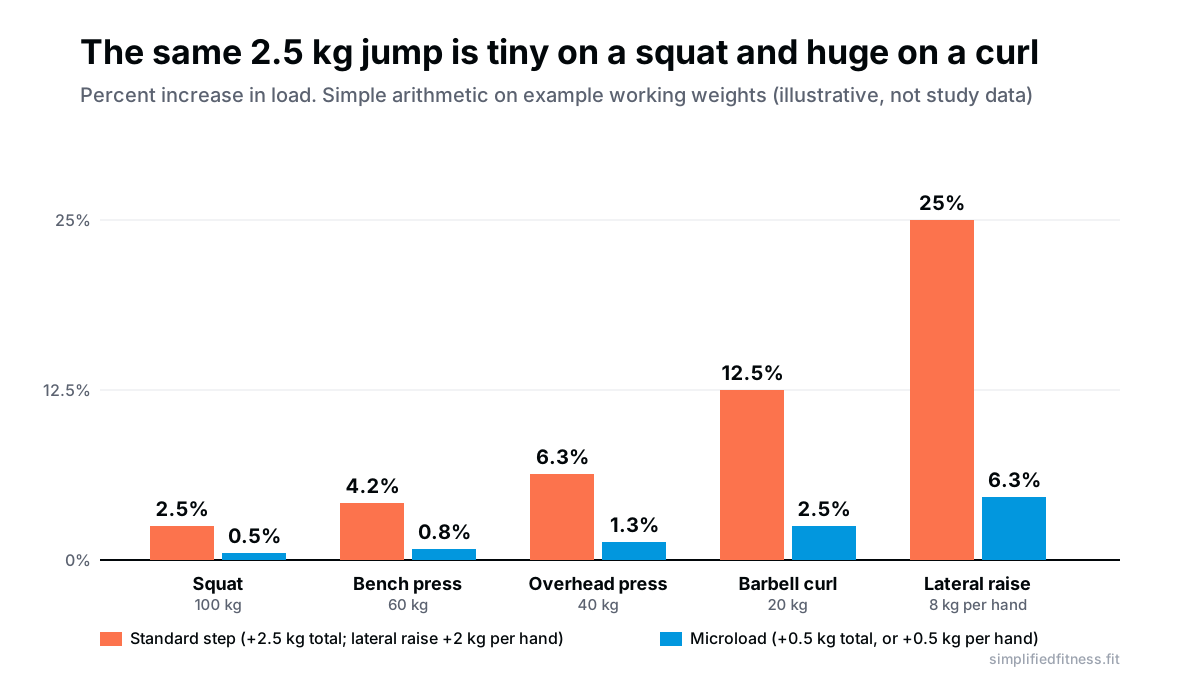
So people stall on curls, side raises and presses and blame genetics, or conclude the muscle “stopped responding.” Often the muscle was ready for 20.5 kg. The gym only offered 22.5.
What does the research say about microloading resistance training?
Honest answer: not much, and it is small.
The most direct evidence is a 2001 trial in which college students did bench press and triceps press (Hostler et al., 2001). After a first 8 weeks of traditional training (adding 1.1-2.2 kg when a rep target was hit), one group continued the same way while the other switched to steps of 0.22 kg (0.5 lb) or 0.44 kg for another 8 weeks. The authors concluded the small-increment approach appeared as effective as traditional steps for building strength over those 8 weeks, in short-term pretrained men and women.
Before you get too excited, look at the limits. The groups had around 9 or 10 people each. The lifters were college students, not experienced gym-goers. It lasted 8 weeks. Not every subgroup improved significantly (the triceps press gains reached significance only in the men). And the authors noted that preliminary data suggested traditional progression might raise the training load more effectively over longer periods.
So what can we say? Small steps are a reasonable way to keep making strength gains when larger steps are not available. We cannot say they build more muscle.
Is adding reps the same as microloading?
Pretty much, yes. Going from 9 reps to 10 at the same weight is progress you can make without any new plates, and it is the first lever to pull before you touch the load. That is the logic behind double progression, which we cover in the double progression guide.
There is some support for working within rep zones. In a secondary analysis of 24 untrained men, a repetition-zone model (training to failure within a rep range) produced greater volume load progression per session, 2.30% versus 1.01% for a fixed percent-of-1RM model, and greater muscle cross-sectional area gains. Strength gains did not differ (Nóbrega et al., 2023). It was exploratory, in untrained men, so I would not stretch it far.
The rep range itself also has more room than the old “5 for strength, 10 for size, 20 for endurance” chart suggests. A 2021 review argues muscular adaptations can be obtained across a wide spectrum of loading zones (Schoenfeld et al., 2021). A 2016 meta-analysis found loads of 50% of 1RM or lighter produced substantial strength and hypertrophy gains in untrained people, with a non-significant trend favouring heavier loads (Schoenfeld et al., 2016). Practically, a curl in the 8-15 rep range gives you room to work with. For how ranges and effort fit together, see our load, rep ranges and RIR guide.
So the order is simple. Add reps first. When the top of the range is clean, add the smallest weight step.
What equipment do you need for fractional loading?
Not much. Here is the kit, cheapest first.
- Fractional plates (0.25, 0.5, 1 kg). Small discs that slide onto a barbell or an EZ-bar. A pair of 0.25 kg plates adds 0.5 kg in total. Ask your gym if they have a set, or buy your own.
- Magnetic add-on weights. Flat magnets that stick to the head of a dumbbell. They are what makes dumbbell lateral raises and dumbbell shoulder presses progressable at 0.5 kg per hand.
- Pin-stack add-ons. Small magnets or clips for cable stacks. They bridge the gap between pins, often by 0.5-2 kg, depending on the machine.
- Washers or similar hardware. A budget option, but weigh them on a kitchen scale before you trust them, and secure them.
- Your own log. The most useful “equipment” is a notebook or app where the exact load is written down.
Plate weights can drift a little from the label, especially on old, painted or cheap plates. I would not assume your gym’s 2.5 kg plates are perfect. This matters more when your step is 0.5 kg, so use the same bar and plates each week and note which ones. If you want to do the maths on a loaded bar, our barbell plate calculator helps.
How do you microload the overhead press?
With a barbell, the arithmetic is neat. Take a 40 kg press.
- Standard step of 2.5 kg total = 6.3%
- A pair of 0.5 kg plates (1 kg total) = 2.5%
- A pair of 0.25 kg plates (0.5 kg total) = 1.3%
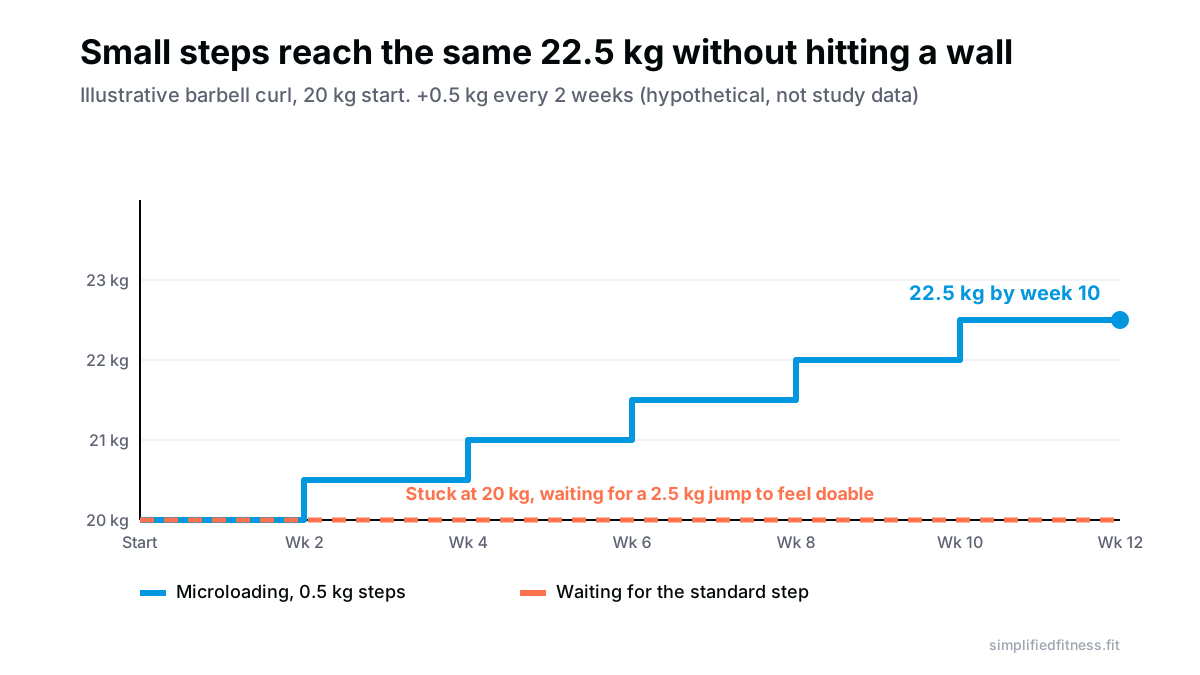
That is the gap between a jump you may need weeks to match and one you might hit next session.
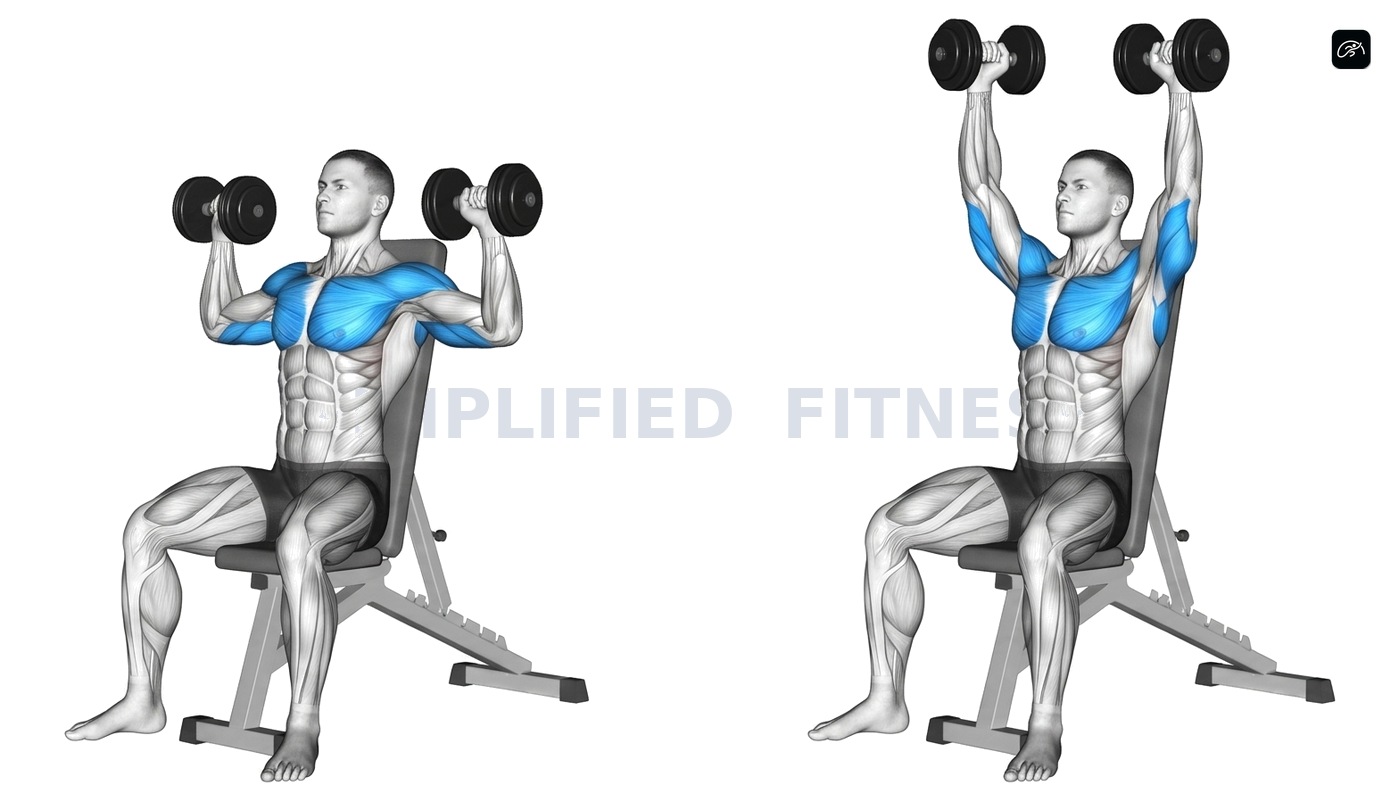
Dumbbell pressing needs magnets, because you cannot split a fixed dumbbell. Take a pair of 14 kg dumbbells. Going to 16 kg is +14%. Adding a 0.5 kg magnet to each takes them to 14.5 kg, a +3.6% step. Same rule as before: only step up once you are at the top of your range on every set. How standing, seated and machine presses differ is covered in overhead pressing: standing vs seated, dumbbell vs machine.
How do you microload curls, lateral raises and triceps work?
These are the lifts where microloading matters most, because working weights are low and the muscles are small.
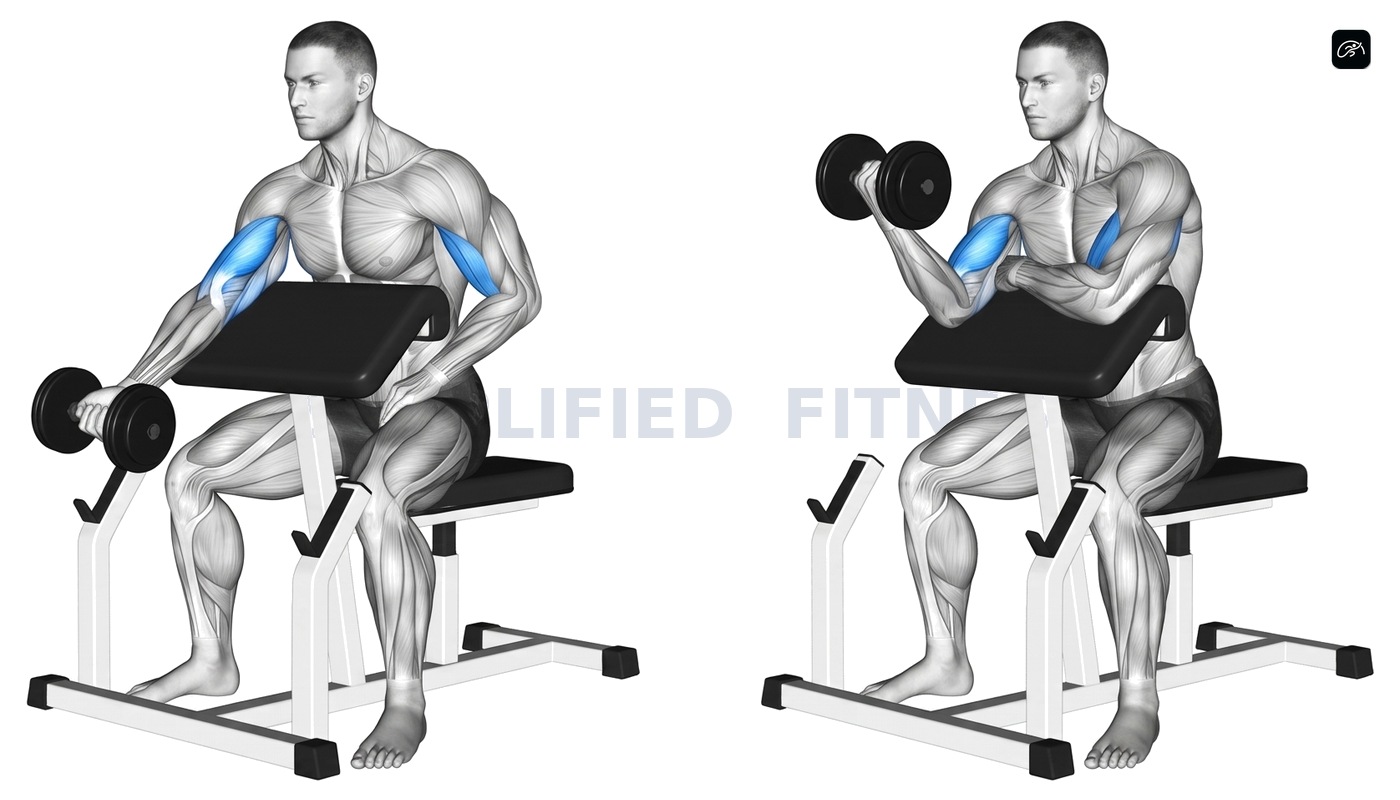
Curls. On a barbell or EZ-bar, a 0.25 kg pair gives +0.5 kg, a 2.5% step on a 20 kg bar. On dumbbells, magnets give +0.5 kg per hand.
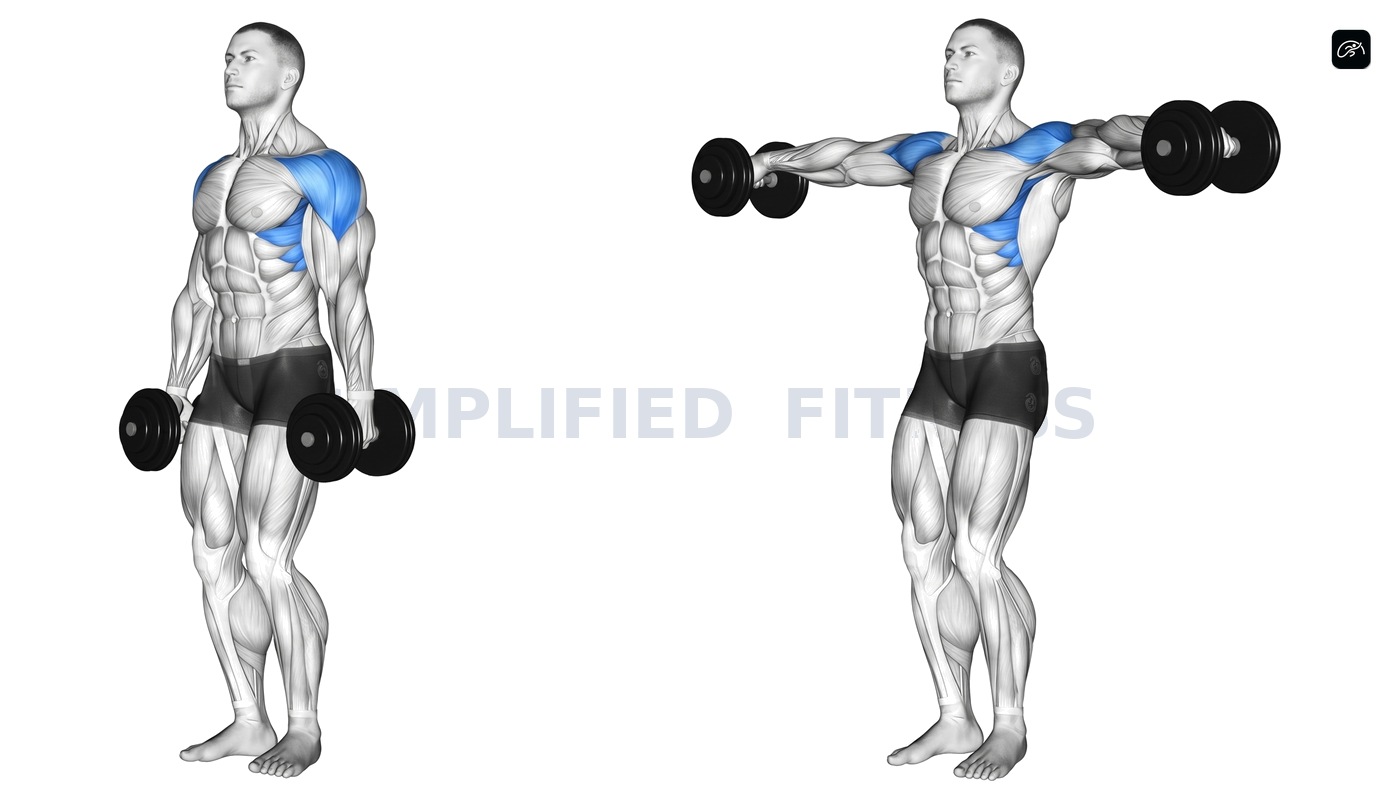
Lateral raises. The gap here is the largest. Moving from 8 kg to 10 kg per hand is a 25% jump, and the lateral deltoid lever arm makes the last few reps feel much heavier than the number suggests. Try 8, then 8.5, then 9, then 9.5, over several weeks. More on this lift in our lateral deltoid training guide.
Triceps pushdowns and cable work. Use a pin-stack add-on, or alternate weeks between adding a rep and adding the add-on magnet.
If the bar is empty and you still want a smaller step, you can also use slower lowering reps, a short pause at the stretch or an extra set. These are not weight, but they are still progress. See the 5 modalities of progressive overload for the full list.
How do you actually run it? A step-by-step progression
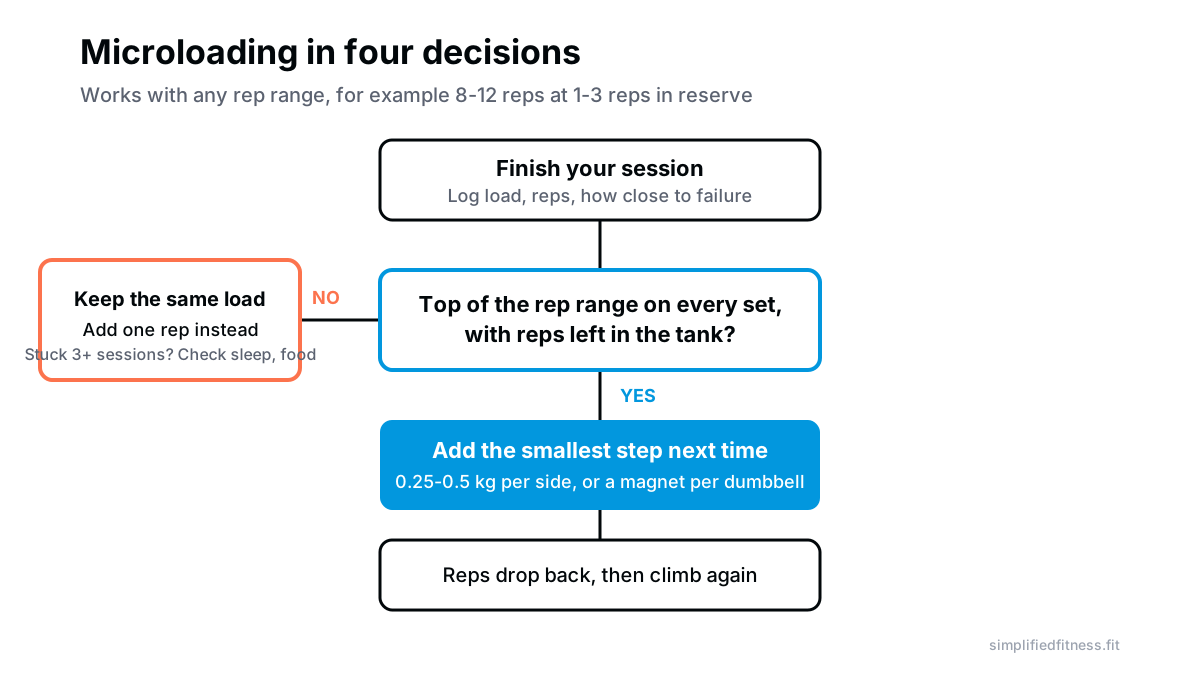
- Pick a range. For example, 8-12 reps on lateral raises, 6-10 on a barbell press.
- Work 1-3 reps from failure. You can check this with the RIR and RPE calculator.
- Log the load, the reps and the effort. Without a log, a 0.5 kg step is invisible. Our guide to tracking variables in a training logbook covers what to write down.
- Hit the top of the range on every set? Add the smallest step next session and expect your reps to drop back toward the bottom of the range.
- Missed reps? Stay at the same weight and chase one more rep next time.
- Stuck for three or four sessions? Drop back one step and look at sleep, calories and protein. If it persists, check our plateau troubleshooting flowchart.
One caveat on effort. A 2024 meta-regression found that, after adjusting for other variables, muscle growth tended to be greater when sets finished closer to failure, while strength gains were similar across a wide range of reps in reserve. The authors flagged the analysis as exploratory and the estimates of reps in reserve as imprecise (Robinson et al., 2024). The takeaway: microloading does not replace effort. A tiny step on a set you finish with 6 reps in the tank is just a slow walk.
Does a heavier log always mean more muscle?
No, and this is worth knowing so you do not become a slave to the number.
A 2024 paper argued that the increase in total training volume reported in studies tells us little about muscle growth, because the link looks noncausal and similar volume increases do not always produce similar growth (Hammert et al., 2024). That is the authors’ interpretation, and others weigh the evidence differently.
In practice: use load as a tool to keep the stimulus honest, but do not chase a heavier number with sloppy form. A 0.5 kg increase that comes from a swinging, half-range rep is not progress. Keep your range of motion and tempo the same from session to session. For how free weights compare with machines when it comes to tracking progress, see progressive overload with machines vs free weights.
When should you not bother microloading?
Plenty of times.
- Squats, deadlifts, leg press. A 2.5 kg step is a small percentage of the load, so standard plates work.
- True beginners. Early gains come fast and normal jumps usually fit. Save the small plates for when progress slows.
- Pain or poor recovery. Smaller jumps do not fix an irritated elbow or a week of 4 hours of sleep. If joint pain is persistent or getting worse, see a doctor or physiotherapist instead of adding weight.
- When adding a rep still works. If reps are still climbing, you do not need more kit yet.
The bottom line
Microloading is not a trick. It is arithmetic. A 2.5 kg step is a different size of problem on a curl than on a squat, so shrink the step to fit the lift. Add reps first, then 0.25-0.5 kg per side or per hand, and keep effort honest.
The research behind it is thin, so I would call it a practical solution, not a proven edge. Still, a pair of 0.25 kg plates costs less than a month of repeating the same weight. If you want a structure that puts all this to work, start with our free workout plans and log every set.
Frequently Asked Questions
What is microloading in resistance training?
Microloading means increasing the weight by a very small amount, usually 0.25-1 kg in total, instead of the standard 2.5-5 kg jump. The idea is to keep each increase small enough that you can still hit your target reps. Use it on lifts where the smallest normal jump is a big percentage of your working weight, like curls and lateral raises.
How much weight should I add each week on overhead press?
There is no universal number, but for most lifters a total increase of 0.5-1 kg (0.25-0.5 kg per side) is a realistic step on a barbell overhead press. Smaller steps keep the jump near 1-2% of the load, which is easier to match with the reps you were already getting. Add weight only after you reach the top of your rep range on every set, not on a fixed weekly schedule.
What are fractional plates and where do I buy them in India?
Fractional plates are small discs, commonly 0.25 kg, 0.5 kg and 1 kg, that sit alongside your normal plates. You can buy them from online fitness stores and some local gym suppliers, and many commercial gyms will let you bring your own. If you cannot find any, ask the gym manager whether they stock a pair, because a set is cheap compared with a month of stalled training.
Can I use washers or coins instead of fractional plates?
Many lifters use steel washers or similar hardware, but you should weigh them on a kitchen scale instead of trusting the label. Coins and washers vary in weight, so a guess can be off by a surprising margin. Tape them or use a proper clip so nothing slides off mid-set, and write the weighed total in your log.
How do I microload dumbbell lateral raises and curls?
Use magnetic add-on weights that stick to the dumbbell, typically 0.25-1 kg each, or move up through rep targets before the weight. Fixed dumbbells in many gyms jump by 1-2 kg, which is a 10-25% change on a light raise. Add 0.5 kg per hand only when you hit the top of your rep range on all sets.
How do I microload on cable machines with a pin stack?
Look for small magnetic or clip-on add-on weights made for pin stacks, which usually add 0.5-2 kg between plates. Some machines have a thin half-plate for exactly this reason. If your gym has none, use a slower tempo or an extra rep to bridge the gap between pins.
Does microloading actually build more muscle than normal jumps?
There is no good evidence that it does. The one small trial on 0.22 kg steps found similar short-term strength gains to larger steps in pretrained students, and the authors noted preliminary data suggesting larger steps might raise the training load more effectively over longer periods. Think of microloading as a way to keep progressing when normal jumps are too big, not as a growth hack.
Is adding a rep better than adding weight?
Neither is better by default, and you will use both. Adding reps inside a range is a very fine form of progression, and trials comparing progression models show gains when lifters work within a repetition zone. Once you reach the top of the range, add the smallest weight step and drop back to the bottom of the range.
How many reps should I leave in reserve when I microload?
Most sets work well finishing with roughly 1-3 reps left, which is the range this site uses for hypertrophy training. A 2024 meta-regression found muscle growth tends to improve as sets get closer to failure while strength gains were similar across a wide range, although the estimates were exploratory. Do not grind to failure every set just to prove the new weight is heavier.
What if I miss reps after adding 0.5 kg?
A small miss is normal and does not mean microloading failed. Stay at the same weight next session and aim to add a rep, or repeat the session if you were short on sleep or food. If you miss across three or four sessions in a row, step back one increment and check recovery before pushing again.
How long can I keep microloading before I stall?
There is no fixed answer, and progress still slows as you get stronger because small steps eventually get small gains. The point is that you stop being stopped by the equipment. When you stall for several weeks despite good sleep, food and effort, it is time for a different tool, such as a deload or a change in exercise.
Do I need microloading for squats and deadlifts?
Usually not, because a 2.5 kg jump is a small percentage of a heavy lower-body lift. Beginners rarely need it anywhere. It becomes useful on lifts with light working weights, like presses, curls, raises and triceps work.
How accurate are gym plates?
Plates labelled the same weight can differ a little, especially cheap or old ones, and I would not assume they are exact. This matters more with microloading because the steps are small. Use the same plates and bar each week and log which ones you used.
Sources & References
Every claim above is checked against peer-reviewed research (PubMed, U.S. National Library of Medicine) or guidance from established health bodies. How we fact-check.
- Hostler D, et al. The effectiveness of 0.5-lb increments in progressive resistance exercise. J Strength Cond Res. 2001. PMID: 11708713
- Schoenfeld BJ, et al. Loading recommendations for muscle strength, hypertrophy, and local endurance: a re-examination of the repetition continuum. Sports (Basel). 2021. PMID: 33671664
- Schoenfeld BJ, et al. Muscular adaptations in low- versus high-load resistance training: a meta-analysis. Eur J Sport Sci. 2016. PMID: 25530577
- Nóbrega SR, et al. Muscle hypertrophy is affected by volume load progression models. J Strength Cond Res. 2023. PMID: 36515591
- Robinson ZP, et al. Exploring the dose-response relationship between estimated resistance training proximity to failure, strength gain, and muscle hypertrophy: a series of meta-regressions. Sports Med. 2024. PMID: 38970765
- Hammert WB, et al. Progression of total training volume in resistance training studies and its application to skeletal muscle growth. Physiol Meas. 2024. PMID: 39178897

Umair Hazrami · Founder & Head Coach, Simplified Fitness
Umair Hazrami founded Simplified Fitness and the Simplified Lifter channel to cut through fitness noise. With 4+ years of consistent training and 10+ coaching clients, he writes every guide from the peer-reviewed research and links the sources so you can check them. Our editorial standards.
Educational content only, not medical advice. If you have a medical condition, are pregnant, or take medication, talk to a qualified doctor before changing your diet, supplements or training. Full disclaimer.
Keep reading
Programming
The 5 Modalities of Progressive Overload: A Checklist for When Weight Won't Go Up
5 ways to progressive overload: load, reps, range of motion, tempo and rest density. A practical checklist for compounds and isolations, with the research.
7 min read
Programming
Autoregulated Progressive Overload (APRE): How Much Weight to Add Next Week
Autoregulated progressive overload (APRE) uses your last-set reps to set next week's weight. Get simple jump rules, a worked example and the evidence.
9 min read

Programming
Deload Science: What a Deload Week Really Does to Fatigue, Muscle and Strength
Deload science explained: the fitness-fatigue model, what trials show for muscle size and strength, and what happens in a deload week. Studies linked.
8 min read

Programming
How to Do a Deload Week: Volume Cut vs Intensity Cut vs Time Off
How to do a deload week workout: compare cutting sets by half, lowering weight by 20%, or taking time off, with a step-by-step template and the research.
9 min read