Deload Science: What a Deload Week Really Does to Fatigue, Muscle and Strength
Deload science explained: the fitness-fatigue model, what trials show for muscle size and strength, and what happens in a deload week. Studies linked.

TL;DR. The short answer
- The fitness-fatigue model says performance equals fitness minus fatigue. Fatigue builds and clears faster than fitness, so a lighter week can reveal strength that hard training was hiding.
- In trials, a one-week deload did not add extra muscle. In trained lifters, one week fully off produced the same muscle size as continuous training but smaller lower body strength gains.
- Short breaks cost little. In untrained people, strength and size lost during a 10-week break were regained quickly once training resumed.
- A deload is best treated as fatigue management, not a growth hack. A simple starting point is to cut sets by roughly half, keep the exercises and usual loads or slightly lower, and stop sets well short of failure.
- Persistent pain, ongoing drops in performance or unusual symptoms are a reason to see a doctor or physio, not just to deload.
Part of our complete guide: Progressive Overload Methods, Deloads and Plateaus: The Long-Term Progression Guide
Table of contents
Deload science comes down to one idea: hard training builds fitness and fatigue at the same time, and the fatigue hides some of the fitness. A lighter week lets fatigue clear faster than fitness fades. What it does not do, according to the trials we have, is build extra muscle on its own.
That second part matters if you want to get bigger as fast as possible. This article covers the model behind deloads, what changes in your body, and what the studies show. For the full picture of overload, deloads and plateaus, start with our progressive overload, deloads and plateaus guide.
Why deload at all? The fitness-fatigue model
Every session does two things. It builds a slow-moving gain (fitness: muscle, neural skill, tendon capacity) and a fast-moving cost (fatigue: soreness, sluggish nervous system, achy joints). The fitness-fatigue model, usually linked to Banister, puts it as a simple subtraction: performance = fitness - fatigue.
Both rise after training. Fatigue is larger at first, so you feel worse right after hard weeks. But fatigue also drains away sooner. Fitness lingers.
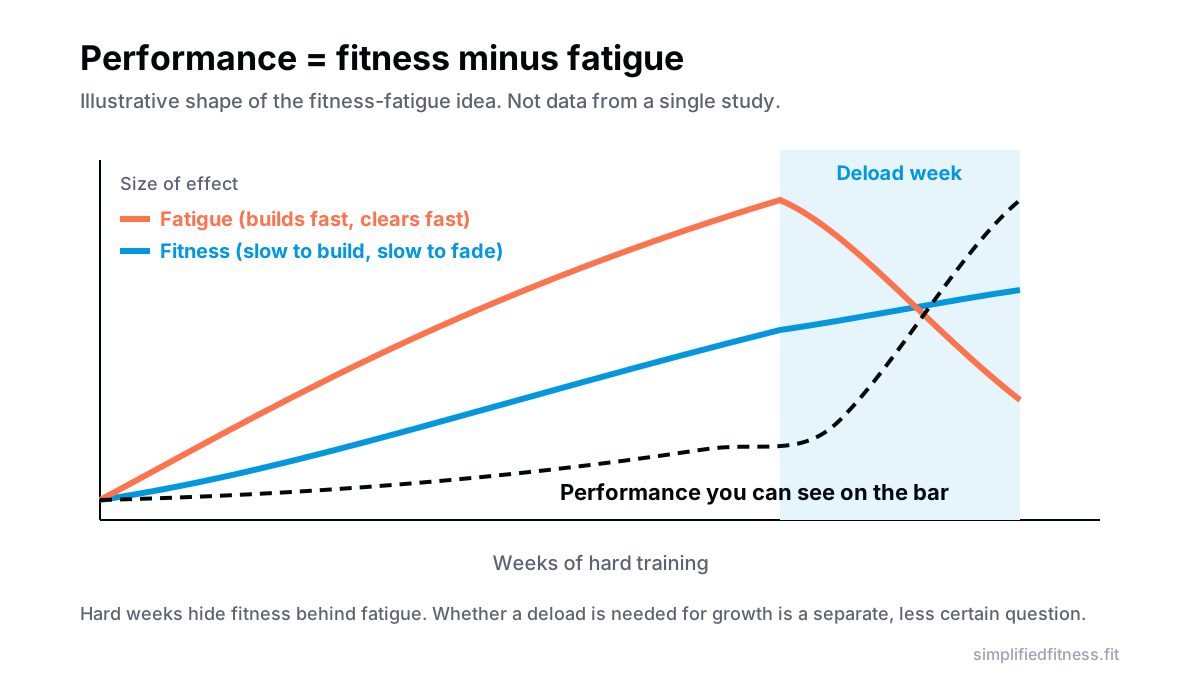
That is one explanation for why lifters sometimes hit a PR after a holiday or an easy week. Strength did not appear from nowhere. It was already there, buried under fatigue.
Keep this in perspective. The model came from endurance and sport research, and it is a fitted curve, not a law. A 2021 study fitted it in nine people doing interval cycling and found that different ways of counting training load evolved differently over time, so the methods could not be swapped for each other (Vermeire et al., 2021). Use it as a mental picture. Do not expect it to tell you exactly when to rest.
What happens during a deload week?
Short answer: less than people expect. In one study, trained young men did six weeks of whole-body training that ramped from 10 to 32 sets per exercise per week, then either trained at about 15% of their peak volume or stopped completely for a week. Muscle biopsies showed only marginal molecular differences between the two. The authors concluded that, practically, both approaches produced largely similar responses (Vann et al., 2021).
Some things did change over time in that study. Total mood disturbance and creatine kinase (a blood marker of muscle strain) were higher after the hard block than before it or after the recovery week. Pressure-to-pain threshold in the thigh muscle dropped after the hard block and came back after the recovery week. In plain gym terms: after the lighter week, the men were less beaten up and their muscle was less tender.
Note the limits. That was 30 trained young men, short term, and the molecular markers moved in several directions at once (genes linked to muscle protein breakdown, such as atrogin-1, MuRF-1 and myostatin, were higher after the recovery week, not lower). Do not read a single gene as proof of “repair”.
If you want a plain-English timeline for how long different kinds of fatigue take to clear, a review of recovery time courses is a good starting point. It explains that the time needed to recover is proportional to the level of fatigue, and that the mechanisms behind fatigue differ across exercise types (Skorski et al., 2019). It does not give a single deload recipe.
Does a deload week build more muscle?
This is the claim many articles make, so it deserves a careful look. The idea comes from “resensitization”: maybe muscle responds better to training after a brief rest.
Here is what the controlled trials found.
- Trained lifters (2024). 39 young men and women trained for nine weeks. One group stopped for a week in the middle, the other trained continuously. Muscle size, local endurance and power did not differ. The continuous group actually gained more lower body isometric and dynamic strength, and reported slightly better readiness-to-train scores (Coleman et al., 2024).
- Untrained men (2026). 19 men trained one leg and one arm continuously and the other limbs with low-volume weeks (once a week, 2 sets) at weeks 4 and 8. Muscle thickness and 10-rep-max endurance improved similarly in both conditions (Pancar et al., 2026).
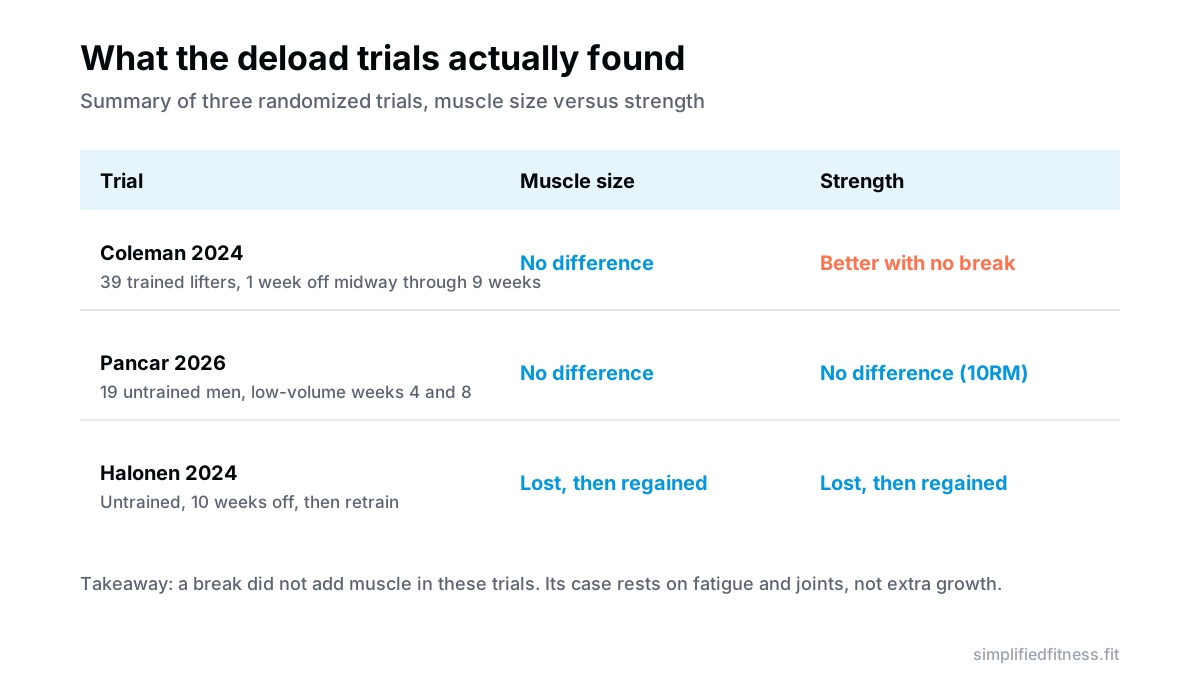
So the honest summary: a deload did not hurt muscle growth, and it did not boost it either. Both trials were short, and the one in trained lifters used a full week off rather than a typical lighter week, so we cannot say for certain how a standard deload would behave over a year.
Will I lose muscle if I take a break?
Not much, and it comes back fast. In a 2024 trial, untrained adults did 10 weeks of training, 10 weeks off, then 10 weeks of training again. Strength and muscle size dropped during the break but were regained rapidly, and the group ended up with similar adaptations to a group that trained continuously (Halonen et al., 2024). The authors concluded that occasional short training breaks should not be a big worry.
A related idea is muscle memory. In a 2024 study, 12 untrained people trained one arm, stopped for 16 weeks and retrained. The extra muscle nuclei built in the first block were maintained after the break. Even so, the retrained muscle did not clearly gain more than the untrained arm, so the real benefit remained unclear (Cumming et al., 2024).
Both studies used untrained people. Trained lifters may behave differently, and these breaks were far longer than a one-week deload. The point is only that a week off is unlikely to undo months of work.
So why do coaches still deload?
Because lifters still get tired, sore and stale. A survey of 246 competitive strength and physique athletes found all of them deloaded. The main reasons were managing energy and fatigue. A typical deload lasted about 6 days and came about every 5 to 6 weeks. Athletes usually cut sets and reps, lowered load and effort (more reps in reserve), and kept the same exercises and training frequency (Rogerson et al., 2024).
That is what athletes do, not proof it is necessary. It is a survey, so it describes habits. Still, it matches what the physiology suggests. The deload is a way to keep training quality high and keep joints happy while you chase long-term progress.
There is also a competition-prep cousin: tapering. A meta-analysis of 27 studies in competitive athletes found the best strategy was a two-week taper with training volume reduced by 41-60%, leaving intensity and frequency unchanged (Bosquet et al., 2007). Useful for meet day or match day, but it is a performance peak, not a muscle building tactic. If you compete in powerlifting, our strength peaking and tapering guide covers it properly.
How to deload in practice
Think of this as the default, not a rule.
- Keep the exercises. Skill practice is part of why you do not feel rusty after the week.
- Cut volume by roughly half. If you do 4 sets, do 2. Athletes in the survey reported cutting sets and reps; the exact “half” is a common coaching starting point, not a tested number.
- Keep loads similar or slightly lower. Leave several reps in reserve. Use our RIR and RPE calculator to find a load for “easy”.
- Keep your usual days. Frequency stayed the same in the survey, and a routine is easier to protect.
- Return to normal the next week. Do not “make up” the sets.
Want a deeper breakdown of volume versus intensity cuts? See deloading methodologies: volume vs intensity reduction. To judge when to pull the trigger, use the signs you need a deload checklist.
Sleep and food matter too. Eating enough protein and calories during a lighter week is not wasted. In India, that can be as simple as dal, curd, paneer and eggs at your usual portions. A deload is not a diet break or a licence to skip meals. For sleep, see our sleep and systemic recovery guide.
Do you always need one?
No. A review of overtraining in resistance exercise found few studies that properly established overreaching or overtraining, and the only reliable marker was a sustained fall in performance, not any single blood test or heart rate reading (Grandou et al., 2020). Researchers have struggled to reliably produce true overtraining with resistance training, which suggests it is less common than the internet implies, and it means your logbook (are your numbers going down for weeks?) is a better guide than a gadget.
If you train three days a week, sleep well and your lifts keep climbing, you may go a long time without needing one. If you are cooked, add one early.
See a doctor if you have pain that persists after an easy week, pain that wakes you at night, numbness, or fatigue that does not lift with rest and sleep. A deload is not a treatment for those things.
Key takeaways
- Performance equals fitness minus fatigue. Fatigue clears faster.
- Deloads are good at taking the edge off fatigue. They have not been shown to add muscle.
- A one-week break costs little, and strength returns quickly.
- Halve the volume, keep the exercises, stay away from failure.
- Plan by how you feel and how your lifts are moving, not by a fixed calendar.
Next, read the full pillar guide and our piece on proactive vs reactive deloads.
Frequently Asked Questions
Why do you need a deload week?
You do not strictly need one, but many lifters find it helpful. Hard training accumulates fatigue that can mask the fitness you have built, and a lighter week lets that fatigue clear. If your joints ache and your lifts are slipping, a planned easy week is a cheap fix.
What is the fitness-fatigue model?
It is a model that describes performance as fitness minus fatigue, both of which rise after each training session. Fitness builds and fades slowly while fatigue builds and fades quickly, so performance dips right after hard training and recovers as fatigue clears. Use it as a mental picture, not a precise calculator, because researchers fit it with different load measures that do not always agree.
What happens to your body during a deload?
In one study, mood disturbance and a blood marker of muscle strain settled after a recovery week, and muscle tenderness eased. In the same biopsy study of trained men, one week of reduced or no training produced only small molecular differences between the two approaches. Squat bar speed did not change across the study. Expect to feel fresher by the end of the week, and expect your strength to be about where it was.
Will a deload make me lose muscle?
Not in a meaningful way over one week. A trial in resistance-trained lifters found no difference in muscle size between a one-week full break and continuous training. If you worry, train lightly instead of stopping, since that keeps the habit and the movement practice.
Does a deload build more muscle?
The evidence so far says no. A 2024 trial in trained lifters found equal muscle growth with and without a one-week break, and a 2026 trial in untrained men found the same for lighter weeks. Do not expect a deload to add size; treat it as maintenance while fatigue clears.
Can a deload hurt my strength?
Possibly, based on one trial. Lifters who took one week fully off gained less lower body strength than those who trained straight through. A light week with reduced sets keeps some practice in the heavy lifts and may avoid that dip, though no trial has tested that directly.
How long should a deload last?
About a week is the usual choice. A survey of 246 competitive strength and physique athletes found deloads typically lasted around 6 days. Tapering research in athletes points to roughly two weeks before competitions, but that is a different goal from regular training.
How often should I deload?
The same survey found athletes deloaded about every 5 to 6 weeks on average. That is a habit of competitive lifters, not a proven interval. Many recreational lifters do fine going longer if recovery is good, and you can base timing on how you feel and whether performance is stalling.
What is supercompensation, and is it real in the gym?
Supercompensation is the idea that performance rebounds above baseline after rest. It is well discussed for endurance and competition tapering, where a meta-analysis found performance gains after a taper. For hypertrophy, trials have not shown a clear rebound, so do not rely on it.
Should I stop training completely or do a light week?
Either can work, and the research does not show a big winner. Complete rest and about 15% of training volume produced largely similar responses in trained men in a muscle-biopsy study. A light week is usually easier to keep consistent, so most coaches default to that.
How should I train during a deload week?
Keep the same exercises, cut the number of sets by roughly half, and leave several reps in reserve. Surveyed athletes reported lowering volume and effort while keeping training frequency and exercise selection the same. Treat the week as practice, not a test.
What does a deload do to your joints and tendons?
Direct evidence is thin, so be careful with big claims. Lifters commonly report that joint aches settle during lighter weeks, and surveyed athletes cited joint aches as a trigger for deloading. If pain persists after an easy week, see a doctor or physiotherapist.
Do I need a deload if I train only three days a week?
Often not as regularly. A lower training dose means fatigue accumulates more slowly, so you may go many weeks without needing a break. If strength has stalled and you feel run down, add one.
Sources & References
Every claim above is checked against peer-reviewed research (PubMed, U.S. National Library of Medicine) or guidance from established health bodies. How we fact-check.
- Coleman M, et al. Gaining more from doing less? The effects of a one-week deload period during supervised resistance training on muscular adaptations. PeerJ. 2024. PMID: 38274324
- Pancar Z, et al. Effects of deload periods in resistance training on muscle hypertrophy and strength endurance in untrained young men using a randomized within subject design. Sci Rep. 2026. PMID: 41730991
- Vann CG, et al. Molecular differences in skeletal muscle after 1 week of active vs. passive recovery from high-volume resistance training. J Strength Cond Res. 2021. PMID: 34138821
- Rogerson D, et al. Deloading practices in strength and physique sports: a cross-sectional survey. Sports Med Open. 2024. PMID: 38499934
- Halonen EJ, et al. Does taking a break matter: adaptations in muscle strength and size between continuous and periodic resistance training. Scand J Med Sci Sports. 2024. PMID: 39364857
- Bosquet L, et al. Effects of tapering on performance: a meta-analysis. Med Sci Sports Exerc. 2007. PMID: 17762369
- Vermeire KM, et al. The influence of different training load quantification methods on the fitness-fatigue model. Int J Sports Physiol Perform. 2021. PMID: 33691278
- Grandou C, et al. Overtraining in resistance exercise: an exploratory systematic review and methodological appraisal of the literature. Sports Med. 2020. PMID: 31820373
- Skorski S, et al. The temporal relationship between exercise, recovery processes, and changes in performance. Int J Sports Physiol Perform. 2019. PMID: 31172832
- Cumming KT, et al. Muscle memory in humans: evidence for myonuclear permanence and long-term transcriptional regulation after strength training. J Physiol. 2024. PMID: 39159314

Umair Hazrami · Founder & Head Coach, Simplified Fitness
Umair Hazrami founded Simplified Fitness and the Simplified Lifter channel to cut through fitness noise. With 4+ years of consistent training and 10+ coaching clients, he writes every guide from the peer-reviewed research and links the sources so you can check them. Our editorial standards.
Educational content only, not medical advice. If you have a medical condition, are pregnant, or take medication, talk to a qualified doctor before changing your diet, supplements or training. Full disclaimer.
Keep reading

Programming
The 5 Modalities of Progressive Overload: A Checklist for When Weight Won't Go Up
5 ways to progressive overload: load, reps, range of motion, tempo and rest density. A practical checklist for compounds and isolations, with the research.
7 min read
Programming
Autoregulated Progressive Overload (APRE): How Much Weight to Add Next Week
Autoregulated progressive overload (APRE) uses your last-set reps to set next week's weight. Get simple jump rules, a worked example and the evidence.
9 min read

Programming
How to Do a Deload Week: Volume Cut vs Intensity Cut vs Time Off
How to do a deload week workout: compare cutting sets by half, lowering weight by 20%, or taking time off, with a step-by-step template and the research.
9 min read
Programming
The Double Progression Model: Mastering Rep Ranges (e.g., 8-12 Reps) for Consistent Growth
The double progression model explained: pick a rep range like 8-12, hold the weight, hit the top on every set, then add load. Rules, examples and mistakes.
9 min read