Exercise Rotation Strategy: How Often to Change Exercises (and Why Muscle Confusion Is a Myth)
How often to change exercises for hypertrophy? Research says keep core lifts for whole blocks and swap only 1-2 accessories. Here is the rule and the evidence.
TL;DR. The short answer
- For most lifters, keep your main lifts for a full training block (roughly 8-12 weeks is a common coaching range) and swap only one or two accessory exercises when progress stalls, joints complain or boredom threatens consistency.
- In a trial of 21 resistance-trained men, randomly changing exercises and rep ranges every session produced similar strength and muscle thickness gains to a fixed routine over 8 weeks.
- A 2022 systematic review concluded that planned, anatomically sensible variation may help, while excessive or random rotation may hinder muscle gains.
- Muscle confusion is not a mechanism. Muscle grows when you progressively overload it, and you cannot measure progress on a lift you never repeat.
- Swap a lift immediately if it causes joint pain. Persistent or sharp pain is a reason to see a doctor or physio, not to push through.
Part of our complete guide: Progressive Overload Methods, Deloads and Plateaus: The Long-Term Progression Guide
Table of contents
How often to change exercises for hypertrophy? Less often than most gym advice suggests. For most lifters, the main lifts can stay for a whole training block, and one or two accessories get swapped when progress stalls, a joint complains or boredom is hurting consistency. This is part of our complete guide to progressive overload, deloads and plateaus.
The idea that you must keep “confusing” your muscles by changing the workout every week is one of the oldest gym myths going. It sounds clever. It also quietly sabotages the one thing that reliably builds muscle, which is beating your own numbers over time.
What is the muscle confusion myth?
The pitch goes like this: your muscles adapt to a routine, so you must change it constantly or they stop growing. Hence the Monday-to-Monday rotation of new exercises, new angles, new “shock” techniques.
There is a kernel of truth buried in there. If you do the exact same workout with the exact same weights for a year, you will stall. But that is a progressive overload problem, not a confusion problem. The fix is to add reps, load or sets, not to change the exercise list.
Muscle does not need to be tricked. What it responds to is enough hard work, repeated and gradually increased. We cover the full toolbox in our guide to the five modalities of progressive overload, and the myth itself gets a full teardown in why muscle confusion stalls progress. This piece stays on the practical question: how often to rotate.
What does the research say about varying exercises?
Direct evidence is thinner than the confidence of gym debates suggests, so here is what exists.
A 2022 systematic review pulled together 8 studies on exercise variation, with a combined 241 participants, all young men (Kassiano et al., 2022). The authors concluded that some degree of systematic variation seems to enhance regional hypertrophic adaptations and maximise dynamic strength. But they also concluded that excessive, random variation may compromise muscular gains, and that swapping in exercises that provide a redundant stimulus may actually hinder adaptations.
So the review does not say “never change anything”. It says planned variation with a reason can help, while frequent, random change may hurt.
A single trial makes the point concrete. In a 2019 study, 21 resistance-trained men followed an 8-week programme, training 4 times per week with 3 sets of 6 exercises (Baz-Valle et al., 2019). One group kept a fixed exercise selection. The other had their exercises and rep ranges randomly varied every session by an app. Both groups made large gains in bench press and squat 1RM with no difference between them. Muscle thickness of the vastus lateralis and rectus femoris also rose in both with no between-group differences. For the vastus intermedius, only the fixed group showed a significant increase from baseline, though the groups did not differ significantly.
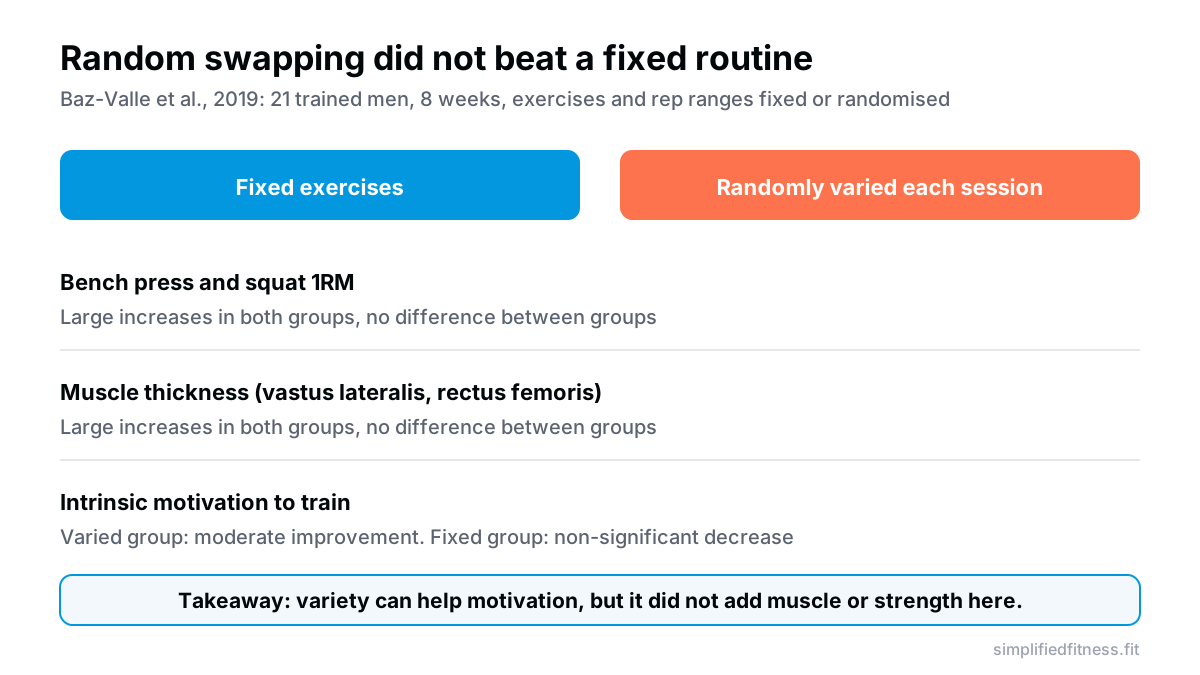
The same study found something worth taking seriously. The varied group showed a moderate improvement in intrinsic motivation to train, while the fixed group showed a non-significant decrease. That matters because the best programme is the one you keep doing.
Why constant swapping can backfire
Three reasons. None has been tested head to head, so read them as informed reasoning rather than proof.
1. You cannot track progress on something you never repeat. If this week’s lateral raise is a cable one and next week’s is a machine one, your log tells you nothing. Progress becomes a feeling instead of a number. Our piece on the science of the training logbook explains why those numbers matter.
2. Early strength gains involve learning the movement. A review of neural adaptations notes that strength gains early in a training regimen are associated with increased neural drive, and that retention of strength after physiological effects fade shows a strong practice effect (Gabriel et al., 2006). In plain terms, part of getting stronger on a lift is getting better at that lift. A new exercise resets some of that practice. The review does not put a number on how long relearning takes, so be sceptical of any claim that a swap “wastes exactly two weeks”.
3. Redundant swaps add no new stimulus. The 2022 review specifically warns against rotating among exercises that deliver the same stimulus. Swapping one pressing machine for another near-identical pressing machine changes the label, not the work.
None of this means variation is bad. It means the reason for the change should be better than “it has been a while”.
When should you swap an exercise?
There are four good reasons.
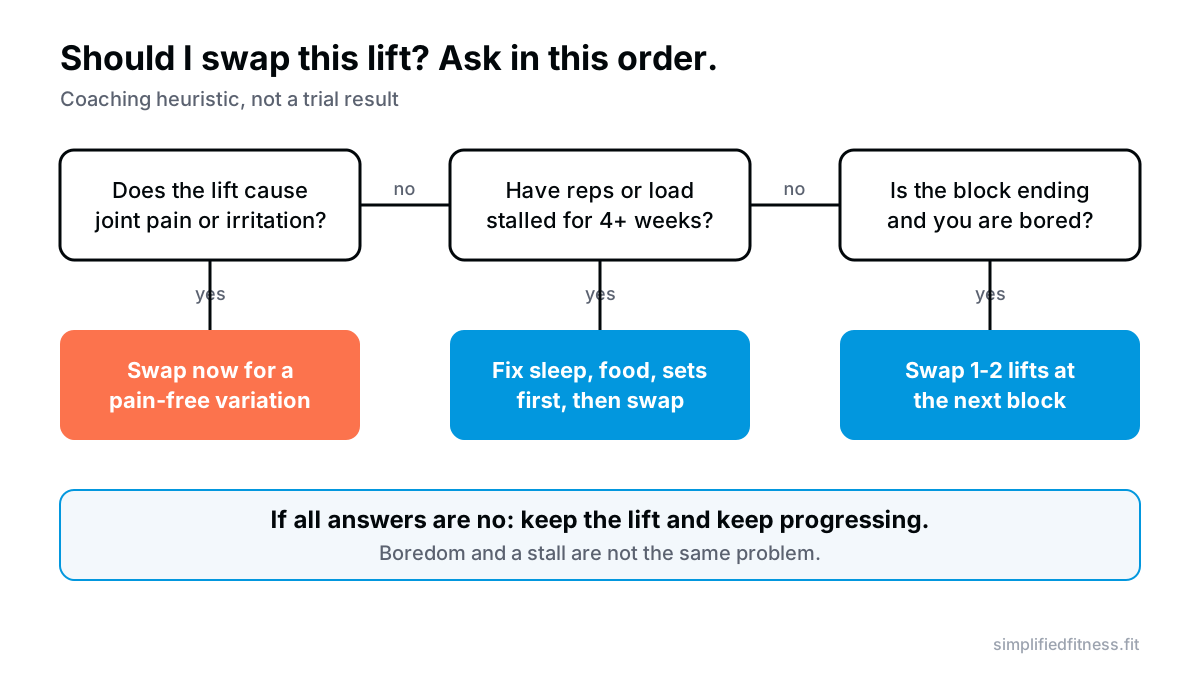
- Joint irritation. If a lift reliably aggravates your shoulder, elbow or knee, change it. This is the strongest reason of all.
- A genuine stall. Reps and load have not moved for about four weeks even though sleep, food and effort are in order. Use our systematic plateau flowchart before blaming the exercise.
- The end of a block. Block boundaries are the natural place to change things. See mesocycle architecture for how to structure them.
- Boredom that threatens consistency. The motivation finding above makes this a legitimate reason, as long as the swap is small.
How many exercises should you rotate per mesocycle?
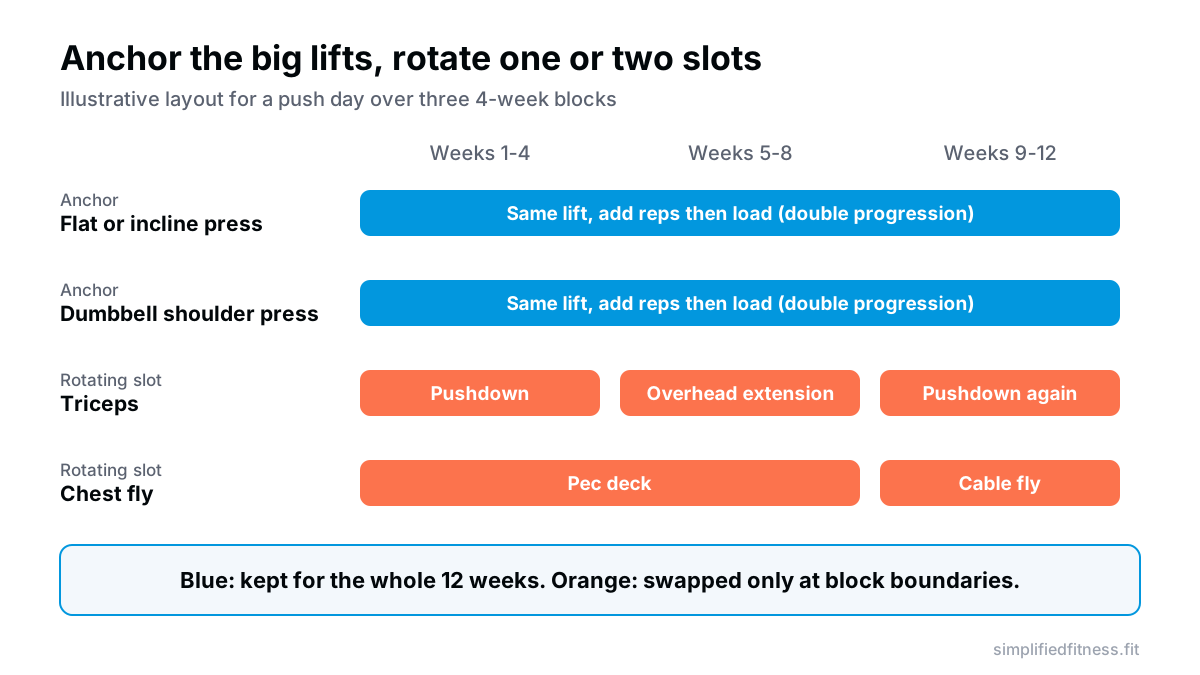
A practical rule many coaches use: keep your main compound lifts for the whole block, and rotate one or two accessories at block boundaries. The usual range is 8-12 weeks, sometimes stretched to 16 if progress is still coming. These numbers are a coaching convention, not something a trial has pinned down, so treat them as a starting point.
Why this works in practice:
- Your log stays mostly comparable from block to block.
- Fatigue and soreness stay predictable because you are not constantly meeting new movements.
- You still get some regional variety, which the 2022 review suggests may help when it is planned.
What makes a good swap
Choose a variation that trains the same muscle with a different angle, grip or equipment, not a redundant clone. For triceps, going from a pushdown to an overhead extension keeps the target the same while changing how the arm is positioned.
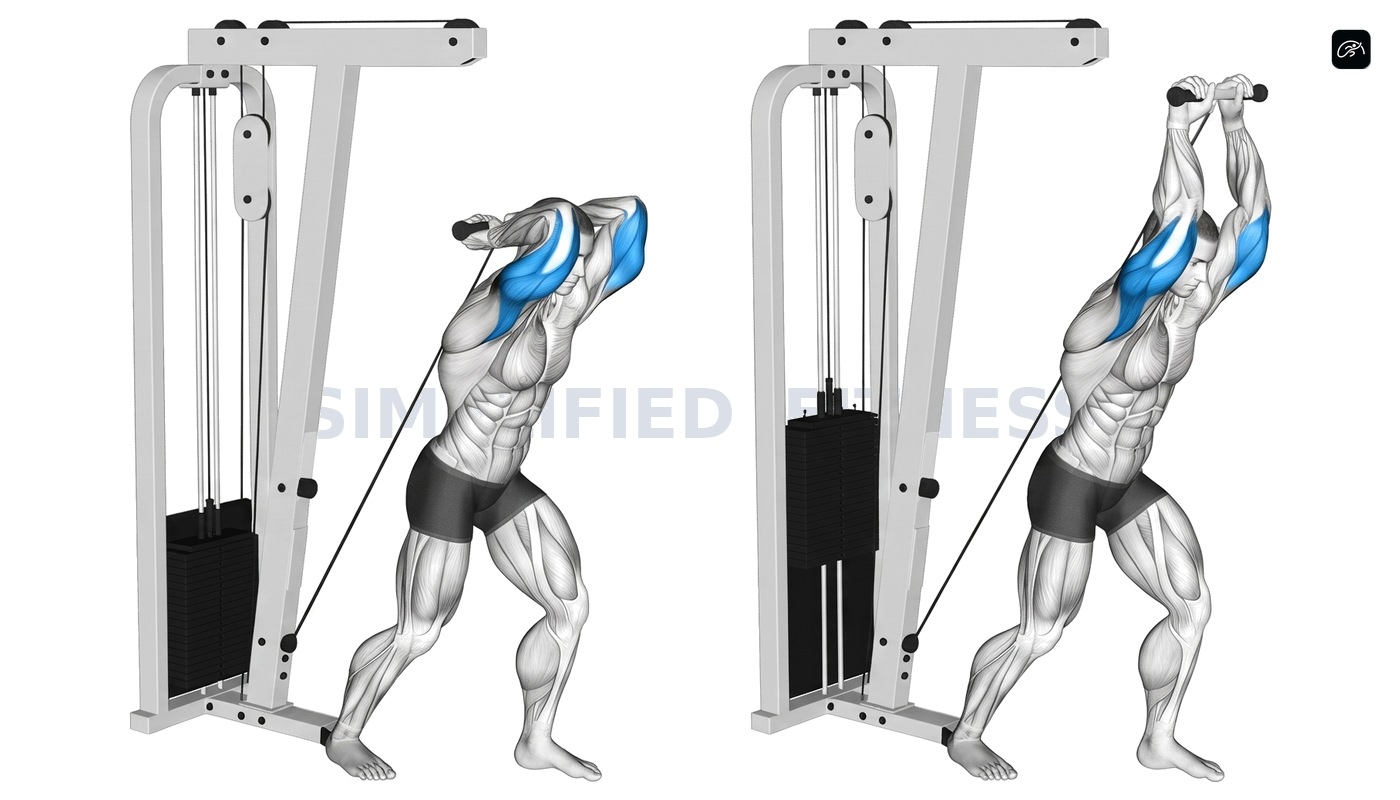
Keep rep ranges, effort and rest similar so the new lift slots into your existing log. When you introduce it, treat the first session as a baseline and start progressing from there. If the new lift is technically demanding, see how to standardise form so you know when a set really counts.
How to introduce a new exercise without wrecking your block
When you do swap, a little structure keeps the change cheap.
- Swap one slot at a time. If you change the triceps lift and the chest fly in the same week, a bad session could be blamed on either. One change per muscle group keeps the picture clear.
- Start conservatively. On the first session, stop a couple of reps short of failure and note the load and reps. That session is your new baseline, not a test of how strong you are.
- Run it for the whole block. A single session on a new movement tells you almost nothing about whether it suits you. Give it enough weeks to log real progression.
- Judge it on the log, not the pump. If reps and load are climbing and the target muscle is working, keep it. If your elbow aches or numbers sink for several weeks, drop it at the next boundary.
This is also where double progression earns its keep: pick a rep range, add reps until you hit the top, then add load. Our guide to double progression and rep ranges walks through the mechanics.
What should never rotate?
Your anchors. Squat or leg press, a horizontal and a vertical press, a row and a pulldown, and a hinge. These are the lifts where steady progression carries most of your results.
Weekly sets matter here too. A meta-analysis of 15 studies found a graded dose-response relationship in which higher weekly set volume was associated with more muscle growth (Schoenfeld et al., 2017). Swapping exercises does not change your set count, but a messy rotation often leads to people quietly doing fewer hard sets. Check yours with the training volume calculator.
What about beginners and busy lifters?
Beginners gain quickly from a small set of repeated lifts, so there is little reason to rotate in the first months. Repeat the basics, learn them, and let your numbers climb.
For busy lifters training three days a week with limited time, a fixed plan is also easier. Our free push, pull and leg plans are built around stable anchor lifts so you can log and progress without rewriting your week.
In an Indian gym context, equipment can also change under you: the cable stack is busy, the hack squat is broken, the dumbbells you used are taken at peak hours. In that case a substitution is sensible, but note it in your log as a one-off rather than a new permanent lift.
Quick answers
| Situation | What to do |
|---|---|
| Joint pain on a lift | Swap now, see a professional if it persists |
| Stalled 4+ weeks, sleep and food poor | Fix those first |
| Stalled 4+ weeks, everything else fine | Swap one accessory, keep anchors |
| Bored but progressing | Swap one accessory at block end |
| Progressing and enjoying it | Keep everything |
The bottom line
Muscle confusion does not exist as a mechanism. What the research supports is modest: planned variation may help regional growth and motivation, while excessive or random changes may hinder gains. Keep the big lifts for a block, rotate one or two accessories for a reason, and spend your effort on beating last month’s numbers. If joints hurt for more than a couple of weeks, get it checked rather than rotating around it forever.
Frequently Asked Questions
How often should I change my exercises for muscle growth?
Most people do well keeping main lifts for 8-12 weeks and rotating one or two accessories per block. That range is a coaching convention rather than a number proven in trials. Change a lift sooner only if it hurts or your progress has clearly stalled despite good sleep, food and effort.
Is muscle confusion real?
No. We found no evidence that muscles get confused or adapt to a routine in a way that needs constant surprise. The best-supported driver of growth is progressive overload, meaning more reps, load or sets over time. You cannot overload a lift you keep replacing.
Should I change my workout routine every week?
Usually not. A trial of trained men who randomised exercises and rep ranges every session found similar strength and muscle thickness gains to a fixed routine, so weekly changes gave no proven advantage. Keep the routine long enough to log numbers and beat them.
How do I know when to swap an exercise?
Swap when a lift causes joint irritation, when reps and load have stalled for around four weeks despite good recovery, or when you finally reach the end of a block. Stalls often come from sleep, food, or too few sets rather than the exercise itself. Check those before you rewrite the programme.
Does changing exercises prevent plateaus?
Not reliably. Plateaus usually trace back to recovery, volume or how progression is set up, and a new exercise only resets your numbers to a lower starting point. Fix the basics first, then use a swap as one tool among several.
How many exercises should I change per mesocycle?
One or two accessories is a sensible limit, keeping the main compound lifts fixed. This keeps most of your log comparable from block to block. If you change everything at once, you lose the ability to tell what worked.
Do I lose progress when I switch exercises?
Swapping to a similar lift is unlikely to cost you muscle, but your numbers on the new lift usually start lower because you are less practised at it. Strength gains early in training are partly neural, which is why a familiar lift feels better quickly. Expect a short settling-in period and choose variations similar to the original.
Can I never change exercises and still grow?
Yes, many people grow for years on the same core lifts as long as they keep progressing. Some planned variation may help cover different parts of a muscle and keep training enjoyable. Keep the anchors fixed and treat variety as optional.
Does exercise variety improve motivation?
It can. In the same 21-man trial, the group with randomly varied exercises reported a moderate improvement in intrinsic motivation, while the fixed group showed a non-significant decrease. If a fresh accessory keeps you showing up, that is a legitimate reason to rotate.
What is a good exercise swap for the same muscle?
Pick a variation that loads the muscle in a similar way but changes angle, grip or equipment, for example barbell bench to incline dumbbell press. Avoid swaps that are redundant, like two near-identical pressing machines. Keep rep ranges and effort the same so your log stays comparable.
Should I rotate exercises if I get bored?
Yes, boredom is a fair reason, as long as you rotate only an accessory or two at the end of a block. Constant novelty can cost you the repeated practice that helps you lift well and track progress. Choose one new lift, give it the full block, and see how it goes.
Should beginners change exercises often?
No. Beginners gain quickly from repeating a small set of lifts, partly because early strength gains involve neural learning of the movement. Stick with the same basics for months and add variety later.
What if an exercise hurts my joint?
Swap it right away for a variation that is pain-free, and do not train through sharp or worsening pain. Mild discomfort that eases as you warm up is different from pain that lingers or limits movement. If pain persists for more than a couple of weeks or comes with swelling or numbness, see a doctor or physiotherapist.
Sources & References
Every claim above is checked against peer-reviewed research (PubMed, U.S. National Library of Medicine) or guidance from established health bodies. How we fact-check.
- Kassiano W, et al. Does Varying Resistance Exercises Promote Superior Muscle Hypertrophy and Strength Gains? A Systematic Review. J Strength Cond Res. 2022. PMID: 35438660
- Baz-Valle E, et al. The effects of exercise variation in muscle thickness, maximal strength and motivation in resistance trained men. PLoS One. 2019. PMID: 31881066
- Gabriel DA, et al. Neural adaptations to resistive exercise: mechanisms and recommendations for training practices. Sports Med. 2006. PMID: 16464122
- Schoenfeld BJ, et al. Dose-response relationship between weekly resistance training volume and increases in muscle mass: A systematic review and meta-analysis. J Sports Sci. 2017. PMID: 27433992

Umair Hazrami · Founder & Head Coach, Simplified Fitness
Umair Hazrami founded Simplified Fitness and the Simplified Lifter channel to cut through fitness noise. With 4+ years of consistent training and 10+ coaching clients, he writes every guide from the peer-reviewed research and links the sources so you can check them. Our editorial standards.
Educational content only, not medical advice. If you have a medical condition, are pregnant, or take medication, talk to a qualified doctor before changing your diet, supplements or training. Full disclaimer.
Keep reading
Programming
The 5 Modalities of Progressive Overload: A Checklist for When Weight Won't Go Up
5 ways to progressive overload: load, reps, range of motion, tempo and rest density. A practical checklist for compounds and isolations, with the research.
7 min read
Programming
Autoregulated Progressive Overload (APRE): How Much Weight to Add Next Week
Autoregulated progressive overload (APRE) uses your last-set reps to set next week's weight. Get simple jump rules, a worked example and the evidence.
9 min read

Programming
Deload Science: What a Deload Week Really Does to Fatigue, Muscle and Strength
Deload science explained: the fitness-fatigue model, what trials show for muscle size and strength, and what happens in a deload week. Studies linked.
8 min read

Programming
How to Do a Deload Week: Volume Cut vs Intensity Cut vs Time Off
How to do a deload week workout: compare cutting sets by half, lowering weight by 20%, or taking time off, with a step-by-step template and the research.
9 min read