The 7-Minute Dynamic Warm-Up: A Fast Routine to Prep Joints Before Lifting
A dynamic warm up for lifting takes about 7 minutes, not 25. See the 2-3-2 routine, what the research says about stretching and foam rolling, and what to skip.

TL;DR. The short answer
- A dynamic warm up for lifting can take about 7 minutes: 2 minutes of easy cardio, 3 minutes of controlled joint mobility, and 2 minutes rehearsing your first lift. This split is a practical template, not a protocol tested as a whole in trials.
- Warming up works mainly through higher muscle temperature, metabolic and nervous system changes. It is not mainly about stretching anything out.
- Long static stretches before heavy lifting slightly reduce maximal strength in meta-analyses (about 5% on average for strength in one pooled analysis), so save them for the end of the session or a different day.
- Foam rolling raises range of motion in the short term, but it is not superior to stretching, and 20-25 minutes of it before lifting is rarely needed.
- Your working weights still need ramp-up sets. The 7 minutes gets you ready to move; the ramp sets get you ready for load.
Part of our complete guide: Best Workout Split for Muscle Growth: PPL vs Upper/Lower vs Full Body, What the Research Says
Table of contents
A good dynamic warm up for lifting takes about 7 minutes. Two minutes of easy cardio, three minutes of controlled joint mobility and two minutes rehearsing your first lift will get most people ready for training, then a few ramp-up sets handle the load. (It sits inside our guide to workout splits and session architecture.)
If you currently spend 25 minutes foam rolling and stretching before you even touch a bar, you are probably burning the best part of your energy and focus. This article covers the general-body prep that comes before any ramp-up sets.
Quick note on what the 7-minute split is. The 2-3-2 structure is a practical template I like because it is easy to remember. It is not a protocol that has been tested as a package in trials. The pieces behind it, though, have research support, and we will go through them.
What does a warm-up actually do?
Here is the reality: “loosening up” is only part of the story.
A review of warm-up strategies describes temperature, metabolic, neural and psychology-related effects from active warm-ups, including increased anaerobic metabolism, faster oxygen uptake kinetics and post-activation potentiation (McGowan et al., 2015). The same authors note that, for a long time, warm-up routines grew mostly from trial and error and coach experience rather than hard data. So the evidence is decent on mechanisms, thinner on exact recipes.
In plain language:
- Warmer muscle. Easy movement raises temperature, and temperature changes how muscle works.
- Primed nervous system. Your brain gets a few reps of practice at the pattern before the weight is heavy.
- Metabolic readiness. Energy systems start ticking over rather than lurching into action on set one.
- Mental readiness. Underrated. A routine tells your brain the session has started.
The 7-minute routine: 2 mins cardio, 3 mins mobility, 2 mins rehearsal
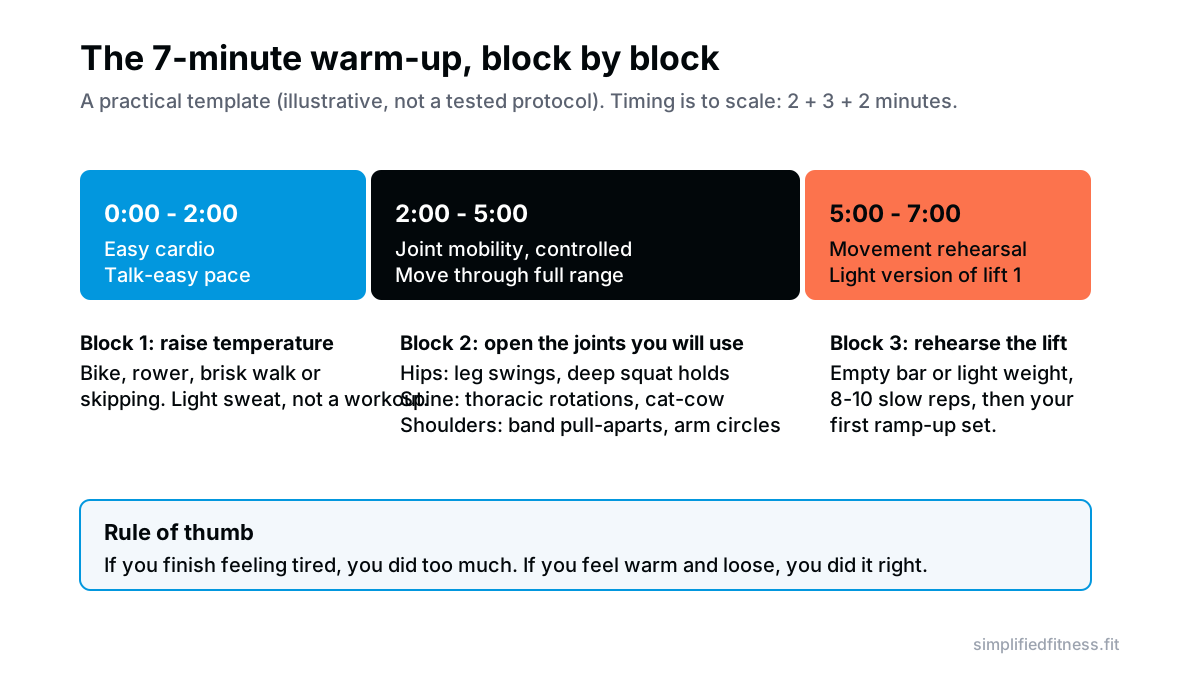
Minutes 0-2: raise your temperature
Pick whatever is closest: bike, rower, skipping, brisk incline walk. You want a light sweat and a slightly higher breathing rate, not a workout. If you could not hold a conversation, ease off.
Minutes 2-5: joint mobility, moving through range
Choose 4-6 movements and flow through them for about 30-40 seconds each. These are examples, not a required list:
- Hips: leg swings (front to back, then side to side), deep bodyweight squat holds with a gentle rock.
- Spine: thoracic rotations on all fours, cat-cow.
- Shoulders: band pull-aparts, arm circles, wall slides.
- Ankles (squat or leg day): knee-over-toes rocks.
Move under control. Slow and smooth beats fast and bouncy. A review of dynamic stretching concluded that controlled dynamic stretching looks more beneficial than ballistic stretching, which uses higher velocities (Opplert & Babault, 2018).
That same review found a substantial amount of evidence pointing to positive effects of dynamic stretching on range of motion and subsequent force, power, sprint and jump performance. It also flagged studies with no change or even impairment, and blamed inconsistent protocols for the lack of a clear consensus. So: helpful on average, but details matter, and I would not oversell it.
Minutes 5-7: rehearse the first lift
Take the movement you are about to train and do 8-10 slow reps with an empty bar, a light dumbbell or bodyweight. Pause in the bottom position on one or two reps. Think about the cues you want on working sets.
Train legs first? Do goblet squats or bodyweight squats. Starting with a press? Push-ups or an empty bar press. This is where the nervous system gets its practice.
Do I still need warm-up sets?
Yes. That surprises people who think mobility replaces ramp sets.
The 7 minutes prepares your body in general. Ramp sets prepare you for the specific load. For deeper detail on how to build those, see our guide on warm-up protocols and ramping working sets without fatigue.
Does the specific warm-up matter for performance? The evidence is mixed. In a crossover study of 40 resistance-trained men aged 19-30, researchers compared three warm-ups before 3 sets of 6 reps at 80% of maximal dynamic strength. They found that squat velocity was higher after 6 reps at 80% than after 6 reps at 40%, and concluded that warming up with few reps and low loads was not enough to optimise squat and bench press performance (Ribeiro et al., 2020).
Another crossover trial in 15 men found no significant difference in total reps or fatigue index across control, specific, aerobic and combined warm-ups for bench press, squat and curls done to failure at 80% of 1RM (Ribeiro et al., 2014). Warm-up did not change performance in that study.
Why might these differ? The studies measured different things (bar velocity versus reps to failure), used different warm-up designs, and had small samples. My takeaway is cautious: rep-to-failure sets in a hypertrophy session may be forgiving, while heavier, lower-rep work where bar speed matters probably benefits more from proper ramp sets. A warm-up is cheap insurance either way.
Should you stretch before lifting?
This is where lifters get confused, so let me untangle it.
What the older evidence said. A 2013 meta-analysis pooled 104 studies and found static stretching reduced strength by 5.4% on average (95% CI -6.6% to -4.2%). Power fell by 1.9% (the interval crossed zero) and explosive performance fell by 2.0% (Simic et al., 2013). The effects were larger in isometric tests and with longer total stretch duration, and the smallest negative effects were with holds of 45 seconds or less. The authors concluded that static stretching as the sole warm-up activity should generally be avoided.
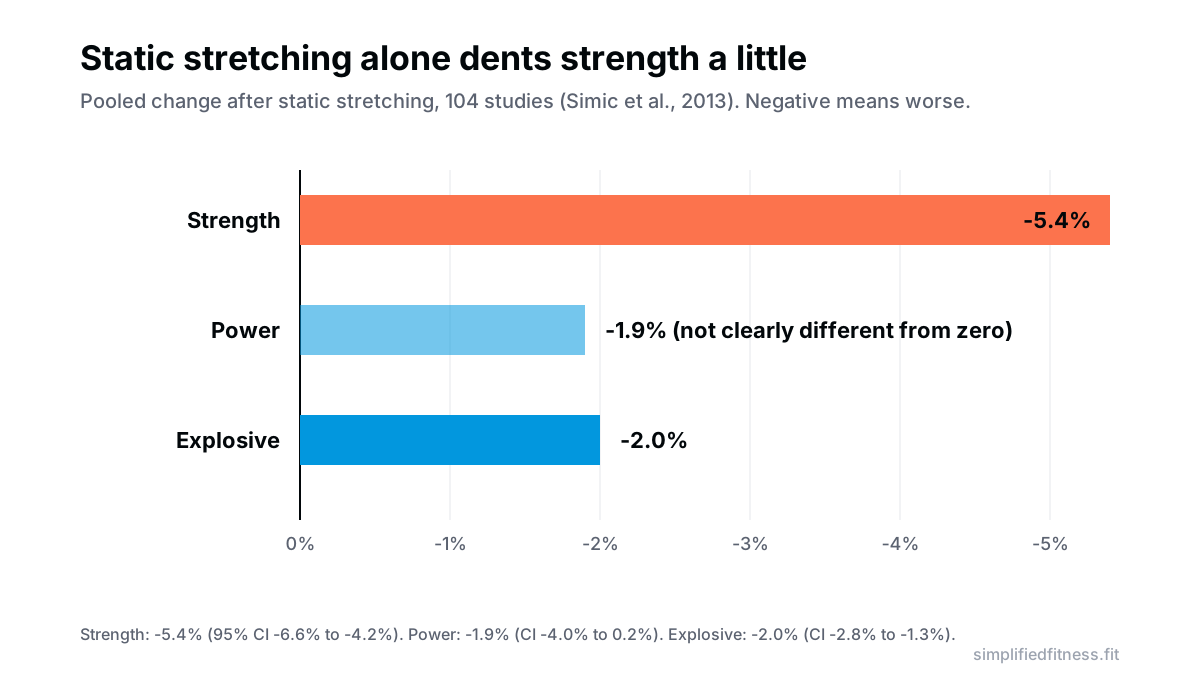
What the newer evidence adds. A 2024 multilevel meta-analysis of 83 studies (more than 2000 participants) found a small effect size of -0.21 for maximal strength loss after static stretching versus passive controls, and a large effect of -0.84 with stretches of 60 seconds or longer per bout. But static stretching did not hurt athletic performance in general, and it was linked to a small positive effect on subsequent jumping in adults (Warneke & Lohmann, 2024). The authors argued their findings do not support excluding static stretching before jumping or sprinting.
Why do they differ? The older pooled estimate included studies without proper control conditions, the newer analysis used controlled pre-post trials and modern statistics. The strength loss itself was confirmed, particularly for isolated muscle tests like leg extensions or calf raises.
My practical takeaway: do not hold long static stretches for your main muscles right before heavy lifts. If you like a short stretch for a tight spot, keep it brief, about 30-45 seconds, and do it inside the dynamic routine, not as the whole warm-up. Long static work fits better after training or on a rest day.
Is foam rolling a good warm-up?
Foam rolling has a place, just a smaller one than social media suggests. For the full myth-versus-evidence breakdown, see our article on foam rolling science and fascia myths.
A multilevel meta-analysis of 26 trials found foam rolling acutely improved range of motion versus doing nothing (SMD 0.74), but it was not superior to stretching (Wilke et al., 2020). The authors concluded it is an effective method for acute range-of-motion improvement. Most factors they tested, such as rolling duration and speed, made no significant difference, though rolling may work a little less well in men.
So if you want a little extra range on a tight area, 1-2 minutes of rolling is a reasonable add-on. The data do not support 20 minutes of it as a prerequisite for lifting. Your time is better spent on ramp sets and the work itself. That is the whole point of a fast warm-up, and it is how you fit full sessions into 30 minutes when time is tight.
What about post-activation potentiation?
You may hear that heavy singles “wake up” the nervous system. Research gets technical here. Classic post-activation potentiation is a brief twitch-force effect with a half-life of about 28 seconds, while voluntary force boosts minutes later are now called post-activation performance enhancement, which may be at least partly explained by changes in muscle temperature, muscle water content and activation (Blazevich & Babault, 2019).
The review also noted minimal evidence that PAP is of significant practical importance when a comprehensive active warm-up has already been done. So for normal gym training, do not chase it. Use ramp sets and move on.
What about synovial fluid and joint lubrication?
The claim that warming up increases synovial fluid and “oils” your joints is everywhere. I could not find direct human evidence in the studies I reviewed for this article that it measurably improves lifting performance. I would call it a plausible but unproven explanation, and I would not lean on it. Temperature, metabolic and nervous system changes are the better supported reasons.
If a joint feels creaky for the first few minutes and settles, that is common. If you have sharp pain, swelling, locking or pain that lingers, stop and see a doctor or physiotherapist rather than warming up harder.
How to adjust it: hot weather, small gyms and bad days
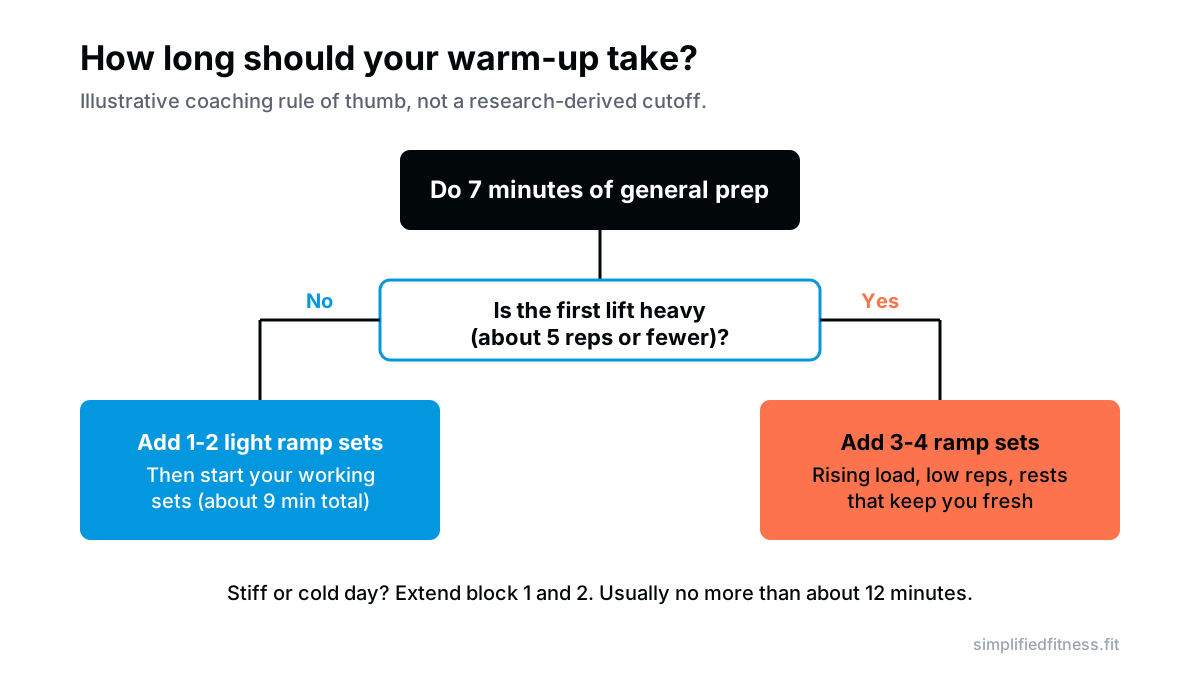
- Hot, humid gym. You will probably feel warm sooner. Trim the cardio to 1 minute and keep the mobility and rehearsal blocks. Sip water as usual.
- Cold morning or desk-bound day. Extend the cardio and mobility blocks by a couple of minutes. Stop around 12 minutes total before ramp sets.
- No equipment. Skipping or brisk walking, bodyweight mobility, light rehearsal with a water bottle or broomstick. It still counts.
- Squat or deadlift day. Bias mobility to hips and ankles. Check our leg day plan for the exercises you will be warming up for.
- Push day. Bias mobility to shoulders and upper back. The push day plan pairs well with the band work above.
For stretching you actually want to do for range of motion over months, see range of motion and stretch-mediated hypertrophy. And if your sessions run long, managing workout duration shows why trimming the warm-up beats trimming working sets.
A quick comparison of common warm-up choices
| Option | What research suggests | Practical use |
|---|---|---|
| Easy cardio, 2 min | Active warm-ups raise temperature and metabolic readiness | Always include |
| Dynamic mobility, 3 min | Positive effects on range of motion and later force, power, jumps; protocol details vary | Include, controlled speed |
| Long static stretches | Small strength loss, bigger with holds of 60 s or more | Skip before heavy lifts |
| Foam rolling | Acutely raises range of motion, not better than stretching | Optional, 1-2 min |
| Ramp-up sets | Light-load-only warm-ups may not optimise heavy squat and bench; rep-to-failure sets may be less affected | Include, scaled to load |
When to see a doctor
A warm-up should make movement feel easier, not reveal a problem. See a doctor or physiotherapist if you have joint pain that does not ease as you warm up, pain that wakes you at night, swelling, locking or catching, numbness or tingling, or chest discomfort and unusual breathlessness during the cardio block. This article is general information, not a diagnosis.
Frequently Asked Questions
How long should a warm-up before lifting take?
For most gym sessions, about 7 minutes of general preparation plus 1-4 ramp-up sets is enough. The aim is to feel warm, loose and ready to move well, not tired. If you feel stiff or the gym is cold, add a few extra minutes to the cardio and mobility blocks.
What is the best dynamic warm up before lifting weights?
The best one is simple: easy cardio, controlled mobility for the joints you are about to load, then a light rehearsal of your first exercise. Reviews of dynamic stretching report positive effects on range of motion and on later force, power and jump performance. Pick 4-6 movements you will actually do every session, not a 20-exercise list.
Should I stretch before lifting?
Static stretching alone before heavy lifting is best avoided, because meta-analyses show a small acute drop in maximal strength, especially with holds of 60 seconds or more per bout. Short holds of about 45 seconds or less showed the smallest losses. Use dynamic movements before the bar and keep long static stretches for after training.
Does static stretching before lifting reduce strength?
Yes, slightly. A 2013 meta-analysis pooled a 5.4% average reduction in strength, and a 2024 multilevel meta-analysis found a small effect size of -0.21 for maximal strength. The loss is larger with longer holds and seems most relevant to isolated strength tests, so a short stretch inside a full warm-up is unlikely to ruin a session.
Is foam rolling a good warm-up?
It is an option, not a requirement. A meta-analysis of 26 trials found foam rolling acutely improved range of motion compared with doing nothing, but it was not better than stretching. If you enjoy it, 1-2 minutes on the tightest area is plenty; spending 20 minutes on it is a poor trade for your training time.
Do I need cardio before lifting?
A couple of minutes of easy cardio is a quick way to raise body temperature and heart rate before you touch a weight. Warm-up reviews link active warm-ups to temperature, metabolic and neural changes that can help later performance. Keep it at a pace where you could hold a conversation so you start your first set fresh.
Do warm-up sets matter if I already did mobility work?
Yes. Mobility drills prepare your joints but do not rehearse the load or the exact movement pattern. In one crossover study of 40 resistance-trained men, warming up with only a few light reps did not fully optimise squat and bench press performance. Add 1-4 ramp sets that climb toward your working weight.
Does a warm-up lubricate the joints with synovial fluid?
It is a popular explanation, but I could not find direct human evidence in the studies cited here that a warm-up measurably changes joint lubrication in a way that boosts lifting. The better supported reasons are temperature, metabolic and nervous system effects. Treat joint lubrication as a plausible idea, not a proven benefit, and warm up for the reasons that have evidence.
Will a warm-up prevent injuries?
The research I cited focuses on performance, so I cannot promise injury prevention from a general 7-minute routine. Warming up does let you check how your joints feel before loading them, which is a practical safeguard. If a movement hurts sharply or pain persists, stop and see a doctor or physiotherapist.
What is post-activation potentiation and should I use it?
Post-activation potentiation is a short-lived increase in muscle force after a heavy contraction, and researchers now often separate it from post-activation performance enhancement, which can last minutes. A 2019 review noted that there is minimal evidence PAP matters much after a comprehensive, active warm-up. For hypertrophy training, simple ramp sets are a sensible approach and extra tricks are unnecessary.
How should I warm up in hot weather in India?
In hot, humid conditions you may need less cardio to feel warm, so shorten block one to 1 minute or skip the bike. Keep the mobility and rehearsal blocks, drink water as you normally would, and watch for early signs of overheating. A fan and a sweat towel matter more than a longer warm-up.
Can I do this warm-up at home or in a small gym?
Yes, because it needs only a resistance band at most. Brisk walking or skipping covers cardio, bodyweight moves cover mobility, and an empty broomstick or light dumbbells handle rehearsal. Use the same routine every session so it becomes automatic.
Should the warm-up change for upper and lower body days?
Slightly. Keep the 2-minute cardio the same, then bias the mobility block toward the joints in play: hips and ankles for squat day, shoulders and upper back for push or pull days. Rehearse your first exercise with a light load before ramping up.
Sources & References
Every claim above is checked against peer-reviewed research (PubMed, U.S. National Library of Medicine) or guidance from established health bodies. How we fact-check.
- McGowan CJ, et al. Warm-Up Strategies for Sport and Exercise: Mechanisms and Applications. Sports Med. 2015. PMID: 26400696
- Simic L, et al. Does pre-exercise static stretching inhibit maximal muscular performance? A meta-analytical review. Scand J Med Sci Sports. 2013. PMID: 22316148
- Warneke K, et al. Revisiting the stretch-induced force deficit: A systematic review with multilevel meta-analysis of acute effects. J Sport Health Sci. 2024. PMID: 38735533
- Opplert J, et al. Acute Effects of Dynamic Stretching on Muscle Flexibility and Performance: An Analysis of the Current Literature. Sports Med. 2018. PMID: 29063454
- Blazevich AJ, et al. Post-activation Potentiation Versus Post-activation Performance Enhancement in Humans: Historical Perspective, Underlying Mechanisms, and Current Issues. Front Physiol. 2019. PMID: 31736781
- Wilke J, et al. Acute Effects of Foam Rolling on Range of Motion in Healthy Adults: A Systematic Review with Multilevel Meta-analysis. Sports Med. 2020. PMID: 31628662
- Ribeiro B, et al. The Role of Specific Warm-up during Bench Press and Squat Exercises: A Novel Approach. Int J Environ Res Public Health. 2020. PMID: 32971729
- Ribeiro AS, et al. Effect of different warm-up procedures on the performance of resistance training exercises. Percept Mot Skills. 2014. PMID: 25153744

Umair Hazrami · Founder & Head Coach, Simplified Fitness
Umair Hazrami founded Simplified Fitness and the Simplified Lifter channel to cut through fitness noise. With 4+ years of consistent training and 10+ coaching clients, he writes every guide from the peer-reviewed research and links the sources so you can check them. Our editorial standards.
Educational content only, not medical advice. If you have a medical condition, are pregnant, or take medication, talk to a qualified doctor before changing your diet, supplements or training. Full disclaimer.
Keep reading

Programming
2-Day per Week Lifting Programs: Minimum Effective Dose for Busy Professionals
Can a 2 day a week workout routine hypertrophy goals support? Yes. Get a ready two-day full-body plan, the research behind it and how to run it in 60 minutes.
9 min read
Programming
30-Minute High-Density Hypertrophy Sessions: Micro-Workouts for Time-Constrained Lifters
Can a 30 minute workout for muscle growth work? See how paired sets, Myo-reps and machine setups fit 16 hard sets into half an hour, plus a 4-day plan.
10 min read

Programming
Antagonist Paired Sets: Cut Workout Time by About 40% Without Losing Reps
Antagonist paired sets supersets time saving explained: pairing push and pull cuts a session by roughly 40% keeping reps. Pairings and rest times included.
8 min read
Programming
The Arnold Split (Chest/Back, Shoulders/Arms, Legs): Does It Work for Natural Lifters?
Does the Arnold split workout routine work for natural lifters? See how chest/back supersets, arm days and weekly volume play out, with a 3, 5 and 6 day setup.
10 min read