30-Minute High-Density Hypertrophy Sessions: Micro-Workouts for Time-Constrained Lifters
Can a 30 minute workout for muscle growth work? See how paired sets, Myo-reps and machine setups fit 16 hard sets into half an hour, plus a 4-day plan.
TL;DR. The short answer
- A 30 minute workout for muscle growth can work if you cut the dead time, not the hard sets: paired opposing exercises, machines and cables, and one ramp-up set instead of a long warm-up.
- In a meta-analysis of 19 studies (313 people), supersets matched traditional sets for total volume, strength gains and hypertrophy while shortening the session.
- Cutting rest to about 60 seconds saves time but may cost a little hypertrophy. A 2024 meta-analysis found a small benefit to resting more than 60 seconds and little extra beyond 90 seconds.
- Myo-reps matched straight sets for muscle size and strength in an 8-week trial of 22 trained men while taking less time, though that trial was small.
- A 4-day upper/lower layout of 30-minute sessions gives about 2 hours a week and roughly 6-12 direct hard sets per major muscle per week, above the minimum of about 4 weekly sets suggested in a time-efficiency review.
Part of our complete guide: Best Workout Split for Muscle Growth: PPL vs Upper/Lower vs Full Body, What the Research Says
Table of contents
A 30 minute workout for muscle growth works when you remove dead time instead of removing hard sets. Pair opposing muscles, pick machines and cables you can set up in seconds, and treat the warm-up as one ramp-up set. Do that and 12-16 genuinely hard sets fit into half an hour.
This is a cluster article inside our complete guide to workout splits and session architecture. If you have 30 minutes on a lunch break and want a session that still feels like training, read on. We will cover the evidence, the session flow, and a full 4-day routine.
Can a 30 minute workout for muscle growth really work?
Mostly yes, with honest caveats. A review of time-efficient training recommended at least 4 weekly sets per muscle group in a 6-15 repetition range, and noted that weekly volume matters more than how many days you train (Iversen et al., 2021). It is a narrative review, so treat it as expert synthesis, not a proven formula.
The same review suggests advanced techniques such as supersets, drop sets and rest-pause roughly halve training time while keeping volume similar. It adds that these methods probably suit hypertrophy better than maximal strength, and that long-term data are limited.
So the target is not “a shorter workout”. It is the same hard sets with less standing around.
What does “high-density” training actually mean?
Density is the amount of quality work per minute. You raise it by overlapping rest with work on a different muscle, reducing walking and setup, and skipping low-value extras.
It does not mean going faster on every rep, and it does not mean training to exhaustion on everything. The reps are the same ones you would do in a 60 minute session. You are just collapsing the gaps.
The most common mistake here is confusing density with intensity of effort. A 30 minute session where you rush, use half the weight and finish each set with 5 reps in reserve is neither dense nor effective.
Why do paired sets make 30 minutes possible?
The core tool is the agonist-antagonist pair: chest then back, quads then hamstrings, biceps then triceps. While one muscle works, its opposite recovers, so the pair shares one rest period.
The best data come from a 2025 systematic review and meta-analysis of 19 studies and 313 participants (Zhang et al., 2025). Compared with traditional sets, supersets produced a similar number of repetitions and similar volume load, with a shorter session and higher training efficiency. Chronic gains in maximal strength, strength endurance and hypertrophy were also similar. Agonist-antagonist pairs were better at maintaining reps, while pairs hitting the same muscle reduced volume load.
The cost matters too. Supersets raised perceived exertion and blood lactate, and the authors noted more muscle damage may mean longer recovery between sessions. That is why we do not pair everything and do not train 6 days a week this way.
One small trial of 18 recreationally trained men tested rest between pairs of bench row plus bench press and lat pulldown plus overhead press (Behenck et al., 2022). One minute between pairs cut total volume. Two minutes, or self-selected rest, offered a better balance of volume and efficiency. That was acute work in young men over four sessions, so use it as a starting point, not a rule.
For a deeper look at pairing logic, see our article on antagonist paired sets and supersets for time efficiency.
How short can you make the rest periods?
This is where time-poor lifters get greedy. Shaving rest feels like free time, but it has a cost in reps.
A 2024 Bayesian meta-analysis of 9 randomized studies found hypertrophy was similar across rest categories, with a small benefit to resting longer than 60 seconds and no appreciable difference beyond 90 seconds (Singer et al., 2024). The authors suggest the small benefit is perhaps mediated by volume load, and the credible intervals were wide.
An older trial reached a stronger conclusion. In 21 resistance-trained men over 8 weeks, 3-minute rests produced greater squat and bench strength and greater anterior thigh thickness than 1-minute rests, with everything else matched (Schoenfeld et al., 2016).
Why the difference? The 2016 study was a single small trial with whole-body sessions of 7 exercises, and the 2024 review pooled studies with different designs and found large heterogeneity. A reasonable reading: very short rests (about 1 minute) may cost you a little, while 60-90 seconds, or a pair rotation that naturally gives 60-75 seconds per muscle, is a sensible compromise.
What are Myo-reps and are they worth it?
Myo-reps are a rest-pause style method. A common version is one activation set of about 12-20 reps taken close to failure, then several mini-sets of 3-5 reps with roughly 15-20 seconds of rest, stopping when reps drop. The idea is to collect many close-to-failure reps in under 3 minutes.
A 2026 trial gave 22 resistance-trained men either Myo-reps or traditional straight sets for 8 weeks on bench press, incline press and seated cable fly, twice weekly (Bradshaw et al., 2026). Both groups gained muscle size and strength, with no differences between them, even though the Myo-reps group did about 30% less volume load. In a separate acute crossover with 9 subjects, Myo-reps shortened the session without differences in muscle excitation or bar velocity.
Related rest-pause and drop-set work points the same way. In 28 resistance-trained males, rest-pause, drop sets and traditional sets with equalized volume produced similar thigh muscle thickness over 8 weeks, with rest-pause giving slightly higher squat 1RM (Enes et al., 2021).
Take-home: these methods look like a decent way to get similar results in less time, but the samples are small and the programs short. Use Myo-reps on a stable, low-skill exercise (a cable fly, leg extension or cable curl), not a heavy squat.
Which exercises suit a 30 minute session?
Choose movements with fast setup and low technical risk. Machines and cables win because you change a pin, not a barbell. You also need less warm-up between exercises because the path is guided.
Time-efficiency reviewers advise building a session around multi-joint movements: a leg press or squat pattern, an upper-body pull and an upper-body push, then adding isolation where time remains (Iversen et al., 2021). Machines and free weights are both acceptable in that review, so pick what suits your gym.
If you are unsure which gym equipment is best for your goal, our guide on free weights vs cables vs machines for hypertrophy goes deeper.
Do the old “rep ranges” still apply when you are short on time?
Less than you were told. A 2021 review argued that muscle growth can be obtained across a wide spectrum of loading zones, rather than only in a “8-12 rep” band (Schoenfeld et al., 2021). The Iversen review also noted 15-40 reps can work if you train to failure.
Practically: use 6-15 reps for compound machines, 10-20 for isolations, and stop each set close to failure. If you want help judging that, use our RIR and RPE calculator. The full detail sits in our guide to load, rep ranges, RIR and rest intervals.
What does the session flow look like minute by minute?
Here is the template. All timings are illustrative, not measured.
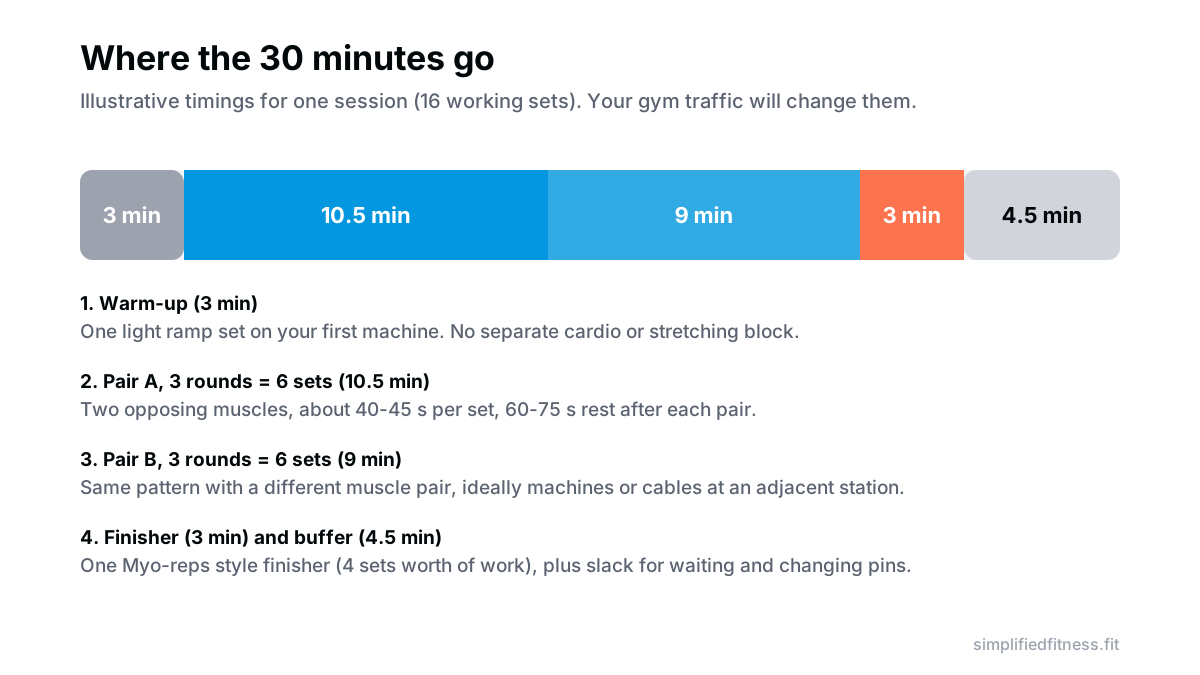
- Minutes 0-3: one light ramp-up set on your first exercise (about 50% of working weight for 8-10 reps), then one near-working set. Skip general cardio and static stretching.
- Minutes 3-13.5: Pair A for 3 rounds (6 sets). Work set, move to the opposing exercise, work set, then 60-75 seconds before the next round.
- Minutes 13.5-22.5: Pair B for 3 rounds.
- Minutes 22.5-25.5: one Myo-reps finisher on a cable or machine.
- Minutes 25.5-30: buffer for traffic, plus water and a short walk-out.
The warm-up advice matches the time-efficiency review: keep it exercise-specific and skip stretching unless flexibility is the goal (Iversen et al., 2021). If you want a quick joint prep before a session, our 7-minute dynamic warm-up covers it, though you will not have time for the full version on busy days.
What is the 4-day 30 minute routine?
This is an upper/lower layout with two sessions of each type, so every muscle trains twice a week.
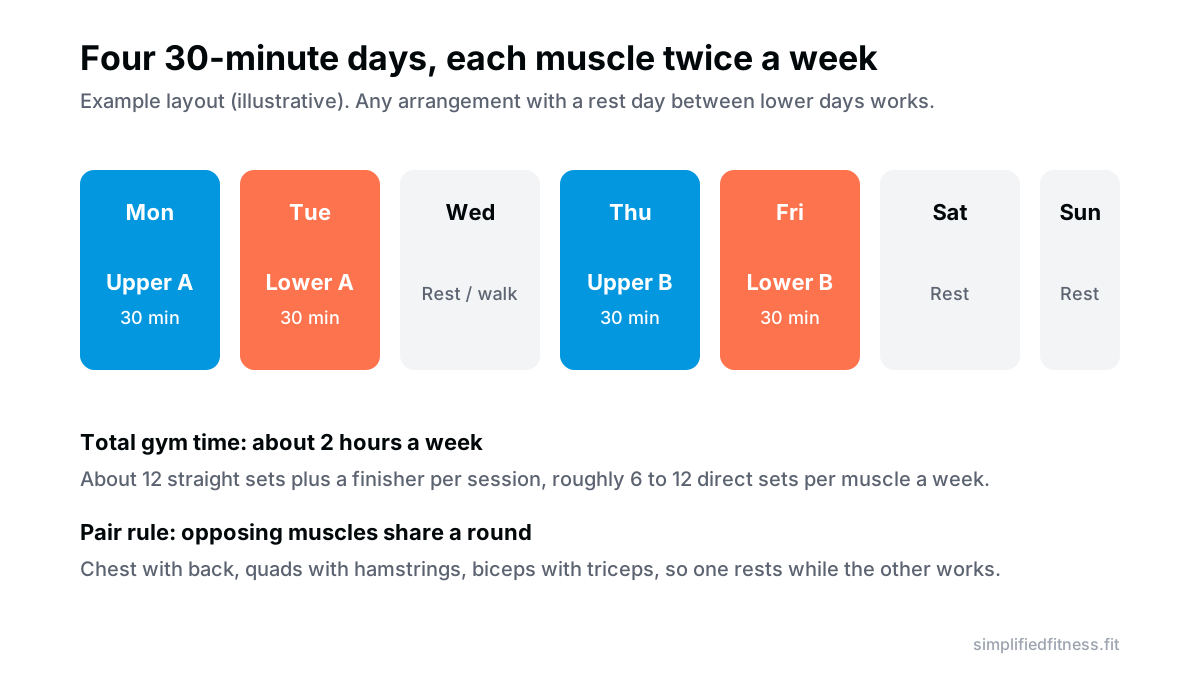
Rep targets are guidelines. Stop sets 1-3 reps short of failure on compounds and closer to failure on isolations.
Day 1: Upper A (push-led)
| Block | Exercise | Sets x reps |
|---|---|---|
| Pair A | Machine or incline dumbbell press | 3 x 8-12 |
| Pair A | Chest-supported or seated row | 3 x 8-12 |
| Pair B | Lateral raise (dumbbell or cable) | 3 x 12-20 |
| Pair B | Cable or machine rear-delt fly | 3 x 12-20 |
| Finisher | Triceps pushdown, Myo-reps | 1 activation + mini-sets |
Day 2: Lower A (quad-led)
| Block | Exercise | Sets x reps |
|---|---|---|
| Pair A | Leg press or hack squat | 3 x 8-12 |
| Pair A | Seated leg curl | 3 x 10-15 |
| Pair B | Single-leg extension | 3 x 12-15 |
| Pair B | Standing calf raise | 3 x 10-15 |
| Finisher | Leg extension, Myo-reps | 1 activation + mini-sets |
Day 3: Upper B (pull-led)
| Block | Exercise | Sets x reps |
|---|---|---|
| Pair A | Wide-grip lat pulldown | 3 x 8-12 |
| Pair A | Dumbbell shoulder press or machine press | 3 x 8-12 |
| Pair B | Cable or hammer curl | 3 x 10-15 |
| Pair B | Overhead cable triceps extension | 3 x 10-15 |
| Finisher | Pec deck fly, Myo-reps | 1 activation + mini-sets |
Day 4: Lower B (hamstring and glute-led)
| Block | Exercise | Sets x reps |
|---|---|---|
| Pair A | Hip thrust or stiff-leg deadlift | 3 x 8-12 |
| Pair A | Leg press (high foot placement) or hack squat | 3 x 10-12 |
| Pair B | Seated leg curl | 3 x 10-15 |
| Pair B | Adductor machine | 3 x 12-15 |
| Finisher | Standing calf raise, Myo-reps | 1 activation + mini-sets |
That is 12 straight sets plus a finisher worth roughly 3-4 sets of effort, so about 15-16 per session. Across the week, most major muscles get roughly 6-12 direct hard sets (quads and hamstrings sit at the top, chest, back, shoulders and triceps around 6-7). Biceps and rear delts get about 3 direct sets plus indirect work from rows and pulldowns, so add a set or two there if they lag. You can compare that against our training volume calculator and the broader training volume and frequency guide.
How do you progress inside 30 minutes?
Use double progression. Pick a rep range, such as 8-12. When all sets reach 12 with good form, add the smallest weight jump available next time.
Log one number per exercise: the weight and reps of your best set. Anything more costs time. If a session feels like a failed week, you probably over-paired. Drop one exercise rather than rushing the rest.
What are the limits of a 30 minute plan?
Be honest with yourself. A 30 minute plan is not ideal for chasing a barbell squat PR, because heavy singles need long rests. It is also tough to add specialization volume for a lagging muscle without extending sessions.
Most evidence here comes from trained or recreationally trained young men over 8 weeks or fewer, so it may not translate perfectly to older adults, women, or long-term lifters. If you have a medical condition, joint pain that worsens with training, or high blood pressure, speak to your doctor or a qualified coach before training close to failure with advanced techniques. Supersets raised perceived exertion and blood lactate in the review above, so they feel harder than normal sets.
If your week is truly packed, a 2-day plan may fit better, so see our 2-day lifting routine for busy professionals. For judging when a session is too long to be effective, see managing workout duration and physiological drop-off.
What should you eat around a lunch-break workout?
Keep it simple. A light snack 60-90 minutes before, such as a banana with curd, roasted chana or a handful of peanuts, keeps energy up without stomach issues. Afterwards, an easy protein-rich meal like dal with rice and paneer or a soya chunks sabzi with roti works well. Use our protein calculator to set a daily target. In hot weather, drink water throughout, since a rushed, sweaty session still counts as work.
Frequently Asked Questions
Can you build muscle in 30 minutes?
Yes, for most people, if the 30 minutes are mostly hard sets rather than waiting. A narrative review of time-efficient training recommends a minimum of about 4 weekly sets per muscle group in a 6-15 rep range as a starting point for strength and size. Plan 12-16 hard sets per session and keep the rest of the time for a single warm-up set and quick transitions.
How many sets can you fit into a 30 minute workout?
Roughly 12-16 working sets using paired exercises. One round of a pair (two working sets, the walk between adjacent machines and 60-75 seconds of rest) takes about 3 minutes, so 6 rounds take around 18-20 minutes. Add one ramp-up set and a short finisher and you land near 30 minutes.
Are supersets as good as normal sets for muscle growth?
In a 2025 meta-analysis of 19 studies they were similar: supersets matched traditional sets for total volume, strength and hypertrophy with shorter sessions. Agonist-antagonist pairs such as chest and back were best at maintaining reps, while pairing two exercises for the same muscle cut volume load. The catch is higher perceived exertion, so keep the pairs sensible and watch your recovery.
What are Myo-reps?
Myo-reps are a rest-pause style method: one activation set of roughly 12-20 reps near failure, then several short mini-sets of 3-5 reps with about 15-20 seconds between them. An 8-week trial in 22 resistance-trained men found similar muscle size and strength gains versus straight sets, with about 30% less total volume load. Use them on one safe machine or cable exercise per session, not on everything.
How long should I rest between sets in a short workout?
Use about 60-90 seconds between sets of the same muscle, and let the second exercise of a pair act as your rest. A 2024 meta-analysis found a small hypertrophy advantage for resting over 60 seconds, with no clear difference beyond 90 seconds. Shorter rests mainly cost you reps, so lower the weight a little rather than rushing.
Should I skip warming up to save time?
Do not skip it, shrink it. A time-efficiency review recommends keeping the warm-up exercise-specific, which in practice means one or two lighter ramp-up sets on your first movement. Skip long stretching or cardio blocks unless flexibility is your goal.
What exercises are best for a 30 minute gym session?
Pick multi-joint machines and cables you can set up in seconds: chest press or incline press, lat pulldown or seated row, leg press, leg curl, lateral raises and cable curls or pushdowns. They need less balancing and fewer plate changes than free weights. Choose the version that feels stable and lets you get close to failure safely.
Is a 30 minute workout enough for legs?
It can be, if you give lower body its own day. A leg press or squat variation, a hamstring curl, a leg extension and a calf raise cover the main muscles in about 25 minutes using pairs. Rest times matter more here, because heavy lower-body sets are tiring.
How often should I do 30 minute workouts?
Four days a week in an upper/lower split works well for time-poor lifters, and three full-body days also works. Weekly hard sets matter more than how they are spread, so choose the schedule you will actually keep. Leave at least one rest day between the two lower-body sessions.
Can I do 30 minute workouts on my lunch break in India's heat?
Yes. Short sessions suit a lunch break because you finish before you cool down and need a shower anyway. Carry water, eat a light snack such as banana and curd or roasted chana beforehand, and pick a machine-based plan so you are not hunting for equipment.
Do shorter rest periods build more muscle?
No. The idea that short rests trigger more growth is not well supported. A 2016 trial in 21 trained men found that 3-minute rests gave greater strength and quadriceps growth than 1-minute rests over 8 weeks. Short rests are a time tool, not a growth hack.
How do I progress in a 30 minute workout?
Add reps within a set range first, then add a small amount of weight once you hit the top of the range on every set. Track one number per exercise so you do not waste minutes thinking. Our RIR and RPE calculator helps you judge how close to failure you actually are.
What if the machine I need is taken?
Swap in a similar movement and keep the pair order. A cable row can replace a seated row, a dumbbell press can replace a machine press. Do not wait around, because every idle minute removes working time from a session that has no spare minutes.
Sources & References
Every claim above is checked against peer-reviewed research (PubMed, U.S. National Library of Medicine) or guidance from established health bodies. How we fact-check.
- Zhang X, et al. Superset Versus Traditional Resistance Training Prescriptions: A Systematic Review and Meta-analysis Exploring Acute and Chronic Effects on Mechanical, Metabolic, and Perceptual Variables. Sports Med. 2025. PMID: 39903375
- Singer A, et al. Give it a rest: a systematic review with Bayesian meta-analysis on the effect of inter-set rest interval duration on muscle hypertrophy. Front Sports Act Living. 2024. PMID: 39205815
- Schoenfeld BJ, et al. Longer Interset Rest Periods Enhance Muscle Strength and Hypertrophy in Resistance-Trained Men. J Strength Cond Res. 2016. PMID: 26605807
- Iversen VM, et al. No Time to Lift? Designing Time-Efficient Training Programs for Strength and Hypertrophy: A Narrative Review. Sports Med. 2021. PMID: 34125411
- Bradshaw JT, et al. Similar Strength and Hypertrophic Adaptations in Less Time? Myo-Reps vs. Traditional Straight-Sets in Resistance-Trained Men. J Strength Cond Res. 2026. PMID: 42112925
- Behenck C, et al. The Effect of Different Rest Intervals Between Agonist-Antagonist Paired Sets on Training Performance and Efficiency. J Strength Cond Res. 2022. PMID: 32541619
- Enes A, et al. Rest-pause and drop-set training elicit similar strength and hypertrophy adaptations compared with traditional sets in resistance-trained males. Appl Physiol Nutr Metab. 2021. PMID: 34260860
- Schoenfeld BJ, et al. Loading Recommendations for Muscle Strength, Hypertrophy, and Local Endurance: A Re-Examination of the Repetition Continuum. Sports (Basel). 2021. PMID: 33671664

Umair Hazrami · Founder & Head Coach, Simplified Fitness
Umair Hazrami founded Simplified Fitness and the Simplified Lifter channel to cut through fitness noise. With 4+ years of consistent training and 10+ coaching clients, he writes every guide from the peer-reviewed research and links the sources so you can check them. Our editorial standards.
Educational content only, not medical advice. If you have a medical condition, are pregnant, or take medication, talk to a qualified doctor before changing your diet, supplements or training. Full disclaimer.
Keep reading

Programming
2-Day per Week Lifting Programs: Minimum Effective Dose for Busy Professionals
Can a 2 day a week workout routine hypertrophy goals support? Yes. Get a ready two-day full-body plan, the research behind it and how to run it in 60 minutes.
9 min read

Programming
The 7-Minute Dynamic Warm-Up: A Fast Routine to Prep Joints Before Lifting
A dynamic warm up for lifting takes about 7 minutes, not 25. See the 2-3-2 routine, what the research says about stretching and foam rolling, and what to skip.
9 min read
Programming
Antagonist Paired Sets: Cut Workout Time by About 40% Without Losing Reps
Antagonist paired sets supersets time saving explained: pairing push and pull cuts a session by roughly 40% keeping reps. Pairings and rest times included.
8 min read
Programming
The Arnold Split (Chest/Back, Shoulders/Arms, Legs): Does It Work for Natural Lifters?
Does the Arnold split workout routine work for natural lifters? See how chest/back supersets, arm days and weekly volume play out, with a 3, 5 and 6 day setup.
10 min read