Open vs Closed Kinetic Chain Exercises: Are Leg Extensions Really Worse Than Squats?
Open vs closed kinetic chain lifting explained: what the knee-force and hypertrophy research says about leg extensions vs squats, and how to program both.
TL;DR. The short answer
- Open kinetic chain means the foot or hand moves freely (leg extension, curl). Closed means it is fixed (squat, leg press). The label describes the setup, not whether an exercise is 'functional' or good for muscle growth.
- Neither type is clearly safer. Open-chain extensions load the ACL near full extension, while squats load the PCL more and put more hamstring activity into the movement. A cadaver simulation found open-chain patellofemoral stress was not supraphysiologic or significantly higher than in squats.
- Open-chain exercises can grow muscles that squats train less well. In one randomized trial, leg extensions grew all three regions of the rectus femoris, while Smith machine squats did not.
- A hybrid leg day (closed-chain compounds plus a few open-chain isolations) is a sensible default for most healthy lifters. Add the isolations if a muscle lags, not by default for every session.
- If you have had a knee injury or ACL surgery, ask your physio or surgeon which exercises and ranges suit your stage of recovery.
Part of our complete guide: Exercise Selection Biomechanics: Moment Arms, Strength Curves and Free Weights vs Machines
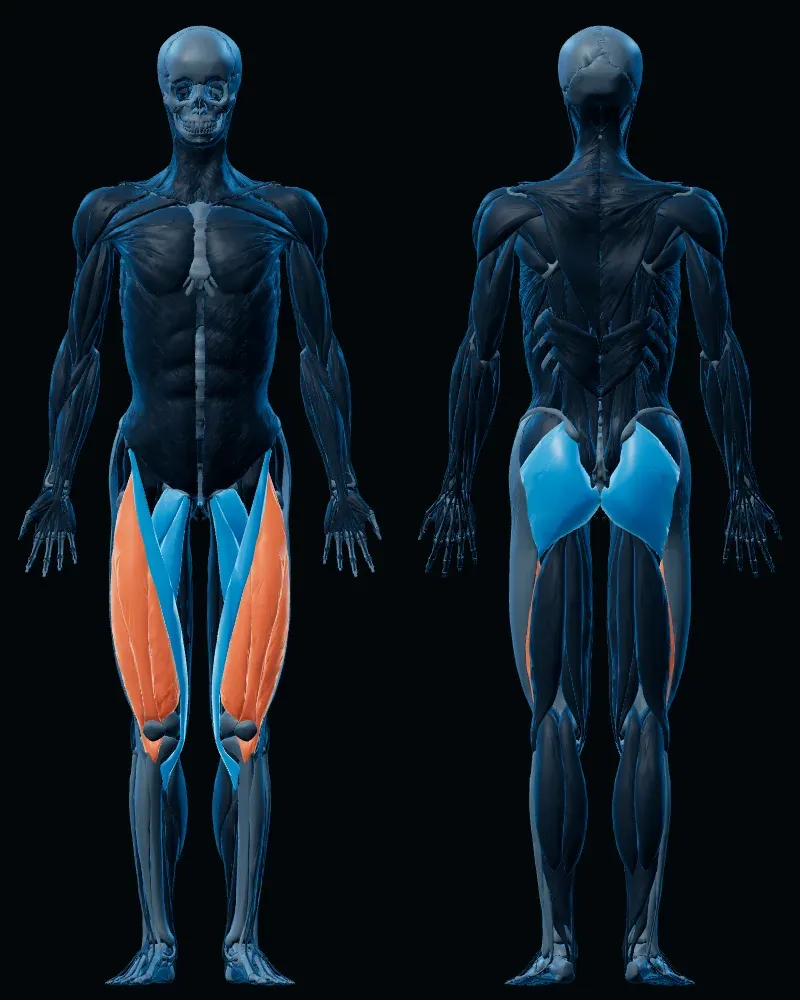
Muscles worked: quads
Main movers: rectus femoris and the three vasti
Assisting: adductors, sartorius and glutes
Table of contents
Open vs closed kinetic chain lifting is a setup difference, not a quality ranking. In an open chain exercise like the leg extension your foot moves freely, and in a closed chain exercise like the squat it is fixed to the floor. Neither is clearly safer or better for muscle growth, and each loads the knee and the muscles differently. This article is a deep dive inside our exercise selection and biomechanics guide.
If someone in your gym has told you leg extensions are “dangerous” or “not functional”, this is for you. We will look at the actual knee-force studies, what they do and do not show, and how to use both types in one programme.
What are open and closed kinetic chain exercises?
Think of your leg as a chain of linked segments: hip, thigh, shin, foot. What matters is whether the last link is free or fixed.
- Open chain: the foot (or hand) moves freely in space. Leg extension, leg curl, lateral raise, biceps curl.
- Closed chain: the foot (or hand) is fixed against something. Squat, leg press, lunge, push-up.
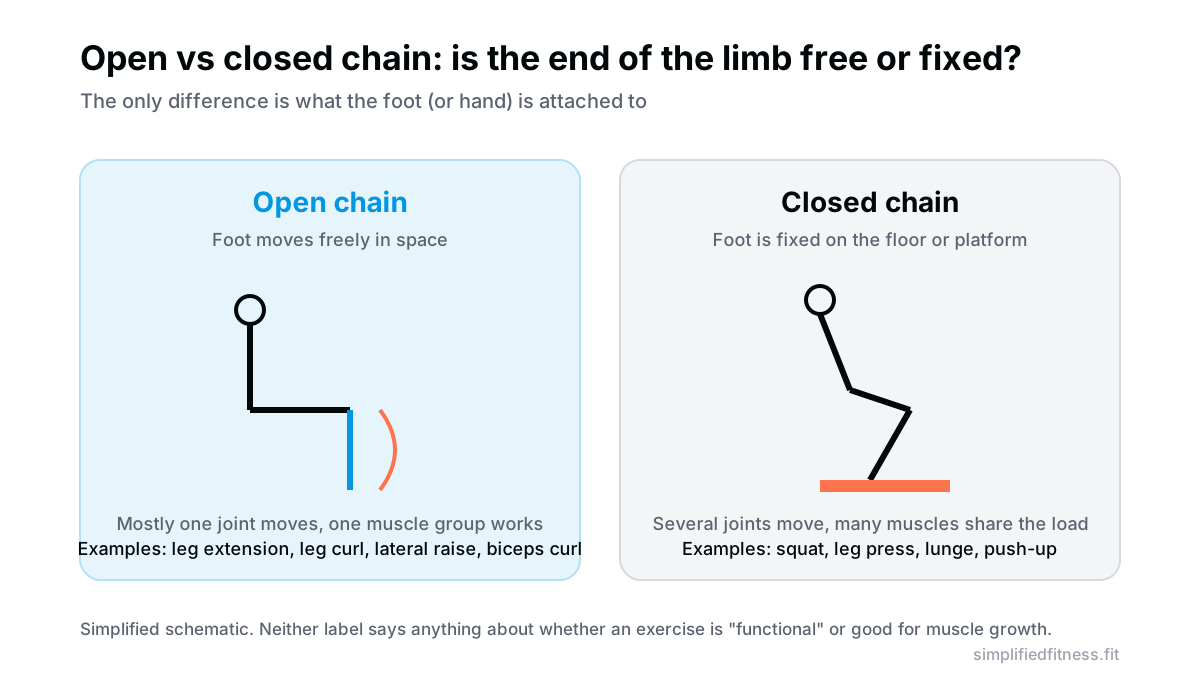
Closed chain exercises usually involve several joints and many muscles. Open chain exercises usually isolate one joint. But that overlap is not a rule: a cable row is closed at the feet and open at the hands, so real exercises sit on a spectrum.
Are leg extensions worse for your knees than squats?
The idea that leg extensions are risky and squats are safe comes from early rehab thinking. The lab data tell a more mixed story.
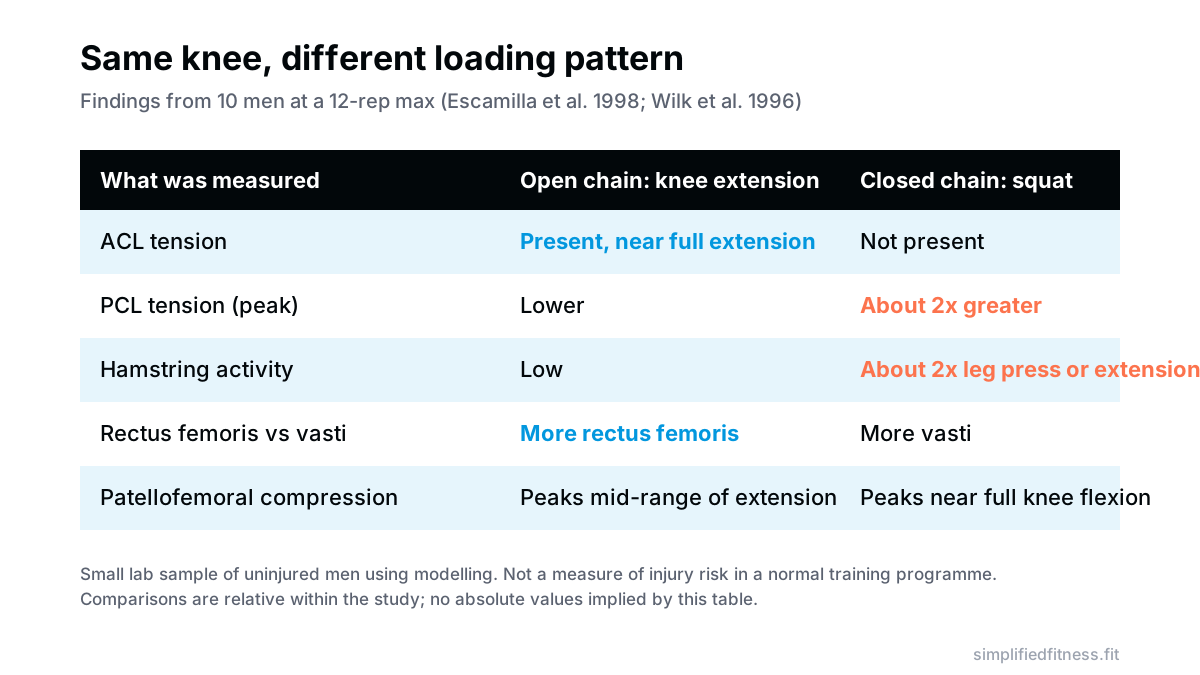
In a biomechanics study of ten men lifting a 12-rep max, the squat, leg press and knee extension loaded the knee in different ways, not in simply “better” or “worse” ways (Escamilla et al., 1998):
- ACL tension was present only in the open chain extension, and only near full knee extension.
- Peak PCL tension was about twice as great in the closed chain exercises, and grew with knee flexion.
- The squat produced about twice as much hamstring activity as the leg press and knee extension.
- Patellofemoral compression peaked near full flexion in closed chain exercises, and in the mid-range of the extending phase in open chain.
A companion study from the same group found a peak anterior shear force (the ACL-stressing direction) of 248 N at 14 degrees of knee flexion during extensions, and greater quad-hamstring co-contraction during the squat. Peak compressive force was actually higher in the squat (about 6139 N at 91 degrees of flexion) than in the knee extension (about 4598 N at 90 degrees) (Wilk et al., 1996).
What about the kneecap?
The patellofemoral joint (kneecap and thigh bone) is where most “leg extensions wreck your knees” claims come from. A computer simulation using geometry from five cadaver knees compared three leg extension variations with knee bends from 20 to 90 degrees of flexion. Open chain stresses were not supraphysiologic, nor significantly higher than closed chain stresses across the range (Cohen et al., 2001). The authors suggest low-flexion open chain work can suit people whose kneecap lesions make deeper bending uncomfortable.
Important limits: this is a simulation on a handful of cadaver knees, not a trial of people lifting for years. Both the Escamilla and Wilk studies used ten uninjured men. They tell us how loads are distributed, not how many people get injured.
Do open chain exercises matter after an ACL injury?
This is where conflicting findings show up, so let’s lay them out fairly.
Study A (rehab meta-analysis): a systematic review of ten randomized trials after ACL reconstruction found low- to moderate-quality evidence of no between-group differences in tibial laxity, strength or patient-reported function when open chain quadriceps exercises were used, compared with closed chain exercises (Perriman et al., 2018).
Study B (lab study in ACL-deficient knees): in 12 patients with an ACL injury and 12 controls, all squats produced less forward tibial movement than the active extension exercise. The authors concluded closed chain exercises are preferable to limit translation in ACL-deficient knees managed without surgery (Kvist & Gillquist, 2001). Hamstring co-contraction was low in that study.
Why might they differ? One measures short-term mechanics in a lab with specific loads and angles, the other measures longer-term clinical outcomes in a surgical population following rehab programmes. They are also different people: ACL-deficient knees versus reconstructed ones.
The cautious takeaway: if you are healthy, this debate mostly does not apply to you. If you are rehabbing a knee, the right exercise and range depend on your surgery, graft and timeline, so follow your physio’s plan.
Do open chain exercises build muscle as well as squats?
Often, yes, and sometimes in places squats do not reach.
In a randomized trial with matched training volume and intensity, one group did squats on a Smith machine and the other did leg extensions. All three regions (proximal, central and distal) of the rectus femoris grew significantly in the leg extension group, while only the central region of the vastus lateralis grew significantly in the Smith machine group (Zabaleta-Korta et al., 2021). Note this was a single trial and the squat was on a Smith machine, which may differ from a free barbell squat.
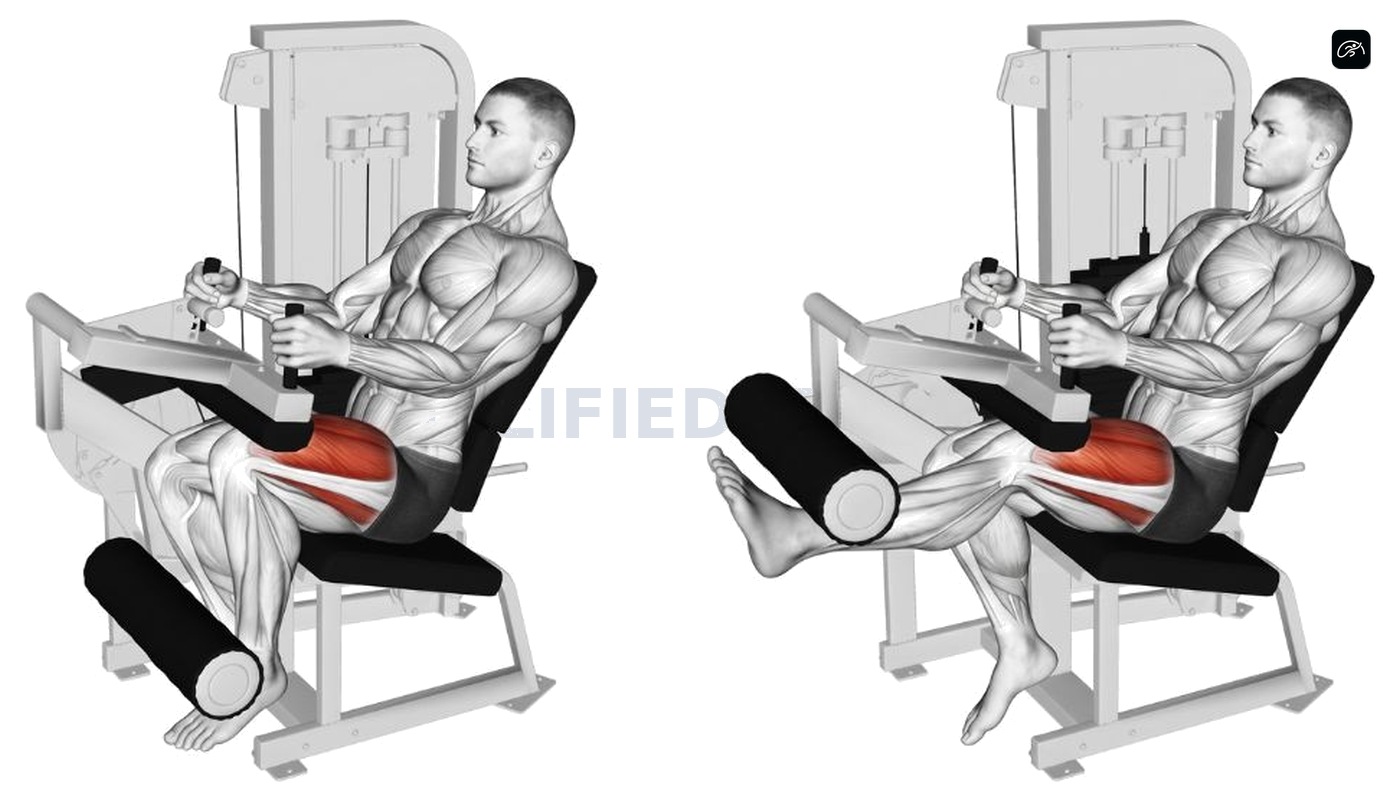
The rectus femoris crosses both the hip and the knee. In a squat the hip and knee extend together, so its length changes relatively little, while a leg extension loads it purely as a knee extensor. That is one likely reason Escamilla’s group found knee extension produced more rectus femoris activity than the squat or leg press, which produced more vasti activity (Escamilla et al., 1998). For more on the heads of the quads, see our guide to quadriceps anatomy: vasti and rectus femoris, and for the full leg extension case, leg extensions, the rectus femoris and knee safety.
The seated leg curl is open chain too
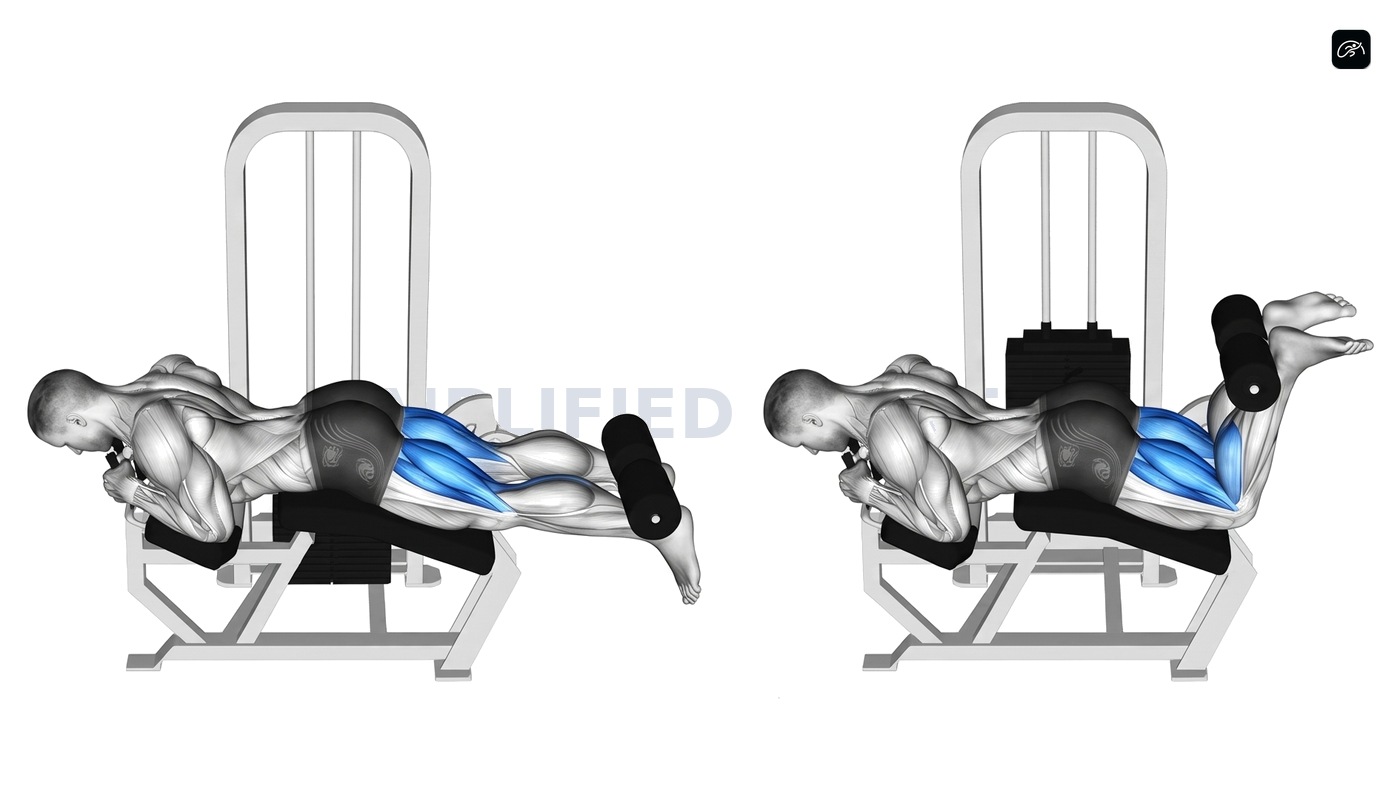
The best example of an open chain exercise doing its job is the seated leg curl. In a 12-week study, 20 healthy adults trained one leg with seated leg curls and the other with prone leg curls. Whole hamstring muscle volume rose more in the seated leg (+14%) than the prone leg (+9%) (Maeo et al., 2021). The seated position trains the hamstrings at a longer muscle length, the likely reason. You can read more in seated vs lying leg curls.
Do squats and other closed chain lifts have a place?
Absolutely. Closed chain compounds train many muscles in one lift, load heavy, and teach coordination under a bar. The squat’s higher hamstring co-contraction and its hip and quad demands are real (Wilk et al., 1996).
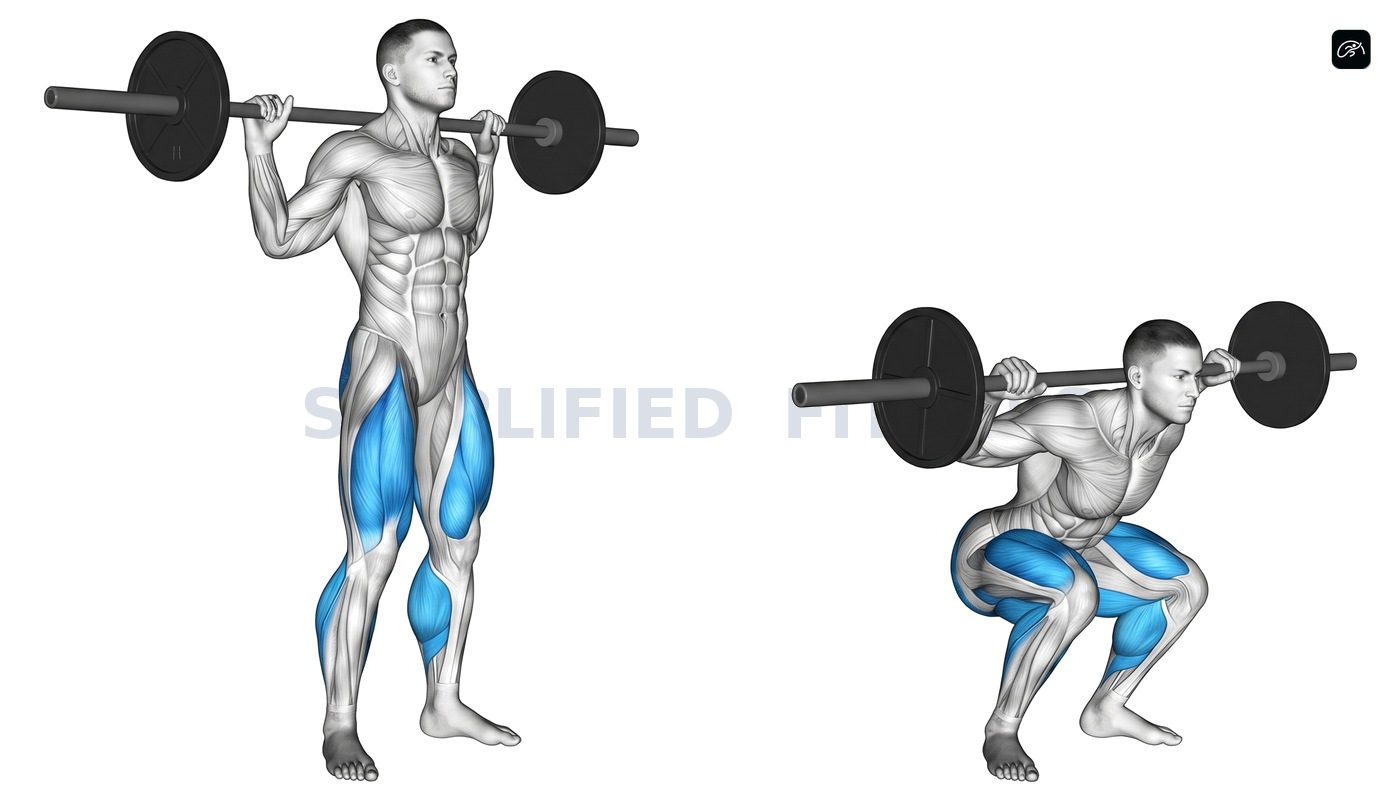
The catch is that compounds are limited by their weakest link. In a squat, the lower back, balance or hip strength might stop you before the quads are truly pushed. That is why isolation work earns a place for some lifters. We compare the two in depth in compound vs isolation exercises.
If your worry is knee safety in squats specifically, see are squats bad for your knees.
Do you actually need isolation exercises?
The evidence is mixed, which is itself useful. A 2017 review of 23 studies found surface EMG of the prime movers did not differ between single- and multi-joint exercises, and that long-term upper-limb studies reported no extra benefit from adding single-joint work. It also noted single-joint exercise may be needed to correct muscular imbalances (Gentil et al., 2017).
Compare that with the regional growth trial above. The two are not contradictory: one is mostly upper-body work, one is a specific leg muscle that squats trained less. The practical reading is that isolation work is a tool for a specific gap, not a requirement for every muscle.
How to program open and closed chain exercises together
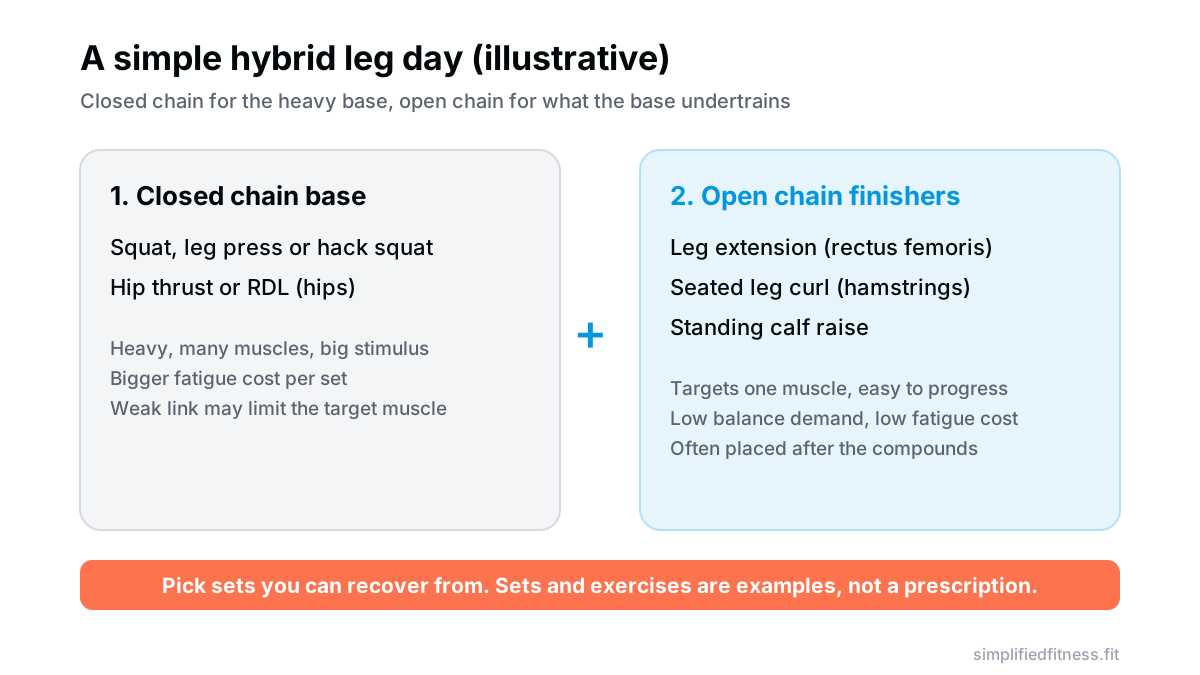
A simple hybrid works for most healthy lifters:
- Start with a closed chain compound for the base: a squat, leg press or hack squat.
- Add a hinge or hip movement like a Romanian deadlift or hip thrust.
- Finish with open chain isolation for what the compounds undertrain: leg extension for the rectus femoris, seated leg curl for the hamstrings, calf raise for the calves.
Some practical notes:
- Order: isolations after the compound lifts usually works better, because you are not pre-fatiguing the muscles you need for the heavy lifts.
- Range: use a range you can control and that feels okay for your knees. If a certain angle pinches, shorten it or lighten the load, then rebuild.
- Volume: you do not need to do everything. Our training volume calculator can help you check weekly sets per muscle, and a ready-made plan is on our leg day plan.
- Machines and budget: if your gym has only one leg extension machine and it is always taken, a Bulgarian split squat or sissy squat variation is a closed or semi-closed alternative, and a resistance band leg extension at home works too.
- Hamstring balance: if you want to understand knee balance, look at the hamstring to quadriceps ratio.
When to see a doctor or physio
Persistent knee pain, swelling, clicking with pain, giving way or a recent injury or surgery deserve proper assessment. This article cannot tell you what is wrong with your knee, and exercise choice for an injured knee should come from someone who has examined it. Stop an exercise that causes sharp or worsening pain and get it checked rather than pushing through.
The bottom line
Open vs closed kinetic chain lifting is a useful description, not a moral ranking. Squats and leg presses give heavy, efficient loading with more hamstring involvement. Leg extensions and curls give targeted work, including regions of muscle that compounds can undertrain. The research does not show open chain exercise to be clearly more dangerous for healthy knees, although it does show different loading patterns, and rehab populations need individual advice.
So use both, in proportion to your goals, recovery and how your knees feel. Start with a closed chain base, add open chain isolations where you are lagging, and stop worrying about whether an exercise is “functional” enough.
Frequently Asked Questions
What is the difference between open and closed kinetic chain exercises?
In an open kinetic chain exercise the end of the limb (foot or hand) moves freely, like in a leg extension or biceps curl. In a closed chain exercise it is fixed against the floor or a platform, like in a squat or leg press. The distinction describes how forces travel through the joints, so pick based on which muscle you want to train and which setup your knees tolerate.
Are leg extensions bad for your knees?
For most healthy lifters there is no good evidence that leg extensions are uniquely harmful. A cadaver-based computer simulation found open-chain patellofemoral stresses were not supraphysiologic nor significantly higher than closed-chain knee bends across 20 to 90 degrees of flexion. If a particular range hurts, shorten it, lighten the load, or see a physio instead of dropping the exercise forever.
Are squats better than leg extensions for muscle growth?
Not necessarily. In a randomized trial with matched volume, leg extensions grew all three regions of the rectus femoris while Smith machine squats did not, although squats grew the central vastus lateralis. Use squats or leg presses as the base and add leg extensions if you want more rectus femoris work.
Do leg extensions hit the rectus femoris more than squats?
Probably. One biomechanics study in ten men found open-chain knee extension produced more rectus femoris activity, while squats and leg presses produced more vasti activity. The rectus femoris crosses the hip and knee, so in a squat its length changes little as both joints extend together, while a leg extension asks it only to straighten the knee. Add a set or two of extensions after your main squat pattern if your quads feel under-trained.
Is the leg extension ACL safe?
It depends on your knee and your stage of recovery. Research shows ACL tension appears in open-chain extension only near full extension, and a 2018 meta-analysis of ten randomized trials after ACL reconstruction found no differences in laxity, strength or function between open and closed exercises. If you have had ACL surgery, follow your surgeon's protocol rather than a general rule.
Is the squat more functional than the leg extension?
Squats resemble daily tasks like standing up, so they carry over well to those tasks. 'Functional' is not a muscle-growth property, though, and hypertrophy depends on how hard the muscle works near failure. Choose by the goal: skill and carryover favour closed chain, targeted size gains can come from either.
Do squats work the hamstrings?
Somewhat. One study found the squat generated about twice as much hamstring activity as the leg press and knee extension, and another found greater quad and hamstring co-contraction in squats. Neither shows that squats grow the hamstrings much, so you should still train the hamstrings directly with a hinge and a curl.
Should I do both open and closed chain exercises?
For most lifters, yes, because they cover each other's gaps. Closed-chain compounds give heavy, efficient loading, and open-chain isolations let you target a muscle with low balance demand and low fatigue. Start with one or two compounds, then add one to three isolation exercises where you need them.
Is the seated leg curl open or closed chain?
Open chain, because the foot moves freely against the pad. It is also a good example of why open chain is not 'inferior': in a 12-week trial, seated leg curls grew whole hamstring volume more than prone leg curls (+14% vs +9%) in 20 healthy adults. Seated curls train the hamstrings at a longer muscle length, which is the likely reason.
Do I have to avoid leg extensions with patellofemoral pain?
Not always, but range and load matter. A computer simulation suggested that open-chain exercise at low flexion angles can be a reasonable option when deeper flexion loads a painful part of the kneecap. Because pain varies a lot between people, a physio can help you pick the pain-free range.
Can I build big quads with only open chain exercises?
You probably can grow quads with leg extensions alone, since they train all quadriceps heads, but you would miss the hips and the skill and heavy loading of squat patterns. The evidence here is short-term, mostly in healthy young people. For a balanced result, include at least one closed-chain lower-body exercise most weeks.
Do isolation exercises add anything if I already do compounds?
It depends on the muscle. A review found that for the upper limbs, adding single-joint exercises did not add benefit in the studies reviewed, but single-joint work may help correct muscular imbalances. If a muscle is clearly lagging, adding direct work is reasonable, otherwise it is optional.
Sources & References
Every claim above is checked against peer-reviewed research (PubMed, U.S. National Library of Medicine) or guidance from established health bodies. How we fact-check.
- Escamilla RF, et al. Biomechanics of the knee during closed kinetic chain and open kinetic chain exercises. Med Sci Sports Exerc. 1998. PMID: 9565938
- Wilk KE, et al. A comparison of tibiofemoral joint forces and electromyographic activity during open and closed kinetic chain exercises. Am J Sports Med. 1996. PMID: 8827313
- Cohen ZA, et al. Patellofemoral stresses during open and closed kinetic chain exercises. An analysis using computer simulation. Am J Sports Med. 2001. PMID: 11476390
- Zabaleta-Korta A, et al. The role of exercise selection in regional muscle hypertrophy: a randomized controlled trial. J Sports Sci. 2021. PMID: 34743671
- Perriman A, et al. The effect of open- versus closed-kinetic-chain exercises on anterior tibial laxity, strength, and function following anterior cruciate ligament reconstruction: a systematic review and meta-analysis. J Orthop Sports Phys Ther. 2018. PMID: 29685058
- Kvist J, et al. Sagittal plane knee translation and electromyographic activity during closed and open kinetic chain exercises in anterior cruciate ligament-deficient patients and control subjects. Am J Sports Med. 2001. PMID: 11206260
- Maeo S, et al. Greater hamstrings muscle hypertrophy but similar damage protection after training at long versus short muscle lengths. Med Sci Sports Exerc. 2021. PMID: 33009197
- Gentil P, et al. A review of the acute effects and long-term adaptations of single- and multi-joint exercises during resistance training. Sports Med. 2017. PMID: 27677913

Umair Hazrami · Founder & Head Coach, Simplified Fitness
Umair Hazrami founded Simplified Fitness and the Simplified Lifter channel to cut through fitness noise. With 4+ years of consistent training and 10+ coaching clients, he writes every guide from the peer-reviewed research and links the sources so you can check them. Our editorial standards.
Educational content only, not medical advice. If you have a medical condition, are pregnant, or take medication, talk to a qualified doctor before changing your diet, supplements or training. Full disclaimer.
Keep reading
Exercise Technique
Anthropometry-Based Exercise Selection: Long Limbs, Short Torsos, and Lever Adjustments
Anthropometry exercise selection explained: how long femurs, long arms and a short torso change squats, deadlifts and presses, plus a simple audit and swaps.
9 min read
Exercise Technique
Axial Loading vs Non-Axial Exercises: Managing Spinal Fatigue for Bigger Legs and Back
Axial loading vs non axial exercises explained: how spinal compression limits your weekly volume, and which squat and row swaps spare your lower back.
7 min read
Exercise Technique
Cable Setup Mastery: Pulley Heights, Cable Angles, and Customizing Force Vectors
Cable machine setup guide: how to set pulley height, stance and cable angle for chest, lats, delts and arms, with what the research does and does not show.
9 min read
Exercise Technique
Compound vs Isolation Exercises for Hypertrophy: Do You Need Both?
Compound vs isolation exercises for hypertrophy: what trials say about arms, delts and hamstrings, and which muscles actually need direct sets. Sources linked.
7 min read