Free Weights vs Cables vs Machines: What Actually Builds Muscle
Free weights vs machines vs cables for hypertrophy: what a 13-study meta-analysis found, where each tool wins in practice, and how to mix them in your split.
TL;DR. The short answer
- In a 2023 meta-analysis of 13 studies and 1016 adults, free-weight and machine training produced no detectable difference in muscle hypertrophy (SMD -0.055, 95% CI -0.397 to 0.287).
- Strength is more specific than size. Free-weight training raised free-weight test strength a bit more, and machine training tended to raise machine test strength more.
- Cables have fewer direct trials, but a 10-week study of 35 young adults found similar biceps growth from a cable preacher curl and a barbell preacher curl.
- Pick the tool you can train hard, progress and repeat safely. Free weights for the big lifts you want to be good at, cables and machines for isolation and for pushing close to failure.
- If you have chest pain, joint pain that does not settle, or a known medical condition, get cleared by a doctor or physio before loading heavy on any equipment.
Part of our complete guide: Exercise Selection Biomechanics: Moment Arms, Strength Curves and Free Weights vs Machines
Table of contents
Are machines as good as free weights? For building muscle size, the research says they are close enough that equipment is rarely your bottleneck. A 2023 meta-analysis found no detectable difference in hypertrophy between the two, and the real differences show up in strength specificity, safety near failure, and practical convenience.
That is the short answer to the free weights vs machines vs cables hypertrophy debate. The rest of this article covers what the studies actually measured, where cables fit, and how to mix all three in a split without turning it into a religion. (This sits inside our wider exercise selection and biomechanics guide, which is worth reading if you are building a program from scratch.)
Barbell purism is an old gym habit. The data does not back it up.
Free weights vs machines vs cables: what the best evidence says
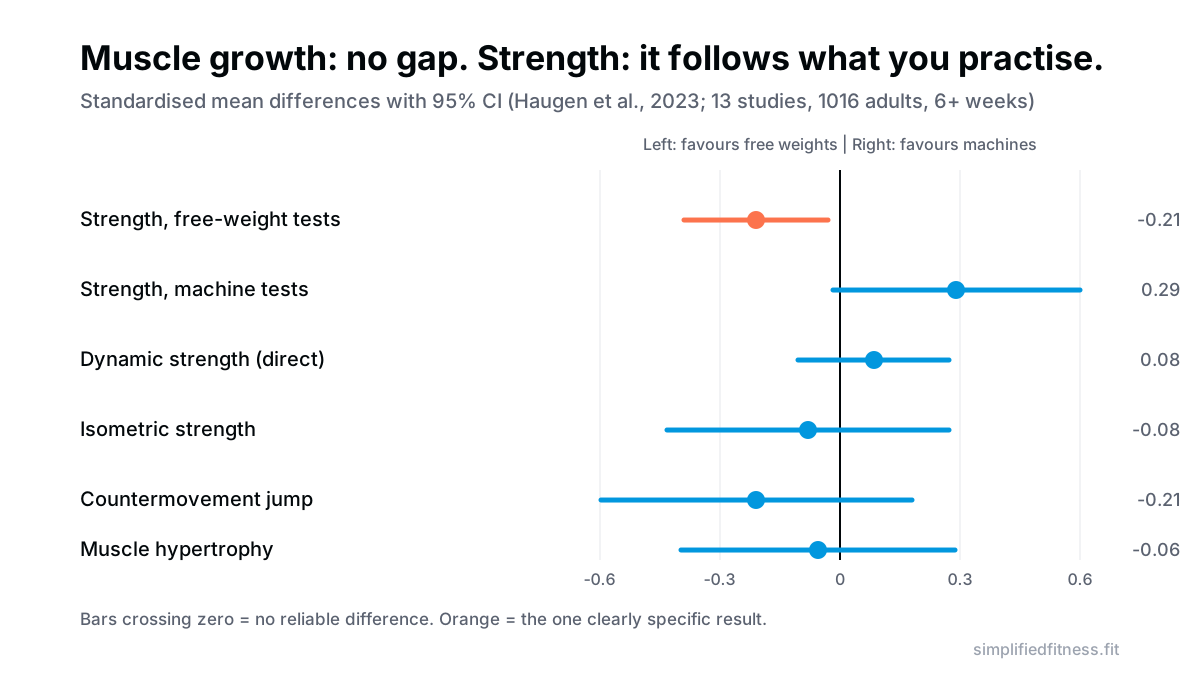
The biggest piece of evidence is Haugen et al. (2023), a systematic review and meta-analysis of studies that directly compared free-weight and machine training for at least 6 weeks in adults aged 18-60. It pooled 13 studies and 1016 participants (789 men, 219 women). Only 5 of those looked at hypertrophy, so keep that in mind.
Here is what it found.
- Hypertrophy: no difference between modalities (SMD -0.055, 95% CI -0.397 to 0.287).
- Dynamic and isometric strength in a direct comparison: no difference.
- Jump performance: no difference.
- Strength specificity: strength on free-weight tests rose a little more after free-weight training (SMD -0.210), and strength on machine tests tended to rise more after machine training (SMD 0.291, not quite significant).
The authors concluded that strength changes are specific to the training modality, and that the choice between free weights and machines comes down to individual preferences and goals.
Why the hypertrophy result is believable
It is not one lucky paper. Several smaller trials point the same way, each with its own limits.
- Schwanbeck et al. (2020) randomised 46 people (26 women, average age 22) to free weights or machines for 8 weeks. Biceps and quadriceps thickness rose with no difference between groups. Machine bench press strength rose more in the machine group (13.9 vs 8.6%), while free-weight bench, squat and Smith machine squat strength rose similarly in both.
- Hernandez-Belmonte et al. (2023) took 34 resistance-trained men and trained them for 8 weeks on a barbell or machine version of squat, bench, bench pull and shoulder press, with intensity matched using bar velocity. No between-group differences in muscle architecture or athletic measures. The free-weight group improved change of direction and some balance tests, and the machine group meaningfully improved upper-limb anaerobic power.
- Amanuma et al. (2025) trained each leg of 8 untrained young women differently for 9 weeks, lunges on one side and incline leg press on the other. Ultrasound showed comparable thickness gains in the vastus lateralis and rectus femoris. The sample was tiny and untrained, so treat it as supporting evidence, not proof.
One caveat that matters. Most of these trials ran 8-10 weeks in young adults. Over years of training, other factors may creep in, and nobody has run a ten-year free-weight versus machine trial.
Why would machines work as well as barbells?
Because muscle does not know what equipment it is pulling against. It responds to mechanical tension, and tension can be produced by a barbell, a cable stack or a plate-loaded sled.
Two things seem to matter far more than the tool.
First, how hard the set is. In Refalo et al. (2023), a meta-analysis of 15 studies, there was a trivial advantage for training to any definition of set failure, but no evidence that training to momentary muscular failure beat stopping short. In plain terms: sets should be hard, but you do not need to grind every rep into the ground.
Second, load range. A review by Schoenfeld and colleagues (2021) argues that muscle adaptations can be obtained across a wide spectrum of loading zones, not only a narrow “hypertrophy range”. That is one reason light-to-moderate loads on a cable work.
So when you compare tools, compare them at matched effort. A sloppy dumbbell set stopped 6 reps short loses to a hard machine set, and the reverse is also true. Our RIR and RPE calculator helps you judge how close to failure a set really was.
Free weights vs cables: do cables build muscle as well?
Cables have the thinnest direct evidence of the three. There is no large meta-analysis of cables against dumbbells, so be careful with anyone who says otherwise.
The closest controlled data I would point to is Nunes et al. (2020). Thirty-five young adults trained the biceps for 10 weeks, three times a week, with preacher curls for 3 sets of 8-12. One group used a cable, where torque is higher when the elbow is flexed. The other used a barbell, where torque is higher when the elbow is extended and the biceps is stretched.
- Biceps thickness rose 7% on cable and 8% on barbell, not a meaningful difference.
- Strength gains were greater for the barbell only at the longest muscle length (39% vs 30% at 20 degrees of elbow flexion).
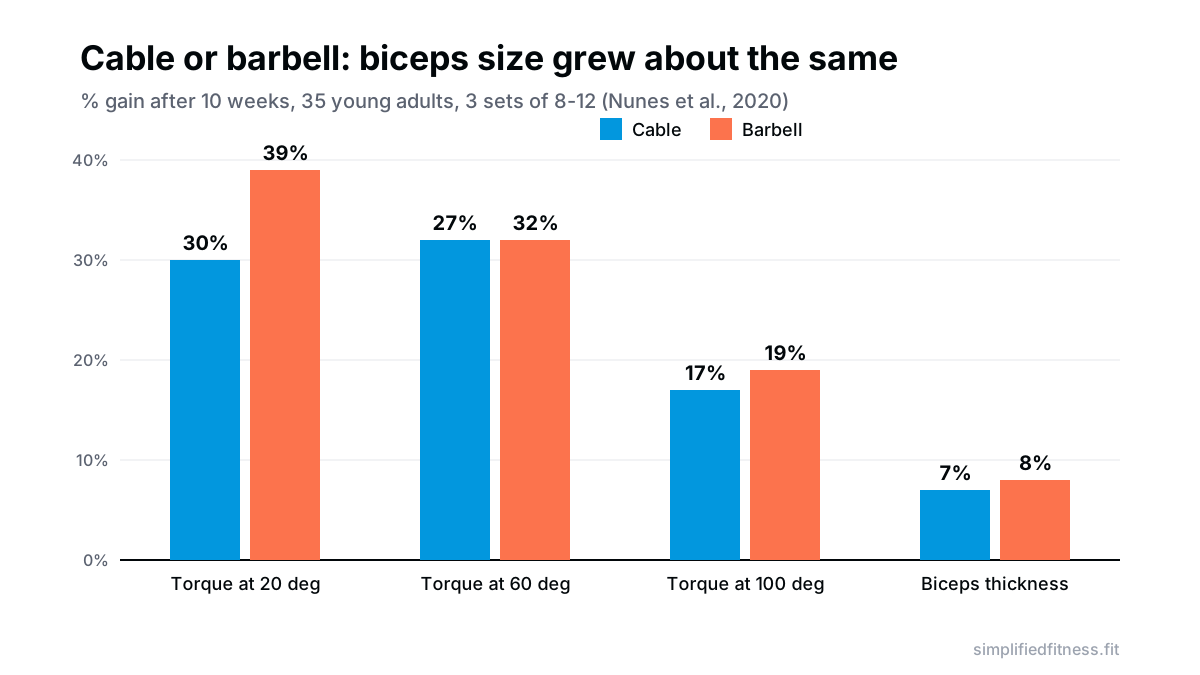
That tells you something useful. The bar and the cable load the muscle differently, and the growth was still similar in this group. It does not tell you the same would hold for the chest, back or shoulders, and it does not tell you what happens in advanced lifters.
Where cables earn their place
These are practical reasons, not proven growth advantages.
- Constant direction of pull. On a dumbbell lateral raise, the load is easiest at the bottom. A cable can keep tension on the side delts at the start of the rep. We cover pulley setup in our cable setup guide.
- Small jumps, sometimes. Stack plates are often 5 kg or more, but many stacks take add-on weights or magnetic plates, so you can progress in smaller steps.
- Easy to train one side at a time. Single-arm cable work is simple to set up.
- Safe to take hard. There is no bar to drop.
The downside is busy-gym reality. In many commercial gyms the cable station is the most crowded spot, so the “best” cable setup is the one with a free pulley at 6 pm. That is a good reason to have a dumbbell fallback.
Does stability or instability change muscle growth?
This is the main argument for free weights: the extra balance demand recruits stabilisers.
Behm and colleagues (2006) reviewed the literature on instability in resistance training. They note that instability can decrease the externally measured force output while maintaining high muscle activation, and that the lower force may be detrimental to absolute strength gains. Some studies also report increased co-contractions with unstable training. For health and rehabilitation programs, they suggest including both stable and unstable exercises.
Two cautions. This is a review, not a hypertrophy trial, and it deals with unstable surfaces and devices more than with barbell versus machine. Second, more muscle activity in stabilisers is not the same thing as more growth in the muscle you want to train.
A practical way to hold this: if the stabiliser is not the muscle you are training, it can become the weak link that ends the set early. This is the logic behind our article on external stability in exercise design.
The practical advantages that actually matter
If growth is similar, the choice becomes about everything else.
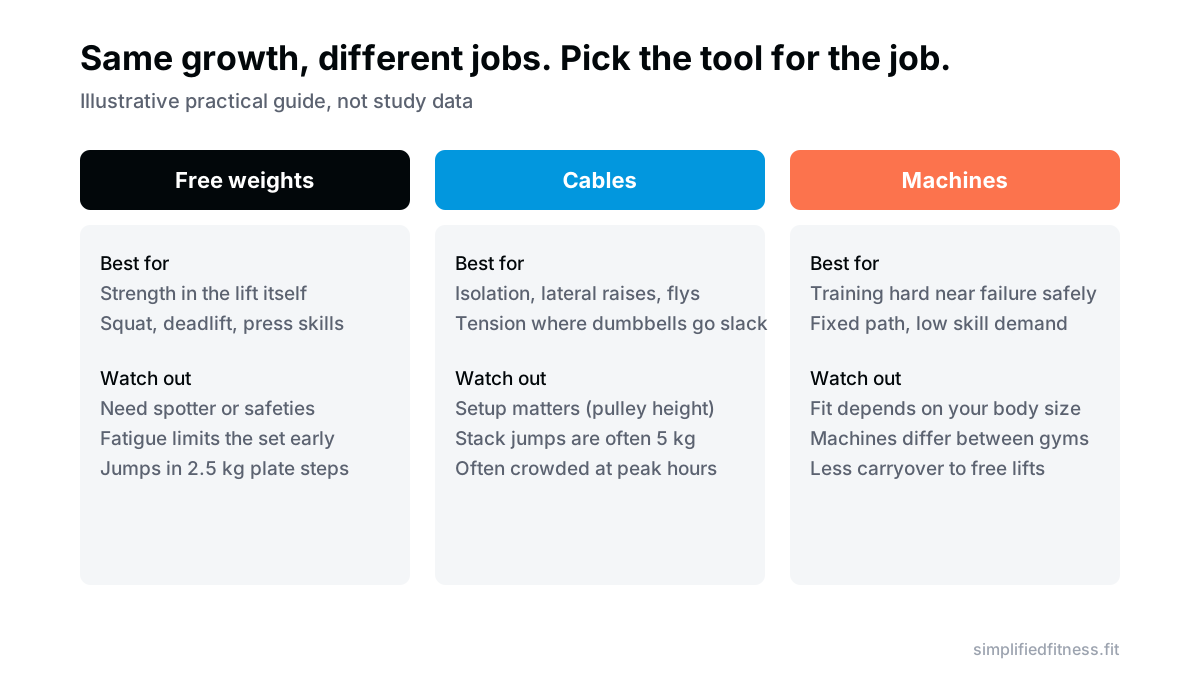
| Factor | Free weights | Cables | Machines |
|---|---|---|---|
| Size (hypertrophy) | Comparable | Comparable (limited direct evidence) | Comparable |
| Strength on that specific lift | Best carryover | Limited data | Best on the machine itself |
| Skill demand | Higher | Moderate | Lower |
| Safety near failure | Needs spotter or safeties | Generally good | Generally good |
| Load jumps | Often 2.5 kg plates | Depends on stack | Depends on stack |
| Setup | Easy | Fiddly | Fit varies by body |
Safety near failure
Free weights ask you to bail out of a failed rep. A heavy barbell squat or bench to failure alone is a bad plan, which is why people stop two or three reps short. A machine lets you chase effort without that overhead.
I am not citing a trial that proves lower injury rates on machines, so treat this as common-sense gym logic. If you are tired, training alone, or working near a joint that is acting up, the fixed path is easier on your nerves.
Microloading
Free-weight progress is often limited by plate sizes. Going from 20 kg dumbbells to 22 kg is a 10% jump. Some cables and machines take add-on weights for smaller increments, and fractional plates exist if your gym has them. Our article on progressive overload on machines vs free weights goes into how to track it.
Machine fit
A machine built for an average body can fit you badly. If a seat cannot be adjusted to your height or the pad lands on a joint instead of a muscle, skip it. That is not a hypertrophy loss, that is a bad tool.
How to mix free weights, cables and machines
You do not need a formula. Here is a simple pattern that follows the evidence above.
- Start with a heavy compound while you are fresh: squat, row, press, or a machine version if that is what you can progress.
- Add a stable machine or cable movement for the same muscle, taken close to failure.
- Finish with isolation on a cable or machine, where the target muscle is the limiting factor.
A sample day, written in plain terms.
- Incline dumbbell press, 3 sets of 6-10
- Machine chest press, 2-3 sets of 8-12, near failure
- Cable lateral raise, 3 sets of 12-15
- Overhead cable triceps extension, 2-3 sets of 10-15
On our free workout plans you will see this pattern applied across a full split. If your gym is crowded and you need alternatives, see equipment shortage substitutions.
Budget and home training
If you train at home on a budget, a pair of adjustable dumbbells, a bench and a resistance band cover a lot of what a gym does for muscle growth. Bands are not cables, but they offer a similar direction-of-pull idea. Do not feel pressure to buy a rack and cable tower to build muscle. Evidence does not require it.
Common mistakes in the equipment debate
Other patterns I see often.
- Machines for the ego, free weights for the ego. Either way, you are choosing for identity, not for the target muscle.
- Sloppy reps on cables. Swinging the stack turns a tension exercise into a momentum exercise.
- Avoiding free weights completely while wanting a bigger squat or bench. The strength specificity finding applies.
- Avoiding machines completely and then getting stuck because a joint complains.
Limits of the evidence
It would be dishonest to stop at “parity” without saying where the data is thin.
- Only 5 of the 13 studies in the main meta-analysis measured hypertrophy.
- Most trials ran 6-10 weeks, mostly in young adults, many untrained. Long-term outcomes in advanced lifters are less certain.
- Few trials compare cables directly, so the cable story rests on mechanism, one biceps study, and practical experience.
- “Machine” covers dozens of designs, from plate-loaded presses to cam-based stacks. Results for one may not carry to another. For how cam shape plays into this, see selectorized machine cam profiles.
If you have a joint injury, ongoing pain, or a medical condition, see a doctor or physiotherapist about which loading is appropriate before adding heavy sets on any equipment.
So which should you choose?
Take the tool you can train hard, progress and repeat for months. If you love barbells, use barbells. If your knees prefer a leg press, use the leg press. If a cable gives you a better feel for your side delts, use that.
Use free weights for the lifts you want to be strong at. Use cables and machines to add volume without the fatigue and risk of another heavy compound. Track your sets and weights, and let the numbers, not tradition, decide if it works.
For a related look at fixed-path barbells, read our piece on the Smith machine vs free barbell, and for choosing exercises by effort versus fatigue, see stimulus-to-fatigue ratio.
Frequently Asked Questions
Are machines as good as free weights for building muscle?
For muscle size, current evidence says yes, roughly. A 2023 meta-analysis of 13 studies found no difference in hypertrophy between free-weight and machine training. Choose whichever lets you train hard and progress for months, and use both if you like variety.
Do free weights build more muscle than cables?
There is no good evidence that they do. Direct cable-versus-free-weight trials are few, and the one we cover here (cable versus barbell preacher curl, 35 young adults, 10 weeks) found similar biceps growth. Use cables where they let you keep tension on the target muscle through the whole rep.
Are cables better than dumbbells for hypertrophy?
Not as a rule. Both load the muscle, and what matters is that the target muscle is challenged close to failure over many weeks. Cables can feel better on lateral raises or flys because tension does not drop off at the start of the rep, but that is a practical advantage, not proven extra growth.
Is a 'free weights only' approach necessary for natural lifters?
No. The evidence does not support the idea that machines are a lesser tool for size. The meta-analysis found strength changes were specific to the equipment used, not that free weights made muscle bigger. If your goal is a heavy squat or bench, practise those lifts; if your goal is size, you have options.
Do free weights recruit more stabiliser muscles, and does that mean more growth?
They demand more balance, but that does not automatically mean more growth in the target muscle. A review of instability training notes that instability can lower the force you produce while keeping muscle activation high, and that lower force may hurt absolute strength gains. For hypertrophy, being stable enough to push the target muscle hard often matters more than adding wobble.
Are machines safer than free weights?
Machines are generally more forgiving near failure because the path is fixed and there is no bar to drop on you, though I am not citing a trial that proves lower injury rates. Free weights are fine when you have safeties or a spotter and sensible loads. If you are training alone near failure on a hard lift, a machine or cable is the lower-risk option.
What about the Smith machine?
It is a fixed-path barbell, so it sits between free weights and machines. We cover it in detail in a separate article. For now, treat it as another valid option rather than a trap.
Do I lose strength if I train on machines?
You may gain less on the specific free lifts you stop practising. The meta-analysis found strength gains were specific to the testing modality, so a squat or bench test favours people who trained the squat or bench. Keep at least a few weeks of practice on any lift you want to test.
How should I split free weights, cables and machines in a program?
A simple pattern is a free-weight or heavy compound first when you are fresh, then machines and cables for the rest. This puts skill and heavy loading early and fatigue-friendly tools later. Adjust to what your gym has and what you enjoy.
Are machines good for beginners?
Yes. A fixed path lowers the skill demand, so a beginner can focus on effort and progression. In a 9-week trial in untrained women, leg press and lunges produced comparable thigh muscle growth, though that study was tiny (8 participants). Add free weights as you get comfortable.
Do I need to train to failure on machines to grow?
Not necessarily. A meta-analysis of 15 studies found no evidence that training to momentary failure beats stopping short, though a trivial advantage appeared when pooling broader definitions of set failure. Take most sets hard, leaving a rep or two in reserve, and save true failure for safe movements.
What if my gym has limited equipment or the machines do not fit me?
Then swap in the free-weight or cable version of the movement. Since hypertrophy does not seem tied to one equipment type, a substitution should not cost you much if effort and progression stay the same. If a machine feels awkward or pinches a joint, move on.
How often should I change exercises or equipment?
Not often. Progression on a movement you can measure beats constant rotation. Change equipment when a movement bothers a joint, the gym is busy, or you have stalled for several weeks.
Sources & References
Every claim above is checked against peer-reviewed research (PubMed, U.S. National Library of Medicine) or guidance from established health bodies. How we fact-check.
- Haugen ME, et al. Effect of free-weight vs. machine-based strength training on maximal strength, hypertrophy and jump performance - a systematic review and meta-analysis. BMC Sports Sci Med Rehabil. 2023. PMID: 37582807
- Amanuma MT, et al. Comparable regional hypertrophy of the knee extensor muscles in response to resistance training with machines versus free weights: a randomized within-subject approach. J Bodyw Mov Ther. 2025. PMID: 41316621
- Schwanbeck SR, et al. Effects of training with free weights versus machines on muscle mass, strength, free testosterone, and free cortisol levels. J Strength Cond Res. 2020. PMID: 32358310
- Hernandez-Belmonte A, et al. Adaptations in athletic performance and muscle architecture are not meaningfully conditioned by training free-weight versus machine-based exercises: challenging a traditional assumption using the velocity-based method. Scand J Med Sci Sports. 2023. PMID: 37340878
- Nunes JP, et al. Placing greater torque at shorter or longer muscle lengths? Effects of cable vs. barbell preacher curl training on muscular strength and hypertrophy in young adults. Int J Environ Res Public Health. 2020. PMID: 32823490
- Behm DG, et al. The role of instability with resistance training. J Strength Cond Res. 2006. PMID: 16937988
- Schoenfeld BJ, et al. Loading recommendations for muscle strength, hypertrophy, and local endurance: a re-examination of the repetition continuum. Sports (Basel). 2021. PMID: 33671664
- Refalo MC, et al. Influence of resistance training proximity-to-failure on skeletal muscle hypertrophy: a systematic review with meta-analysis. Sports Med. 2023. PMID: 36334240

Umair Hazrami · Founder & Head Coach, Simplified Fitness
Umair Hazrami founded Simplified Fitness and the Simplified Lifter channel to cut through fitness noise. With 4+ years of consistent training and 10+ coaching clients, he writes every guide from the peer-reviewed research and links the sources so you can check them. Our editorial standards.
Educational content only, not medical advice. If you have a medical condition, are pregnant, or take medication, talk to a qualified doctor before changing your diet, supplements or training. Full disclaimer.
Keep reading
Exercise Technique
Anthropometry-Based Exercise Selection: Long Limbs, Short Torsos, and Lever Adjustments
Anthropometry exercise selection explained: how long femurs, long arms and a short torso change squats, deadlifts and presses, plus a simple audit and swaps.
9 min read
Exercise Technique
Axial Loading vs Non-Axial Exercises: Managing Spinal Fatigue for Bigger Legs and Back
Axial loading vs non axial exercises explained: how spinal compression limits your weekly volume, and which squat and row swaps spare your lower back.
7 min read
Exercise Technique
Cable Setup Mastery: Pulley Heights, Cable Angles, and Customizing Force Vectors
Cable machine setup guide: how to set pulley height, stance and cable angle for chest, lats, delts and arms, with what the research does and does not show.
9 min read
Exercise Technique
Compound vs Isolation Exercises for Hypertrophy: Do You Need Both?
Compound vs isolation exercises for hypertrophy: what trials say about arms, delts and hamstrings, and which muscles actually need direct sets. Sources linked.
7 min read