Axial Loading vs Non-Axial Exercises: Managing Spinal Fatigue for Bigger Legs and Back
Axial loading vs non axial exercises explained: how spinal compression limits your weekly volume, and which squat and row swaps spare your lower back.
TL;DR. The short answer
- Axial loading means weight that pushes down along your spine, as with a barbell on your back or a heavy deadlift. Non-axial lifts (leg press, hack squat, chest-supported rows) put the load somewhere else.
- A model of loaded half-squats put compression at the lower spine at roughly 6-10 times body weight. Healthy spines tolerate heavy lifting, but trunk fatigue can end a session before your legs or back are done.
- Weekly sets per muscle matter for growth, so if a tired lower back caps your sets, swapping one or two lifts for supported versions can protect volume.
- Supported versions are not identical. In one study the hack squat trained the trunk muscles less than the back squat, and belt squats activated the glutes less.
- Numbness, leg weakness or pain that does not settle is a reason to see a doctor, not to swap exercises.
Part of our complete guide: Exercise Selection Biomechanics: Moment Arms, Strength Curves and Free Weights vs Machines
Table of contents
Axial loading is any resistance that pushes down along the length of your spine, like a barbell on your back or a heavy deadlift. Non-axial exercises put the load through a machine, belt or hips instead. The difference matters less for injury than for fatigue: a tired lower back can end a session before your quads or lats are finished.
This is one piece of the bigger picture in our guide to exercise selection and biomechanics. Here we focus on axial loading vs non axial exercises, and how to swap lifts so your back stops being the limiter.
What is axial loading, exactly?
Picture your spine as a stack of blocks. Axial load is weight stacked on top of it. A back squat does it with the bar on your traps. A conventional deadlift does it with the bar in your hands. Standing overhead presses and loaded carries do it too.
Non-axial exercises still make your trunk work, but the weight does not sit down the spine. Think leg press, leg extension, leg curl, hip thrust, cable work and most machine rows.
How much compression are we talking about?
More than most people expect. A 1985 model of four people doing half-squats with the bar at 0.8 to 1.6 times body weight estimated compression at L3-L4 of 6 to 10 times body weight, and trunk lean affected it the most (Cappozzo et al., 1985). The same model predicted erector spinae forces of 30-50% of their maximum.
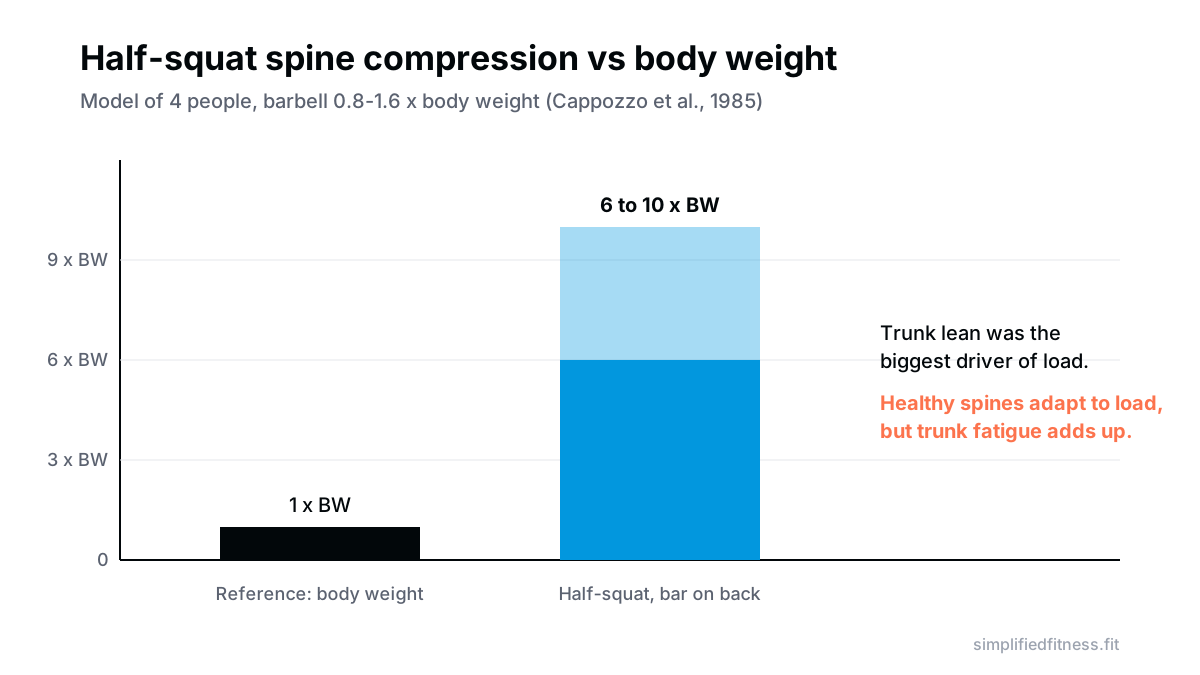
Caveat: that is four people, a model rather than direct measurement, and half-squats rather than your own squat. It gives scale, not a danger threshold.
Is that harmful? Not by default. A 2013 review of 164 articles concluded that deep squats do not carry added injury risk to passive tissues like menisci and ligaments when technique is learned properly and loads progress gradually (Hartmann et al., 2013). The same review describes bone, cartilage and ligaments adapting to progressive training, though it also warned that very heavy half and quarter squats may favour degenerative changes in the knees and spine over the long term. The practical reading: build load gradually and recover from it.
Why does spinal fatigue limit your weekly volume?
The honest mechanism is practical rather than mysterious.
Muscle growth tracks weekly hard sets. A meta-analysis of 15 studies found a graded dose-response: each additional weekly set was associated with a 0.37% greater gain in muscle size (Schoenfeld et al., 2017). Those are average findings across mostly short studies, so treat the per-set number as a rough guide.
Now think about your week. If Monday’s squats and rows leave your lower back sore, Wednesday’s leg day gets shorter, Friday’s back day gets skipped, and your weekly sets drop on muscles that were never the problem. Your quads and lats did not fail. Your trunk did.
That second-order effect (a tired back reducing training for unrelated muscles) is mostly coaching logic rather than a directly tested finding. I have not seen a trial that tracks it. But it matches how most lifters experience it, and it explains why swapping one lift can rescue a week of training. For how fatigue types differ, see central vs peripheral fatigue in lifting.
Back squat swaps: hack squat, belt squat and leg press
Hack squat. The pad supports your back, so your trunk does less. In a study of 10 men, trunk muscle activation was higher in the back squat than the hack squat at the same relative loads, even though the hack squat allowed heavier loads (Clark et al., 2019). That cuts both ways. It is easier on the trunk, but it will not train your trunk as much. For a deeper look, see our hack squat stimulus-to-fatigue breakdown.
Belt squat. The weight hangs from a belt on your hips, so there is no bar on your spine. In 31 participants, belt squats and back squats were compared with muscle sensors on the quads and glutes. Glute activation was lower in the belt squat, and the authors noted belt squats may differ from back squats in glute work (Evans et al., 2019). If you use belt squats, pair them with hip thrusts or split squats for the glutes. Belt squat machines are uncommon in many gyms, so a hack squat or leg press is often the realistic swap.
Leg press. In 12 physically active men, a Smith machine back squat produced more total work than a horizontal leg press, but the fatigue induced within the quadriceps was reported as similar and everything recovered within 24 hours (Kotikangas et al., 2025). Small sample, active men rather than trained lifters, so take it as suggestive only. Leg press setup is covered in leg press foot placement.
Back row swaps: barbell row vs chest-supported row
In a study of 7 healthy men comparing three rows, the standing bent-over row produced large activation across the whole back but also the largest lumbar spine load, and the inverted row had the lowest spine load (Fenwick et al., 2009). The authors noted that lifters wanting to spare the low back may prefer lower-load options, and that higher spine load can suit athletic training goals.
Chest-supported rows were not tested there. The reasoning is that a pad holds your torso, so your erectors do not need to stay braced for the whole set. Treat that as a reasonable inference, not a measured result. We cover execution in chest-supported rows for upper back hypertrophy and the barbell version in bent-over rows and spinal load.
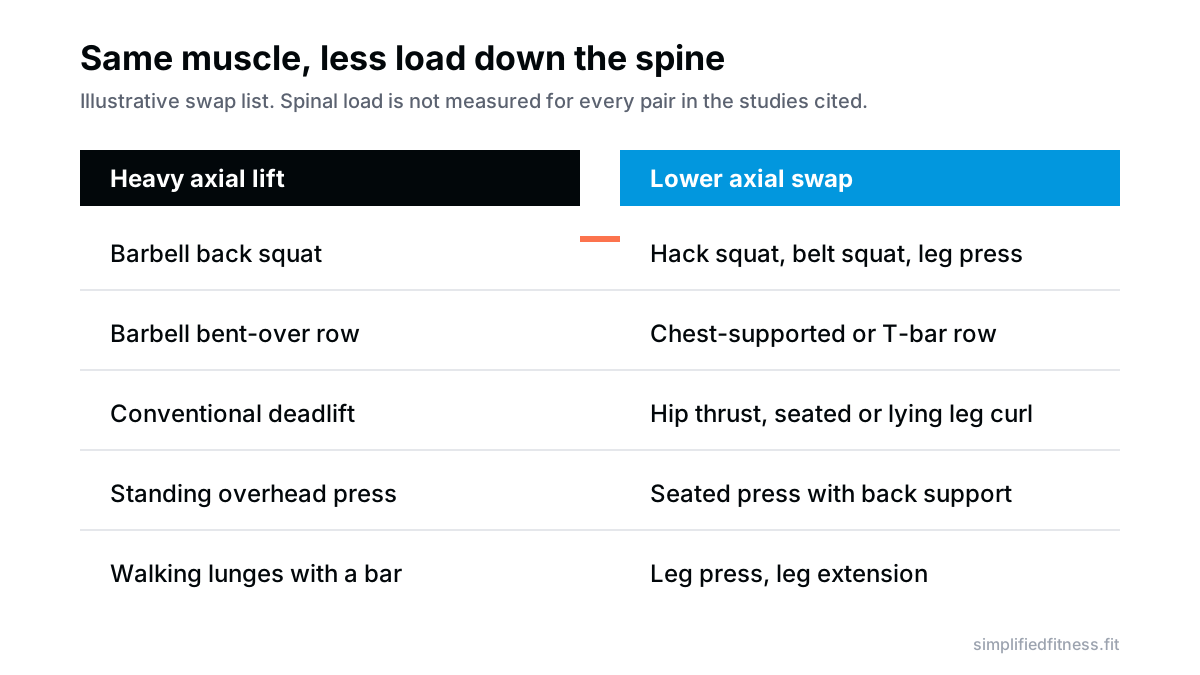
Axial vs non-axial: a quick swap table
| Goal | Axial option | Lower axial option | Trade-off |
|---|---|---|---|
| Quads | Back squat | Hack squat, leg press | Less trunk work (Clark et al.) |
| Quads and glutes | Back squat | Belt squat | Lower glute activation in one study |
| Upper back | Barbell row | Chest-supported or T-bar row | Less lower back demand, less trunk training |
| Hamstrings | Stiff-leg deadlift | Seated or lying leg curl | Different hamstring stretch position |
| Glutes | Deadlift, squat | Hip thrust | Different strength curve |
How to manage spinal fatigue without wrecking your program
Do not delete axial lifts. Rebalance them.
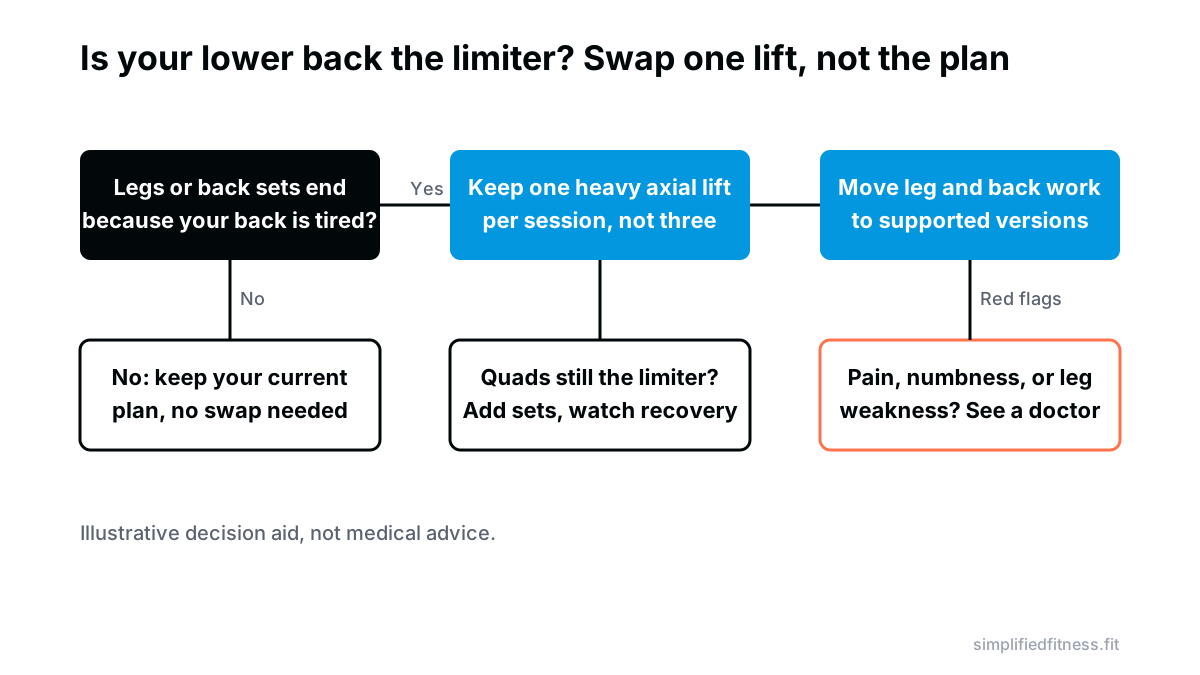
- Keep one heavy axial lift per session at most. Squat or deadlift or heavy rows, not all three.
- Put the first quad slot on whichever lift you can load hard and recover from. Fill the rest of the volume with hack squat, leg press and single-leg extension.
- Move back volume to supported rows. Use the barbell row as a feature lift if you like it, once or twice a week.
- Check the next day. If your lower back is still sore after 48 hours, drop one axial set group next week.
- Keep total weekly sets steady. Our training volume calculator can show you whether the swap kept your weekly sets per muscle intact, and weekly set volume and hypertrophy explains why it matters.
For a sample leg session built on these swaps, see our leg day plan. For selecting exercises by stimulus per unit of fatigue, read stimulus-to-fatigue ratio.
A simple decision flow
Indian gym reality: what you will actually find
Many Indian commercial gyms have a leg press and a leg extension, fewer have a plate-loaded hack squat, and a belt squat is rare. If you train at a budget gym or at home, the practical path is: leg press and single-leg extension for quads, a seated or lying leg curl for hamstrings, and dumbbell or machine rows with chest support if there is a bench. If a back pad does not exist, a bench set at a slight incline with dumbbells does the same job.
When to see a doctor
Muscle tiredness in your lower back that fades within a day or two is normal after heavy sets. See a doctor, and stop heavy loading, if you have pain traveling into a leg, numbness or tingling, leg weakness, changes in bladder or bowel control, pain at night, or pain that is getting worse. This article cannot diagnose anything. For the pain side of this topic, our piece on whether deadlifts are bad for your lower back covers it in more detail.
The bottom line
Axial loading is not the enemy. Heavy squats and rows are effective, and healthy lifters generally tolerate loading that is progressed gradually. The real question is where you spend your fatigue. If your lower back ends sessions before your legs and lats do, swap one lift at a time for a supported version, keep weekly sets steady, and see how you feel 48 hours later.
Frequently Asked Questions
What is axial loading?
Axial loading is resistance that travels down the long axis of your spine, for example a barbell on your upper back or a heavy deadlift. Your spine and trunk muscles have to carry that force while your legs or arms do the moving. In practice, count any lift where your torso must stay braced under weight as axial.
What are non axial leg exercises?
Examples are the leg press, hack squat, belt squat, leg extension, leg curl and hip thrust. They load the legs through a machine, a belt or the hips instead of a bar on your back. Pick one or two of these when your lower back is the limiter, not your legs.
Is axial loading bad for you?
No, axial loading is not harmful by itself for most healthy lifters. A 2013 review concluded deep squats did not raise injury risk to passive tissues when technique was learned well and loads were progressed gradually, and it described tissues such as bone, cartilage and ligaments adapting to training. The issue for most lifters is fatigue and recovery, so manage how much you stack, not whether you do it.
How much compression does a barbell squat put on the lower back?
In one model of four people doing half-squats with 0.8-1.6 times body weight on the bar, compression at L3-L4 was about 6-10 times body weight. Trunk lean influenced it most. That is a small, old sample, so treat it as a rough sense of scale, not a safety limit.
Can I build big legs without back squats?
Yes, most likely. Hypertrophy depends heavily on how many hard sets you do per muscle each week, and machines and free weights show no clear difference in muscle growth in a meta-analysis. Use hack squats, leg presses and single-leg work, taken close to failure, and progress the load over time.
Is the hack squat easier on the back than the back squat?
Usually yes in terms of how much your trunk has to work, because the pad supports your back. In a 10-man study trunk muscle activation was higher in the back squat than the hack squat even though hack squat loads were heavier. Use the hack squat when you want leg volume without taxing your trunk.
Are belt squats the same as back squats?
No. A belt squat hangs the load from your hips, so there is no bar on your spine, but in a 31-person study the glutes were less active than in the back squat. Quadriceps activation did not differ significantly in that test. If glutes are a priority, add hip thrusts or split squats.
Are chest-supported rows better than barbell rows?
They are better when your lower back is the weak link. In a study of three rowing exercises, the standing bent-over row produced the largest lumbar spine load, while the inverted row had the lowest. Chest-supported rows were not in that study, but the logic of taking the lower back out of the movement is similar.
Why does my lower back get tired before my legs do?
Your trunk muscles work isometrically to hold your position under a bar, so they can fatigue before your quads or glutes do. Technique breakdown, long sets and poor bracing add to it. If your back stops the set first, move leg work to a supported exercise.
How does spinal fatigue limit weekly volume?
If your lower back is sore after squats and rows, you may cut or skip sets on other days, and total weekly sets per muscle drops. A meta-analysis found each added weekly set was associated with a small gain in muscle size, about 0.37% per set. Keeping volume steady by swapping exercises can help.
Should I drop deadlifts and squats completely?
Not necessarily. Keep one heavy axial lift per session if you enjoy it and recover well, and put the rest of your volume into supported work. Drop a lift only when it consistently costs you training the next day.
How many axial lifts per week is okay?
There is no research-based number, since it depends on your recovery, sleep, experience and total volume. A reasonable starting point is two heavy axial sessions a week, with other leg and back work supported. Adjust based on how your lower back feels 24-48 hours later.
When should I see a doctor about back pain from lifting?
See a doctor if you have pain that spreads down a leg, numbness, tingling, leg weakness, trouble controlling your bladder or bowels, or pain that wakes you or does not settle. These signs need assessment, not new exercise choices. Ordinary muscle tiredness after heavy sets that fades in a day or two is different.
Sources & References
Every claim above is checked against peer-reviewed research (PubMed, U.S. National Library of Medicine) or guidance from established health bodies. How we fact-check.
- Fenwick CM, et al. Comparison of different rowing exercises: trunk muscle activation and lumbar spine motion, load, and stiffness. J Strength Cond Res. 2009. PMID: 19620925
- Schoenfeld BJ, et al. Dose-response relationship between weekly resistance training volume and increases in muscle mass: A systematic review and meta-analysis. J Sports Sci. 2017. PMID: 27433992
- Cappozzo A, et al. Lumbar spine loading during half-squat exercises. Med Sci Sports Exerc. 1985. PMID: 4068969
- Hartmann H, et al. Analysis of the load on the knee joint and vertebral column with changes in squatting depth and weight load. Sports Med. 2013. PMID: 23821469
- Evans TW, et al. Comparison of muscle activation between back squats and belt squats. J Strength Cond Res. 2019. PMID: 28595237
- Clark DR, et al. Trunk muscle activation in the back and hack squat at the same relative loads. J Strength Cond Res. 2019. PMID: 28704312
- Haugen ME, et al. Effect of free-weight vs. machine-based strength training on maximal strength, hypertrophy and jump performance: a systematic review and meta-analysis. BMC Sports Sci Med Rehabil. 2023. PMID: 37582807
- Kotikangas J, et al. Acute neuromuscular fatigue, hormonal responses, and recovery in males during high-volume resistance exercises: Smith machine back squat vs horizontal leg press. Eur J Appl Physiol. 2025. PMID: 40323412

Umair Hazrami · Founder & Head Coach, Simplified Fitness
Umair Hazrami founded Simplified Fitness and the Simplified Lifter channel to cut through fitness noise. With 4+ years of consistent training and 10+ coaching clients, he writes every guide from the peer-reviewed research and links the sources so you can check them. Our editorial standards.
Educational content only, not medical advice. If you have a medical condition, are pregnant, or take medication, talk to a qualified doctor before changing your diet, supplements or training. Full disclaimer.
Keep reading
Exercise Technique
Anthropometry-Based Exercise Selection: Long Limbs, Short Torsos, and Lever Adjustments
Anthropometry exercise selection explained: how long femurs, long arms and a short torso change squats, deadlifts and presses, plus a simple audit and swaps.
9 min read
Exercise Technique
Cable Setup Mastery: Pulley Heights, Cable Angles, and Customizing Force Vectors
Cable machine setup guide: how to set pulley height, stance and cable angle for chest, lats, delts and arms, with what the research does and does not show.
9 min read
Exercise Technique
Compound vs Isolation Exercises for Hypertrophy: Do You Need Both?
Compound vs isolation exercises for hypertrophy: what trials say about arms, delts and hamstrings, and which muscles actually need direct sets. Sources linked.
7 min read
Exercise Technique
Dumbbell vs Barbell Bench Press for Chest: Which Builds More Pec?
Dumbbell vs barbell bench press hypertrophy: what EMG and strength studies show, why dumbbells may suit your chest and shoulders, and how to use both.
7 min read