Anthropometry-Based Exercise Selection: Long Limbs, Short Torsos, and Lever Adjustments
Anthropometry exercise selection explained: how long femurs, long arms and a short torso change squats, deadlifts and presses, plus a simple audit and swaps.
TL;DR. The short answer
- Anthropometry exercise selection means choosing and adjusting lifts around your limb and torso lengths. Studies show proportions are linked to performance in some lifts, but the effects are modest and based on small samples.
- Long femurs and short torsos tend to make a barbell back squat or conventional deadlift feel awkward, because the torso has to lean further forward to keep the bar balanced. A wider stance, a hack squat or leg press, a sumo or Romanian deadlift often feel better.
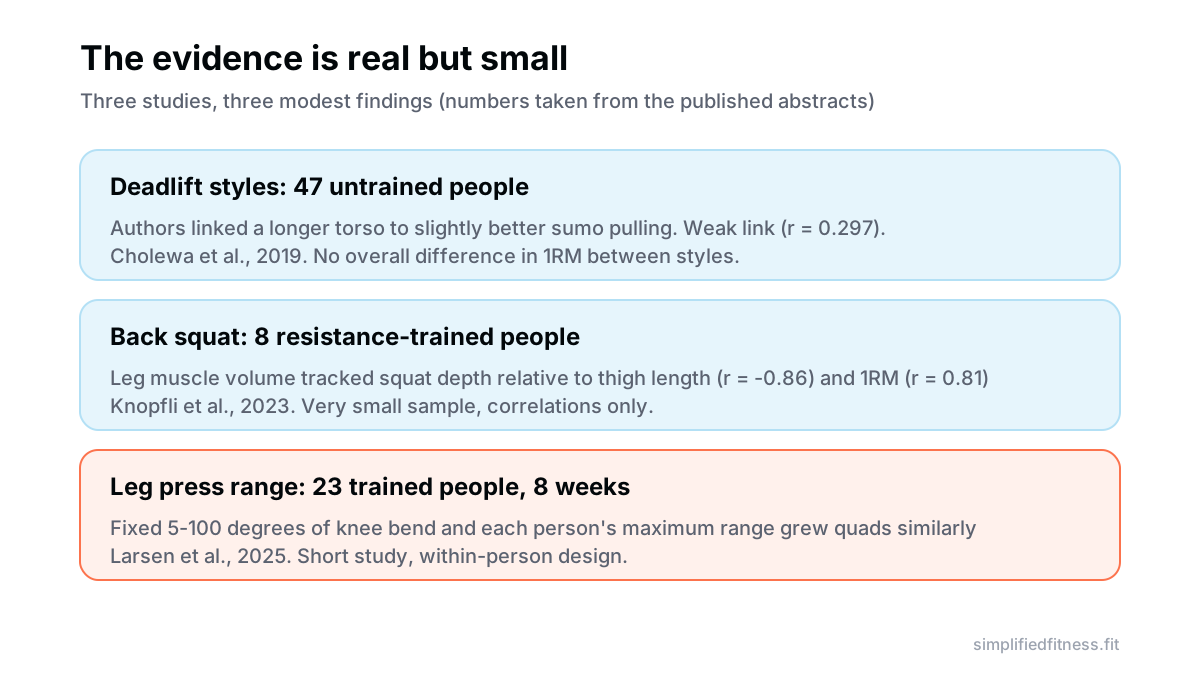
- In a 47-person study of untrained people, the authors concluded sumo may suit longer torsos and conventional shorter torsos, but the link was weak (r = 0.297) and 1RM did not differ significantly between styles.
- Awkward does not mean defective. If an exercise hurts or stalls you, change stance, grip or range first, then swap to a lift that loads the same muscle with a friendlier lever.
- Persistent joint pain, numbness or a sharp pinch is not an anthropometry problem. See a doctor or physiotherapist.
Part of our complete guide: Exercise Selection Biomechanics: Moment Arms, Strength Curves and Free Weights vs Machines
Table of contents
If standard barbell lifts feel awkward and you are tall, long-limbed or both, your body is probably not the problem. Anthropometry exercise selection is the habit of choosing and adjusting lifts around your own limb and torso lengths, and for many people it turns “I am bad at squats” into “I was using a setup that did not fit.”
This article is the personal-audit companion to our exercise selection and biomechanics guide. Here we cover upper and lower body together. For the squat-depth side in detail, see adapting range of motion for femur length.
One honest note before we start. The research on body proportions and lifting is thin. Most studies are small, many use untrained people, and few test whether swapping exercises actually produces better muscle growth. I will say where the evidence stops and where I am reasoning from mechanics.
What does anthropometry mean for lifting?
Anthropometry is just measurement of the body: femur length, torso length, arm length, shoulder width. In the gym it matters because the lever you load changes with those lengths. A longer thigh puts the bar further from the hip when you fold forward. A longer arm means the bar travels further on a bench press.
Same exercise, same weight, different job for different bodies.
Two things are worth keeping apart:
- Fixed: bone lengths, and to a degree joint structure.
- Trainable: mobility, technique, muscle size, and how practised a movement feels.
That split is useful. You cannot change your femurs. You can change your stance, grip, range and exercise list.
What does the research actually show?
Let’s go through the studies I could verify, with their limits.
Deadlift styles. Researchers measured arm, hand, thigh, lower leg and seated height in 47 deadlift-naive people (28 men, 19 women), then tested 1RM in sumo and conventional styles. There was no significant difference in 1RM between styles overall. The one significant link was between the sitting height to total height ratio and the sumo-to-conventional strength ratio (r = 0.297). The authors suggested sumo may be slightly advantageous for people with longer torsos and conventional for shorter torsos (Cholewa et al., 2019). A correlation of 0.297 is weak, these were untrained subjects, and the abstract calls the relationship inverse while reporting a positive r, so even the direction deserves some caution.
Squat. In eight resistance-trained people, summed quadriceps and hamstring volume correlated with squat depth normalised to thigh length (r = -0.86), and leg size correlated with 1RM (r = 0.81) (Knopfli et al., 2023). Eight people is a pilot, not proof. The gentle practical message is that having muscle to push with matters, and a study this small says little about limb length itself.
Bench press. In 36 men, total arm length was moderately associated with 1RM and with performance at the lightest submaximal load, while body mass had strong links with 1RM and force measures. Biacromial (shoulder) width was inversely related to repetitions at the two lighter loads (Caruso et al., 2012). Body size beat limb length as a predictor.
Elite powerlifters. Among 63 male powerlifters at a national tournament, winners had more muscle mass relative to height and a higher muscle-to-bone ratio than non-winners. The authors summarised segment lengths as similar, although winners also had a higher crural index, meaning a longer shin relative to the thigh (Lovera & Keogh, 2015). So proportions were not irrelevant, but muscle mass was the clearest difference.
Why do squats feel awkward with long femurs?
The bar has to stay roughly over the middle of your foot. If your thighs are long compared with your torso, the only way to do that at the bottom is to lean your chest forward. More lean shifts effort toward your hips and lower back and away from your quads, so the squat can feel like a bad good morning.
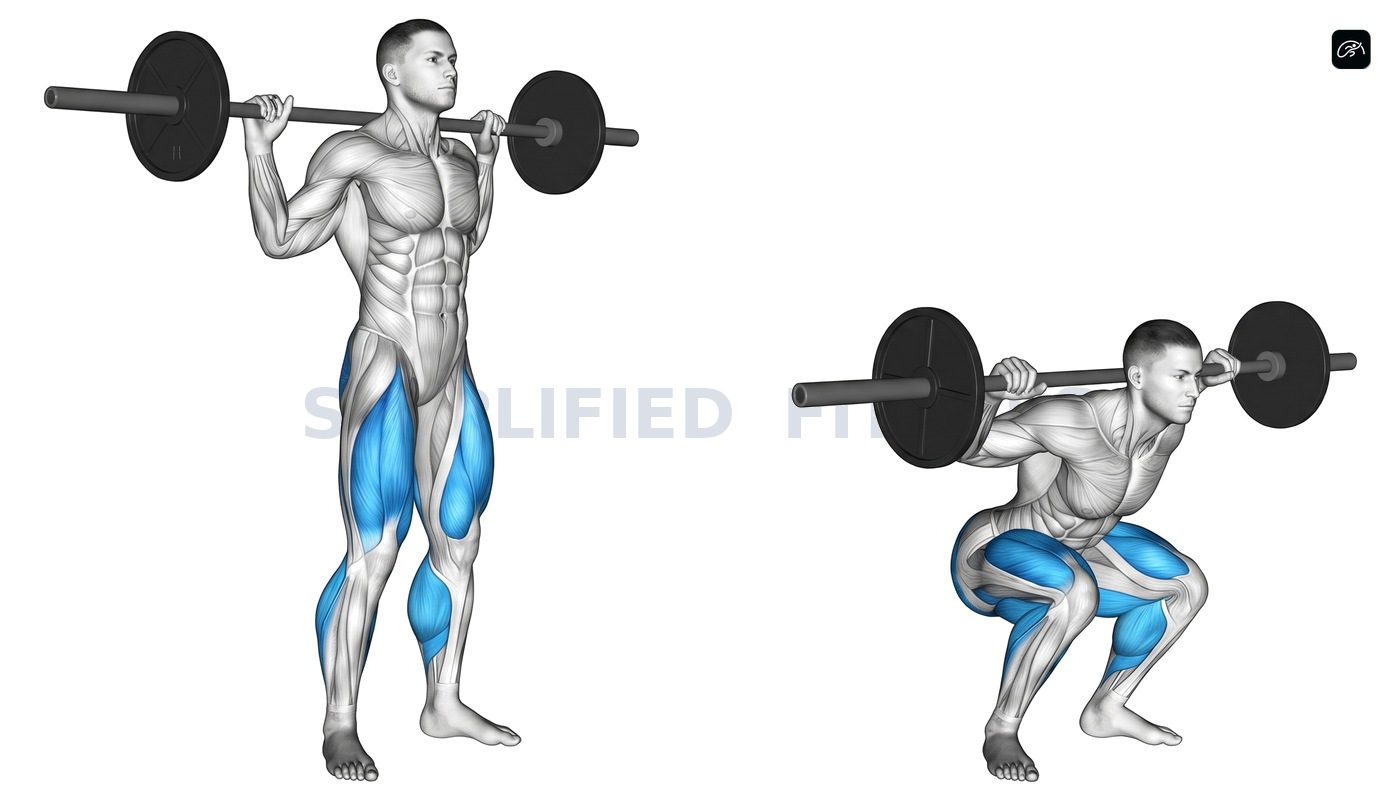
What I would try, in this order:
- Widen your stance a bit and turn your toes out. This changes how far your knees and hips travel.
- Slightly raise your heels with small plates or lifting shoes if your ankles limit you.
- Control the depth. Stop where your pelvis starts to tuck under (people call it butt wink).
- Swap to a supported variation if the barbell still limits you.
That last option is where machines shine. A hack squat or leg press holds your torso against a pad, so your back is not the weak link, and you can load the quads hard. Our guides on hack squats and leg press foot placement go into setup. For stance details, see stance width and foot placement.
On depth, you do not need to chase a range your body fights. In an 8-week study of 23 trained people, one leg trained leg press at roughly 5-100 degrees of knee flexion and the other at each person’s maximum range (about 5-154 degrees). Quadriceps growth was similar, and the authors concluded both ranges worked over this short period (Larsen et al., 2025).
A systematic review of range of motion studies suggests the stretched position matters, and that training at long muscle lengths, through full or partial range, tends to favour growth in muscles such as the quads, biceps and triceps (Kassiano et al., 2023). Put the two together: aim for a range that loads the stretched position, and do not obsess over hitting a specific depth number.
What about deadlifts with a short torso?
A short torso with long legs means your hips start higher or further back, and the pull can feel like a stiff-legged lift with the bar far away. Many people in that position feel the lift in the lower back first.
The 2000 biomechanical analysis of 12 sumo and 12 conventional lifters at a national championship found sumo lifters used a much wider stance (70 cm versus 32 cm on average), a more upright trunk (5-10 degrees), and moved the bar a shorter vertical distance than conventional lifters (Escamilla et al., 2000). These were competitive lifters, so the data describe technique differences, not who benefits from which.
Combined with the Cholewa study above, a rough practical reading:
- Longer torso, shorter legs: sumo may feel smoother, but the effect is small.
- Shorter torso, longer legs: conventional may fit slightly better, but the Romanian deadlift or trap-bar variations can be friendlier if the floor pull bothers your back.
Try both styles for a few sessions. If you want to go deeper into the choice, our conventional versus sumo deadlift piece covers setup, and Romanian deadlifts cover the hinge pattern.
How do long arms change pressing and rowing?
Long arms mean the bar moves further on a bench press, and the bottom position can pull your shoulders into a deep stretch. Some people love that. Others feel it in the front of the shoulder.
Based on the Caruso data, arm length is one factor, but body mass and shoulder width also showed relationships. I would not use that study to claim long arms are a disadvantage. It does not say that.
What helps in practice:
- Adjust grip width. A slightly narrower grip can shorten the path and reduce shoulder strain. See bench press grip width.
- Use dumbbells or a neutral-grip press. Hands can follow a natural arc rather than a fixed bar path. Compare angles in our incline dumbbell bench press guide.
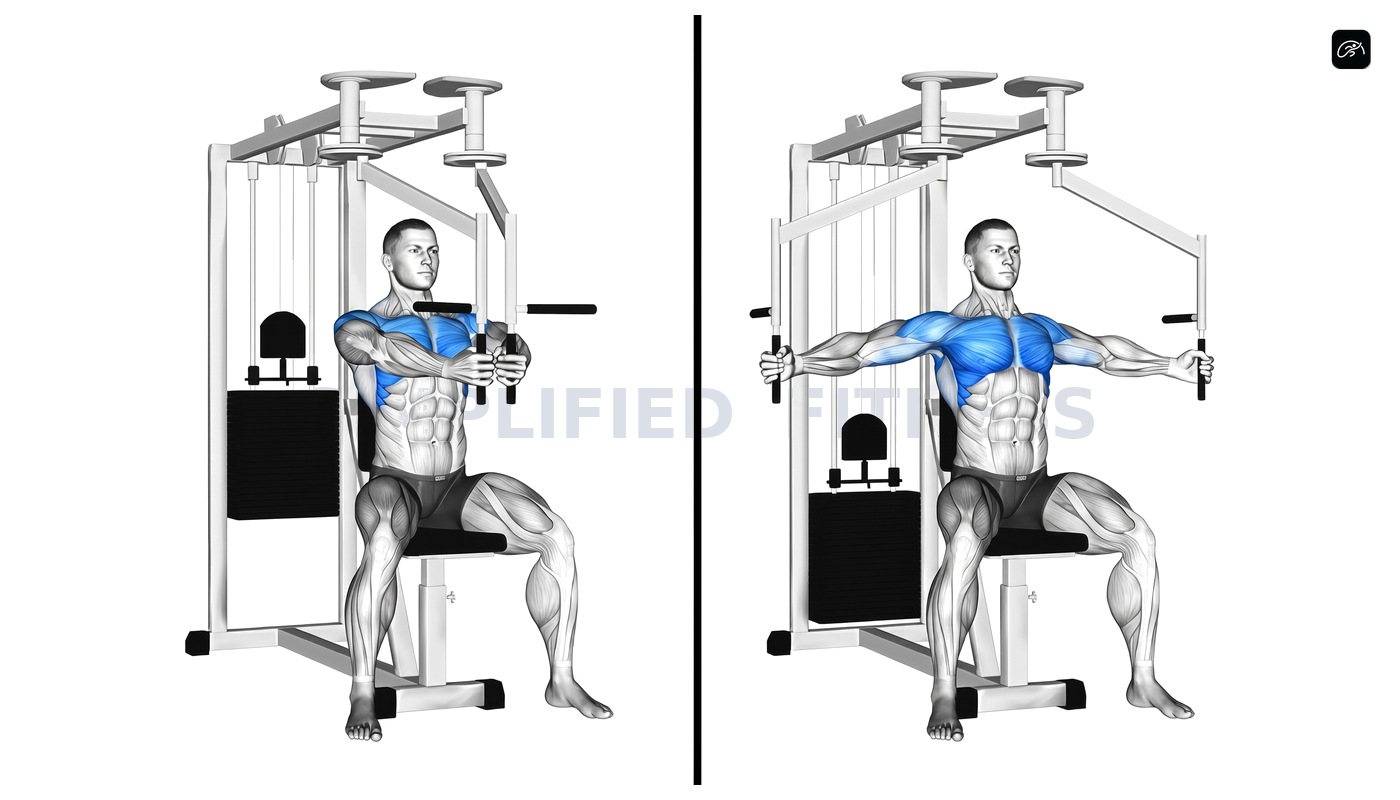
- Add a machine fly for the stretch. A pec deck lets you train the chest through its lengthened position with the shoulder supported.
For rows, long arms mean a longer pull, and a barbell can bump your thighs or knees before your shoulder blades fully reach forward at the bottom. Dumbbells give your arms room to hang. A chest-supported row takes away the need to hold your torso position and lets you focus on pulling.
On the stretched position in upper body work, a 2025 trial of 30 trained participants compared lengthened partial reps with full range over 8 weeks and found similar elbow flexor and extensor growth; the authors suggested emphasising the stretched position, using full range or lengthened partials (Wolf et al., 2025). So if a very deep bench bottom is uncomfortable, you do not have to give up the stretch entirely. Short of pain, use the longest range you can control.
How do I audit my own proportions?
You do not need calipers. You need a phone and an honest eye.
- Film a bodyweight or light squat from the side. Note where your hips sit and how far your chest leans.
- Film a light deadlift from the side. Check whether your hips rise before the bar moves.
- Film a bench set from the front. Check elbow flare and where the bar touches your chest.
- Log what feels limiting. Is it your back, your hips, your shoulders, or just balance?
- Change one thing at a time for three to four weeks: stance, grip, range or exercise.
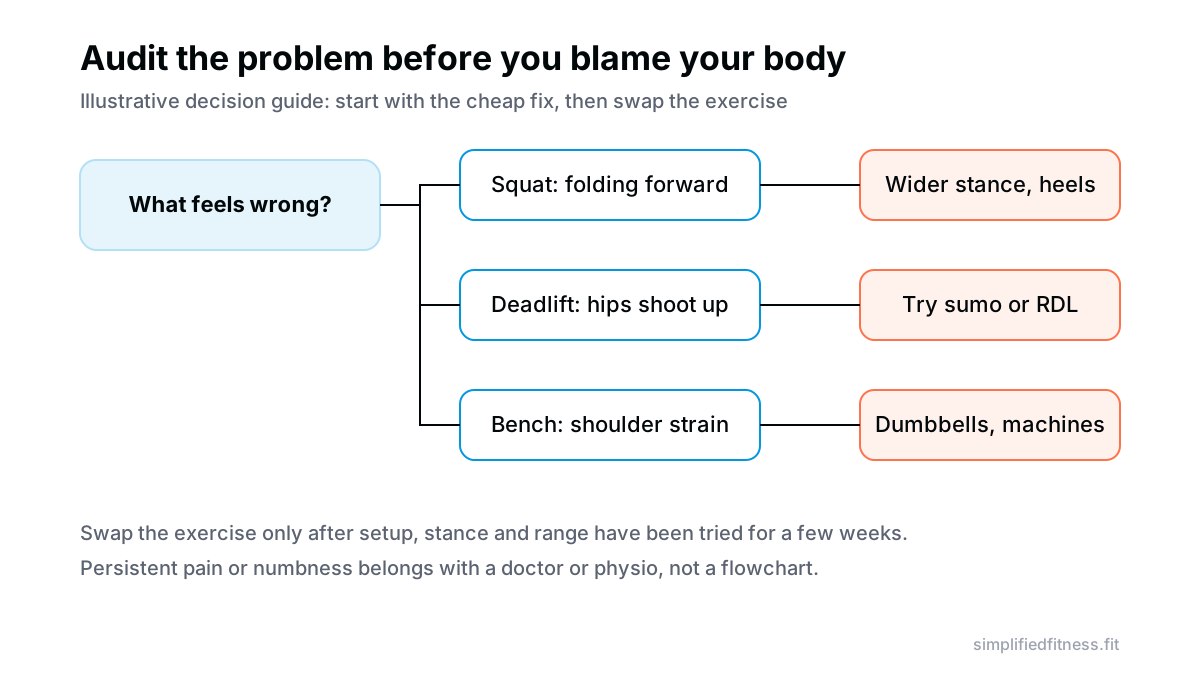
The aim is a lift that lets you train hard, close to failure, with a stable position and no pain. If a setup lets you do that, it is good enough, even if it does not match the photo in a textbook.
Which exercises should long-limbed lifters try?
Here is a starting map. It comes from mechanics and practical coaching logic, not from head-to-head trials.
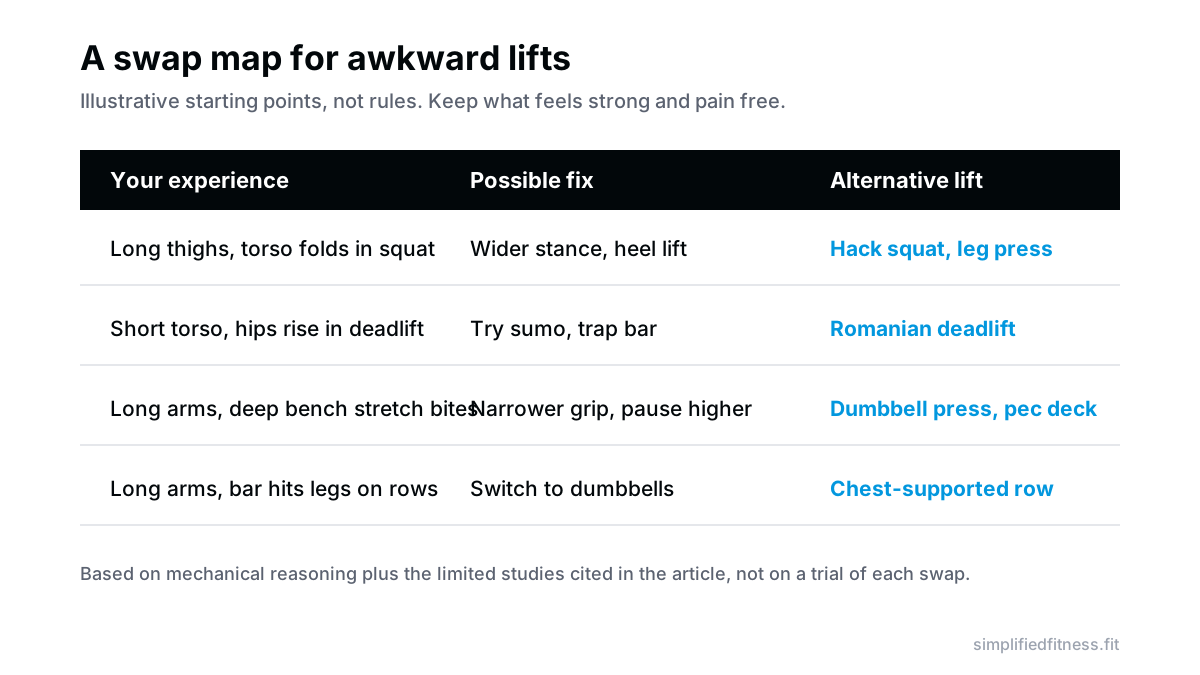
| Problem | First fix | Alternative |
|---|---|---|
| Long thighs, torso folds in squat | Wider stance, heel lift | Hack squat, leg press |
| Short torso, hips rise in deadlift | Try sumo or trap bar | Romanian deadlift |
| Long arms, shoulder strain on bench | Narrower grip, controlled depth | Dumbbell press, pec deck |
| Long arms, barbell bumps legs on rows | Switch to dumbbells | Chest-supported row |
If you have a limited budget or a crowded gym in India, you can often get the same result with what is available: a leg press instead of a hack squat, dumbbells instead of a barbell, a cable row with a chest pad in place of a bent-over row. See gym equipment shortages and substitutions for more.
For a ready-made split that already uses several of these friendlier options, check our leg day plan.
Common mistakes with body-proportion advice
- Treating a correlation as a rule. A correlation of 0.3 or so means many people will not follow the pattern.
- Ditching a lift too early. New stances feel odd for a few weeks. Give them time.
- Chasing a “perfect” picture. Strong lifters come in many shapes, and in the powerlifting data above muscle mass separated winners far more clearly than limb lengths did.
- Ignoring pain. If a lift causes sharp or lingering pain, mechanics tweaks are not enough.
When to see a doctor
Anthropometry explains awkward lever lengths, not injuries. See a doctor or physiotherapist if you notice sharp or persistent joint pain, numbness or tingling, pain that wakes you at night, or soreness that does not settle after a couple of weeks of changing the exercise. Do not self-diagnose from a video.
The practical takeaway
- Fixed bone lengths shape lever lengths, but studies show only modest links to performance, and most are small.
- Adjust stance, grip and range first. Then swap to a supported or friendlier exercise.
- Pick the lift that lets you train hard, stay stable and progress, whatever your proportions are.
- Track your progress with a simple log, and use our 1RM calculator to compare variations once you have a few weeks of data.
Frequently Asked Questions
What is anthropometry in weightlifting?
Anthropometry is the measurement of body proportions such as femur length, arm length, torso length and shoulder width. In lifting, it describes how those lengths change the leverage and range of motion of each exercise. Measure your own proportions loosely, by feel and by video, and use them to adjust setups rather than to rule out lifts.
What are the best exercises for long femurs?
Hack squats, leg presses and wider-stance squats often feel more comfortable with long thighs because the machine or stance supports your torso. There are no trials that prove one is superior for long femurs, so this is based on how the mechanics work. Try two or three variations for a few weeks each and keep the one that lets you train close to failure with a stable position.
Why do squats feel so hard with long legs?
Long thighs relative to your torso usually mean your torso leans further forward to keep the bar over your midfoot. That shifts more work toward the hips and lower back, so the lift can feel like a good morning. A wider stance, slightly elevated heels or a front-loaded variation can reduce the lean, so test them before dropping the squat.
Is a short torso better for conventional deadlifts?
A 2019 study of 47 untrained people concluded that conventional pulling may suit shorter torsos (relative to height) slightly better and sumo longer torsos. The correlation was weak and there was no significant overall strength difference between styles. Try both styles for several sessions and choose the one you can pull with a flat back and consistent bar path.
Do long arms make bench press harder?
Longer arms usually mean a longer bar path, so the same load is lifted over a bigger distance. A 2012 study in 36 men found total arm length was moderately associated with 1RM and with performance at the lightest submaximal load. Hedge your expectations, since body mass was a stronger predictor, and treat arm length as one factor among several.
Are dumbbells better than a barbell for long arms?
Dumbbells let your hands travel on a path that suits your shoulders, which many long-armed lifters find more comfortable than a fixed bar. No study has shown dumbbell pressing to be superior for long arms. If the barbell bothers your shoulders, try neutral-grip or angled dumbbell presses and see if the discomfort settles.
Do I need to squat to full depth if I have long femurs?
Not necessarily. In an 8-week study of 23 trained people, leg press at about 5-100 degrees of knee flexion built quads about as well as each person's maximum range. Use a depth you can control without your pelvis tucking under, and increase range gradually as your mobility allows.
Can I change my proportions with training?
No. Bone lengths are fixed in adults, so you adapt the exercise to the body rather than the reverse. Mobility, technique and muscle size can all change, which is why a lift that feels bad today can feel fine after a few months of practice.
Is the sumo deadlift cheating?
No, it is a different technique. A 2000 analysis of championship lifters found sumo lifters use a wider stance and a more upright trunk than conventional lifters, and the bar travels a shorter vertical distance. If you are training for muscle, either is fine; choose based on comfort and how much hamstring and back work you want.
How do I know if my torso is short or my legs are long?
Compare how you look in a squat video from the side. If your hips sit well behind your heels at the bottom and your chest tilts well forward, your thighs are probably long relative to your torso, though tight ankles and stance width also play a part. Anthropometric measurement is more exact, but for training purposes a video is enough to guide setup changes.
Should tall lifters avoid barbell exercises?
No. Plenty of tall lifters squat, bench and deadlift well. A 2015 study of 63 male powerlifters found winners mainly stood out for more muscle mass relative to height; most segment lengths were similar to non-winners, although winners did have a higher crural index (shin length relative to thigh length). Pick lifts you can progress, and use machines or dumbbells where a barbell is a poor fit.
When should I see a doctor about pain from lifting?
See a doctor if you have sharp or persistent joint pain, numbness, tingling, pain at night, or pain that does not settle within a couple of weeks of changing the exercise. Mechanics changes help with awkwardness, not with injuries. A physiotherapist can assess what is happening rather than guessing from a video.
How long should I try a new setup before switching exercises?
Give each change about three to four weeks of consistent practice, unless it hurts. New stances feel odd at first because the movement pattern is unfamiliar rather than because it is wrong. Track reps, load and how stable the lift feels, then keep the variation that improves those numbers.
Sources & References
Every claim above is checked against peer-reviewed research (PubMed, U.S. National Library of Medicine) or guidance from established health bodies. How we fact-check.
- Cholewa JM, et al. Anthropometrical Determinants of Deadlift Variant Performance. J Sports Sci Med. 2019. PMID: 31427866
- Knopfli C, et al. First Insights in the Relationship between Lower Limb Anatomy and Back Squat Performance in Resistance-Trained Males and Females. Bioengineering (Basel). 2023. PMID: 37508892
- Caruso JF, et al. Anthropometry as a predictor of bench press performance done at different loads. J Strength Cond Res. 2012. PMID: 22027858
- Lovera M, et al. Anthropometric profile of powerlifters: differences as a function of bodyweight class and competitive success. J Sports Med Phys Fitness. 2015. PMID: 25611080
- Escamilla RF, et al. A three-dimensional biomechanical analysis of sumo and conventional style deadlifts. Med Sci Sports Exerc. 2000. PMID: 10912892
- Kassiano W, et al. Which ROMs Lead to Rome? A Systematic Review of the Effects of Range of Motion on Muscle Hypertrophy. J Strength Cond Res. 2023. PMID: 36662126
- Larsen S, et al. Knee flexion range of motion does not influence muscle hypertrophy of the quadriceps femoris during leg press training in resistance-trained individuals. J Sports Sci. 2025. PMID: 40113586
- Wolf M, et al. Lengthened partial repetitions elicit similar muscular adaptations as full range of motion repetitions during resistance training in trained individuals. PeerJ. 2025. PMID: 39959841

Umair Hazrami · Founder & Head Coach, Simplified Fitness
Umair Hazrami founded Simplified Fitness and the Simplified Lifter channel to cut through fitness noise. With 4+ years of consistent training and 10+ coaching clients, he writes every guide from the peer-reviewed research and links the sources so you can check them. Our editorial standards.
Educational content only, not medical advice. If you have a medical condition, are pregnant, or take medication, talk to a qualified doctor before changing your diet, supplements or training. Full disclaimer.
Keep reading
Exercise Technique
Axial Loading vs Non-Axial Exercises: Managing Spinal Fatigue for Bigger Legs and Back
Axial loading vs non axial exercises explained: how spinal compression limits your weekly volume, and which squat and row swaps spare your lower back.
7 min read
Exercise Technique
Cable Setup Mastery: Pulley Heights, Cable Angles, and Customizing Force Vectors
Cable machine setup guide: how to set pulley height, stance and cable angle for chest, lats, delts and arms, with what the research does and does not show.
9 min read
Exercise Technique
Compound vs Isolation Exercises for Hypertrophy: Do You Need Both?
Compound vs isolation exercises for hypertrophy: what trials say about arms, delts and hamstrings, and which muscles actually need direct sets. Sources linked.
7 min read
Exercise Technique
Dumbbell vs Barbell Bench Press for Chest: Which Builds More Pec?
Dumbbell vs barbell bench press hypertrophy: what EMG and strength studies show, why dumbbells may suit your chest and shoulders, and how to use both.
7 min read