Grip Width and Wrist Orientation: What Your Hands Really Change
Grip width lifting biomechanics explained: what wide, narrow, pronated, supinated and neutral grips change in bench, pulldown and curl EMG, and how to pick one.

TL;DR. The short answer
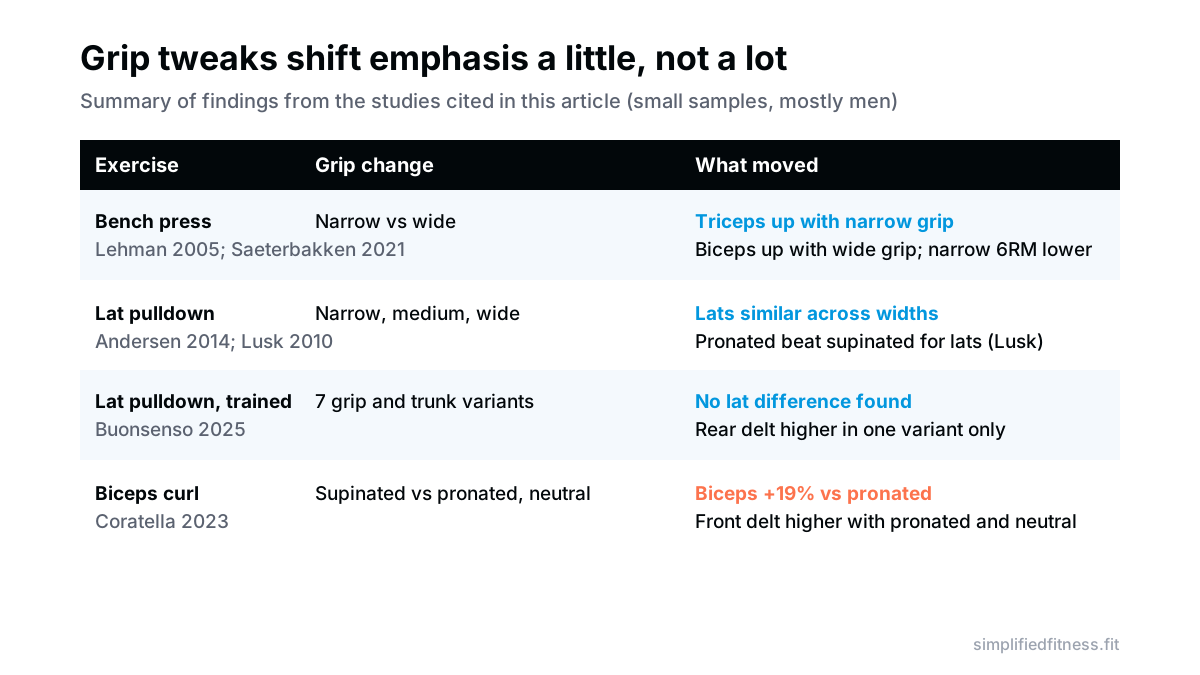
- Grip width and wrist orientation change which muscles help most, but the shifts in EMG studies are modest. On the lat pulldown, lat activity was similar across narrow, medium and wide grips in 15 men.
- On the bench press, narrower grips raise triceps involvement and wider grips raise biceps and reduce triceps involvement. A narrow grip also lowered the 6-rep max load in 28 men.
- In the biceps curl, a supinated grip gave about 19% more biceps excitation than pronated and 12% more than neutral in 10 bodybuilders.
- Joint comfort is the best reason to change grip. If a grip hurts your shoulder, elbow or wrist, change width or wrist angle and lower the load, and see a clinician if pain persists.
- Most evidence is acute EMG in small groups of men, not long-term growth trials, so treat grip as a fine-tuning tool, not a growth hack.
Part of our complete guide: Exercise Selection Biomechanics: Moment Arms, Strength Curves and Free Weights vs Machines
Table of contents
Grip width lifting biomechanics comes down to one honest answer: your hands change the exercise a little, not completely. Wider or narrower grips and pronated, supinated or neutral wrists shift how much your triceps, biceps and shoulders help, and they change how the joints feel under load. They rarely turn a lat exercise into a different muscle’s exercise.
This page is part of our exercise selection and biomechanics guide, and it covers the general grip principles you can apply to every pressing, pulling and curling movement. For the exercise-specific versions, see bench press grip width and wide vs close vs neutral lat pulldowns.
Why does your grip change the exercise at all?
Three things change when your hands move: the path your elbows travel, the length of the lever between the load and each joint, and which small muscles have to stabilise the forearm. If you want the physics behind levers, our piece on moment arms and joint torque covers it.
Here is the plain version. On a bench press, a wider grip moves the bar further from your shoulders in the horizontal plane, which changes the torque there. In a study of recreationally trained men, wide and medium grips produced larger horizontal shoulder moments than a narrow grip at the sticking region (Larsen et al., 2020). A narrow grip moves the work toward the elbow and triceps instead.
In powerlifters, the sticking region did not appear at the same joint angles across narrow, medium and wide grips, which the authors linked to different bar-to-elbow moment arms (Gomo & Van Den Tillaar, 2016).
Wide vs close grip bench press: what do the studies show?
Two EMG studies point the same way. In 12 healthy men holding isometric bench positions, moving from wide to narrow grip raised triceps activity and lowered activity in the sternoclavicular portion of the pectoralis major. A supinated grip raised biceps and clavicular pec activity, and the authors noted the changes were small (Lehman, 2005).
In 28 men (novice and resistance-trained) lifting 6-rep maximum loads, biceps activity rose as grip widened, while the wide grip showed less triceps activity than medium and narrow. The narrow grip also gave lower 6-RM loads than the others (Saeterbakken et al., 2021).
Add the 1-RM data from recreationally trained men: about 109.8 kg with wide, 108.9 kg with medium and 103.7 kg with narrow. The wide grip also produced lateral barbell forces of roughly 13-16% of vertical force (Larsen et al., 2020).
What this means in practice:
- Want heavier loads? A medium grip is a reasonable default.
- Want more triceps work from a press? A narrower grip gives more, and our guide to the close-grip bench press covers wrist spacing.
- Want chest growth? Do not expect grip alone to decide it. Angle, range and weekly volume matter more.
Does wide grip build wider lats? What the pulldown data says
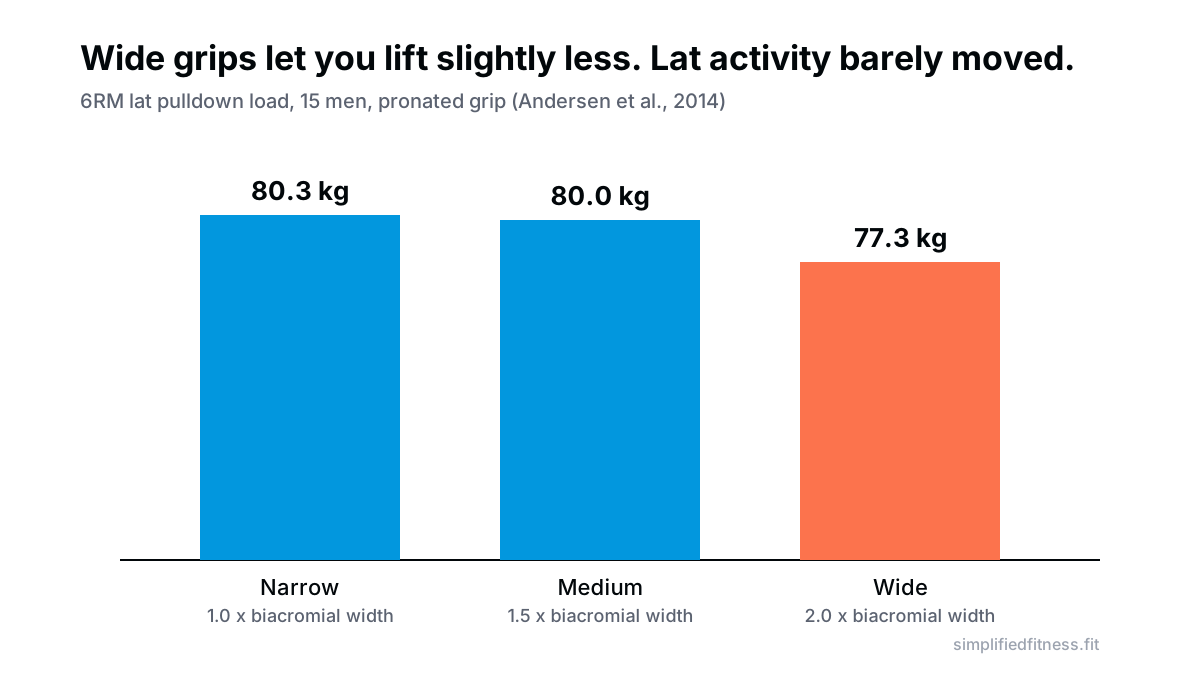
This is the gym belief with the least support. A common claim is that a wider grip hits the lats harder. Andersen et al. noted this was a general belief without broad scientific support, then tested it. Fifteen men did 6-RM pulldowns at 1, 1.5 and 2 times their biacromial distance. The 6-RM was higher with narrow (80.3 kg) and medium (80 kg) grips than with wide (77.3 kg). Lat, trapezius and infraspinatus activity was similar overall, with a small advantage for medium grip in biceps activity during the lifting phase (Andersen et al., 2014).
A different design found something different. In 12 men, a pronated grip gave more lat activity than a supinated grip, regardless of whether the grip was at carrying width or biacromial width (Lusk et al., 2010). Why might the results differ? Lusk compared forearm orientation, Andersen compared width within one orientation, and both used small male samples with different loads and cadence.
The newest study in trained lifters, 40 men with at least 5 years of experience, tested seven variants differing in grip type, width and trunk inclination. No significant lat difference appeared. Only the posterior deltoid differed, in a wide pronated grip with 30 degrees of trunk lean (Buonsenso et al., 2025). The authors concluded grip variations may not significantly change lat recruitment.
A cautious takeaway: pick a grip around 1-2 times your shoulder width, use the grip that lets you pull your elbows down without shrugging, and judge it by progress. Your own pull-day plan matters more; see our pull day template.
Pronated vs supinated grip curls: which hits biceps more?
Here the evidence is clearer, though it is one small study. Ten competitive bodybuilders did bilateral curls with 8-RM loads in supinated, pronated and neutral positions. In the lifting phase, biceps excitation was higher with supinated than pronated (+19%) or neutral (+12%). The brachioradialis was also higher with supinated, by about 5-6%. The anterior deltoid worked more with pronated and neutral grips (Coratella et al., 2023).
That fits the idea that the biceps both bends the elbow and turns the palm up, so a supinated grip lets it work with less help. I would treat that as the mechanism that makes sense rather than something this study proved.
Practical use:
- Supinated curls as your main biceps curl.
- Neutral curls when your wrists or elbows prefer them. Note that in this study neutral did not raise brachioradialis excitation over supinated.
- Pronated curls occasionally, knowing the front delt works a little harder and the biceps does less.
For bar choices and wrist angle, see our article on barbell vs EZ-bar curls.
Which grip is safest for wrists, elbows and shoulders?
This is the part where I want to be careful. The studies above measured muscle activity and load, not injury. None of them tested whether one grip prevents or causes shoulder, elbow or wrist problems. Anything stronger than “this may be more comfortable for some people” goes beyond the evidence.
What coaching experience and basic mechanics suggest, held loosely:
- If a wide grip pinches the front of your shoulder, narrow it slightly or change the angle, as covered in our guide to subacromial shoulder impingement lifting solutions.
- If a straight bar bothers your elbows or wrists, try a neutral or angled handle.
- Keep the bar over the forearm bones with the wrist reasonably straight so the load goes through the forearm, not through a bent wrist.
If pain lasts more than a couple of weeks, wakes you at night, causes numbness or tingling, or follows a clear injury, see a doctor or physiotherapist. Do not try to grip your way through it.
How should you choose your grip?
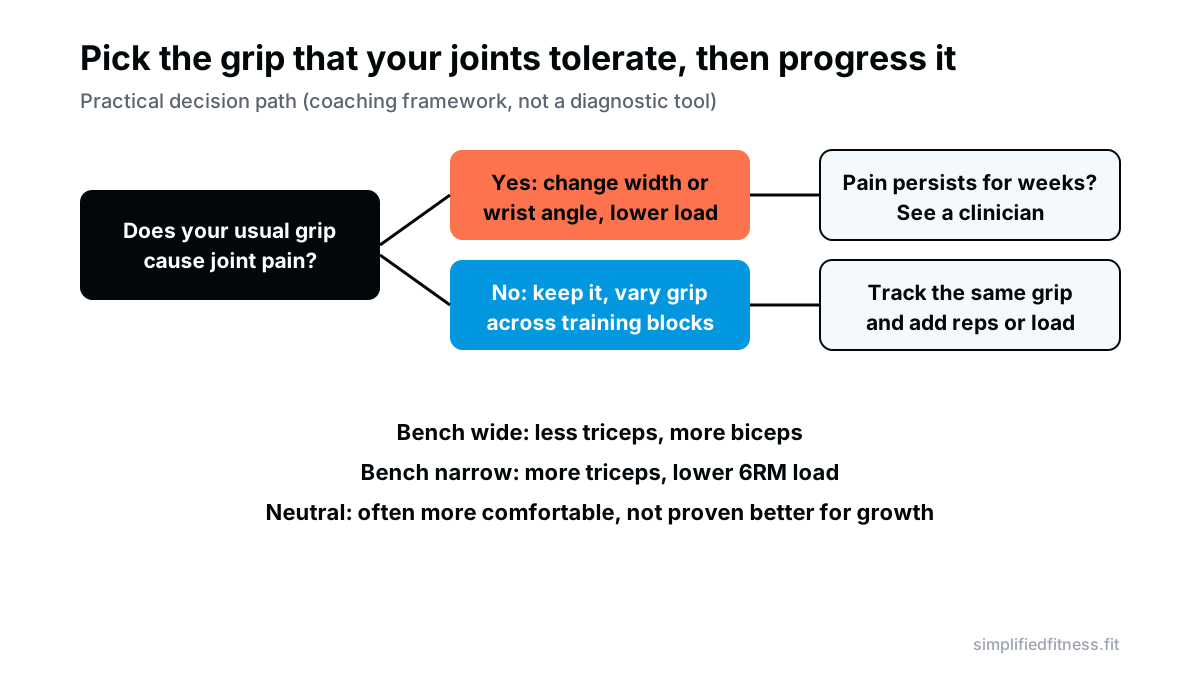
A simple rule set:
- Start with a medium grip and a pronated or neutral wrist, depending on the exercise.
- Use the same grip for at least 4-6 weeks so your logbook means something. A tool like the 1RM calculator helps compare loads.
- If a joint complains, change one thing at a time: width, then wrist angle, then handle.
- Rotate grips across training blocks for variety, which Coratella et al. suggested for varying the stimulus.
Common grip mistakes in Indian gyms
Crowded gyms often have a single straight bar, one pulldown station and a shared EZ-bar. The practical fix is not a new gadget. Use a cable handle or a pair of dumbbells for neutral work, and borrow the lower-loaded version of a grip rather than forcing the bar you have.
Another common one: copying a heavily built lifter’s wide pulldown grip without matching their shoulder structure or range. Your best grip is the one you can pull through full range with controlled reps.
Then there is the myth that you must change your grip every few weeks to “shock” the muscle. The evidence here does not support that, and constant swapping makes progress hard to track.
The bottom line
Grip width and wrist orientation are fine-tuning tools. They shift emphasis between the triceps, biceps and shoulders in small ways, and they change lever arms and comfort. The best-supported specifics are that narrower bench grips raise triceps work, that supinated curls raise biceps excitation, and that pulldown width barely changes lat activity in the studies we have.
Pick a grip you can progress without pain, keep it for a few weeks, and adjust one variable at a time when something hurts.
Frequently Asked Questions
Does grip width change which muscles work in the lat pulldown?
Only a little. In 15 men, lat, trapezius and infraspinatus activity was similar across narrow, medium and wide pronated grips, with small differences mainly in the eccentric phase. Pick a width you can pull through smoothly, roughly 1-2 times your shoulder width, and focus on progressing the load.
Is a wide grip better for building lats?
The evidence does not support that belief. Andersen et al. (2014) found similar lat activation across widths, and a 2025 study of 40 trained men found no lat difference across seven pulldown variants. Choose the grip that lets you feel the lats and move the most load with good form.
Is pronated or supinated better for lat pulldowns?
In one study of 12 men, a pronated grip gave more lat activity than a supinated grip regardless of width. That is small-sample EMG, though, and supinated pulldowns often feel better on the elbows for some lifters. Try both and keep the one you can progress without elbow irritation.
Does a close grip bench press work triceps more than a wide grip?
Yes, in EMG studies narrower grips increased triceps activity compared with wide grips. Wide grips also showed more biceps activity, and the narrow grip lowered the 6-rep max load in 28 men. If triceps are your goal, a medium to close grip is reasonable, as long as your wrists and elbows tolerate it.
Does wide grip bench press work the chest more?
Slightly, at most. Lehman (2005) found moving from wide to narrow grip lowered activity in one portion of the pec and raised triceps activity, but the changes were small. Treat grip as a minor lever and lean on exercise angle, range of motion and weekly volume for chest growth.
Which bench press grip is strongest?
In recreationally trained men, medium and wide grips allowed heavier 1-rep max loads than a narrow grip (about 109 kg, 109 kg and 104 kg for wide, medium and narrow). Wide and medium grips had larger horizontal shoulder moments than narrow. If a heavy single is your goal, a medium to wide grip is the better starting point, as long as your shoulders tolerate it.
Is a supinated grip better for biceps curls?
In 10 competitive bodybuilders, supinated curls produced the highest biceps excitation, about 19% above pronated and 12% above neutral. Pronated and neutral curls asked more of the front delt, and the brachioradialis was actually slightly more active with the supinated grip too. Use supinated curls as your main version and rotate neutral or pronated variations for variety.
What is a neutral grip and why use it?
A neutral grip has your palms facing each other, like holding a hammer. Some lifters find it kinder on shoulders and elbows, although the research here does not prove it is safer. Use it when a pronated grip feels pinchy, and keep the load honest.
Does grip width affect shoulder safety?
It can change how the shoulder is loaded, since wide and medium bench grips create larger horizontal shoulder moments than narrow. Direct injury data comparing grip widths is lacking, so treat this as a mechanical reason to experiment, not a proven rule. If a grip causes shoulder pain, change it and see a clinician if the pain lingers.
Should I use a thumbless grip?
Wrapping the thumb around the bar or handle is the standard choice for heavy pressing and pulling because it holds the load securely. Thumbless grips are not addressed by the studies cited here, so I would not recommend them for heavy sets. Keep the thumbless variations for light cable work if you use them at all.
How do I protect my wrists when pressing or curling?
Keep the bar over your forearm bones with a fairly straight wrist, rather than letting it bend back. Wrists that bend back heavily under load can feel sore, though the studies here did not test wrist injury directly. Lower the load, adjust the bar position in your palm, and see a clinician if wrist pain keeps coming back.
How often should I change my grip?
You do not need to change it every session. Keeping a main grip lets you track progress, and rotating variations across blocks adds variety. Coratella et al. suggested handgrip variation can vary the mechanical and neural stimulus, so use it as a rotation, not a daily experiment.
Sources & References
Every claim above is checked against peer-reviewed research (PubMed, U.S. National Library of Medicine) or guidance from established health bodies. How we fact-check.
- Lehman GJ. The influence of grip width and forearm pronation/supination on upper-body myoelectric activity during the flat bench press. J Strength Cond Res. 2005. PMID: 16095407
- Saeterbakken AH, et al. The Effect of Grip Width on Muscle Strength and Electromyographic Activity in Bench Press among Novice- and Resistance-Trained Men. Int J Environ Res Public Health. 2021. PMID: 34198674
- Andersen V, et al. Effects of grip width on muscle strength and activation in the lat pull-down. J Strength Cond Res. 2014. PMID: 24662157
- Lusk SJ, et al. Grip width and forearm orientation effects on muscle activity during the lat pull-down. J Strength Cond Res. 2010. PMID: 20543740
- Buonsenso A, et al. Electromyographic Analysis of Back Muscle Activation During Lat Pulldown Exercise: Effects of Grip Variations and Forearm Orientation. J Funct Morphol Kinesiol. 2025. PMID: 40981044
- Coratella G, et al. Biceps Brachii and Brachioradialis Excitation in Biceps Curl Exercise: Different Handgrips, Different Synergy. Sports (Basel). 2023. PMID: 36976950
- Larsen S, et al. A Biomechanical Analysis of Wide, Medium, and Narrow Grip Width Effects on Kinematics, Horizontal Kinetics, and Muscle Activity on the Sticking Region in Recreationally Trained Males During 1-RM Bench Pressing. Front Sports Act Living. 2020. PMID: 33554113
- Gomo O, et al. The effects of grip width on sticking region in bench press. J Sports Sci. 2016. PMID: 26055260

Umair Hazrami · Founder & Head Coach, Simplified Fitness
Umair Hazrami founded Simplified Fitness and the Simplified Lifter channel to cut through fitness noise. With 4+ years of consistent training and 10+ coaching clients, he writes every guide from the peer-reviewed research and links the sources so you can check them. Our editorial standards.
Educational content only, not medical advice. If you have a medical condition, are pregnant, or take medication, talk to a qualified doctor before changing your diet, supplements or training. Full disclaimer.
Keep reading
Exercise Technique
Anthropometry-Based Exercise Selection: Long Limbs, Short Torsos, and Lever Adjustments
Anthropometry exercise selection explained: how long femurs, long arms and a short torso change squats, deadlifts and presses, plus a simple audit and swaps.
9 min read
Exercise Technique
Axial Loading vs Non-Axial Exercises: Managing Spinal Fatigue for Bigger Legs and Back
Axial loading vs non axial exercises explained: how spinal compression limits your weekly volume, and which squat and row swaps spare your lower back.
7 min read
Exercise Technique
Cable Setup Mastery: Pulley Heights, Cable Angles, and Customizing Force Vectors
Cable machine setup guide: how to set pulley height, stance and cable angle for chest, lats, delts and arms, with what the research does and does not show.
9 min read
Exercise Technique
Compound vs Isolation Exercises for Hypertrophy: Do You Need Both?
Compound vs isolation exercises for hypertrophy: what trials say about arms, delts and hamstrings, and which muscles actually need direct sets. Sources linked.
7 min read