Stimulus-to-Fatigue Ratio (SFR): How to Pick Exercises That Pay Off
Stimulus to fatigue ratio (SFR) explained: how to score exercises, which lifts give more growth per fatigue, and what the research does and does not show.

TL;DR. The short answer
- Stimulus-to-fatigue ratio (SFR) is a coaching heuristic, not a lab measurement: how much muscle-building tension an exercise gives the target muscle compared with the joint, axial and whole-body fatigue it costs.
- Higher SFR exercises let you do more productive sets per week and still recover, which matters because weekly set volume has a graded dose-response relationship with muscle growth.
- Machines and free weights have produced similar hypertrophy in direct comparisons, so SFR is more about setup and stability than about the equipment label.
- Training a muscle at long lengths (overhead triceps work, seated leg curls) produced more growth than shorter-length versions in two within-person trials, which is one reason some exercises score well.
- No one has published an SFR score for each exercise. Treat any ranking, including ours, as informed judgement and adjust it to your own body, joints and recovery.
Part of our complete guide: Exercise Selection Biomechanics: Moment Arms, Strength Curves and Free Weights vs Machines
Table of contents
In our exercise selection guide, the stimulus to fatigue ratio (SFR) is the central yardstick. It is a simple way to judge an exercise: how much growth signal does the target muscle get, compared with how much joint, spinal and whole-body fatigue you pay for it? An exercise with a high SFR trains the muscle hard and leaves you fresh enough to train again. One with a low SFR leaves you wrecked for the same return. It is a coaching heuristic, not a number you can measure, and this guide shows how to use it honestly.
What is the stimulus to fatigue ratio?
The term is popularised by Dr. Mike Israetel and used by many evidence-based coaches. There is no validated SFR score for each exercise in the research literature, so everything below is a framework built on real studies, not a table of proven values.
Think of it as two columns.
Stimulus is what you want: the target muscle working hard, under tension, close to failure, through a useful range of motion.
Fatigue is the bill. It comes in three flavours:
- Local fatigue in the target muscle, which is mostly the point.
- Joint and connective tissue stress, like a cranky elbow or knee.
- Systemic and axial fatigue: the whole-body tiredness and spinal loading that bleeds into your next session.
Local fatigue is not the enemy. The trouble is when an exercise generates lots of the other two without giving the target muscle much extra.
Why SFR matters: volume is limited by recovery
Muscle growth has a dose-response relationship with weekly volume. A meta-analysis of 15 studies (34 treatment groups) found that more weekly sets were associated with more growth, with each additional set linked to roughly 0.37% more gain in muscle size (Schoenfeld et al., 2017). The effect was graded, not a cliff, though the three-level comparison (under 5, 5-9, and 10 or more sets per muscle) only showed a trend.
That is where SFR earns its keep. If you can recover from 12 hard weekly sets of a low-fatigue exercise but only from 6 of a high-fatigue one, the first plan may give you more total productive work. The research does not test SFR directly, so this is reasoning from the volume data, not a proven result. If you want to count your own weekly sets, our training volume calculator makes it quick.
How do you score an exercise?
Use three quick scores out of 5 for any exercise. The scores in Figure 1 are illustrative, from a hypothetical lifter, and yours may differ with your limb lengths, injuries and technique.
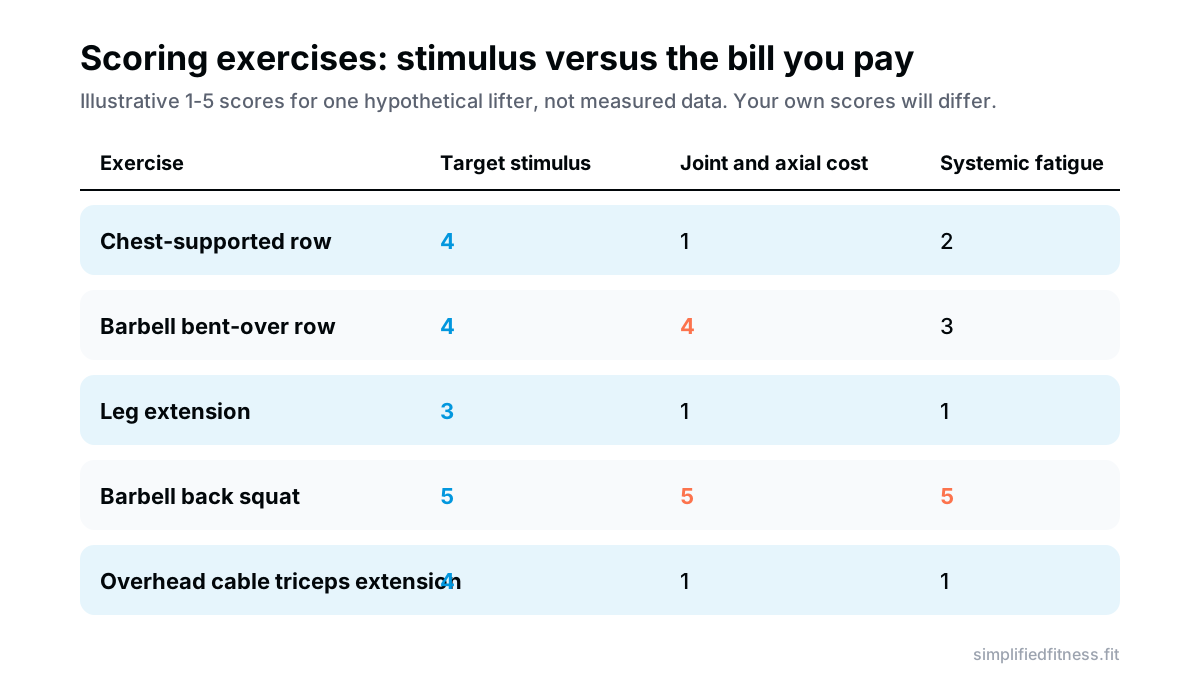
- Target tension. Does the target muscle feel like it is the limiting factor? If your grip, lower back or balance fails first, the stimulus score drops.
- Joint and axial cost. Do your joints feel fine during and after? Does your spine carry the load?
- Recovery disruption. Is your next session worse because of this one?
The best exercises are not the ones with a perfect stimulus score. They are the ones where a good stimulus does not come with a large fatigue bill.
Which exercises tend to have a high SFR?
Coaches commonly point to leg extensions, chest-supported rows, cable curls, lateral raises, hack squats and overhead cable triceps extensions. We look at one of these in detail in hack squats and the stimulus to fatigue ratio. What they tend to share: stable support, a smooth resistance, and a clear path to train the target muscle without much else getting involved.
Here is where the research supports parts of that picture.
Back support reduces the limiter
In a small lab study of 7 healthy men, three rows were compared. The inverted row produced the highest lat and upper back activation with the lowest lumbar spine load, while the standing bent-over row produced large activation across the back but the largest lumbar load (Fenwick et al., 2009). Chest-supported rows were not tested in that study, so I would not claim they were measured. The logical step, though, is that when your torso is supported your lower back is less likely to be what ends the set.
The most common mistake here is picking the row you can lift the most weight on, rather than the one that makes your lats and upper back fail first.
Long muscle lengths can raise the stimulus
Two within-person trials from the same research group are worth knowing. In 20 adults training one leg with seated leg curls and the other with prone leg curls, the same sets produced more hamstring growth in the seated version (whole hamstrings +14% versus +9%) (Maeo et al., 2021). In 21 adults doing cable elbow extensions with one arm overhead and the other in a neutral position, the overhead arm grew more (whole triceps +19.9% versus +13.9%), even though it used lower absolute loads (Maeo et al., 2023).
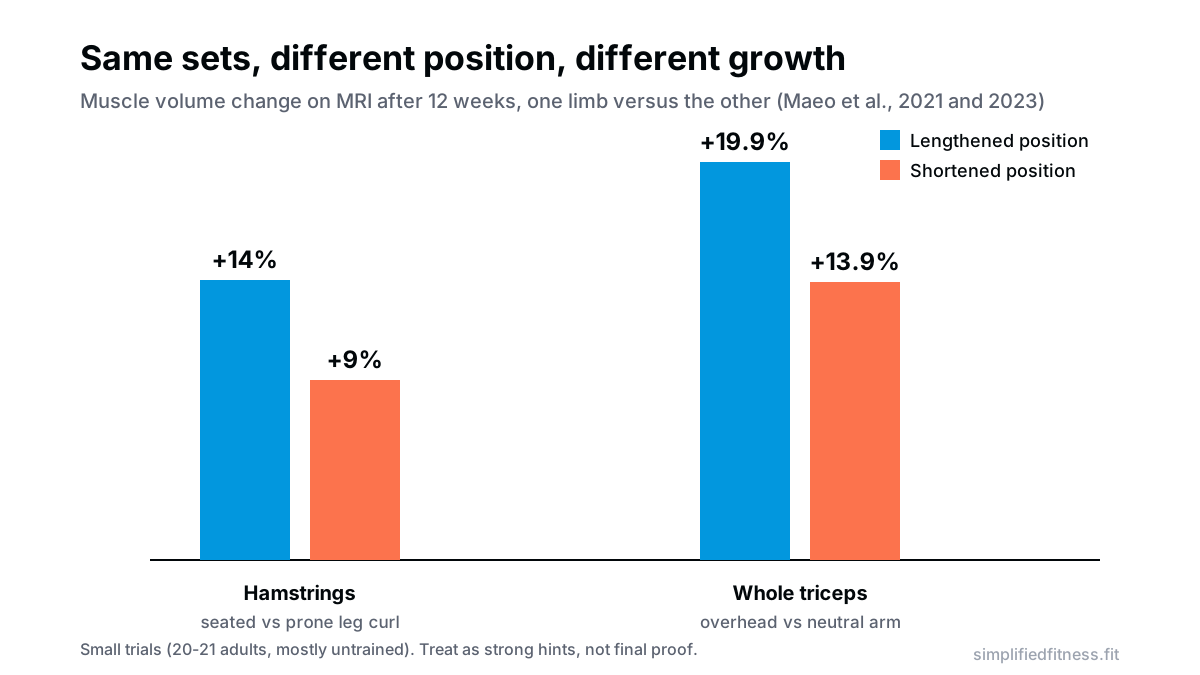
That second point matters for SFR. Lower loads can mean less joint stress for the same or better result. These were small trials, mostly in people who were not experienced lifters, so treat them as strong hints rather than final proof.
Lengthened emphasis does not mean you must do partials
It is tempting to turn this into “only train the stretched half”. A 2025 trial in 30 resistance-trained participants compared lengthened partial reps with full range reps over 8 weeks. Growth in the elbow flexors and extensors was similar, and the authors concluded that trainees should likely emphasise the stretched position, whether by full range or by lengthened partials (Wolf et al., 2025). It was an 8-week upper-body study, so it does not tell us about legs or longer timeframes.
Do machines have a better SFR than free weights?
People often assume so, because the machine handles balance and you can put all your effort into the target muscle. A 2023 meta-analysis of 13 studies (1,016 participants) found no differences between free-weight and machine training for hypertrophy, dynamic strength, isometric strength or jump performance in direct comparisons, though strength gains were specific to the modality you trained on (Haugen et al., 2023). The studies lasted at least 6 weeks and included adults aged 18-60.
So the label on the equipment is not the useful variable. The useful variable is whether the target muscle fails first. A well-set-up machine, a stable cable or a supported dumbbell exercise can all give you that. For a deeper comparison see free weights vs cables vs machines for hypertrophy.
| Exercise style | Typical stimulus | Typical fatigue cost | Best for |
|---|---|---|---|
| Heavy barbell compounds | High, many muscles | High (axial, systemic) | Strength, big overall return, when you recover well |
| Supported machine compounds | High | Moderate | High volume for legs and back without spinal load |
| Cable and machine isolations | Moderate to high for one muscle | Low | Topping up weekly sets cheaply |
| Dumbbell isolations | Moderate to high | Low | Home or budget gym setups |
This table is a coaching summary, not a measured ranking. For how compounds and isolations fit together, read compound vs isolation exercises for hypertrophy.
Does soreness or “feeling wrecked” mean the exercise is working?
No, and this is where SFR thinking protects you. Exercise-induced muscle damage is real, but a review of the literature noted that hypertrophy can occur with little muscle damage, and that whether damage is needed for growth remains debated (Schoenfeld, 2012). Soreness is therefore a poor scoreboard for stimulus.
Failure is another place fatigue creeps up. A meta-analysis of 15 studies found no evidence that training to momentary muscular failure beat non-failure training for muscle growth, though the authors point to a possible non-linear relationship (Refalo et al., 2023). In practice, going to absolute failure on a squat costs far more than going to failure on a leg extension. Use our RIR and RPE calculator to leave a rep or two in reserve on the expensive lifts.
A four-question SFR check you can use today
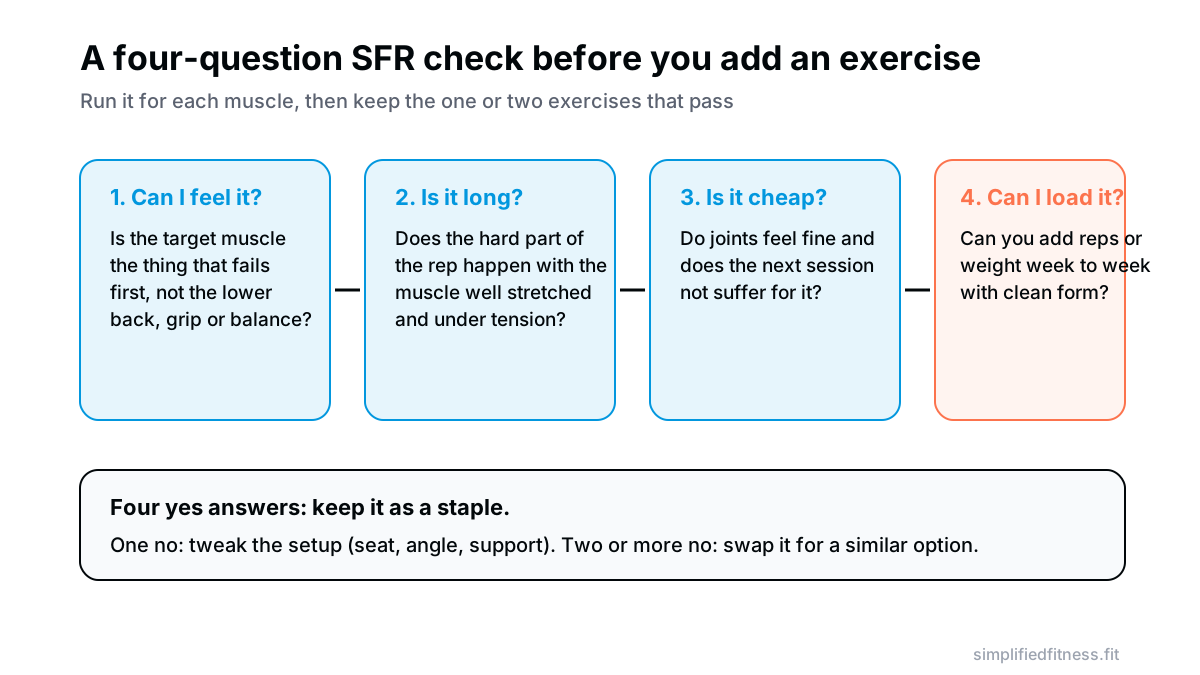
- Can I feel it? Is the target muscle the first thing to fail?
- Is it long? Is the hard part of the rep done with the muscle stretched?
- Is it cheap? Do joints feel fine and does your next session stay intact?
- Can I load it? Can you add reps or weight with clean form?
SFR in an Indian gym: budget, space and recovery
Many gyms here are crowded, and machines might be limited. Cables and dumbbells cover most low-fatigue options: incline dumbbell curls, one-arm cable rows, overhead cable triceps work. If you train in hot weather or eat a mostly vegetarian diet (dal, paneer, curd, soya), recovery may feel slower during high-volume phases. That is a good reason to favour exercises that cost less fatigue per set, though total calories and protein still matter more than any exercise swap. If your gym lacks a machine you want, see gym equipment shortages and exercise substitutions.
Limits of the SFR idea
Be honest about what this framework can and cannot do.
- It is subjective. Two lifters can score the same exercise differently because of limb lengths and injury history.
- The evidence is indirect. Studies cover volume, muscle length and failure separately. No trial tests “SFR” as a variable.
- Most trials are short. The long-length studies ran 8-12 weeks and several used small samples.
- A low-fatigue exercise is not automatically good. If you can’t feel the target muscle or load it, the stimulus is low.
If a movement causes sharp or lingering joint pain, stop using it and see a doctor or physiotherapist rather than trying to work around it.
The bottom line
Pick exercises where the target muscle fails first, the hard part of the rep happens at long muscle lengths, joints feel fine and you can progress the load. Use a heavy compound or two when you recover well, then fill weekly volume with lower-fatigue options. Re-score every few months, because the best exercise for you is the one that keeps producing progress without costing you tomorrow.
Frequently Asked Questions
What is the stimulus to fatigue ratio in lifting?
It is a way of judging an exercise by how much growth stimulus the target muscle gets compared with the fatigue the exercise creates. The idea is popularised by Dr. Mike Israetel and used by many evidence-based coaches, but it is a framework, not a measured quantity. Score your exercises honestly and keep the ones that train the muscle hard without wrecking your joints or your next session.
What are high stimulus, low fatigue exercises?
These are movements where the target muscle works close to failure while your lower back, joints and cardiovascular system stay relatively fresh. Examples usually given include leg extensions, chest-supported rows, cable curls and overhead cable triceps extensions. The exact ranking is a judgement call, so test them in your own training and pick the ones you can load progressively.
Is the squat a low SFR exercise?
Not necessarily low, but it carries a large fatigue cost because it loads the spine, hips, knees and your whole system at once. It also gives a big stimulus to several muscles, so it can still earn its place. If squats leave you too beaten up for the rest of your leg work, a hack squat or leg press may give you a better trade.
Do machines have a better SFR than free weights?
Often they feel that way because the machine supplies the balance, but the research does not show a hypertrophy winner. A 2023 meta-analysis of 13 studies found no difference in muscle growth between free-weight and machine training. Choose whichever lets the target muscle fail first, whichever you can progress on and whichever your gym actually has.
How do I measure fatigue from an exercise?
You cannot measure it precisely in a normal gym, so use proxies. Ask whether your joints feel fine afterwards, whether you recover by the next session, and whether performance on later exercises drops more than it should. Keep a simple log with notes, because patterns show up over a few weeks.
Does muscle soreness mean an exercise has a good stimulus?
No. Soreness is only loosely linked to muscle damage, and a review of the evidence noted that growth can occur in the relative absence of damage, so the role of damage in hypertrophy remains unclear. Soreness can also reduce the quality of your next session. Use performance trends and how the target muscle feels during sets instead of next-day soreness.
Can I use SFR to decide how many sets to do?
Indirectly, yes. A meta-analysis of 15 studies found a graded relationship between weekly sets and muscle growth, with each extra set linked to about 0.37% more gain. Exercises with lower fatigue costs let you reach higher productive volume without burning out, so you can usually stack more sets of them.
Should beginners worry about SFR?
Mostly no. A beginner grows from almost any sensible program, and the main job is learning the movements and showing up consistently. SFR matters more as volume rises and recovery becomes the limiting factor. Start with a few reliable exercises and refine your selection after a few months.
How does training to failure affect SFR?
Taking sets to failure raises fatigue, and any extra growth looks small. A 2023 meta-analysis of 15 studies found no evidence that training to momentary failure beat stopping short of it for hypertrophy, with at most a trivial edge when looser definitions of failure were pooled. On exercises that are very stable and joint friendly you can push closer to failure, while on heavy, spine loading lifts it usually makes sense to stop a rep or two short.
Are lengthened partials a good high SFR technique?
They can be, but they are not magic. In a 2025 trial of 30 resistance-trained people, lengthened partial reps and full range reps produced similar arm growth over 8 weeks. The takeaway is to emphasise the stretched part of the rep, not to abandon full range automatically.
Is the barbell row bad for my back?
It is not bad, but it is demanding. In a small lab study of 7 men, the standing bent-over row produced the largest lumbar spine load of the three rows tested, while the inverted row produced the lowest. If your back limits you before your lats do, a chest-supported row removes that limiter. See a doctor or physio if you have persistent back pain.
How do I use SFR on a budget or in a crowded gym?
You do not need fancy machines. Cables, dumbbells and a bench give you plenty of low-fatigue options, such as incline dumbbell curls or one-arm cable work. Pick two or three exercises per muscle, learn them well and progress them steadily.
How often should I change exercises based on SFR?
Rarely. Switch when an exercise stops being loadable, starts irritating a joint or consistently leaves you more tired than the muscle justifies. Keeping the same staples for 8-12 weeks lets you track progress properly.
Sources & References
Every claim above is checked against peer-reviewed research (PubMed, U.S. National Library of Medicine) or guidance from established health bodies. How we fact-check.
- Schoenfeld BJ, et al. Dose-response relationship between weekly resistance training volume and increases in muscle mass: A systematic review and meta-analysis. J Sports Sci. 2017. PMID: 27433992
- Fenwick CM, et al. Comparison of different rowing exercises: trunk muscle activation and lumbar spine motion, load, and stiffness. J Strength Cond Res. 2009. PMID: 19620925
- Haugen ME, et al. Effect of free-weight vs. machine-based strength training on maximal strength, hypertrophy and jump performance: a systematic review and meta-analysis. BMC Sports Sci Med Rehabil. 2023. PMID: 37582807
- Refalo MC, et al. Influence of resistance training proximity-to-failure on skeletal muscle hypertrophy: a systematic review with meta-analysis. Sports Med. 2023. PMID: 36334240
- Schoenfeld BJ. Does exercise-induced muscle damage play a role in skeletal muscle hypertrophy? J Strength Cond Res. 2012. PMID: 22344059
- Maeo S, et al. Triceps brachii hypertrophy is substantially greater after elbow extension training performed in the overhead versus neutral arm position. Eur J Sport Sci. 2023. PMID: 35819335
- Maeo S, et al. Greater hamstrings muscle hypertrophy but similar damage protection after training at long versus short muscle lengths. Med Sci Sports Exerc. 2021. PMID: 33009197
- Wolf M, et al. Lengthened partial repetitions elicit similar muscular adaptations as full range of motion repetitions during resistance training in trained individuals. PeerJ. 2025. PMID: 39959841

Umair Hazrami · Founder & Head Coach, Simplified Fitness
Umair Hazrami founded Simplified Fitness and the Simplified Lifter channel to cut through fitness noise. With 4+ years of consistent training and 10+ coaching clients, he writes every guide from the peer-reviewed research and links the sources so you can check them. Our editorial standards.
Educational content only, not medical advice. If you have a medical condition, are pregnant, or take medication, talk to a qualified doctor before changing your diet, supplements or training. Full disclaimer.
Keep reading
Exercise Technique
Anthropometry-Based Exercise Selection: Long Limbs, Short Torsos, and Lever Adjustments
Anthropometry exercise selection explained: how long femurs, long arms and a short torso change squats, deadlifts and presses, plus a simple audit and swaps.
9 min read

Exercise Technique
Axial Loading vs Non-Axial Exercises: Managing Spinal Fatigue for Bigger Legs and Back
Axial loading vs non axial exercises explained: how spinal compression limits your weekly volume, and which squat and row swaps spare your lower back.
7 min read
Exercise Technique
Cable Setup Mastery: Pulley Heights, Cable Angles, and Customizing Force Vectors
Cable machine setup guide: how to set pulley height, stance and cable angle for chest, lats, delts and arms, with what the research does and does not show.
9 min read

Exercise Technique
Compound vs Isolation Exercises for Hypertrophy: Do You Need Both?
Compound vs isolation exercises for hypertrophy: what trials say about arms, delts and hamstrings, and which muscles actually need direct sets. Sources linked.
7 min read