Matching Resistance Profiles to Human Strength Curves: Ascending vs Descending
Resistance profiles and strength curves explained: why lifts feel brutal at the bottom and light at the top, and how cables, bands and cams change that.
TL;DR. The short answer
- A strength curve describes how much force you can produce at each joint angle. A resistance profile describes how hard the exercise asks you to work at each angle. Problems start when the two do not line up.
- Squats and presses are often described as ascending (easier near lockout), many pulling and curling movements are bell-shaped or descending, but the exact shape depends on the joint, the person and the setup.
- In a meta-analysis of 17 studies (491 healthy adults), variable resistance such as bands, chains or cams did not beat traditional training for maximal strength or power, though a second meta-analysis found a strength benefit in some subgroups.
- Mismatch is not wasted effort in the dramatic sense. It mostly means part of the range is easy while another part limits the set. Cables, angle changes and long-muscle-length positions are the practical fixes.
- Stretched positions look especially valuable: cable triceps work overhead produced about 1.4-fold greater triceps growth than the neutral arm position in one 12-week trial.
Part of our complete guide: Exercise Selection Biomechanics: Moment Arms, Strength Curves and Free Weights vs Machines
Table of contents
Ever noticed that a squat feels impossible in the hole and almost easy near lockout? That gap is the idea behind resistance profiles and strength curves. Your strength changes with joint angle, but a barbell weighs the same all the way up, so some parts of the rep end up hard and others end up soft.
This article is a cluster of our exercise selection and biomechanics guide. Here we cover the three common curve shapes, how mismatch shows up, and what cables, bands, cams and body position can do about it. Where the evidence is thin, I will say so.
What are resistance profiles and strength curves?
Two terms, easy to mix up.
- Strength curve: how much force you can produce at each joint angle. It comes from muscle length (force changes as a muscle stretches or shortens) and from lever arms (joint angles change the moment arm). Our moment arms and joint torque article covers that side.
- Resistance profile: how much torque the exercise demands at each angle. Free weights have a constant load but a changing demand. Cables, bands and cams change the demand in other ways.
A good match means the exercise challenges the muscle across the range you care about. A poor match means one short stretch of the rep is the hard part and the rest is a free ride.
One caution up front. The shapes below are simplified. Real curves vary by joint, by person, by limb length and by how you set up. Treat them as a starting point to test, not a law.
Ascending vs descending vs bell-shaped curves
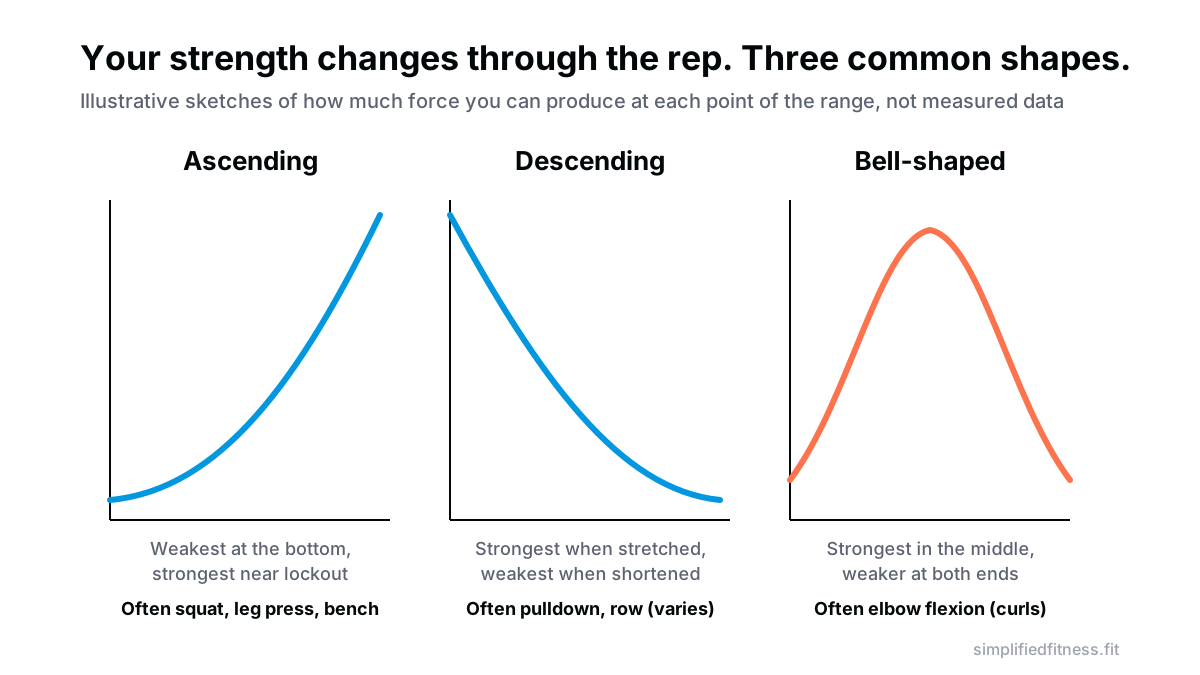
Ascending. You are weakest at the start and strongest near lockout. Squats, leg press and pressing movements are the classic examples. The bottom of a squat is where the lever arms work against the hips and knees, so that is where most failed reps stall, usually a little above the very bottom.
There is some measured support here, with a caveat. In 18 men doing maximal isometric leg presses, knee torque showed an ascending-descending pattern across knee angles from 30 to 100 degrees of flexion, with an optimum shifted toward extension compared with single-joint literature (Hahn et al., 2011). That was isometric, in one machine, and in men only, so it does not describe your squat exactly. It does show that leg strength is not flat across angles, and that single-joint and multi-joint tasks behave differently.
Descending. You can produce the most force when the muscle is long and less as it shortens. Pulldowns and rows are often described this way, but it depends on the joint and the person, so I would hold that label loosely.
Bell-shaped. Force peaks in the middle and drops at both ends. Elbow flexion (curls) is the usual example, with strength highest somewhere in the middle of the range.
Why a mismatch makes sets less efficient
Take a standing barbell curl. Gravity pulls straight down, so the torque on your elbow is biggest when the forearm is horizontal and falls toward zero at the bottom and the top.
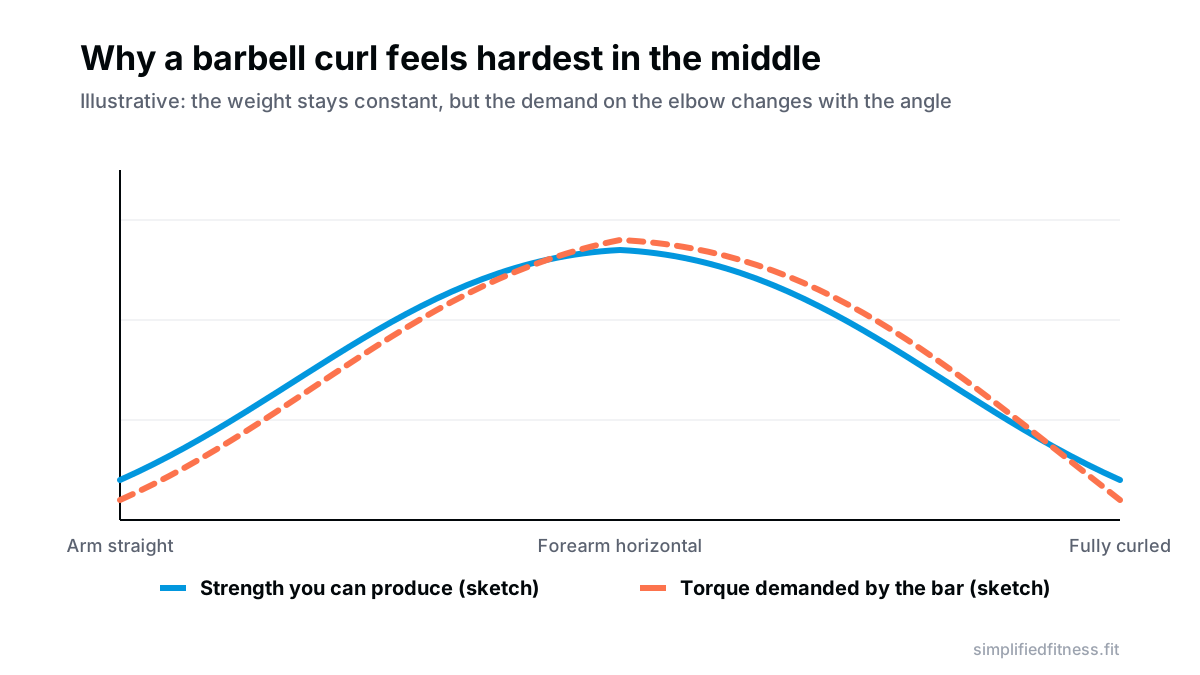
Your strength is also bell-shaped, but the two shapes do not overlap perfectly. The practical result is that the set is limited by one portion of the range and the rest is lightly loaded. You do not “waste energy” in any dramatic way. You just get less useful tension in the easy zones.
The most common mistake here is blaming yourself when the real issue is the setup. A curl that feels dead at the top is not a lack of effort, it is the load direction.
Do variable resistance tools work better?
Variable resistance means changing the load through the rep, usually with bands, chains or cam machines. The evidence is genuinely mixed.
- A 2022 meta-analysis of 17 studies and 491 healthy adults (aged 18-37) found no significant difference in maximal strength or muscle power, upper or lower body, between variable and traditional training. For lower-body strength, traditional training did better when sets had more reps (Andersen et al., 2022).
- A 2022 meta-analysis of 14 studies found variable resistance gave greater maximal-strength gains overall (ES = 0.80). In trained people the benefit appeared at loads of 80% of 1RM or more, while untrained people benefited at loads below 80% (Lin et al., 2022).
Why might they disagree? Different study pools, different definitions of variable resistance, small trials and different outcome tests. A cautious reading: variable resistance can help some people at some loads, but it is not a clear upgrade. It is a tool, not a requirement.
Bands specifically look similar to weights for strength. A meta-analysis of eight studies found no difference between elastic and conventional resistance for upper or lower limb strength (Lopes et al., 2019). Note these were strength outcomes, so this says little about muscle size.
How to match the profile: cables, bands, cams and body position
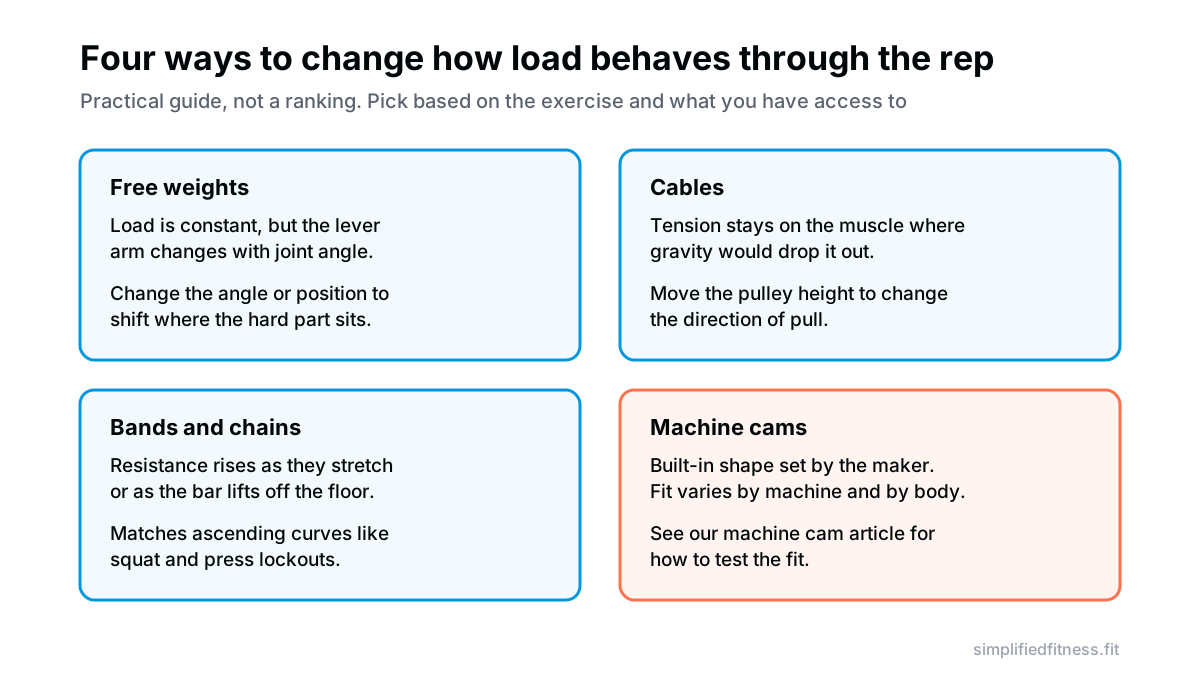
Free weights: change the angle, not the weight. The load is constant but the torque is not. Tilting the bench, leaning the torso or changing your grip moves the hard point. Our free weights vs cables vs machines article compares these options in more detail.
Cables: keep tension where gravity quits. A cable keeps pulling when a dumbbell would no longer resist, such as the bottom of a lateral raise or the top of a curl, depending on pulley height. Pulley height and line of pull decide where it feels hardest, which is the whole topic of cable setup and pulley angles. For fibre-direction logic, see line of pull and muscle fibre alignment.
Bands and chains: add load near lockout. As a band stretches or a chain leaves the floor, resistance rises, which suits ascending lifts like squat and press. A heavy band at home is a budget-friendly way to do this.
Machine cams: shape built in. Cam-based machines try to shape resistance for you. Fit depends on the design and on your body, so we cover how to test it in selectorized machine cam profiles. I do not go deep here to avoid overlap.
Where in the range should the hard part be?
Here the strength curve and muscle growth research meet, and the findings are interesting but not final.
A systematic review of six studies found full range of motion beneficial for lower-body hypertrophy compared with partial range, while upper-limb evidence was limited and conflicting (Schoenfeld and Grgic, 2020).
A more recent trial in 30 resistance-trained people trained each arm with either lengthened partial reps or full range for 8 weeks. Muscle thickness and lat pulldown strength-endurance improved similarly, and the authors concluded that emphasizing the stretched position is likely wise for muscle size (Wolf et al., 2025). That is upper body only, and eight weeks is short.
The best-known example with cables: in a 12-week trial of 21 adults, cable elbow extensions in the overhead position (long head of the triceps stretched) produced about 1.4-fold greater whole triceps growth than the neutral position (+19.9% vs +13.9%), even though lighter loads were used (Maeo et al., 2023). It is one muscle in one study, but it fits the idea that the stretched part of the range matters.
Applying this to common lifts
Squat and leg press (ascending). The bottom is the hard part. Use full range if your mobility allows, control the descent, and consider bands or a pause.
Leg curl. Seat position changes hip angle and the stretch on the hamstrings, so test it rather than assume.
Curls (bell-shaped). Try preacher or cable curls if the top of your barbell curl goes slack. Incline dumbbell curls bias the stretched position.
Rows and pulldowns. The stretched position is at the start. Let the shoulder blade move, keep control at the bottom, and add a short squeeze at the top.
You can fold these ideas into a program using our free leg day plan, or browse the push, pull and legs plans.
Common mistakes with strength curves
- Chasing a perfect match. No equipment matches every person. Aim for “good enough” and use the rest of the program for coverage.
- Ignoring the dead zone. If the top of every curl and lateral raise is slack, that muscle gets less useful tension per rep.
- Shortening the range to lift heavier. Ego partials in the strong zone can reduce stretch, which the research above suggests matters for lower body growth.
- Buying gear before testing a setup change. Pulley height, bench angle and seat position are free.
- Over-reading studies. Many trials are short, use young adults, and measure strength, not muscle size.
The bottom line
Resistance profiles and strength curves are a useful lens, not a magic formula. Strength changes with angle, torque demands change with lever arms, and equipment can reshape the mix. Evidence for bands, chains and cams beating plain training is mixed. Evidence for full range of motion in the lower body, and for training the stretched position in muscles like the triceps, looks more promising, but it comes from small, short studies.
Test where each exercise feels hard, adjust the angle or cable until your target muscle is loaded through the range, and keep progressing. If you have pain at a specific joint angle, that is a reason to see a physiotherapist or doctor, not to push through it.
Frequently Asked Questions
What is a strength curve in weightlifting?
A strength curve shows how much force you can produce at different joint angles through a movement. It exists because muscle force changes with muscle length and because lever arms change as joints move. In practice, notice where in the rep you feel strongest and weakest, since that is where the exercise is likely to be limited.
What is an ascending strength curve?
An ascending curve means you are weakest at the start of the lift and strongest near the finish, which is why a squat is usually hardest out of the hole and easier at the top. Leg press data show knee torque is not flat across angles, with peak torque shifted toward the more extended positions, which fits the bottom often being the limiting point. Use pauses or slightly lower loads in the bottom position if you want to train the hard part honestly.
What is a descending strength curve?
A descending curve means you can produce the most force when the muscle is lengthened and less as it shortens. Rowing and pulldown variations are often described this way, though it varies by joint and person. If the end of the rep feels weak, adding a brief squeeze or using a cable can keep the muscle working there.
What is a bell-shaped strength curve?
A bell-shaped curve means force is highest in the middle of the range and lower at both ends. Elbow flexion is the typical example. In a standing barbell curl the bar also demands the most when the forearm is horizontal, so the middle of the rep feels hardest. Preacher curls or cable curls change where the bar feels heavy, so try both and see which keeps the biceps loaded across the full range.
What is a resistance profile?
A resistance profile is how hard an exercise feels at each point of the rep, set by the weight, the lever arms and the equipment. A dumbbell has a constant weight, but the torque at your joint changes with the angle. Match the profile to the muscle by adjusting body position, cable height or equipment.
Does variable resistance training build more muscle or strength than regular weights?
Not clearly. A 2022 meta-analysis of 17 studies found no significant strength or power differences between variable and traditional resistance training in healthy adults. Another meta-analysis found larger strength gains with variable resistance, particularly at 80% of 1RM or more in trained people, so the evidence is mixed. Treat bands and chains as optional tools, not requirements.
Are bands as good as weights?
For strength, probably close. A meta-analysis of eight studies found no difference between elastic and conventional resistance for upper or lower limb strength. Bands rise in tension as they stretch, which suits the top of squats and presses, so they are a fair choice when you train at home or travel.
Do cables flatten the resistance curve?
Often, yes, because the pulley keeps a steady pull where gravity would not. A cable curl keeps tension on the biceps at the bottom, where a free-weight curl goes slack. Set the pulley so the line of pull is roughly perpendicular to the working limb at the hard part of the range.
Is mismatching resistance and strength curve a waste of energy?
Not really, but it can make the set less efficient. If the easy part of the rep is far easier than the hard part, the hard part limits you while the rest is under-trained. You do not need a perfect match, only enough tension where you want the muscle to work.
Is training at long muscle lengths better for hypertrophy?
It looks promising, especially for some muscles. A 12-week trial found greater triceps growth with overhead cable extensions than with a neutral arm position, and a trained-lifter trial concluded that emphasizing the stretched position is likely wise. Both studies are small and muscle-specific, so use stretched positions on some exercises without overhauling everything.
Should I use full range of motion on every exercise?
Mostly yes for lower body lifts. A systematic review found full range of motion beneficial for lower-body hypertrophy, while upper-limb evidence was limited and conflicting. Lengthened partial reps matched full range in an 8-week upper-body trial in trained people, so partial reps at the stretched end are a reasonable tool, not a shortcut.
Why does the top of my squat or bench feel so easy?
The lever arms improve as you approach lockout, so the same bar demands less torque from your joints. For the knee, torque data from a leg press show a rise and fall across angles rather than a flat line. Use chains, bands or a slow tempo through the top if you want that part to count.
Do I need special machines to match my strength curve?
No. Small changes with the equipment you already have do most of the work: pulley height, bench angle, pauses at the weak point and using a cable for isolation moves. If you are using a machine, test whether the hard point matches your own and adjust seat position before you worry about the cam.
Is this different for beginners?
Beginners improve with almost any sensible setup, so exercise mechanics matter less early on. One meta-analysis found untrained lifters did better with variable resistance below 80% of 1RM, but that was strength only and the studies were small. Get consistent with basic lifts first, then fine-tune.
Sources & References
Every claim above is checked against peer-reviewed research (PubMed, U.S. National Library of Medicine) or guidance from established health bodies. How we fact-check.
- Hahn D, et al. Knee and ankle joint torque-angle relationships of multi-joint leg extension. J Biomech. 2011. PMID: 21621211
- Andersen V, et al. Comparing the effects of variable and traditional resistance training on maximal strength and muscle power in healthy adults: A systematic review and meta-analysis. J Sci Med Sport. 2022. PMID: 36130847
- Lin Y, et al. Effects of Variable-Resistance Training Versus Constant-Resistance Training on Maximum Strength: A Systematic Review and Meta-Analysis. Int J Environ Res Public Health. 2022. PMID: 35886409
- Lopes JSS, et al. Effects of training with elastic resistance versus conventional resistance on muscular strength: A systematic review and meta-analysis. SAGE Open Med. 2019. PMID: 30815258
- Schoenfeld BJ, et al. Effects of range of motion on muscle development during resistance training interventions: A systematic review. SAGE Open Med. 2020. PMID: 32030125
- Wolf M, et al. Lengthened partial repetitions elicit similar muscular adaptations as full range of motion repetitions during resistance training in trained individuals. PeerJ. 2025. PMID: 39959841
- Maeo S, et al. Triceps brachii hypertrophy is substantially greater after elbow extension training performed in the overhead versus neutral arm position. Eur J Sport Sci. 2023. PMID: 35819335

Umair Hazrami · Founder & Head Coach, Simplified Fitness
Umair Hazrami founded Simplified Fitness and the Simplified Lifter channel to cut through fitness noise. With 4+ years of consistent training and 10+ coaching clients, he writes every guide from the peer-reviewed research and links the sources so you can check them. Our editorial standards.
Educational content only, not medical advice. If you have a medical condition, are pregnant, or take medication, talk to a qualified doctor before changing your diet, supplements or training. Full disclaimer.
Keep reading
Exercise Technique
Anthropometry-Based Exercise Selection: Long Limbs, Short Torsos, and Lever Adjustments
Anthropometry exercise selection explained: how long femurs, long arms and a short torso change squats, deadlifts and presses, plus a simple audit and swaps.
9 min read
Exercise Technique
Axial Loading vs Non-Axial Exercises: Managing Spinal Fatigue for Bigger Legs and Back
Axial loading vs non axial exercises explained: how spinal compression limits your weekly volume, and which squat and row swaps spare your lower back.
7 min read
Exercise Technique
Cable Setup Mastery: Pulley Heights, Cable Angles, and Customizing Force Vectors
Cable machine setup guide: how to set pulley height, stance and cable angle for chest, lats, delts and arms, with what the research does and does not show.
9 min read
Exercise Technique
Compound vs Isolation Exercises for Hypertrophy: Do You Need Both?
Compound vs isolation exercises for hypertrophy: what trials say about arms, delts and hamstrings, and which muscles actually need direct sets. Sources linked.
7 min read