Stance Width and Foot Placement: Squat and Leg Press Biomechanics
Squat stance width biomechanics explained: what wide vs narrow changes at the hip and knee, why foot placement can't isolate quad heads and how to choose yours.
TL;DR. The short answer
- Stance width shifts load between the hip and knee. A narrower squat tends to load the knee extensors and quads more, while a wider squat tends to raise hip extensor demand.
- No stance or foot position isolates the 'inner' or 'outer' quad. In EMG work on squats, the vastus medialis, vastus lateralis and rectus femoris did not respond differently to stance width.
- Leg press foot height and toe angle change joint angles and forces a little, but they do not turn the leg press into a glute or inner-quad exercise.
- A wide stance has not been shown to build bigger adductors. One 2024 lab study found hip adductor demand did not change with stance width.
- Pick the stance that lets you reach a controlled depth with knees tracking over your toes, then adjust a few centimetres. Comfort and consistent progression beat any single 'optimal' width.
Part of our complete guide: Exercise Selection Biomechanics: Moment Arms, Strength Curves and Free Weights vs Machines
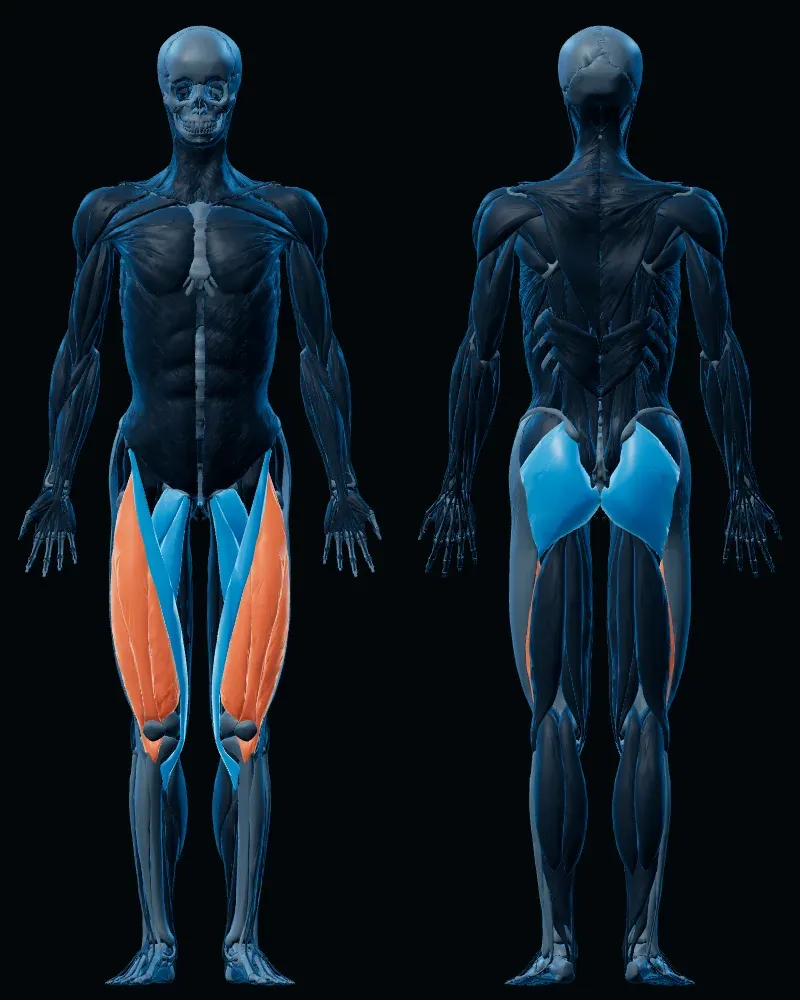
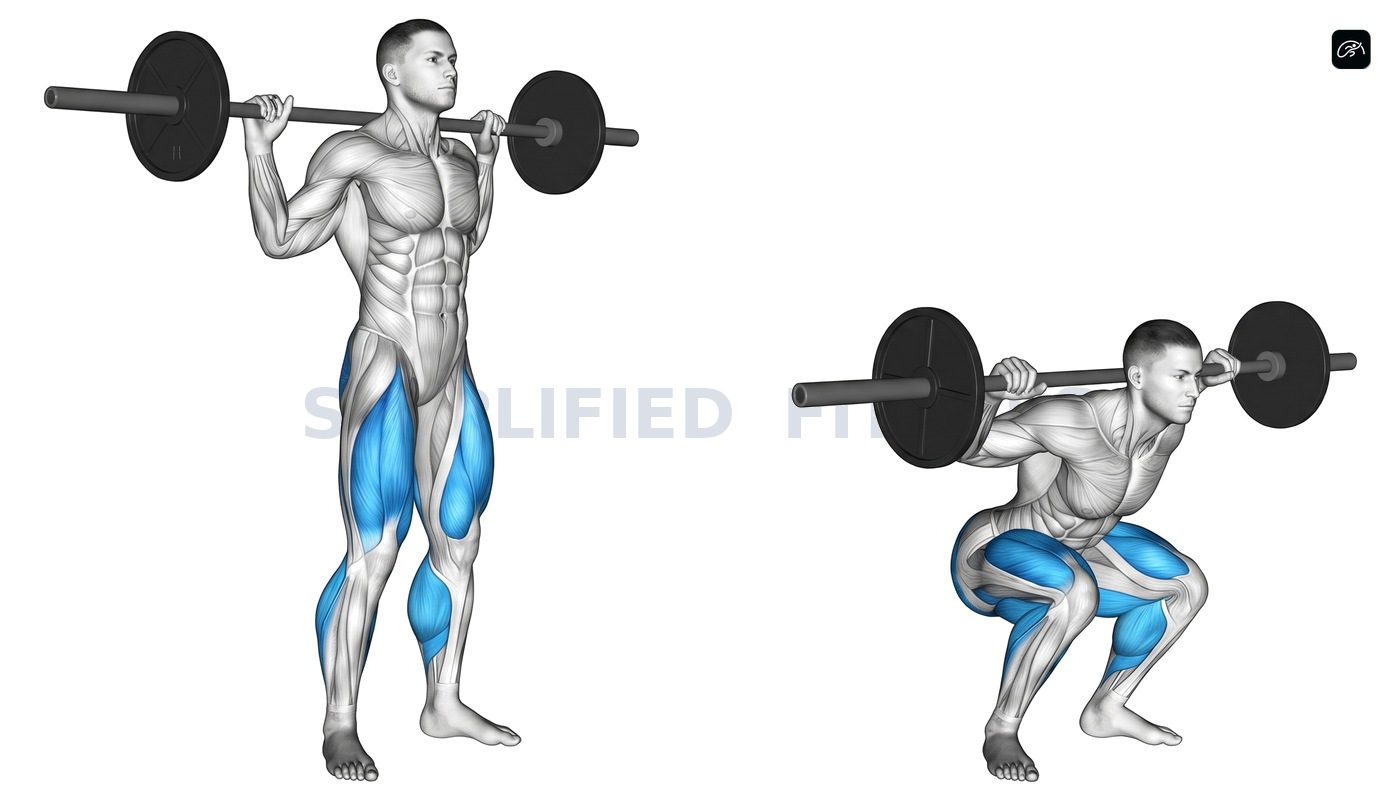
Muscles worked: quads
Main movers: rectus femoris and the three vasti
Assisting: adductors, sartorius and glutes
Table of contents
Squat stance width biomechanics comes down to one idea: where you put your feet changes how the load is shared between your hips and knees, but it does not switch individual muscles on and off. A narrower stance tends to load the knee extensors more, a wider one tends to load the hip extensors more, and neither isolates an “inner quad,” “outer quad” or adductor.
That is the short answer to the gym rumour that wide squats build the inner thigh and narrow squats build the quad sweep. The longer answer is more useful, because it tells you how to set your feet. This is one of the practical details inside our guide to exercise selection and biomechanics, so start there if you want the bigger picture.
What does stance width actually change in a squat?
Three things: the angles at your hip and knee, the moments (rotational demands) each joint has to produce, and the direction your knees point.
Start with the oldest data. A 2001 analysis of 39 lifters at a national powerlifting championship split them by stance: narrow (about 107% of shoulder width), medium (142%) and wide (169%). Compared with narrow, the hips were flexed 6-11 degrees more and the thighs were more horizontal in the medium and wide groups, and knee and hip moments were greater in the wide group (Escamilla et al., 2001). That was a field recording of competitive lifters, so it describes what people do, not a controlled comparison of one person’s two stances.
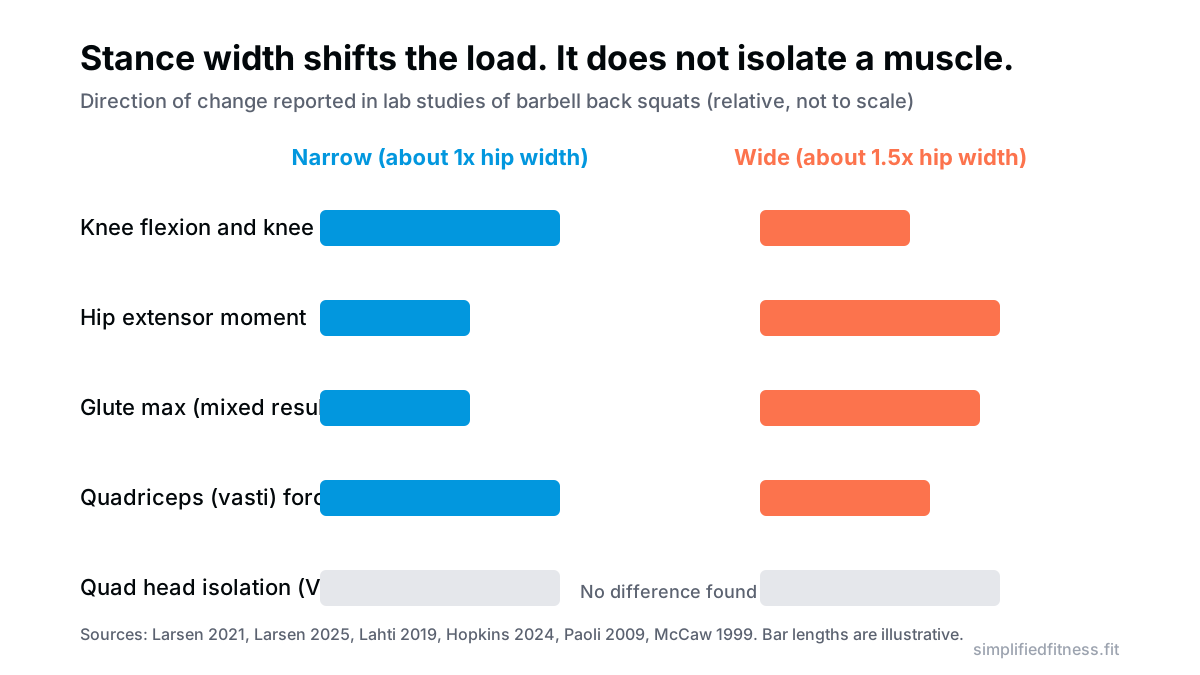
Controlled lab studies point the same direction. In 14 amateur rugby players squatting to femur-parallel at 70% and 85% of 1RM, knee flexion was greater in the narrow stance, and the hip-to-knee extension moment ratio was greater in the wide stance (Lahti et al., 2019). A 2024 study of 11 men and 13 women found hip extensor moment was greatest in the wide stance, and hip lateral rotator moment rose from narrow to medium to wide (Hopkins et al., 2024).
In plain gym language: narrow → more knee travel, more work at the knee. Wide → hips do relatively more.
Does a wide stance squat build bigger glutes and adductors?
Partly yes for glutes, probably not for adductors.
On the glute side, the picture is mixed. In six experienced lifters, only the gluteus maximus differed across stance widths, and it was more active at the widest stance, while seven other thigh muscles did not differ (Paoli et al., 2009). In 18 lifters (nine men, nine women) doing three-rep-max squats, a high-bar narrow stance produced higher vastus lateralis and lower gluteus maximus activity, while the low-bar wide stance gave larger hip contributions to the total moment (Larsen et al., 2021). A bodyweight modelling study, though, found gluteus maximus force increased as stance got narrower (Asayama et al., 2021). Different loads, bar positions and methods, different answers.
Now the adductor claim. A 1999 EMG study of nine male lifters found stance width changed adductor longus activity, with a stance-by-phase interaction, but the quadriceps did not differ (McCaw & Melrose, 1999). The 2024 inverse dynamics study found the net hip adductor moment was invariant across widths (Hopkins et al., 2024). Both are acute lab measures, and none of them measured adductor growth over months.
For adductor growth specifically, depth and hip flexion probably matter more than width. We cover that in hip flexion depth and the adductor magnus and in the dedicated adductor magnus training guide.
Does a narrow stance squat build the quad sweep?
It might emphasise the quads a bit more, but the “sweep” is not a separate muscle you can aim at.
Modelling data in 12 recreationally trained men squatting 3RM found the wide stance (1.7 times acromion width) produced smaller knee flexion angles, lower knee extension moments and lower vastii forces than the narrow stance (0.7 times), with the authors suggesting a narrow stance for lifters who want more vastii force (Larsen et al., 2025). A two-experiment study in 70 and 20 lifters likewise found the narrow condition increased modelled quadriceps force, while the wide stance increased posterior chain force, though the authors concluded that there is no optimal stance width (Sinclair et al., 2022).
But here is the catch for the myth. The quads are four muscles crossing the knee. The vastus medialis, lateralis and intermedius only extend the knee, and the rectus femoris also crosses the hip. In McCaw and Melrose’s EMG study, rectus femoris, vastus medialis and vastus lateralis were affected by load but not by stance, and the authors concluded stance width “does not cause isolation within the quadriceps” (McCaw & Melrose, 1999). Paoli found the same for the vastus medialis, vastus lateralis and rectus femoris.
So narrower may mean slightly more total quad demand. It does not mean “more outer quad” or “more VMO.” For the anatomy behind that, see our piece on quadriceps heads and why you cannot isolate them.
How does foot placement on the leg press change things?
Mostly the same story, with a few extra details. On the leg press, foot position changes joint angles and forces a little, but it does not isolate quad heads, glutes or inner thighs.
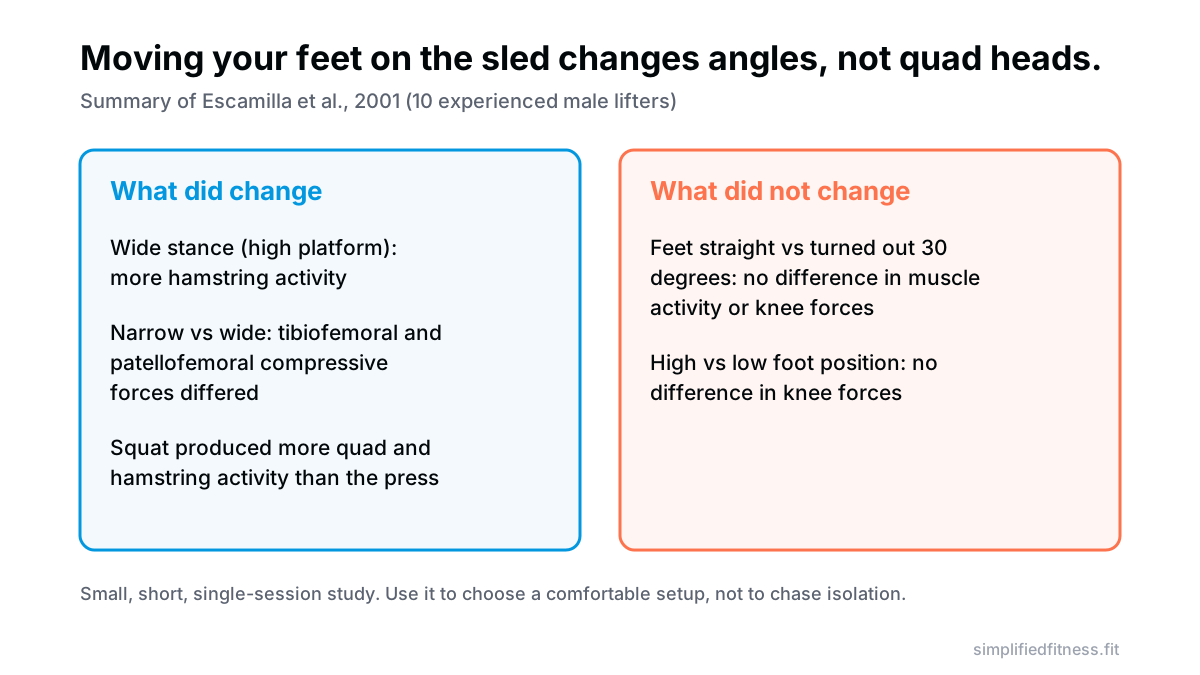
The most detailed data comes from a 2001 study of ten experienced male lifters who did the squat plus high-foot and low-foot leg presses with wide and narrow stances and with feet straight versus turned out 30 degrees. There were no differences in muscle activity or knee forces between foot angles. The squat produced more quadriceps and hamstring activity than either leg press. A wide, high-foot press gave more hamstring activity than a narrow one. And on the leg press, a narrow stance produced greater tibiofemoral and patellofemoral compressive forces than a wide stance (Escamilla et al., 2001).
Two cautions. This is ten men, one session, and surface measures of muscle activity. And “more hamstring activity” is not proof of “more hamstring growth.” Still, nothing in it supports “feet high for glutes, feet low for quads” as a rule you can build a programme on.
What foot position does change in practice is range of motion and comfort. Feet very low means more knee travel and more ankle dorsiflexion. Feet very high or wide means the pelvis can tuck under earlier. We go deeper on this in leg press foot placement, range of motion and safety.
What about toe angle and knee tracking?
Turn your toes out as much as your hips need, and let your knees follow them. That is the rule that holds up best.
Hip anatomy varies. Some people have hip sockets that allow a straight-ahead foot comfortably, others need 20-30 degrees of toe-out to reach depth without the pelvis tucking under. A cue like “toes straight” or “toes 45 degrees” for everyone ignores that.
The research on toe angle is thin and mixed. In 12 healthy adults doing bodyweight squats, 30 degrees of toe-out increased medial knee contact force and quadriceps force relative to neutral, and a narrow stance increased medial knee contact force relative to medium and wide (Asayama et al., 2021). The authors suggested medium stance and neutral toes may suit people wanting to reduce medial knee load. But in the leg press study above, 30 degrees of toe-out changed neither muscle activity nor knee forces (Escamilla et al., 2001). Different exercise, different method, different answer.
What about “knees in” versus “knees out”? In a 6-week trial, 11 healthy novice women trained squats with one of the two alignments. Both groups gained strength and vasti volume, but no hip extensor muscle grew, and knee health scores did not differ (Chiu & Fry, 2025). It is tiny, and the authors say a longer study may be needed, so we cannot call either alignment better.
Practical read: let the knee track over the toe line, keep the foot flat (including the big toe and heel), and do not let your arches collapse. If you want to check your foot mechanics, see foot pronation, knee valgus and squat mechanics. If squats irritate your knees, are squats bad for your knees covers the evidence.
Why do the studies disagree?
Because they measure different things in different people.
- Population: powerlifters, rugby players, recreationally trained men, novice women, healthy adults.
- Load: bodyweight, 30% to 85% of 1RM, or a 3RM.
- Method: surface EMG (electrical activity under the skin) versus musculoskeletal modelling (computer-estimated forces).
- Stance definition: as a percentage of shoulder width, hip (trochanter) width or acromion width.
- Bar position: high bar versus low bar changes the hip-knee balance too (high bar vs low bar biomechanics).
None of these are long hypertrophy trials comparing stance widths. Until those exist, the honest summary is that stance changes how the joints share load, with small and sometimes inconsistent effects on which muscles are most active.
| Variable | Narrower stance | Wider stance | Confidence |
|---|---|---|---|
| Knee flexion / knee moment | Greater | Smaller | Moderate (several lab studies) |
| Hip extensor demand | Smaller | Greater | Moderate |
| Gluteus maximus activity | Mixed | Higher in some studies | Low to moderate |
| Quad head isolation | None | None | Moderate (EMG studies agree) |
| Adductor growth | Unknown | Unproven | Low |
| Knee compression (barbell squat) | Lower in one study | Higher in one study | Low |
How should I choose my stance? (A practical routine)
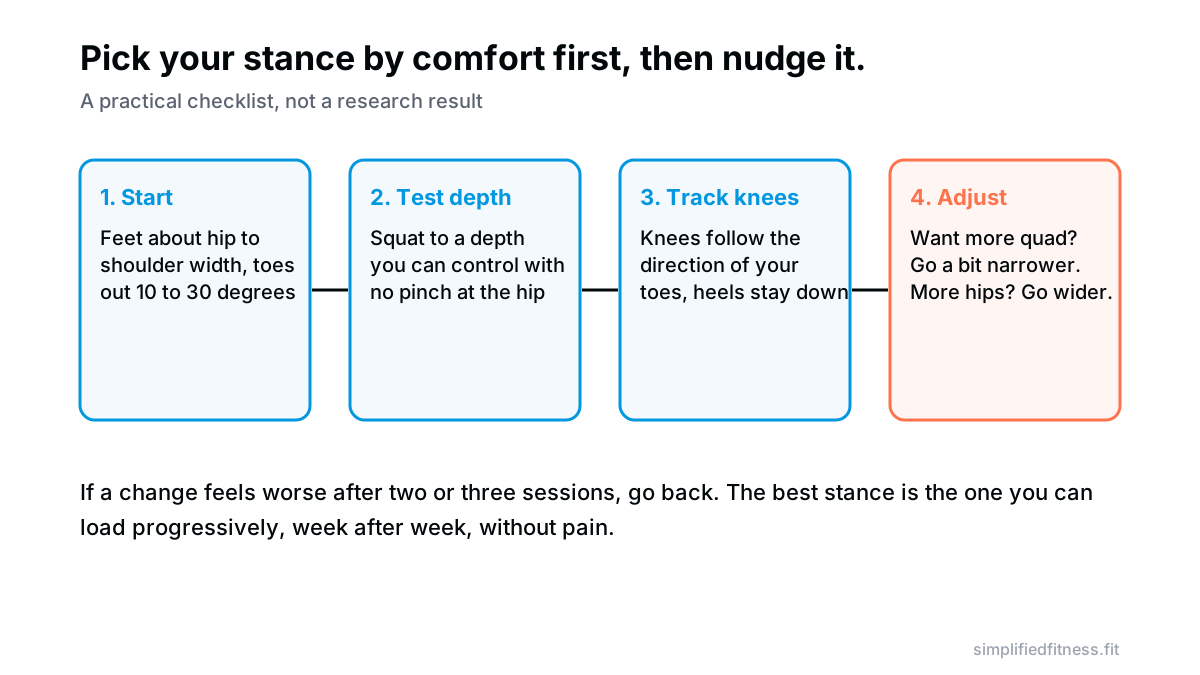
Start with feet about hip to shoulder width, toes turned out 10-30 degrees, and let comfort decide.
- Find your depth. Squat to a depth you can control, with no pinch at the front of the hip and heels flat.
- Check knee tracking. Knees should travel in line with the toes, not collapse inward.
- Test two widths. Try your current stance and one a few centimetres narrower or wider, with a light weight. Choose the one that feels strong and smooth.
- Stay put for a few weeks. Muscle grows with progressive overload, not stance hopping. Use the training volume calculator to keep your weekly sets honest.
What does this mean for Indian lifters and typical gyms?
Most commercial gyms here have a leg press, a hack squat or Smith machine, and a power rack. You do not need all of them.
If your gym has one leg press with a small platform, you will mostly use whatever foot position fits, and that is fine. If your hips are tight from long hours sitting on a desk chair or a scooter, a slightly wider, more toes-out stance may make depth easier. If you squat in a hot, crowded gym with poor bar access, a leg press with the same foot position every week is a consistent way to track progress. And if you are vegetarian, getting enough protein and hard training volume will matter more than a couple of centimetres of foot width, so check the protein calculator first.
When to see a doctor
Pain is not a stance problem to fix on your own. Sharp pain at the front of the hip, groin or knee, clicking with pain, locking, swelling or giving way are reasons to stop and see a doctor or physiotherapist. The studies here were done in healthy people, so they cannot tell you what is safe for an injured joint. We cannot diagnose anything from an article.
The bottom line on squat stance width biomechanics
Stance width and foot placement tweak the angles and load sharing between hips and knees. They do not isolate inner quad, outer quad or adductors, and long-term growth differences between stances are unproven. Pick a stance you can sit deep in with knees tracking over toes, adjust a little to taste, and keep adding load and reps. Next, read how squat depth changes things more than stance does.
Frequently Asked Questions
What is the best stance width for squats?
There is no single best width, because research reports different trade-offs rather than a winner. A stance near hip to shoulder width with toes turned out slightly suits most lifters. Choose the width that lets you reach a controlled depth without pinching at the hip, then keep it for several weeks so you can progress the load.
Does a wide stance squat work the glutes more than a narrow stance?
Possibly a little, but the evidence is mixed. In some lab studies, wide-stance squats showed higher gluteus maximus activity or higher hip extensor demand than narrow ones, while a bodyweight modelling study found glute force rose as the stance got narrower. If you want more hip involvement, go wider by a few centimetres and judge it by how the set feels and how you progress.
Does a narrow stance squat build bigger quads?
A narrow stance raises knee flexion and knee extensor demand, and musculoskeletal modelling shows higher quadriceps force in recreationally trained men. That does not prove it builds more quad muscle, because those studies were short, single-session lab tests. Use a slightly narrower stance if your quads are your priority, and keep sets close to failure.
Does a wide stance squat build bigger adductors or inner thighs?
There is no good evidence that it does. A 2024 lab study found hip adductor net joint moment did not differ between narrow, medium and wide squats, though adductors are active in the squat at depth. If the adductors are a priority, deep squats and dedicated work such as a machine or a split squat variation give you more control over the stimulus.
Can foot placement on the leg press target the inner or outer quad?
No. The vasti cross the knee only, so their job is knee extension whatever your foot position. A 2001 study found no difference in muscle activity between feet straight and feet turned out on the leg press. Place your feet for comfort and range of motion, not to chase a particular quad head.
Does high or low foot placement on the leg press change quad or glute work?
It changes hip and knee angles, and in one study a wide, high foot position raised hamstring activity versus a narrow one. The same study found no difference in knee forces between high and low foot positions. If your hips tuck under at the bottom, move your feet slightly higher or reduce depth.
How much should I turn my toes out when squatting?
Toes out roughly 10 to 30 degrees is a common starting point, and the right angle depends on your hip anatomy. The research is limited: in one bodyweight study 30 degrees of toe-out increased medial knee contact force, while a leg press study found toe angle changed neither muscle activity nor knee forces. Choose the angle where your knees track over your toes without your arches collapsing.
Should my knees go over my toes in a squat?
Knees travelling forward is normal and necessary for deep squats. What matters more is that they track in line with your toes and that your heels stay down. If you feel pressure at the front of the knee, sit back slightly, reduce depth, or try a slightly wider stance.
Is a wide stance squat safer for the knees than a narrow stance?
It depends on the joint and the measure. In a bodyweight modelling study, narrow stance raised medial knee contact force, while another study found wide-stance squats raised patellofemoral and tibiofemoral compression in the barbell squat. With any knee pain, see a doctor or physiotherapist rather than choosing a stance from a study.
Do I need to change my stance if my hips pinch at the bottom?
Often yes, because hip structure varies and a pinch at depth usually means your current stance and toe angle do not suit your anatomy. Try a slightly wider stance with toes turned out a bit more. If pain, clicking or locking persists, speak to a doctor or physiotherapist.
Do I need squat shoes or heel raises to change my stance?
No. A raised heel lets some lifters reach depth with a more upright torso, but it is optional. Try a flat shoe first, and only add a plate or lifting shoe if your heels lift off the floor.
Does stance width change how much weight I can squat?
Slightly, because it changes the joint leverage. In one study of nine men and nine women, average three-repetition-max loads ranged from about 93 to 103 kg across stance and bar placement conditions, with the low-bar narrow stance heaviest. Do not chase a heavier number; pick a stance that you can repeat with the same depth every session.
Sources & References
Every claim above is checked against peer-reviewed research (PubMed, U.S. National Library of Medicine) or guidance from established health bodies. How we fact-check.
- Escamilla RF, et al. A three-dimensional biomechanical analysis of the squat during varying stance widths. Med Sci Sports Exerc. 2001. PMID: 11404665
- Escamilla RF, et al. Effects of technique variations on knee biomechanics during the squat and leg press. Med Sci Sports Exerc. 2001. PMID: 11528346
- Lahti J, et al. Effects of barbell back squat stance width on sagittal and frontal hip and knee kinetics. Scand J Med Sci Sports. 2019. PMID: 30230052
- Hopkins JE, et al. Greater squat stance width alters three-dimensional hip moment demands. J Biomech. 2024. PMID: 39486379
- Paoli A, et al. The effect of stance width on the electromyographical activity of eight superficial thigh muscles during back squat with different bar loads. J Strength Cond Res. 2009. PMID: 19130646
- Larsen S, et al. Effects of stance width and barbell placement on kinematics, kinetics, and myoelectric activity in back squats. Front Sports Act Living. 2021. PMID: 34541522
- McCaw ST, et al. Stance width and bar load effects on leg muscle activity during the parallel squat. Med Sci Sports Exerc. 1999. PMID: 10188748
- Larsen S, et al. The impact of stance width on kinematics and kinetics during maximum back squats. J Strength Cond Res. 2025. PMID: 39652724
- Sinclair J, et al. A multi-experiment investigation of the effects stance width on the biomechanics of the barbell squat. Sports (Basel). 2022. PMID: 36136391
- Asayama A, et al. Influence of stance width and toe direction on medial knee contact force during bodyweight squats. J Biomech. 2021. PMID: 34717162
- Chiu LZF, et al. Effects of lower extremity alignment during barbell squat training on muscle volumes. J Strength Cond Res. 2025. PMID: 40570305

Umair Hazrami · Founder & Head Coach, Simplified Fitness
Umair Hazrami founded Simplified Fitness and the Simplified Lifter channel to cut through fitness noise. With 4+ years of consistent training and 10+ coaching clients, he writes every guide from the peer-reviewed research and links the sources so you can check them. Our editorial standards.
Educational content only, not medical advice. If you have a medical condition, are pregnant, or take medication, talk to a qualified doctor before changing your diet, supplements or training. Full disclaimer.
Keep reading
Exercise Technique
Anthropometry-Based Exercise Selection: Long Limbs, Short Torsos, and Lever Adjustments
Anthropometry exercise selection explained: how long femurs, long arms and a short torso change squats, deadlifts and presses, plus a simple audit and swaps.
9 min read
Exercise Technique
Axial Loading vs Non-Axial Exercises: Managing Spinal Fatigue for Bigger Legs and Back
Axial loading vs non axial exercises explained: how spinal compression limits your weekly volume, and which squat and row swaps spare your lower back.
7 min read
Exercise Technique
Cable Setup Mastery: Pulley Heights, Cable Angles, and Customizing Force Vectors
Cable machine setup guide: how to set pulley height, stance and cable angle for chest, lats, delts and arms, with what the research does and does not show.
9 min read
Exercise Technique
Compound vs Isolation Exercises for Hypertrophy: Do You Need Both?
Compound vs isolation exercises for hypertrophy: what trials say about arms, delts and hamstrings, and which muscles actually need direct sets. Sources linked.
7 min read