Line of Pull vs Muscle Fiber Orientation: Eliminating Wasted Force in Exercise Paths
Line of pull and muscle fiber orientation decide which exercise path loads a muscle. Learn to align presses, rows and raises with your chest, lats and delts.
TL;DR. The short answer
- Muscle fibers pull in a specific direction, and an exercise loads a region best when the resistance opposes that direction. This is a useful design rule, not a precise measurement.
- Bench angle measurably shifts pec activity. Studies find the upper chest is more active at about 30 degrees, and the mid and lower chest are more active on a flat bench.
- For lats, the direction the elbows travel appears to matter more than grip width. Wide, medium and narrow pulldown grips produce broadly similar lat activation.
- Acute EMG differences do not automatically become different growth. One 8-week trial in untrained men found similar strength gains from flat, incline and combined pressing.
- Pain in a joint during a lift, with no muscle burn, often means the path is fighting your anatomy. Adjust the angle, and see a doctor if pain persists.
Part of our complete guide: Exercise Selection Biomechanics: Moment Arms, Strength Curves and Free Weights vs Machines
Table of contents
Line of pull and muscle fiber orientation come down to one rule: a muscle works hardest when the resistance directly opposes the direction its fibers shorten along. If the load pulls across the fibers instead, part of it ends up stressing the joint rather than the muscle you are trying to train.
That is the practical core of the exercise selection and biomechanics guide, and this article zooms in on one skill: reading a muscle’s fibers, then choosing a bench angle, elbow path or cable direction to match. The research here is mostly acute EMG, which measures how active a muscle is during a set, so I will flag where it stops short of proving growth.
What does line of pull mean?
Every muscle has fibers that run in a particular direction between two attachments. When they contract, they shorten along that line. That direction is the line of pull.
Many muscles are not one neat rope. The pec, lat and deltoid are broad and fan out, so different regions have different lines of pull. That matters, because it means “chest” is not one target. It is at least two.
Now the other half: resistance direction. Gravity pulls straight down on a dumbbell. A cable pulls toward the pulley. A machine pulls along its cam path. Whatever the source, you can draw an arrow for it.
When the resistance arrow points directly against the fiber arrow, the fibers carry the load. When the two arrows sit at an angle, only part of the load acts along the fibers.
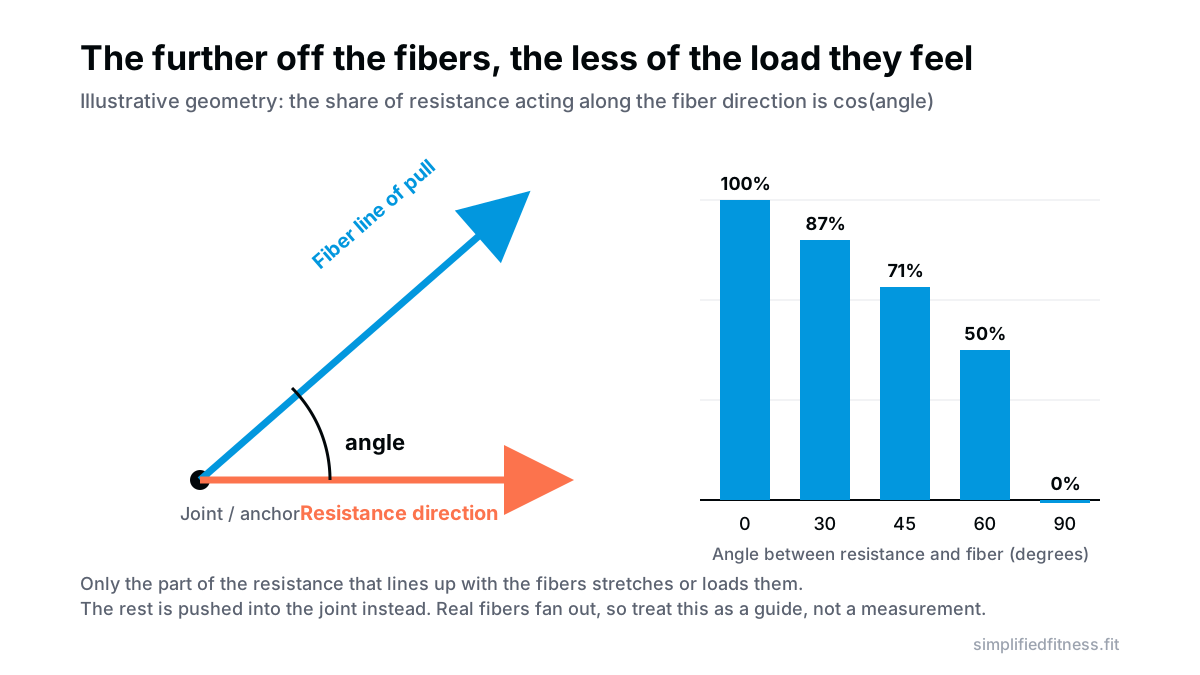
The numbers in that figure are simple trigonometry (the cosine of the angle), so treat them as a mental model. Real fibers fan out and joints move through arcs, so no lift stays perfectly aligned from start to finish.
Why does wasted force matter?
Think of two lifters doing the same cable movement with the same weight. One sets the cable so it opposes the fibers. The other sets it at a bad angle. The second lifter is still working, but more of the effort goes into holding the joint in place, and the target muscle gets a weaker signal.
You usually notice this as one of three things:
- you feel a joint (front of the shoulder, elbow, wrist) more than the muscle
- your weights go up but the target muscle does not seem to change
- you “cheat” by shifting your body until the lift feels natural
None of those prove anything on their own, and joint discomfort has many causes. Still, they are a good prompt to try a different angle before you blame your genetics.
How does bench angle change which part of the chest works?
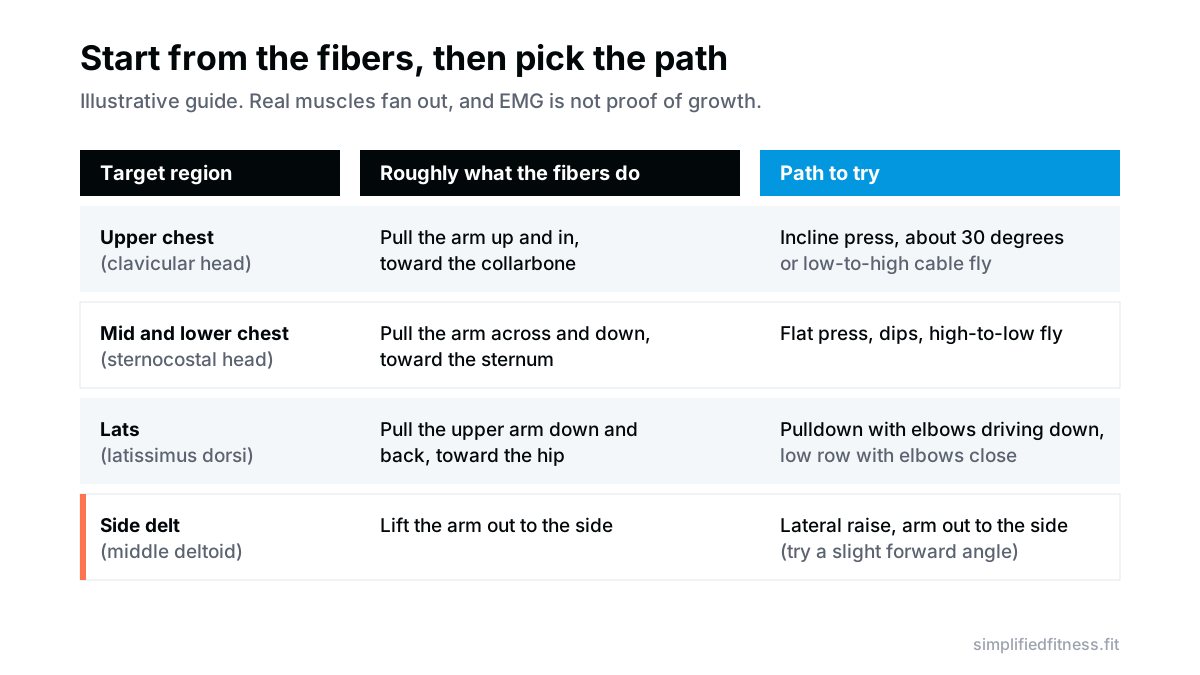
The pec has at least two regions that matter for training. The clavicular head attaches near the collarbone, and its fibers pull the arm up and in. The sternocostal head attaches along the breastbone and ribs, and its fibers pull the arm across and down.
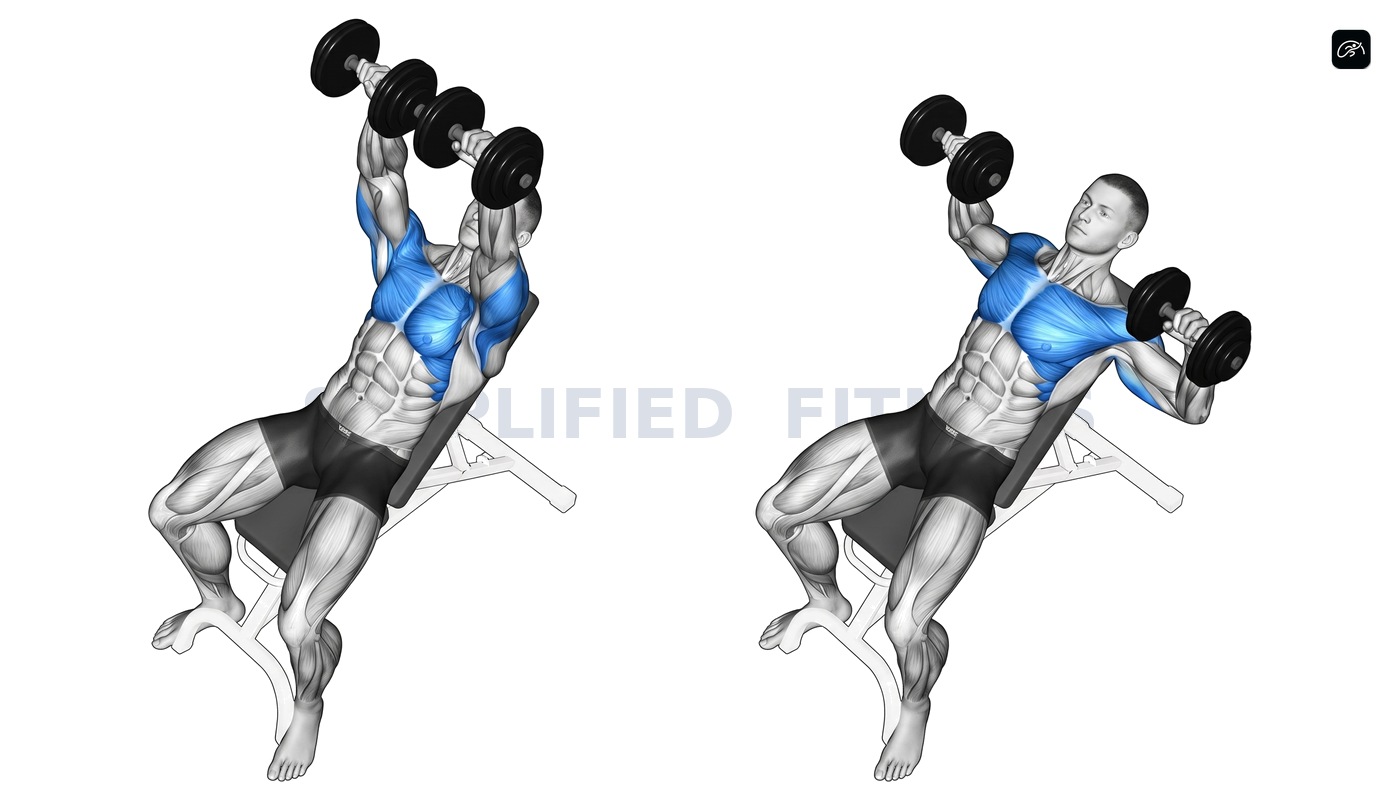
So an incline press, where the arms move upward, should favor the upper head. Does the research agree? Mostly, yes.
- In 14 resistance-trained men, upper pec EMG was higher at 30 and 45 degrees than flat or declined, but only during one portion of the lift. Lower pec activity was lower at 45 degrees than at the other angles (Lauver et al., 2016).
- In 30 trained adults tested at five angles, upper pec activity peaked at 30 degrees, while the middle and lower pec were higher flat. Angles above 45 degrees increased front delt activity and the authors noted reduced pec performance (Rodriguez-Ridao et al., 2020).
- With high-density EMG in 8 volunteers, activity shifted toward the clavicular region when the bench went from flat to 45 degrees (Cabral et al., 2022).
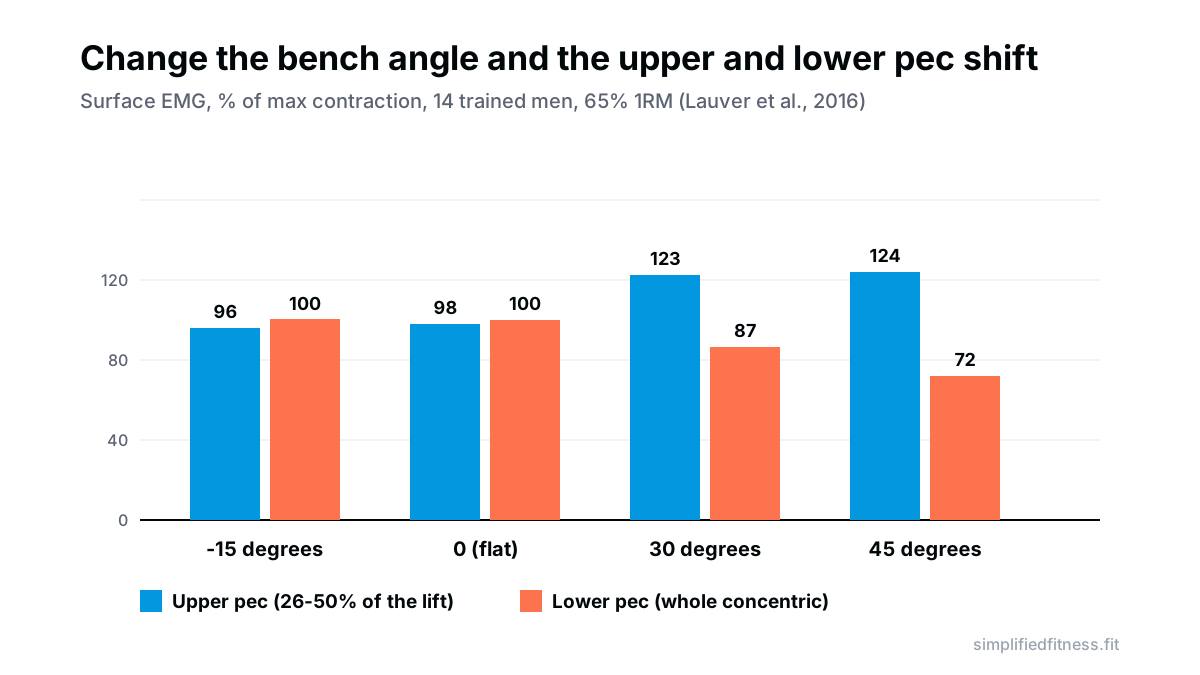
Does that change growth? A small follow-up study of 13 men found that after four sets, the clavicular head’s cross-sectional area (measured on ultrasound) rose more after incline pressing, and the sternocostal head’s after flat pressing (Albarello et al., 2022). That is acute swelling, not long-term muscle growth, so read it as supportive rather than conclusive.
When the research disagrees
Here is the conflicting piece. In an 8-week trial, 47 untrained men trained flat, incline or both once a week with equal sets. Strength gains were similar across groups, and muscle thickness differed at only one of three sites, favoring incline at the second intercostal space (Chaves et al., 2020).
Why the gap with the EMG studies? The trial used untrained men, trained only once a week, and measured at a few ultrasound sites. EMG studies use trained lifters but look at one session. Neither design can say what happens over a year in an experienced lifter.
Cautious takeaway: use both. A flat press covers the bulk of the chest, and an incline at about 30 degrees adds extra work where the upper fibers are more active. You do not need to be precious about the exact number. For a full breakdown of angles, see incline vs flat bench press for the upper chest.
Where should lat fibers be loaded from?
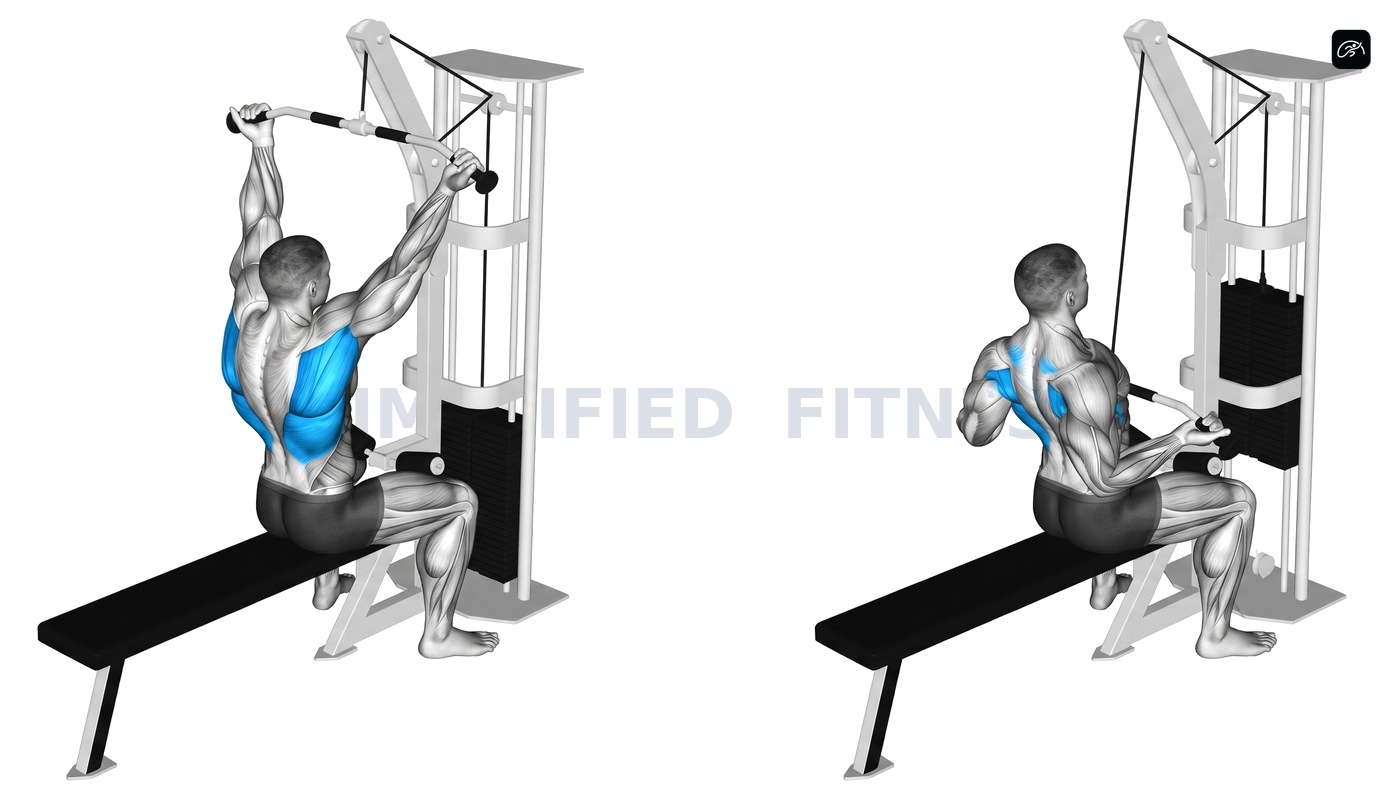
The lats run from your spine and pelvis up and out to the front of your upper arm bone. Roughly, they pull the upper arm down and back toward your hip. That points to a simple cue: the elbow should travel down and back, not just bend.
What about grip? Gym lore says go wide. The evidence is much less clear.
- In 15 men, narrow, medium and wide pronated grips (1, 1.5 and 2 times shoulder width) gave similar lat EMG across the whole movement. Wide was slightly weaker in 6RM load, and the authors suggested similar hypertrophy is likely with grips of 1-2 times shoulder width (Andersen et al., 2014).
- A 2026 narrative review of 23 studies found an anterior bar path (the bar traveling in front of the face) was the configuration most consistently linked to higher lat EMG, while grip width effects were inconsistent. In the seated row, narrower grips and a lower shoulder-abduction angle were each associated with higher lat activity in separate studies, and the authors stress this is acute EMG rather than long-term results (Di Fonza et al., 2026).
That fits the fiber logic. Where the elbows go determines the direction of the pull, and grip width mostly changes comfort and how your hands feel.
How do you line up the side delts and the rest of the shoulder?
The deltoid has three heads, and each has a different job. The front head raises the arm forward, the side head lifts it out, and the rear head pulls it back.
Rotation changes the picture. In 10 competitive bodybuilders, the side delt was most active in a neutral lateral raise, internal rotation increased rear delt, triceps and upper trap activity, and external rotation shifted more work to the front delt (Coratella et al., 2020). The sample was small and all participants were bodybuilders, so it may not transfer directly to beginners.
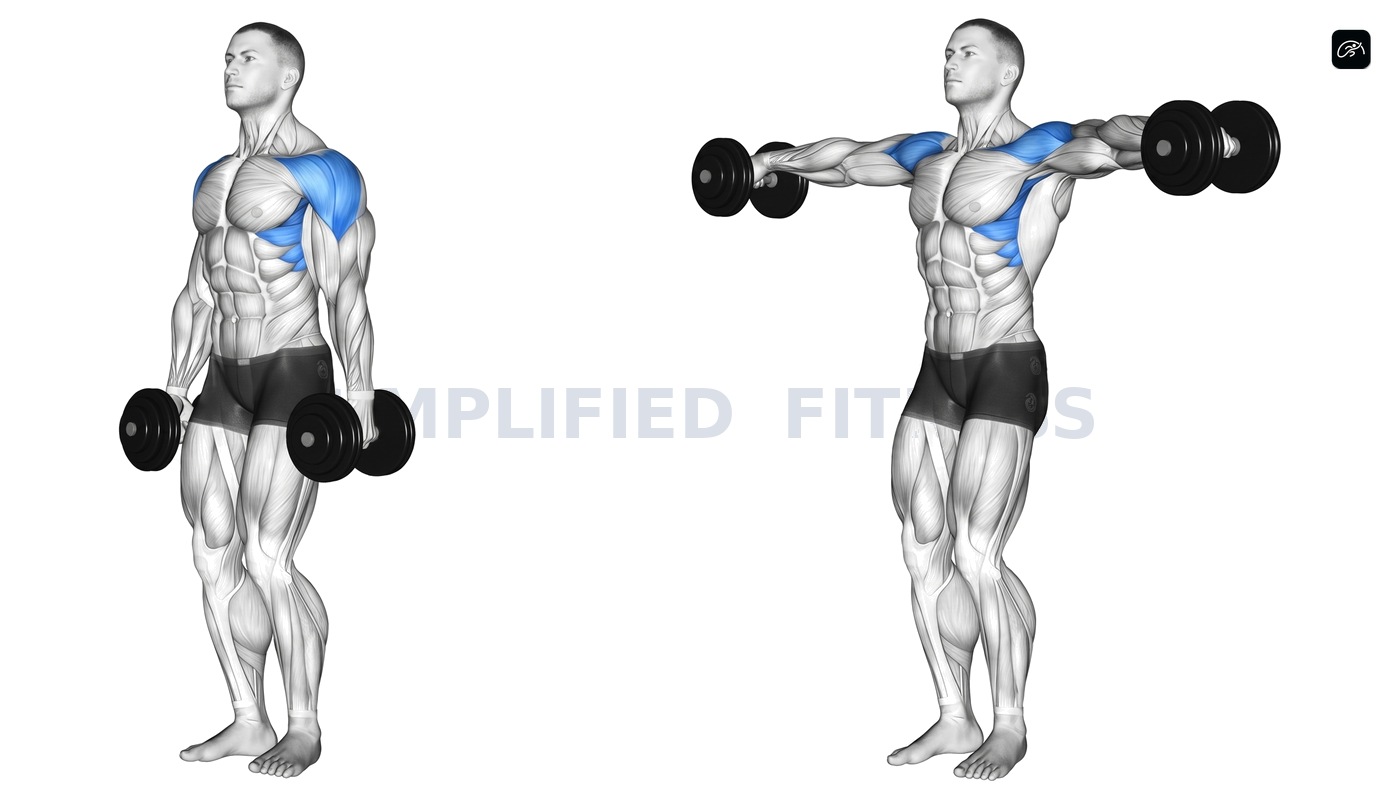
Practical translation: keep the elbow slightly bent, lead with the elbow rather than the hand, and avoid tipping the dumbbell so the pinky points up.
Joint strain without muscle load: how to spot it
Rotary force is the part of a load that tries to turn a joint instead of stretching the working fibers. When it dominates, you tend to feel pinching, pulling or achiness in the joint and little in the muscle.
Here is a simple check list:
- Do you feel the target muscle within the first few reps?
- Does the weight move on a smooth, repeatable path?
- Can you pause for a second at the hardest point without your body twisting?
If the answer to the first is no, change the angle by small steps (5-10 degrees, one hand width on the grip, one pulley notch). Do not change everything at once.
Joint pain is not automatically a line of pull problem. If pain is sharp, lingers after training, wakes you at night or comes with numbness or weakness, see a doctor or physiotherapist before you keep loading it.
What does this mean in a normal week?
You do not need a new exercise for every fiber. A simple template is enough:
- Chest: one flat press and one incline around 30 degrees per week. Add a fly with a cable path that matches the head you want to emphasize. We cover setups in cable setup mastery.
- Back: one vertical pull and one row, thinking about elbow path first and grip second.
- Shoulders: presses and bench work cover the front delts for most people, so lateral raises with a clean path carry the side delts.
If your body proportions make a movement awkward, that is normal. Limb length changes the path, which we explain in anthropometry-based exercise selection. The physics of why angles change the difficulty is in moment arms and joint torque, and how the resistance changes over the rep is covered in matching resistance profiles to strength curves.
Tracking total hard sets per muscle is a better habit than chasing perfect angles. Use the training volume calculator to count your weekly sets, or follow the free push day plan as a ready-made chest, shoulder and triceps session.
What the research cannot tell you
A few honest limits:
- Most of the data above is surface EMG. It shows activation in one session, and it can be influenced by electrode placement, normalization and how the muscle fans out.
- Sample sizes are small, often 8-15 people, and mostly young men.
- Long-term trials comparing angles are few, and the one I cited used untrained men for 8 weeks.
- Even where the angle changes activation, the extra growth from it may be small. Consistent hard training, enough protein and recovery matter more.
So the rule is a design tool, not a promise. Align the path sensibly, keep what you feel working, and judge it by your progress over months.
Bottom line
Match the direction of the load to the direction of the fibers you want to train. Use roughly 30 degrees for the upper chest, drive the elbows down and back for lats, and keep lateral raises clean for the side delts. Do not expect grip width or tiny angle tweaks to transform your results.
Frequently Asked Questions
What is line of pull in muscle anatomy?
Line of pull is the direction a muscle's fibers shorten along when they contract. Each muscle, or region of a muscle, has its own direction based on where it attaches. When you pick an exercise, aim to move the resistance directly against that direction so the fibers do the work.
Why does muscle fiber orientation matter for exercise selection?
Fibers produce force along their own length, so resistance that opposes them loads them more directly than resistance that cuts across them. Studies using electromyography show different regions of one muscle switch on at different bench angles. Use that to choose a path that matches the region you want to train.
Does incline bench press really target the upper chest?
Mostly yes, in terms of activation. A 2020 study in 30 trained adults found upper pec activity peaked at 30 degrees, and a 2022 study found the clavicular head was more active than the sternocostal head on a 45 degree incline. Use 30 degrees as a starting point and keep a flat press for the rest of the chest.
What is the best incline angle for upper chest?
Around 30 degrees looks like the best-supported starting point. In a 2020 study with five angles, upper pec EMG peaked at 30 degrees, while angles above 45 degrees raised front delt activity and, in the authors' words, decreased pec performance. Try 25-35 degrees and keep the one where you feel your chest, not your shoulders.
Does grip width change lat activation on pulldowns?
Probably only a little. A study of 15 men found similar lat EMG across narrow, medium and wide grips, and a 2026 narrative review called the effects of grip width inconsistent. Pick a grip where your elbows travel down comfortably and your shoulders feel fine.
Where should I feel a lat pulldown?
You should feel it in the sides of your back under your armpits, with your elbows driving down toward your hips. If the burn is mostly in your forearms and biceps, you are probably curling the bar. Think about pulling your elbows to your ribs, not pulling the bar with your hands.
What is a rotary force in lifting?
A rotary force is the part of the resistance that tries to spin a joint instead of being absorbed by the target muscle's fibers. In plain terms, it is load that stresses the joint without loading the muscle you want. Reduce it by changing the angle until the resistance runs against the working fibers.
Can the wrong line of pull cause shoulder pain?
It can contribute, but pain has many causes and no single cause can be assumed. A path that forces your shoulder into an awkward position under load may feel uncomfortable even when the target muscle is working. Change the angle or the exercise, and see a physio or doctor if pain is sharp, persistent or comes with numbness.
How do I hit the side delts with lateral raises?
Lift the arm out to the side so the middle deltoid does the work, and stop shrugging with your upper traps. A study of bodybuilders found that rotating the arm internally shifted work toward the rear delts, triceps and upper traps. Keep the arm roughly neutral, thumb forward, and lift with the elbow.
Is EMG proof that an exercise builds more muscle?
No. EMG shows how active a muscle is during a set, not how much it will grow over months. One 8-week trial in 47 untrained men found flat, incline and combined bench pressing built similar strength, though thickness changed more at one pec site with incline. Use EMG as a clue and let your training results decide.
Do I need to change my angles every workout?
No. Pick a sensible angle, keep it for several weeks and progress the load or reps. Constantly changing angles makes it hard to see whether you are getting stronger. Rotate angles across a training block, not within one session.
How do cables help with matching line of pull?
Cables keep tension in the direction of the cable, so you can set the pulley to line up with the fibers you want. Dumbbells only pull straight down, which is why the bench or your body has to change angle. Our guide on cable setup covers pulley heights in detail.
Sources & References
Every claim above is checked against peer-reviewed research (PubMed, U.S. National Library of Medicine) or guidance from established health bodies. How we fact-check.
- Lauver JD, et al. Influence of bench angle on upper extremity muscular activation during bench press exercise. Eur J Sport Sci. 2016. PMID: 25799093
- Rodriguez-Ridao D, et al. Effect of five bench inclinations on the electromyographic activity of the pectoralis major, anterior deltoid, and triceps brachii during the bench press exercise. Int J Environ Res Public Health. 2020. PMID: 33049982
- Cabral HV, et al. Non-uniform excitation of the pectoralis major muscle during flat and inclined bench press exercises. Scand J Med Sci Sports. 2022. PMID: 34644424
- Albarello JCDS, et al. Non-uniform excitation of pectoralis major induced by changes in bench press inclination leads to uneven variations in the cross-sectional area measured by panoramic ultrasonography. J Electromyogr Kinesiol. 2022. PMID: 36334406
- Chaves SFN, et al. Effects of horizontal and incline bench press on neuromuscular adaptations in untrained young men. Int J Exerc Sci. 2020. PMID: 32922646
- Andersen V, et al. Effects of grip width on muscle strength and activation in the lat pull-down. J Strength Cond Res. 2014. PMID: 24662157
- Di Fonza D, et al. Electromyographic analysis of latissimus dorsi activation during common resistance training exercises: a narrative review. J Funct Morphol Kinesiol. 2026. PMID: 42647355
- Coratella G, et al. An electromyographic analysis of lateral raise variations and frontal raise in competitive bodybuilders. Int J Environ Res Public Health. 2020. PMID: 32824894

Umair Hazrami · Founder & Head Coach, Simplified Fitness
Umair Hazrami founded Simplified Fitness and the Simplified Lifter channel to cut through fitness noise. With 4+ years of consistent training and 10+ coaching clients, he writes every guide from the peer-reviewed research and links the sources so you can check them. Our editorial standards.
Educational content only, not medical advice. If you have a medical condition, are pregnant, or take medication, talk to a qualified doctor before changing your diet, supplements or training. Full disclaimer.
Keep reading
Exercise Technique
Anthropometry-Based Exercise Selection: Long Limbs, Short Torsos, and Lever Adjustments
Anthropometry exercise selection explained: how long femurs, long arms and a short torso change squats, deadlifts and presses, plus a simple audit and swaps.
9 min read
Exercise Technique
Axial Loading vs Non-Axial Exercises: Managing Spinal Fatigue for Bigger Legs and Back
Axial loading vs non axial exercises explained: how spinal compression limits your weekly volume, and which squat and row swaps spare your lower back.
7 min read
Exercise Technique
Cable Setup Mastery: Pulley Heights, Cable Angles, and Customizing Force Vectors
Cable machine setup guide: how to set pulley height, stance and cable angle for chest, lats, delts and arms, with what the research does and does not show.
9 min read
Exercise Technique
Compound vs Isolation Exercises for Hypertrophy: Do You Need Both?
Compound vs isolation exercises for hypertrophy: what trials say about arms, delts and hamstrings, and which muscles actually need direct sets. Sources linked.
7 min read