External Stability in Resistance Training: Why Chest Support Makes Rows and Curls Feel More Targeted
External stability resistance training means bracing your body so the target muscle does the work. See what the research says, and which swaps are worth making.
TL;DR. The short answer
- External stability means a pad, bench, seat or pole holds your torso still, so your muscles do not have to. The saved effort can go into the muscle you actually want to train.
- Studies on unstable bench pressing in trained men found lower prime mover activity and about 7-8% lower 6RM loads than on a stable bench. Less stability tends to mean less output from the target muscle.
- The claim that your brain actively shuts down prime movers when you balance is a plausible idea, not a proven mechanism. The measurable effects are lower force, lower load and more torso work.
- No long-term trial has directly compared chest-supported and free-standing versions for muscle growth. Treat the case for supported exercises as strong reasoning backed by indirect evidence.
- Supported exercises are tools, not replacements. Keep some free-standing lifts if you want the whole body to practise bracing.
Part of our complete guide: Exercise Selection Biomechanics: Moment Arms, Strength Curves and Free Weights vs Machines
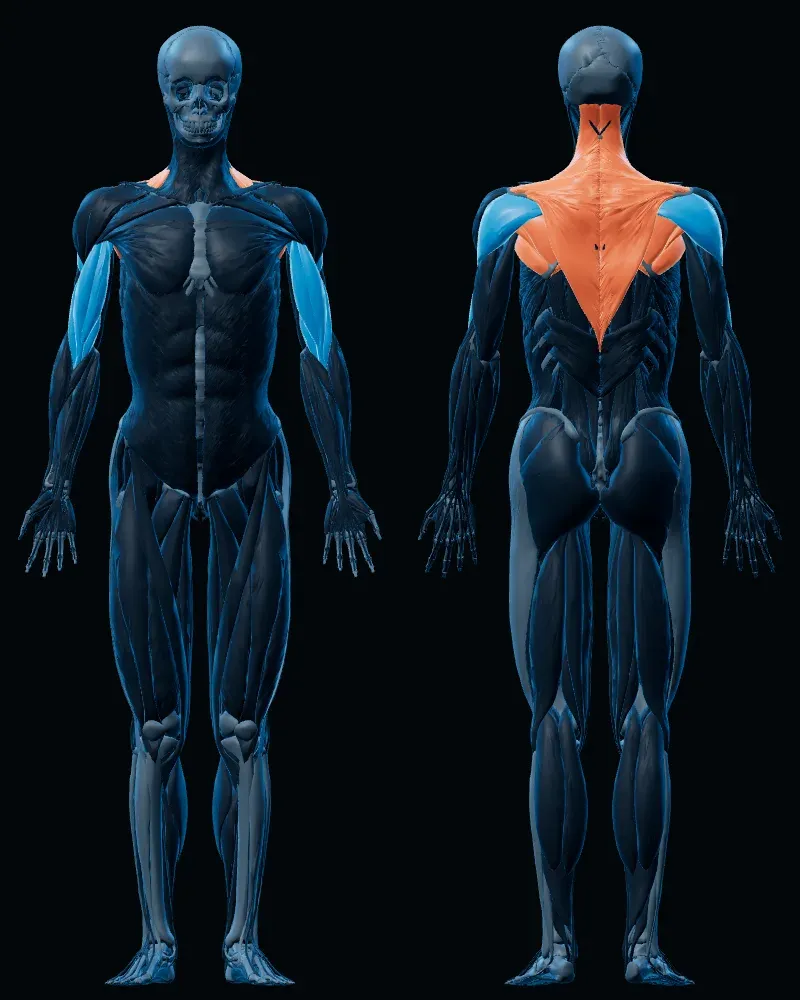
Muscles worked: upper back
Main movers: traps, rhomboids, teres major, infraspinatus and teres minor
Assisting: rear delts, biceps and brachialis
Table of contents
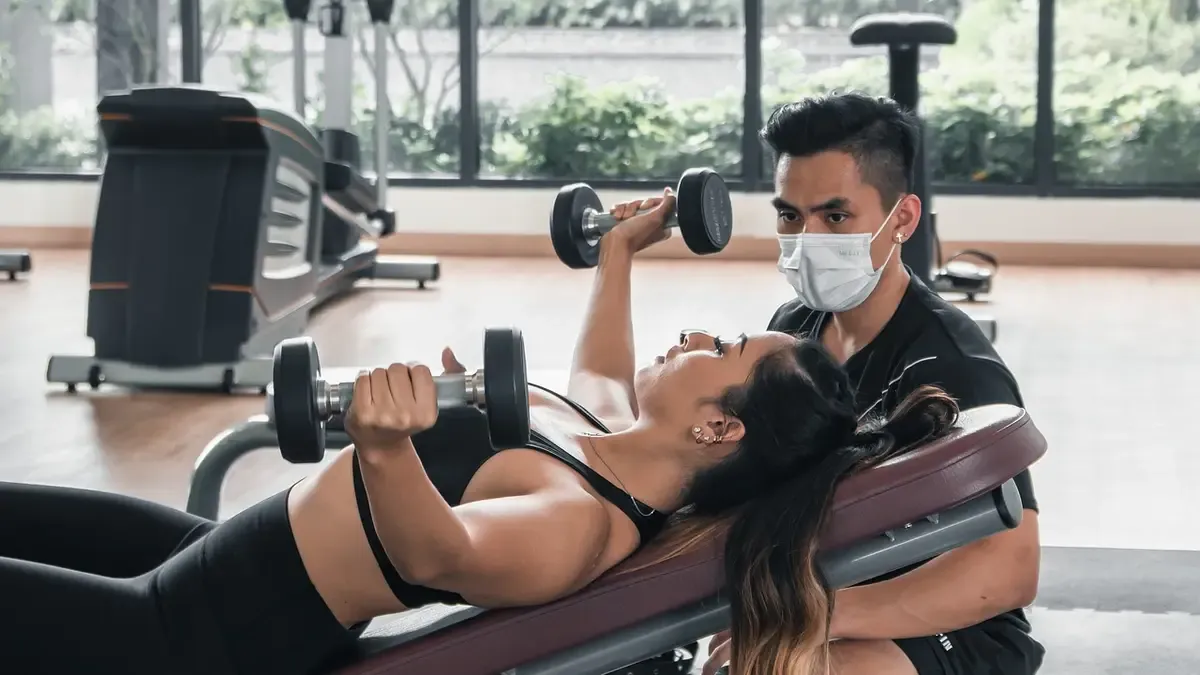
External stability resistance training is simple to say: you let a pad, a seat or a bench hold your body still, so your muscles do not have to. The effort you save goes into the muscle you are trying to train. That is why a chest-supported row feels like it lives in your back, while a heavy bent-over row can end with a tired lower back before your lats feel finished.
This article sits inside our guide to exercise selection and biomechanics and covers one principle in it. I will also be upfront about something. The popular explanation, that your brain shuts down the prime movers when you have to balance, is not as settled as it sounds online. We will separate what is measured from what is guessed.
What does external stability mean in resistance training?
Every lift has two jobs. One is moving the load with the prime movers (lats on a row, biceps on a curl). The other is keeping the rest of you in a position where that movement can happen (spine, hips, shoulder blades, feet).
External stability is anything outside your body that does the second job for you:
- A chest pad on a row or T-bar
- A seat back on a press or pulldown
- A preacher pad under your upper arm
- A bench or pole you brace a hand against during single-arm cable work
- A machine frame that fixes the path of the weight
Internal stability is what you supply yourself, mostly with your trunk and hips. Neither one is good or bad. The question is which one fits your goal for that exercise.
Why do stable setups feel more targeted?
Think about a heavy bent-over row. Your lats and upper back pull the bar. Meanwhile your lower back, glutes and hamstrings hold a hinged position against gravity for every second of the set. If the lower back gets tired first, the set ends, and your lats were never pushed to their limit.
Now add a chest pad. The torso is held. The only thing left to fail is the muscle doing the pulling.
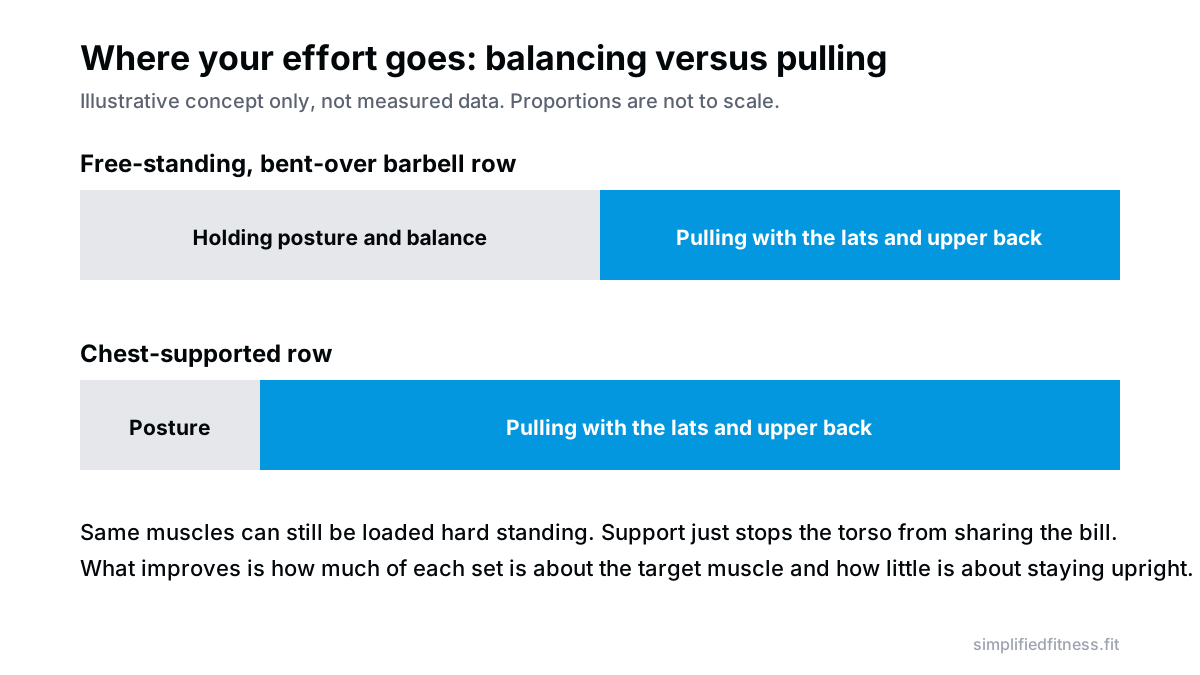
In coaching terms, this is a stimulus-to-fatigue idea. You want the most useful work for the target muscle per unit of tiredness you pay. If you want to go deeper on that framework, read our piece on stimulus-to-fatigue ratio in exercise selection.
What does the research actually show?
There is no study that put one group on chest-supported rows and another on standing rows for months and measured muscle growth. So the case rests on indirect evidence. Here is what that evidence is.
Less stability usually means less output
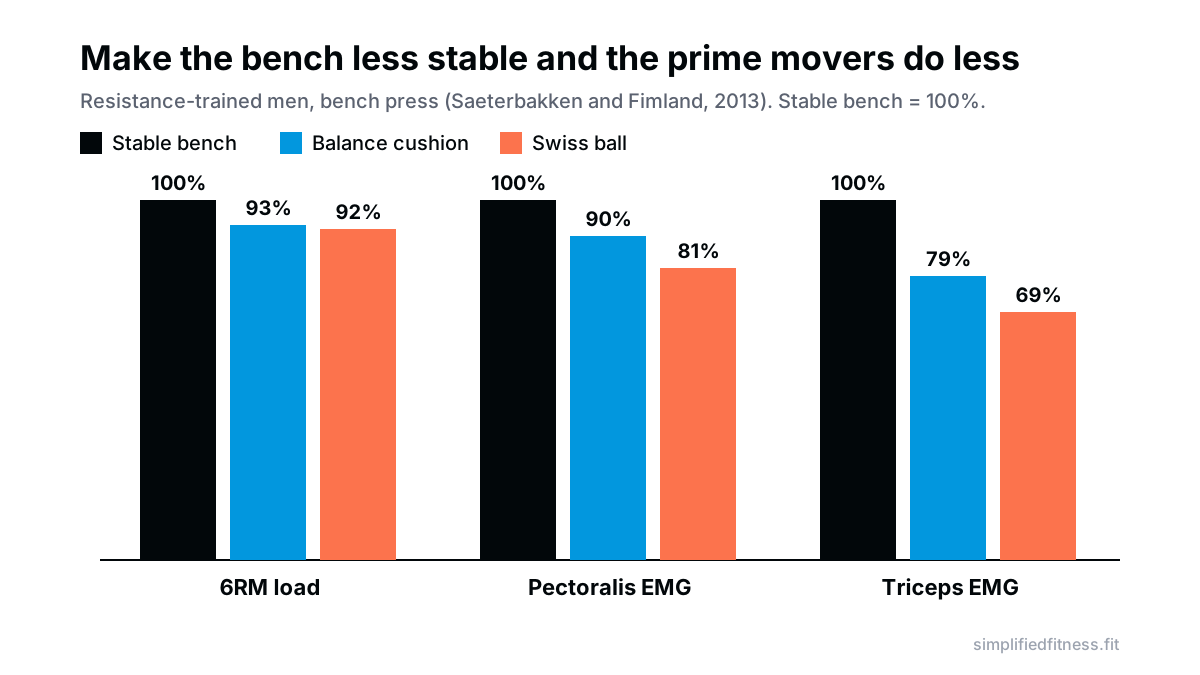
Saeterbakken and Fimland tested 16 resistance-trained men on the bench press using a stable bench, a balance cushion and a Swiss ball (Saeterbakken et al., 2013). Compared with the stable bench, 6RM strength was about 93% on the cushion and about 92% on the Swiss ball. Pectoralis EMG was about 90% (cushion) and 81% (Swiss ball), and triceps EMG about 79% and 69%. The authors concluded the unstable surfaces had an inferior effect on activation of the prime movers and on strength.
A different design, same direction. Kohler and colleagues had 30 resistance-trained people do seated shoulder presses with barbells or dumbbells, on a bench or a Swiss ball (Kohler et al., 2010). As instability went up, the external load went down. Triceps activation was highest with the barbell on the bench and lowest with dumbbells on the Swiss ball. The authors said the findings gave little support for training lighter on unstable setups.
Koshida and colleagues found a smaller penalty in 20 male collegiate athletes doing single bench press repetitions at 50% of 1RM on a Swiss ball versus a flat bench (Koshida et al., 2008). Peak force fell about 6% and power and velocity about 10%. They argued such small drops may not compromise training effects.
So the direction is consistent (less stability, less output) while the size varies by exercise and method.
The review that ties it together
Behm and colleagues reviewed instability training and concluded that unstable devices are not recommended as the primary exercises for hypertrophy, absolute strength or power, particularly in trained athletes (Behm et al., 2010). They did see value for core training, balance and rehab. That fits what we would expect: instability is a tool for stabilizers, not for the prime movers.
What about the rowing data?
Fenwick and colleagues studied seven healthy men performing an inverted row, a standing bent-over row and a standing one-arm cable row (Fenwick et al., 2009). The inverted row, where you hang under a bar with your heels on the floor, gave the highest lat and upper back activation along with the lowest lumbar load. The standing bent-over row gave large activation across the whole back but also the largest lumbar spine load. The one-arm cable row challenged the trunk’s torsional capacity.
That is a small study, and an inverted row is not a chest-supported row. What it does show is a trade-off: the row that did not require holding a hinged torso against gravity had the lowest spine load and still drove the back muscles hard. A chest pad removes that hinge demand too, but nobody has measured it in this way. (Compare this with how chest-supported rows build the upper back and T-bar rows done chest-supported versus standing.)
Does the brain really shut down muscle output when you balance?
You will see this claim a lot: when the body must stabilize, the brain automatically limits motor output to the prime movers as a protective measure. It sounds scientific, and it may be partly right. But none of the studies above tested that mechanism. They measured lower loads and lower EMG, not a neural inhibition circuit.
Here is what we can say with confidence.
- When the base gets less stable, trained lifters lift less, and in the bench press and seated press studies the prime movers showed less activity too (Saeterbakken and Fimland, Kohler).
- When the torso must be held without support, the trunk muscles become part of the limiting factor.
- Why exactly that happens is open. A protective neural limit is one explanation. Simple fatigue sharing, safety margins and coordination are others.
I would treat the brain-inhibition idea as a reasonable hypothesis and not build a training plan on it. The practical conclusion does not depend on it anyway.
Where the evidence is mixed
Two findings complicate the tidy story.
Standing versus seated presses. In a study of 15 men, the exercise with the highest stability requirement (standing with dumbbells) showed the highest deltoid activity, even though it had the lowest 1RM (Saeterbakken and Fimland, 2013). Posterior deltoid activity was about 25% lower seated than standing with a barbell. That is the opposite of “more support equals more target muscle activation.”
My guess, and it is only a guess, is that standing adds a balance and control demand that the deltoids help with, so they show more electrical activity even though you lift less. Either way, more EMG at a lighter load does not prove a better growth stimulus. A companion study from the same group found core activity (rectus abdominis and external obliques) was much lower seated than standing, while erector spinae activity was similar (Saeterbakken and Fimland, 2012). So sitting clearly reduces trunk demand, but its effect on the prime movers is less tidy.
Task specificity. In a 10-week trial, 36 resistance-trained men trained chest press on a Swiss ball, a Smith machine or with dumbbells, and no group differences in prime mover EMG were found (Saeterbakken et al., 2016). The more unstable groups showed more task-specific strength gains in the trained lift. Muscle size was not measured, so this tells us about skill and strength specificity, not growth.
Where does this leave us? On the bench press, less stability lowered both the load and prime mover EMG. On the shoulder press, the least stable version lifted the least but showed the most deltoid EMG. Load and EMG do not always move together, and neither is a direct measure of growth. The safe takeaway is to use support when your aim is to load the target muscle heavily, and keep some free-standing work for everything else.
Does stability help you train closer to failure?
The idea is attractive. If your balance and spine hold up, you can take the target muscle nearer to its limit and judge how many reps you have left more honestly.
Be careful with how far you push that. A systematic review with meta-analysis of 15 studies found no evidence that training to momentary muscular failure was superior to non-failure training for hypertrophy, and it suggested a possible non-linear relationship between proximity to failure and growth (Refalo et al., 2023). So support is not a ticket to grind every set into the floor.
What it does do is make hard sets cleaner. A set that ends because the lats are done is more useful than a set that ends because your lower back is cooked or your torso starts swaying.
Which exercises have a supported version worth using?
Here is where it applies in a typical week.
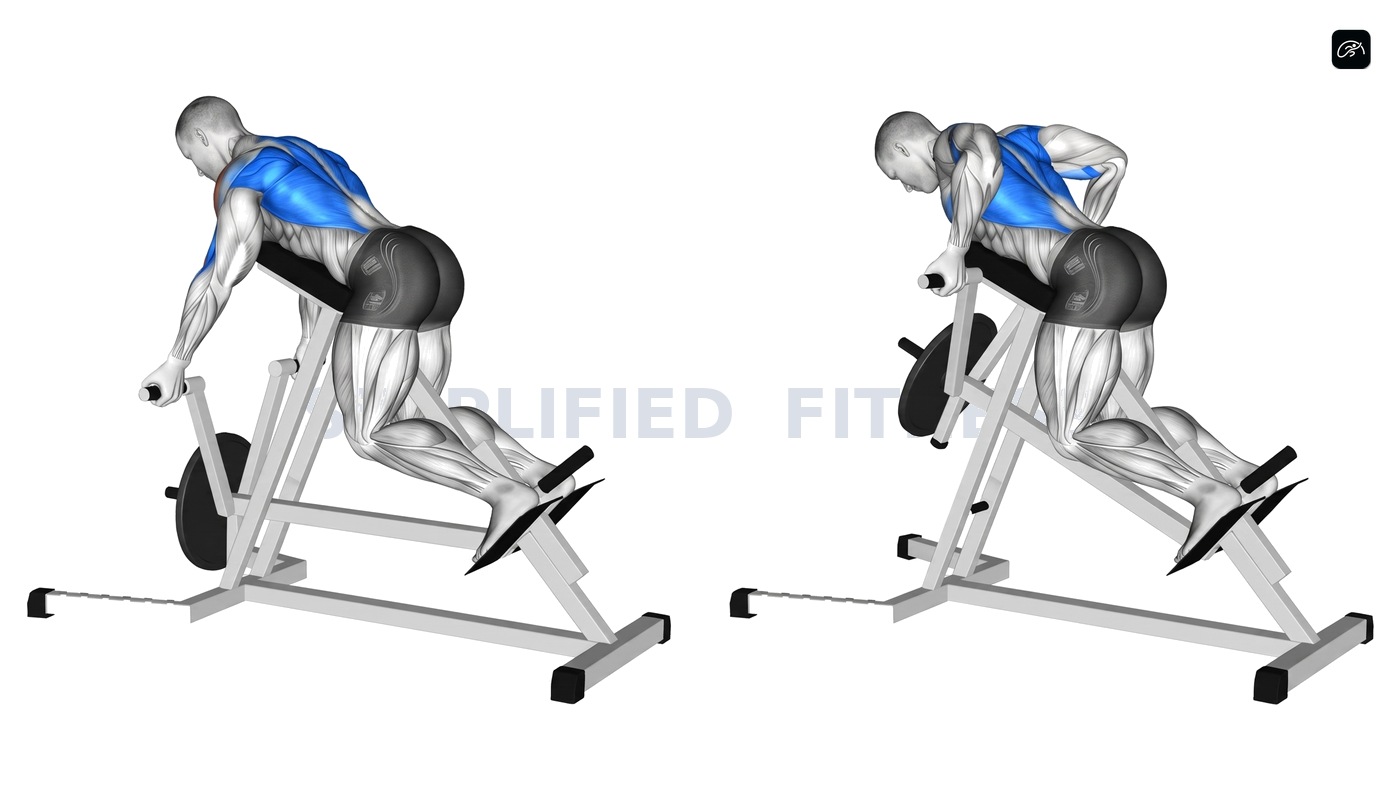
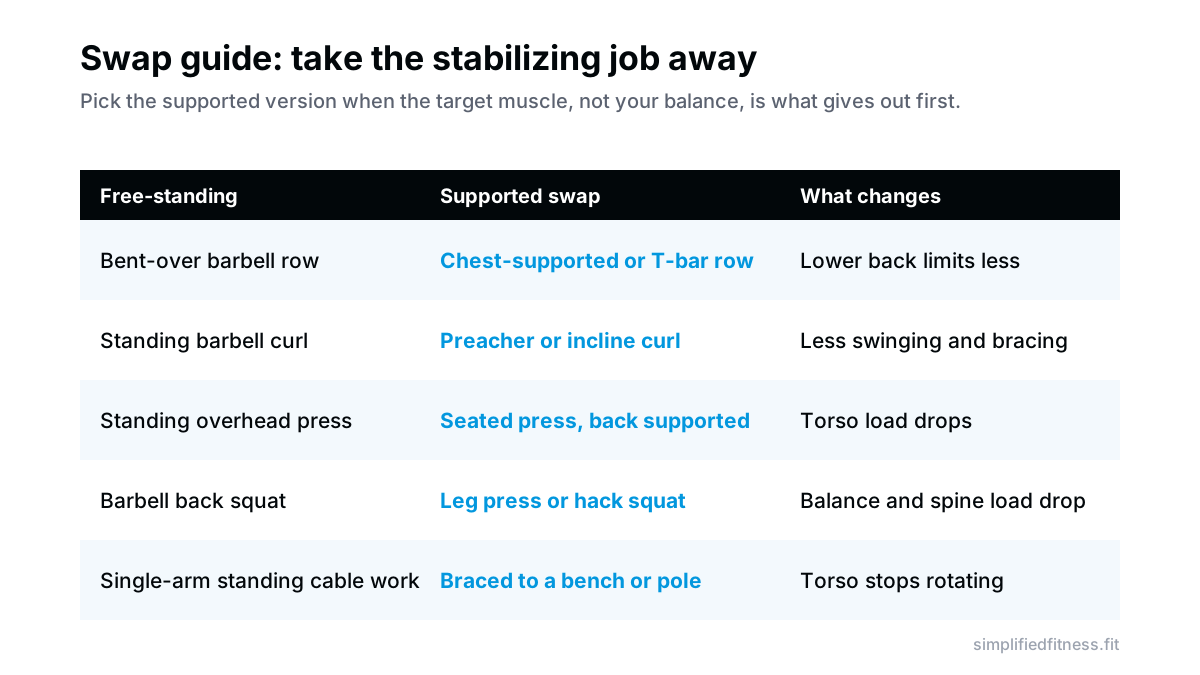
- Rows. Chest-supported dumbbell rows, T-bar rows with a pad, and machine rows. These often let you load the back without your lower back deciding the set.
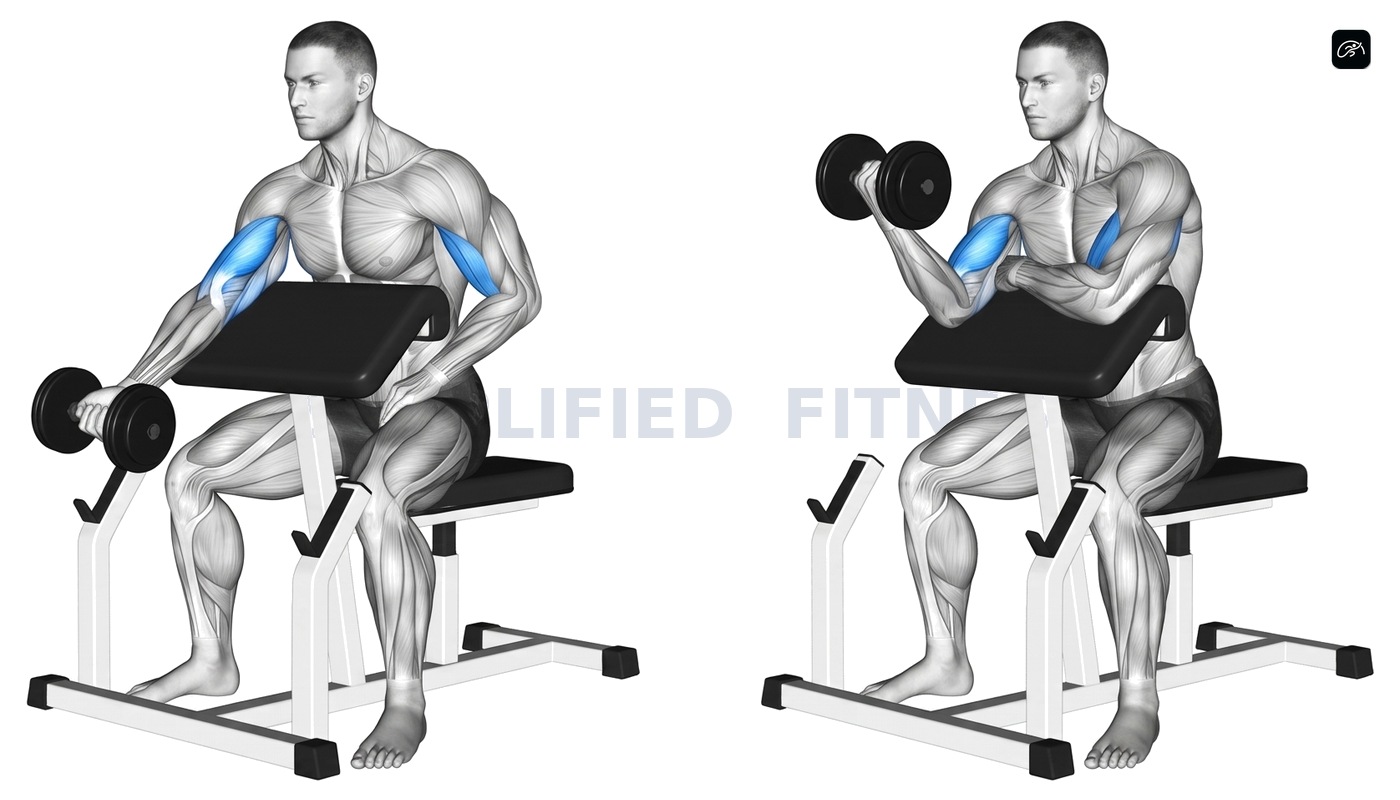
- Curls. Preacher curls and incline curls fix the upper arm or the torso, which reduces swinging. See preacher curls and peak tension.
- Presses. A seated dumbbell press with a back pad removes some of the bracing demand.
- Legs. Leg press, hack squat and leg extensions take balance and spine load out of the equation compared with a free barbell squat.
- Single-arm cable work. Brace your free hand on a bench or pole so your torso does not twist. Our guide to cable setup, pulley heights and angles covers positions in more detail.
When should you not remove stability?
Support is a tool, and tools have costs.
- You train your trunk less. That is the point of the swap, but it is also the trade-off. Keep squats, carries, or rows with some torso demand if you care about trunk strength.
- Real life is not braced. Lifting a suitcase or a child is a free-standing task. Core work and free-standing lifts still matter for that.
- Your gym might not have the kit. A bench and a dumbbell can make a chest-supported row: lie face down on an incline bench and row. No machine needed.
- Some free-weight lifts are worth the stabilizer cost. Squats, deadlifts and overhead presses train a lot at once. Our comparison of free weights, cables and machines shows how to mix them.
Instability on purpose, like a Swiss ball or BOSU, is a separate tool for balance, rehab and core training. It is not a good main tool for building the prime movers, per the review above.
A simple way to use this
You do not need to rebuild your routine. Start with one change.
- Find the exercise where something other than the target muscle ends your set. Lower back on rows, swinging on curls, balance on single-leg work.
- Swap in a supported version for the same muscle.
- Keep the rep range and effort the same, around 6-12 reps, stopping a rep or two before you would fail. Use our RIR and RPE calculator if you are unsure how to judge that.
- Track the load and reps over the next 4-6 weeks. If the muscle you wanted starts feeling it more and your numbers climb, the swap is doing its job.
- Keep one or two free-standing lifts in the week so your trunk still gets training.
Prefer a ready-made structure? Our pull day plan already uses supported rows and pulldowns for the back.
The bottom line
External stability works because it takes a job away from your body so the target muscle can do more of the work. The best evidence, from trained lifters on benches and presses, is that less stability lowers the load you can lift and often lowers prime mover activity. The neural-inhibition story is a reasonable guess, not a proven fact, and the long-term growth comparison has not been done.
Use supported exercises where they help you feel and load the target muscle, keep some free-standing work in the mix, and let the muscle, not your balance, end the set. If you have back pain, a spine condition or an injury, speak to a doctor or physiotherapist before changing how you load your spine.
Frequently Asked Questions
What is external stability in resistance training?
External stability is support from outside your body, such as a chest pad, seat back, bench or machine frame, that holds your torso in position. It reduces how much your core, spine and hips need to work to keep you balanced. That lets more of your effort go into the target muscle, so pick supported versions when your goal is hypertrophy.
Why do chest-supported rows feel more targeted than bent-over rows?
In a bent-over row, your lower back and hips must hold a hinged position for the whole set, and that often tires or limits you before your lats and upper back do. A chest pad removes that job, so the back muscles you want to train become the limiting factor. If your lower back gives out first on rows, try a chest-supported version.
Do chest-supported rows build more muscle than barbell rows?
There is no direct long-term trial that settles this, so nobody can say for certain. The reasoning is that removing the spinal stabilizing demand lets you train the lats and upper back closer to their limit with less lower back fatigue. Use both if you can, and pick the one that leaves your back muscles, not your spine, feeling worked.
Does instability reduce muscle activation?
In trained men, bench pressing on a Swiss ball produced about 81% of pectoralis EMG and 69% of triceps EMG compared with a stable bench, with 6RM load around 92%. The mechanism is that when the base moves, you cannot push as hard, so the prime movers receive less demand. For muscle growth, keep the base stable and save instability work for balance or core training.
Is it true that your brain limits muscle output when you have to balance?
It is a plausible explanation but not a directly proven one in this context. What studies do show is that when stability demands rise, external load and prime mover activity tend to fall. Treat the brain-inhibition story as a hypothesis and focus on the practical result, which is that stable setups let you load the target muscle harder.
Are seated exercises better than standing ones for hypertrophy?
Seated exercises reduce core demand, but whether that improves growth has not been tested head to head. In two shoulder press studies from the same research group, seated versions had lower activity in some core muscles and sometimes lower deltoid activity than standing ones. Choose seated when your balance or back fatigue limits you, and standing when you want the extra bracing practice.
Can I build muscle with free-standing exercises like squats and deadlifts?
Yes, absolutely. Free-standing lifts build lots of muscle, and the stabilizing work is part of why they are good for overall strength. The trade-off is that fatigue in the stabilizers can end a set before the target muscle is fully challenged, so many lifters add supported exercises for specific muscles.
What is the difference between external and internal stability?
Internal stability is what your own muscles, spine and nervous system do to hold position, such as bracing your core. External stability is what the equipment provides, such as a pad, seat or bench. More external stability means less internal stabilizing work is needed, which can free up effort for the muscle you want to train.
Should beginners use supported or free-standing exercises?
Both have a place, and many beginners find it easier to start with machines and supported versions because they are easier to learn and to load safely. They also let you feel the target muscle working more clearly. Add free-standing lifts gradually as you get stronger and more confident with bracing.
Do preacher curls work better because of stability?
Preacher curls remove the swing, so the biceps do more of the lifting and your torso does less. That is a stability benefit, though other factors like the shoulder position also change how the biceps are loaded. If you tend to rock and lean on standing curls, try the preacher version with a weight you can control.
Will training on a Swiss ball or BOSU help me build muscle?
For muscle growth it is not a good choice. A review of instability training concluded unstable devices are not recommended as the primary exercises for hypertrophy, absolute strength or power in trained people. Use stable setups for your main muscle-building work and keep unstable work for balance or rehab goals.
Is training closer to failure easier on supported exercises?
Probably, because your balance and spine are less likely to break down before the target muscle does. That makes it easier to judge how many reps you really have left and to push safely. Note that a 2023 meta-analysis found no clear hypertrophy advantage of momentary failure over stopping short, so you do not need to grind every set.
Do I lose core strength if I only use machines and supported exercises?
You will train your core less directly, because supported exercises are designed to reduce that demand. Most lifters keep some free-standing work such as squats, carries or rows so the trunk still gets practice. If core strength matters to you, add it deliberately instead of hoping every exercise will cover it.
Sources & References
Every claim above is checked against peer-reviewed research (PubMed, U.S. National Library of Medicine) or guidance from established health bodies. How we fact-check.
- Saeterbakken AH, et al. Electromyographic activity and 6RM strength in bench press on stable and unstable surfaces. J Strength Cond Res. 2013. PMID: 22692120
- Kohler JM, et al. Muscle activation patterns while lifting stable and unstable loads on stable and unstable surfaces. J Strength Cond Res. 2010. PMID: 20072068
- Koshida S, et al. Muscular outputs during dynamic bench press under stable versus unstable conditions. J Strength Cond Res. 2008. PMID: 18714228
- Saeterbakken AH, et al. Effects of body position and loading modality on muscle activity and strength in shoulder presses. J Strength Cond Res. 2013. PMID: 23096062
- Saeterbakken AH, et al. Muscle activity of the core during bilateral, unilateral, seated and standing resistance exercise. Eur J Appl Physiol. 2012. PMID: 21877146
- Fenwick CM, et al. Comparison of different rowing exercises: trunk muscle activation and lumbar spine motion, load, and stiffness. J Strength Cond Res. 2009. PMID: 19620925
- Behm DG, et al. The use of instability to train the core musculature. Appl Physiol Nutr Metab. 2010. PMID: 20130672
- Refalo MC, et al. Influence of resistance training proximity-to-failure on skeletal muscle hypertrophy: a systematic review with meta-analysis. Sports Med. 2023. PMID: 36334240
- Saeterbakken AH, et al. Resistance-training exercises with different stability requirements: time course of task specificity. Eur J Appl Physiol. 2016. PMID: 27671996

Umair Hazrami · Founder & Head Coach, Simplified Fitness
Umair Hazrami founded Simplified Fitness and the Simplified Lifter channel to cut through fitness noise. With 4+ years of consistent training and 10+ coaching clients, he writes every guide from the peer-reviewed research and links the sources so you can check them. Our editorial standards.
Educational content only, not medical advice. If you have a medical condition, are pregnant, or take medication, talk to a qualified doctor before changing your diet, supplements or training. Full disclaimer.
Keep reading
Exercise Technique
Anthropometry-Based Exercise Selection: Long Limbs, Short Torsos, and Lever Adjustments
Anthropometry exercise selection explained: how long femurs, long arms and a short torso change squats, deadlifts and presses, plus a simple audit and swaps.
9 min read
Exercise Technique
Axial Loading vs Non-Axial Exercises: Managing Spinal Fatigue for Bigger Legs and Back
Axial loading vs non axial exercises explained: how spinal compression limits your weekly volume, and which squat and row swaps spare your lower back.
7 min read
Exercise Technique
Cable Setup Mastery: Pulley Heights, Cable Angles, and Customizing Force Vectors
Cable machine setup guide: how to set pulley height, stance and cable angle for chest, lats, delts and arms, with what the research does and does not show.
9 min read
Exercise Technique
Compound vs Isolation Exercises for Hypertrophy: Do You Need Both?
Compound vs isolation exercises for hypertrophy: what trials say about arms, delts and hamstrings, and which muscles actually need direct sets. Sources linked.
7 min read