Cable Setup Mastery: Pulley Heights, Cable Angles, and Customizing Force Vectors
Cable machine setup guide: how to set pulley height, stance and cable angle for chest, lats, delts and arms, with what the research does and does not show.
TL;DR. The short answer
- Pulley height decides the direction of the resistance, because a cable always pulls from your hand toward the pulley. Set the pulley so that line runs along the muscle fibres you want to load.
- Pulley height itself has little direct trial evidence. The best-supported cable idea is arm position: in one 12-week MRI study, overhead cable triceps extensions grew the triceps 19.9% versus 13.9% for a neutral arm position.
- Cables are not magic. In trained lifters, cable and dumbbell lateral raises grew the lateral deltoid similarly over 8 weeks, so use cables for setup flexibility, not because they beat free weights.
- Shoulder angle on a Bayesian cable curl did not change biceps or brachialis growth in two short trials once the resistance profile was matched, so pick the version your shoulder tolerates.
- Use a four step check: pulley height, stance, range of motion, then feel. Change one variable at a time.
Part of our complete guide: Exercise Selection Biomechanics: Moment Arms, Strength Curves and Free Weights vs Machines
Table of contents
A good cable machine setup guide comes down to one idea: a cable always pulls from your hand toward the pulley, so the pulley height and your stance decide the direction of the resistance. Set that line so it runs along the muscle you want to train, keep the cable taut at the start, and you have most of the benefit.
This is the practical, hands-on side of the physics we cover in the exercise selection and biomechanics guide. If you want the theory of why fibre direction matters, read line of pull and muscle fibre alignment. Here we are at the cable column, deciding which hole the pin goes in.
One honest caveat before we start. Almost nobody has run a long trial comparing pulley holes. So this article separates what the research supports (arm position, stretched range, cables versus dumbbells) from setup advice that is sound biomechanics but not yet tested head to head.
How does pulley height change the exercise?
Imagine the cable as a straight line from your hand to the pulley. The muscle works against that line. Move the pulley up and the line points down at you. Move it down and the line points up. Move it behind you and the cable tries to drag your arm backward.
That is why one cable column can train your chest, back, delts and arms. You are not changing the weight, you are changing where the weight is pulling from.
Two things follow:
- The resistance is hardest where the cable is furthest from the joint, at a right angle to the limb. Where the cable runs close to the joint, the exercise feels easy even with a heavy stack.
- The same pin position feels different at different heights. Drop the pulley a notch and a weight that was fine suddenly is not. Re-test your load after any change.
The four step cable setup check
Before any new cable exercise, run this short check. It stops the usual guessing.
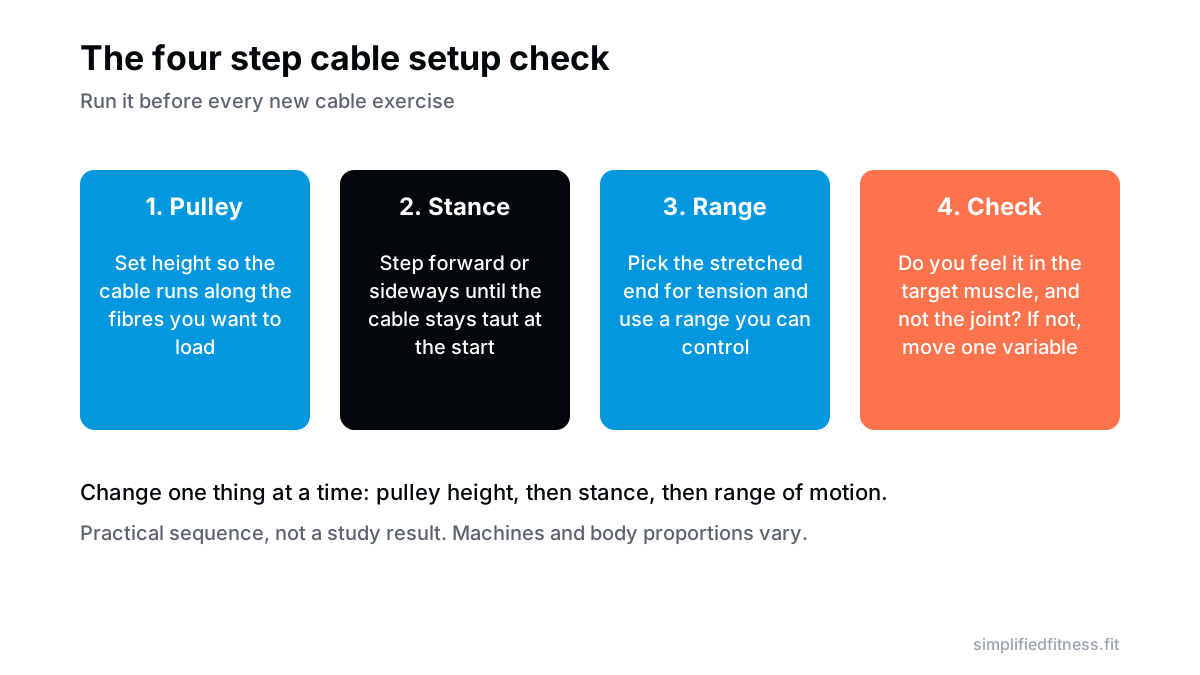
- Pulley. Pick a starting height for the exercise (the table below).
- Stance. Step forward or sideways until the cable is taut before you move. Slack at the start means no tension at the stretched end, which is where it matters.
- Range. Choose a range you control, with the stretched end emphasised.
- Check. Do you feel it in the target muscle and not the joint? If not, change one thing and test again.
The most common mistake here is changing the pulley, stance and weight all at once, then not knowing which one fixed the problem.
Pulley height starting points
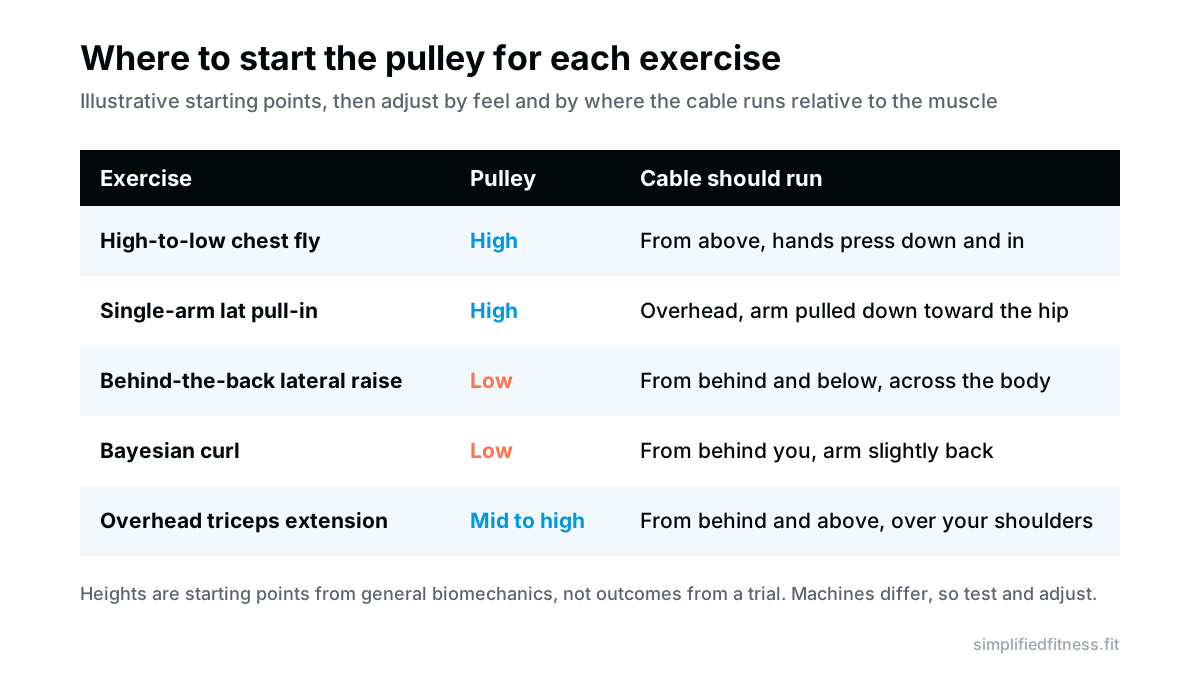
These are starting points, not rules. Body proportions, machine design and even how far the stack is from the wall change them.
How do you set up high-to-low cable flyes for the chest?
Set both pulleys high, take a step forward so the cables are taut, and lean slightly forward from the hips. Bring the hands down and together in front of the lower chest, not up toward your face.
The logic: with a high pulley, the cable pulls your hands up and out, so you work by bringing them down and in. That movement roughly matches the direction of the lower chest fibres, which run from the lower breastbone and ribs up toward the arm. This is why people use high pulleys for the lower chest and low pulleys for the upper chest.
What the evidence does and does not say. I could not find a trial that compared pulley heights for chest growth, so the “high for lower chest, low for upper chest” idea is biomechanical reasoning, not a proven hypertrophy result. For the detailed vector discussion, see cable crossover vectors and angles for chest, and for how cables compare with dumbbells and the pec deck, see chest flyes with dumbbells, cables and the pec deck.
Where should the pulley be for a lat pull-in?
For a single-arm lat pull-in, set the pulley high, stand side-on, and begin with the arm reaching up and out. Drive the elbow down toward your hip. Think of putting your elbow in your back pocket, not curling the hand to the stack.
The stretched, overhead start is the point. A cable keeps the line of pull on the lat from the first inch, while a dumbbell pullover loses most of its tension as the arms come up over the chest. We compare both in dumbbell pullovers versus cable lat pull-ins and give the full steps in single-arm iliac lat pulldowns.
Again, trials directly testing this setup for lat growth are limited. Use the stretch, the elbow path and your own feel as the guide.
How do you set a behind-the-back cable lateral raise?
Set the pulley low, stand with the machine beside you, and let the working arm sit slightly behind your body. Raise the arm out to the side, leading with the elbow. Because the cable pulls across the body, resistance is high near the start, where a dumbbell lateral raise has almost none.
Does that make it better? Not on the best evidence we have. In an 8-week trial in 24 resistance-trained men and women, one arm did dumbbell lateral raises and the other did cable lateral raises, with range of motion matched. Lateral deltoid thickness rose 3.3% to 4.6%, and the authors concluded both were similarly effective (Larsen et al., 2025).
So the practical takeaway is modest. Cables are a handy option when you want tension near the bottom of the raise. They are not a requirement. For more on this, see cable lateral raises behind the back versus cross-body.
Does arm position on a cable change growth? The triceps example
This is where cable setup has its strongest evidence. In a 12-week study, 21 adults trained one arm with cable elbow extensions in the overhead position and the other in a neutral position. Muscle volume from MRI rose 28.5% versus 19.6% in the long head, and 19.9% versus 13.9% for the whole triceps, in favour of the overhead position, even though the loads used were 34% to 39% lower (Maeo et al., 2023).
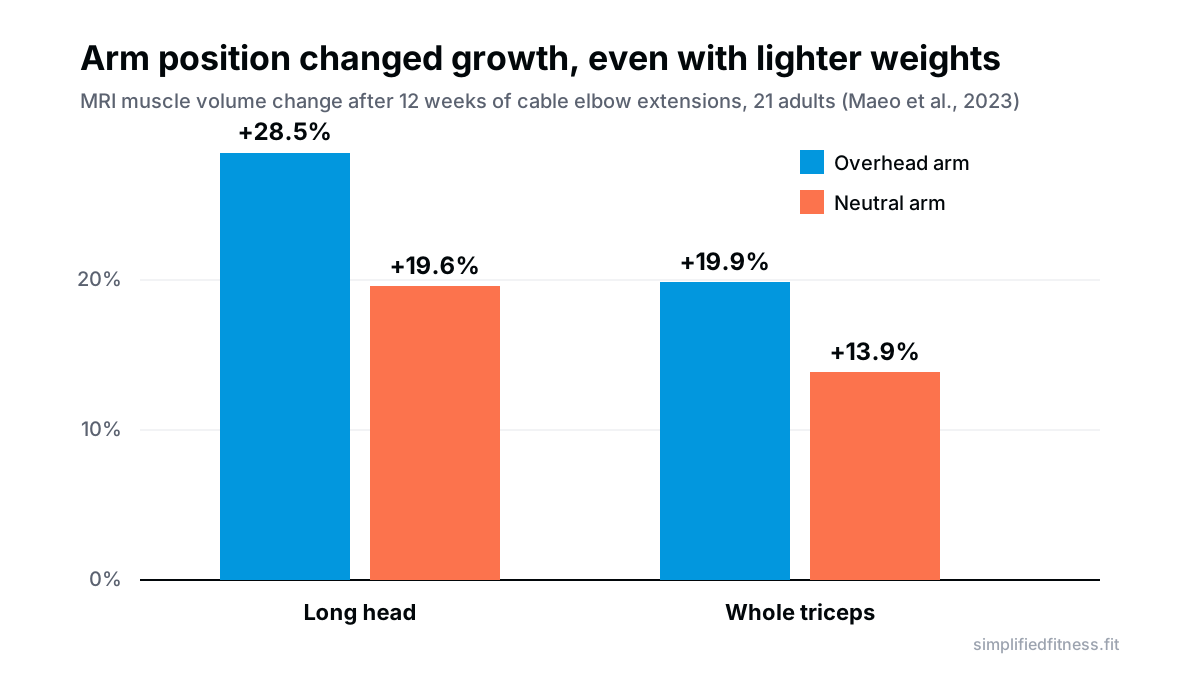
Why might this happen? The long head of the triceps crosses the shoulder, so raising the arm overhead stretches it. A growing body of research suggests training in a lengthened position can be especially effective, as the authors note. Keep in mind this was a single trial of 21 adults, not a final answer.
To set it up, put the pulley at mid to high height, face away from the machine, hold the rope overhead with elbows pointing forward, and extend. If you want the full setup, read overhead cable triceps extensions: long head mastery.
Does shoulder angle matter for Bayesian cable curls?
Maybe less than social media suggests. In a 10-week trial of 15 young men, one arm did a preacher-style cable curl (shoulder flexed) and the other a Bayesian cable curl (shoulder extended), with resistance profiles matched. Both grew the biceps and brachialis, with no significant differences between them (Attarieh et al., 2025).
A second trial reached a similar result. Thirty untrained men (24 finished) did cable curls with one arm at their peak shoulder extension angle and the other at a neutral position for 10 weeks. Both arms grew about 7% to 9%, and the difference between them was centered close to zero (Larsen et al., 2026).
Both studies were short and in young men, and the second used untrained participants, so we should be cautious about applying them to everyone. The cautious takeaway: pick the curl you can load, feel in the biceps and keep your shoulder comfortable. More on that in preacher curls versus Bayesian cable curls and Bayesian cable curls.
Should you train the stretched end of the rep?
This one is worth setting up for. A 2025 meta-analysis of 12 studies in young adults found trivial differences in regional hypertrophy between training at longer versus shorter muscle lengths, with the authors urging caution because the length differences between conditions were small (Varovic et al., 2025). So the picture is mixed: single trials like the triceps study look promising, but pooled data show little regional difference so far.
In a within-person trial of 30 trained participants, lengthened partial reps and full range of motion gave similar muscle growth in the arms over 8 weeks, and the authors suggest emphasising the stretched position (Wolf et al., 2025). Reviews on range of motion show a clearer full range of motion benefit for the lower body, while upper-limb evidence is limited and conflicting (Schoenfeld and Grgic, 2020). A meta-analysis of 16 studies likewise found full range of motion gave greater strength gains (effect size 0.56) and lower-limb hypertrophy, with no large differences in muscle architecture (Pallares et al., 2021).
Practically, a cable lets you keep tension at the stretched end, which a lot of dumbbell movements do not. Use a controlled range, load the stretch, and do not bounce out of the bottom. For how cables fit in beside barbells and machines, see free weights versus cables versus machines.
Quick tips for crowded gyms and humid weather
- One cable station? Pair a cable exercise with a non-cable one (superset) so you are not hogging it.
- Hot, sweaty gym? Wipe the handle and your hand. A slipping grip pulls attention from the target muscle.
- Short on time? Pick two setups per session. A well-set high-to-low fly and a stretched lat pull-in beat six half-attempted setups.
- Home or budget gym with limited cable options? Fix one pulley height you can use for most things and vary your stance and body angle instead.
Putting it into a week
Use cables as finishers after your main compound lifts, at 2 to 3 sets, taken close to failure with control. Our free push day and pull day templates show where cable work fits. Progress by adding reps first, then weight, and keep the same setup between sessions so you can see real progress.
When to see a doctor
Sharp pain in the shoulder, elbow or chest during cable work, pain that lingers after you stop, numbness, or a pop followed by weakness are reasons to stop and see a doctor or physiotherapist. Do not push through a joint that hurts at a particular angle. Change the angle, lower the weight, or swap the exercise.
The bottom line
Pulley height and stance set the direction of the resistance, and a good setup lets the cable stay taut in the stretched position. The strongest supported idea is arm position, with overhead cable triceps work beating the neutral arm in a 12-week trial. For delts and arms, cables and dumbbells perform similarly, and for Bayesian versus preacher curls the shoulder angle did not matter in two short trials.
Run the four step check, change one variable at a time, and pick the setup that puts tension in the target muscle without bothering your joints. That beats chasing perfect angles.
Frequently Asked Questions
What is the best pulley height for a cable chest fly?
There is no single best height, because it depends on which part of the chest you want to emphasise and how your body is built. With a high pulley you bring the handles down and in, which lines up better with the lower chest fibres, while a low pulley has you bring them up and in, closer to the upper chest fibres. Start with the pulley high for a high-to-low fly, keep the cable taut at the start, and adjust until you feel the chest working and not the front of the shoulder.
Does pulley height really matter for muscle growth?
It matters for how the exercise feels and where the tension is, but direct trials comparing pulley heights for hypertrophy are scarce. What we do have are studies on arm and shoulder position, such as overhead versus neutral triceps work, which show that position can change growth. Treat pulley height as a tool to get a good line of pull, then judge it by tension in the target muscle.
How do I set up a cable machine for the first time?
Pick the attachment, set the pulley height for the exercise, then step away from the stack until the cable is taut before you start the rep. Check that the weight pin is fully in and the cable runs freely through the pulleys. Begin lighter than you expect, because the same weight feels different when the angle changes.
Are cables better than dumbbells for muscle growth?
Not on current evidence. In an 8-week trial in 24 resistance-trained lifters, dumbbell and cable lateral raises produced similar lateral deltoid growth when range of motion was matched. Cables offer more adjustable angles and steadier tension in some positions, so use whichever you can load progressively and feel in the right muscle.
Why do my cable flyes hit my front delts instead of my chest?
Often the cable sits too far behind you or the hands drift up toward the face, so the line loads the front of the shoulder more than the chest. Raise or lower the pulley a few holes, take a half step forward, and bring the hands together in front of the chest rather than the face. Lighter weight with a slow stretch often fixes it too.
What is a Bayesian curl and is it worth doing?
A Bayesian curl is a cable curl done facing away from a low pulley with the arm slightly behind the body, which keeps tension on the biceps in a stretched position. In a 10-week trial of 15 young men, it grew the biceps and brachialis about as much as a preacher curl once the resistance profile was matched. It is worth doing if you like the feel, but it is not required.
Where should the pulley be for a single-arm lat pull-in?
Set the pulley high, stand side-on or slightly facing it, and start with the arm reaching up and out in a stretch. Pull the elbow down toward your hip rather than curling the hand. Because direct evidence for this exact setup is limited, use the stretch and the feeling of the lat pulling as your guide.
How do I set a behind-the-back cable lateral raise?
Set the pulley low, stand with the pulley beside you and the working arm reaching behind your body, and raise the arm out to the side. The cable then pulls the arm across the body, so the resistance is high near the start of the raise. Trials show dumbbell and cable raises grow the side delt similarly, so this version is an option, not a necessity.
Does an overhead cable triceps extension work better than a pushdown?
In one 12-week MRI study of 21 adults, overhead cable extensions grew the whole triceps about 19.9% versus 13.9% for the neutral arm position, and the long head 28.5% versus 19.6%. The overhead arm stretches the long head, which crosses the shoulder. If your shoulders tolerate it, put an overhead variation in your triceps work.
How far should I stand from the cable stack?
Far enough that the cable is taut at the start of every rep and the weight stack does not rest between reps. A good test is that you feel tension in the target muscle before you move. If you have to lean on the cable to hold position, step back a little.
Should I use full range of motion on cables?
For most people, yes, with the emphasis on the stretched end. A 2025 trial in trained lifters found that lengthened partials grew arm muscles similarly to full range of motion. Use a range you can control, and do not swing or bounce out of the stretch.
Can I use cables if I train at a crowded Indian gym with one cable station?
Yes, because cables are quick to adjust and you can rotate between exercises with minimal plate changing. Use supersets to avoid hogging the station, and choose one or two setups per session rather than trying all of them. A lighter weight on a well-set cable beats a heavy weight on a bad angle.
Sources & References
Every claim above is checked against peer-reviewed research (PubMed, U.S. National Library of Medicine) or guidance from established health bodies. How we fact-check.
- Attarieh P, et al. Comparison between shoulder flexed and extended positions in elbow flexion resistance training on regional hypertrophy and maximum strength: preacher versus Bayesian cable curls. Eur J Sport Sci. 2025. PMID: 40082069
- Larsen S, et al. The effects of shoulder extension angle on elbow flexor hypertrophy in the cable curl exercise. Front Physiol. 2026. PMID: 41988507
- Larsen S, et al. Dumbbell versus cable lateral raises for lateral deltoid hypertrophy: an experimental study. Front Physiol. 2025. PMID: 40692697
- Maeo S, et al. Triceps brachii hypertrophy is substantially greater after elbow extension training performed in the overhead versus neutral arm position. Eur J Sport Sci. 2023. PMID: 35819335
- Varovic D, et al. Does muscle length influence regional hypertrophy? A systematic review and meta-analysis. Int J Sports Med. 2025. PMID: 40570881
- Wolf M, et al. Lengthened partial repetitions elicit similar muscular adaptations as full range of motion repetitions during resistance training in trained individuals. PeerJ. 2025. PMID: 39959841
- Schoenfeld BJ, et al. Effects of range of motion on muscle development during resistance training interventions: a systematic review. SAGE Open Med. 2020. PMID: 32030125
- Pallares JG, et al. Effects of range of motion on resistance training adaptations: a systematic review and meta-analysis. Scand J Med Sci Sports. 2021. PMID: 34170576

Umair Hazrami · Founder & Head Coach, Simplified Fitness
Umair Hazrami founded Simplified Fitness and the Simplified Lifter channel to cut through fitness noise. With 4+ years of consistent training and 10+ coaching clients, he writes every guide from the peer-reviewed research and links the sources so you can check them. Our editorial standards.
Educational content only, not medical advice. If you have a medical condition, are pregnant, or take medication, talk to a qualified doctor before changing your diet, supplements or training. Full disclaimer.
Keep reading
Exercise Technique
Anthropometry-Based Exercise Selection: Long Limbs, Short Torsos, and Lever Adjustments
Anthropometry exercise selection explained: how long femurs, long arms and a short torso change squats, deadlifts and presses, plus a simple audit and swaps.
9 min read
Exercise Technique
Axial Loading vs Non-Axial Exercises: Managing Spinal Fatigue for Bigger Legs and Back
Axial loading vs non axial exercises explained: how spinal compression limits your weekly volume, and which squat and row swaps spare your lower back.
7 min read
Exercise Technique
Compound vs Isolation Exercises for Hypertrophy: Do You Need Both?
Compound vs isolation exercises for hypertrophy: what trials say about arms, delts and hamstrings, and which muscles actually need direct sets. Sources linked.
7 min read
Exercise Technique
Dumbbell vs Barbell Bench Press for Chest: Which Builds More Pec?
Dumbbell vs barbell bench press hypertrophy: what EMG and strength studies show, why dumbbells may suit your chest and shoulders, and how to use both.
7 min read