Exercise Redundancy: Why 3 Near-Identical Exercises Waste Your Energy
Exercise redundancy explained: why bench, dumbbell press and machine press in one session pile up fatigue for little new stimulus, plus a quick audit.
TL;DR. The short answer
- Exercise redundancy means doing several exercises that load the same muscle at the same joint angle and the same point of the rep, so you collect extra fatigue without a clearly different stimulus.
- A systematic review of eight studies (241 young men) concluded that exercises giving a redundant stimulus, or rotating exercises too often, may hinder muscle gains, while planned variation can help.
- Extra sets still matter: meta-regression links more weekly sets to more growth, so the fix is usually to move sets to a different exercise, not to delete them.
- Keep two or three exercises per muscle that differ in angle, path or where the load peaks, and spend your sets there.
- The evidence on redundancy itself is indirect and mostly short-term in young men, so treat this as a sensible programming rule, not a law.
Part of our complete guide: Exercise Selection Biomechanics: Moment Arms, Strength Curves and Free Weights vs Machines
Table of contents
Exercise redundancy is what happens when you stack exercises that load the same muscle at the same angle, along the same path, with the hardest point in the same part of the rep. You pay the fatigue of three exercises, but the later sets are done tired and keep hitting the same part of the muscle in the same way. This article sits inside our guide to exercise selection and biomechanics, and it gives you a way to audit your split and swap clones for exercises that earn their place.
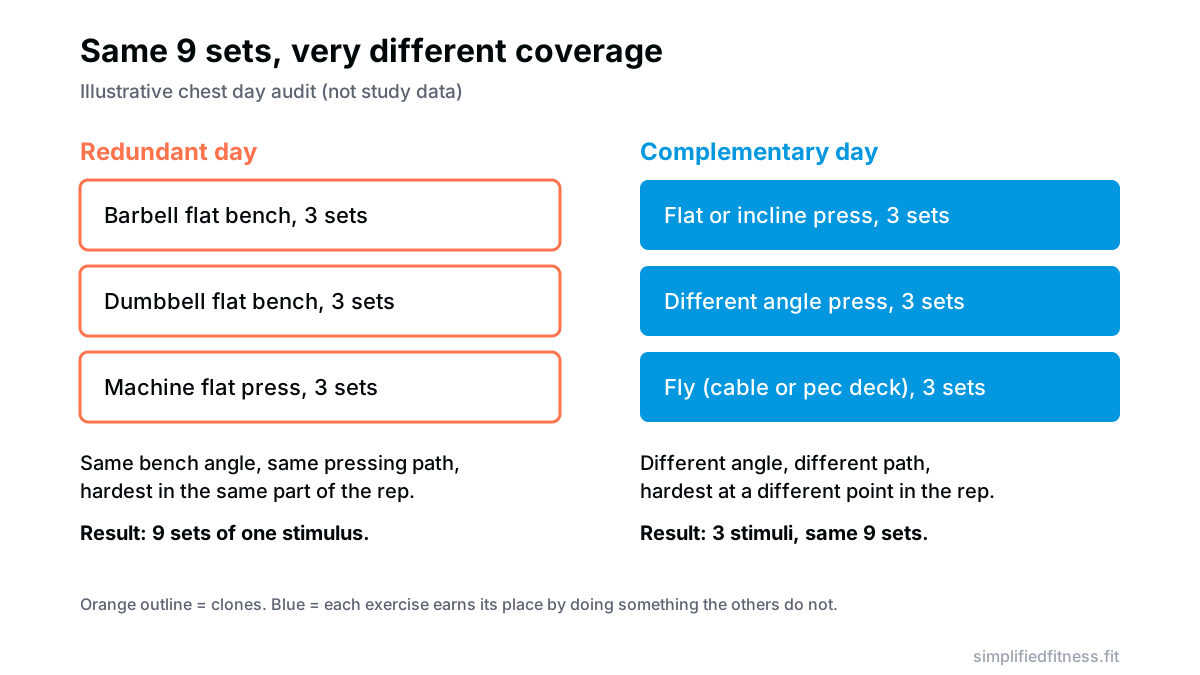
Picture a common chest day. Barbell bench, dumbbell flat press, machine flat press. Nine hard sets. You walk out wrecked, and the effort is real. The question is whether all of it is buying something the first exercise did not already give you.
What is exercise redundancy in a workout?
An exercise is redundant when a different exercise in the same session already delivers what it would deliver. Not “uses similar equipment”. Delivers the same stimulus.
Three things define a stimulus for a muscle:
- Joint angle and path. A flat press and a flat dumbbell press both move the upper arm in roughly the same plane relative to your torso.
- Where the load peaks. Gravity-based loads like a barbell or dumbbell are generally hardest at a similar point in the press. A cable or a machine cam can move that point.
- Which muscles limit the set. If your triceps give out first on all three presses, the chest never gets a fresh signal on exercises two and three.
When all three match, you are doing the same exercise with different handles. That is redundancy.
Why do overlapping exercises add fatigue instead of growth?
Short answer: fatigue keeps building with every hard set, while later sets of an identical movement are done tired and add no new angle or position. Those sets still count as volume. They are just a less efficient way to spend it.
Think of exercise number three on that chest day. Your triceps and front delts are already cooked from the first six sets. You press less weight or stop a rep or two earlier, so the chest gets a lower quality set than the first one did. You paid full recovery cost and received a discounted stimulus.
There is no trial that directly tests “three flat presses versus one flat press and two different exercises”. So be careful what you take from this. What exists is indirect support:
- A 2022 systematic review of exercise variation covered eight studies and 241 young men. It concluded that some systematic variation seems to enhance regional hypertrophy and maximize dynamic strength, while excessive, random variation may compromise gains. The authors added that using different exercises that provide a redundant stimulus may actually hinder adaptation (Kassiano et al., 2022).
- A 2019 review on counting sets argued that multi-joint lifts do not necessarily train every involved muscle equally. For example, during the leg press and squat, hamstring activation is markedly lower than quadriceps activation (Schoenfeld et al., 2019). That is a reminder that “a set of squats” is not a set for every leg muscle.
That is limited evidence from small trials, mostly young men, with short follow-ups. It supports a sensible rule. It does not prove an exact cost of redundancy.
Is more volume not always better? How redundancy fits with set counts
Fair objection. If more weekly sets generally means more growth, why not pile on the presses?
Because volume and variety are two different dials. A meta-regression of 15 studies found that each additional weekly set was associated with a 0.37% larger gain in muscle size, and a graded dose-response relationship overall (Schoenfeld et al., 2017). So sets matter. Nobody should read redundancy as “do fewer sets”.
The practical point is where those sets go:
- Same 9 sets, one stimulus: you concentrate fatigue on the same joints and tissues, and the last few sets are low quality.
- Same 9 sets, three different stimuli: you spread joint stress, keep each set fresher, and cover more of the muscle’s job.
If you want a longer look at how many sets to run, our guide on volume, frequency and hypertrophy covers it. For this article, treat your set budget as fixed and ask where to spend it.
What counts as a genuinely different exercise?
Equipment is the weakest difference. Barbell versus dumbbell versus Smith machine can change stability demands and comfort, but the muscle is often loaded much the same way. If you want the equipment angle, see our piece on free weights, cables and machines.
Stronger differences are these:
- Joint angle. Flat versus incline press changes the line of pull on the chest. See incline versus flat bench.
- Path. A press moves the hands in a pushing arc. A fly moves them in a hugging arc around the shoulder with the elbow roughly fixed.
- Where the resistance peaks. Cables and cam machines can be hard in positions where a dumbbell is easy. We cover this in matching resistance profiles to strength curves.
- Muscle length. Some exercises load the muscle hardest when it is stretched, others when it is shortened.
Regional growth research shows why this matters. In one randomized trial, two groups with equal volume and intensity trained either Smith machine squats or leg extensions. All three measured regions of the rectus femoris grew in the leg extension group, while only the central region of the vastus lateralis grew in the squat group (Zabaleta-Korta et al., 2021). Different exercise, different pattern of growth, even at matched volume.
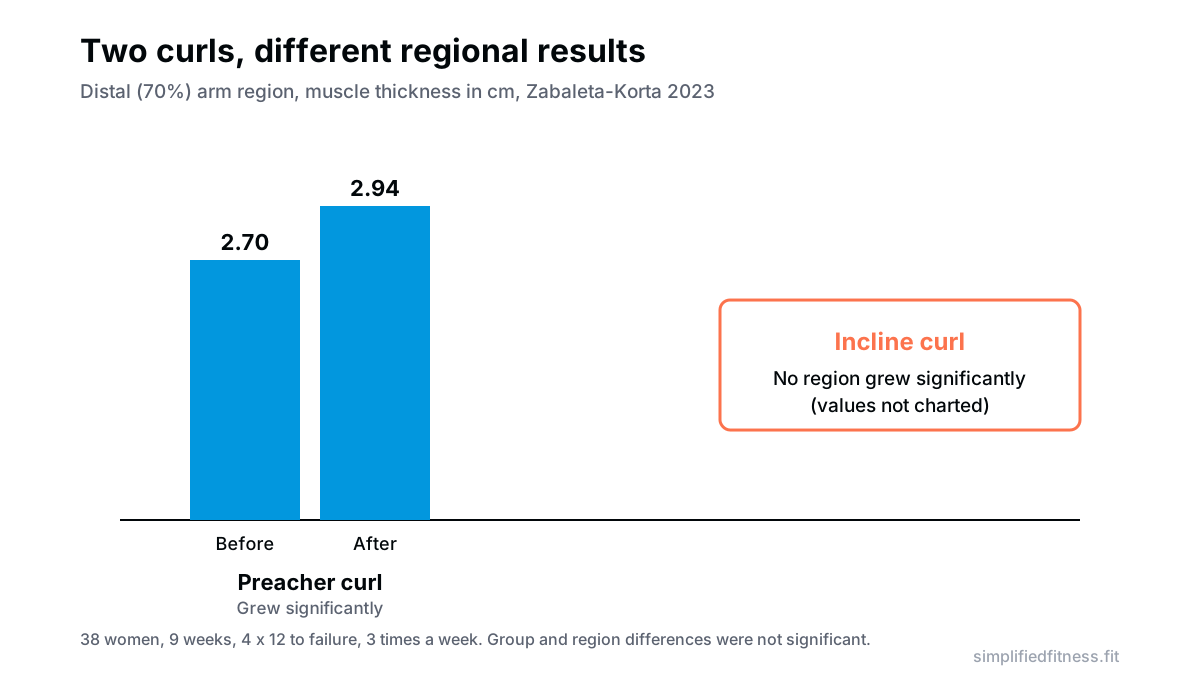
A second study from the same lab compared two curls in 38 recreationally trained women over 9 weeks. The preacher curl, which loads the elbow flexors at long muscle lengths, grew the distal region (thickness 2.7 cm to 2.94 cm), while no region grew in the incline curl group. The authors found no significant difference between groups or regions in the statistical comparison, so the signal is suggestive rather than decisive (Zabaleta-Korta et al., 2023).
How to audit your split in 10 minutes
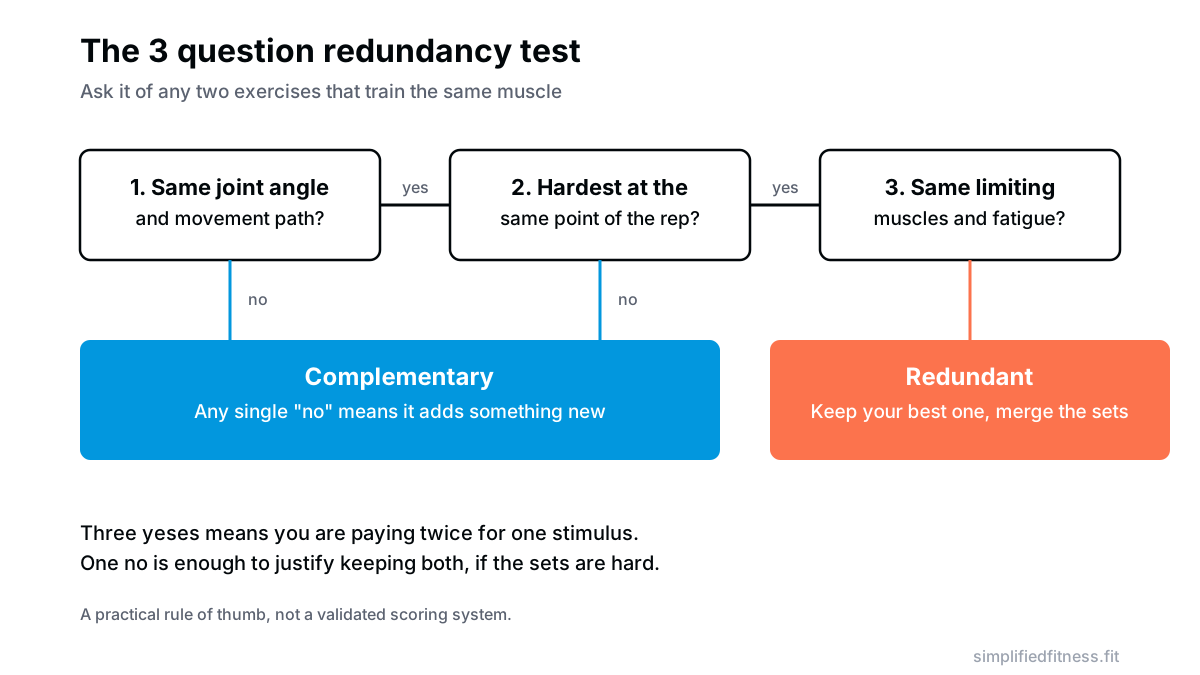
Take one muscle, one session, and run each pair of exercises through three questions. Is the joint angle and path the same? Is it hardest at the same point of the rep? Does the same limiting muscle fail first? Three yeses means redundant.
Then decide:
- Merge. Keep the exercise you can progress and feel most, add the sets from the clone to it.
- Replace. Swap the clone for a version that changes the angle or the load peak.
- Cut. If time is the problem, drop the clone. Try to move its sets elsewhere in the week, because weekly volume still matters.
A redundant chest day versus a cleaned up version
The brief example: barbell bench, dumbbell flat press, machine flat press.
| Slot | Redundant version | Cleaned up version | What changed |
|---|---|---|---|
| 1 | Barbell flat bench, 3 sets | Barbell or dumbbell flat press, 3-4 sets | Heavy compound anchor, kept |
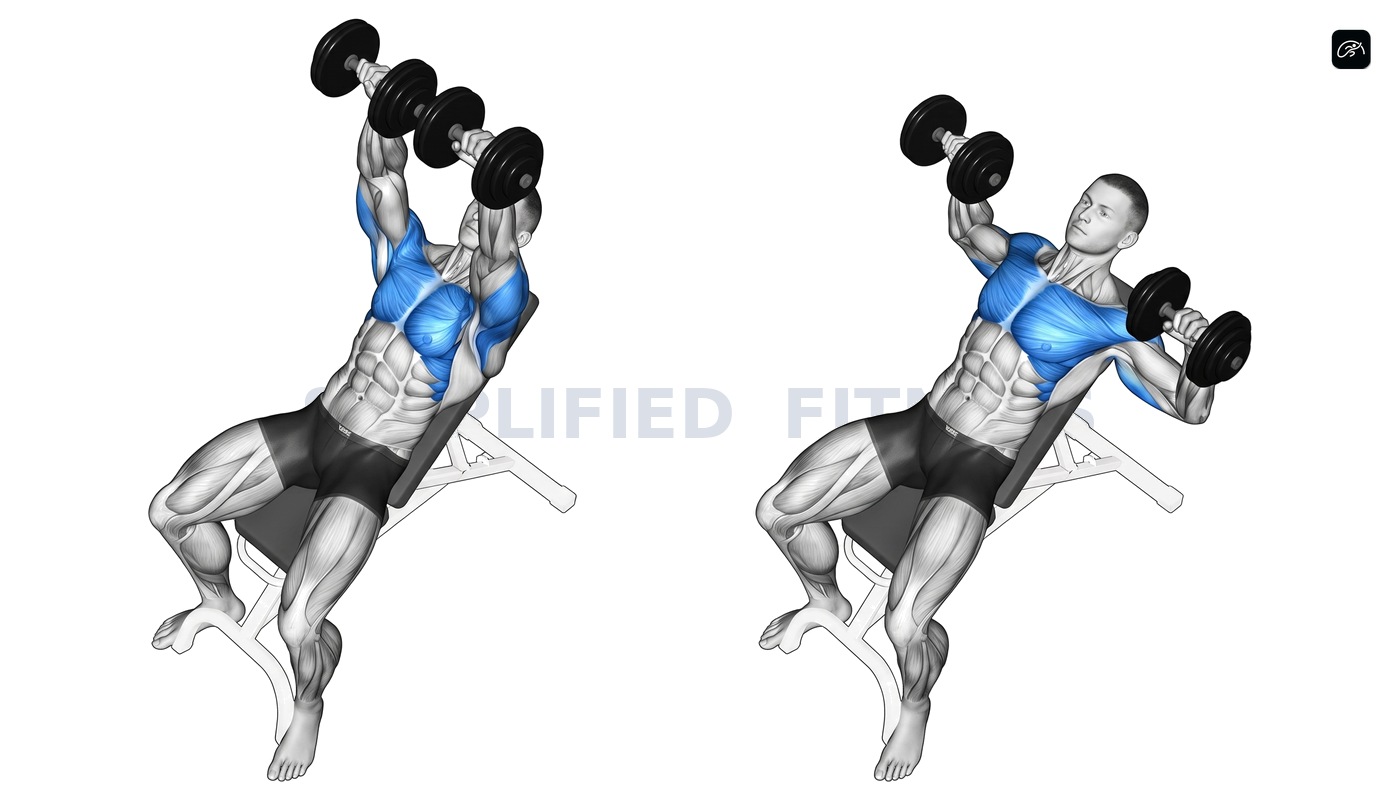
| 2 | Dumbbell flat press, 3 sets | Incline dumbbell press, 3 sets | New angle, more upper chest |
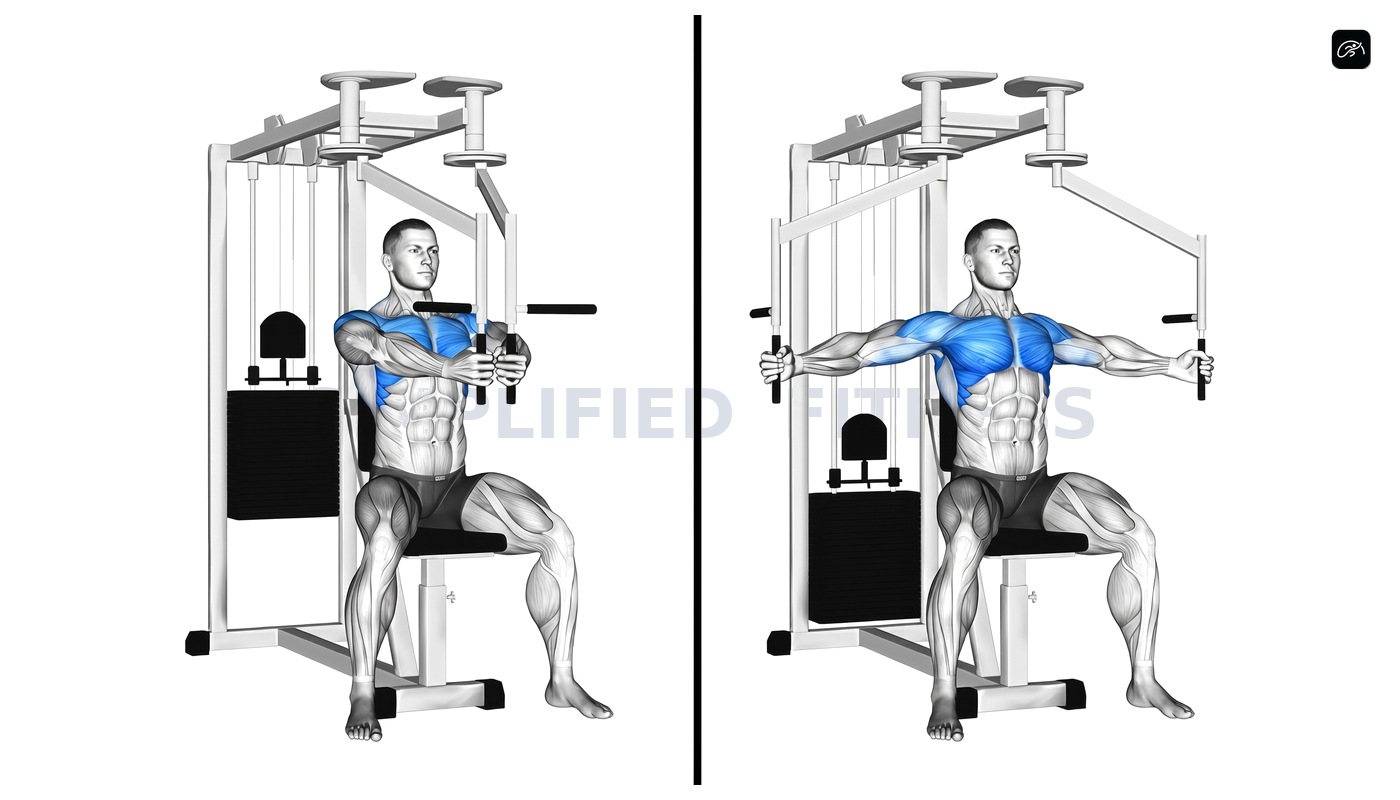
| 3 | Machine flat press, 3 sets | Cable fly or pec deck, 3 sets | New path and load peak |
Same set count, similar time. The second layout asks the chest three different questions. If you want to build the rest of the session around this, see chest workout architecture.
Are isolation exercises redundant with compound lifts?
Not by default. A press loads chest, front delts and triceps together, so the weakest link may stop the set before the chest is fully worked. An isolation exercise can then top up a muscle that did not get fully worked.
The research is mixed here. In a trial of 20 trained men over 8 weeks, adding single-joint exercises to a multi-joint program produced no significant extra strength or size gains compared with multi-joint work alone, though the group with single-joint work had numerically larger arm muscle circumference gains (3.17% versus 1.33%) (de Franca et al., 2015). With 10 per group and only 8 weeks, that trial was small and may not detect modest differences.
The cautious takeaway: isolation work is not a duplicate of compounds, but it is optional. Keep it if it fills a gap you can name (a stretched position, a muscle that lags) and you have recovery to spare. For more, see compound versus isolation exercises.
Does changing exercises constantly help? The muscle confusion problem
The opposite mistake is just as common. Someone reads that variety matters and rotates five new exercises every week.
The same 2022 review notes that excessive rotation, meaning frequent changes, may actually hinder adaptation (Kassiano et al., 2022). It makes practical sense. Progressive overload needs repeated exposures, and you cannot tell if you got stronger on an exercise you did once.
A workable approach:
- Keep your main lifts for a block of 8-12 weeks.
- Rotate accessories only when they stop progressing or hurt.
- When you rotate, change something meaningful (angle, path, load peak), not just the handle.
Also remember that range of motion matters for how well each exercise grows muscle. A review of range of motion studies suggests full ROM training favors lower body hypertrophy, while upper-limb results were limited and conflicting (Schoenfeld and Grgic, 2020). A narrative review recommends emphasizing long muscle lengths (Androulakis Korakakis et al., 2023). Whichever exercise you keep, do it properly.
How to build non-redundant sessions on an Indian budget and schedule
Most of what matters here costs nothing. A few specifics:
- Limited equipment. Some gyms have two or three press machines that do much the same job. Pick one, then use your free time for an incline dumbbell press and a cable or pec deck movement.
- Short sessions. If you can train for only 45-60 minutes, cut the third clone first. A tight session with 2-3 different exercises beats a long one done tired.
- Hot weather. Long sessions in a warm, humid gym drain you faster. Fewer, more different exercises keeps quality up late in the session.
- Food. Plenty of dal, curd, paneer, eggs or soya help recovery from the sets you do keep. Our protein calculator gives a daily target for your body weight.
For a ready-made structure, our push day plan avoids stacking clones.
Where this advice has limits
Be honest about the gaps:
- No study directly compares “three clone exercises” with “three different exercises” at equal sets.
- Most trials are 8-12 weeks, in young men or recreationally trained participants.
- Hypertrophy measured at one site does not capture the whole muscle.
- Beginners can grow on almost anything, so redundancy matters less early on.
If one exercise suits your body and you are progressing on it, keep it. The audit is a tool for cluttered routines, not a reason to ditch something that works. See also stimulus-to-fatigue ratio in exercise selection for how to judge which exercises give the most return for the tiredness.
When to see a doctor
Training tiredness should ease with rest, food and sleep. If you have chest pain, shortness of breath out of proportion to effort, dizziness, fainting, unexplained weight loss, or exhaustion that does not lift after a few easy days, see a doctor. This article cannot tell you whether your fatigue is a programming issue or a health one.
The short version
Keep two or three exercises per muscle per session, make sure they differ in angle, path or load peak, and spend your sets there. Use the three question test, merge or swap the clones, and hold your core lifts long enough to progress them.
Frequently Asked Questions
What is exercise redundancy?
It is when two or more exercises in a session train the same muscle in nearly the same way, with the same joint angle, path and hardest point in the rep. The extra exercises add fatigue and time without a clearly new stimulus. Check your routine for clones and merge their sets into your best version.
Is it bad to do barbell bench, dumbbell press and a machine press in the same workout?
It is usually inefficient, not harmful. All three are flat presses that load the chest, front delts and triceps through a similar path, so you are mostly repeating one stimulus. Keep one flat press, then swap the others for an incline press and a fly.
Can too many exercises per muscle hurt muscle growth?
A 2022 systematic review suggested that redundant exercises and very frequent exercise changes may hinder gains. One plausible reason is fatigue and lower set quality, since later exercises are done tired. Cap yourself at two or three exercises per muscle per session and push each set hard.
How many exercises per muscle group per workout is enough?
For most people, two or three exercises per muscle per session is plenty. The number matters less than total hard sets and how different the exercises are. Pick a number that lets you keep your last exercise as sharp as your first.
Does exercise variety build more muscle?
Some planned variety seems to help, particularly for regional growth, but random variety does not. The 2022 review found that systematic variation based on anatomy and biomechanics looked useful, while excessive rotation looked counterproductive. Change exercises for a reason, and keep them for a few months.
What counts as a different exercise for the same muscle?
A different exercise changes at least one of these: joint angle, movement path, or the point in the rep where the load is hardest. An incline press versus a flat press changes the angle, and a cable fly versus a press changes the path. Equipment alone, such as barbell versus dumbbell, is a weak difference.
Should I add sets or add exercises to increase volume?
Add sets first. A meta-regression of 15 studies found that each extra weekly set was associated with a small increase in muscle gain, so volume matters. Add a new exercise only when it covers a gap, such as a stretched position you are missing.
Why am I exhausted after chest day but not growing?
Common causes are too many near-identical presses, sets stopped far from failure, and not enough recovery between sessions. Duplicate exercises can inflate fatigue without adding a new stimulus. Audit the session, cut clones, and track whether your reps or loads are going up over several weeks.
Is a fly redundant if I already do presses?
Usually not. A fly is a single-joint movement with a different path and a different resistance profile, so it is a complementary exercise. Evidence on single-joint add-ons is mixed in trained men, so keep it if you enjoy it and recover well, and drop it if time is short.
Is exercise redundancy the same as muscle confusion?
No, they are nearly opposites. Muscle confusion says constantly changing exercises forces growth, while redundancy says duplicate exercises waste effort. Progress mainly comes from repeating well chosen exercises and progressively loading them.
Do isolation exercises count as redundant with compounds?
Not automatically. A compound lift trains several muscles and an isolation lift can target one in a different position. Muscles are often challenged differently, so the question is whether the isolation exercise covers a gap the compound leaves.
How often should I swap exercises?
Less often than most people think. Constant swapping makes it hard to progress and, per the 2022 review, excessive rotation may compromise gains. Keep your core exercises for at least 8-12 weeks and rotate only the accessories that stopped progressing.
When should I see a doctor about workout fatigue?
If you are persistently exhausted, dizzy, losing weight without trying, or have chest pain or shortness of breath, see a doctor. Training fatigue should fade with rest and normal food, sleep and recovery. If it does not, do not assume it is a programming problem.
Sources & References
Every claim above is checked against peer-reviewed research (PubMed, U.S. National Library of Medicine) or guidance from established health bodies. How we fact-check.
- Kassiano W, et al. Does varying resistance exercises promote superior muscle hypertrophy and strength gains? A systematic review. J Strength Cond Res. 2022. PMID: 35438660
- Schoenfeld BJ, et al. Dose-response relationship between weekly resistance training volume and increases in muscle mass: a systematic review and meta-analysis. J Sports Sci. 2017. PMID: 27433992
- Schoenfeld BJ, et al. Calculating set-volume for the limb muscles with the performance of multi-joint exercises: implications for resistance training prescription. Sports (Basel). 2019. PMID: 31336594
- Zabaleta-Korta A, et al. The role of exercise selection in regional muscle hypertrophy: a randomized controlled trial. J Sports Sci. 2021. PMID: 34743671
- Zabaleta-Korta A, et al. Regional hypertrophy: the effect of exercises at long and short muscle lengths in recreationally trained women. J Hum Kinet. 2023. PMID: 37559762
- de Franca HS, et al. The effects of adding single-joint exercises to a multi-joint exercise resistance training program on upper body muscle strength and size in trained men. Appl Physiol Nutr Metab. 2015. PMID: 26244600
- Androulakis Korakakis P, et al. Optimizing resistance training technique to maximize muscle hypertrophy: a narrative review. J Funct Morphol Kinesiol. 2023. PMID: 38249086
- Schoenfeld BJ, et al. Effects of range of motion on muscle development during resistance training interventions: a systematic review. SAGE Open Med. 2020. PMID: 32030125

Umair Hazrami · Founder & Head Coach, Simplified Fitness
Umair Hazrami founded Simplified Fitness and the Simplified Lifter channel to cut through fitness noise. With 4+ years of consistent training and 10+ coaching clients, he writes every guide from the peer-reviewed research and links the sources so you can check them. Our editorial standards.
Educational content only, not medical advice. If you have a medical condition, are pregnant, or take medication, talk to a qualified doctor before changing your diet, supplements or training. Full disclaimer.
Keep reading
Exercise Technique
Anthropometry-Based Exercise Selection: Long Limbs, Short Torsos, and Lever Adjustments
Anthropometry exercise selection explained: how long femurs, long arms and a short torso change squats, deadlifts and presses, plus a simple audit and swaps.
9 min read
Exercise Technique
Axial Loading vs Non-Axial Exercises: Managing Spinal Fatigue for Bigger Legs and Back
Axial loading vs non axial exercises explained: how spinal compression limits your weekly volume, and which squat and row swaps spare your lower back.
7 min read
Exercise Technique
Cable Setup Mastery: Pulley Heights, Cable Angles, and Customizing Force Vectors
Cable machine setup guide: how to set pulley height, stance and cable angle for chest, lats, delts and arms, with what the research does and does not show.
9 min read
Exercise Technique
Compound vs Isolation Exercises for Hypertrophy: Do You Need Both?
Compound vs isolation exercises for hypertrophy: what trials say about arms, delts and hamstrings, and which muscles actually need direct sets. Sources linked.
7 min read