Gym Equipment Shortages and Substitutions: Science-Based Swaps for Crowded Gyms
Machine taken? Use these gym exercise substitutions for a crowded gym to keep the same muscle and joint action, with a swap chart and the studies behind it.
TL;DR. The short answer
- Good gym exercise substitutions keep the same target muscle, the same joint action and a similar loading position. The brand of equipment matters much less than those three things.
- Meta-analytic and trial evidence shows free weights and machines grow muscle about equally, so swapping a taken machine for a dumbbell, cable or Smith version is unlikely to cost you much hypertrophy.
- Strength is more specific than size: you get better at the exact tool you train on, so a one-off swap is harmless, but months of training on the swap may leave the original lift a little behind.
- Swap like for like: seated leg curl to lying leg curl, hack squat to heel-elevated goblet or Smith squat, chest-supported row to seated cable or chest-on-incline dumbbell row.
- Do not swap in a redundant exercise you already did, and do not reshuffle your whole program every week. Plan one backup per lift in advance.
Part of our complete guide: Exercise Selection Biomechanics: Moment Arms, Strength Curves and Free Weights vs Machines
Table of contents
When the machine you need is taken, the best gym exercise substitutions keep three things the same: the muscle you are targeting, the joint action, and roughly where in the range the muscle is loaded. If those match, a dumbbell or Smith machine swap grew muscle about as well as the original in the research we have, and a cable version follows the same logic even though it has been studied less. The exact equipment matters far less than most lifters fear.
This article is the quick, in-the-moment version of our exercise selection and biomechanics guide. It is built for the 7 pm commercial gym where every rack, hack squat and leg curl has a queue.
What makes a good gym exercise substitution?
A swap is good when it passes three checks.
- Same prime mover. If the original exercise trains quads, the swap should too, not “legs” in general.
- Same joint action. Knee extension for knee extension, elbow-driven rowing for rowing. A leg press does not replace a leg curl, even though both are on the lower-body day.
- Similar loading position. Where the muscle is stretched and where the exercise is hardest. This is the one lifters skip. We cover it in depth in matching resistance profiles to strength curves.
Equipment brand, plate colour and whether it has a cable are not on the list. That is deliberate.
Do machines and free weights grow muscle equally?
Mostly yes, and this is why a swap rarely wrecks a session.
A 2023 meta-analysis pooled 13 studies and 1,016 adults (aged 18-60) that compared free-weight and machine training for at least 6 weeks. For hypertrophy (5 studies), the direct comparison found no difference between the two (SMD -0.055, p = 0.751) (Haugen et al., 2023). The authors concluded the choice comes down to preference and goals.
Individual trials point the same way:
- In 46 young adults (26 women, average age 22) trained for 8 weeks, biceps and quadriceps muscle thickness rose in both free-weight and machine groups with no difference between them (Schwanbeck et al., 2020).
- In 8 untrained women, one leg trained with lunges and the other with an inclined leg press for 9 weeks, thickness of the vastus lateralis and rectus femoris rose in both legs with no group-by-time difference (Amanuma et al., 2025).
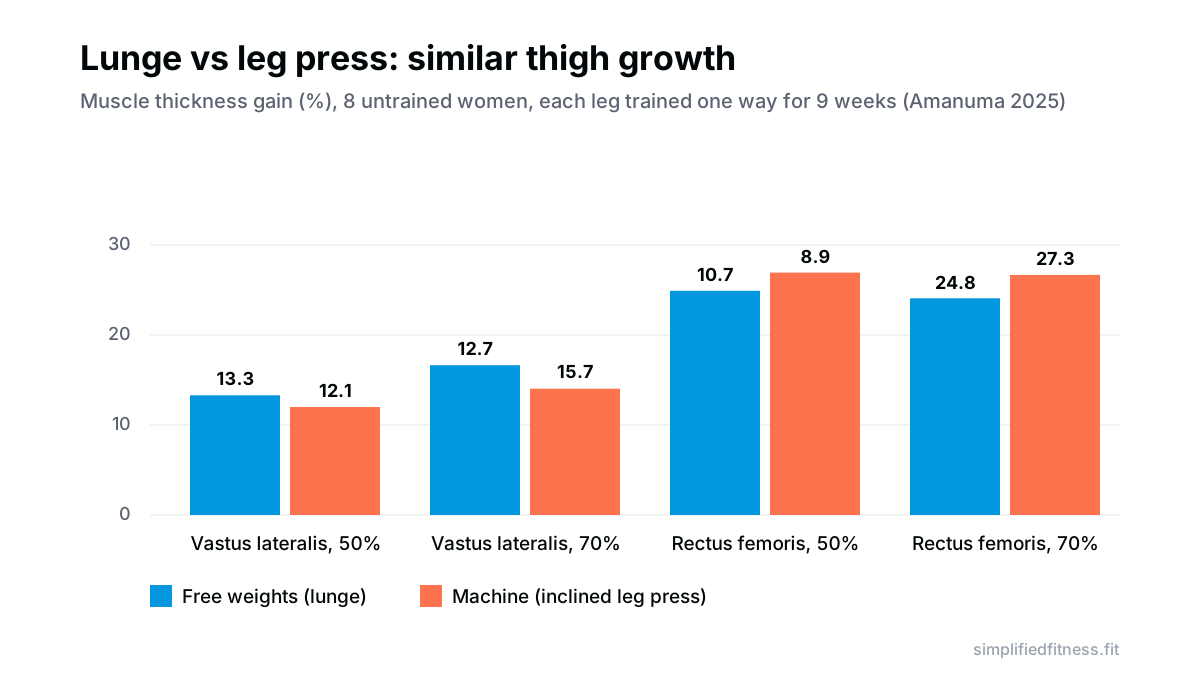
Now the caveats, because they matter. The Amanuma study had only 8 participants, all untrained women, over 9 weeks. The Schwanbeck trial lasted 8 weeks in young adults averaging 22 years. Most hypertrophy comparisons are short and in beginners or recreational lifters. For experienced lifters, the data are thinner, so treat “equal” as “no detectable difference so far”, not “proven identical”.
Strength is more specific than size
Here is the part people mix up. Muscle size transfers well between tools. Strength does not transfer as well.
The same meta-analysis found that strength on free-weight tests rose more after free-weight training (SMD -0.210, p = 0.023), and strength on machine tests tended to rise more after machine training, though that second result did not reach significance (p = 0.064) (Haugen et al., 2023). In one trial, machine bench press strength rose 13.9% in the machine group versus 8.6% in the free-weight group, while free-weight bench, squat and Smith squat strength improved similarly in both groups (Schwanbeck et al., 2020).
A 2025 trial of 37 students compared back squat and bench press with a free barbell versus a Smith machine for 8 weeks. Vastus lateralis and pectoralis major cross-sectional areas improved comparably, but the strength gains were larger when training and testing conditions matched (Marcos-Frutos et al., 2025).
What does this mean at the gym? A one-off swap is harmless. If you live on the Smith machine for six months and then test your barbell squat, expect it to lag. That only matters if barbell strength is your goal. For pure muscle size, it is much less of a concern. For more on this, see Smith machine versus free barbell.
The swap chart: what to do when a machine is taken
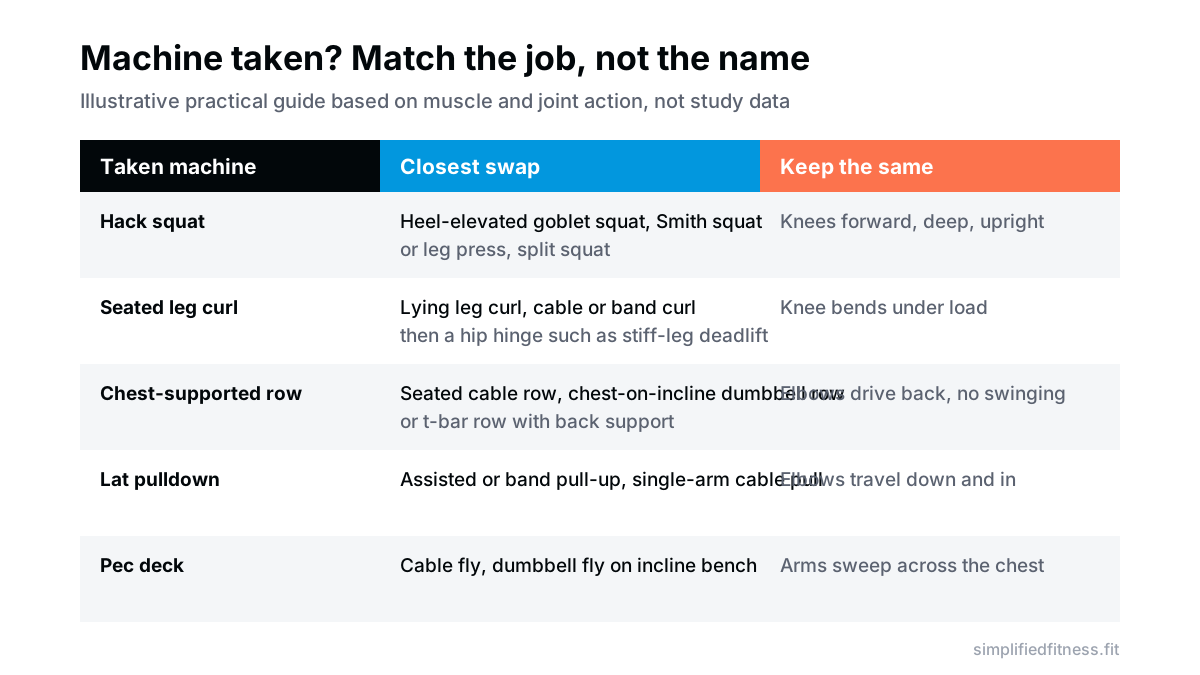
This is the reference most people come for. The pairs below are practical guidance built from joint action and muscle position. They are not each tested head to head, and I flag where the evidence is direct and where it is reasoning.
Hack squat substitutes
The hack squat lets you sit back against a pad, push through the floor and take your knees far forward with little balance demand. To copy that:
- Heel-elevated goblet squat. Heels on a 2.5 or 5 kg plate lets your knees travel forward while your torso stays upright. Use a heavy dumbbell held at the chest.
- Smith machine squat with feet slightly forward. The fixed bar path removes the balance demand, a bit like the hack squat does.
- Leg press or split squat. Not identical, but both train the quads through heavy knee flexion and extension.
Honest limit: I am not aware of a study that directly compares these swaps for quad growth. The logic is joint angle and balance demand, plus the machine versus free weight evidence above. If you want the full case for the hack squat itself, see hack squats and quad stimulus-to-fatigue ratio.
Seated leg curl alternatives
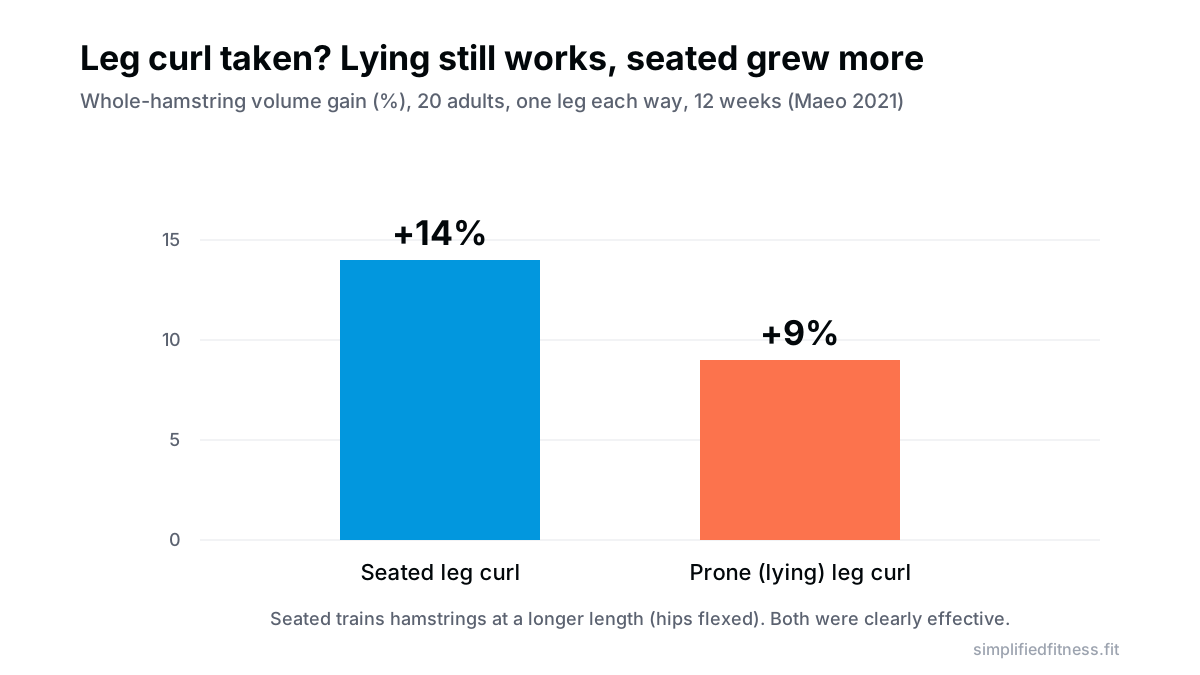
The seated leg curl is worth defending, because one study found a real difference. In a within-person trial, 20 adults trained one leg with seated curls and the other with prone (lying) curls for 12 weeks. Whole-hamstring muscle volume rose +14% in the seated leg versus +9% in the prone leg (Maeo et al., 2021). The authors suggest training at longer muscle lengths promotes more hypertrophy, since the seated position keeps the hips flexed.
So if the seated machine is occupied:
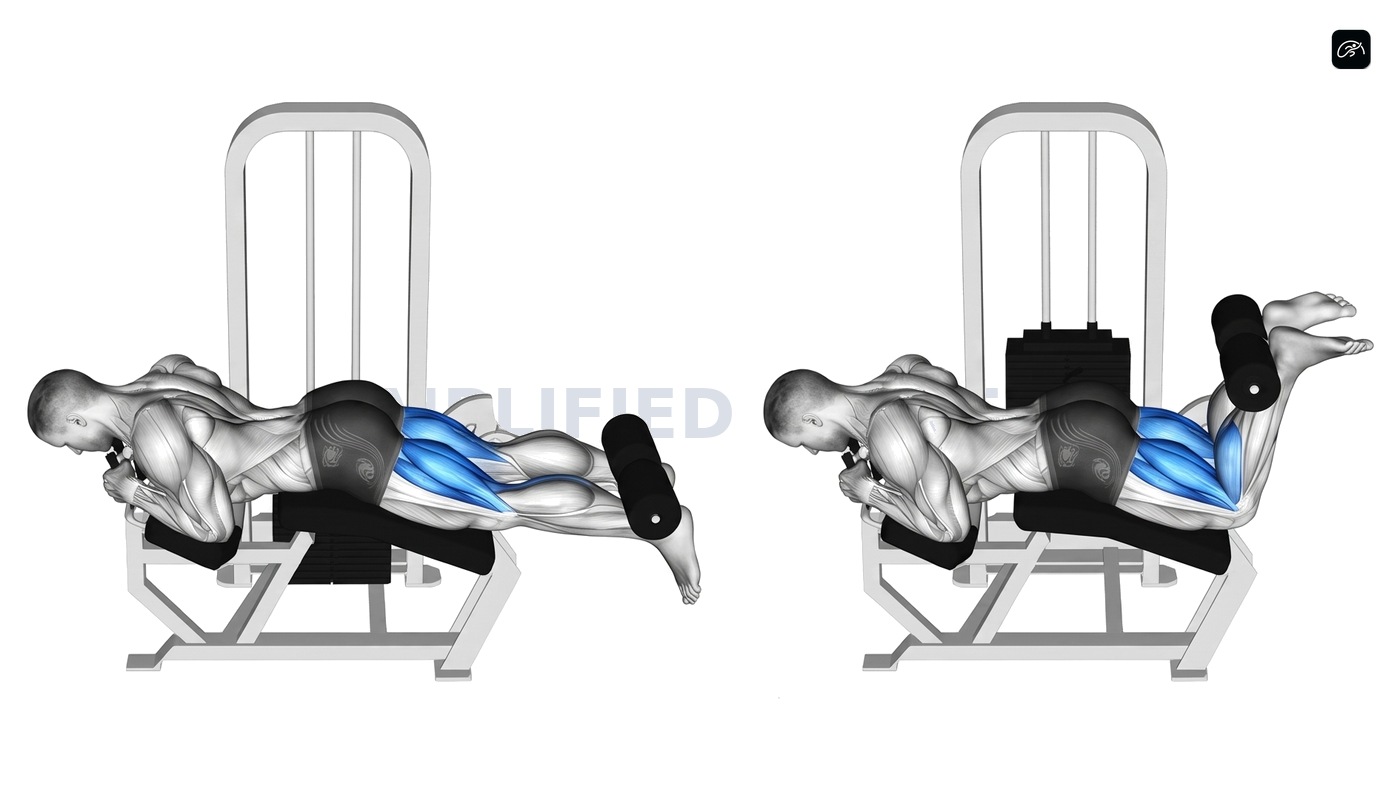
- Lying leg curl is the closest machine swap. It cost some growth in that trial, but 9% over 12 weeks is far from nothing.
- Cable or band leg curl works if you can set the angle so your knee, not your hip, is doing the moving.
- Stiff-leg or Romanian deadlift loads the hamstrings across the hip joint. It does a different job than a curl, so use it as a complement, not a clone.
The study had 20 participants and a single exercise comparison, so it is one piece of evidence. Our dedicated article on seated versus lying leg curls goes deeper.
Chest-supported row swaps
The chest-supported row is popular because the pad takes your lower back out of the movement, so you can pull hard without fatigue spreading to your spinal erectors. Replace it with:
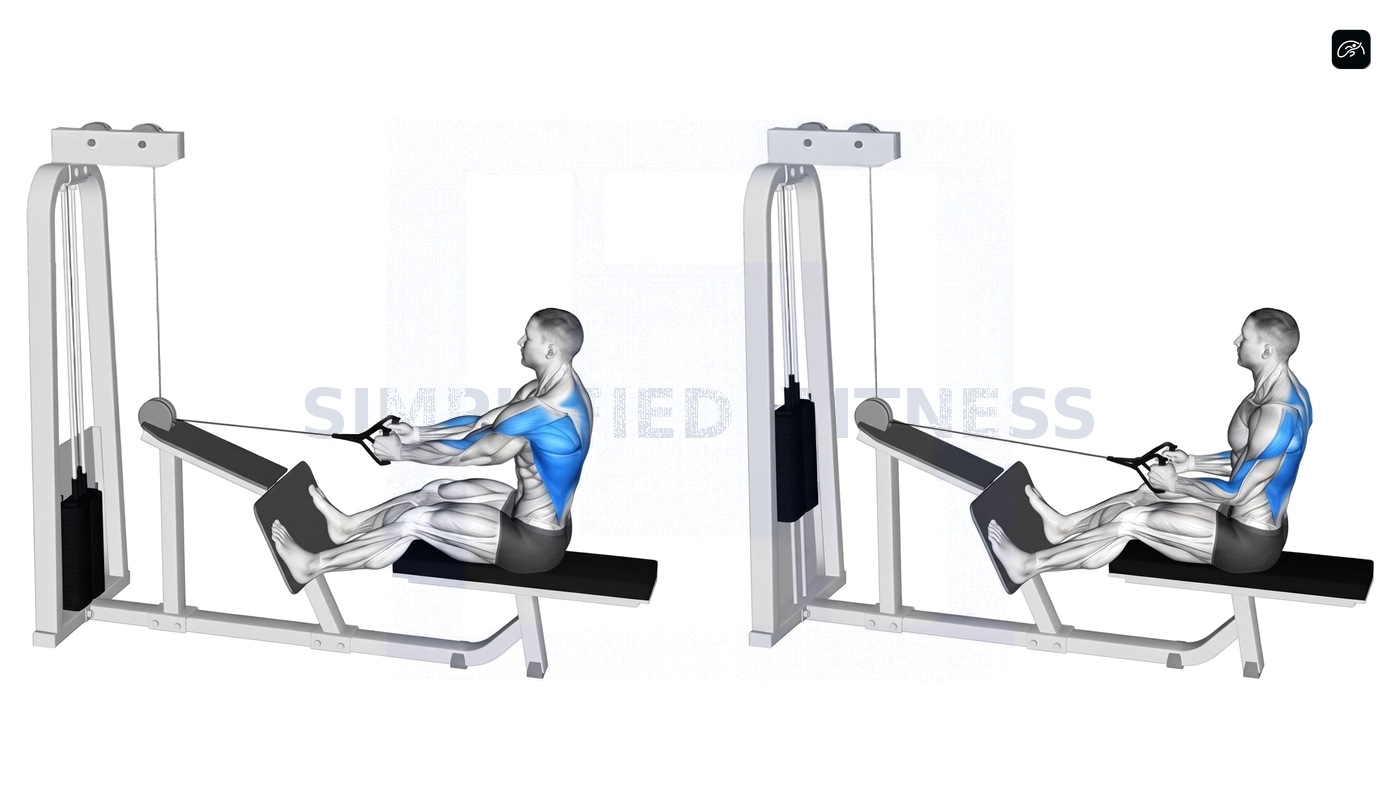
- Seated cable row with a neutral grip, driving elbows back and keeping your torso mostly still.
- One-arm dumbbell row with your chest on an incline bench. Set the bench at around 30-45 degrees, chest on the pad, and row up and back.
- T-bar row with chest support, if there is a platform with a pad.
If none is free, a one-arm dumbbell row braced on a flat bench works. The key is not letting the swap turn into a swinging, momentum-driven row. Read chest-supported rows for the upper back for execution details.
A few more quick swaps
| Taken | Try | Watch for |
|---|---|---|
| Lat pulldown | Assisted or band pull-up, single-arm cable pull | Drive elbows down, not hands |
| Pec deck | Cable fly, incline dumbbell fly | Keep tension at the stretch |
| Leg extension | Single-leg cable extension, sissy-style squat | Do not swap for a squat only |
| Shoulder press machine | Dumbbell shoulder press | Use a lighter load and a stable bench |
| Calf raise machine | Standing calf raise on a step | Go to full stretch and pause |
How do I keep range of motion the same?
A swap can quietly cut your range of motion, and that matters. A systematic review of 6 studies (135 participants) concluded that lower-body training through a full range of motion promoted more hypertrophy than partial range, while upper-body evidence was limited and conflicting (Schoenfeld and Grgic, 2020). A narrative review also recommends a range that emphasises training at long muscle lengths (Androulakis Korakakis et al., 2023).
In practice: if you swap a deep hack squat for a Smith squat, do not stop at a half squat. If you swap a cable fly for a dumbbell fly, let the arms open to a comfortable stretch. Keep the depth.
What about reps and loads on the swap?
You rarely have the same load capacity on a swapped exercise. A dumbbell goblet squat will never match what you hack squat. That is fine.
A 2021 review of the “repetition continuum” argued that muscle growth can be obtained across a wide spectrum of loading zones, and in some cases optimised there (Schoenfeld et al., 2021). So a lighter weight for more reps is a valid path. The rule is simple: choose a load that brings you within roughly 1-3 reps of failure, and keep that effort the same as the exercise you replaced.
Will changing exercises hurt my progress?
One occasional swap, no. A 2022 systematic review of 8 studies, all in young men (241 participants combined), found that some systematic variation seemed to enhance regional hypertrophy and dynamic strength, while excessive, random variation or swapping in redundant exercises might compromise gains (Kassiano et al., 2022).
For you, that suggests two rules. Keep main lifts stable. And do not substitute with an exercise that duplicates one you already did earlier in the session. If you have already done leg press, do not “swap” a taken hack squat for another heavy knee-dominant press-style lift without thinking about it. Our guide to exercise redundancy explains how to avoid that.
A decision flow for a busy gym
When you walk to a taken station, ask in order:
- Can I superset or skip ahead and return in 5 minutes? If yes, do that. It costs nothing.
- If not, is there a same-pattern swap in the chart above? Use it.
- Is the lift a main strength lift you are tracking? If yes, wait a few minutes or reschedule it to another day. If it is an accessory, just swap.
- Is it a bigger-risk swap (heavy free barbell, no spotter)? Pick the version where failure is safest.
If your gym is crowded at fixed times, a free push, pull and legs plan with a backup written beside each lift saves time. For picking how hard to push the substitute, the RIR and RPE calculator helps you stay a few reps from failure.
Plan your backups before you walk in
The quickest fix is preparation. For each main lift, write one backup in your phone’s notes, matched on muscle, joint action and position:
- Quad compound: leg press, backup heel-elevated goblet squat.
- Hamstring curl: seated, backup lying or cable curl.
- Row: chest-supported, backup seated cable row.
- Vertical pull: lat pulldown, backup assisted or band pull-up.
Fifteen minutes of thought at home beats five minutes of staring at a queue. This matters most in busy city gyms, where the evening rush can mean a wait at every popular station, so having alternatives that use dumbbells and cables, which are usually more plentiful, keeps the session moving.
When to speak to a professional
If a swap hurts in a joint, such as a knee pain on a goblet squat or a sharp shoulder pinch on a row variation, stop and choose a different pattern. If pain persists or you have an existing injury, see a doctor or physiotherapist. A shortage of equipment is never a reason to push through pain.
The bottom line
Gym exercise substitutions work when you match the muscle, joint action and loading position. Free weights, Smith machines and machines produced similar muscle growth in the studies done so far, which were mostly short trials of a few months in untrained or recreational lifters. Strength is more tool specific, and some pairs, such as seated versus lying leg curl, are not equal. Plan a backup for each lift, keep effort close to failure, log the swap separately, and move on. For the wider logic behind picking exercises, return to the exercise selection and biomechanics guide and our comparison of free weights, cables and machines.
Frequently Asked Questions
What should I do when the machine I need is taken?
Do not wait around for more than a couple of minutes. Pick a swap that trains the same muscle through the same joint action, such as a cable or dumbbell version of the same movement. Keep the sets, reps and effort the same so the session still counts.
Can I swap any exercise for another one that hits the same muscle?
Not quite, because the same muscle can be loaded at very different muscle lengths and strength curves. Research on hamstrings found that a seated curl, which trains at a longer length, grew more muscle than a lying curl, even though both worked well. Choose a swap that matches the original's position and range, not just its muscle name.
Are free weights better than machines for muscle growth?
Current evidence says no meaningful difference for hypertrophy. A 2023 meta-analysis of 13 studies (5 of which measured muscle size) found no difference between free-weight and machine training for muscle growth. Strength tended to improve more on tests that matched the training tool. So pick the option you can train hard and safely, and avoid agonising over it.
Is the Smith machine a good substitute for a free barbell squat or bench?
Yes for most people who are not competing in powerlifting. A 2025 trial found similar thigh and chest muscle growth after 8 weeks of squats and bench presses on a Smith machine or with a free barbell, with strength gains most specific to the tool used. Use it when the rack is taken, and move your feet slightly forward to keep your balance.
What can I do instead of a hack squat?
A heel-elevated goblet squat, a Smith machine squat with feet slightly forward, or a leg press all load the quads with a similar knee-forward pattern. There is no head-to-head study of these exact swaps, so this is reasoning from joint action rather than direct proof. Use a load that brings you within 1-3 reps of failure.
What can I do if the seated leg curl is occupied?
Use a lying leg curl, a cable or band leg curl, or a hip-hinge such as a stiff-leg deadlift. In one 12-week study, prone curls still grew hamstrings by about 9% versus 14% for seated, so the swap costs some growth but still clearly works. Add a stiff-leg deadlift or Romanian deadlift later in the week to cover the long-length end.
What can I use instead of a chest-supported row machine?
A seated cable row, a one-arm dumbbell row with your chest braced on an incline bench, or a t-bar row with back support will do. All keep your lower back out of the work so your lats and upper back take the set. Pull your elbows back rather than shrugging or swinging.
Will changing exercises hurt my progress?
Occasional swaps will not, and a planned rotation can even help. A 2022 systematic review of 8 studies in young men found that some systematic variation seemed useful, while excessive random variation might compromise gains. Keep your main lifts stable and rotate only the accessory slots.
How do I track progress when I keep swapping?
Log each variation as its own lift, with the load, reps and how close to failure you went. Compare the swap with itself next time rather than with the original, because loads rarely transfer one to one. If a swap becomes a regular fixture, give it its own progression.
Should I do the substitute for more reps if the weight feels lighter?
Match effort rather than a rep number. A review of loading research suggests muscle growth can be achieved across a wide spectrum of loads, so a lighter weight for more reps is fine if the set ends close to failure. Stop each set 1-3 reps before you would fail on the swap.
Is it better to rearrange my workout order when a station is busy?
Yes, as long as your heavy compound lifts still come when you are fresh. Performance on later exercises drops when you are tired, so shuffling two accessories costs very little. Do the busy-station exercise last, or return to it after one more exercise.
What are good crowded gym workout alternatives at peak hours in India?
Evening rush is the problem, so keep dumbbells, a cable station or a bench as your fallback because they are rarely monopolised for long. Plan a backup for each main lift before you walk in. If evenings are always packed, shift to early morning or mid-afternoon if your schedule allows.
Do I need a spotter for a free-weight swap?
For heavy barbell squats and bench presses, yes or use safety bars, because a failed rep is the risk. Dumbbell, cable and machine swaps let you drop the weight safely, which is part of why they work well on busy days. If you are training alone, choose the version where failure is safest.
Sources & References
Every claim above is checked against peer-reviewed research (PubMed, U.S. National Library of Medicine) or guidance from established health bodies. How we fact-check.
- Haugen ME, et al. Effect of free-weight vs. machine-based strength training on maximal strength, hypertrophy and jump performance: a systematic review and meta-analysis. BMC Sports Sci Med Rehabil. 2023. PMID: 37582807
- Amanuma MT, et al. Comparable regional hypertrophy of the knee extensor muscles in response to resistance training with machines versus free weights: a randomized within-subject approach. J Bodyw Mov Ther. 2025. PMID: 41316621
- Schwanbeck SR, et al. Effects of training with free weights versus machines on muscle mass, strength, free testosterone, and free cortisol levels. J Strength Cond Res. 2020. PMID: 32358310
- Marcos-Frutos D, et al. Comparative effects of the free weights and Smith machine squat and bench press: the important role of specificity for strength adaptations. Int J Sports Physiol Perform. 2025. PMID: 39740659
- Maeo S, et al. Greater hamstrings muscle hypertrophy but similar damage protection after training at long versus short muscle lengths. Med Sci Sports Exerc. 2021. PMID: 33009197
- Kassiano W, et al. Does varying resistance exercises promote superior muscle hypertrophy and strength gains? A systematic review. J Strength Cond Res. 2022. PMID: 35438660
- Schoenfeld BJ, et al. Loading recommendations for muscle strength, hypertrophy, and local endurance: a re-examination of the repetition continuum. Sports (Basel). 2021. PMID: 33671664
- Androulakis Korakakis P, et al. Optimizing resistance training technique to maximize muscle hypertrophy: a narrative review. J Funct Morphol Kinesiol. 2023. PMID: 38249086
- Schoenfeld BJ, Grgic J. Effects of range of motion on muscle development during resistance training interventions: a systematic review. SAGE Open Med. 2020. PMID: 32030125

Umair Hazrami · Founder & Head Coach, Simplified Fitness
Umair Hazrami founded Simplified Fitness and the Simplified Lifter channel to cut through fitness noise. With 4+ years of consistent training and 10+ coaching clients, he writes every guide from the peer-reviewed research and links the sources so you can check them. Our editorial standards.
Educational content only, not medical advice. If you have a medical condition, are pregnant, or take medication, talk to a qualified doctor before changing your diet, supplements or training. Full disclaimer.
Keep reading
Exercise Technique
Anthropometry-Based Exercise Selection: Long Limbs, Short Torsos, and Lever Adjustments
Anthropometry exercise selection explained: how long femurs, long arms and a short torso change squats, deadlifts and presses, plus a simple audit and swaps.
9 min read
Exercise Technique
Axial Loading vs Non-Axial Exercises: Managing Spinal Fatigue for Bigger Legs and Back
Axial loading vs non axial exercises explained: how spinal compression limits your weekly volume, and which squat and row swaps spare your lower back.
7 min read
Exercise Technique
Cable Setup Mastery: Pulley Heights, Cable Angles, and Customizing Force Vectors
Cable machine setup guide: how to set pulley height, stance and cable angle for chest, lats, delts and arms, with what the research does and does not show.
9 min read
Exercise Technique
Compound vs Isolation Exercises for Hypertrophy: Do You Need Both?
Compound vs isolation exercises for hypertrophy: what trials say about arms, delts and hamstrings, and which muscles actually need direct sets. Sources linked.
7 min read