Selectorized Machine Cam Profiles: How Variable Resistance Shapes Muscle Loading
How do cam design gym machines change the feel of the weight? Learn what the odd-shaped wheel does, why cheap machines feel off, and how to test any machine.
TL;DR. The short answer
- A cam is a non-circular pulley. As it rotates, the distance between its pivot and the cable changes, so the same weight stack produces more or less torque at different points of the rep.
- The goal of a good cam is to roughly follow how strong you are at each joint angle, but no cam fits every body, because limb length and muscle attachments differ.
- Meta-analyses show free-weight and machine training produce similar hypertrophy (SMD -0.055, 5 studies). Cam quality is a comfort and fit question, not a growth secret.
- Variable resistance research mostly tests bands and chains, not cams, so those results do not transfer cleanly to selectorized machines.
- Test a machine with a light set: adjust the seat to the cam pivot, then check the stretch, the middle and the end range for jerks or dead spots.
Part of our complete guide: Exercise Selection Biomechanics: Moment Arms, Strength Curves and Free Weights vs Machines
Table of contents
You have probably stared at that odd-shaped wheel on the side of a leg extension and wondered what it is for. It is a cam, and cam design gym machines use it to change how hard the weight feels at different points of the rep, without changing the plate you picked. That is the whole trick. The rest of this article covers how it works, why some machines feel great and others feel off, and what the research does and does not say. For the wider picture on choosing movements, start with our exercise selection and biomechanics guide.
What is a cam on a gym machine?
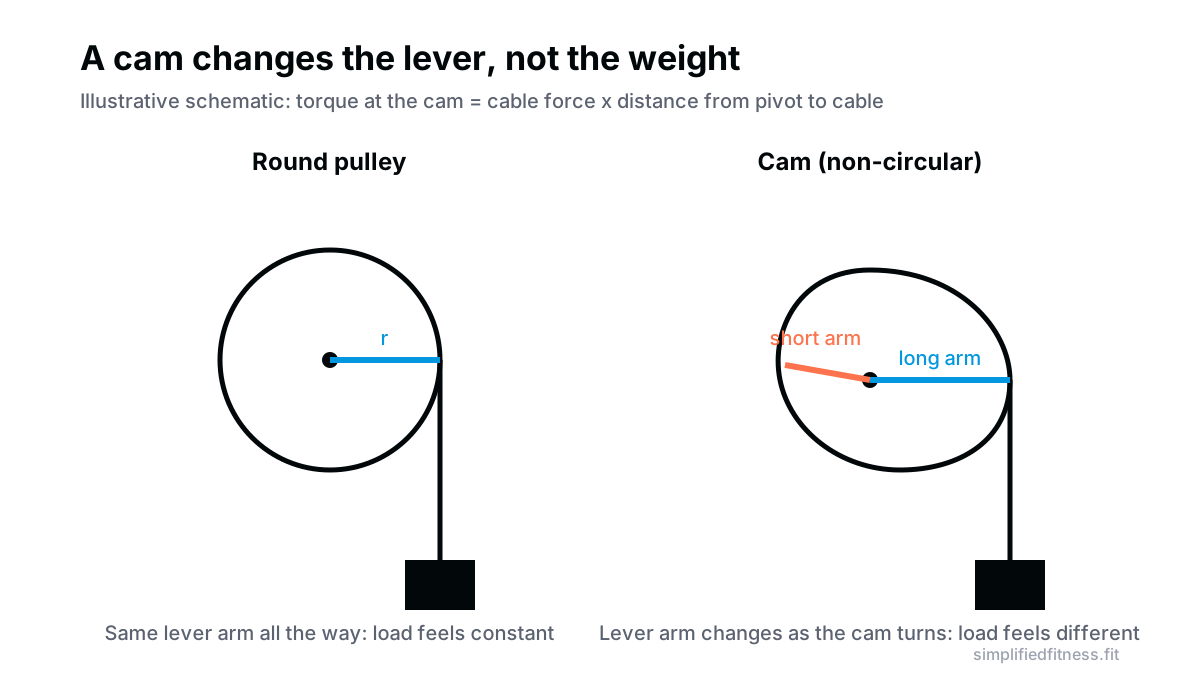
A cam is a pulley that is not round. The weight stack cable wraps around it, and as the cam rotates, the point where the cable leaves the wheel moves closer to or further from the pivot.
Closer to the pivot means a short lever arm. Further away means a long one. The torque the machine applies to your joint is roughly the cable force multiplied by that distance. Same stack, different torque.
A round pulley cannot do this. Its radius never changes, so the lever arm stays fixed through the rep.
Where did cams come from?
The usual story credits Arthur Jones, who founded Nautilus and built cam-based machines from the early 1970s. His argument was simple: your muscles are not equally strong at every joint angle, so a load that never changes is too hard at some angles and too easy at others. A cam, he reasoned, could vary the load to match.
Take the dates and details as popular gym history. I could not find a peer-reviewed source for them, and the engineering idea matters more than who first sold it.
Why do muscles need a changing load?
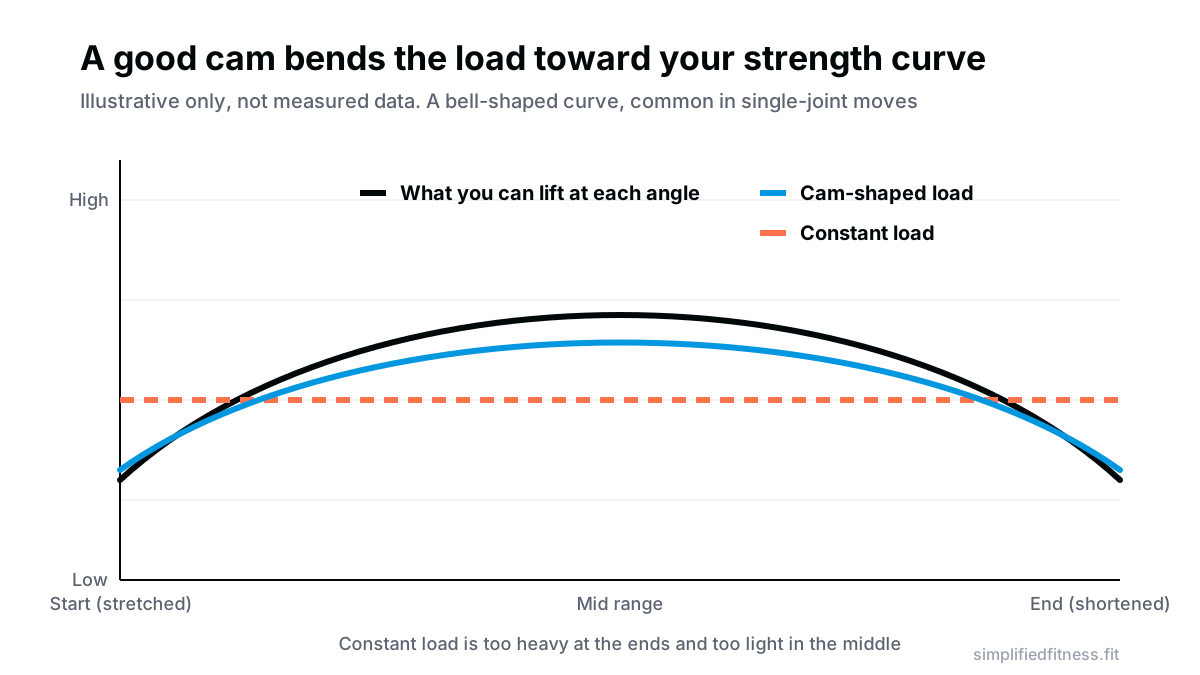
Because your strength is not flat across a rep. For many movements, you are weakest in one position (often the very stretched start or the fully shortened end) and strongest somewhere in the middle. The shape differs by exercise and by person, a point we cover in matching resistance profiles to human strength curves.
A dumbbell curl shows the problem. Gravity pulls straight down, and the lever arm of the weight is longest when your forearm is horizontal. So the curl feels hardest in the middle and easy at the top, whatever your muscle is capable of there.
A well-shaped cam tries to fix that. It raises the torque where you are strong and lowers it where you are weak, so the muscle works closer to its limit across more of the range.
Does variable resistance actually build more muscle or strength?
Here the research is thinner than the marketing.
Most variable resistance studies use elastic bands or chains on a barbell, not selectorized cams. They are a related idea (load changes through the rep) but a different mechanism. So treat them as rough context. We cover the band and chain research itself in accommodating resistance with bands and chains.
- A 2022 meta-analysis of 17 studies and 491 healthy adults found no significant difference between variable and traditional training for maximal strength or power, upper or lower body (Andersen et al., 2022).
- Another 2022 meta-analysis of 14 studies found larger maximum-strength gains with variable resistance (ES = 0.80 overall, 0.57 in trained people), with the benefit depending on load: 80% of 1RM or more helped trained lifters (Lin et al., 2022).
- A 2026 meta-analysis reported modest advantages for variable resistance over free weights in maximal strength and jump distance (SMD 0.28 to 0.37), with chains and smaller variable loads looking best. The subgroups were bands and chains, not cams (Li et al., 2026).
Why might they disagree? Different inclusion rules, different loads, different populations (trained vs untrained) and different outcome tests. Mostly short studies too.
The cautious takeaway: variable resistance is unlikely to hurt, may help strength a little under some conditions, and says very little about muscle size on a cam stack.
Are machines as good as free weights for hypertrophy?
Mostly, yes. A 2023 meta-analysis of 13 studies and 1016 adults found no difference in hypertrophy between free-weight and machine training (SMD -0.055, 5 studies), with the choice coming down to preference and goals (Haugen et al., 2023). Strength gains were more specific: lifters got stronger on the equipment they trained with. For the full comparison, see free weights vs cables vs machines for hypertrophy.
So a cam is not a growth hack. It is a way to make a fixed path feel smooth and loaded where you want it.
Why do some machines feel unnatural?
Several things can go wrong, and the cam is only one of them.
- The seat does not line up. Your joint axis should sit near the cam pivot. If it does not, the machine moves your limb on a different arc than the cam was built for.
- The cam was designed for an average body. Longer or shorter limbs and different muscle attachments change your real strength curve.
- Friction. Guide rods, pulleys and cable routing add resistance that is not part of the cam design. Older or cheaper machines often have more of it.
- Loose tolerances. Slack in the cable or pivot can create a jerk at the start of the rep.
- Big stack jumps. If the next pin is 5 or 7 kg heavier, the machine can feel wrong simply because you cannot choose a fitting load.
Cheaper or simpler machines often feel odd because they use more basic pulley layouts and less careful cam shaping, though I would not claim it as a rule. Brand and price are rough guides.
How to spot a well-designed cam machine
Use a quick, repeatable test.
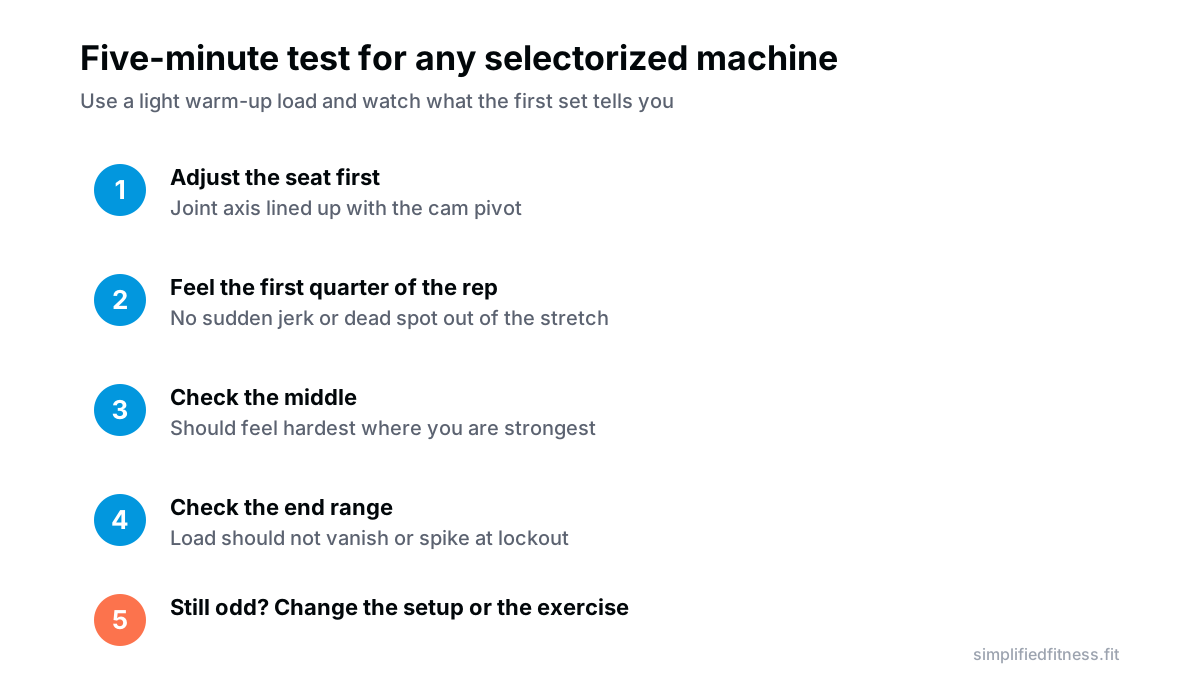
- Adjust the seat first. Line the joint axis up with the pivot as closely as the machine allows.
- Feel the stretch. Tension should build smoothly, with no jerk or dead spot.
- Feel the middle. On many single-joint machines this is where you are strongest, so it should feel hardest here. If it feels easiest, the cam or the seat is probably off for you.
- Check the end range. The load should not suddenly spike or disappear at lockout.
- Repeat with a heavier load. A machine can feel fine at 20 kg and fail at 60.
If it fails, try a different seat height or hand position. Still odd? Swap it for a cable, dumbbell or another machine. Cables are covered in our cable setup guide.
What about the stretched position?
Some cams lighten the start of the rep, which can make the stretched position easy to cut short. That matters because training in the lengthened range seems to matter for muscle growth. A 2020 systematic review found full range of motion beneficial for lower-body hypertrophy, with upper-body evidence limited and conflicting (Schoenfeld and Grgic, 2020).
A more recent trial in 30 resistance-trained people found lengthened partial reps and full range of motion produced similar arm muscle growth over 8 weeks, with the authors suggesting trainees emphasize the stretched position (Wolf et al., 2025). Two points: the sample was small and the study short, and it tested arms and a lat pulldown, not every machine.
So if a cam makes the stretch feel soft, control that part of the rep instead of bouncing out of it.
Pin-loaded cams vs plate-loaded levers
Not every machine uses a cam. Plate-loaded machines usually use a pivoting arm, and the load changes as that arm swings. We compare the two in plate-loaded vs pin-loaded chest machines. A pec deck is a good place to feel how a cam and a pivot arm shape the load, and our pec deck setup guide covers it.
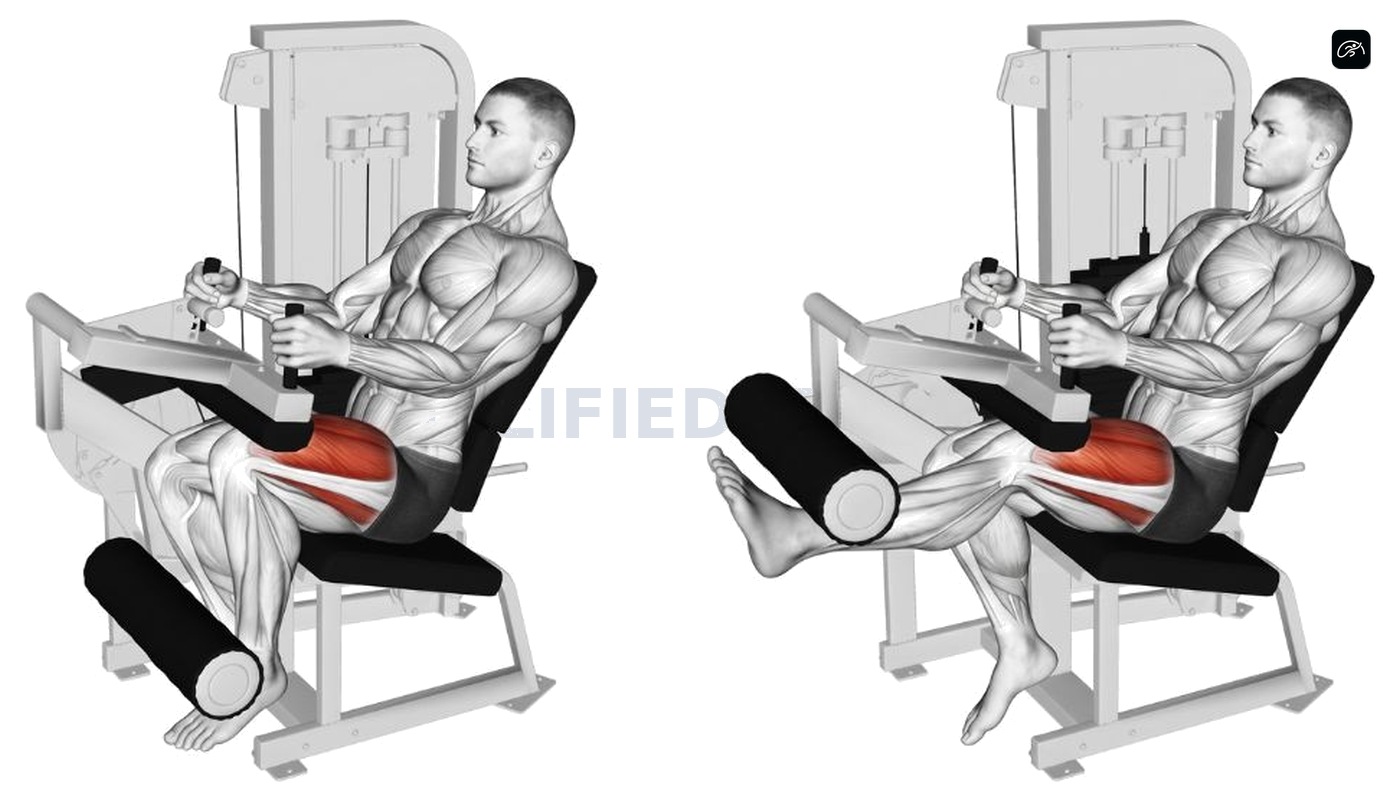
Machine progression, friction and cam quirks
Each machine has its own friction, stack steps and cam shape. A 40 kg pin on one leg extension is not a 40 kg pin on another. So track progress on the same machine, and log the pin position, reps and effort. Our guide to progressive overload on machines goes deeper.
Effort is the real yardstick. Use the RIR and RPE calculator to check how close to failure you took a set, then add weight when you hit your rep target with a rep or two in reserve.
For those training in a hot Indian gym without much machine variety, the practical point is that you do not need a perfect cam. A decent leg extension, a lat pulldown and a cable stack are enough for most muscles.
When a machine hurts
A cam should challenge the muscle, not the joint. Sharp or pinching pain at one specific angle is a sign the machine does not fit you. Stop and change the setup or the exercise. If pain persists or comes with swelling, numbness or weakness, see a doctor or physiotherapist rather than pushing through. This article is general education, not a diagnosis.
The bottom line
A cam changes the lever arm, so the same plate applies different torque through the rep. Designers aim to match average human strength curves, but no cam fits every body. The research suggests machines build muscle about as well as free weights, and the variable resistance studies mostly cover bands and chains, so they only loosely apply to cams.
In the gym, that means: set up the seat, test the three zones, and pick the machine that feels smooth and hard in the target muscle. If you want a plan to put those machines to work, try our free leg day plan.
Frequently Asked Questions
What is a cam on a gym machine?
A cam is a non-circular pulley or wheel, often shaped like a kidney or a snail shell, that the weight stack cable runs over. As it turns, the cable sits at a changing distance from the pivot, which changes the leverage. The practical result is that the same plate on the stack feels heavier or lighter at different parts of the rep.
Who invented the cam machine?
The cam is most often credited to Arthur Jones, who built Nautilus machines in the early 1970s. His idea was that a round pulley gives a constant lever arm while your muscles are not equally strong at every angle. Treat the exact dates as popular history, because I did not find a peer-reviewed source for them.
Do cam machines build more muscle than free weights?
There is no good evidence that they do. A 2023 meta-analysis of 13 studies found no difference in hypertrophy between free-weight and machine training (SMD -0.055, 5 studies). Pick the option you can load progressively, feel in the target muscle and do consistently.
What does variable resistance mean in a gym machine?
It means the effective load on the muscle changes through the range of motion, even though the weight on the stack does not change. This happens through leverage, mainly the cam shape and the pivot position. Bands and chains also create variable resistance, but by adding load as they stretch or lift off the floor.
Why do some machines feel awkward or jerky?
The cam may be poorly matched to the strength curve, the seat may put your joint away from the pivot, or friction in the guide rods and pulleys may add its own resistance. Cheaper machines often use simpler pulley layouts with less careful cam shaping. Adjust the seat first, then try a lighter load before judging the machine.
Is variable resistance training better for strength?
The evidence is mixed. A 2022 meta-analysis of 17 studies found no significant difference in maximal strength between variable and traditional training, while another 2022 meta-analysis of 14 studies found larger gains with variable resistance. Most of that work used bands or chains, so use it as a rough guide for cam machines, not proof.
Do cams match the human strength curve?
They try to, with a rough bell or ascending shape depending on the exercise, but a single cam cannot match every lifter. Strength at each angle depends on muscle attachment points, limb length and tendon geometry. That is why the same machine can feel perfect to one person and odd to the next.
Are pin-loaded machines with cams safer?
They are easier to use near failure because you can release the handle without a barbell crashing down, and the path is fixed. That does not make them risk-free: a poor fit can still load a joint awkwardly. If a machine causes joint pain rather than muscle effort, stop and see a doctor or physio if it persists.
How do I know if a machine cam suits my body?
Adjust the seat so your joint sits near the cam pivot, use a light load, and move through the full range slowly. You want smooth tension from the stretch, the hardest point roughly where you feel strongest and no spike or vanishing load at the end. If it fails, change the seat height or switch to a cable or dumbbell version.
Should I stop at the same weight if the machine feels easy at the bottom?
Judge a set by effort near failure, not by how the first few inches feel. Many cams ease the load in one part of the range, so the last reps are limited by the hardest point. Use our RIR and RPE calculator to track effort and add weight only when you hit the rep target with a rep or two in reserve.
Do cams matter for progressive overload?
They matter less than consistency. Each machine has its own friction and stack jumps, so a progress log on the same machine is more useful than comparing numbers across gyms. Record the pin position, reps and how close you got to failure.
Are plate-loaded machines different from cam machines?
Yes. Plate-loaded machines usually rely on a pivoting lever arm, and the load changes with the angle of that arm, rather than a cam on a cable. Both alter leverage, but the mechanics and the feel are different.
Can a machine with a bad cam still be worth using?
Yes, if you can adjust it to feel smooth and hard in the target muscle. Many lifters use a stretch-biased or mid-range portion of the rep and keep the rest controlled. If nothing makes it comfortable, there is almost always another exercise that trains the same muscle.
Sources & References
Every claim above is checked against peer-reviewed research (PubMed, U.S. National Library of Medicine) or guidance from established health bodies. How we fact-check.
- Haugen ME, et al. Effect of free-weight vs. machine-based strength training on maximal strength, hypertrophy and jump performance - a systematic review and meta-analysis. BMC Sports Sci Med Rehabil. 2023. PMID: 37582807
- Andersen V, et al. Comparing the effects of variable and traditional resistance training on maximal strength and muscle power in healthy adults: A systematic review and meta-analysis. J Sci Med Sport. 2022. PMID: 36130847
- Lin Y, et al. Effects of Variable-Resistance Training Versus Constant-Resistance Training on Maximum Strength: A Systematic Review and Meta-Analysis. Int J Environ Res Public Health. 2022. PMID: 35886409
- Li J, et al. Comparison of Variable Resistance and Free Weight Training on Long-Term and Acute Effects on Different Assessments of Strength: A Systematic Review and Meta-Analysis. J Strength Cond Res. 2026. PMID: 41460711
- Schoenfeld BJ, Grgic J. Effects of range of motion on muscle development during resistance training interventions: A systematic review. SAGE Open Med. 2020. PMID: 32030125
- Wolf M, et al. Lengthened partial repetitions elicit similar muscular adaptations as full range of motion repetitions during resistance training in trained individuals. PeerJ. 2025. PMID: 39959841

Umair Hazrami · Founder & Head Coach, Simplified Fitness
Umair Hazrami founded Simplified Fitness and the Simplified Lifter channel to cut through fitness noise. With 4+ years of consistent training and 10+ coaching clients, he writes every guide from the peer-reviewed research and links the sources so you can check them. Our editorial standards.
Educational content only, not medical advice. If you have a medical condition, are pregnant, or take medication, talk to a qualified doctor before changing your diet, supplements or training. Full disclaimer.
Keep reading
Exercise Technique
Anthropometry-Based Exercise Selection: Long Limbs, Short Torsos, and Lever Adjustments
Anthropometry exercise selection explained: how long femurs, long arms and a short torso change squats, deadlifts and presses, plus a simple audit and swaps.
9 min read
Exercise Technique
Axial Loading vs Non-Axial Exercises: Managing Spinal Fatigue for Bigger Legs and Back
Axial loading vs non axial exercises explained: how spinal compression limits your weekly volume, and which squat and row swaps spare your lower back.
7 min read
Exercise Technique
Cable Setup Mastery: Pulley Heights, Cable Angles, and Customizing Force Vectors
Cable machine setup guide: how to set pulley height, stance and cable angle for chest, lats, delts and arms, with what the research does and does not show.
9 min read
Exercise Technique
Compound vs Isolation Exercises for Hypertrophy: Do You Need Both?
Compound vs isolation exercises for hypertrophy: what trials say about arms, delts and hamstrings, and which muscles actually need direct sets. Sources linked.
7 min read