Progressive Overload on Machines: What to Do When the Next Pin Is Too Heavy
Progressive overload on machines is easier than it looks. Learn double progression, microloading, tempo and pin tracking when the next stack jump is too big.
TL;DR. The short answer
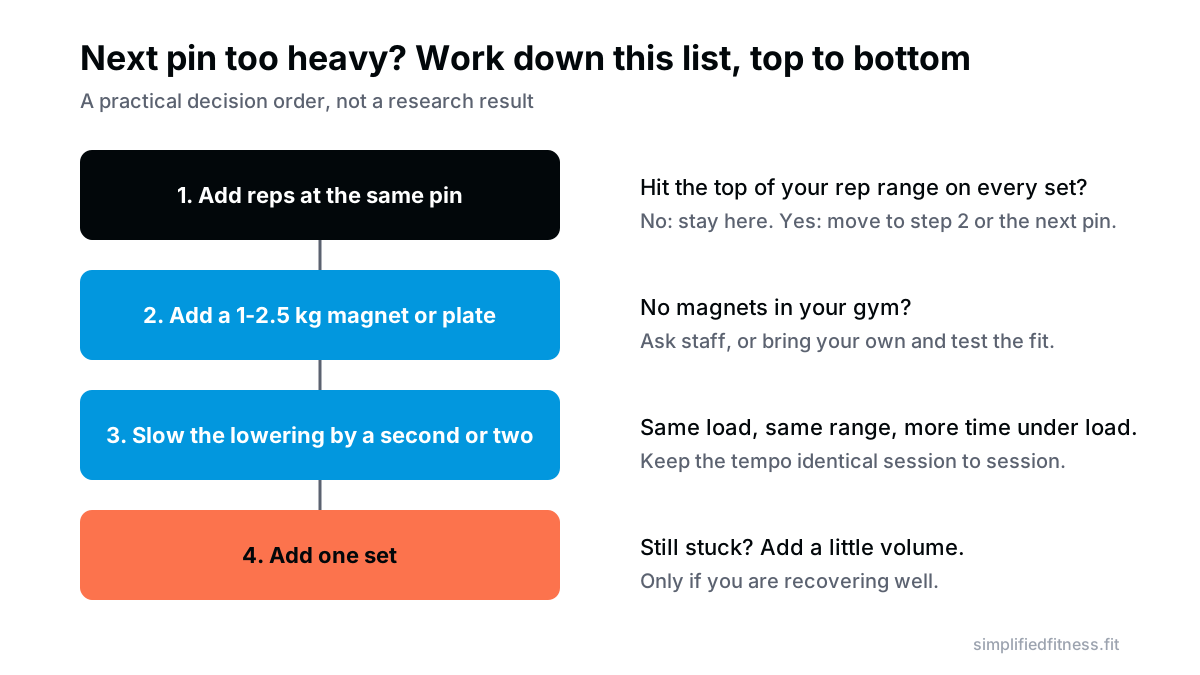
- Progressive overload on machines works the same way as on a barbell: do more over time. When the next pin is too heavy, add reps at the same pin first (double progression), then add a small magnet or plate, a slower tempo, or an extra set.
- In a 2023 meta-analysis of 13 studies, the 5 that measured muscle size found similar growth with free weights and machines, so slower-looking machine progress is a logistics problem, not a muscle-building one.
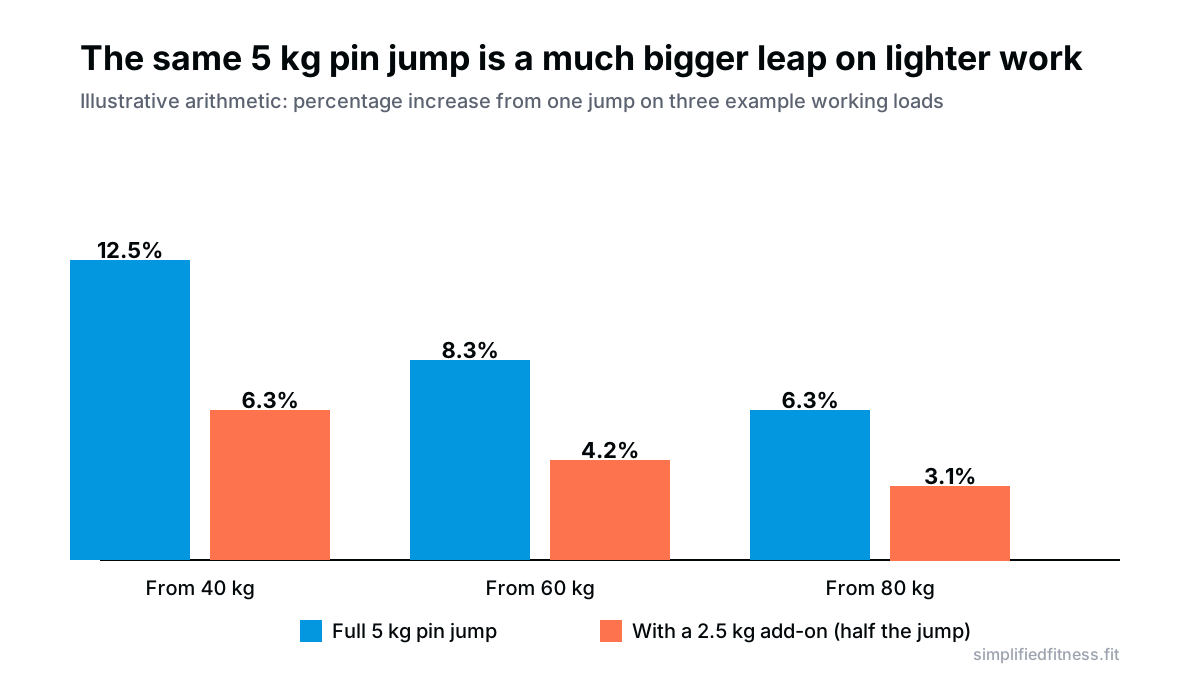
- A 5 kg pin jump is a 12.5% increase from 40 kg but only about 6% from 80 kg, which is why light machines (lateral raise, curl, tricep) feel stuck first.
- Pin numbers are only comparable on the same machine. Log the machine, the pin, your seat setting and the tempo, because friction and stack labels differ between brands.
- Muscle growth does not require one narrow rep zone. Heavy and light loads grew muscle similarly when sets were taken to failure, which gives you room to progress with reps.
Part of our complete guide: Exercise Selection Biomechanics: Moment Arms, Strength Curves and Free Weights vs Machines
Table of contents
Progressive overload on machines works exactly like it does with a barbell (see our guide to exercise selection and biomechanics): you do slightly more over time. The catch is that a weight stack only lets you add load in big steps, so when the next pin is too heavy, you progress with reps first, then with small add-on weights, a slower tempo or an extra set.
That is the whole idea. The rest of this guide is the practical detail. If you have ever stared at a lat pulldown stack thinking “I can do pin 8 for 10 reps but pin 9 feels impossible”, this is for you.
Why does progressive overload on machines feel harder?
Three things make machines feel stickier than a barbell, and none of them mean machines are worse for muscle.
The jumps are big. A barbell lets you add 1 kg with two small plates. A weight stack might jump 5 kg per pin, or 10 kg on older machines. For a big muscle group that is fine. For biceps, triceps and side delts it is a wall.
The stack number is not the force you feel. Pulleys, cables, guide rods and cams all lose some force to friction, and the mechanical advantage changes through the range. The exact amount varies by machine and brand, and I cannot give you a reliable figure. What matters is that 40 kg on one machine is not the same effort as 40 kg on another.
Every gym has different gear. A Hammer Strength plate-loaded press, a Life Fitness pin-loaded press and a cheap local gym version all load you differently, even if each says “40”.
Do machines build muscle as well as free weights?
Largely yes, and that matters because it means you are not giving anything up by leaning on machines.
A 2023 systematic review and meta-analysis pooled 13 studies and 1,016 adults who trained with free weights or machines for at least 6 weeks. Hypertrophy did not differ between the two (SMD -0.055, a negligible gap), and neither did dynamic or isometric strength in direct comparison (Haugen et al., 2023). Strength did show some specificity: free-weight strength rose more with free-weight training. Only five of the studies measured hypertrophy, so treat the muscle-size conclusion as good rather than final.
A small 2025 randomized within-subject trial agrees. Eight untrained young women trained one leg with lunges and the other with an inclined leg press for 9 weeks. Both legs grew, with no difference between them (Amanuma et al., 2025). Eight untrained women is a tiny sample, so I would lean on the meta-analysis more.
If you want the broader comparison, see our guide to free weights vs cables vs machines.
Step 1: Use double progression before you touch the pin
Double progression is the lowest-effort fix. You choose a rep range, keep the load fixed, and only move up once every set reaches the top. We cover the full model in double progression explained, but here is how it plays out on a machine.
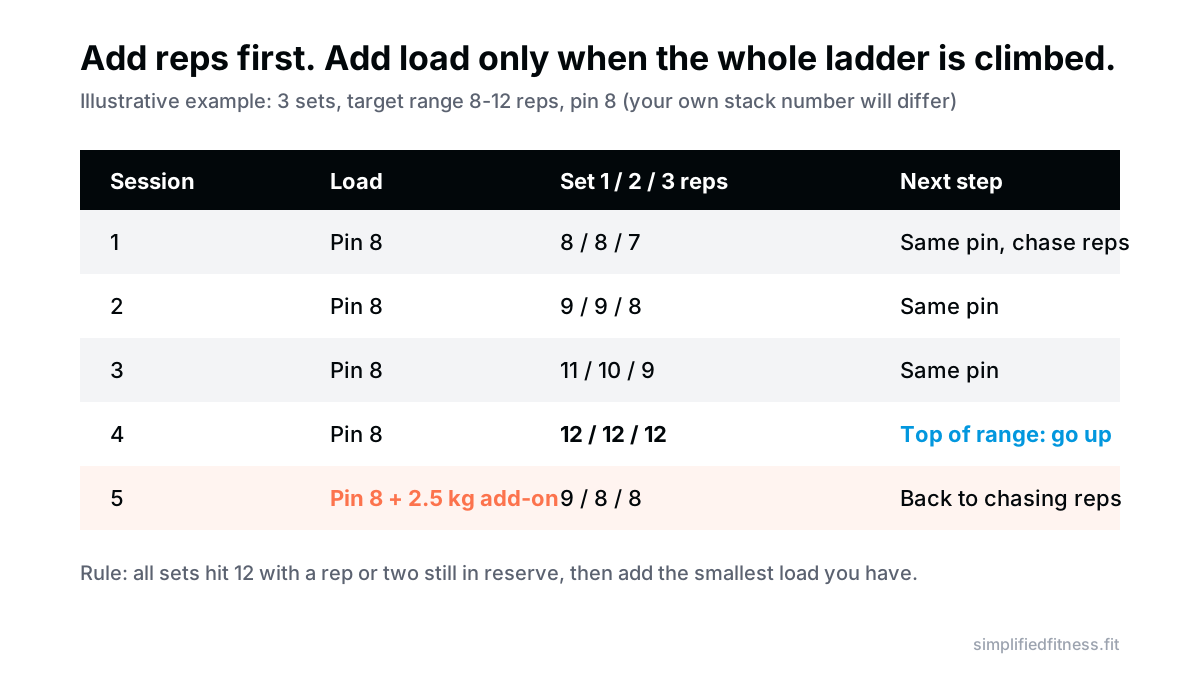
Say you are doing a seated row at pin 8, target 8-12 reps for 3 sets.
- Session 1: 8, 8, 7 reps
- Session 2: 9, 9, 8
- Session 3: 11, 10, 9
- Session 4: 12, 12, 12. Go up.
Why does this work? Research on loading suggests you have more room than the old rule of thumb allows. A 2021 review argued that muscular adaptations can be obtained, and in some cases optimised, across a wide spectrum of loading zones, rather than only in a narrow “hypertrophy rep range” (Schoenfeld et al., 2021). A 2017 meta-analysis of 21 studies, with all sets taken to momentary failure, found muscle hypertrophy was similar between low-load (60% of 1RM or less) and high-load training, while max strength favoured heavy loads (Schoenfeld et al., 2017).
In practice, that means a machine set of 12 and a set of 8 can both grow muscle, so climbing from 8 to 12 reps is real progress, not a consolation prize. One caution: those studies mostly compared sets taken to or near failure, so reps only count if the effort is honest.
Step 2: Microloading machines with add-on weights
When the next pin is more than you can handle, microloading fills the gap. Many gyms keep small magnetic plates or clip-on add-ons designed to sit on top of the stack. Typical sizes run from about 0.5 to 2.5 kg, but check what your gym actually has. We go deeper on the upper-body version in microloading with fractional plates.
A few practical points:
- Place the magnet on the top plate being lifted, directly above the pin, so it lifts with the stack and does not rattle against the rods.
- Check it does not touch the frame. A magnet that catches adds friction and noise, which defeats the purpose.
- Add it to your log as a separate line, for example “pin 8 + 2.5 kg”.
- If your gym has none, ask. Small add-on weights are inexpensive, and some gyms will buy a set if members request it.
Home gyms are the same story. Small fractional plates cost little and last for years, and our plate calculator helps you work out loads when you mix sizes.
Step 3: Tempo and range of motion as small steps
If you have no magnets, you can still make the same pin harder in a controlled way. Slowing the lowering phase by a second or two increases the time the muscle works per rep, and you can record it like any other variable.
I would treat this as a tiebreaker, not a main strategy. We cover the evidence in our review of tempo and repetition duration, and the practical message is that you do not need to slow every rep to grow. Use it when you have nothing smaller to add, keep it identical from session to session, and write it down (“3 sec down”). If you change tempo and pin in the same week, you cannot tell which one helped.
Range of motion works the same way: a deeper, controlled stretch on the same pin is harder. Just do not count a sloppy shortened range as progress. The point is to do the same job better, not to cheat the number.
Step 4: Add a set
If reps, magnets and tempo are all exhausted, add a little volume. A 2017 meta-regression of 15 studies found that each additional weekly set per muscle was associated with a small increase in growth, about 0.37% greater gain, within a graded dose-response relationship (Schoenfeld et al., 2017). That is an average across studies, not a promise for you, and more sets cost more recovery.
One trap: switching to single-arm or single-leg work does not shrink the pin jump. You use roughly half the stack on one limb, so the same 5 kg step becomes a bigger percentage, not a smaller one. If the jumps feel strange through the range, our note on selectorized machine cam profiles explains why stacks load you unevenly.
How hard should machine sets be?
Machines are a good place to push close to failure because the path is guided and the weight will not trap you. The evidence on exactly how close is mixed, so here are both sides.
A 2023 meta-analysis of 15 studies found a trivial advantage for training to set failure over non-failure (effect size 0.19), and no advantage for momentary muscular failure specifically (effect size 0.12, confidence interval crossing zero) (Refalo et al., 2023). A 2024 exploratory meta-regression using estimated reps in reserve found the opposite direction for hypertrophy: muscle growth increased as sets finished closer to failure, while strength gains were similar across a wide range (Robinson et al., 2024).
Why might they differ? The first compared categories (failure versus not), the second treated proximity as a continuous scale and relied on estimated RIR, which the authors themselves call exploratory. A cautious takeaway: stop most sets roughly 1-3 reps short, and take the last set of an exercise to or near failure if the machine feels safe. You can estimate this with our RIR and RPE calculator.
How to track machine progress without fooling yourself
Pin numbers only mean something inside one machine. A good log line has five parts:
- Machine name and brand (or “gym B chest press”)
- Seat, pad or lever setting
- Pin number plus any add-on
- Reps for each set
- Reps in reserve and tempo
The seat setting matters more than people think, because moving it changes the lever arm and the feel of the same pin. Our training logbook guide shows a simple layout. If you want to compare how plate-loaded and pin-loaded designs differ for chest work, read plate-loaded vs pin-loaded chest machines.
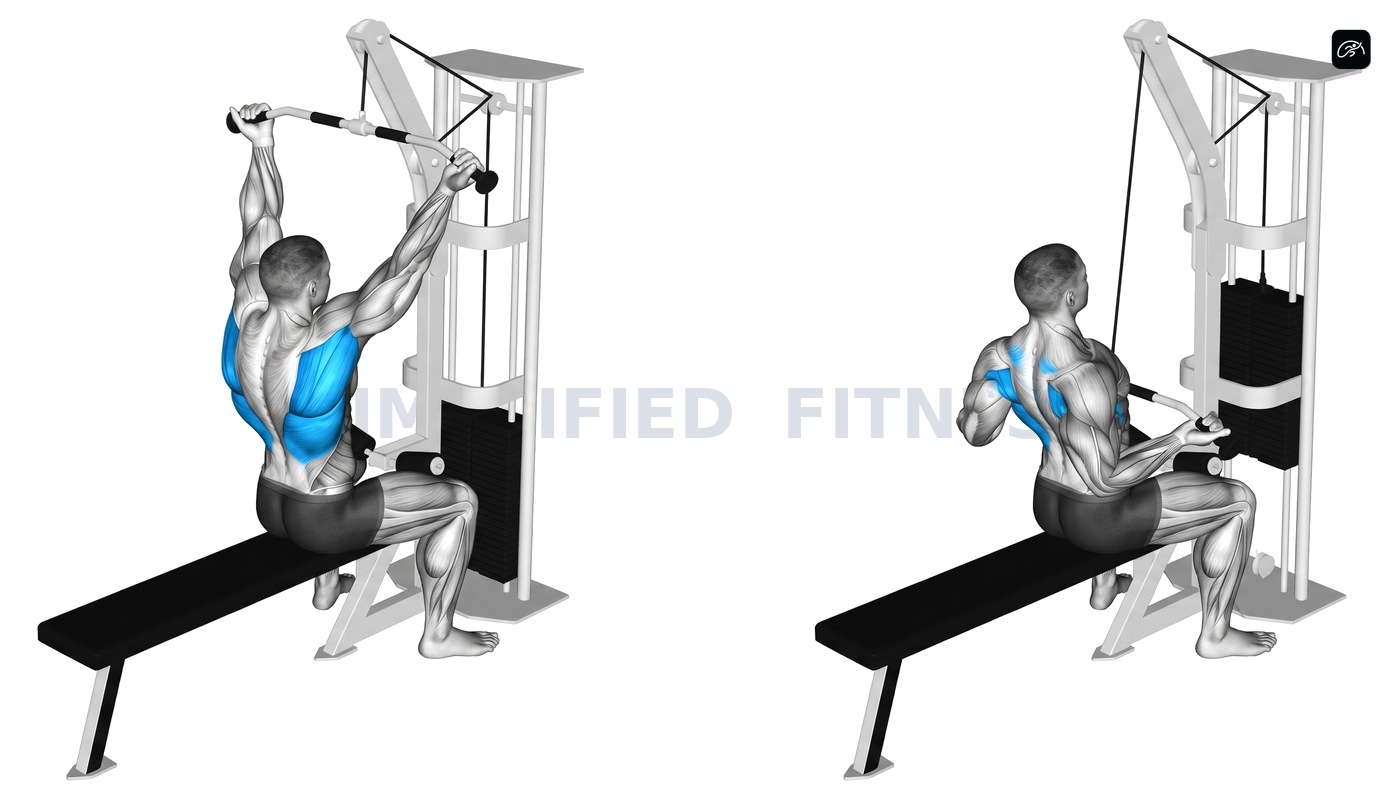
A simple weekly routine for stuck machine lifts
If you want a plan to paste into your notes, try this for a lift that has stalled for two or three weeks:
- Week 1: Same pin, aim to beat last session by one rep on any set.
- Week 2: Keep chasing reps. If you have a magnet, add the smallest one once all sets hit the top.
- Week 3: Hold the pin and slow the lowering by about 2 seconds, noting it down.
- Week 4: If you are still stuck and recovering well, add one set. If you are tired, rest instead.
If a lift keeps stalling for more than a month, look at sleep, food and weekly volume before blaming the machine. Our free workout plans give a structure you can drop these lifts into.
A note on pain: if a joint hurts as the weight rises, back off and see a physio or doctor rather than pushing through. Progress that costs you an injury is not progress.
The bottom line
Progressive overload on machines is not a downgrade from free weights. Muscle growth looks similar in the research, the stack jumps are just bigger. Add reps first, then use small add-on weights, a consistent slower tempo or one extra set, and log your pin, your seat and your reps so you are always comparing like with like. Small repeatable wins add up faster than one heroic jump you cannot hold.
Frequently Asked Questions
How do you progress on machines when the weight jumps are too big?
Add reps at the same pin until you reach the top of your rep range on every set, then look for a smaller step. That can be a magnetic add-on weight, a slower lowering phase or one extra set. This works because muscle growth responds to total hard work, not only to a heavier pin, so any measurable increase counts.
What is double progression on a machine?
Double progression means you pick a rep range such as 8-12 and keep the weight fixed until all sets reach the top of the range. You then raise the load and drop back toward the bottom of the range. It suits machines well because the weight stack only gives you big jumps, so reps become your small steps.
Can I use magnetic weights on a gym machine?
Many gyms have small magnetic or clip-on plates that sit on top of the stack, and they are a common way to add 0.5-2.5 kg. Check that the add-on sits firmly and does not touch the guide rods or catch as the stack moves. Ask a staff member first, because some gyms prefer you use their own.
Do machines have friction that changes the real weight?
Yes, pulleys, cables, guide rods and cam systems all add some resistance loss, and the amount differs between machines and brands. There is no standard number I can give you, and the stack label is not exactly the force at the handle. Treat pin numbers as relative to that one machine and compare yourself only against your own previous logs.
Is 10 kg between pins too much of a jump?
On most machines it is, especially for small muscles like biceps, triceps and side delts. A 10 kg jump from 40 kg is a 25% increase, which most people cannot match rep for rep. Use reps, add-on weights or a slower tempo to bridge the gap instead of forcing the jump.
How do I track progress on machines properly?
Write down the machine name, pin number, seat or pad settings, reps per set and how close to failure you stopped. The settings matter because a different seat height changes the lever arm and the feel. Our free logbook method makes this quick enough to do between sets.
Is the weight on a Hammer Strength the same as a Life Fitness machine?
No, they are not directly comparable. Plate-loaded and pin-loaded designs use different levers, pulleys and cam shapes, so 40 kg on one is not 40 kg of effort on another. Stay with one machine for a training block when you can, and note the brand in your log if you switch gyms.
Does slowing the tempo count as progressive overload?
It can, as long as you keep it consistent and record it. Slow reps have not been shown to be necessary for growth, so treat tempo as a tiebreaker rather than a main driver. Use it when you have no smaller weight step, not as a replacement for adding reps.
Should I train machines to failure?
Machines are a sensible place to train close to failure because the path is guided and the weight does not fall on you. A 2023 meta-analysis found no clear advantage for going to full failure over stopping short, though a 2024 meta-regression suggested growth rises as sets finish closer to it. Stopping around 1-3 reps before failure is a reasonable default, and our RIR calculator helps you judge it.
How many reps should I do on machines for muscle growth?
A range of about 6-15 reps is a practical default, with lighter or heavier sets also working if you train hard. A 2017 meta-analysis found muscle growth was similar across heavy and light loads when sets were taken to failure. Pick a range your joints like and progress within it.
Are machines worse than free weights for progressive overload?
Not for muscle size. A 2023 meta-analysis of 13 studies found no difference in hypertrophy between free weights and machines. Strength carries over best to the exercise you train, so if you want a bigger barbell squat, practise the barbell squat.
What if my gym stack has no half plates or magnets?
Then reps, tempo and sets are your small steps. If you train at home or in a small gym, a set of fractional plates is cheap and lasts for years.
How do I know when to move up a pin?
Move up when every set hits the top of your rep range with a rep or two to spare and your form stays the same. If the next pin drops you below the bottom of your range, use an add-on weight rather than the full jump. Moving up too soon usually shows up as ragged reps and a shorter range of motion.
Sources & References
Every claim above is checked against peer-reviewed research (PubMed, U.S. National Library of Medicine) or guidance from established health bodies. How we fact-check.
- Schoenfeld BJ, et al. Loading Recommendations for Muscle Strength, Hypertrophy, and Local Endurance: A Re-Examination of the Repetition Continuum. Sports (Basel). 2021. PMID: 33671664
- Schoenfeld BJ, et al. Strength and Hypertrophy Adaptations Between Low- vs. High-Load Resistance Training: A Systematic Review and Meta-analysis. J Strength Cond Res. 2017. PMID: 28834797
- Haugen ME, et al. Effect of free-weight vs. machine-based strength training on maximal strength, hypertrophy and jump performance - a systematic review and meta-analysis. BMC Sports Sci Med Rehabil. 2023. PMID: 37582807
- Amanuma MT, et al. Comparable regional hypertrophy of the knee extensor muscles in response to resistance training with machines versus free weights: a randomized within-subject approach. J Bodyw Mov Ther. 2025. PMID: 41316621
- Refalo MC, et al. Influence of Resistance Training Proximity-to-Failure on Skeletal Muscle Hypertrophy: A Systematic Review with Meta-analysis. Sports Med. 2023. PMID: 36334240
- Robinson ZP, et al. Exploring the Dose-Response Relationship Between Estimated Resistance Training Proximity to Failure, Strength Gain, and Muscle Hypertrophy: A Series of Meta-Regressions. Sports Med. 2024. PMID: 38970765
- Schoenfeld BJ, et al. Dose-response relationship between weekly resistance training volume and increases in muscle mass: A systematic review and meta-analysis. J Sports Sci. 2017. PMID: 27433992

Umair Hazrami · Founder & Head Coach, Simplified Fitness
Umair Hazrami founded Simplified Fitness and the Simplified Lifter channel to cut through fitness noise. With 4+ years of consistent training and 10+ coaching clients, he writes every guide from the peer-reviewed research and links the sources so you can check them. Our editorial standards.
Educational content only, not medical advice. If you have a medical condition, are pregnant, or take medication, talk to a qualified doctor before changing your diet, supplements or training. Full disclaimer.
Keep reading
Exercise Technique
Anthropometry-Based Exercise Selection: Long Limbs, Short Torsos, and Lever Adjustments
Anthropometry exercise selection explained: how long femurs, long arms and a short torso change squats, deadlifts and presses, plus a simple audit and swaps.
9 min read
Exercise Technique
Axial Loading vs Non-Axial Exercises: Managing Spinal Fatigue for Bigger Legs and Back
Axial loading vs non axial exercises explained: how spinal compression limits your weekly volume, and which squat and row swaps spare your lower back.
7 min read
Exercise Technique
Cable Setup Mastery: Pulley Heights, Cable Angles, and Customizing Force Vectors
Cable machine setup guide: how to set pulley height, stance and cable angle for chest, lats, delts and arms, with what the research does and does not show.
9 min read
Exercise Technique
Compound vs Isolation Exercises for Hypertrophy: Do You Need Both?
Compound vs isolation exercises for hypertrophy: what trials say about arms, delts and hamstrings, and which muscles actually need direct sets. Sources linked.
7 min read