Smith Machine vs Free Barbell for Hypertrophy: What the Research Says
Smith machine vs free barbell hypertrophy: what EMG studies and a 2023 meta-analysis show about muscle activation, safety, foot placement and when each wins.
TL;DR. The short answer
- The Smith machine is not dangerous or useless for muscle growth. A 2023 meta-analysis of free weights versus machines found no difference in hypertrophy, though no study in it tested the Smith machine on its own.
- Free barbells usually produce higher muscle activation on EMG in small lab studies, especially in the legs and trunk. Higher activation is not proof of more growth.
- The fixed track lets you move your feet freely, take failure safely without spotters, and train with less balance demand. These are real advantages, not excuses.
- Strength is specific to the tool. If you want a bigger free-weight squat or bench, you still need to practise them.
- Joint pain, a back injury or chest pain during lifting needs a doctor or physio, not a different bar.
Part of our complete guide: Exercise Selection Biomechanics: Moment Arms, Strength Curves and Free Weights vs Machines
Table of contents
The Smith machine is not dangerous and it is not useless, but it is not magic either. In the research so far, smith machine vs free barbell hypertrophy comes out close to a tie for muscle growth, while free barbells tend to show higher muscle activation in the lab.
This sits inside our wider guide to exercise selection and biomechanics. Here we look at one specific argument: should you train on the fixed track or the free bar? I will also correct one popular claim on the pro-Smith side, because it goes further than the science does.
Is the Smith machine actually bad for muscle growth?
No. The strongest evidence we have is a 2023 systematic review and meta-analysis of free-weight versus machine-based training. It pooled 13 studies and 1,016 adults, with five studies measuring hypertrophy. It found no difference in muscle growth between the two, and the authors concluded the choice comes down to individual preference and goals (Haugen et al., 2023).
One caveat matters here. That review compared free weights with machines in general. It did not isolate the Smith machine, so we are borrowing the conclusion, not quoting it.
A single 8-week trial points the same way. Forty-six young adults (26 women, average age 22) trained with free weights or machines, and biceps and quadriceps thickness rose with no difference between groups (Schwanbeck et al., 2020). Young adults over 8 weeks, so be careful extrapolating to a lifter with ten years under the bar.
What does the Smith machine really change?
Think of it as removing two jobs. The bar no longer has to be balanced, and it no longer chooses its own path. Your muscles still have to move the load. They just do not have to steer it.
That is the whole mechanism. The rest is what you do with it.
Muscle activation: free barbells usually win on EMG
Here is where I disagree with the “100% of the tension goes to your target muscle” line you hear in gym forums. The lab data does not say that.
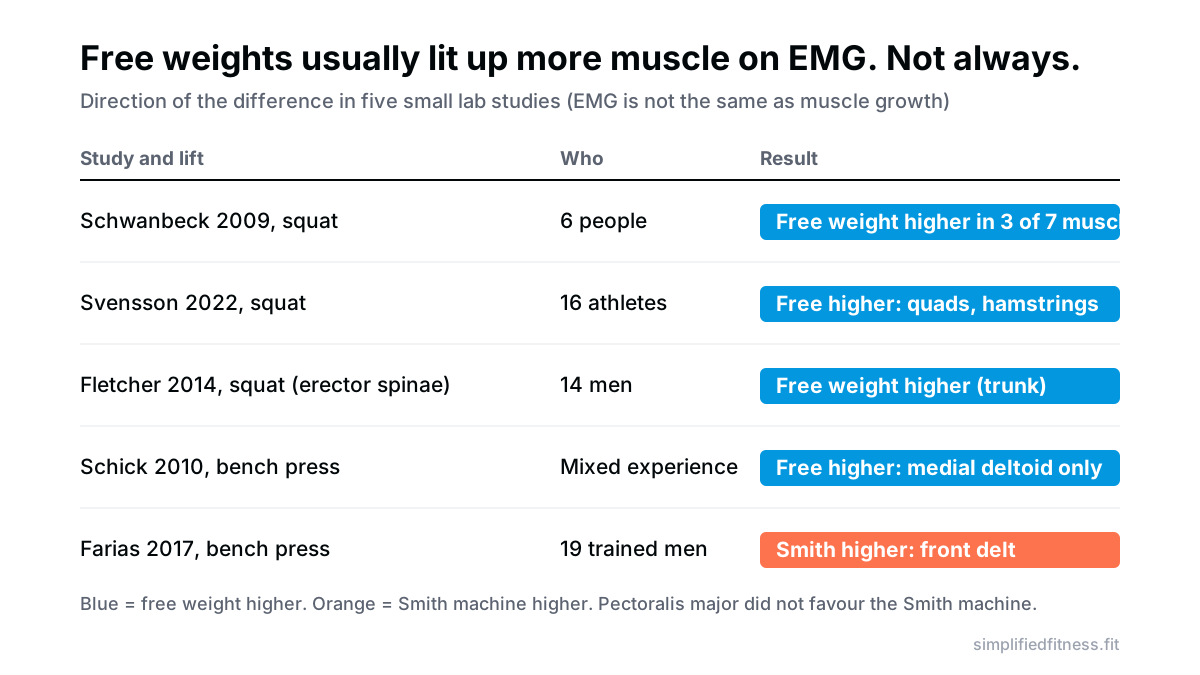
In a study of 6 people, squatting with a free bar produced 34%, 26% and 49% higher EMG in the gastrocnemius, biceps femoris and vastus medialis, and about 43% higher average activation across all measured muscles, than the Smith squat (Schwanbeck et al., 2009). Six people is tiny, so treat it as a clue.
A larger one followed up. Sixteen athletes squatted with a free or fixed bar path using loads equal to body mass. Quadriceps and hamstring activation was higher on the free path, with no difference for gluteus maximus (Svensson et al., 2022). The load was only body mass, well short of a hard working set for trained athletes, and EMG is not a growth measurement.
The bench press tells a messier story
On the bench, the picture is mixed. In one study testing lifts at 70% and 90% of 1RM, medial deltoid activity was higher with the free bar, and the authors leaned towards the free weight bench for upper-body development (Schick et al., 2010).
Nineteen trained men told the opposite story for the front delts. The Smith bench produced more anterior deltoid activity than barbell or dumbbell, and more triceps activity than the dumbbell press, while the dumbbell press gave more pec activity than the barbell (Farias et al., 2017). The Smith bench did not show a pec advantage, and it shifted work towards the front delts.
Does the Smith machine really reduce stabiliser fatigue?
Partly. In 14 men, 1RM was about 10.9% higher in the Smith squat than the free barbell squat, and erector spinae EMG at 85% of 1RM was higher on the free bar (Fletcher & Bagley, 2014). So the machine let them lift more while asking less of the lower back muscles.
That is the real advantage. If your lower back or balance gives up before your quads do, the fixed track moves the bottleneck. I would not call this a proven hypertrophy edge, because I could not find a trial that trained people on both and measured leg growth directly. It is a sensible, mechanism-based reason to use it.
This is the same idea behind external stability and exercise design, where we look at how much stability a given movement should hand you.
Can foot placement make the Smith squat a quad or glute exercise?
Yes, and this is where the machine gets interesting. A biomechanical model of the Smith squat found that moving the feet forward in front of the knees, leaning the trunk forward, or shifting weight to the forefoot emphasises hip and lower back torque and reduces knee torque. The opposite choices do the reverse (Biscarini et al., 2011).
Put plainly: feet under the bar and knees travelling forward put more demand on the knees. Feet forward with a tall chest puts more on the hips. This is a model, not a trial, so it tells you the direction of the shift, not how many percent more your quads will grow.
I want to be clear about one thing. A “pure quad isolation” Smith squat is not something the research promises. You can bias the squat towards the knees with foot placement, but the hips still work. For more on stance, see our piece on stance width and foot placement in squats and leg press.
Is Smith machine bench press safe?
It is forgiving, which is the machine’s strongest practical feature. You can rotate the bar to hook it on the catches at nearly any point, so a failed rep ends with a twist of the wrists instead of a bailout. That is a design feature, not something I can back with injury statistics, because I did not find injury-rate data comparing Smith and free-bar benching.
What to do about it:
- Set the safety catches just below your lowest chest position.
- Test the hook with an empty bar before heavy sets.
- Position the bench so the bar lands over your mid-chest or lower, not your throat.
The fixed track can also be unforgiving if your body does not fit it. A bar that cannot drift will drive your shoulder through whatever arc the machine dictates. If your shoulder pinches, change bench position, grip width or range of motion. If pain is sharp or sticks around, see a physio or doctor.
Does the fixed track build as much strength as a free bar?
Strength is specific. The meta-analysis found that free-weight strength tests improved more after free-weight training, and machine tests tended to improve more after machine training, though direct comparisons of dynamic and isometric strength showed no difference (Haugen et al., 2023).
In plain gym language: if you want a bigger barbell squat, you must squat with a barbell at least some of the time. Practising the skill is part of the strength.
An example from the 8-week trial above: free-weight and Smith squat strength improved in both groups, by about 11-19%, regardless of which tool they trained with (Schwanbeck et al., 2020). Interestingly, machine bench press strength rose more in the machine group (13.9% vs 8.6%), which fits the specificity point. Short and in young people, so I would not stretch it far. You can estimate your numbers with our 1RM calculator.
Smith machine vs free barbell: a quick comparison
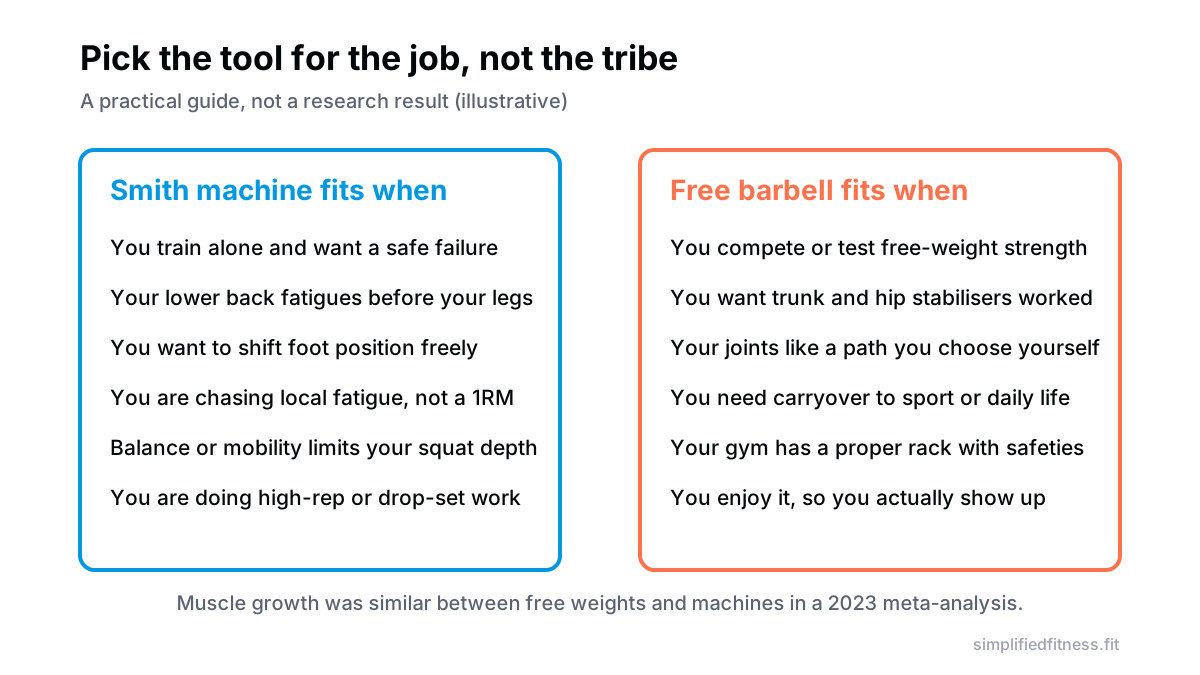
| Factor | Smith machine | Free barbell |
|---|---|---|
| Balance demand | Low | High |
| Muscle activation on EMG | Often lower in small studies | Often higher in small studies |
| Foot placement freedom | Large | Limited by balance |
| Failure safety alone | Strong (catches anywhere) | Needs a rack with safeties |
| Carryover to free-weight strength | Lower | Higher |
| Hypertrophy (meta-analysis) | No difference vs free weights overall | No difference vs machines overall |
| Fatigue elsewhere (lower back) | Lower in one squat study | Higher |
How should I use both in a program?
Most people do well mixing them. Use the barbell for your main strength lift, then use the Smith machine where extra volume is limited by something other than the target muscle.
A simple pattern for a leg session: heavy back squats first, then Smith squats with a forward foot position for hips and hamstrings, or feet back for a quad-focused finisher. Our leg day plan has a full template.
Think of it through a stimulus-to-fatigue lens too. If a movement gives you plenty of target-muscle work for little fatigue, it earns its place. We explain that idea in stimulus-to-fatigue ratio in exercise selection, and how machines and cables fit in free weights vs cables vs machines.
If lower-back load is your sticking point, read axial loading versus non-axial exercises as well.
Smith machine in India: practical notes
Many Indian commercial gyms have a Smith machine and only one or two proper racks, and in peak hours the rack is taken. A Smith machine lets you train close to failure without waiting for a spotter, which is a real benefit when training alone at 6 am before work.
Also check the machine itself. Some are poorly maintained, with sticky tracks or missing safety hooks. If the bar does not glide smoothly, switch to a rack or ask the staff to service it. A rough track adds friction that changes how heavy the load feels.
What should you take away from this?
The loudest claims on both sides are weaker than they sound. “Smith machines are dangerous” is mostly a setup problem, and “Smith machines isolate your muscles better” is not supported by EMG data. Muscle growth looks similar overall, strength is specific to the tool, and stability demand is the main trade-off.
Pick the tool that lets you train hard, close to failure, with good technique. If you have joint pain, a back issue or chest pain while lifting, see a qualified professional before you load up.
Frequently Asked Questions
Is the Smith machine good for building muscle?
Yes, it can be. A 2023 meta-analysis found no difference in muscle growth between free-weight and machine-based training across five hypertrophy studies, so the fixed track does not block growth. Muscle responds to hard sets taken close to failure, so use it for that and progress the load over time.
Is the Smith machine worse than a barbell for squats?
For muscle activation in the lab, usually slightly, yes. In 16 athletes, quadriceps and hamstring activation was higher with a free bar path than a fixed one, though gluteus maximus did not differ. That does not mean the Smith squat fails to grow legs, so treat it as a different tool rather than a bad one.
Does the Smith machine reduce stabiliser work?
It does reduce balance demand. In a study of 14 men, erector spinae activity was lower in the Smith squat than the free barbell squat. If your goal is the quads or chest, less stabiliser fatigue can let you push those muscles harder, but there is no strong direct evidence that this produces more growth.
Is the Smith machine bench press safe?
It is generally forgiving because you can twist the bar to hook it on the safety catches at any height, which makes training alone easier. That design is a mechanical feature, not a trial outcome, so no study here proves injury rates. Set the safeties just below chest level and test the hooks before heavy sets.
Can I put my feet forward on a Smith machine squat?
Yes, and that is one of its main advantages. A biomechanical model of the Smith squat showed that moving the feet forward of the knees shifts torque to the hips and lowers it at the knees, while feet nearer the bar does the opposite. Try feet slightly forward for glutes and hamstrings, and feet under the bar for more knee travel and quad emphasis.
Does the Smith machine build less strength than free weights?
It builds strength that carries over less to free-weight lifts. The 2023 meta-analysis found strength in free-weight tests rose more after free-weight training, while machine training tended to favour machine tests. If you compete or test with a barbell, keep the barbell in your plan.
Is Smith machine bench press worse for shoulders?
Not proven either way. One study of 19 trained men found more front deltoid activity on the Smith bench than the barbell, while an earlier one found more medial deltoid on the free bar. If your shoulders hurt, change grip width, bench angle and range of motion first, and see a physio if pain persists.
Does a fixed bar path reduce spinal load?
It can change how load is shared, but the evidence is indirect. The Smith squat model showed that body position and foot placement shift torque between hips and knees. If your lower back limits you, a Smith squat with a more upright torso is worth trying, and persistent back pain needs a clinician.
Should beginners start on the Smith machine?
It is a reasonable starting point but not a replacement for learning free lifts. The fixed track removes balance as a variable, which can build confidence. Add free-weight work as you get comfortable so your strength is not limited to one machine.
Is the Smith machine good for glutes?
It can be, mainly because you can place your feet where you like. Gluteus maximus activation did not differ between Smith and free squats in the 16-athlete EMG study, which suggests the machine does not shortchange them. Use a slightly forward foot position, squat to a comfortable depth, and pause at the bottom.
Why do some people say the Smith machine is dangerous?
Mostly because the fixed path can force an unnatural arc if your body does not fit it. The bar cannot adjust to you, so a poor setup can load joints awkwardly. Fix the foot position and torso angle so the movement feels natural, and stop if you feel sharp pain.
Smith machine or barbell for a home or crowded gym?
If you train alone, the Smith machine's safety catches are a big practical plus. A rack with proper safeties gives the same protection with a free bar. Pick the one that is available, safe and lets you train close to failure with confidence.
Do I need to switch between both?
Not necessarily, but mixing them is a sensible approach. Use the barbell for your main strength lift and the Smith machine for extra volume where fatigue elsewhere is limiting you. Track your reps and loads on each so you know you are still progressing.
Sources & References
Every claim above is checked against peer-reviewed research (PubMed, U.S. National Library of Medicine) or guidance from established health bodies. How we fact-check.
- Haugen ME, et al. Effect of free-weight vs. machine-based strength training on maximal strength, hypertrophy and jump performance: a systematic review and meta-analysis. BMC Sports Sci Med Rehabil. 2023. PMID: 37582807
- Svensson F, et al. Textile electromyography electrodes reveal differences in lower limb muscle activation during loaded squats when comparing fixed and free barbell movement paths. Front Sports Act Living. 2022. PMID: 36524056
- Schwanbeck S, et al. A comparison of free weight squat to Smith machine squat using electromyography. J Strength Cond Res. 2009. PMID: 19855308
- Fletcher IM, et al. Changing the stability conditions in a back squat: the effect on maximum load lifted and erector spinae muscle activity. Sports Biomech. 2014. PMID: 25434609
- Biscarini A, et al. Modelling the joint torques and loadings during squatting at the Smith machine. J Sports Sci. 2011. PMID: 21225486
- Schick EE, et al. A comparison of muscle activation between a Smith machine and free weight bench press. J Strength Cond Res. 2010. PMID: 20093960
- Farias DA, et al. Maximal strength performance and muscle activation for the bench press and triceps extension exercises adopting dumbbell, barbell, and machine modalities over multiple sets. J Strength Cond Res. 2017. PMID: 27669189
- Schwanbeck SR, et al. Effects of training with free weights versus machines on muscle mass, strength, free testosterone, and free cortisol levels. J Strength Cond Res. 2020. PMID: 32358310

Umair Hazrami · Founder & Head Coach, Simplified Fitness
Umair Hazrami founded Simplified Fitness and the Simplified Lifter channel to cut through fitness noise. With 4+ years of consistent training and 10+ coaching clients, he writes every guide from the peer-reviewed research and links the sources so you can check them. Our editorial standards.
Educational content only, not medical advice. If you have a medical condition, are pregnant, or take medication, talk to a qualified doctor before changing your diet, supplements or training. Full disclaimer.
Keep reading
Exercise Technique
Anthropometry-Based Exercise Selection: Long Limbs, Short Torsos, and Lever Adjustments
Anthropometry exercise selection explained: how long femurs, long arms and a short torso change squats, deadlifts and presses, plus a simple audit and swaps.
9 min read
Exercise Technique
Axial Loading vs Non-Axial Exercises: Managing Spinal Fatigue for Bigger Legs and Back
Axial loading vs non axial exercises explained: how spinal compression limits your weekly volume, and which squat and row swaps spare your lower back.
7 min read
Exercise Technique
Cable Setup Mastery: Pulley Heights, Cable Angles, and Customizing Force Vectors
Cable machine setup guide: how to set pulley height, stance and cable angle for chest, lats, delts and arms, with what the research does and does not show.
9 min read
Exercise Technique
Compound vs Isolation Exercises for Hypertrophy: Do You Need Both?
Compound vs isolation exercises for hypertrophy: what trials say about arms, delts and hamstrings, and which muscles actually need direct sets. Sources linked.
7 min read