Compound vs Isolation Exercises for Hypertrophy: Do You Need Both?
Compound vs isolation exercises for hypertrophy: what trials say about arms, delts and hamstrings, and which muscles actually need direct sets. Sources linked.
TL;DR. The short answer
- For prime movers, compounds alone appear to grow muscle about as well as compounds plus isolation in the short trials we have. Gentil's 2017 review of 23 studies found no extra benefit from adding single-joint work to upper-limb programs.
- The picture is not one-sided. Mannarino 2021 found a curl grew the elbow flexors about twice as much as a row (11.06% vs 5.16%) in 10 untrained men, so direct work may matter for some muscles.
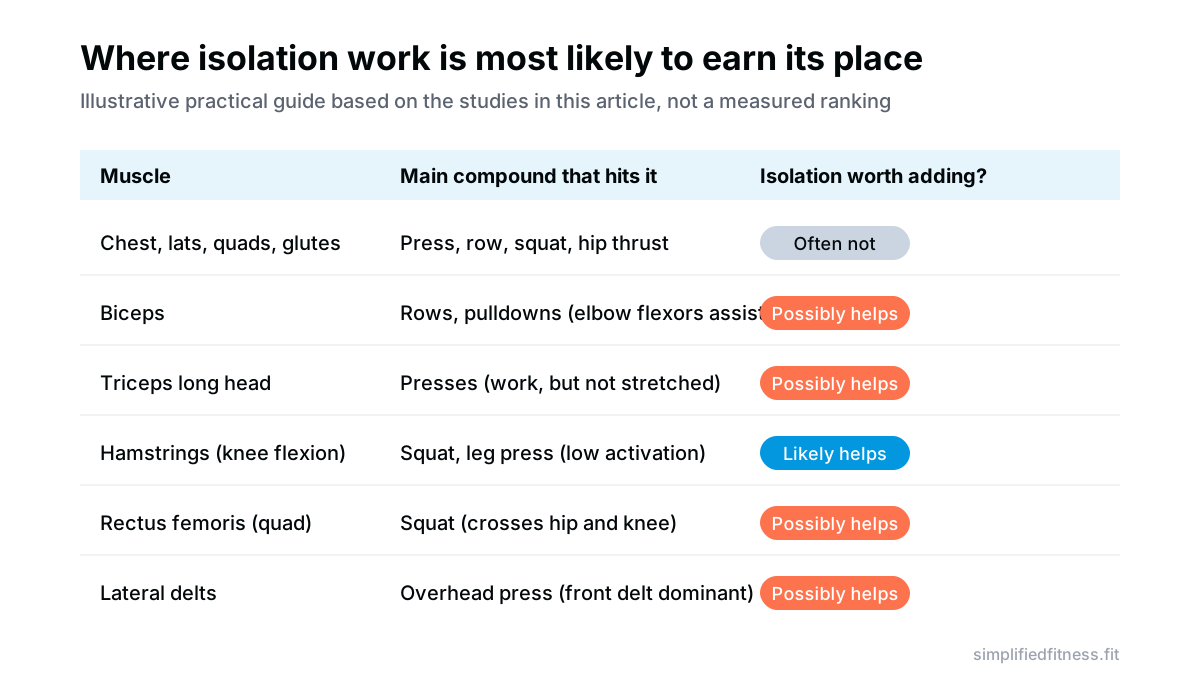
- Muscles that compounds load poorly, such as hamstrings from squats and leg presses, are the strongest case for adding direct isolation sets.
- Fractional volume counting (a compound set counts as less than 1 set for a helper muscle) is a reasoned idea, not a proven ratio. Schoenfeld and colleagues suggest starting at 1:1 and adjusting with judgment.
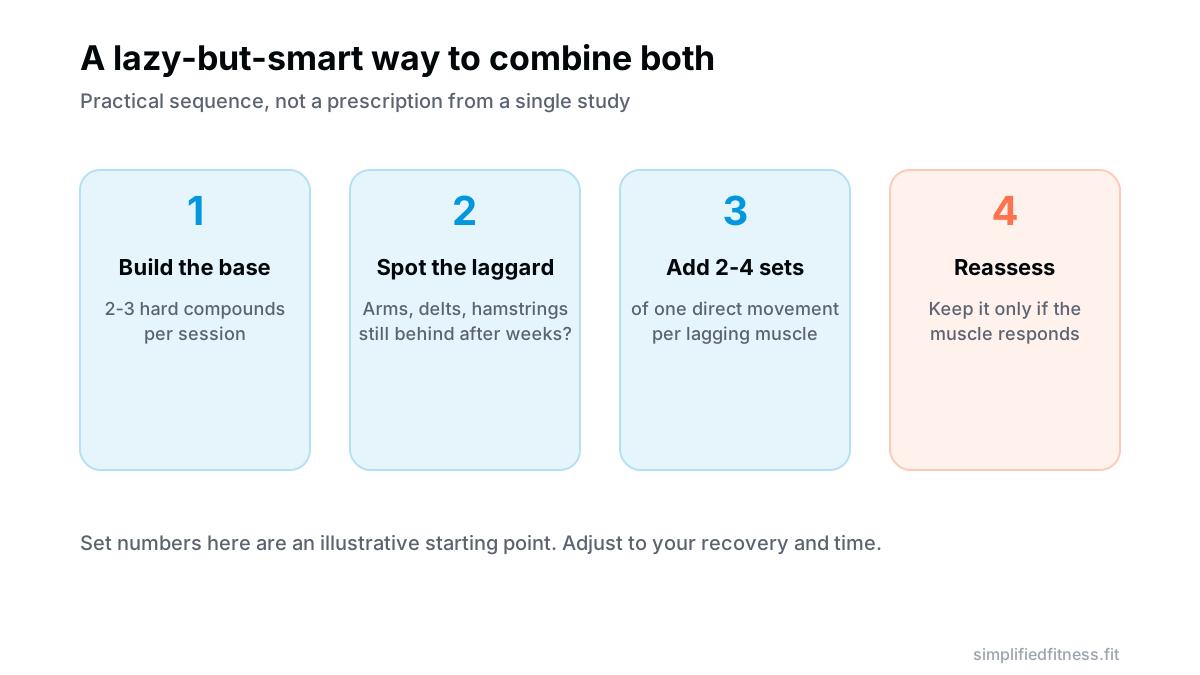
- A practical default: build around 2-3 hard compounds, then add 2-4 sets of one isolation movement only for muscles that lag.
Part of our complete guide: Exercise Selection Biomechanics: Moment Arms, Strength Curves and Free Weights vs Machines
Table of contents
Do compound vs isolation exercises matter for hypertrophy? Mostly, compounds are enough for the big prime movers, and isolation earns its place for specific muscles that compounds under-train. The research is small, short and mixed, so the honest answer is “it depends on the muscle.”
This sits inside our wider exercise selection and biomechanics guide. Here we stay on one question: if you bench, row, squat and press hard, do you still need curls, extensions and lateral raises?
What counts as compound vs isolation?
A compound (multi-joint) exercise moves more than one joint. Squat, bench press, row, pulldown. An isolation (single-joint) exercise moves one. Biceps curl, leg extension, lateral raise.
The line is blurry. A pec dec is single-joint at the shoulder, while a dip is multi-joint but leans heavily on chest and triceps. Treat it as a spectrum.
Do compounds alone build muscle as well as adding isolation?
For many muscles, the short trials say yes.
In a 2017 review, Gentil and colleagues analysed 23 experimental studies. For upper and lower limbs, surface EMG showed no differences between single- and multi-joint exercises for the prime movers. Long-term upper-limb studies reported no difference in size or strength, and no added effect from including single-joint work in a multi-joint program (Gentil et al., 2017). They concluded single-joint exercises may only be necessary for lumbar extensors and to correct imbalances.
Two small trials show the pattern:
- Untrained men, 10 weeks: 29 men did lat pulldown and bench press, with or without added elbow flexion and extension work. Elbow flexor thickness rose 6.5% vs 7.04%, with no between-group difference (Gentil et al., 2013).
- Trained men, 8 weeks: 20 men with at least 2 years of training had similar gains in elbow strength, arm circumference and arm muscle circumference with or without added single-joint work (de Franca et al., 2015).
Can you build arms with compounds only?
You can grow arms with rows, pulldowns, pull-ups and presses. The question is whether you grow them as well as you could.
Here the evidence conflicts. Gentil’s 2013 trial found no extra biceps growth from curls. But a 2021 within-person trial had 10 untrained men train one arm with unilateral dumbbell rows and the other with biceps curls for 8 weeks. Elbow flexor thickness rose 11.06% on the curl arm vs 5.16% on the row arm (Mannarino et al., 2021). Strength gains followed specificity: rows improved row strength, curls improved curl strength.
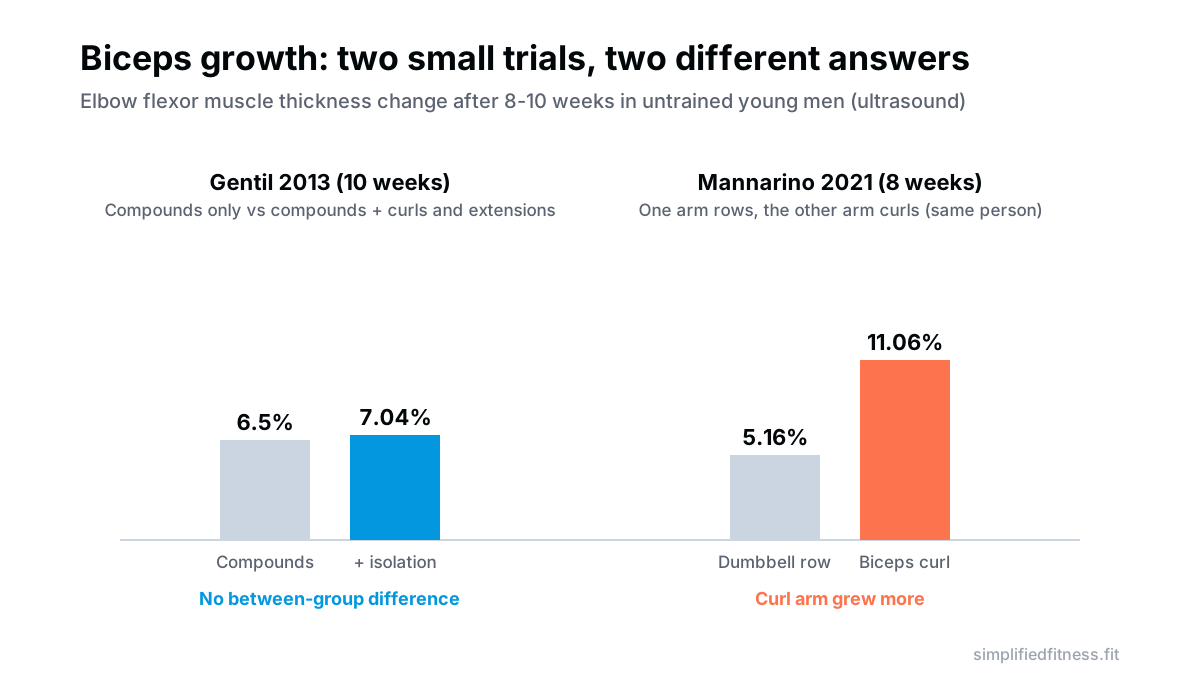
Why might they differ? Mannarino compared single exercises head to head with matched arms, while Gentil compared whole programs where compounds already trained the biceps heavily. Different designs answer different questions. The cautious takeaway: compounds likely get you most of the way, and a few direct sets are cheap insurance.
What is fractional volume, and does it apply to compounds?
Fractional volume means a compound set counts as less than one full set for a muscle that only helps. If a bench press set gives your triceps “half a set,” 10 weekly bench sets would be 5 triceps sets.
Schoenfeld and colleagues laid out the logic: moment arms, “motor abundance” (many muscles share the load), and time under tension for each muscle may favour isolation for some limb muscles. Activation data back this for hamstrings, which are markedly lower than quads in squat and leg press. But longitudinal data are limited to elbow flexors and somewhat conflicting, so they advised starting with 1:1 set counting and then using judgment (Schoenfeld et al., 2019).
That is the honest position. A fractional ratio is a reasoned tool, not a measured constant. For the weekly counting side, see our guide to direct vs indirect volume for compound lifts. This article stays on movement mechanics.
Which muscles do compounds leave behind?
Three situations show up repeatedly.
Hamstrings. Squats and leg presses train the quads far more than the hamstrings. A seated leg curl fills the gap, and a 12-week MRI study in 20 adults found seated curls (long muscle length) grew the whole hamstrings more than prone curls (+14% vs +9% volume) (Maeo et al., 2021).
Rectus femoris. A randomized trial matched volume and intensity between smith machine squats and leg extensions. All three regions of the rectus femoris grew in the leg extension group, while the abstract reports only the central vastus lateralis growing in the squat group (Zabaleta-Korta et al., 2021). Our piece on leg extensions for rectus femoris growth goes deeper.
Triceps long head and side delts. Here the case rests on mechanics, not head-to-head trials. Presses train the triceps but not at a long muscle length, and overhead pressing leans on the front delt. This is reasoning, so hold it loosely. See overhead vs pushdown triceps work and our shoulder training guide.
Do compounds cause more systemic fatigue?
People often say compounds are “more fatiguing.” True in feel: a heavy deadlift taxes your back, grip and breathing in a way a leg extension does not.
But evidence is thin. In Gentil’s review only one study directly compared recovery, and it found single-joint work produced more muscle fatigue and soreness. So the claim is not settled either way. A useful lens is stimulus-to-fatigue ratio: how much growth signal you get per unit of fatigue. Machines and isolation often score well when you are already tired.
Do trained lifters need isolation?
Evidence in trained groups is limited. Alongside the 20 trained men above, a 6-month trial of 30 trained women compared compound-only, isolation-only and combined programs. All groups gained muscle thickness, but compound and combined programs gave larger gains in glutes, quads and pecs than isolation alone. The authors suggested compounds seem necessary for optimal results, with isolation possibly needed for knee flexion strength (Barbalho et al., 2021).
Taken together: compounds are a strong foundation, isolation alone is a weaker one, and combining them is a flexible, safe default.
How should you combine them in practice?
Keep it simple.
- Build each session around 2-3 hard compounds.
- Look at your physique and logs after 6-8 weeks. Which muscle lags?
- Add 2-4 hard sets of one direct movement for that muscle.
- Reassess. Keep it only if it helps.
Order matters. Put the lift you most want to progress first, since fatigue lowers performance later in the session. Count your total with our training volume calculator.
If you train in a crowded Indian gym, isolation machines are your friend. A leg curl or cable station fits into a busy floor more easily than a free squat rack, and a tight schedule makes 3 compounds plus 2 isolation moves a realistic session. Fuel it with enough protein from dal, paneer, curd, soya or eggs.
What the research cannot tell you yet
Be wary of anyone who sounds certain. Most of these trials were short and small, and several were run in untrained people. Many measured only elbow flexors, so claims about triceps long head, side delts or calves are extrapolated from mechanics and activation data, not from long-term growth trials.
Measurement also varies. Ultrasound thickness at one site, arm circumference and MRI muscle volume do not always agree, and a muscle can grow unevenly along its length. That is partly why Zabaleta-Korta found regional differences and why a single “thickness” number can hide them.
So hold two ideas together. First, compounds are an efficient base and the claim that you must do endless isolation sets is not supported. Second, the claim that compounds alone always maximise every muscle is not supported either. Your own training log, photos and tape measure over a couple of months are better evidence for your body than any single paper.
How the isolation vs compound choice changes with your goal
If your goal is general size and strength with limited time, lean on compounds and add one or two isolation moves at the end. If you are chasing a specific lagging area, move that muscle’s direct work earlier in the session and give it a few focused sets each week.
If you are rehabbing or managing a sore joint, isolation or machine work can let you train a muscle without loading the painful pattern. If you are short on recovery, say you are sleeping badly or training in heavy summer heat, trimming heavy compounds and keeping the cheaper isolation work is a reasonable trade.
When to see a doctor
Pain during isolation moves such as elbow twinges on curls or knee pain on leg extensions is not something to push through. Sharp or persistent joint pain, numbness or swelling deserves a check with a doctor or physiotherapist.
Frequently Asked Questions
Are compound exercises better than isolation exercises for muscle growth?
Neither is clearly better across the board. In a 2017 review of 23 studies, adding single-joint exercises to multi-joint programs gave no extra upper-body size or strength gains in the trials included. Pick compounds as your base because they train many muscles per set, then add isolation where a muscle is lagging.
Can you build big arms with compound exercises only?
Possibly, but the evidence is mixed. One trial in untrained men and one in trained men found no extra arm growth from adding curls and triceps work, while Mannarino 2021 found curls grew the elbow flexors more than rows. Rows, pull-ups and presses do grow arms, so start there and add curls or triceps work if your arms stall.
What is fractional volume in resistance training?
It is the idea that one set of a compound should count as less than a full set for a muscle that only assists the lift. A 2019 review argues this is logical for some limb muscles, but also notes the research is limited and advises starting at a 1:1 count. In practice, count hard compound sets for the main mover and count helper-muscle sets conservatively.
Do compounds cause more systemic fatigue than isolation exercises?
It is plausible because heavy squats and deadlifts load more muscle and the spine, but direct trial evidence is thin. The 2017 review found only one study comparing recovery, and it reported more fatigue and soreness after single-joint work. Judge by how you feel: if heavy compounds leave you wrecked, add machines or isolation to get volume more cheaply.
Do isolation exercises build more muscle in a specific muscle?
Sometimes. A randomized trial found leg extensions grew all three regions of the rectus femoris, while a smith machine squat group showed significant growth only in the central vastus lateralis. Use isolation when you want to target a muscle the compound underloads.
Do I need leg curls if I squat and deadlift?
Probably yes if you want well-developed hamstrings. A 2019 review notes hamstring activation is markedly lower than quad activation in the squat and leg press. Adding a seated leg curl is a simple fix, and a 12-week MRI study found seated curls grew the hamstrings more than prone curls.
Are lateral raises necessary if I do overhead press?
No trial in our sources tested this directly, so treat it as reasoning, not proof. Overhead pressing loads the delts but leans on the front delt and triceps. If side delt width is your goal, 2-4 sets of lateral raises is a cheap addition.
How many isolation sets should I add per week?
No study gives an exact number, so use a flexible range. Starting with 2-4 hard sets per session for a lagging muscle, then checking progress over 6-8 weeks, is a sensible test. Our training volume calculator can help you total sets.
Should I do compounds or isolation first in a workout?
Do the exercise you want to progress most first, because fatigue lowers performance on whatever comes later. For most people that is the heavy compound. If a small muscle is the priority, put its isolation work first and accept a lower load on the compound.
Is a compound-only routine enough for beginners?
Yes, for most beginners. In untrained men, adding single-joint exercises gave no extra elbow flexor thickness or strength over compounds alone (Gentil 2013). Learn the main lifts well, progress them, and add isolation after a few months if something lags.
Do trained lifters need isolation exercises?
The data are limited and mixed. A small 8-week trial in 20 trained men found no extra upper-body benefit from adding single-joint exercises, while a 6-month trial in trained women found compound-based programs gave larger gains in glutes, quads and pecs than isolation alone. Treat isolation as a tool for fixing weak points, not a requirement.
Is isolation training good for a vegetarian lifter on a tight budget of time and food?
Yes, it can be time-efficient, because a few direct sets for a lagging muscle take little time and little setup. Food needs depend on your total training and goals, not on whether a set is compound or isolation. Pair it with enough protein from dal, paneer, curd or soya, and use our protein calculator to check your target.
Sources & References
Every claim above is checked against peer-reviewed research (PubMed, U.S. National Library of Medicine) or guidance from established health bodies. How we fact-check.
- Gentil P, et al. A Review of the Acute Effects and Long-Term Adaptations of Single- and Multi-Joint Exercises during Resistance Training. Sports Med. 2017. PMID: 27677913
- Gentil P, et al. Effect of adding single-joint exercises to a multi-joint exercise resistance-training program on strength and hypertrophy in untrained subjects. Appl Physiol Nutr Metab. 2013. PMID: 23537028
- de Franca HS, et al. The effects of adding single-joint exercises to a multi-joint exercise resistance training program on upper body muscle strength and size in trained men. Appl Physiol Nutr Metab. 2015. PMID: 26244600
- Mannarino P, et al. Single-Joint Exercise Results in Higher Hypertrophy of Elbow Flexors Than Multijoint Exercise. J Strength Cond Res. 2021. PMID: 31268995
- Schoenfeld BJ, et al. Calculating Set-Volume for the Limb Muscles with the Performance of Multi-Joint Exercises: Implications for Resistance Training Prescription. Sports (Basel). 2019. PMID: 31336594
- Maeo S, et al. Greater Hamstrings Muscle Hypertrophy but Similar Damage Protection after Training at Long versus Short Muscle Lengths. Med Sci Sports Exerc. 2021. PMID: 33009197
- Zabaleta-Korta A, et al. The role of exercise selection in regional Muscle Hypertrophy: A randomized controlled trial. J Sports Sci. 2021. PMID: 34743671
- Barbalho M, et al. The Effects of Resistance Exercise Selection on Muscle Size and Strength in Trained Women. Int J Sports Med. 2021. PMID: 32252103

Umair Hazrami · Founder & Head Coach, Simplified Fitness
Umair Hazrami founded Simplified Fitness and the Simplified Lifter channel to cut through fitness noise. With 4+ years of consistent training and 10+ coaching clients, he writes every guide from the peer-reviewed research and links the sources so you can check them. Our editorial standards.
Educational content only, not medical advice. If you have a medical condition, are pregnant, or take medication, talk to a qualified doctor before changing your diet, supplements or training. Full disclaimer.
Keep reading
Exercise Technique
Anthropometry-Based Exercise Selection: Long Limbs, Short Torsos, and Lever Adjustments
Anthropometry exercise selection explained: how long femurs, long arms and a short torso change squats, deadlifts and presses, plus a simple audit and swaps.
9 min read
Exercise Technique
Axial Loading vs Non-Axial Exercises: Managing Spinal Fatigue for Bigger Legs and Back
Axial loading vs non axial exercises explained: how spinal compression limits your weekly volume, and which squat and row swaps spare your lower back.
7 min read
Exercise Technique
Cable Setup Mastery: Pulley Heights, Cable Angles, and Customizing Force Vectors
Cable machine setup guide: how to set pulley height, stance and cable angle for chest, lats, delts and arms, with what the research does and does not show.
9 min read
Exercise Technique
Dumbbell vs Barbell Bench Press for Chest: Which Builds More Pec?
Dumbbell vs barbell bench press hypertrophy: what EMG and strength studies show, why dumbbells may suit your chest and shoulders, and how to use both.
7 min read