Moment Arms, Lever Arms, and Joint Torque: The Physics of Weightlifting Explained Simply
Moment arms in weightlifting explained without equations: how distance from a joint sets torque, why small changes make lifts harder, and how to use it.
TL;DR. The short answer
- A moment arm is the perpendicular distance between a joint's axis and the line of force. Joint torque is force multiplied by that distance, so the same weight can feel light or brutal depending on where it sits relative to the joint.
- The external moment arm (weight to joint) is usually much longer than the internal moment arm (muscle pull to joint), which is why muscles must produce forces well above the weight you hold.
- Small changes in trunk lean, arm angle or elbow position change which joint carries the load. In squats, more forward trunk lean shifts demand from knee extensors toward hip extensors.
- You do not need to calculate anything. Ask one question per exercise: where is the weight relative to the joint I want to train, and where is that distance longest?
- Mechanics explains why a lift feels hard in one spot, but it does not predict muscle growth by itself. Use it to choose and adjust exercises, then confirm with how the target muscle feels and how you progress.
Part of our complete guide: Exercise Selection Biomechanics: Moment Arms, Strength Curves and Free Weights vs Machines
Table of contents
Moment arms in weightlifting come down to one idea: the further a weight sits from a joint, measured at a right angle to the direction of the force, the harder that joint has to work. Joint torque is simply force multiplied by that distance, so the same 10 kg dumbbell can feel easy or brutal depending on where your joints are relative to it.
That is the whole physics lesson. The rest of this guide shows how it plays out in lateral raises, curls, squats and rows, so you can use it when choosing and tweaking exercises. It sits inside our wider exercise selection and biomechanics guide, and no maths is needed beyond one multiplication.
What is a moment arm, in plain gym language?
Take a joint, say your shoulder. Imagine its axis as a bolt your arm swings around. Now hold a dumbbell. Gravity pulls it straight down. The moment arm is the horizontal distance between that bolt and the vertical line of gravity through the dumbbell.
Hang your arm by your side and the dumbbell is almost directly under the shoulder, so the distance is close to zero. Lift your arm until it is level and the dumbbell sits as far out to the side as your arm allows, so the distance is at its largest.
Torque is what that distance turns the weight into:
torque = force x perpendicular distance
A heavier weight raises torque. A longer distance raises torque. Both count equally. This is why a light dumbbell held far from your body can feel worse than a heavy one held close.
How lateral raises show moment arms in action
Lateral raises are the cleanest everyday example, because the weight never changes but the difficulty swings widely.
Here is a quick, illustrative calculation. Say a dumbbell is 8 kg and its centre sits about 0.6 m from your shoulder joint (a made-up but plausible number, and it ignores the weight of your arm). Weight is roughly 8 x 9.81 = 78 N. With your arm level, the perpendicular distance is the full 0.6 m, so torque is around 47 N-m. Raise the arm only to 45 degrees from vertical and the horizontal distance becomes about 0.6 x 0.71 = 0.42 m, so torque drops to roughly 33 N-m. Same dumbbell, about 30% less torque.
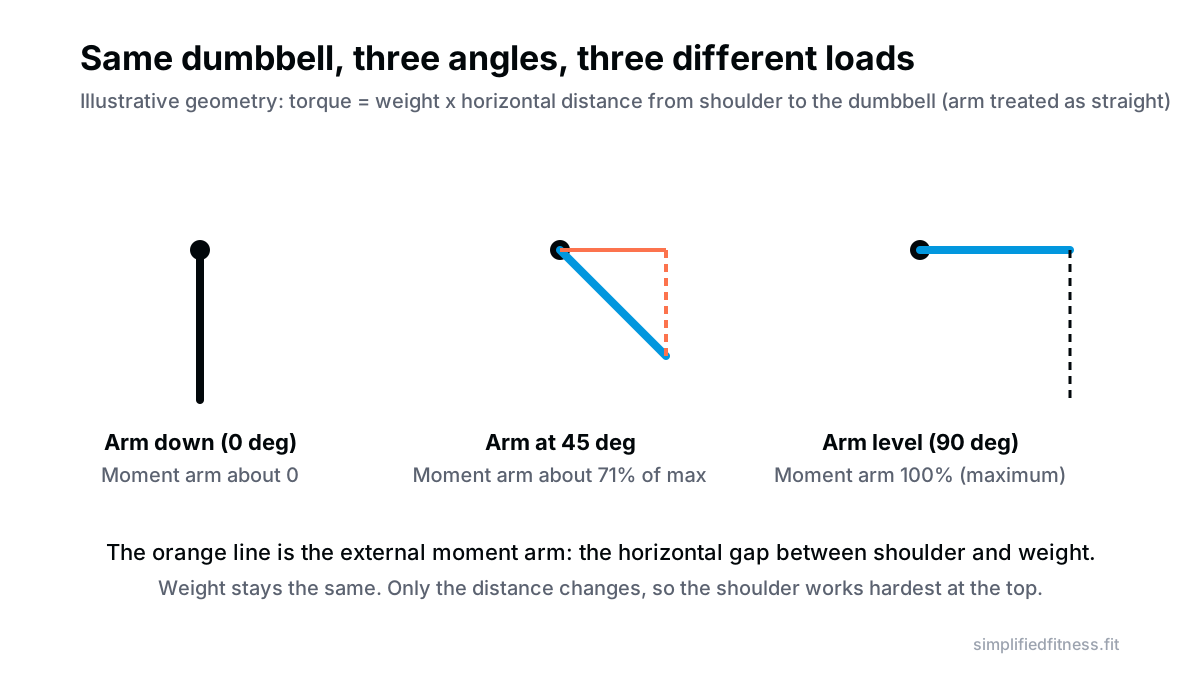
This explains two things lifters notice. The bottom of a lateral raise feels almost empty, and the top feels hard. And it is why a cable, which pulls in a different direction, changes where the exercise is hardest. If you want a deeper look at that, see our guide to lateral deltoid training with dumbbells vs cables and machines.
What is the difference between internal and external moment arms?
Every lift involves two levers fighting each other.
- External moment arm: the distance from the joint to the line of the load (dumbbell, barbell, cable).
- Internal moment arm: the distance from the joint to the line of pull of the muscle’s tendon.
For the muscle to hold or lift the weight, its torque must match the load’s torque. Because the internal arm is typically only a few centimetres, while the external arm can be 20 to 60 cm, the muscle has to pull many times harder than the weight itself. That is just a ratio of two distances.
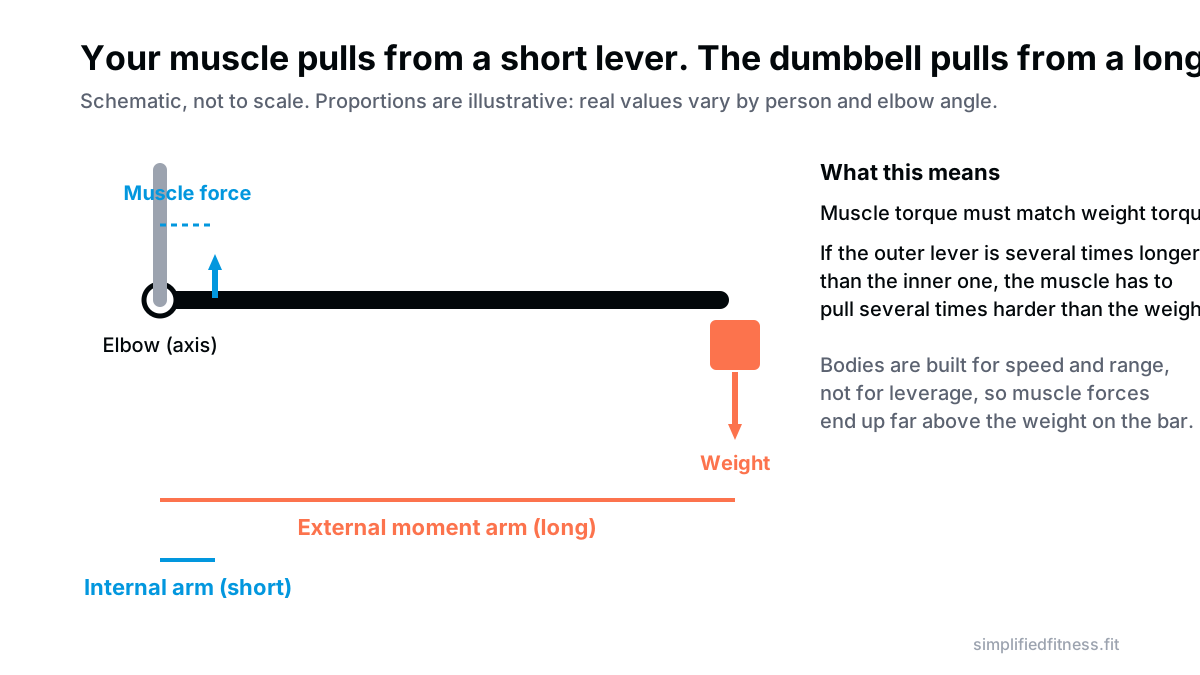
Think of it like a door. Push near the hinge and you need a huge force. Push at the handle and a finger will do. Your biceps is pushing near the hinge, while the dumbbell is hanging off the handle.
Real moment arms are not fixed numbers, either. In ten young men, the moment arms of the biceps, brachialis and brachioradialis at the elbow increased during isometric contractions in most conditions, especially in flexed positions, probably because the muscles thicken when they contract (Akagi et al., 2012). At the knee, the patellar tendon moment arm in ten healthy young people stayed near 46 mm between 0 and 70 degrees of knee flexion and dropped by no more than about 20% at higher flexion angles, with more variation between individuals than between activities (Gray et al., 2021).
Does moment arm length make some people stronger?
A little, but not much. A study compared 16 young men with about four years of heavy knee-extensor training against 52 untrained men. The trained group had about 60% higher knee extension torque and 56% more quadriceps volume, but a patellar tendon moment arm only about 4% larger (Maden-Wilkinson et al., 2020). The authors concluded muscle size was the primary explanation for the strength gap.
So if you have been told your levers are “bad” for a lift, the practical impact is probably modest compared with how much muscle you build. This was a cross-sectional comparison, so it cannot prove training changed the moment arm. It only shows that lever length is not the main driver of strength.
Why small changes in squat position change which joint works
Now apply this to the squat. In a well-balanced squat the bar travels roughly straight up and down over your mid-foot, and your hip and knee are two different bolts. The distance from each bolt to the line of the bar is that joint’s moment arm.
Lean your trunk forward and your hips move back relative to the bar, so the hip moment arm gets longer and the knee’s gets shorter. Stay upright and sit more between your heels, and the opposite happens.
Lab data supports this. In 100 people doing bilateral squats at depths between 60 and 110 degrees of knee flexion, the ratio of hip to knee moment rose with a more forward trunk angle and with a more vertical shank, with trunk angle explaining more of the variance than shank angle (Graber et al., 2023). The authors note this supports using trunk position as a coaching cue to alter hip and knee demands. It is an observational study, so it describes a relationship in those participants, not a guarantee for every body.
What about bar position? A study of 12 recreationally trained men at their 3-rep max found no significant differences in hip, knee or ankle net joint moments between high-bar and low-bar squats when stance width was kept the same, and the loads lifted were similar (Larsen et al., 2024). In other words, bar height alone mattered less than the posture you adopt. Stance width and foot angle also shift joint demands, which we cover in stance width and foot placement for squats and leg press.
Squat vs deadlift: same joints, different loading
In 28 resistance-trained lifters (17 men, 11 women), the deadlift produced a larger hip extensor net joint moment than the back squat (3.59 vs 2.98 Nm per kg), while the squat produced a larger knee extensor moment (2.14 vs 1.18 Nm per kg) (Choe et al., 2021). Those figures were taken at 70 and 85% of each lift’s 1RM.
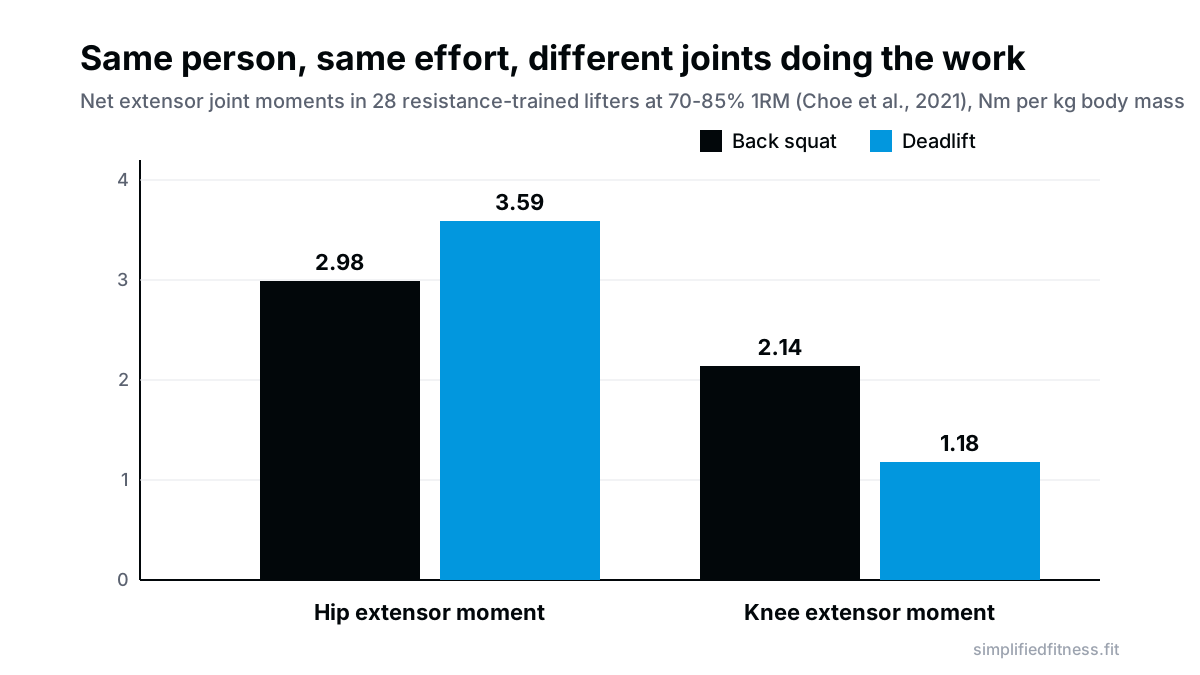
The deadlift keeps the bar closer to the shins, so the hip carries a long lever while the knee carries a short one. The squat splits the demand more evenly. Neither exercise “isolates” a joint, they simply distribute torque differently. For gym planning, that makes squats or leg presses a sensible knee-dominant choice and hinges a sensible hip-dominant one. For the wider picture, see our look at how body proportions change exercise selection.
Why a bent-over row loads your lower back
The lumbar spine has moment arms too. When you fold forward to row, the weight hangs far in front of your lower back, which creates a long external lever and a large demand on the spinal muscles.
In a laboratory study of seven healthy men comparing three rowing variations, the standing bent-over row produced large activation across the back and the largest lumbar spine load, while the inverted row produced lower lumbar load (Fenwick et al., 2009). The sample was small and healthy, so it is a lab snapshot, not a verdict on any one lifter.
A practical read: if your lower back, not your lats, ends up as the limiting factor in a row, a chest-supported row removes that lever. The back is held up by the pad, and the target muscle does the work. If back pain is persistent, see a doctor or physiotherapist rather than just changing exercises.
How to use moment arms without turning into a physicist
You do not need to calculate anything. Use this short checklist for any exercise:
- Find the joint you want to train. Elbow for curls, shoulder for lateral raises, knee for leg extensions.
- Find the line of the load. Gravity pulls straight down on a dumbbell. A cable pulls along the cable.
- Look at the right-angle distance between the two. Where that gap is biggest, the joint is working hardest.
- Adjust the setup. Move the weight closer to take load off a joint, or further away to put more on it.
Some examples:
- Preacher vs standing curl: where the forearm sits relative to gravity changes where the biceps meets peak load. We compare them in incline vs preacher curls.
- Holding a dumbbell closer to your body: a shorter external arm means lower torque at that joint.
- Machines and cams: these change the load as the joint moves. See matching resistance profiles to human strength curves.
Common mistakes with moment arms
- Assuming heavier is always harder on the joint. A lighter weight held further out can load a joint more than a heavy one held close.
- Ignoring body-position drift. As you tire, you lean, sway or let the weight drift away from the body, which lengthens the lever and shifts load to joints you did not intend to train.
- Copying someone else’s setup exactly. Limb lengths and tendon attachment sites vary, so an identical-looking position can load you differently. Gray et al. found the knee moment arm varied by as much as 13% from the mean across individuals.
- Using physics to override pain signals. Mechanics can suggest why something hurts, but it cannot diagnose it. Persistent joint pain, numbness or swelling deserves a medical assessment.
Quick reference: what changes the external moment arm
| Change | Effect on external moment arm | Example |
|---|---|---|
| Move the weight further from the joint | Longer, so higher torque | Lateral raise with a straight vs bent arm |
| Raise the limb toward horizontal | Longer, so higher torque | Top of a lateral raise |
| Lean the trunk forward under a bar | Hip arm longer, knee arm shorter | Hinge-style squat |
| Fold forward unsupported | Lumbar arm longer | Bent-over row |
| Support the torso | Lumbar arm removed | Chest-supported row |
Bending the elbow in a lateral raise shortens the lever, and straightening it lengthens it, a free way to scale difficulty with the same dumbbell.
The bottom line
Moment arms explain a large share of why one rep feels hard and another feels easy: the same weight creates different torque depending on its distance from the joint. External arms are usually long and internal arms short, so muscle forces are far greater than the weight you hold. Small changes in trunk angle, arm angle and support alter which joint carries the load.
Keep it practical. Pick the joint you want to train, look at where the load sits relative to it, and adjust. To put it into a plan, try our free push, pull and leg-day programs, and use the training volume calculator to keep your weekly sets in check.
Frequently Asked Questions
What is a moment arm in weightlifting?
A moment arm is the perpendicular (right-angle) distance from a joint's axis of rotation to the line along which a force acts. In the gym, the weight has an external moment arm and your muscle has an internal one. Picture a line straight down from your dumbbell and measure the horizontal gap to the joint to see the external arm.
What is the difference between internal and external moment arms?
The external moment arm is the distance from the joint to the line of the load (dumbbell, bar or cable). The internal moment arm is the distance from the joint to the line of pull of the muscle tendon, which is typically only a few centimetres. Muscle torque must balance load torque, so a short internal arm against a long external arm means the muscle pulls far harder than the weight itself.
How do you calculate joint torque in lifting?
Torque equals force times the perpendicular distance to the joint. For a dumbbell held out to the side, multiply its weight (mass in kg times 9.81 gives newtons) by the horizontal distance from shoulder to dumbbell, in metres. You never need to do this in training, but one worked example helps the idea stick.
Why is a lateral raise hardest at the top?
When your arm is level, the dumbbell sits as far out horizontally as it can, which gives the longest external moment arm and the highest shoulder torque. Near the bottom the dumbbell hangs almost under the shoulder, so the arm is close to zero. If the top feels brutal and the bottom feels empty, that is geometry, not weakness.
Why does leaning forward in a squat change the exercise?
Leaning the trunk forward moves the bar further in front of the hip, which lengthens the hip's external moment arm. A 100-person laboratory study found the hip-to-knee moment ratio rose with more trunk lean and with a more vertical shin. If you want more knee work, stay more upright; if you want more hip work, hinge more.
Is a longer moment arm always harder?
For the external arm, yes, because the same weight creates more torque the further it sits from the joint. For the internal arm, a longer one is helpful because the muscle needs less force to make the same torque. Different people have different tendon and bone geometry, so identical lifts can feel different across lifters.
Does moment arm length affect how strong I am?
It plays a small part. In a study of long-term trained versus untrained young men, trained lifters had about 60% greater knee extension torque and a patellar tendon moment arm only about 4% larger, so muscle size explained most of the strength gap. Building muscle matters far more than the lever length you were born with.
Can changing my grip or stance reduce joint stress?
It can redistribute load rather than remove it. Moving the weight closer to the joint, or shifting the load toward a stronger joint, can make a movement more comfortable. If a movement hurts, change the setup, lower the load, or see a physiotherapist or doctor rather than just pushing through.
Do bar position changes in the squat matter for torque?
Less than most people think, at least when stance width is matched. In 12 recreationally trained men doing 3-rep-max squats, high-bar and low-bar placement produced no significant differences in hip, knee or ankle net joint moments, and the loads lifted were similar. Pick the bar position that feels stable and comfortable.
Why does a bent-over row stress the lower back?
In a bent-over row your trunk is close to horizontal and the weight hangs far in front of your lumbar spine, creating a long external moment arm. A lab study of three rowing variations found the standing bent-over row produced the largest lumbar spine load. Using a chest-supported row removes that lever, which is useful if your back is the limiting factor.
Is the deadlift or the squat better for hips and quads?
In 28 resistance-trained lifters, the deadlift produced a larger hip extensor moment than the back squat, while the squat produced a larger knee extensor moment. Both involve all the same joints, they just distribute demand differently. Use deadlift-type hinges to emphasise the hips and squats or leg presses to emphasise the knees.
Does the moment arm of a muscle stay constant through a rep?
No, it changes with joint angle and sometimes with contraction. In young healthy people the patellar tendon moment arm stayed near 46 mm from 0 to 70 degrees of knee flexion and fell by no more than about 20% at deeper angles. Muscles such as the elbow flexors also showed larger moment arms during contraction, so real values are person and position specific.
Do I need to understand biomechanics to build muscle?
No, plenty of people grow muscle with simple progressive training and sensible form. Understanding moment arms helps mainly when an exercise feels wrong, a joint complains, or you want to adjust a lift to hit a target muscle. Use it as a troubleshooting tool, not a requirement.
Sources & References
Every claim above is checked against peer-reviewed research (PubMed, U.S. National Library of Medicine) or guidance from established health bodies. How we fact-check.
- Graber KA, et al. The effect of trunk and shank position on the hip-to-knee moment ratio in a bilateral squat. Phys Ther Sport. 2023. PMID: 37001335
- Choe KH, et al. Hip and Knee Kinetics During a Back Squat and Deadlift. J Strength Cond Res. 2021. PMID: 30335723
- Larsen S, et al. A Biomechanical Comparison Between a High and Low Barbell Placement on Net Joint Moments, Kinematics, Muscle Forces, and Muscle-Specific Moments in 3 Repetition Maximum Back Squats. J Strength Cond Res. 2024. PMID: 38900172
- Maden-Wilkinson TM, et al. What makes long-term resistance-trained individuals so strong? A comparison of skeletal muscle morphology, architecture, and joint mechanics. J Appl Physiol. 2020. PMID: 31873069
- Gray HA, et al. Moment arm of the knee-extensor mechanism measured in vivo across a range of daily activities. J Biomech. 2021. PMID: 34062347
- Akagi R, et al. In vivo measurements of moment arm lengths of three elbow flexors at rest and during isometric contractions. J Appl Biomech. 2012. PMID: 22431216
- Fenwick CM, et al. Comparison of different rowing exercises: trunk muscle activation and lumbar spine motion, load, and stiffness. J Strength Cond Res. 2009. PMID: 19620925

Umair Hazrami · Founder & Head Coach, Simplified Fitness
Umair Hazrami founded Simplified Fitness and the Simplified Lifter channel to cut through fitness noise. With 4+ years of consistent training and 10+ coaching clients, he writes every guide from the peer-reviewed research and links the sources so you can check them. Our editorial standards.
Educational content only, not medical advice. If you have a medical condition, are pregnant, or take medication, talk to a qualified doctor before changing your diet, supplements or training. Full disclaimer.
Keep reading
Exercise Technique
Anthropometry-Based Exercise Selection: Long Limbs, Short Torsos, and Lever Adjustments
Anthropometry exercise selection explained: how long femurs, long arms and a short torso change squats, deadlifts and presses, plus a simple audit and swaps.
9 min read
Exercise Technique
Axial Loading vs Non-Axial Exercises: Managing Spinal Fatigue for Bigger Legs and Back
Axial loading vs non axial exercises explained: how spinal compression limits your weekly volume, and which squat and row swaps spare your lower back.
7 min read
Exercise Technique
Cable Setup Mastery: Pulley Heights, Cable Angles, and Customizing Force Vectors
Cable machine setup guide: how to set pulley height, stance and cable angle for chest, lats, delts and arms, with what the research does and does not show.
9 min read
Exercise Technique
Compound vs Isolation Exercises for Hypertrophy: Do You Need Both?
Compound vs isolation exercises for hypertrophy: what trials say about arms, delts and hamstrings, and which muscles actually need direct sets. Sources linked.
7 min read