Dumbbell vs Barbell Bench Press for Chest: Which Builds More Pec?
Dumbbell vs barbell bench press hypertrophy: what EMG and strength studies show, why dumbbells may suit your chest and shoulders, and how to use both.
TL;DR. The short answer
- Neither press has been shown to build clearly more chest in long-term trials. Short-term EMG studies are mixed, so the best choice is usually the one you can load progressively and perform through a full, comfortable range.
- Dumbbells let your hands and wrists settle into their own path and allow a deeper stretch, which is a plausible reason some lifters feel their chest more. Direct hypertrophy trials comparing the two are lacking.
- The barbell lets you lift more total weight. In one study of 11 trained men, 1RM was 106.4 kg on the barbell versus 89.5 kg with dumbbells.
- If your shoulders pinch on the barbell, dumbbells are a reasonable swap, but the evidence for that is indirect. Persistent or sharp pain is a reason to see a doctor or physio.
- A simple plan for most lifters is to use one as the heavy lift and the other as a higher-rep second exercise, and track progress in both.
Part of our complete guide: Exercise Selection Biomechanics: Moment Arms, Strength Curves and Free Weights vs Machines
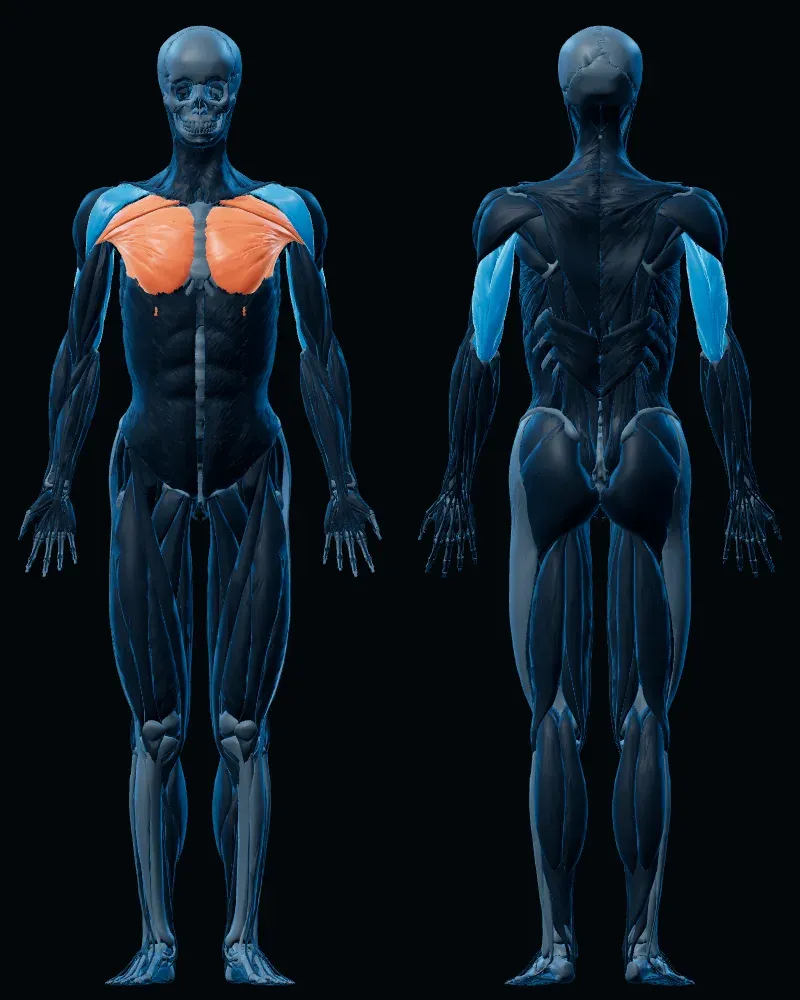
Muscles worked: chest
Main movers: pectoralis major
Assisting: front delts and triceps
Table of contents
If you want to know whether dumbbell vs barbell bench press hypertrophy favours one lift, the honest answer is that the research does not crown a winner. Some short-term studies show a bit more pectoral muscle activity with dumbbells, others show no difference, and no long-term trial has settled which one grows more chest. What does differ is the path, the stretch, the load you can use and how your shoulders feel.
This article is one of our exercise selection and biomechanics guide deep dives. We will stay on the side-by-side comparison here. For the full chest picture, see our complete chest training guide.
What is actually different between the two lifts?
On a barbell, both hands are locked to one rigid bar. Your grip width is fixed, the bar travels in a mostly straight line, and your wrists and forearms have to follow it.
With dumbbells, each arm works independently. Your hands can drift slightly toward each other as you press, your wrists can rotate to a neutral or semi-neutral position, and you can lower the weights below chest level without a bar stopping you or a rib cage blocking the path.
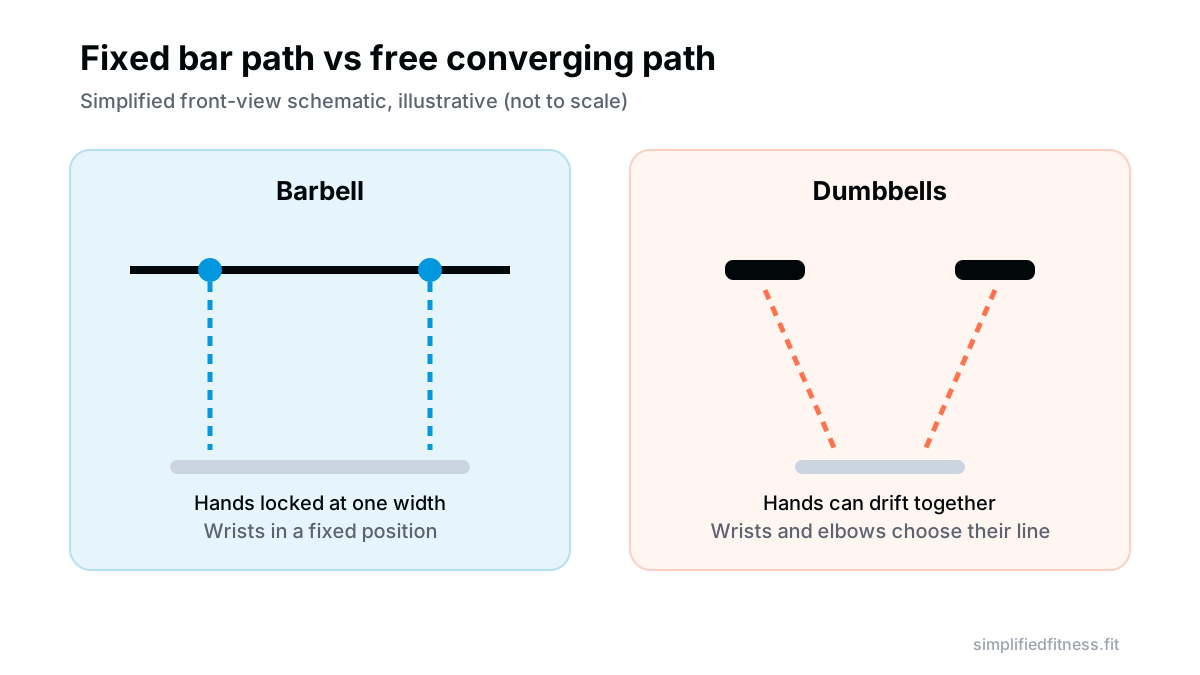
That is the mechanical story behind the idea of a “converging” pressing path. The pecs pull the upper arm across the body (horizontal adduction), and a path where your hands move closer together at the top fits that action more naturally than a rigid, parallel bar. To be clear, this is a biomechanical argument. We did not find a trial that measured it directly and then tracked muscle growth, so treat it as a reasonable explanation for why dumbbells feel different, not as proof they build more.
Does EMG show dumbbells recruit more pec?
It depends on the study, which is why this topic keeps going in circles.
What study A found. Nineteen trained men did four sets at their 10-rep max on a barbell, a Smith machine and dumbbells. Pectoralis major EMG was significantly higher during the dumbbell press than the barbell press, and they also completed more total reps with dumbbells (31.2 vs 27.8) (Farias et al., 2017). The barbell and Smith machine, however, produced more triceps activity, while dumbbells produced more biceps activity.
What study B found. Twelve men and women with mixed lifting experience did 6RM sets. Activation of the pecs and the front delts did not differ significantly between the barbell and dumbbell bench press, and the authors concluded the two could be used interchangeably (Welsch et al., 2005).
Why they may differ. Different loads (10RM across four sets versus 6RM), different participants, different EMG methods and different ways of normalising the signal can all move the result. Surface EMG also measures activity in one muscle region in one session. It does not tell you how much muscle you will build over a year.
A third study adds a twist: in 20 lifters, pec activation changed with bench angle, being lower in an incline dumbbell press than in a decline dumbbell press (Christian et al., 2023). That is about angle, not bar versus dumbbell, but it is a reminder that small setup changes can matter as much as the tool.
Do dumbbells give a longer range of motion in the stretch?
Usually yes in practice, because nothing stops the dumbbells from travelling below the level of your chest. A barbell stops at your torso. Whether that extra depth is worth chasing is a separate question.
A systematic review of range-of-motion studies concluded that full range benefits lower-body hypertrophy, but evidence for the upper limbs was limited and conflicting, so no strong practical conclusion was possible (Schoenfeld and Grgic, 2020). A later 8-week trial in 30 resistance-trained people found that training the upper body with lengthened partial reps produced similar arm muscle growth to full range of motion, and the authors suggested emphasising the stretched position, either with full range or lengthened partials (Wolf et al., 2025). That trial measured the elbow flexors and extensors, not the chest, so applying it to pecs is an extrapolation.
What this means for you: a deep, controlled stretch is probably worthwhile, but there is no evidence that pushing the dumbbells as low as possible beats a comfortable full range. If the bottom position makes the front of your shoulder ache, stop where it is still comfortable.
Which lets you load heavier, and does that matter?
The barbell wins on absolute load. In a study of 11 trained men, 1RM was 106.4 kg for the free barbell, 103.6 kg for the Smith machine and 89.5 kg for dumbbells (Tillaar and Saeterbakken, 2012).
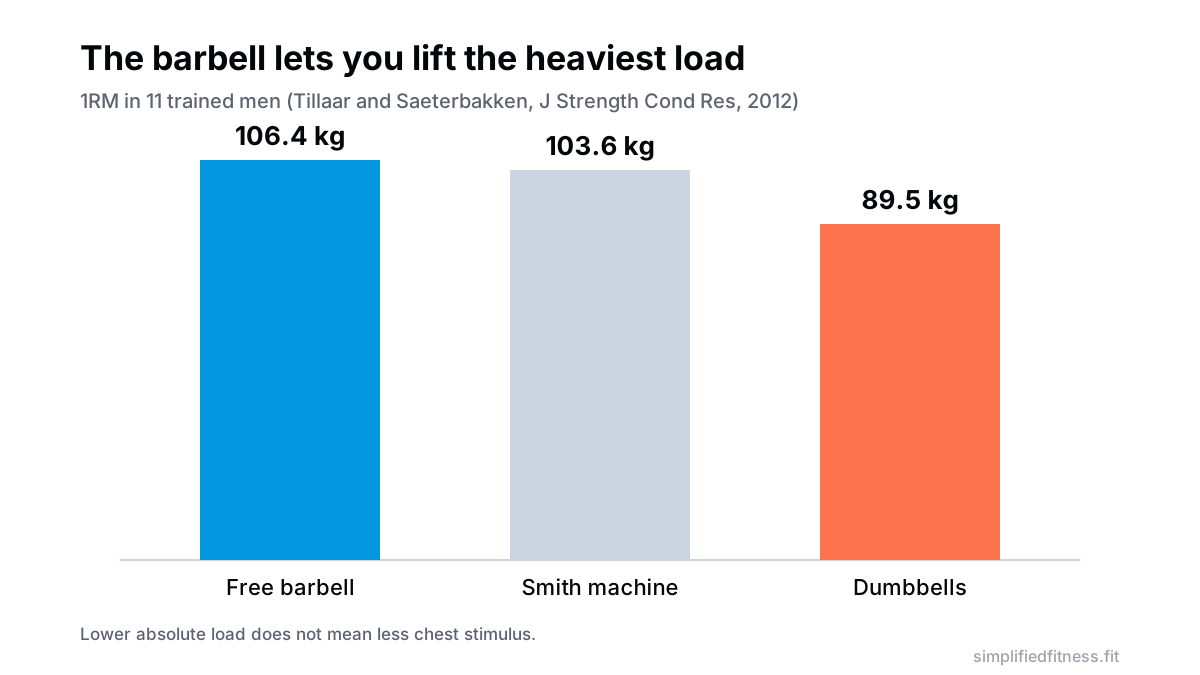
That is about 16% lower with dumbbells, and it makes sense. You have to balance two weights, and the stabilising demand uses up some of your capacity. Another study in 40 college football players found that bar reps and dumbbell reps at the same total weight were highly correlated, with slightly more reps on the bar (13.8 vs 12.5) (Heinecke et al., 2021). So lifters who do well on one tend to do well on the other.
Does the heavier load matter for muscle? Less than people think. Reviews of loading research suggest muscle can grow across a wide spectrum of loads when sets are taken close to failure (Schoenfeld et al., 2021). Where heavy loading does matter is strength and ease of tracking progress. If you want a bigger bench number, the barbell is the more direct tool.
Are dumbbells easier on the shoulders?
Many lifters report that they are, and the mechanical reason is plausible: dumbbells remove a fixed grip width and let your wrists, elbows and shoulders settle into a line that feels comfortable.
The research on this is indirect. A 2024 lab study in 10 experienced strength athletes tested 21 barbell bench variations. A narrower grip (under 1.5 times the width between the bony points of the shoulders) lowered estimated acromioclavicular compression, and retracting the shoulder blades lowered estimated posterior shear at the shoulder joint and rotator cuff activity (Noteboom et al., 2024). That study only tested the barbell and only estimated joint loads with a computer model, so it does not prove that dumbbells are safer. It does suggest that on the barbell, grip width and shoulder blade position are worth fixing before you give up on the lift.
For more on this, see our guides to bench press grip width and shoulder pain on the bench press.
If you feel sharp pain, numbness or pain that lingers for days, that is a reason to see a doctor or physiotherapist, not a reason to swap equipment and hope.
So which should you choose? A practical comparison
| Factor | Barbell bench press | Dumbbell bench press |
|---|---|---|
| Hand path | Fixed, parallel grip | Free, can converge and rotate |
| Depth at the bottom | Limited by chest | Can go slightly deeper |
| Total load | Highest (106.4 kg in one study) | Lower (89.5 kg in the same study) |
| Progress in small steps | Easy with small plates | Harder, jumps are bigger |
| Shoulder comfort | Depends on grip and scapula setup | Often easier to find a comfortable line |
| Setup | Easy, rack and spotter arms | Awkward at heavy loads |
| Best for | Heavy progression, strength | Stretch, comfort, balanced sides |
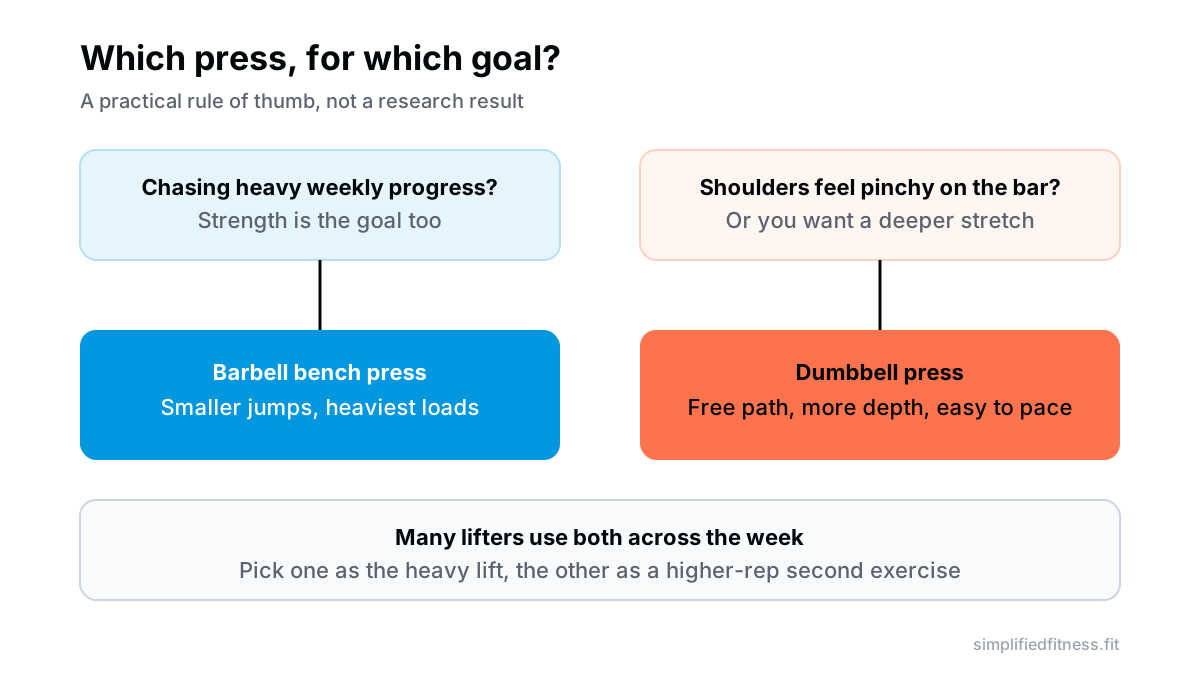
Two other things worth knowing. Dumbbells expose strength differences between sides, because each arm has to do its own work. That can help if one side lags. And they are often easier for a home gym on a budget in India, where a pair of adjustable dumbbells and a bench cost less than a rack, barbell and plates.
A simple way to use both
- Pick a heavy press first. Barbell if you want strength and have a safe setup. Dumbbells if the bar bothers your shoulders.
- Add the other as your second chest exercise. For example, flat barbell 3 sets of 5-8, then incline dumbbell press 3 sets of 8-12. We cover angles in our incline dumbbell bench press angle guide, and the barbell’s trade-offs in flat barbell bench press limitations.
- Take most sets 1-3 reps short of failure. That keeps the stimulus high without grinding every set.
- Control the lowering for 2-3 seconds and pause briefly at the bottom.
- Track both lifts. Use the 1RM calculator to estimate your top weights, or the plate calculator to load the bar quickly. For a ready plan, see our push day workout.
If you are weighing the same questions for machines, our piece on progressive overload on machines versus free weights picks up where this one stops.
The bottom line
Dumbbells and barbells both build chest. Dumbbells give your arms a freer path and a deeper stretch, and some studies show a bit more pec activity. The barbell lets you lift more and track small gains. The research does not tell us one is clearly better for growth, so choose by comfort, progression and how well you can perform each rep, and use both if you like variety.
Frequently Asked Questions
Is dumbbell bench press better than barbell for chest?
Not clearly. One study in 19 trained men found higher pectoralis major EMG during dumbbell presses, while another in 12 lifters found no difference between the two. EMG shows muscle activity in a single session, not long-term growth, so choose the version you can progress on and feel in your chest.
Which is better for hypertrophy, dumbbell or barbell bench press?
We do not have a long-term trial that settles it. Hypertrophy depends mostly on hard sets taken close to failure, enough weekly volume and progressive loading, all of which both lifts allow. Pick one as your main press and use the other as a second exercise.
Why do dumbbells feel like they work my chest more?
Dumbbells let your hands move together and let you lower the weight deeper than a bar that hits your chest. That deeper stretch and freer path may change where you feel the work, though feel is not proof of more growth. Try a controlled 2-3 second lowering and see whether your chest, rather than your shoulders, feels loaded.
Can you get a big chest with only dumbbells?
Yes, most likely. Muscle growth responds to a wide range of loads when sets are hard, and dumbbells let you add reps or small weight jumps over months. Pair them with an incline press and a fly or cable movement for variety.
Is the barbell bench press bad for your shoulders?
Not inherently, but technique matters. A 2024 lab study of 10 experienced strength athletes found that a narrower grip (under 1.5 times shoulder bone width) and pulling the shoulder blades back reduced several estimated shoulder joint loads. If pain continues, see a doctor or physiotherapist rather than pushing through it.
Are dumbbells safer for the shoulders than a barbell?
There is no direct trial showing that. Dumbbells remove the fixed bar width so your arms can pick a more comfortable line, which helps some people. If a dumbbell press hurts too, the problem is likely setup, depth or load, so reduce range or weight and get it checked if it lingers.
How much lighter are dumbbells than a barbell on bench press?
Expect to use noticeably less total weight. In a study of 11 trained men, the 1RM was 106.4 kg with a barbell and 89.5 kg with dumbbells, about 16% lower. The extra balance and stabilising demand likely explains much of the gap, so do not read it as a weaker chest.
Do dumbbells work the triceps and biceps differently?
Somewhat. In the 19-man study, the barbell and Smith machine produced greater triceps EMG than dumbbells, while dumbbells produced greater biceps EMG. This suggests the arms contribute differently, so do not assume the lifts are identical.
Should I do dumbbell or barbell bench first in my workout?
Put the lift you want to progress hardest first, when you are freshest. If strength is a goal, that is usually the barbell. If you mostly care about chest size and joint comfort, leading with dumbbells is fine.
How many reps should I do on dumbbell bench for muscle?
A review of loading research suggests muscle can grow across a wide range of loads when sets are taken close to failure. For dumbbells, 6-15 reps works well in practice, because very heavy sets are awkward to set up. Stop 1-3 reps before failure on most sets.
Do I need to switch between dumbbell and barbell to avoid plateaus?
You do not need to, but alternating can be a useful tool. One EMG study concluded that barbell and dumbbell presses can be used interchangeably, which makes rotating them a reasonable way to vary your training. Keep the rep range and effort similar so you can still track progress.
What weight dumbbells should I use for bench press?
Start with a weight you can lift for 8-12 controlled reps with 2-3 reps left in the tank. Dumbbell jumps are bigger than plate jumps, so use rep targets to progress. Our one rep max calculator can estimate a working weight from a set you already did.
Sources & References
Every claim above is checked against peer-reviewed research (PubMed, U.S. National Library of Medicine) or guidance from established health bodies. How we fact-check.
- Farias DA, et al. Maximal Strength Performance and Muscle Activation for the Bench Press and Triceps Extension Exercises Adopting Dumbbell, Barbell, and Machine Modalities Over Multiple Sets. J Strength Cond Res. 2017. PMID: 27669189
- Welsch EA, et al. Electromyographic activity of the pectoralis major and anterior deltoid muscles during three upper-body lifts. J Strength Cond Res. 2005. PMID: 15903389
- Tillaar RV, et al. The sticking region in three chest-press exercises with increasing degrees of freedom. J Strength Cond Res. 2012. PMID: 22158100
- Christian JR, et al. Analysis of the Activation of Upper-Extremity Muscles During Various Chest Press Modalities. J Strength Cond Res. 2023. PMID: 36026487
- Schoenfeld BJ, et al. Effects of range of motion on muscle development during resistance training interventions: A systematic review. SAGE Open Med. 2020. PMID: 32030125
- Wolf M, et al. Lengthened partial repetitions elicit similar muscular adaptations as full range of motion repetitions during resistance training in trained individuals. PeerJ. 2025. PMID: 39959841
- Noteboom L, et al. Effects of bench press technique variations on musculoskeletal shoulder loads and potential injury risk. Front Physiol. 2024. PMID: 38974522
- Heinecke ML, et al. Relationship of barbell and dumbbell repetitions with one repetition maximum bench press in college football players. J Strength Cond Res. 2021. PMID: 33666593
- Schoenfeld BJ, et al. Loading Recommendations for Muscle Strength, Hypertrophy, and Local Endurance: A Re-Examination of the Repetition Continuum. Sports (Basel). 2021. PMID: 33671664

Umair Hazrami · Founder & Head Coach, Simplified Fitness
Umair Hazrami founded Simplified Fitness and the Simplified Lifter channel to cut through fitness noise. With 4+ years of consistent training and 10+ coaching clients, he writes every guide from the peer-reviewed research and links the sources so you can check them. Our editorial standards.
Educational content only, not medical advice. If you have a medical condition, are pregnant, or take medication, talk to a qualified doctor before changing your diet, supplements or training. Full disclaimer.
Keep reading
Exercise Technique
Anthropometry-Based Exercise Selection: Long Limbs, Short Torsos, and Lever Adjustments
Anthropometry exercise selection explained: how long femurs, long arms and a short torso change squats, deadlifts and presses, plus a simple audit and swaps.
9 min read
Exercise Technique
Axial Loading vs Non-Axial Exercises: Managing Spinal Fatigue for Bigger Legs and Back
Axial loading vs non axial exercises explained: how spinal compression limits your weekly volume, and which squat and row swaps spare your lower back.
7 min read
Exercise Technique
Cable Setup Mastery: Pulley Heights, Cable Angles, and Customizing Force Vectors
Cable machine setup guide: how to set pulley height, stance and cable angle for chest, lats, delts and arms, with what the research does and does not show.
9 min read
Exercise Technique
Compound vs Isolation Exercises for Hypertrophy: Do You Need Both?
Compound vs isolation exercises for hypertrophy: what trials say about arms, delts and hamstrings, and which muscles actually need direct sets. Sources linked.
7 min read