Unilateral vs Bilateral Training: The Bilateral Deficit and Correcting Asymmetries
Unilateral vs bilateral training for hypertrophy: what a 2025 meta-analysis found, what the bilateral deficit really is, and how to fix side-to-side imbalances.
TL;DR. The short answer
- Current evidence shows no significant difference in muscle growth between unilateral and bilateral training. A 2025 meta-analysis of 9 studies found similar hypertrophy, with moderate risk of bias and a small literature.
- Strength is specific. Bilateral training raised bilateral strength more, and unilateral training raised single-limb strength more.
- The bilateral deficit means each limb often produces somewhat less force when both work together than when tested alone. It is inconsistent, not a fixed percentage.
- Unilateral work is a practical tool for side-to-side imbalances, for lifters who cannot load a barbell comfortably, and for adding variety, not a magic growth switch.
- Most lifters do best with a mix: one heavy bilateral lift plus one single-limb lift per muscle group, with the weaker side going first.
Part of our complete guide: Exercise Selection Biomechanics: Moment Arms, Strength Curves and Free Weights vs Machines
Table of contents
Unilateral vs bilateral training for hypertrophy is less of a contest than gym talk makes it sound. On current evidence, training one limb at a time and training both together build similar amounts of muscle, as long as the sets are hard and the exercise suits you. What changes is which strength you build, how much weight you can load, and how well you can fix a weaker side.
This article sits inside our exercise selection and biomechanics guide, and it covers one question in depth: when do split squats, single-arm rows and one-arm presses earn a place next to the barbell?
Does unilateral vs bilateral training matter for hypertrophy?
Probably not as much as you think. A 2025 systematic review and meta-analysis pooled 9 studies and found no significant difference in muscle hypertrophy between bilateral and unilateral resistance training (Kassiano et al., 2025). The authors were careful about their own limits: the literature was small and the included studies had a moderate risk of bias.
Strength told a more specific story. Bilateral training produced a larger increase in bilateral strength, while unilateral training produced a larger increase in unilateral strength. The authors concluded that strength gains seem to follow the principle of specificity.
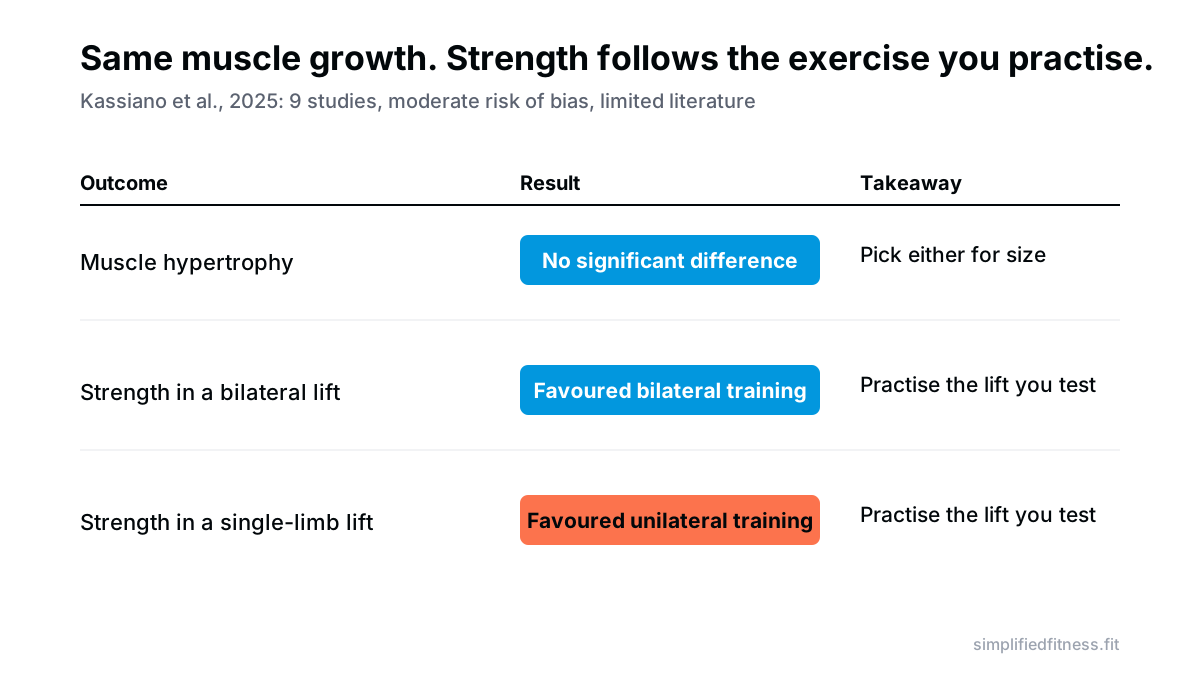
An older trial points the same way. Middle-aged and elderly adults did 12 weeks of knee extension training either bilaterally or unilaterally. Quadriceps cross-sectional area increased in both groups with no significant difference between them, while strength gains favoured the type of exercise each group had practised (Häkkinen et al., 1996). That sample was middle-aged and older, so it is a supporting detail, not proof for young lifters.
What is the bilateral deficit?
The bilateral deficit is the finding that a limb can produce less force when both limbs work together than when it works alone. Add up two single-leg efforts and the total can exceed one two-leg effort.
Here is a simple, purely illustrative picture.
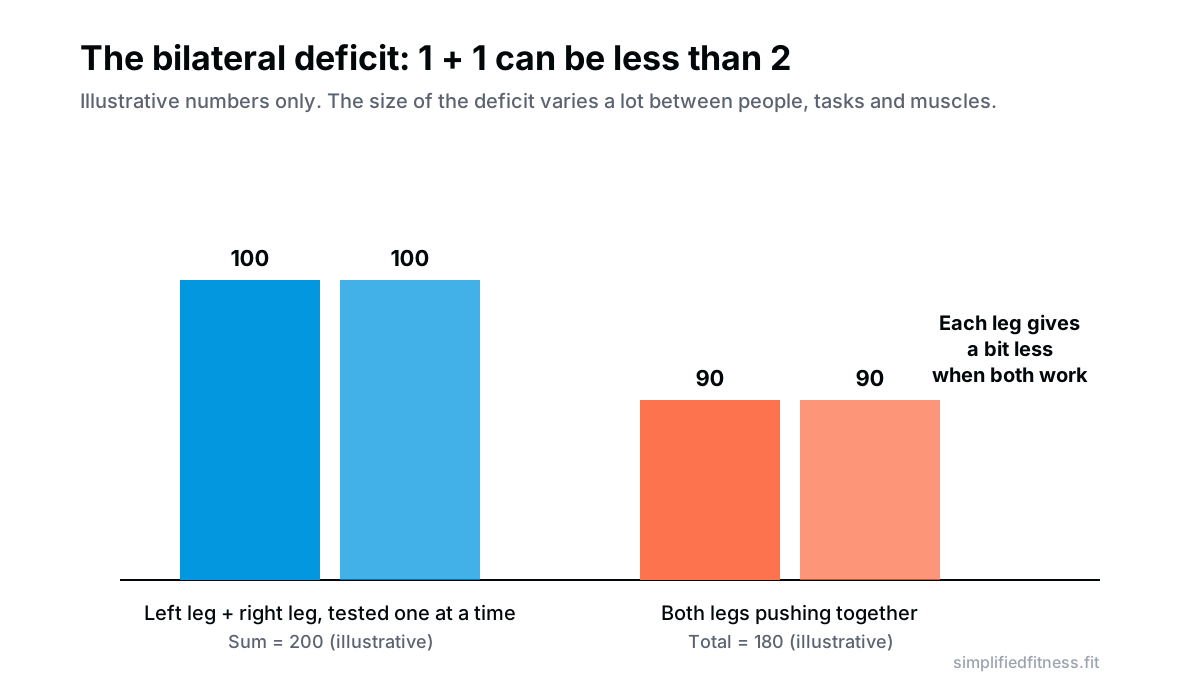
Now the honest part. A review of the research describes the bilateral deficit as an inconsistent phenomenon, with high variability in size and even in whether it appears, and sometimes the opposite (bilateral facilitation) shows up instead (Škarabot et al., 2016). It was more consistent in dynamic than in isometric contractions. The same review says task familiarity has a large influence, and that postural stabilisation demands and the ability to use counterbalances during single-limb actions strongly affect it.
On the cause, the review points to higher-order neural inhibition as a possible mechanism and notes that biomechanical factors seem to matter in explosive efforts. It also says many proposed mechanisms remain largely unknown. So the “neural” explanation is plausible but not settled.
Why single-limb work can still be a smart choice
If hypertrophy is similar, why bother? Because exercise selection is also about what you can actually do well.
- Lighter total load. A split squat with a pair of dumbbells can challenge your quads without you carrying a heavy bar on your back. That is a practical argument, not a proven injury-prevention effect.
- Less equipment needed. A pair of dumbbells and a bench go a long way, which suits a crowded gym or a home setup.
- Balance and trunk demand. Your hips and trunk have to resist tilting and rotating. That can make the exercise feel harder than the load suggests, but it also means balance can limit the set before the muscle does.
- Back-friendly options. If a barbell row or squat flares up your lower back, supported single-limb variations can let you keep training. If pain is ongoing, get it assessed first.
The main downside is the other side of the same coin. When balance, not muscle, ends the set, you are not getting a hard enough stimulus. Use a wall, rack or bench for support so your legs fail first.
Can unilateral training fix muscle imbalances?
It can help, though the research here is thin and mostly from athletes, not everyday lifters.
A 2024 randomized proof-of-concept trial took 30 male university basketball players and gave half of them 10 weeks of unilateral compound training (split squats, Bulgarian split squats, step-ups, single-leg calf raises, plus single-leg jumps), while the other half kept their usual training. The trained group showed a significant reduction in single-leg jump height and power asymmetry (Zhang et al., 2024). A meta-analysis of 8 randomized trials with 157 participants also found that unilateral plyometric training reduced lower limb asymmetry in athletes, though the authors called for further high-quality trials (Sun et al., 2025).
Both are small, athlete-based and jump-focused. They suggest single-limb work is a reasonable tool for asymmetry, but they do not show that it fixes size differences in your biceps or chest.
The most common mistake with side-to-side differences is letting the stronger side set the weight and the reps. With dumbbells that happens quietly, because each arm gets the same load but the weaker arm fails first.
How to correct a lagging side
- Start each exercise with the weaker side.
- Match the stronger side to the same reps and the same effort (RIR 1-3).
- If the weaker side is clearly behind, add one extra set for it. Do not go beyond that, because extra volume you cannot recover from will not help.
- Re-check every 6-8 weeks. Small left-right differences are very common and often never fully disappear.
For chest-specific side differences, see our guide on fixing an uneven chest with unilateral pressing.
Does training one limb help the other?
There is also a curious effect called cross-education. A meta-analysis of 31 randomized trials (785 subjects) found that unilateral resistance training raised strength in the untrained limb by about 11.9% on average, with larger effects in the lower limb (16.4%) than the upper limb (9.4%), although the studies had a high risk of bias (Manca et al., 2017).
That matters most when one side is injured or in a cast. If you have an injury, ask your doctor or physiotherapist what is safe for you before you train the other side.
Bilateral or unilateral: how to choose per muscle
| Situation | Better starting choice | Why |
|---|---|---|
| Chasing a bigger barbell squat, bench or row | Bilateral | Strength is specific to the lift you practise |
| Lower back gets tired before legs do | Unilateral or machine-supported | Lighter spinal load, easier to control |
| One side is clearly weaker | Unilateral | Each side works on its own |
| Short on time | Bilateral | More load per set, fewer sets to do |
| Crowded gym, no free rack | Unilateral with dumbbells | Needs little equipment |
| Balance fails before muscle | Supported unilateral, or bilateral | Needs a hard enough stimulus |
How to add unilateral work to your program
You do not need to rebuild your split. Keep your main bilateral lift for a muscle group and add one single-limb movement after it.
- Legs: squat or leg press first, then a split squat, lunge or step-up. We cover the specifics in Bulgarian split squats and lunges for the legs.
- Back: a barbell or chest-supported row first, then a single-arm row. Our guide to single-arm dumbbell rows, bench versus tripod stance shows how to set up.
- Chest and shoulders: a bilateral press first, then single-arm dumbbell or cable work.
Keep the same weekly hard-set range you would use anyway; adding single-limb work does not mean adding a whole extra block of volume. Count single-limb sets as sets for that muscle, and use the training volume calculator to check your weekly total. Or start from our free leg day plan and swap in the single-leg exercise that fits your gym.
If your spine is a concern, our piece on axial versus non-axial exercises and spinal recovery explains how to spread load without dropping the hard work.
When to see a doctor
Muscle size or strength differences between sides are common. See a doctor or physiotherapist if a gap is large, growing, painful, or began after an injury, or if you notice numbness, tingling or weakness in a limb. Do not try to train through those symptoms.
The bottom line
Unilateral and bilateral training both build muscle, and the 2025 meta-analysis found no significant difference between them for hypertrophy. Strength follows specificity, so keep your main barbell lifts if barbell strength is the goal. Use single-limb exercises where they fix a weak side, spare your back or fit your equipment, and always take the weaker side first. Use the 1RM calculator to track your main lifts while you do it.
Frequently Asked Questions
Is unilateral training better than bilateral training for muscle growth?
No, not on current evidence. A 2025 meta-analysis of 9 studies found no significant difference in hypertrophy between the two approaches, though the literature is small. Choose whichever you can load hard, control well and recover from, and train it close to failure.
What is the bilateral deficit in lifting?
It is the finding that a limb often produces less force when both limbs push or pull together than when it works alone. Reviews describe it as inconsistent, and it depends on the task, posture and how familiar you are with the movement. Practically, it means two single-leg efforts can add up to more than one two-leg effort, but you should not expect an exact number.
What causes the bilateral deficit?
The mechanisms are not fully settled. A review points to higher-order neural inhibition as one candidate, and to biomechanical factors in fast, explosive efforts. Because the cause is unclear, treat the idea as a useful concept rather than a rule you can calculate with.
Do split squats build more muscle than back squats?
There is no good evidence that either one builds more muscle when sets are matched and taken close to failure. The unilateral versus bilateral meta-analysis found similar hypertrophy overall, though it pooled several exercises. Pick the one that lets you push your legs hard without your back or balance becoming the limiter.
Are single-arm rows better than barbell rows?
They are not clearly better for growth, but they are often easier to control. Single-arm rows let you brace on a bench, adjust the range of motion and avoid loading the lower back. Use them when a barbell row leaves your back more tired than your lats.
Will unilateral training fix muscle imbalances?
It can help, but it is not guaranteed. Training each side separately stops the stronger side from taking over, and a 2024 trial in 30 male basketball players found that a 10-week unilateral program reduced jump asymmetry. Start the weaker side first and match the stronger side to its reps.
Should I do extra sets for my weaker side?
A small bump is reasonable, but keep it modest. There is little direct research on how much extra work a weaker side needs, so this is a practical rule rather than a tested dose. A simple approach is to do the same sets on both sides and add one extra set for the lagging side if the gap persists.
Is my muscle size difference between sides normal?
A small difference between your left and right side is very common, because most people favour one side in daily life. It usually only needs attention if the gap is large, growing, painful or came on after an injury. In those cases, see a doctor or physiotherapist rather than guessing.
Does training one limb make the other limb stronger?
Yes, to a degree. A meta-analysis of 31 studies found about an 11.9% strength gain in the untrained limb after unilateral training, though with a high risk of bias. This cross-education effect is mostly useful when one limb is temporarily out of action.
Do unilateral exercises hit the core harder?
Often they feel that way, because your trunk and hips have to resist rotation and tilt. A review notes that postural stabilisation demands strongly shape how the bilateral deficit shows up. Whether that translates into measurable extra core growth is not well tested, so treat it as a bonus, not a reason to pick the exercise.
Is unilateral training safer for the lower back?
It can reduce how much weight you need on your spine, since each leg handles a lighter load. That is a practical argument rather than a proven injury-prevention effect. If you have ongoing back pain, get it assessed and use the version that does not aggravate it.
How should I add unilateral exercises to a program?
Keep your main bilateral lift for a muscle group and add one single-limb exercise after it. This gives you heavy loading first and balance work second. Use our free leg day plan as a base and add single-leg work where it fits.
Do I need unilateral work to get strong at squats or deadlifts?
No, because strength is specific to what you practise. The meta-analysis found bilateral training raised bilateral strength more. If your goal is a bigger barbell squat, keep squatting with both legs, and use single-leg work as support.
Sources & References
Every claim above is checked against peer-reviewed research (PubMed, U.S. National Library of Medicine) or guidance from established health bodies. How we fact-check.
- Kassiano W, et al. Comparison of muscle growth and dynamic strength adaptations induced by unilateral and bilateral resistance training: a systematic review and meta-analysis. Sports Med. 2025. PMID: 39794667
- Škarabot J, et al. Bilateral deficit in maximal force production. Eur J Appl Physiol. 2016. PMID: 27582260
- Häkkinen K, et al. Neuromuscular adaptations during bilateral versus unilateral strength training in middle-aged and elderly men and women. Acta Physiol Scand. 1996. PMID: 8876751
- Manca A, et al. Cross-education of muscular strength following unilateral resistance training: a meta-analysis. Eur J Appl Physiol. 2017. PMID: 28936703
- Zhang W, et al. The potential of a targeted unilateral compound training program to reduce lower limb strength asymmetry and increase performance: a proof-of-concept in basketball. Front Physiol. 2024. PMID: 38989050
- Sun W, et al. Unilateral plyometric training effectively reduces lower limb asymmetry in athletes: a meta-analysis. Front Physiol. 2025. PMID: 40271209

Umair Hazrami · Founder & Head Coach, Simplified Fitness
Umair Hazrami founded Simplified Fitness and the Simplified Lifter channel to cut through fitness noise. With 4+ years of consistent training and 10+ coaching clients, he writes every guide from the peer-reviewed research and links the sources so you can check them. Our editorial standards.
Educational content only, not medical advice. If you have a medical condition, are pregnant, or take medication, talk to a qualified doctor before changing your diet, supplements or training. Full disclaimer.
Keep reading
Exercise Technique
Anthropometry-Based Exercise Selection: Long Limbs, Short Torsos, and Lever Adjustments
Anthropometry exercise selection explained: how long femurs, long arms and a short torso change squats, deadlifts and presses, plus a simple audit and swaps.
9 min read
Exercise Technique
Axial Loading vs Non-Axial Exercises: Managing Spinal Fatigue for Bigger Legs and Back
Axial loading vs non axial exercises explained: how spinal compression limits your weekly volume, and which squat and row swaps spare your lower back.
7 min read
Exercise Technique
Cable Setup Mastery: Pulley Heights, Cable Angles, and Customizing Force Vectors
Cable machine setup guide: how to set pulley height, stance and cable angle for chest, lats, delts and arms, with what the research does and does not show.
9 min read
Exercise Technique
Compound vs Isolation Exercises for Hypertrophy: Do You Need Both?
Compound vs isolation exercises for hypertrophy: what trials say about arms, delts and hamstrings, and which muscles actually need direct sets. Sources linked.
7 min read