Barbell Bent-Over Rows: Spinal Load, Hamstring Fatigue and Lat Growth
Is the barbell bent over row hypertrophy gold or a fatigue generator? See what the research says about spinal load, torso angles and better rows for lat growth.
TL;DR. The short answer
- The barbell bent-over row builds muscle, but it is not the most efficient lat builder for most lifters. In a small lab study it produced the largest lower-back load of three row types, and because you hold a hinge for the whole set, your back and hamstrings can tire before your lats do.
- Free-weight and machine training produced similar hypertrophy in a 2023 meta-analysis, so a supported row is not 'lesser' for muscle growth. It simply lets the target muscle be the limiting factor.
- Yates (about 45 degrees) and Pendlay (torso parallel to the floor) rows are different tools. No study has shown one grows more muscle, so pick the one you can repeat with the same torso angle every rep.
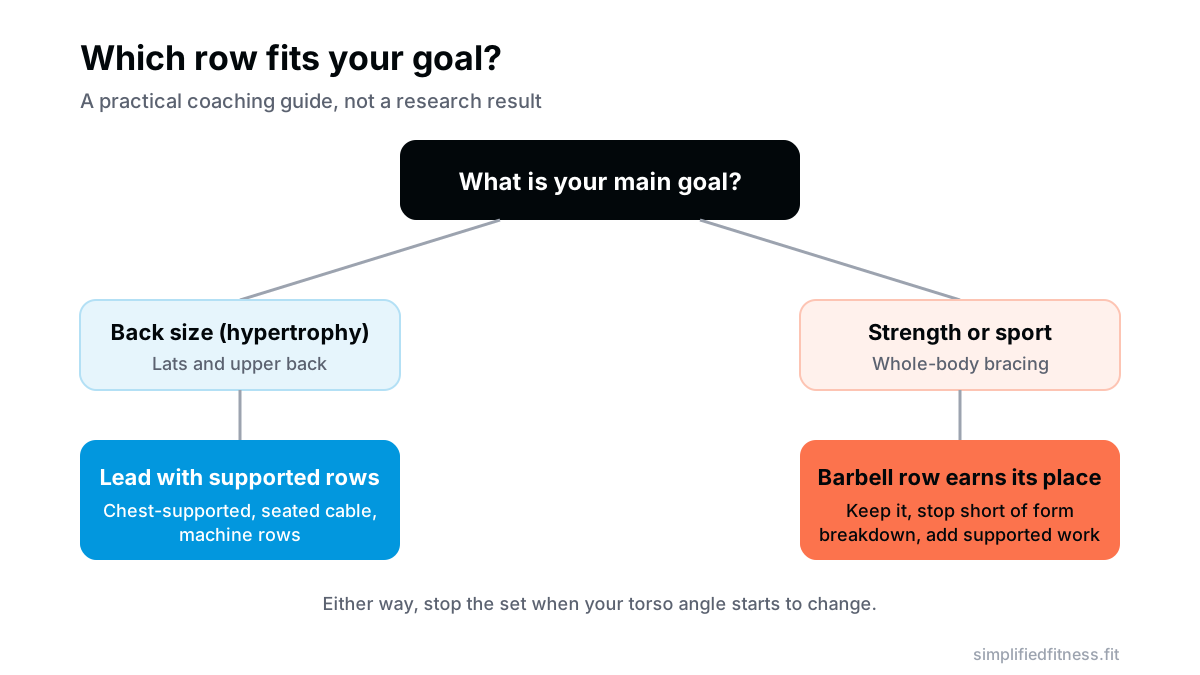
- Keep barbell rows if you are a strength athlete or you enjoy them and recover well. For pure back size, make chest-supported, cable or machine rows your main work and use the barbell row as an optional extra.
- Persistent or sharp low back pain, or pain, numbness or tingling down a leg, is a reason to see a doctor or physio rather than push through more rows.
Part of our complete guide: Complete Back Training Guide: Lats vs Upper Back, Best Exercises and a Hypertrophy Workout
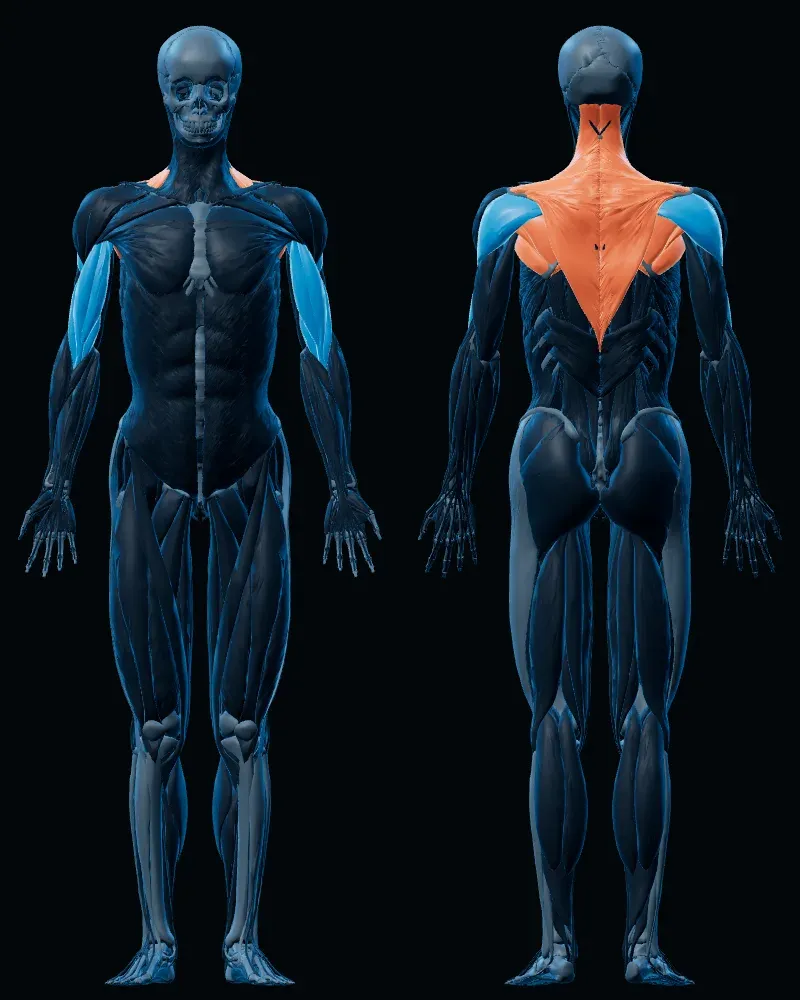
Muscles worked: upper back
Main movers: traps, rhomboids, teres major, infraspinatus and teres minor
Assisting: rear delts, biceps and brachialis
Table of contents
The barbell bent over row builds muscle, but for most people chasing back size it is not the most efficient way to do it. Your lower back, glutes and hamstrings have to hold a hinge for the whole set, and they often get tired before your lats are anywhere near failure.
That is the honest answer to the barbell bent over row hypertrophy question. It is a good strength exercise and an average-to-awkward pure lat builder. This article sits inside our complete back training guide, and here we zoom in on one lift: what it loads, where the 45 degree and 90 degree versions differ, and when something else deserves the slot.
Is the barbell row good for lats?
Yes, the lats work hard in a barbell row. The catch is that they are not the only thing working, and not usually the thing that ends the set.
Think about what you are actually doing. You hinge forward, brace, and hold that position while pulling a bar from the floor or from hang. Your spinal erectors hold your torso up. Your glutes and hamstrings stop your hips from dropping. All of that is isometric work that stacks up fatigue with every rep.
In practice, that is where the set often falls apart. Your torso starts to rise, the pull turns into a hip jerk, and the last reps stop being lat reps. The most common mistake here is calling that a “heavy row” when it has become a standing shrug-and-heave.
What does the research say about bent-over row spinal load?
The cleanest data comes from a spine biomechanics lab at the University of Waterloo. Researchers had 7 healthy men perform an inverted row, a standing bent-over row and a standing 1-armed cable row while measuring muscle activity and modelling spine load (Fenwick et al., 2009).
Here is what they reported:
- The inverted row produced the highest activation of the lats, upper back and hip extensors, with lower erector activity and the lowest spine load.
- The standing bent-over row produced large, symmetrical activation across the back, but also the largest lumbar spine load and the highest spine stiffness.
- The 1-armed cable row challenged the trunk’s resistance to twisting.
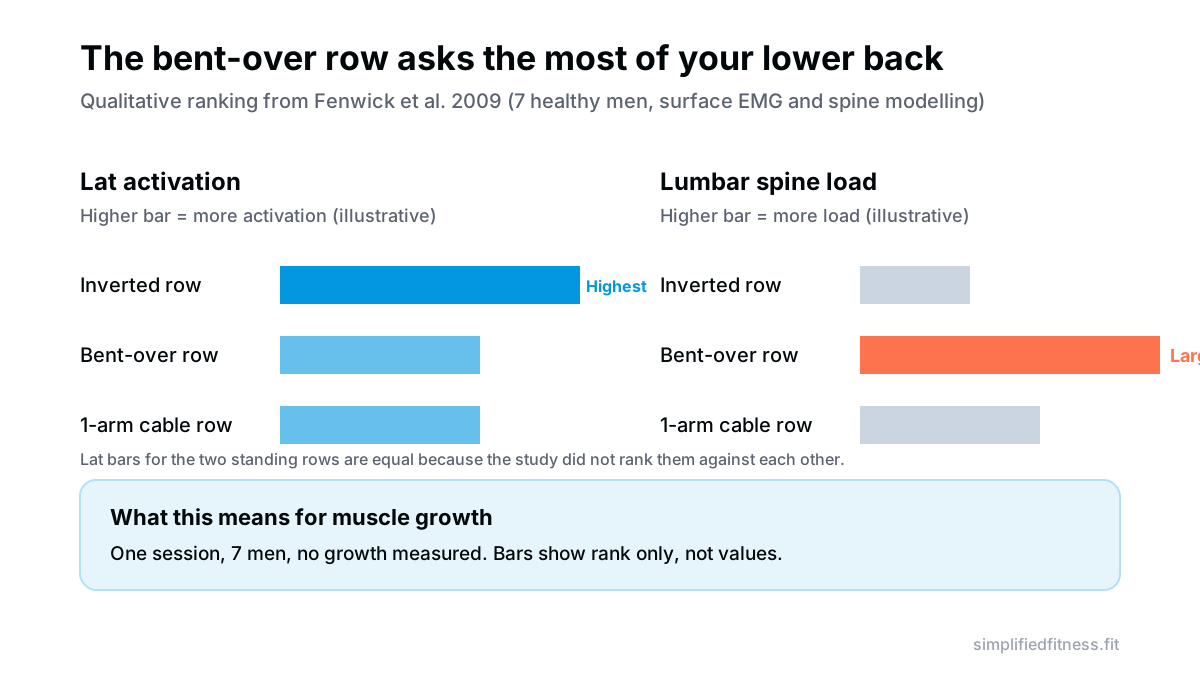
The authors did not frame the bent-over row as dangerous. They framed it as a trade-off: exercises with higher spine load may suit athletic training, while lower-load options may suit people who want to spare the back.
A second study backs up the same pattern. In 15 resistance-trained men, a free-weight bent-over row produced more erector spinae activity than a machine row, about 34% more in the two-handed version (Saeterbakken et al., 2015). More stabiliser work is not automatically bad. It does confirm that the free-weight row asks more of your lower back, which matters if that is what ends your sets.
Why hamstrings and lower back fail before the lats
This part is coaching logic more than measured fact, so treat it as a working explanation. No study has tracked which muscle ends the set in a barbell row for each lifter, and people vary.
What we do know is that the position is demanding. The Waterloo data shows large activation across the lower back and hips in the standing row. If the lower back and hips are working near their limit while the lats still have reps left, those muscles set the ceiling.
You can usually feel which camp you are in:
- Lower back or hamstrings burn first, torso creeps up: the hinge is your limiter.
- Grip fades first: straps will fix that, see lifting straps for back hypertrophy.
- Lats and mid-back burn and you still hold the angle: the barbell row is working for you.
If the first one sounds like you, a supported row can help. Our chest-supported rows guide covers that in depth.
Barbell bent over row hypertrophy: is it enough?
Here is where the argument often goes wrong. People assume that because a barbell row is heavy and “free weight”, it must grow more muscle than a machine or supported row.
The evidence does not back that up. A 2023 systematic review and meta-analysis of 13 studies (1016 participants) compared free-weight and machine training for at least 6 weeks and found no difference in hypertrophy (5 studies), dynamic strength or jump performance. Strength gains were specific to the type of test used (Haugen et al., 2023). The analysis was not specific to back exercises, so applying it to rows is an inference.
Load matters less than people think too. A 2021 review argued that muscle growth can be achieved, and in some cases optimised, across a wide range of loading zones (Schoenfeld et al., 2021). So you do not need a heavy barbell to drive growth, and a lighter, supported row can do the same job.
How close to failure you train matters a bit, but there is no need to grind. A 2023 meta-analysis found no evidence that training to momentary failure beat stopping short of it for hypertrophy (Refalo et al., 2023). That helps barbell rowers: you can stop a couple of reps before form breaks and lose little.
Yates row vs Pendlay row: which torso angle?
These two are the main bent-over variations people argue about.
| Yates row | Pendlay row | |
|---|---|---|
| Torso angle | About 45 degrees | Roughly parallel to the floor |
| Bar path | Pulled to lower stomach | Pulled to lower chest, bar returns to floor each rep |
| Grip | Often underhand or shoulder-width | Usually overhand, wider |
| Hamstring and lower-back demand | Lower | Higher |
| Cheating risk | Higher, torso tends to rise | Lower, the floor reset keeps it honest |
| Best for | Lifters who tire at the hinge | Strength athletes, lifters who want strict reps |
No trial has shown that one grows more back than the other. What the research does support is that the humerus-to-trunk relationship may be a key determinant of how load is spread across muscles (Di Fonza et al., 2026). That review is a narrative review, and it stresses that its findings reflect acute EMG amplitude, not long-term training outcomes.
So here is the practical rule. Whichever angle you pick, keep it the same from rep one to rep ten. If it changes, the set has changed into something else. Our guide on lats vs upper back, arm path and elbow flare shows how elbow position shifts the target.
When barbell rows make sense
I would keep them in these cases:
- You are a strength athlete. The row trains bracing and a held hinge, which is useful beside deadlifts. The Waterloo data also showed the highest spine stiffness in this row.
- You enjoy them and recover well. Enjoyment is a real training variable because you will do more of what you like.
- You have the technique. If you can hold a flat, consistent torso angle for every rep, the lift works.
- Your gym is short on equipment. A barbell and plates are enough to get a hard back session done.
When machines and supported rows are better
For a lifter whose main goal is back size, supported rows usually let the back be the weak link instead of the hinge. Good options include:
- Chest-supported T-bar rows, which remove the hinge and make cheating much harder
- Seated cable rows, which keep tension steady through the rep
- Single-arm dumbbell rows, which allow a long range of motion with a free hand for support
Remember what the lab data says: the inverted row gave the highest lat activation among the three tested, with lower erector load. The latest lat EMG review calls that finding preliminary because it comes from a single small study that needs replication (Di Fonza et al., 2026). So read it as a hint, not a verdict.
How to keep barbell rows if you want them
If you decide to keep the lift, a few habits make it more useful:
- Pick one torso angle (45 degrees or lower) and keep it. Film a set from the side.
- Use a load you can pull for about 6-15 reps without the hips taking over. Since training load has a wide effective range, you have room to go lighter.
- Stop a rep or two before form changes. The failure meta-analysis suggests you lose little by doing so.
- Put supported rows first or alongside, so total back volume does not depend on your hinge.
- Consider straps if grip ends the set early.
For a ready-made layout, our free pull day plan shows how rows, pulldowns and arm work can fit in one session, and our training volume calculator helps you check weekly sets. For the whole picture, see how to design a complete back workout.
Who should be careful
Bodybuilders report most injuries in the shoulder, elbow, lumbar spine and knee, based on a questionnaire study of 71 competitive and elite bodybuilders in Germany (Siewe et al., 2014). That does not single out rows, but it is a reminder that the lower back is a common weak point.
See a doctor or physio before loading heavy hinge-based rows if you have:
- ongoing or recurring low back pain
- numbness, tingling or weakness in a leg
- a recent back injury or surgery
- pain that wakes you at night or does not ease with rest
Sharp or radiating pain is a stop sign, not something to push through. A professional can assess it, which this article cannot do.
The bottom line
The barbell bent-over row is a legitimate lift, but it is a better strength exercise than a pure lat builder. It loads the lower back more than supported alternatives, it demands a held hinge, and it makes cheating easy. None of that makes it bad, and none of it means you must drop it.
If you want back size, build your week around rows and pulldowns you can train hard and repeat with the same form, and let the barbell row be an optional extra. If you want strength, keep it, load it sensibly, and add supported work for volume. Either way, the lift that you can progress safely for months will beat the one that looks best on paper.
Frequently Asked Questions
Is the barbell bent-over row good for lat growth?
It can be, but it is rarely the most efficient choice. The row trains the lats along with the whole back, but your lower back and hamstrings must also hold the hinge position, so they can tire first. Pair it with a supported row if lat size is your priority.
Is the barbell row bad for your lower back?
Not automatically, but it loads the lower back more than supported rows do. A 2009 lab study of 7 men found the standing bent-over row produced the largest lumbar spine load of three row types. Use a weight you can hold the same torso angle with, and see a doctor if you get persistent or radiating pain.
Why do my hamstrings and lower back burn during bent-over rows?
You are holding a hip hinge for the entire set, which keeps the spinal erectors, glutes and hamstrings working isometrically. That fatigue can end the set before your lats are close to failure. A chest-supported row removes that job.
What is the difference between a Yates row and a Pendlay row?
A Yates row is done with the torso around 45 degrees, usually with an underhand or shoulder-width grip, while a Pendlay row keeps the torso roughly parallel to the floor and resets the bar on the ground each rep. The Pendlay version is stricter, while the Yates version is easier on the hamstrings but allows more body English. Choose the one where you can repeat the same torso angle on every rep.
Which is better for hypertrophy, barbell rows or chest-supported rows?
For most lifters aiming at back size, chest-supported rows are the easier option to train hard and close to failure. No trial has directly compared these two for back growth, so this is a practical judgement and not a proven ranking. A 2023 meta-analysis found free weights and machines produced similar hypertrophy overall, so the best row is the one you can load and repeat well.
How do I stop cheating on barbell rows?
Cheating usually means the torso rises to pull the bar, which shifts work from the lats to the hips and lower back. Lower the load, pause briefly at the top, and end the set when your torso angle changes. Filming one set from the side helps you spot it.
Should I use straps for barbell rows?
Straps are reasonable if your grip fails before your back does. They remove grip as a limiter without changing the row itself. Keep training grip separately with carries or hangs if you want it strong.
Can I build a big back without barbell rows?
Yes. Muscle growth depends on training each muscle hard with enough volume, and many exercises can deliver that. Chest-supported rows, cable rows, lat pulldowns and pull-ups can fill the same role, so use whichever you can progress reliably.
How heavy should I go on bent-over rows for muscle growth?
A wide range of loads can build muscle if the sets are hard enough. A 2021 review argued hypertrophy can be achieved across a broad range of loading zones, so you do not need to chase heavy singles on a row. Pick a weight you can pull for roughly 6-15 clean reps with your torso angle intact.
Are barbell rows better for strength athletes?
They can be, because they train whole-body bracing and a heavy hinge position, which may carry over to deadlifts and similar lifts. The 2009 lab study found they gave the highest spine stiffness among the rows tested. If strength is your goal, keep them and treat supported rows as the volume work.
How many sets of barbell rows per week do I need?
There is no single proven number for the barbell row specifically. Count rows towards your total weekly back volume alongside pulldowns and other pulls, and start modestly, for example 3-6 hard sets a week, then add if you recover well. Our complete back training guide covers total volume.
When should I see a doctor about back pain from rowing?
See a doctor or physio if pain is sharp, lasts for days, wakes you at night, or comes with numbness, tingling or weakness in a leg. Ordinary muscle tiredness is different from nerve-type symptoms. Stop the exercise that triggers it until you have been assessed.
Sources & References
Every claim above is checked against peer-reviewed research (PubMed, U.S. National Library of Medicine) or guidance from established health bodies. How we fact-check.
- Fenwick CM, et al. Comparison of different rowing exercises: trunk muscle activation and lumbar spine motion, load, and stiffness. J Strength Cond Res. 2009. PMID: 19620925
- Saeterbakken A, et al. The effect of performing bi- and unilateral row exercises on core muscle activation. Int J Sports Med. 2015. PMID: 26134664
- Di Fonza D, et al. Electromyographic analysis of latissimus dorsi activation during common resistance training exercises: a narrative review. J Funct Morphol Kinesiol. 2026. PMID: 42647355
- Haugen ME, et al. Effect of free-weight vs. machine-based strength training on maximal strength, hypertrophy and jump performance: a systematic review and meta-analysis. BMC Sports Sci Med Rehabil. 2023. PMID: 37582807
- Schoenfeld BJ, et al. Loading recommendations for muscle strength, hypertrophy, and local endurance: a re-examination of the repetition continuum. Sports (Basel). 2021. PMID: 33671664
- Refalo MC, et al. Influence of resistance training proximity-to-failure on skeletal muscle hypertrophy: a systematic review with meta-analysis. Sports Med. 2023. PMID: 36334240
- Siewe J, et al. Injuries and overuse syndromes in competitive and elite bodybuilding. Int J Sports Med. 2014. PMID: 24886919

Umair Hazrami · Founder & Head Coach, Simplified Fitness
Umair Hazrami founded Simplified Fitness and the Simplified Lifter channel to cut through fitness noise. With 4+ years of consistent training and 10+ coaching clients, he writes every guide from the peer-reviewed research and links the sources so you can check them. Our editorial standards.
Educational content only, not medical advice. If you have a medical condition, are pregnant, or take medication, talk to a qualified doctor before changing your diet, supplements or training. Full disclaimer.
Keep reading
Exercise Technique
Chest-Supported Rows: Train Your Upper Back Without Lower Back Fatigue
Chest supported row hypertrophy explained: why your lower back quits first, how T-bar, incline and seal rows fix it, and what the research says.
8 min read
Exercise Technique
Complete Back Workout Design: Balancing Vertical Pulls, Horizontal Rows, and Lumbar Recovery
A science-based back workout routine: weekly sets, how to balance pulldowns and rows, and how to protect your lower back, with a sample pull day plan.
9 min read

Exercise Technique
Conventional Deadlifts for Back Hypertrophy: Stimulus-to-Fatigue Ratio Analysis
Are deadlifts good for back hypertrophy? A stimulus-to-fatigue breakdown of what they build, what they miss for lats, and how to program or replace them.
8 min read

Exercise Technique
Dumbbell Pullover Tension Curve: Why You Feel Triceps and Chest, Not Lats
Dumbbell pullover tension curve explained: why triceps and chest burn instead of lats, what the EMG research shows, and how to fix the exercise or swap it.
8 min read