Lifting Straps for Back Hypertrophy: Cheating or Smart? What the Research Says
Are lifting straps for back hypertrophy cheating? See what trials in trained lifters found, which strap type to buy, and when to leave them in your bag.
TL;DR. The short answer
- Lifting straps are not cheating. They take your forearms out of the equation so your back can keep working when your grip gives up first.
- The evidence is more modest than gym lore. In 12 trained men, straps did not change lat pulldown 1RM, reps or lat EMG, and a 2026 review found no consistent effect for back exercises and no long-term hypertrophy data.
- Straps clearly help on the deadlift: in small trials they preserved grip, allowed more reps in women, and increased force and work in trained lifters.
- Use straps only on heavy or high-volume pulls where grip is what ends the set. Train grip separately with hangs and carries.
- No study has compared strap types. Lasso straps are adjustable and easy to release, figure-8 straps are more secure but harder to bail out of, and both are cheap.
Part of our complete guide: Complete Back Training Guide: Lats vs Upper Back, Best Exercises and a Hypertrophy Workout
Table of contents
Lifting straps are not cheating, and they can help your back training when your grip is what ends the set. But the research on lifting straps for back hypertrophy is thinner than most gym advice suggests, and the benefits show up mainly on heavy deadlift-style pulls, not everywhere.
This article is part of our complete back training guide. Here we sort out what straps actually do, what the studies found (including the ones that did not find much), which type to buy, and when to leave them in your bag.
Are lifting straps cheating?
No. “Cheating” in the gym means changing the movement so the target muscle does less work, like swinging a curl. A strap does not change the movement at all. It holds the bar to your hand so your fingers and forearms are not the limiting link.
Think about what you are trying to do on back day. You want your lats, mid-back and traps to work hard close to failure. Your forearm flexors are a much smaller muscle group with a different job. If your hands open on rep 6 while your lats could do 10, the set ended for the wrong reason.
The most common mistake here is treating grip as a moral test of the back workout. Grip is a separate skill, and you can train it separately.
What does the research say about lifting straps for back hypertrophy?
Here is the honest picture. Nobody has yet run a long training study comparing back growth with and without straps. What we have is short, small, mostly acute studies, and a 2026 narrative review that tried to separate evidence from gym belief.
That review concluded that straps can enhance maximal strength and grip perception, but for pulling and back exercises no consistent effects have been observed. It also says straps may increase mechanical work in the deadlift but, contrary to common belief, appear not to increase muscle recruitment, and that no scientific evidence supports chronic effects of strap use, so those remain a hypothesis (Martins et al., 2026).
That is a more cautious conclusion than “straps unequivocally build a bigger back”. Let’s look at the individual studies.
Lat pulldown: no clear benefit
In a randomized trial, 12 resistance-trained men (about 6.6 years of training) performed the lat pulldown with and without straps. Sessions were 3 sets to concentric failure at 70% of 1RM with 60 seconds of rest. Pulldown 1RM was 96.5 kg with straps and 96.6 kg without. Reps per set, total reps and lat activation did not differ either (Valério et al., 2021).
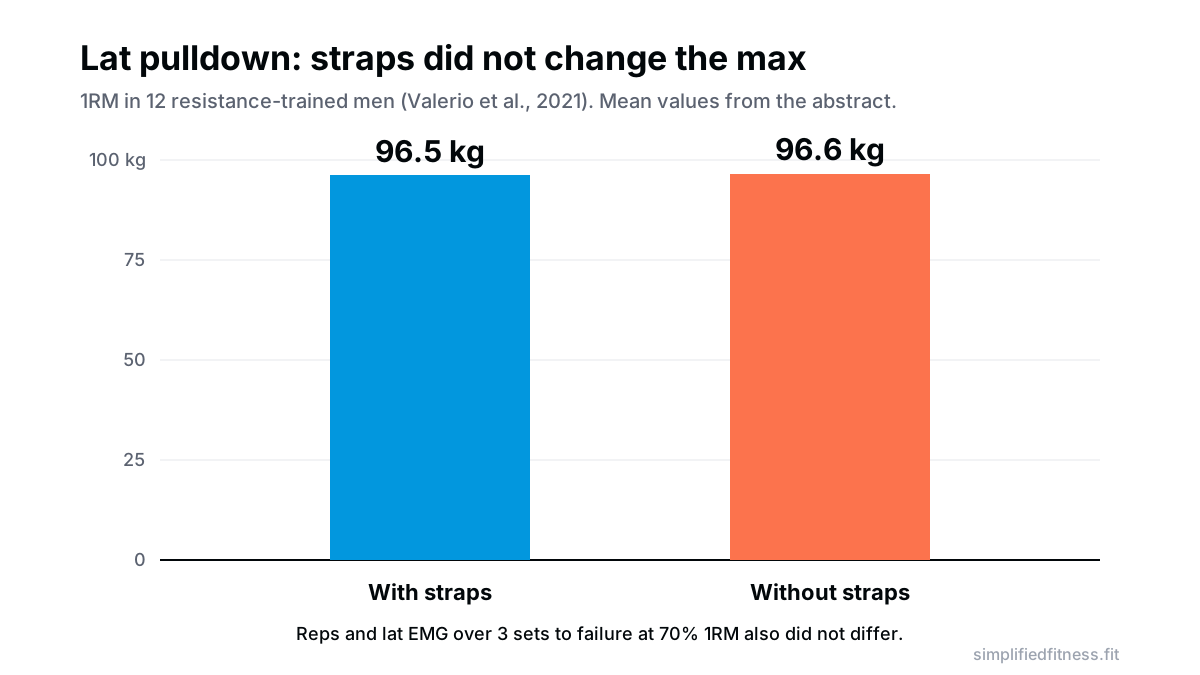
Why might that be? The study did not test a reason, but a likely one is that at these loads and set lengths, grip simply was not what limited these experienced lifters. That is one trial in 12 men, so treat it as a sign, not a law.
Deadlift: this is where straps shine
The deadlift is the movement where grip most often fails first, and the studies line up with that.
- In 16 men doing 4 sets of 4 at 80% of their no-straps 1RM, straps allowed greater mean and peak bar velocity, lower grip fatigue, lower perceived exertion and higher perceived grip security (Jukic et al., 2021). The authors suggested straps allow better maintenance of grip strength and faster grip recovery.
- In 11 trained lifters doing 3 sets to failure at 90% of 1RM, straps were associated with 20-28% greater force, longer concentric phases and lower bar speed, and, the authors concluded, more work performed by the target muscles (Coswig et al., 2015).
- In 10 women (about 3 years of training experience) doing 3 sets of as many reps as possible at 80% of 1RM, straps allowed significantly more reps with no difference in barbell velocity, and grip strength loss was smaller (Trahey et al., 2023).
Notice the caveats. Samples are small (10 to 16 people), the protocols are single-session, and the deadlift is a whole-body lift. Whether extra deadlift reps translate into more back growth over months has not been tested. If you want to see how the deadlift fits into a back plan, read our conventional deadlift stimulus-to-fatigue breakdown.
Why grip failure can cap your back training
The logic behind straps is a weak link argument. Forearm flexors are small and fatigue quickly under heavy, long-duration holds. If they fail before your back does, your lats and mid-back did less total hard work than they could have.
That matters because muscle growth responds to close-to-failure work, but not in a strictly linear way. A meta-analysis found no evidence that training to momentary muscular failure beat stopping short of it for hypertrophy (Refalo et al., 2023). So you do not need to chase failure on every set. The practical point is narrower: a set that ends at “hands gave out” while your back had 4 reps left is a set that probably left some stimulus on the table.
Here is a quick test. After a back set, ask what ended it:
- Lats and upper back burning, rep speed slowing: good, a back-limited set.
- Fingers uncurling, bar slipping, forearms cramping while your back feels fresh: grip-limited.
- Lower back or hamstrings tired on a hinge-style row: that is a different limiter, and a chest-supported row fixes it better than straps do.
Using straps for lat pulldown and rows
Let’s be practical, exercise by exercise.
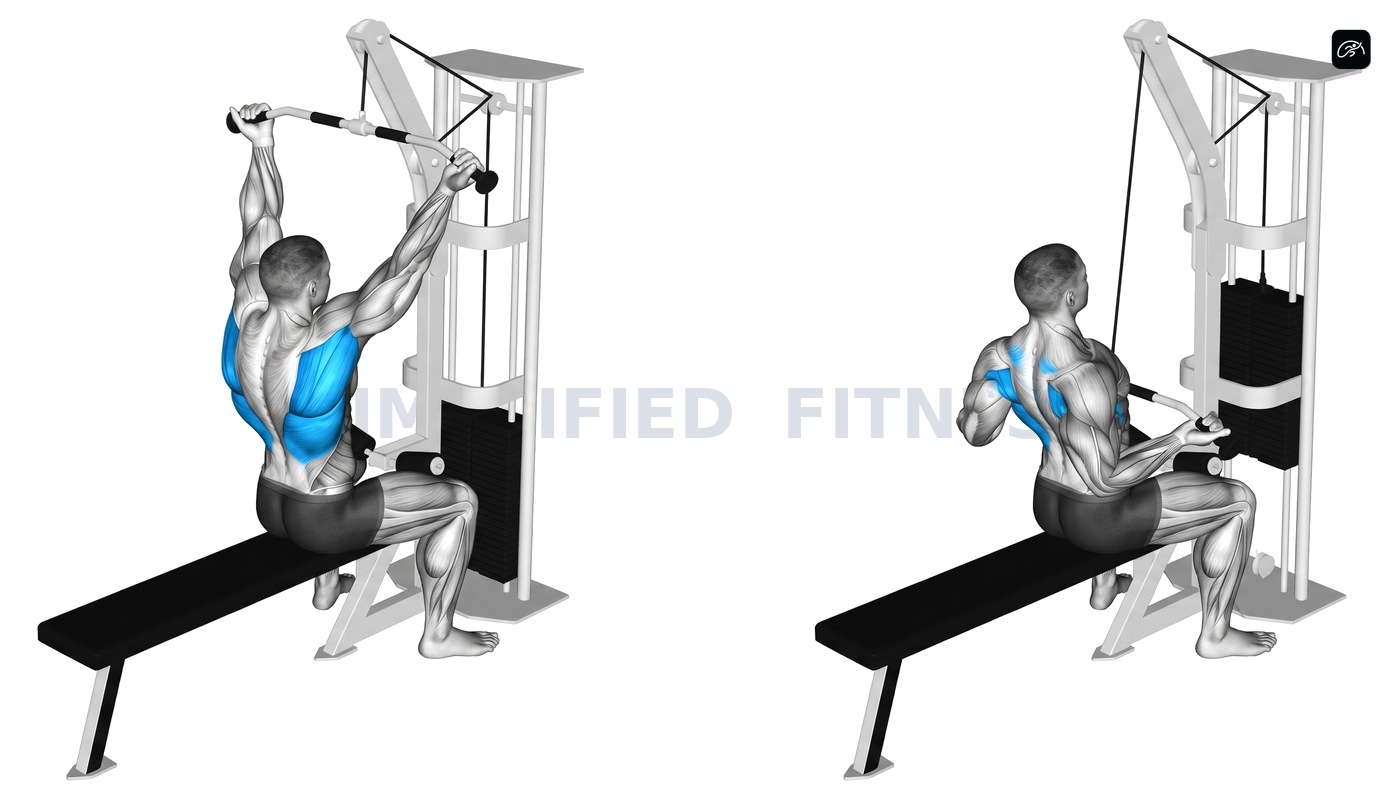
Lat pulldown. Start bare-handed. The one trial we have found no benefit from straps at 70% of 1RM to failure, so there is no reason to add them by default. If your hands genuinely fail first on heavy sets, they are a reasonable option. For setup details on grip choice, see wide vs close vs underhand pulldown grips.
Seated cable rows and chest-supported rows. Long sets with a heavy stack can fry the forearms, especially with a thick handle. Straps (or a pulling hook-style aid) can help here. See seated cable row attachments for which handles are easier on the hands.
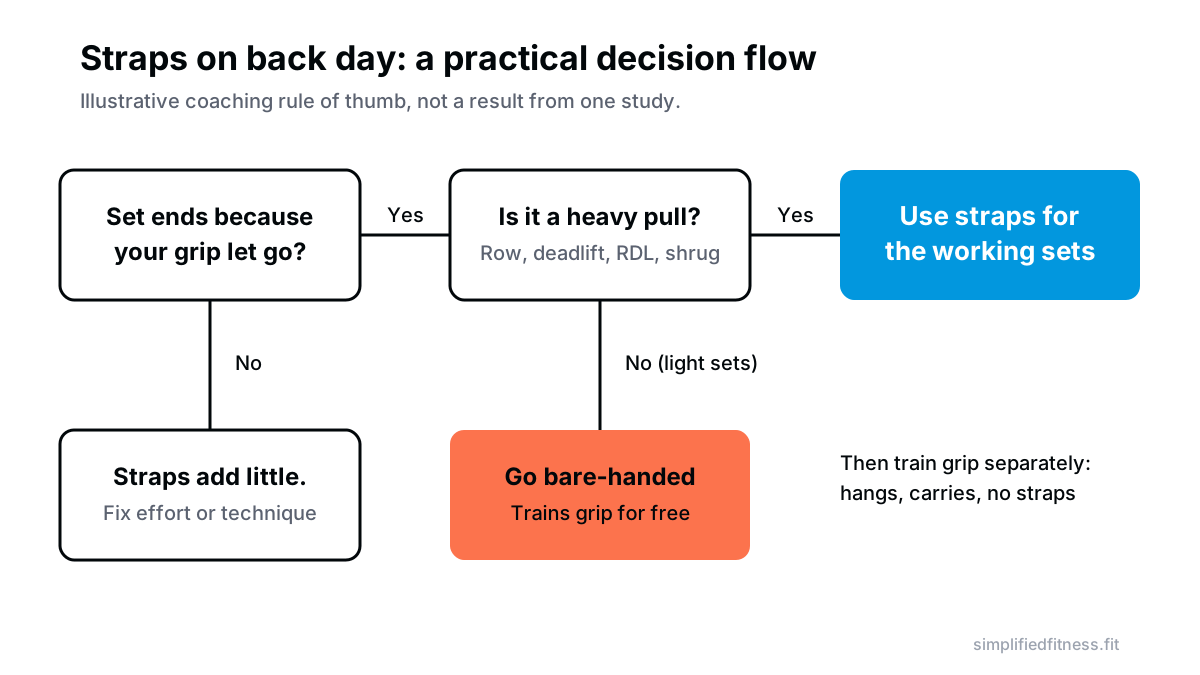
Barbell and T-bar rows, RDL-style pulls and shrugs. These are the heavy, long-hold movements where grip fails first. Straps are most defensible here. There is no row-specific strap trial in the abstracts we reviewed, so this is coaching logic built from the deadlift data.
Pull-ups. Most lifters never need straps here, because bodyweight is a light enough load and the movement is short. If you are adding serious weight and grip fails first, it is your call.
Figure 8 vs lasso straps: which is better?
We could not find published studies comparing strap types, so this comes from how they work, not from research.
| Strap type | How it works | Good for | Trade-off |
|---|---|---|---|
| Lasso (looped) | A single strap threaded into a loop around your wrist, then wrapped around the bar | Deadlifts, rows, shrugs, adjustable fit | Slower to set up, needs some practice |
| Figure-8 | A closed double loop: hand goes through, strap wraps the bar | Heavy rows, shrugs, deadlifts, maximum security | Hard to release fast, so avoid on lifts you may need to bail out of |
| Hook or grip-pad style | A pad or hook that attaches you to the bar | Quick use on rows and pulldowns | Less common, can limit hand position |
For most people, either lasso or figure-8 will do the job. Pick the one that sits comfortably under your wrist and that you can set up before your set rather than during it. Budget straps in India are inexpensive, and a cheap cotton pair that does not dig into the wrist is better than an expensive stiff one.
Will straps weaken my grip?
This is the common fear, and honestly there is no direct evidence either way. The 2026 review says chronic effects are unproven. What we do know is how grip adapts: it responds to being used. If every pulling set is strapped, your hands see less stimulus on those lifts.
The sensible fix is not to ban straps. It is to separate the goals.
- Use straps where grip would cap back volume.
- Do 1-2 short direct grip blocks a week: dead hangs, farmer carries, thick-bar holds.
- Keep some lighter pulls bare-handed.
Our guide to grip strength types gives specific protocols, and if you want bigger forearms specifically, see forearm flexor and extensor training.
How to use lifting straps safely
- Wrap before you lift, with the strap snug against the wrist, not twisted or loose.
- Keep the bar in your fingers and palm. Straps are a backup, not a replacement for a good hold.
- Know how to let go. On very heavy pulls where dropping the bar is not safe, think twice about locking yourself to it.
- Skip them when the weight is light and your grip is fine. More hand time is useful.
- If you get wrist, elbow or hand pain, or numbness or tingling in the fingers that does not settle, stop and see a doctor or physiotherapist. Do not train through it.
Safety data on straps is limited, and the 2026 review lists it as one of the gaps in the literature.
A simple back day with straps
Here is an example of how this looks in practice. It is illustrative, not a prescription.
- Heavy row or deadlift-pattern pull, 3 sets: straps on.
- Chest-supported or cable row, 3 sets: straps only if grip fails first.
- Lat pulldown, 3 sets: bare-handed.
- Light single-arm row or face pull: bare-handed.
- Dead hang or farmer carry, 2 sets: no straps, because this is your grip work.
For where this fits in a full week, see our guide to complete back workout design, and pair it with the training volume calculator to check your weekly sets. If you want a ready-made session, our pull day plan is free.
The bottom line
Straps are a legitimate tool, not a cheat code. Trials show clear benefits on the deadlift, little to no benefit on the lat pulldown, and no long-term study yet shows they build a bigger back. Use them when grip, not your back, ends a heavy set, and train your grip on its own so you do not trade one weak link for another.
If you have persistent hand, wrist or forearm pain, or any numbness, check with a doctor before changing your training.
Frequently Asked Questions
Are lifting straps cheating?
No. Cheating means changing the exercise so the target muscle does less work, and straps do not do that. They only remove forearm grip as the weak link. If your goal is a bigger back, nothing says your forearms must give out first.
Do lifting straps help you build a bigger back?
Probably only when grip is the thing ending your sets, and direct proof is thin. A 2026 narrative review found no consistent effects of straps on pulling and back exercises and no scientific evidence yet for chronic effects. Use them where grip clearly limits you, and judge the result by whether your rep counts and back pump improve.
Do straps increase lat activation?
The best available data says not necessarily. In 12 resistance-trained men, lat EMG during the lat pulldown did not differ with or without straps, and the 2026 review concluded straps do not appear to increase muscle recruitment. Straps help you keep going, they do not make each rep recruit more lat.
Will lifting straps weaken my grip?
There is no good evidence that moderate strap use weakens grip, but there is also no chronic training data, so this is unproven either way. Grip is trained by gripping, so if you strap every set you remove that stimulus. Keep some sets bare-handed and add direct work like dead hangs or farmer carries.
What is the difference between figure 8 and lasso straps?
Lasso straps are a loop you thread through itself and wrap around the bar, figure-8 straps are a closed double loop you put your hands through before wrapping the bar. Figure-8 straps are very secure for rows, shrugs and heavy pulls but are harder to release in a hurry, while lasso straps are more adjustable and easier to let go of. No published study has compared them, so pick on comfort and how fast you can set up.
Should I use straps on lat pulldowns?
Usually not needed. In a trial of 12 trained men doing 3 sets to failure at 70% of 1RM, straps made no difference to 1RM, reps or lat activation. Try pulldowns without straps first, and only strap up if your hands fail well before your lats feel worked.
Should I use straps for rows?
Straps make sense for heavy rows and high-rep rows where your fingers uncurl before your back is done. The mechanism is simple, grip is a smaller, faster-fatiguing link in the chain. If you can finish your sets with your lats burning and your hands fine, you do not need them.
Should I use straps for deadlifts?
On back-focused deadlift work, often yes. Small trials show straps preserved grip, increased force and work done, and let women complete more reps at 80% of 1RM without slower bar speed. Use them for working sets and keep your warm-ups and some top sets bare-handed if you need grip for sport.
Can I use straps if I want a strong grip too?
Yes, but train the two goals separately. Straps on back exercises protect back volume, while dead hangs, farmer carries and heavy holds train grip directly. Our guide to [grip strength types](/blog/grip-strength-types-crushing-pinching-supporting-protocols) lays out how.
Do lifting straps cause injury?
There is no strong evidence that straps cause injury, but safety data is limited and the 2026 review lists it as a gap. The real risk is a wrapped wrist stuck to a bar you cannot drop, so avoid strapped-in heavy pulls where bailing out would be hard. Practise a safe release and never wrap tight on dangerously heavy singles.
Do I still need to train forearms if I use straps?
Yes if you want strong forearms. Straps reduce the forearm work you get from pulling, so some direct work is sensible. A couple of short sessions of wrist curls and holds a week is a sensible starting point, as covered in our guide on [forearm flexor and extensor training](/blog/forearm-flexor-extensor-hypertrophy-wrist-curls).
At what weight should I start using lifting straps?
There is no universal number. Start when grip, not your back, repeatedly ends your working sets, usually on heavy deadlift-pattern pulls or long sets of rows and shrugs. If your back is the limiter, leave them off.
Are straps allowed in competition?
It depends on the sport and federation rules, so check yours. Most powerlifting federations do not allow straps in the deadlift, while many bodybuilding gyms and general training have no rule. For hypertrophy training the rulebook is irrelevant.
Sources & References
Every claim above is checked against peer-reviewed research (PubMed, U.S. National Library of Medicine) or guidance from established health bodies. How we fact-check.
- Martins R, et al. Are Lifting Straps a Game Changer for Resistance Training or an Overrated Tool? An Exploratory Review of Current Evidence and Future Research Directions. Int J Sports Physiol Perform. 2026. PMID: 41569827
- Valério DF, et al. The effects of lifting straps in maximum strength, number of repetitions and muscle activation during lat pull-down. Sports Biomech. 2021. PMID: 31198105
- Jukic I, et al. Ergogenic effects of lifting straps on movement velocity, grip strength, perceived exertion and grip security during the deadlift exercise. Physiol Behav. 2021. PMID: 33306977
- Coswig VS, et al. Kinematics and Kinetics of Multiple Sets Using Lifting Straps During Deadlift Training. J Strength Cond Res. 2015. PMID: 26595133
- Trahey KM, et al. The Effect of Lifting Straps on Deadlift Performance in Females. J Strength Cond Res. 2023. PMID: 37729509
- Schoenfeld BJ, et al. Dose-response relationship between weekly resistance training volume and increases in muscle mass: A systematic review and meta-analysis. J Sports Sci. 2017. PMID: 27433992
- Refalo MC, et al. Influence of Resistance Training Proximity-to-Failure on Skeletal Muscle Hypertrophy: A Systematic Review with Meta-analysis. Sports Med. 2023. PMID: 36334240

Umair Hazrami · Founder & Head Coach, Simplified Fitness
Umair Hazrami founded Simplified Fitness and the Simplified Lifter channel to cut through fitness noise. With 4+ years of consistent training and 10+ coaching clients, he writes every guide from the peer-reviewed research and links the sources so you can check them. Our editorial standards.
Educational content only, not medical advice. If you have a medical condition, are pregnant, or take medication, talk to a qualified doctor before changing your diet, supplements or training. Full disclaimer.
Keep reading
Exercise Technique
Barbell Bent-Over Rows: Spinal Load, Hamstring Fatigue and Lat Growth
Is the barbell bent over row hypertrophy gold or a fatigue generator? See what the research says about spinal load, torso angles and better rows for lat growth.
8 min read
Exercise Technique
Chest-Supported Rows: Train Your Upper Back Without Lower Back Fatigue
Chest supported row hypertrophy explained: why your lower back quits first, how T-bar, incline and seal rows fix it, and what the research says.
8 min read
Exercise Technique
Complete Back Workout Design: Balancing Vertical Pulls, Horizontal Rows, and Lumbar Recovery
A science-based back workout routine: weekly sets, how to balance pulldowns and rows, and how to protect your lower back, with a sample pull day plan.
9 min read
Exercise Technique
Conventional Deadlifts for Back Hypertrophy: Stimulus-to-Fatigue Ratio Analysis
Are deadlifts good for back hypertrophy? A stimulus-to-fatigue breakdown of what they build, what they miss for lats, and how to program or replace them.
8 min read