Lat Pulldown Grip Comparison: Wide vs Close Neutral vs Underhand
Lat pulldown grip comparison: does wide grip build wider lats? What EMG studies show for wide, neutral and underhand grips, plus the setup that works best.

TL;DR. The short answer
- Grip width barely changes lat activation. In a 2014 trial of 15 men, lat EMG was similar for grips at 1, 1.5 and 2 times shoulder (biacromial) width, and the widest grip allowed slightly lighter 6RM loads.
- A pronated grip around 1-1.5 times shoulder width is a sound default. Wide grip does not build wider lats, and the evidence does not show a hypertrophy edge for any single grip.
- Underhand grips bring in more biceps and, in one trial of 12 men, gave lower lat EMG than overhand grips. Use them as a variation, not as a lat-width shortcut.
- Pulling the bar behind the neck showed no clear lat advantage in EMG trials, and one trial found it shifted work toward the rear deltoid and biceps. Pull to the upper chest instead.
- Choose the grip you can pull smoothly through a full range without shoulder pinching. If the shoulder hurts, see a physio or doctor.
Part of our complete guide: Complete Back Training Guide: Lats vs Upper Back, Best Exercises and a Hypertrophy Workout
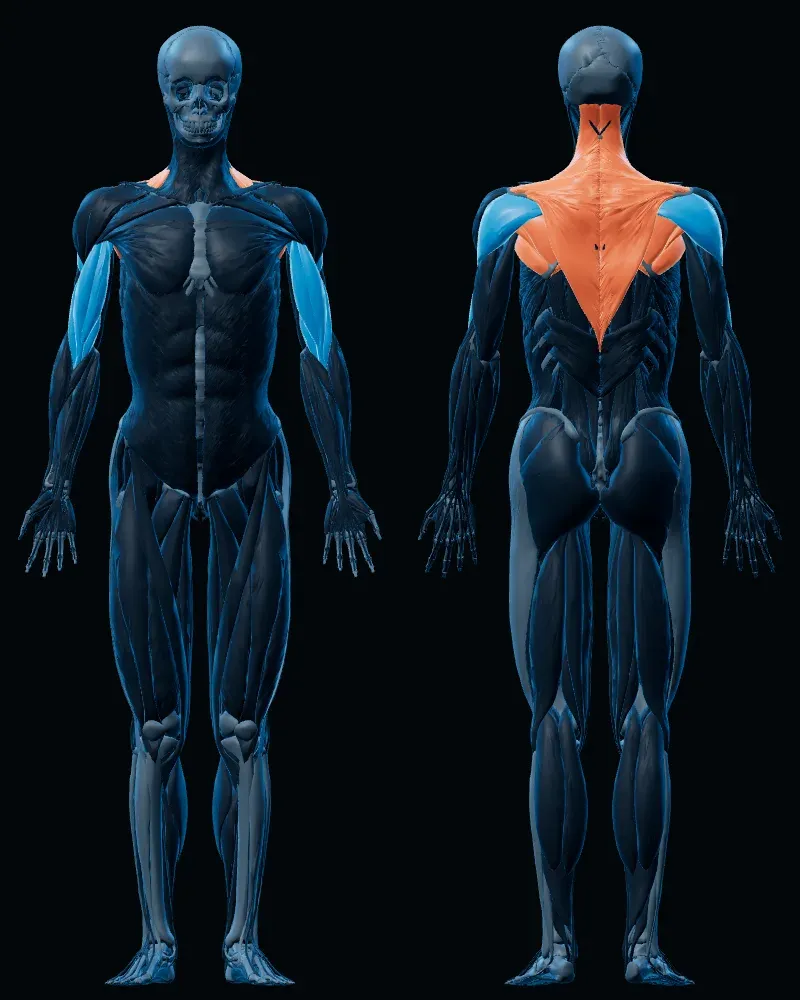
Muscles worked: upper back
Main movers: traps, rhomboids, teres major, infraspinatus and teres minor
Assisting: rear delts, biceps and brachialis
Table of contents
A wide grip does not build wider lats. When researchers compared grips from shoulder width to twice shoulder width, lat muscle activity came out similar, and the widest grip actually let people lift slightly less. This lat pulldown grip comparison covers wide, close neutral and underhand grips, so you can pick the one that fits your shoulders and stop swapping bars every week. It sits inside our complete back training guide.
Does wide grip build wider lats?
The gym belief is simple: wider hands, wider back. It sounds logical, but the evidence does not back it.
In a 2014 trial, 15 men did a 6-rep max pulldown with narrow, medium and wide pronated grips (1, 1.5 and 2 times the distance between the acromion bones on the shoulders). The 6RM was higher with narrow (80.3 kg) and medium grips (80 kg) than with the wide grip (77.3 kg). Lat, trapezius and infraspinatus EMG was similar across widths over the whole movement. The wide grip did show more lat activity in the lowering phase only, which is not enough to change the overall picture. The authors concluded that a grip of 1-2 times shoulder width should produce similar activation and, in turn, similar hypertrophy (Andersen et al., 2014).
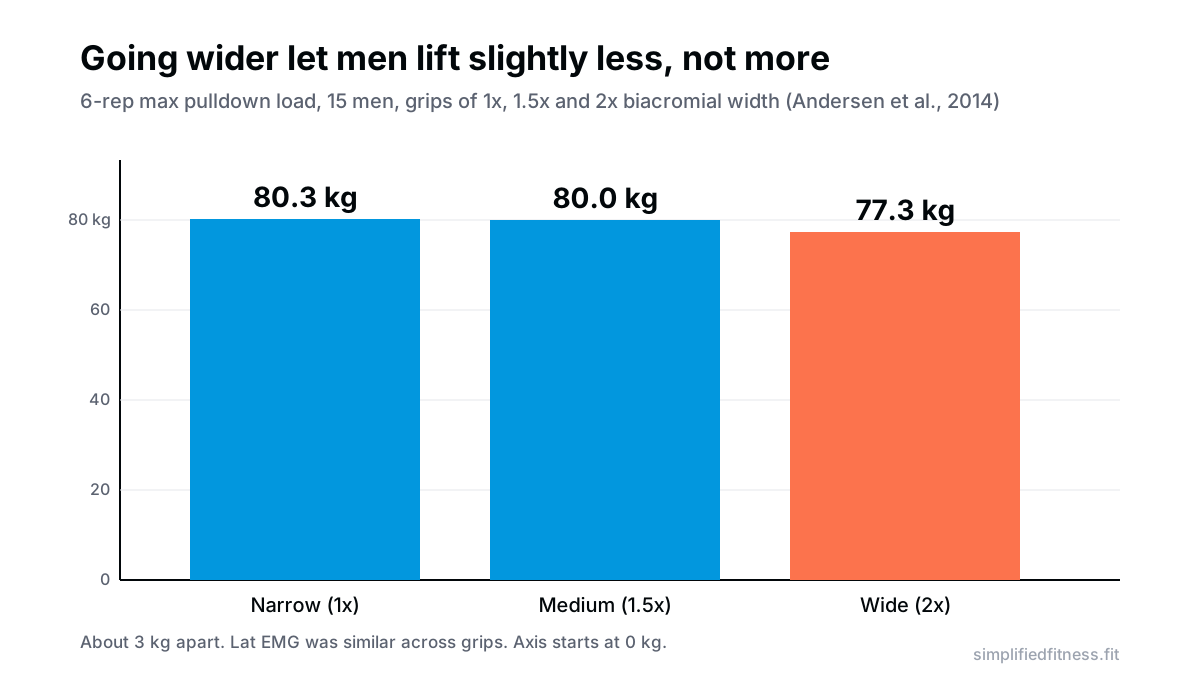
One caution. This was acute EMG in 15 men, not a months-long growth study. EMG tells you how much a muscle is switched on, not how much it will grow. Still, there is no trial showing a wide grip builds more lat muscle, and that is the claim the myth depends on.
Wide, neutral or underhand: what changes
The grip changes how your shoulder and elbow move, which shifts the work between the lats and the arms. Here is how the options compare in plain terms.
| Grip | What research shows | Practical read |
|---|---|---|
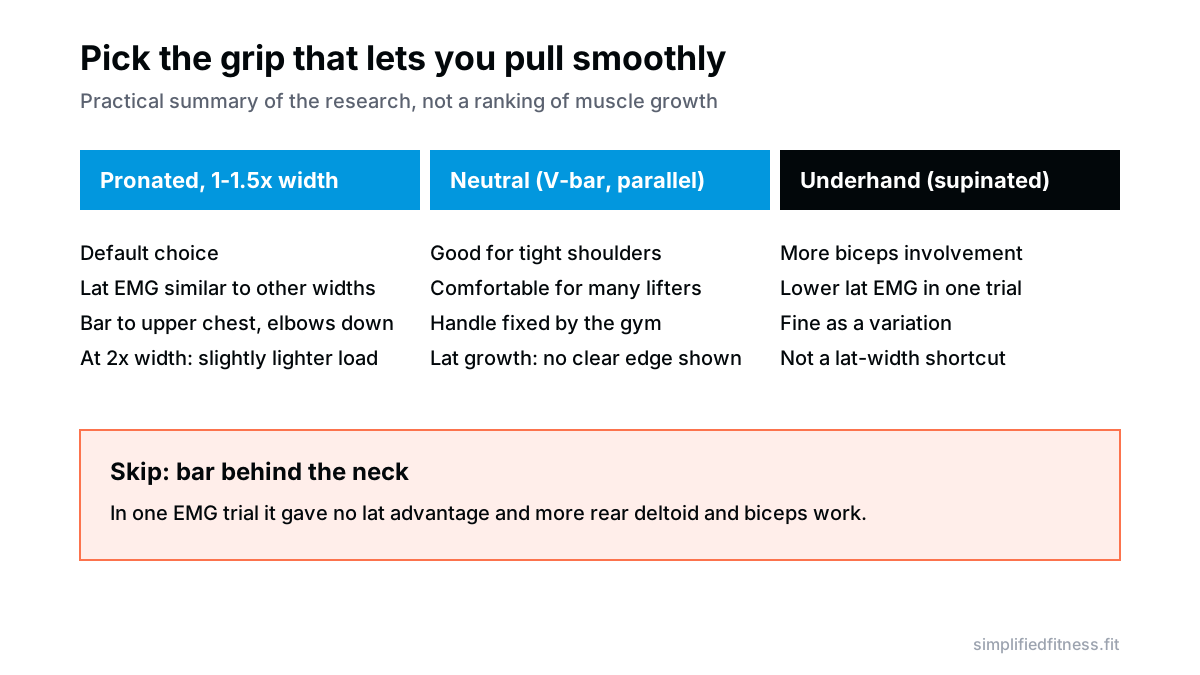
| Pronated, 1-1.5x shoulder width | Similar lat EMG across 1-2x widths (Andersen et al.) | Solid default |
| Very wide (2x and beyond) | Lower 6RM in one trial, no lat gain | No reason to go wider |
| Neutral (V-bar) | Lat EMG similar to front and behind-neck bars (Sperandei et al.) | Good if shoulders prefer it |
| Underhand (supinated) | Lower lat EMG than overhand in one trial (Lusk et al.) | Variation, more biceps feel |
| Behind the neck | No lat advantage, more rear delt and biceps | Skip it |
A 2026 narrative review of 23 EMG studies agrees in spirit. For the pulldown, an anterior bar path (in front of the body) was the setup most consistently tied to higher lat EMG, while the effect of grip width was inconsistent. The authors also note these are acute EMG findings, not long-term training outcomes (Di Fonza et al., 2026).
Neutral grip pulldown for lats
A neutral (palms facing each other) handle is popular because many lifters find it kinder on the shoulders and wrists. Is it worse for the lats? Probably not.
In a 2009 study of 24 trained men at 80% of 1RM, lat activity did not differ between a front bar, a behind-the-neck bar and a V-bar. What changed were the supporting muscles: the front bar raised pec activity, and the behind-the-neck bar raised rear deltoid and biceps activity (Sperandei et al., 2009).
So a neutral grip is a fair option for lats. The honest limit: direct comparisons of neutral grip against pronated grip over several weeks of training are lacking. If you find a close neutral handle lets you keep your elbows tucked and your chest up, it earns a place. If a plain bar feels fine, you are not missing anything.
Underhand and reverse grip pulldowns
Turning the palms toward you puts the elbow-flexing muscles in a stronger position, so most people feel more biceps. The question is whether it costs the lats anything.
In the 2010 study, 12 men did wide and narrow grips, each pronated and supinated, at 70% of 1RM. Overhand grips produced greater lat EMG than underhand grips (p < 0.05), and biceps activity did not differ with grip type. The authors recommended a pronated front pulldown for maximal lat activation regardless of width (Lusk et al., 2010).
Does that mean underhand is useless? No. Twelve men and one session is a small base, and many lifters can handle heavier loads underhand. Use it as a variation to change the stimulus, or if overhand pulls bother your wrists or elbows. Just do not choose it believing it adds lat width.
Why behind-the-neck pulldowns are not worth it
Behind-the-neck pulls are the one grip variation where the evidence points clearly away from the exercise. They also force your shoulder into a position many people cannot comfortably reach.
- The 2009 study concluded the front version is the better choice and that behind-the-neck pulls should be avoided, based on no lat difference and higher rear deltoid and biceps work (Sperandei et al., 2009).
- A 2024 high-density EMG study of 14 trained men found a mixed picture. The front version showed higher lat excitation in the descending phase (ES = 0.97), while the back version showed higher lat excitation in the ascending phase (ES = 0.63). The authors concluded the front version gives greater excitation in the prime movers overall (Padovan et al., 2024).
Why might these studies differ? They used different loads, different EMG methods and different ways of splitting the rep. Both samples were small groups of trained men. The practical takeaway is cautious: the behind-the-neck version offers no clear lat benefit and puts your shoulder in a harder position, so there is little reason to choose it.
Range of motion matters more than grip
If grip width does little, what does matter? Full, controlled range of motion is a better use of your attention. A 2021 meta-analysis of 16 studies found full range training produced greater strength gains (ES = 0.56) and lower-limb muscle growth (ES = 0.88) than partial range, with no clear difference in muscle architecture measures such as muscle thickness (Pallares et al., 2021). Most of that data is for leg exercises, so the back is an extrapolation. For more, read our guide on full vs partial range of motion for hypertrophy.
On a pulldown, full range means letting your arms reach up so you feel a stretch in the lats without your shoulders shrugging up to your ears, then pulling your elbows down until the bar reaches your upper chest.
Volume also counts. A 2017 meta-analysis found a graded dose-response: each extra weekly set was linked to a small increase in muscle gain (Schoenfeld et al., 2017). So a few extra well-performed sets beat endless hunting for the “perfect” grip.
Biceps involvement: how much is too much?
Every pulldown involves the biceps, because the elbow bends as the bar comes down. That is normal and not a sign you are doing it wrong. In the 2014 trial, biceps activity tended to be higher with the medium grip than the narrow one, and the authors saw the medium grip as having minor advantages overall (Andersen et al., 2014).
Where it becomes a problem is when your arms tire long before your back does. The most common mistake here is gripping the bar hard and curling it down with the hands. Loosen your grip, think of your hands as hooks, and picture the elbows moving down and in. If your biceps still cook first, drop the weight 10-20 percent and slow the lowering phase. Lat training also benefits from rowing patterns, so pair pulldowns with a row rather than doing three pulldown variations back to back.
Which grip should you choose? A simple decision
You do not need a perfect answer. Work through this order and stop at the first yes.
- Does an overhand grip at 1-1.5 times shoulder width feel smooth? Use it as your main pulldown.
- Do your shoulders or wrists complain? Move to a neutral V-bar and keep the same elbow path.
- Bored, or elbows irritated by overhand work? Add a set or two of underhand, treating it as a variation.
- Tempted by behind-the-neck or an ultra-wide grip? Skip both. The research shows no lat benefit, and the behind-the-neck position is harder on many shoulders.
Then rotate the handle every few weeks if you like variety, but keep your weekly hard sets and load progression steady. That is what drives growth, not the attachment. As a rough starting point, many lifters do well with 6-10 hard sets of back work for the lats per week, split between pulldown and row patterns, increasing only if recovery stays good. This number is a coaching starting point informed by the dose-response data, not a research-proven target.
How to set up a lat pulldown
Use this checklist with any of the grips above.
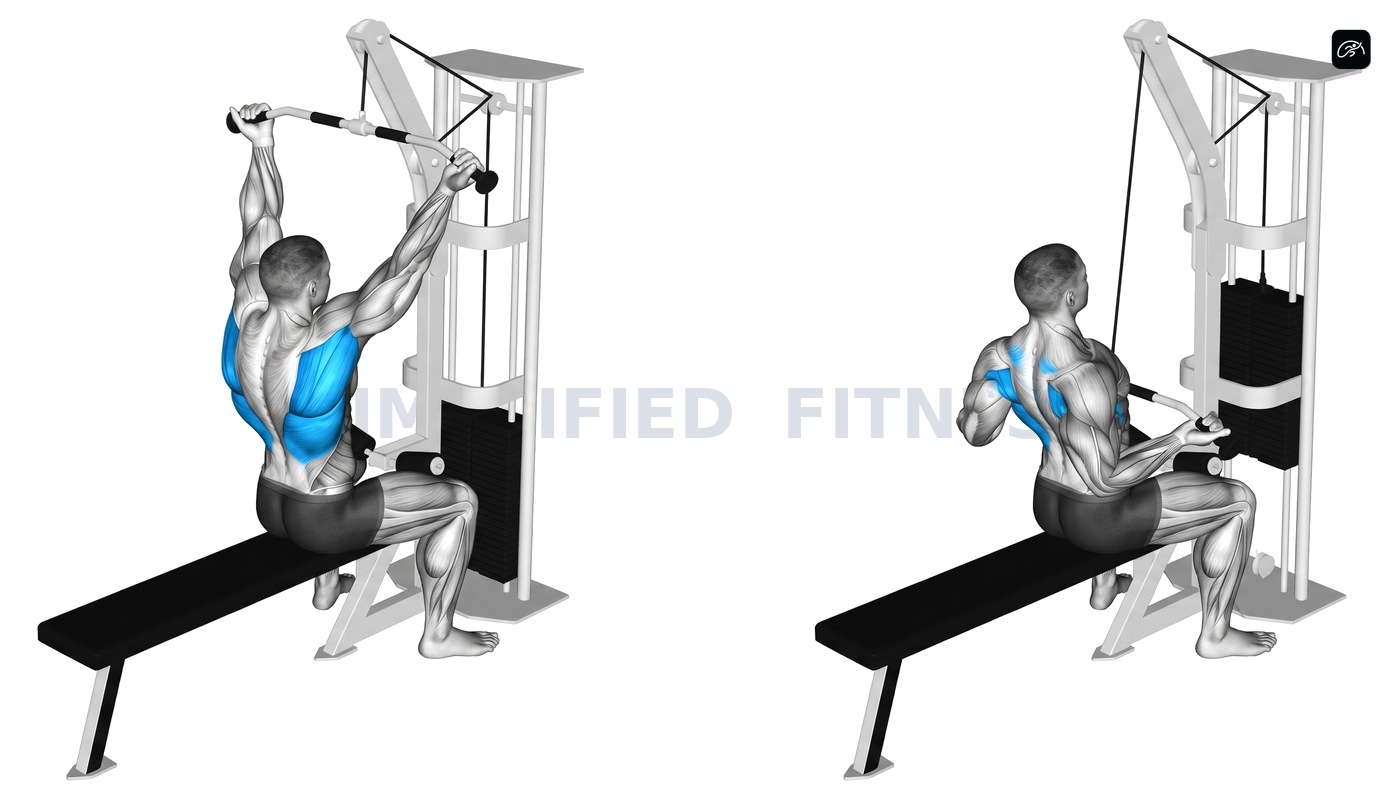
- Adjust the thigh pad so your legs are locked in without cramping.
- Take an overhand grip around 1-1.5 times shoulder width, or a neutral handle.
- Sit tall, lean back slightly, and keep your chest up.
- Start the pull by driving your elbows down and slightly forward, as if putting them into your back pockets.
- Bring the bar to your upper chest, then control it back up until your arms are fully extended.
The elbow path matters more than the hand width. We cover that in lats vs upper back: arm path and elbow flare, and the feel of the contraction in lat flare and mind-muscle connection.
Indian gym tips: using what your gym has
Many gyms in India have a basic straight bar, a V-bar and maybe a short underhand handle. That is enough. Use the straight bar at a comfortable width for most sets and swap to the V-bar when your shoulders feel cranky. If your gym is crowded, a quick swap between those two is more useful than waiting for a specific bar.
If you cannot do a strict pull-up yet, the pulldown is a fair stepping stone, and we compare the bodyweight versions in pull-ups vs chin-ups. For rowing variations that pair well with pulldowns, see seated cable row attachments.
Shoulder comfort and when to see a doctor
Some lifters feel pinching at the top of the shoulder on wide or behind-the-neck pulls. I cannot tell you what is causing yours, and no article can. Narrowing the grip, pulling to the upper chest and stopping at a pain-free stretch often helps, and our guide on lifting with subacromial shoulder impingement goes further.
See a doctor or physiotherapist if you have pain at night, pain that radiates down the arm, numbness or tingling, a sudden loss of strength, or pain that does not settle within a couple of weeks.
The bottom line
Choose a pronated grip around 1-1.5 times shoulder width as your default, and use a neutral handle or underhand grip as variations when they feel better. Skip the bar behind your neck. Stay in a full range, add sets gradually and track your load. Put it into practice with our pull day workout.
Frequently Asked Questions
Does a wide grip lat pulldown build wider lats?
There is no good evidence that it does. In a 2014 trial of 15 men, lat activation was similar across grips from 1 to 2 times shoulder width, and the widest grip allowed less load. Pick a grip near 1-1.5 times shoulder width and focus on pulling your elbows down through a full range.
What is the best grip width for lat pulldowns?
A grip about 1-1.5 times shoulder width is a sensible default. Researchers concluded that anything from 1 to 2 times biacromial distance produced similar activation, with a medium grip having minor advantages. Try the width where your forearms stay roughly vertical at the bottom.
Wide grip vs close grip lat pulldown: which is better?
Neither is clearly better for the lats. Close and medium grips let men lift about 3 kg more in a 6RM test than a very wide grip, and lat EMG across the whole rep was similar. Rotate both if you like, and track total sets and load rather than the grip.
Is a neutral grip pulldown good for lats?
Yes, it is a reasonable option, though the evidence for it is thinner than for pronated grips. One EMG trial of trained men found the V-bar produced similar lat activity to front and behind-neck bars. If it feels better on your shoulders and you can load it progressively, use it.
Do underhand pulldowns work lats or biceps more?
They bring in more elbow flexor work, so biceps usually feel it more. In a 2010 study of 12 men, an overhand grip produced greater lat EMG than an underhand grip at both widths, while biceps activity did not differ. Use underhand as a variation if you like it, but do not expect it to replace overhand pulldowns.
Are behind the neck lat pulldowns bad?
They are not a good use of your shoulders. In a 2009 EMG study of 24 trained men, behind-the-neck pulls gave no lat advantage over front pulls and raised rear deltoid and biceps activity. Pull the bar to your upper chest instead, a position most people find easier on the shoulder.
Where should the bar touch on a lat pulldown?
Aim for the upper chest, with your torso leaning back slightly. A 2026 narrative review found a bar path in front of the body was the setup most consistently linked to higher lat EMG. Stop when your elbows are by your sides rather than yanking the bar lower.
Should I lean back on lat pulldowns?
A small lean, around 10-20 degrees, is common and lets the bar clear your face. Leaning far back turns the movement into a row and shifts load away from the lats, though research on exact angles is limited. Keep the lean consistent and let your arms and lats do the work.
Does grip width change how heavy I can pull?
A little. In one trial, 6RM loads were about 80 kg with narrow and medium grips and 77 kg with a wide grip. That is a small difference, but over months it can affect your progressive overload. Use the grip that lets you load the lats hard with clean reps.
Do pulldowns work the same muscles as pull-ups?
Largely, yes, since both involve pulling the arms down toward the body. Pull-up grip variations show broadly similar lat activation in a recent review, and pulldowns let you control the load more precisely. Use pulldowns if you cannot yet do strict pull-ups, and see our pull-ups vs chin-ups guide for the bodyweight version.
How many sets of lat pulldowns do I need per week?
Total weekly sets matter more than which grip you use. A meta-analysis found each added weekly set was linked to a small extra gain in muscle size. Start with roughly 6-10 hard sets for lats across the week, split between pulldown and row variations, and add sets only if you recover well.
Why do I feel pulldowns in my biceps and not my lats?
Usually because you are pulling with the hands and bending the elbows first. Biceps help in every pulldown, and a tendency for more biceps activity showed up with medium grips in one trial. Think about driving the elbows down toward your hip pockets and lower the load until you feel the lats working.
My shoulder pinches on wide-grip pulldowns. What should I do?
Narrow the grip a little, pull to the upper chest and avoid stopping with the bar behind your head. Shoulder pinching can have many causes, so I cannot diagnose it. If pain persists or travels down the arm, see a doctor or physiotherapist.
Sources & References
Every claim above is checked against peer-reviewed research (PubMed, U.S. National Library of Medicine) or guidance from established health bodies. How we fact-check.
- Andersen V, et al. Effects of grip width on muscle strength and activation in the lat pull-down. J Strength Cond Res. 2014. PMID: 24662157
- Lusk SJ, et al. Grip width and forearm orientation effects on muscle activity during the lat pull-down. J Strength Cond Res. 2010. PMID: 20543740
- Sperandei S, et al. Electromyographic analysis of three different types of lat pull-down. J Strength Cond Res. 2009. PMID: 19855327
- Padovan R, et al. High-Density Electromyography Excitation in Front vs. Back Lat Pull-Down Prime Movers. J Hum Kinet. 2024. PMID: 38689585
- Di Fonza D, et al. Electromyographic Analysis of Latissimus Dorsi Activation During Common Resistance Training Exercises: A Narrative Review. J Funct Morphol Kinesiol. 2026. PMID: 42647355
- Pallares JG, et al. Effects of range of motion on resistance training adaptations: A systematic review and meta-analysis. Scand J Med Sci Sports. 2021. PMID: 34170576
- Schoenfeld BJ, et al. Dose-response relationship between weekly resistance training volume and increases in muscle mass: A systematic review and meta-analysis. J Sports Sci. 2017. PMID: 27433992

Umair Hazrami · Founder & Head Coach, Simplified Fitness
Umair Hazrami founded Simplified Fitness and the Simplified Lifter channel to cut through fitness noise. With 4+ years of consistent training and 10+ coaching clients, he writes every guide from the peer-reviewed research and links the sources so you can check them. Our editorial standards.
Educational content only, not medical advice. If you have a medical condition, are pregnant, or take medication, talk to a qualified doctor before changing your diet, supplements or training. Full disclaimer.
Keep reading
Exercise Technique
Barbell Bent-Over Rows: Spinal Load, Hamstring Fatigue and Lat Growth
Is the barbell bent over row hypertrophy gold or a fatigue generator? See what the research says about spinal load, torso angles and better rows for lat growth.
8 min read
Exercise Technique
Chest-Supported Rows: Train Your Upper Back Without Lower Back Fatigue
Chest supported row hypertrophy explained: why your lower back quits first, how T-bar, incline and seal rows fix it, and what the research says.
8 min read
Exercise Technique
Complete Back Workout Design: Balancing Vertical Pulls, Horizontal Rows, and Lumbar Recovery
A science-based back workout routine: weekly sets, how to balance pulldowns and rows, and how to protect your lower back, with a sample pull day plan.
9 min read

Exercise Technique
Conventional Deadlifts for Back Hypertrophy: Stimulus-to-Fatigue Ratio Analysis
Are deadlifts good for back hypertrophy? A stimulus-to-fatigue breakdown of what they build, what they miss for lats, and how to program or replace them.
8 min read