T-Bar Rows: Chest-Supported vs Free-Standing, and What Each Does to Your Lower Back
T-bar row chest supported vs standing: what changes for your lower back and upper back, plus handle, foot and plate setup. Pick the right version for your goal.
TL;DR. The short answer
- Chest-supported T-bar rows take most of the lower back's holding job away, so the set ends when your upper back is tired, not when your spine is. For pure back size that is usually the better default.
- Free-standing T-bar rows use the same lever but make you hold a hinge. Research on a similar standing row found it produced the largest lumbar spine load of three rowing exercises tested.
- No study has directly compared T-bar variations for muscle growth. Machines and free weights have produced similar hypertrophy in direct comparisons, so choose the one you can load progressively and repeat pain-free.
- Handle width, foot position and plate size are small levers. Neutral handles, a stable stance and a full stretch at the bottom matter more than any exact number.
- Back pain that lingers, travels down a leg or comes with numbness needs a clinician, not a better row variation.
Part of our complete guide: Complete Back Training Guide: Lats vs Upper Back, Best Exercises and a Hypertrophy Workout
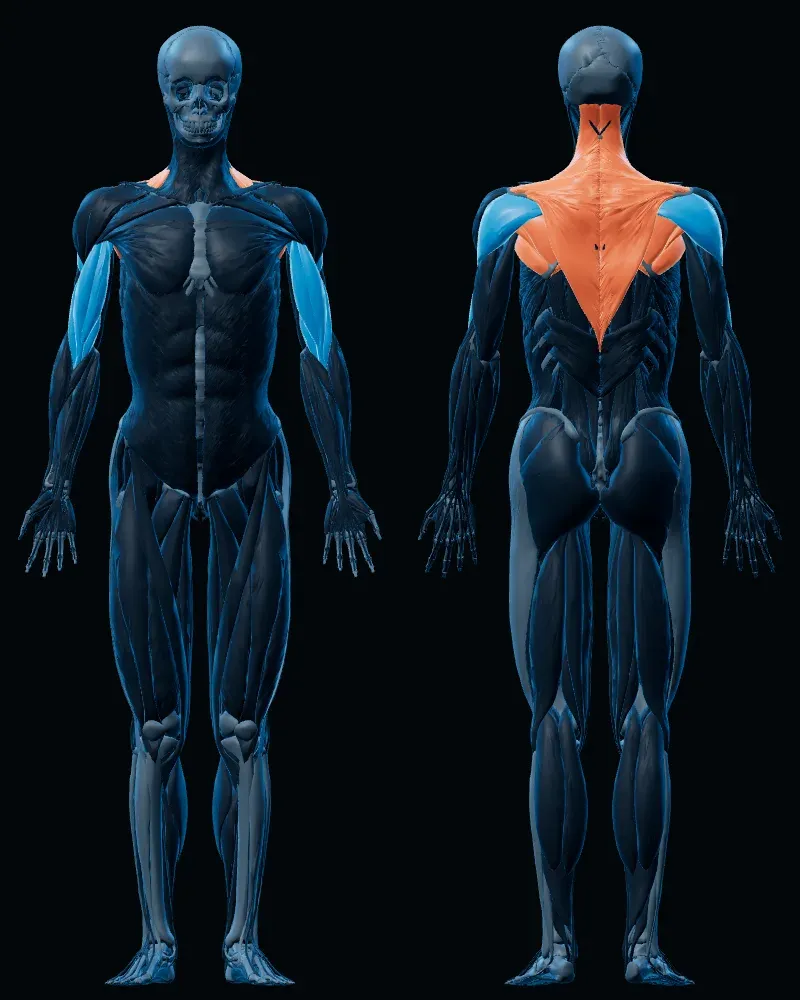
Muscles worked: upper back
Main movers: traps, rhomboids, teres major, infraspinatus and teres minor
Assisting: rear delts, biceps and brachialis
Table of contents
For most lifters chasing a thicker back, the chest-supported T-bar row is the easier version to push hard, because the pad takes over the job your lower back would otherwise do. The free-standing version uses the same lever but asks your spine to hold a hinge while you pull. In the t bar row chest supported vs standing debate, that is the real difference. It is a trade between how hard your upper back can work and how much your lower back has to pay for it. (This article sits inside our complete back training guide, which covers the full picture.)
One honest caveat first. I could not find a study that measured T-bar rows directly for spinal load or muscle growth. What we have is research on similar rows, plus basic lever mechanics. I will tell you which is which as we go.
What is the actual difference between standing and chest-supported?
Both setups use the same angled bar with a loaded end. Your hands grab a handle near the other end and you row it toward your torso.
Free-standing: you hinge forward, hold that position with your lower back, hamstrings and glutes, and row. Your torso is a lever that your spine has to keep still. The heavier the bar, the harder that holding job gets.
Chest-supported: you lean your upper chest onto a pad. Your torso is held up by the pad instead of your muscles. Your hands still do the same pull, but the stabilising work moves off your back extensors.
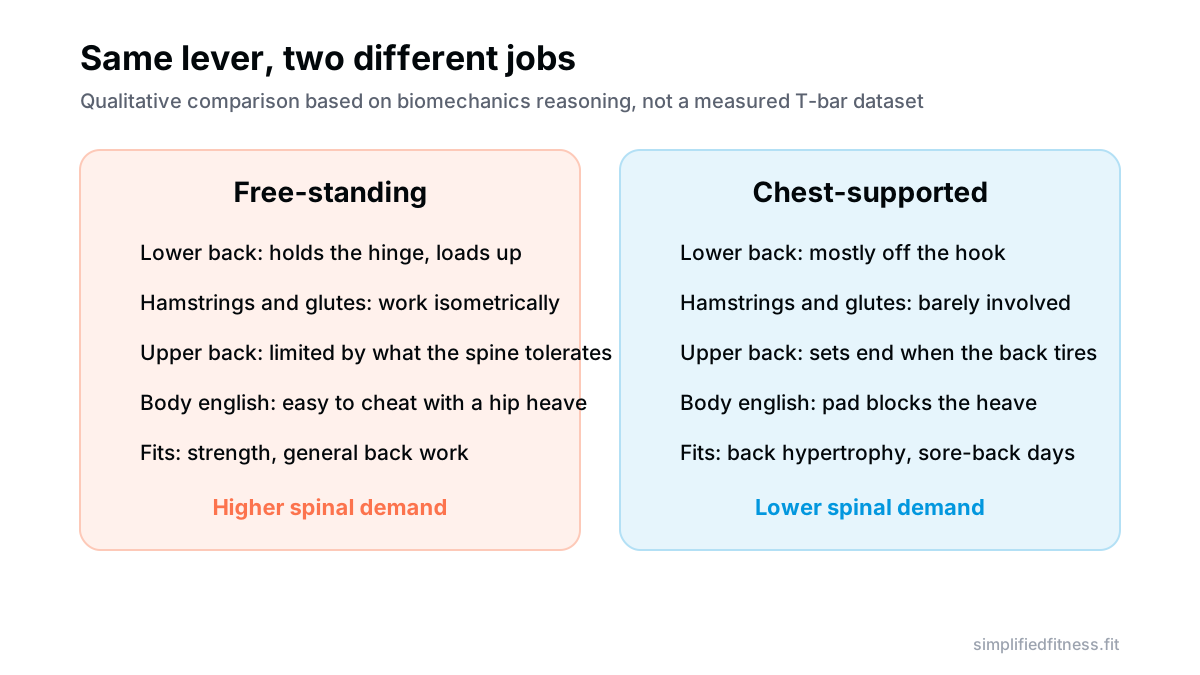
That is the whole idea. Everything else, handles, feet and plates, is fine-tuning around it.
Does the standing T-bar row load the lower back more?
Almost certainly yes, though the best evidence is indirect.
Fenwick and colleagues compared three rows in seven healthy male university students: an inverted row, a standing bent-over row and a standing one-arm cable row. The standing bent-over row produced large activation across the whole back, but it also produced the largest lumbar spine load of the three. The inverted row, where you hang under a bar with your body held straight rather than hinged, had lower lumbar erector activation and the lowest spine load (Fenwick et al., 2009).
Read that carefully. It was seven young, healthy men, surface electrodes and a bent-over barbell-style row, not a T-bar. It does not tell us exactly how many newtons your spine sees on a T-bar.
But the logic transfers well enough to be useful. Anything that makes you hold a bent hinge under load asks your lower back to resist the weight. Anything that supports your torso takes that demand away. The authors themselves frame the choice as a trade: some exercises give modest muscle activation with low spine load, others give higher activation with larger spine load.
Does chest support build more back muscle?
Nobody has tested that head to head, so be wary of anyone who says it does.
What we can say is narrower. Lehman and colleagues measured isometric muscle activity in several lat exercises and found that a seated row, where the torso is upright rather than hinged, produced the highest middle trapezius and rhomboid activity of the four tasks, and the best latissimus-to-biceps activation ratio along with the wide-grip pulldown. Their conclusion was that exercise variations produce only small changes in the primary movers (Lehman et al., 2004). That was a small isometric study, so treat it as a hint, not a ruling.
A second angle is machines versus free weights. A 2023 systematic review and meta-analysis of 13 studies (1,016 participants in total, but only 5 studies measured hypertrophy) found no difference in hypertrophy between free-weight and machine-based training in direct comparison, and concluded the choice comes down to individual preference and goals (Haugen et al., 2023). That reviewed training generally, not T-bar rows. Still, it argues against the idea that the “harder” free-standing version automatically grows more.
So why do I still lean chest-supported for size? One practical reason. When your lower back is not the weak link, you can take your upper back much closer to its limit. If you want more on that logic, see chest-supported rows for upper back hypertrophy.
Why does my lower back hurt on T-bar rows?
A common mistake is letting the torso rise and the hips shoot back as the set gets hard. Your body is trying to turn a row into a deadlift-style pull because it recruits stronger muscles. The pull gets heavier, the back works more as a stabiliser, and the stretch at the bottom disappears.
Common triggers on the free-standing version:
- Too heavy for the hinge you can hold. The bar moves, your torso moves with it.
- Rounding to reach the floor. Chasing a deeper stretch with a flexing spine is not the same as stretching your lats.
- Not enough rest. A tired back is a worse brace.
- Long sets of high-rep rows on an already-sore back.
If your pain is a dull, muscular tightness that settles within a day or two, adjusting the setup is reasonable. If it is sharp, keeps getting worse, travels down a leg, or comes with numbness or weakness, stop and see a doctor or physiotherapist. A row variation will not fix those.
For context, exercise is not the enemy of a sore back. A Cochrane review of 249 trials found moderate-certainty evidence that exercise reduces pain in chronic non-specific low back pain compared with no treatment, usual care or placebo, and the harms reported were mostly minor, such as muscle soreness (Hayden et al., 2021). Separately, a meta-analysis of 8 trials found that 12-16 weeks of posterior-chain resistance training gave greater improvements in disability and strength than general exercise in people with chronic low back pain, with a pain benefit that only just reached statistical significance (Tataryn et al., 2021). The takeaway is not “never train your back through pain”. It is that sensible, graded loading is usually part of the answer, and a clinician can tell you what suits you.
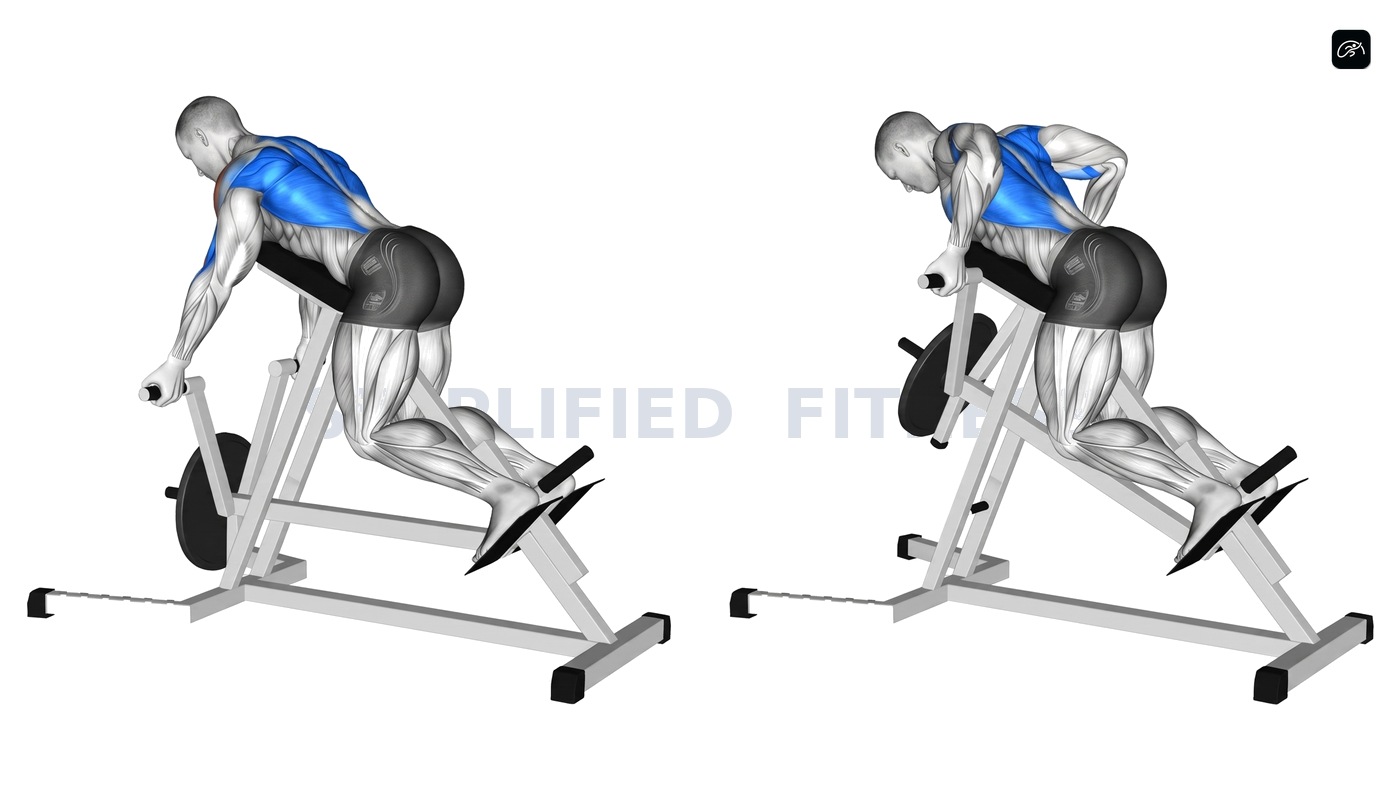
How should I set up a chest-supported T-bar row?
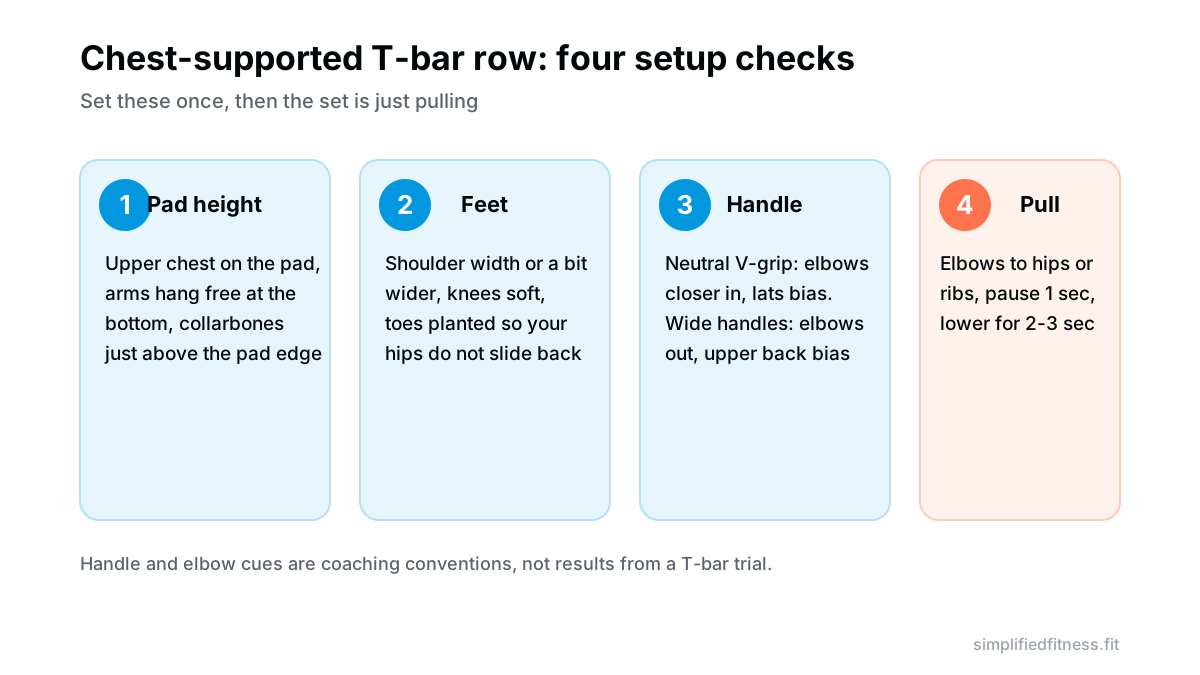
Pad height. Aim for your upper chest on the pad with your arms able to hang straight at the bottom. If the pad sits too high, your shoulders jam and your range shrinks. Too low and your ribs end up bearing the load.
Feet. Shoulder width or slightly wider, knees soft. A wide base keeps your hips still. If your hamstrings start doing the work, you are drifting back.
Handles. On grip width, the honest answer is that nobody has shown one width to be superior for growth. A close neutral V-grip keeps elbows nearer your body and tends to feel lat-dominant. Wider handles flare the elbows and feel more upper-back-dominant. These are coaching conventions, not trial results, so rotate them across a training block and pay attention to which one you feel and can load.
The pull. Drive your elbows toward your hips or ribs rather than yanking with your hands. Pause for a second at the top without shrugging. Lower for two to three seconds and let your shoulder blades spread at the bottom before you pull again.
What about plate size and range of motion?
A fair question for any T-bar. Smaller-diameter plates let the loaded end sit lower, so the bar can travel further down and give you a deeper stretch at the bottom. Larger 20 kg plates put the bar higher off the floor and can cut your range. This is mechanical common sense, not a measured T-bar finding.
Should you chase a deeper stretch? The evidence is less dramatic than gym lore. A 2025 Bayesian meta-analysis of 12 studies in young adults found trivial differences in regional hypertrophy between training at longer and shorter muscle lengths, and the authors urged caution because the length differences between conditions were small (Varovic et al., 2025). Translation: a good range of motion is sensible, but do not sacrifice a neutral spine or a controlled rep to squeeze out an extra few centimetres. For the longer argument, see long muscle length training for hypertrophy.
How do I execute a free-standing T-bar row more safely?
If you love the standing version, you can run it more conservatively.
- Hinge, then brace. Push your hips back, keep your ribs stacked over your pelvis and take a breath into your belly before you pull.
- Hold a fixed torso angle. Pick an angle you can repeat on every rep. If it climbs mid-set, end the set.
- Pick a handle that lets you stay tall. A neutral grip often feels easier on the shoulders than a barbell overhand grip.
- Keep reps controlled. Slow lowering reduces the temptation to heave.
- Leave a rep or two in the tank. Free-standing sets taken to absolute failure are where form usually leaks.
Comparing it with the barbell version? Our piece on barbell bent-over rows and spinal load goes deeper on the hinge. If you want an angled barbell without a machine, Meadows rows and landmine setups are the closest cousins.
Comparison: free-standing vs chest-supported
| Factor | Free-standing | Chest-supported |
|---|---|---|
| Lower back demand | Higher, holds the hinge | Lower, torso is supported |
| What ends the set | Often the spine or hinge | More often the upper back |
| Cheating risk | Higher (hip heave) | Lower |
| Equipment | Landmine or T-bar station | Pad-supported machine or bench |
| Best for | Strength and general pulling | Back size, sore-back days |
| Evidence base | Indirect, from standing rows | Indirect, from supported rows |
Which version should you pick?
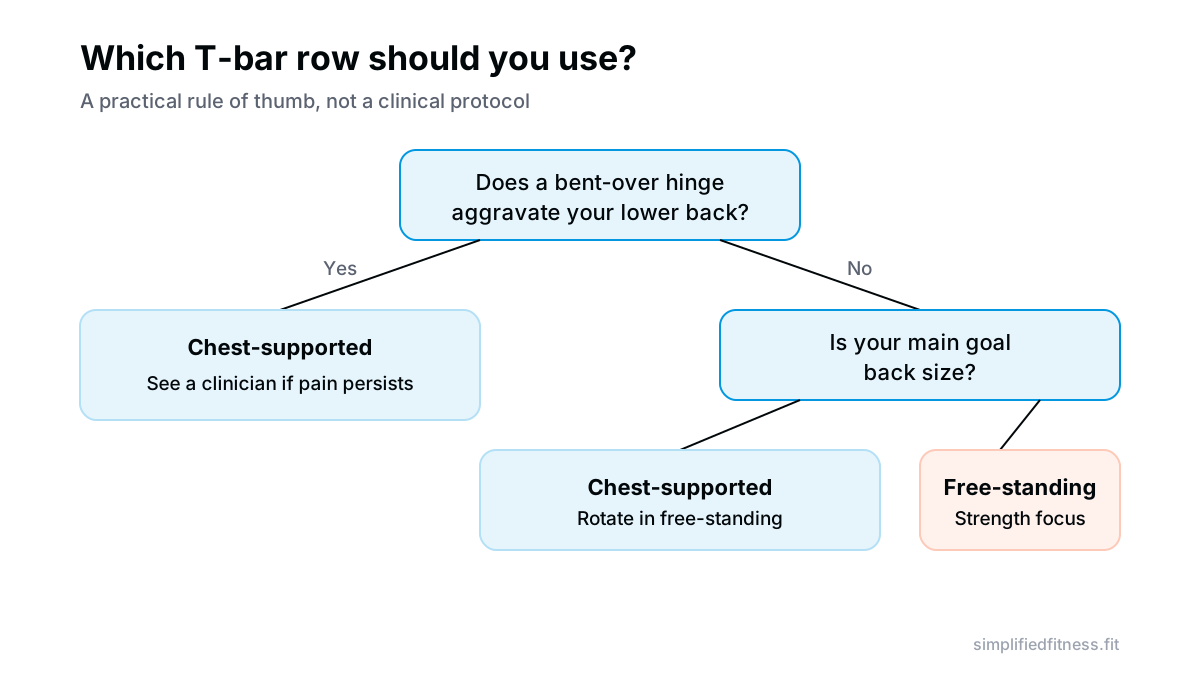
My default for most people: chest-supported for the bulk of your sets, free-standing as an occasional variation if your back handles it well. That is a coaching preference, not a research result. Machines and free weights have produced similar hypertrophy in direct comparisons (Haugen et al., 2023), so the best row is the one you can progress for months without flaring up.
In a budget setting, many Indian gyms do not have a pad-supported T-bar. A landmine-style bar in a corner, or a chest-supported row machine, gets you most of the way. Do not buy equipment for this. Use what is there.
For where this fits in a session, see our pull day plan, and for the rest of the back, spinal erector training explains how to build the lower back deliberately rather than by accident through rows.
How to program T-bar rows
- Sets: 2 to 4 hard sets per session, once or twice a week, as one of two or three back movements.
- Reps: 6 to 12 for most people, finishing each set one to two reps before failure.
- Progression: add a rep or a small amount of load each week, and only count reps with full control.
- Pairing: pair it with a vertical pull such as lat pulldowns, so both the mid back and the lats get direct work.
If you are unsure how to tune volume, our training volume calculator is a quick way to sanity-check your weekly sets.
When should you see a doctor?
Pain after rowing that settles in a day or two with rest is common. See a doctor or physiotherapist if you have:
- Pain that keeps getting worse over days or weeks.
- Pain or numbness that travels into a buttock or leg.
- Weakness in a leg or foot.
- Pain at night that wakes you up and does not ease with position changes.
- Any back pain after a significant injury.
This article cannot diagnose anything. It only helps you choose a gym variation.
Frequently Asked Questions
Are chest-supported T-bar rows better than standing T-bar rows?
For building back muscle, chest-supported rows are usually the more practical choice, but no study has directly proven they grow more muscle. The pad removes most of the lower back's job, so the set ends when your upper back fatigues. Use chest-supported as your default and keep free-standing for when you want a heavier, whole-body pulling variation.
Do T-bar rows hurt your lower back?
They can if the free-standing version is loaded beyond what your hinge and spine tolerate. A lab study on a standing bent-over row found it produced the largest lumbar load among the rows tested, which is why the standing version is the likelier culprit. If you feel strain in your lower back, switch to a chest-supported setup and see a clinician if it persists.
Is the chest-supported T-bar row a good exercise for back thickness?
Yes, it is a sensible way to train the mid and upper back with heavy loading. It supports your torso so effort goes to the muscles doing the pull. Progress it with more reps or weight over time and keep your reps controlled.
What is the best handle for a T-bar row?
There is no research-proven best handle, so choose by comfort and by where you want the focus. A neutral, close V-grip keeps elbows nearer the body and suits most people's shoulders. Wide handles flare the elbows and feel more upper-back dominant, so try both and keep the one you can load consistently.
Should I use 10 kg plates or 20 kg plates on a T-bar row?
Smaller plates let the bar travel further toward the floor, which can give a longer stretch at the bottom if your setup allows it. Plate diameter has not been tested specifically in T-bar studies, so treat it as a practical cue. Use plates that let you reach a full stretch without your lower back rounding to get there.
Are T-bar rows better than barbell rows?
They are different tools rather than one clearly beating the other. A T-bar row lets you use a neutral grip and often a more stable path, and the chest-supported version takes the hinge out entirely. A free-standing T-bar and a barbell row both make you hold a bent-over position, and no study has compared their spinal load directly. If your back tolerates it, you can use both; if not, the chest-supported T-bar is the easier one to repeat.
Do machine T-bar rows build as much muscle as free weights?
In a 2023 meta-analysis of directly compared studies, free-weight and machine training produced similar hypertrophy. That review did not look at T-bar rows specifically, so the match is indirect. Pick whichever version lets you train hard and add load week after week.
How far should I lean on a free-standing T-bar row?
Many coaches suggest a hip hinge with the torso somewhere between 30 and 45 degrees above horizontal, but there is no research-backed number. The right angle is the one where your back stays neutral and you can finish every rep. A more horizontal torso increases the demand on your lower back. If your torso keeps rising as the set goes on, the weight is too heavy.
Where should my feet go on a T-bar row?
Shoulder width or slightly wider usually feels most stable, with soft knees. A stable base keeps your hips from shooting back as you pull. If the platform has a foot position that feels awkward, adjust until you can feel the pull in your back, not your hamstrings.
Does exercise help or hurt low back pain?
For chronic non-specific low back pain, a large Cochrane review found moderate-certainty evidence that exercise reduces pain compared with no treatment or usual care. Mostly minor harms such as muscle soreness were reported. Talk to a doctor or physiotherapist about which movements suit your situation.
Can I do T-bar rows with a landmine setup at home?
Yes, a barbell wedged in a corner or a landmine attachment gives you a similar angled lever. It is usually a free-standing version, so the same lower back considerations apply. Brace your torso and use a stable stance, and keep the load moderate until the movement feels smooth.
How many sets of T-bar rows should I do?
Two to four hard sets, once or twice a week, is a sensible starting range for most lifters as part of overall back volume. Chasing numbers matters less than taking sets close to failure with good form. Add a set only when you are recovering well and progressing.
Sources & References
Every claim above is checked against peer-reviewed research (PubMed, U.S. National Library of Medicine) or guidance from established health bodies. How we fact-check.
- Fenwick CM, et al. Comparison of different rowing exercises: trunk muscle activation and lumbar spine motion, load, and stiffness. J Strength Cond Res. 2009. PMID: 19620925
- Lehman GJ, et al. Variations in muscle activation levels during traditional latissimus dorsi weight training exercises: an experimental study. Dyn Med. 2004. PMID: 15228624
- Haugen ME, et al. Effect of free-weight vs. machine-based strength training on maximal strength, hypertrophy and jump performance: a systematic review and meta-analysis. BMC Sports Sci Med Rehabil. 2023. PMID: 37582807
- Hayden JA, et al. Exercise therapy for chronic low back pain. Cochrane Database Syst Rev. 2021. PMID: 34580864
- Tataryn N, et al. Posterior-chain resistance training compared to general exercise and walking programmes for the treatment of chronic low back pain in the general population: a systematic review and meta-analysis. Sports Med Open. 2021. PMID: 33683497
- Varovic D, et al. Does muscle length influence regional hypertrophy? A systematic review and meta-analysis. Int J Sports Med. 2025. PMID: 40570881

Umair Hazrami · Founder & Head Coach, Simplified Fitness
Umair Hazrami founded Simplified Fitness and the Simplified Lifter channel to cut through fitness noise. With 4+ years of consistent training and 10+ coaching clients, he writes every guide from the peer-reviewed research and links the sources so you can check them. Our editorial standards.
Educational content only, not medical advice. If you have a medical condition, are pregnant, or take medication, talk to a qualified doctor before changing your diet, supplements or training. Full disclaimer.
Keep reading
Exercise Technique
Barbell Bent-Over Rows: Spinal Load, Hamstring Fatigue and Lat Growth
Is the barbell bent over row hypertrophy gold or a fatigue generator? See what the research says about spinal load, torso angles and better rows for lat growth.
8 min read
Exercise Technique
Chest-Supported Rows: Train Your Upper Back Without Lower Back Fatigue
Chest supported row hypertrophy explained: why your lower back quits first, how T-bar, incline and seal rows fix it, and what the research says.
8 min read
Exercise Technique
Complete Back Workout Design: Balancing Vertical Pulls, Horizontal Rows, and Lumbar Recovery
A science-based back workout routine: weekly sets, how to balance pulldowns and rows, and how to protect your lower back, with a sample pull day plan.
9 min read

Exercise Technique
Conventional Deadlifts for Back Hypertrophy: Stimulus-to-Fatigue Ratio Analysis
Are deadlifts good for back hypertrophy? A stimulus-to-fatigue breakdown of what they build, what they miss for lats, and how to program or replace them.
8 min read