Arm Workout Science: The Complete Guide to Biceps, Triceps, Brachialis and Forearm Growth
Arm workout science without the bro myths: what MRI studies show about biceps peaks, triceps long head work, brachialis, forearms and grip. Every study linked.
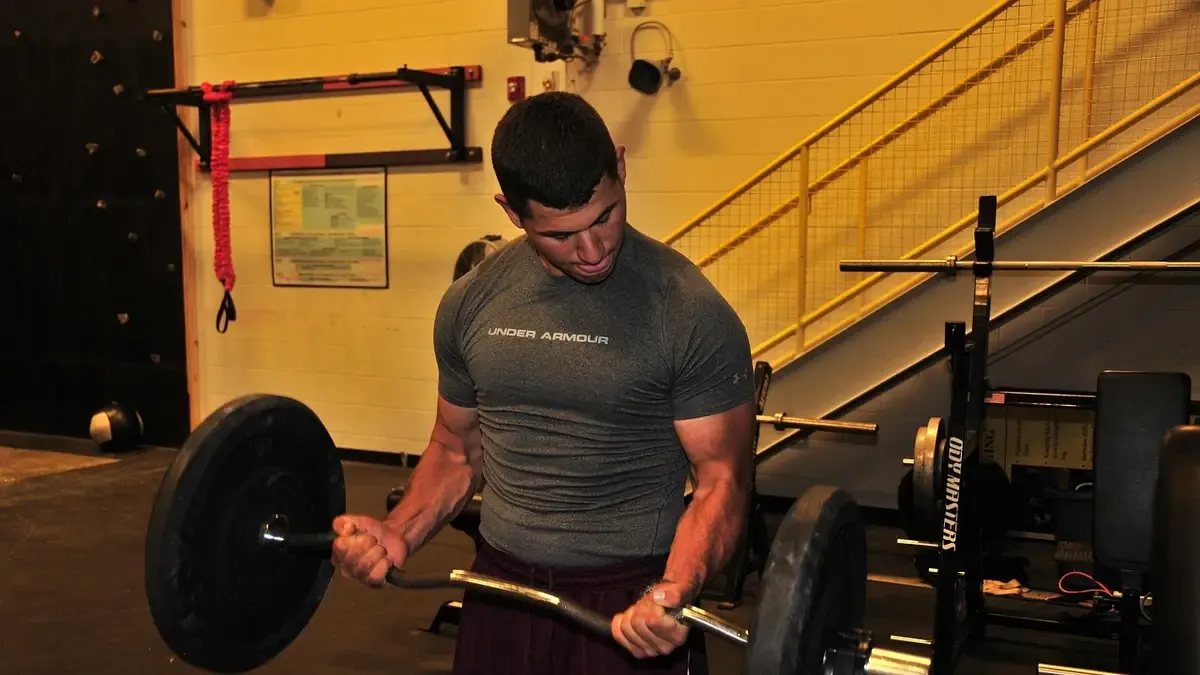
TL;DR. The short answer
- You cannot isolate one biceps head or build a 'peak'. Both heads pull on one shared tendon, and peak shape is mostly anatomy you were born with.
- Shoulder angle matters most for the triceps: in a 12-week MRI study, overhead cable extensions grew the triceps long head about 1.5 times more than pushdowns.
- For the biceps, shoulder angle matters less than gym lore claims. Incline and preacher curls shifted growth between elbow flexor muscles but produced similar total growth.
- Compounds do train your arms, but the evidence on whether they are enough is mixed. A few direct sets, especially an overhead triceps extension, are cheap insurance.
- Grip strength is linked with lower risk of death in large cohort studies, but that is an association. Heavy pulls, carries and hangs are the simplest way to train it.
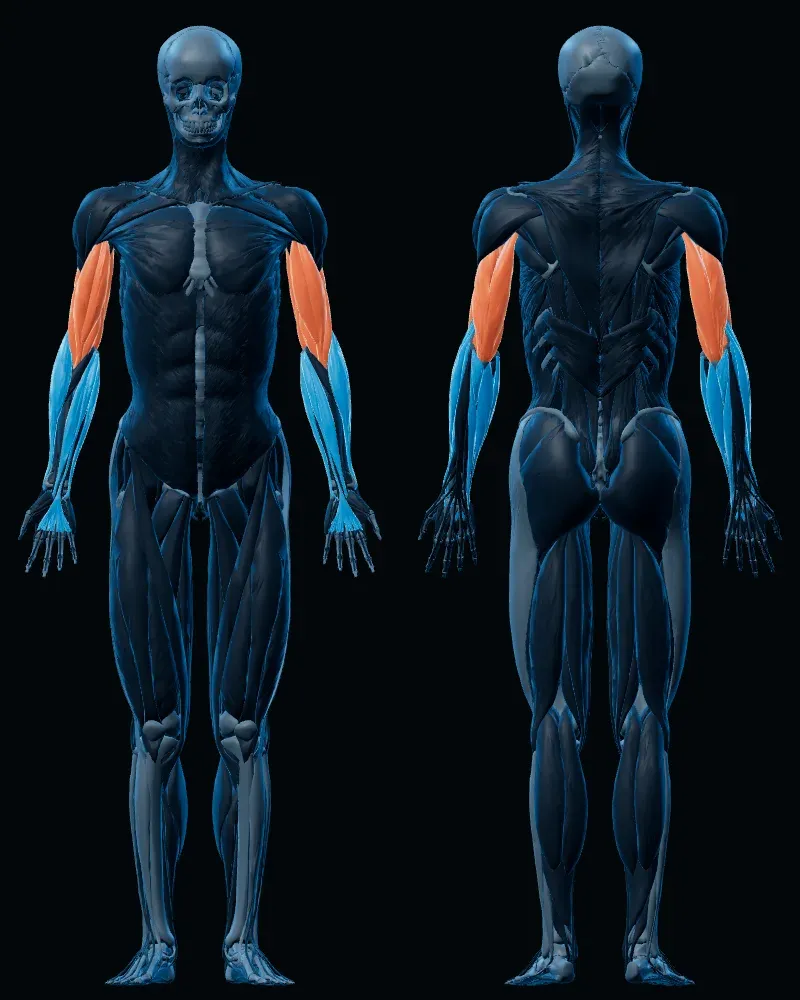
Muscles worked: arms
Main movers: biceps, brachialis and all three heads of the triceps
Assisting: forearm flexors, extensors and brachioradialis
Table of contents
Good arm workout science comes down to three facts. You cannot isolate one biceps head, so “peak” exercises are mostly marketing. Shoulder angle genuinely matters for the triceps, where overhead work grew the long head far more than pushdowns in an MRI study. And the brachialis, brachioradialis and forearms need a neutral grip, a full stretch and direct work to keep up.
That is the short answer. The rest of this guide explains the anatomy behind it, which exercises earn a spot, how much to do, and how to keep your elbows healthy while you do it.
Arms are probably the most trained and most mistrained body part in any gym. A common pattern: lots of curls, ugly momentum-fueled reps, and far less triceps work. Then people wonder why their arms stopped growing two years ago.
Let’s fix that with what the research actually shows.
Arm anatomy in five minutes (the part that explains everything)
Your upper arm has two muscle groups doing opposite jobs. The elbow flexors on the front bend the elbow. The triceps on the back straighten it. Then your forearm adds a crowd of smaller muscles that control the wrist and fingers.
The key detail most programs ignore: some arm muscles cross the shoulder, and some do not.
- Biceps brachii. Two heads. Both start on the shoulder blade, so both cross the shoulder joint. Both merge into one shared tendon that attaches to the radius in your forearm. Besides bending the elbow, the biceps turns your palm up (supination).
- Brachialis. Sits under the biceps and runs from the humerus to the ulna. It crosses the elbow only, and it bends the elbow regardless of grip. It is the reason a well-trained arm looks thick from the side.
- Brachioradialis. The big muscle on top of your forearm near the elbow. It flexes the elbow and works hardest with a neutral, thumbs-up grip.
- Triceps brachii. Three heads. The long head starts on the shoulder blade and crosses the shoulder; the lateral and medial heads start on the humerus and cross the elbow only. The triceps is a bigger muscle than the biceps, so lagging triceps cost you a lot of arm size.
- Forearm flexors and extensors. Two groups that curl and extend the wrist and close and open your hand. They do your gripping.
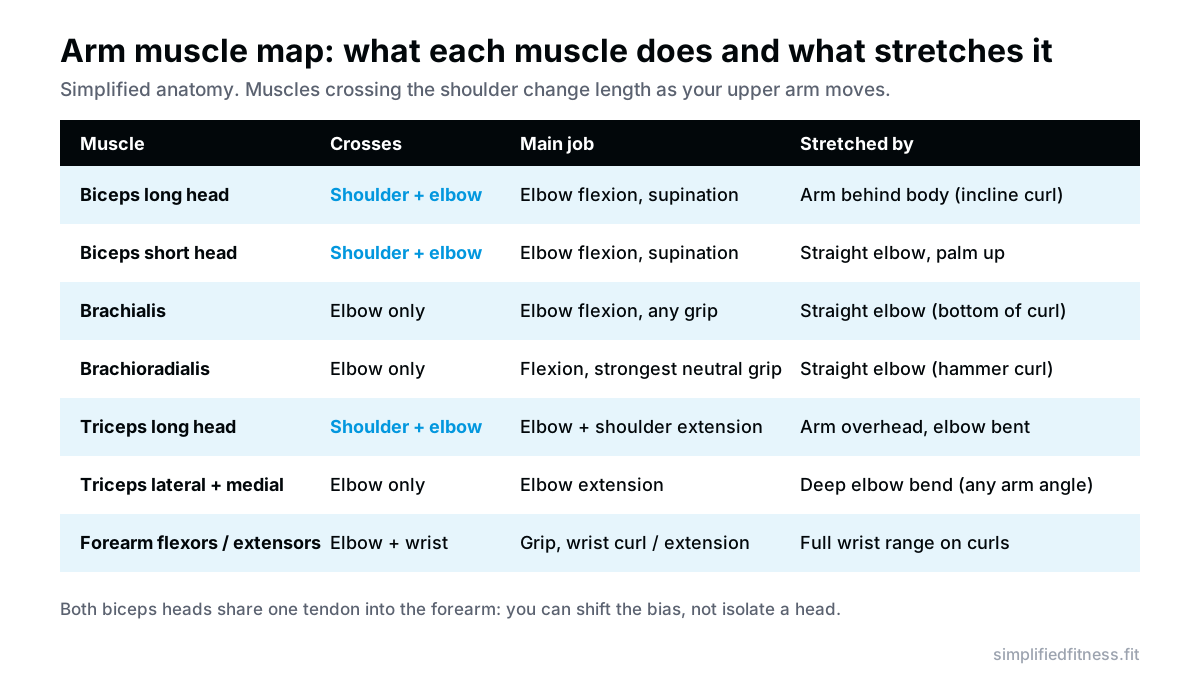
Why does crossing the shoulder matter? Because a muscle that crosses two joints changes length when either joint moves. Raise your arm overhead and the triceps long head gets stretched before you even bend the elbow. Pull your arm behind your body and the biceps long head stretches. Muscles trained in a more stretched position often grow more, an idea we cover in depth in the range of motion and stretch-mediated hypertrophy guide.
For a deeper anatomy breakdown, see our articles on the functional anatomy of the biceps and brachialis and the three heads of the triceps.
Biceps peak anatomy: can you really train the “peak”?
Short answer: no. You can grow the biceps. You cannot sculpt its shape.
Here is the anatomy. The long and short heads blend into one distal tendon before they attach to the forearm. When the muscle contracts, both heads pull on that same tendon. There is no curl that switches one head off.
What people call a “peak” mostly reflects how long your muscle belly is and where your tendon attaches. Someone with a short belly and long tendon gets a tall, bunched biceps when flexed. Someone with a long belly gets a fuller, flatter-looking arm. Training makes either shape bigger. It does not move the tendon.
What you can do is shift the bias a little by changing the shoulder angle:
- Arm behind your body (incline dumbbell curl, Bayesian cable curl): the long head is more stretched.
- Arm in front of your body (preacher curl, spider curl): the long head is slackened, so the brachialis and short head may take more of the work.
So does it matter in practice? Here is where the evidence gets interesting, and a bit messy. Our dedicated piece on long head vs short head biceps and shoulder position goes deeper.
What the curl studies actually show (and where they disagree)
Three recent trials compared curls done with the shoulder in different positions. Their results do not line up perfectly, so let’s go through them honestly.
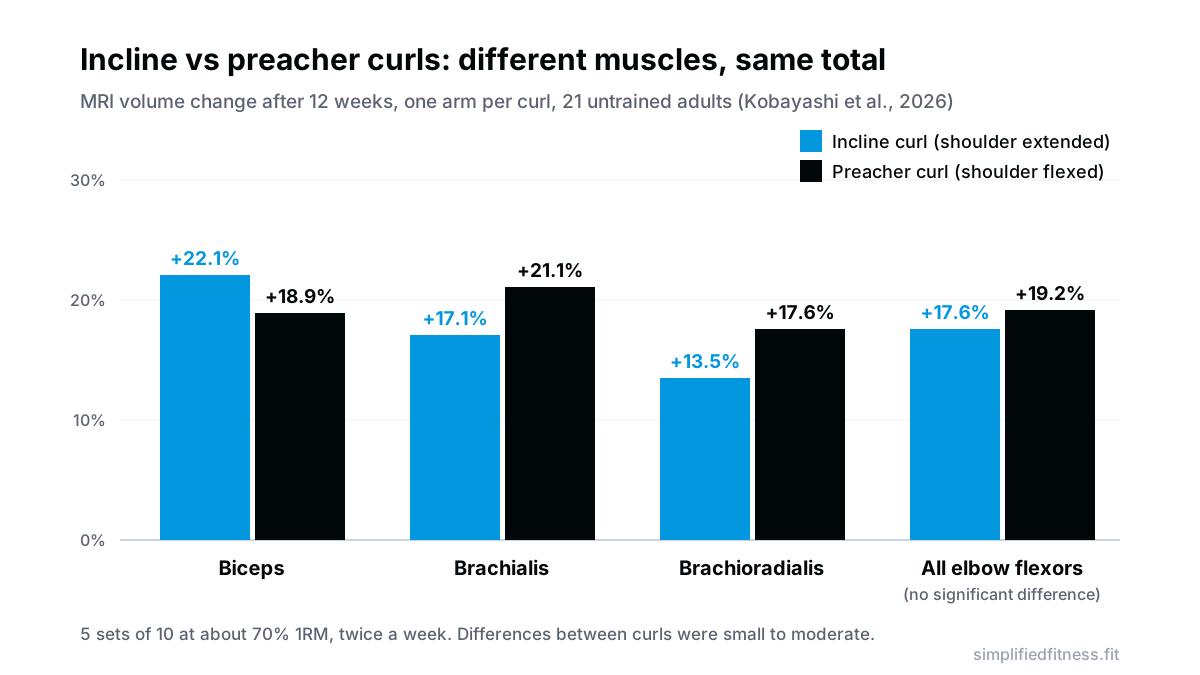
Study A: incline vs preacher dumbbell curls. Twenty-one untrained adults trained one arm with incline curls and the other with preacher curls for 12 weeks, 5 sets of 10 at about 70% of their max, twice a week. MRI measured each muscle separately. The incline arm grew its biceps more (+22.1% vs +18.9%), while the preacher arm grew its brachialis (+21.1% vs +17.1%) and brachioradialis (+17.6% vs +13.5%) more. Total elbow flexor growth was not significantly different (+17.6% vs +19.2%) (Kobayashi et al., 2026).
Study B: preacher vs Bayesian cable curls. Fifteen young men trained one arm with a shoulder-flexed cable curl and the other with a shoulder-extended (Bayesian) cable curl for 10 weeks, with the resistance profiles matched. Ultrasound showed no significant difference in biceps or brachialis thickness at any region, and strength gains were similar (Attarieh et al., 2025).
Study C: neutral vs maximal shoulder extension. Twenty-four untrained men finished 10 weeks of cable curls, one arm at neutral and one at maximum shoulder extension, with resistance profile, elbow range and effort matched. Both arms grew about 7-9%, and the statistics leaned toward no meaningful difference (Larsen et al., 2026).
Why the mismatch? A few likely reasons:
- Measurement. Study A used MRI to measure whole-muscle volume of each flexor separately. Studies B and C used ultrasound thickness at a few sites, which can miss shifts between neighbouring muscles.
- Resistance profile. Studies B and C deliberately matched the loading curve between arms, so only shoulder angle changed. With dumbbells, incline and preacher curls load the elbow differently through the rep.
- Who was tested. Studies A and C were in untrained people, and Study B’s abstract describes young men without detailing training history. Trained lifters may respond differently, and nobody has tested that yet.
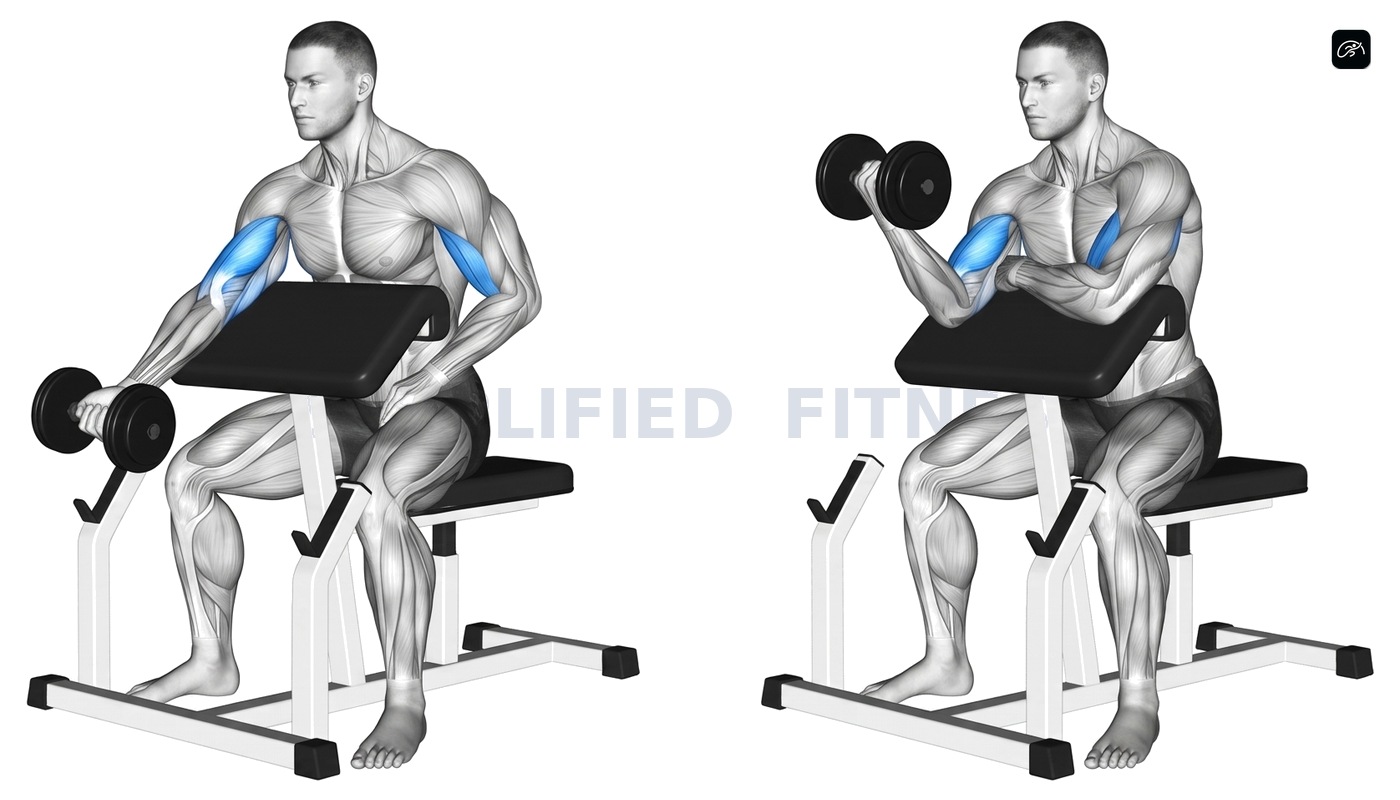
The practical move: program one curl with your arm behind or beside you and one with your arm in front. You cover both biases and stop worrying about it. Exercise-specific guides: incline dumbbell curls, preacher curls, Bayesian cable curls, spider curls, and barbell vs EZ bar curls if your wrists complain on a straight bar.
Do not cut off the bottom of your curls
One more biceps finding worth knowing. In a study of 19 untrained young women, one arm did preacher curls only through the bottom half of the range (elbow nearly straight to about 68 degrees), and the other only through the top half. The bottom-half arm grew more in the lower part of the biceps and gained more full-range strength, while growth at mid-arm was similar (Pedrosa et al., 2023).
That fits a broader pattern, but it is still early. A 2020 systematic review found that full range of motion beats partial range for lower body muscles, while the upper limb data were limited and conflicting (Schoenfeld and Grgic, 2020).
The brachialis and brachioradialis: where arm thickness comes from
If your arms look big from the front but thin from the side, the brachialis is usually the missing piece.
Because the brachialis attaches to the ulna, forearm rotation does not change its pulling angle. It works on every curl. The brachioradialis is different: it is strongest when your thumb points up, which is exactly why hammer curls feel so different from supinated curls.
From the incline vs preacher study above, the preacher arm grew its brachialis and brachioradialis more (Kobayashi et al., 2026). So arm-in-front curls plus a neutral grip is a reasonable recipe for thickness.
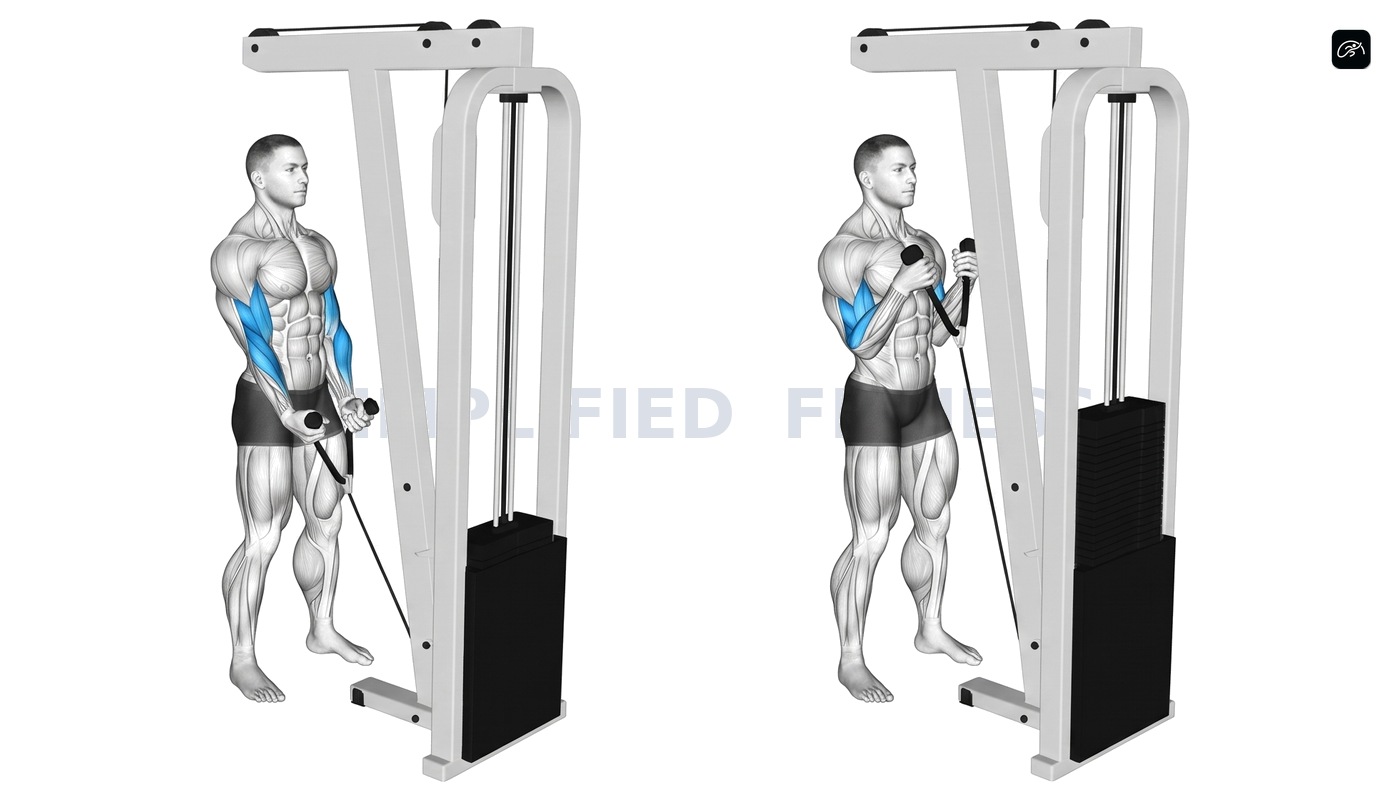
- Hammer curls (dumbbell or cable rope): neutral grip, full stretch at the bottom.
- Reverse curls (palms down, EZ bar): hammer the brachioradialis and wrist extensors at once.
- Preacher hammer curls: combine the arm-in-front position with the neutral grip.
More detail in hammer curls for brachialis and brachioradialis thickness.
Triceps long head exercises: the one place shoulder angle clearly matters
Now the good news. For the triceps, we have cleaner evidence.
In a 12-week study, 21 adults did cable elbow extensions with one arm overhead and the other in a neutral, pushdown-style position: 5 sets of 10 at about 70% of their max, twice a week. MRI measured each head (Maeo et al., 2023).
- Long head: +28.5% overhead vs +19.6% neutral (about 1.5 times more).
- Lateral and medial heads combined: +14.6% vs +10.5%.
- Whole triceps: +19.9% vs +13.9%.
The overhead arm was lifting 34-39% less weight the whole time. Less load on the joint, more growth.
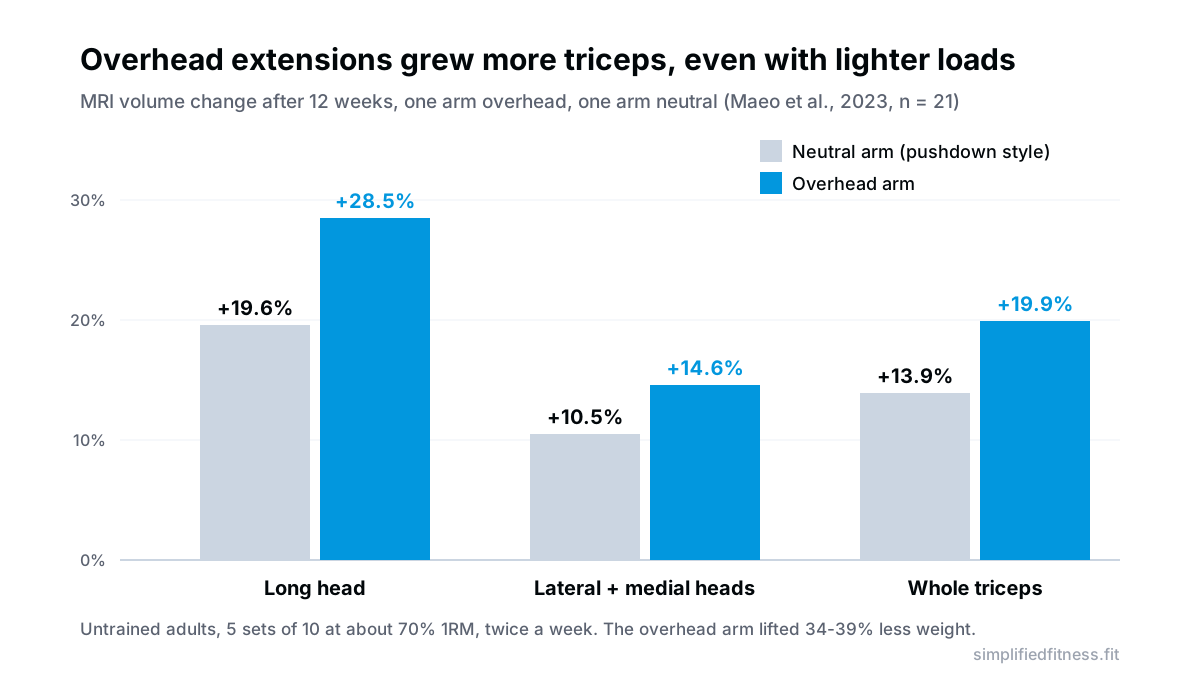
Two honest caveats. This is one study, and the participants were not trained lifters. But the finding matches the anatomy (the long head is stretched overhead) and the wider stretch-position literature, so it is a reasonable bet for trained people too.
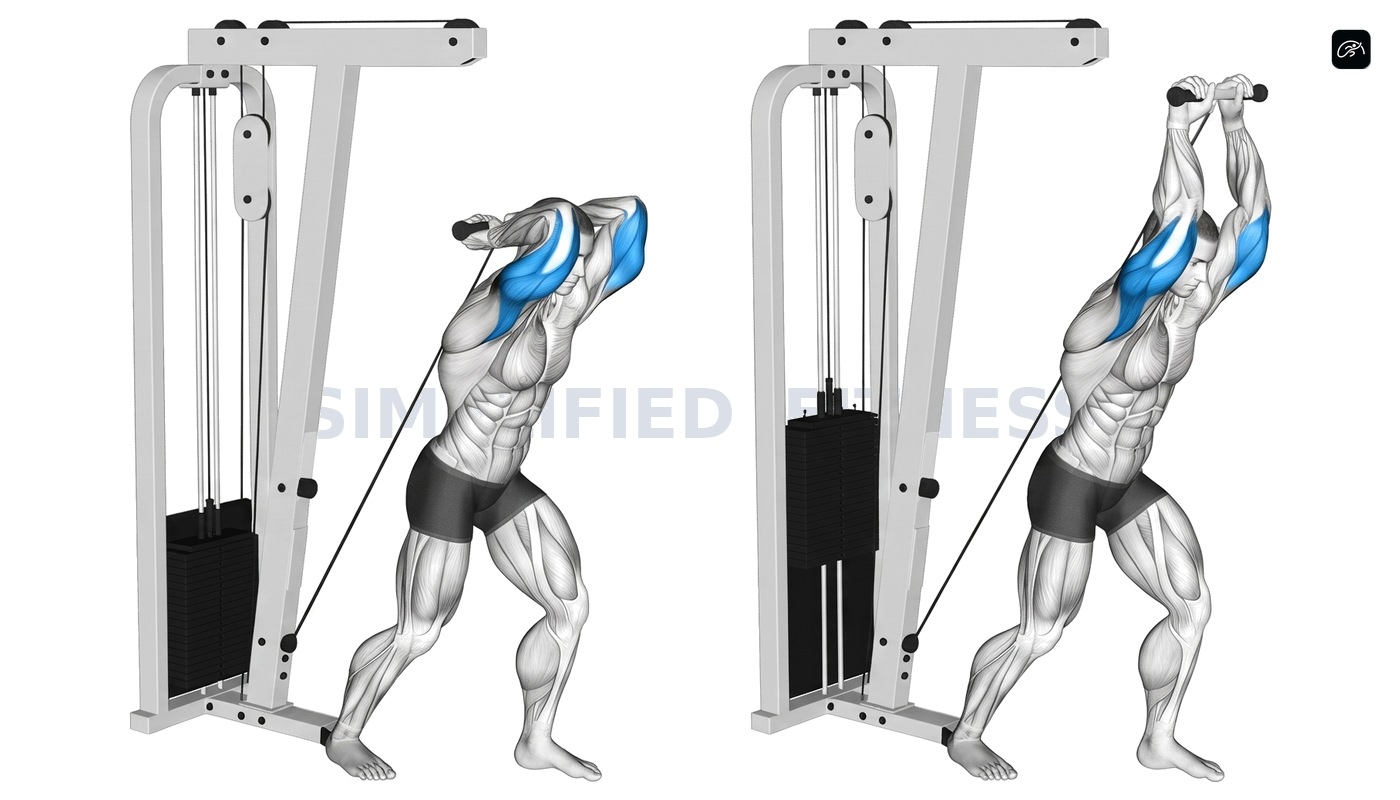
Pushdowns are not useless. The neutral arm still grew its triceps by about 14% in 12 weeks. They are joint-friendly, easy to progress and fine as a second triceps exercise.
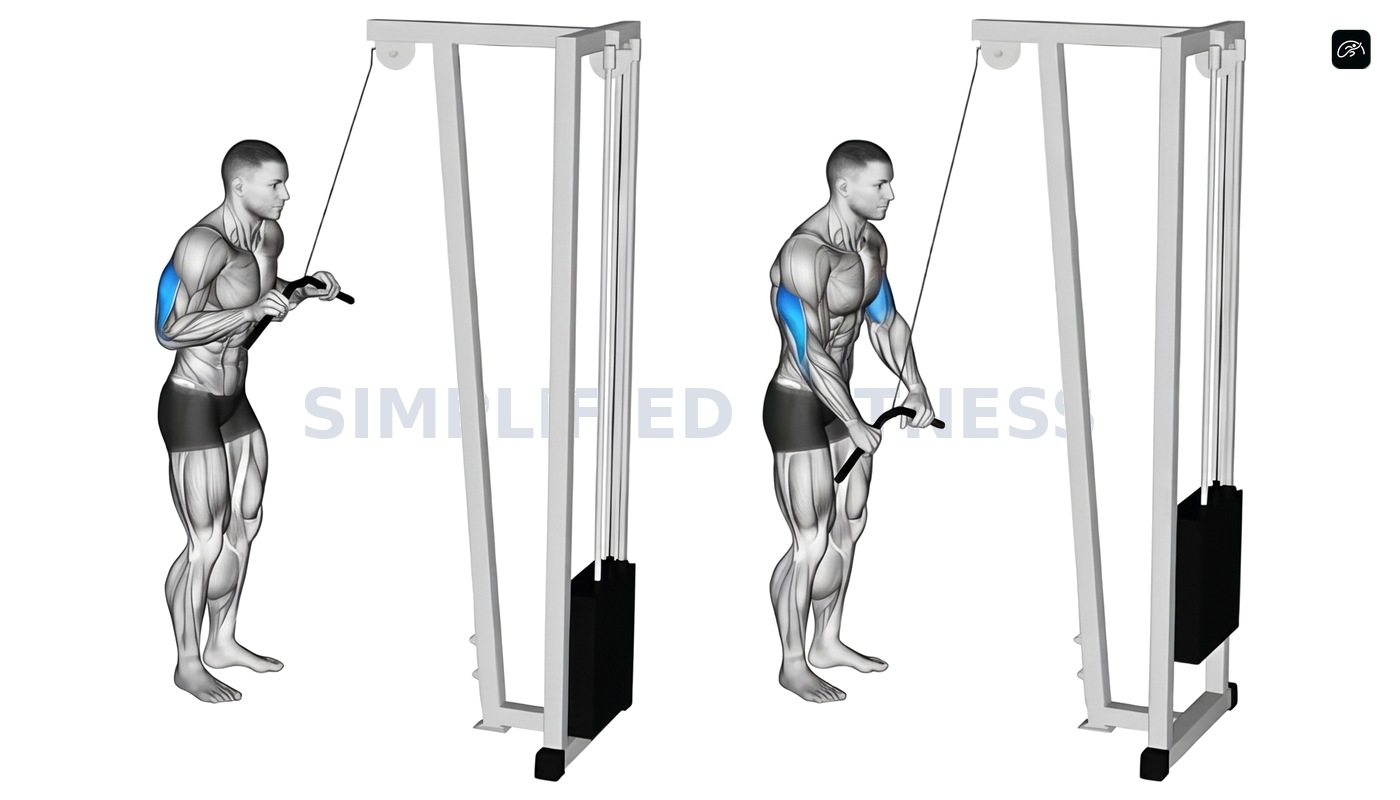
Where each triceps movement fits:
| Exercise | Shoulder position | Long head stretch | Best use |
|---|---|---|---|
| Overhead cable or dumbbell extension | Arm overhead | High | Main triceps builder |
| Skull crusher / lying extension | Arm angled back | Moderate to high | Heavy option if elbows tolerate it |
| Pushdown (bar, V-bar or rope) | Arm at side | Low | Volume, joint-friendly finisher |
| Cross-body cable extension | Arm at side, across body | Low | Variety, comfortable for sore elbows |
| Close-grip bench press | Arm at side | Low | Heavy compound, strength |
| Dips (upright torso) | Arm behind body | Low | Heavy compound if shoulders allow |
Exercise deep dives: overhead cable triceps extensions, pushdowns with a straight bar, V-bar or rope, skull crushers and elbow pain fixes, cross-body cable extensions, close-grip bench press and dips for triceps vs chest.
Do compound lifts build your arms enough?
This is the classic argument. “Just bench and do pull-ups, your arms will grow.” Partly true.
Compounds definitely train the arms. A 10-week bench press study measured four muscles with MRI and found the triceps grew compared with a non-training control group, but less than the pecs (Lanza et al., 2024). An older MRI study using a multi-joint triceps exercise found growth was not even along the muscle: the middle regions grew more than the region closest to the shoulder, matching where the muscle was most active (Wakahara et al., 2013).
On the other side, an 8-week trial in men with at least two years of training found adding curls and extensions to a compound-only program did not produce significantly more arm strength or arm circumference (de França et al., 2015). Short study, small groups (10 per group), and arm circumference is a crude measure, but it is a fair data point.
So who is right? A review on counting sets concluded that multi-joint sets probably should not be counted one-for-one as arm work, but because longitudinal data were limited and conflicting, the authors suggested counting 1:1 for now and using judgment (Schoenfeld et al., 2019).
How to set this up within the rest of your week is covered in direct vs indirect arm volume, and the chest and back sides are in the complete chest training guide and complete back training guide.
How many sets, reps and days for arms?
Nobody has run a clean dose-response trial on arms specifically in trained lifters. So here is the practical version, built on general hypertrophy research.
- Sets: start around 6-10 hard direct sets per week each for biceps and triceps, on top of your compounds. Add sets only if progress stalls and recovery is fine. The full volume picture is in our training volume and frequency guide, and you can tally your week with the training volume calculator.
- Reps: a 2021 review concluded that muscle growth can be achieved across a wide spectrum of loads, not just 8-12 reps (Schoenfeld et al., 2021). For elbows, 6-15 reps tends to be the comfortable zone. Very heavy curls and skull crushers are where tendons start complaining.
- Effort: finish most sets 1-3 reps short of failure. Last set of an isolation movement can go to failure.
- Frequency: twice a week per muscle. Split your weekly sets across two sessions rather than one marathon arm day.
- Exercise count: two exercises per muscle is plenty. One stretch-biased, one different angle.
Supersets help if time is short. Pair a curl with an extension, rest about a minute, repeat. See antagonist arm supersets for setup.
A sample week of arm work
Here is how it might look on a push, pull, legs routine. The base sessions are in our free push day and pull day plans.
| Day | Exercise | Sets x reps |
|---|---|---|
| Push A | Overhead cable triceps extension | 3 x 8-12 |
| Push A | Rope pushdown | 2 x 10-15 |
| Pull A | Incline dumbbell curl | 3 x 8-12 |
| Pull A | Cable hammer curl | 2 x 10-15 |
| Push B | Close-grip bench or dips | 3 x 6-10 |
| Push B | Dumbbell overhead extension | 2 x 10-15 |
| Pull B | Preacher curl | 3 x 8-12 |
| Pull B | Reverse curl + wrist curls | 2 + 2 x 12-20 |
That lands around 10 direct triceps sets (plus pressing), about 10 direct elbow flexor sets (plus rows and pulldowns), and some forearm work. Use the 1RM calculator if you like to set loads from a tested max on close-grip bench.
Forearm hypertrophy: what we know and what we do not
Here is the honest part. There is very little direct research on growing the forearm muscles in healthy lifters. Most forearm studies are in older adults, clinical groups or rock climbers, and they measure grip strength, not muscle size.
So forearm training rests on general hypertrophy principles: load the muscle through a full range, get close to failure, progress over time.
- Wrist curls (palms up, forearms on a bench): let the bar roll down to the fingertips, then curl back up. Trains the flexors.
- Reverse wrist curls (palms down): trains the extensors. Use light weights; these get sore fast.
- Reverse curls and hammer curls: load the brachioradialis, the biggest muscle near the elbow.
- Heavy holds: rows, deadlifts and shrugs without straps when your grip can handle it.
Start with 2-4 sets twice a week, 12-20 reps. Lighter loads and higher reps tend to be easier on the wrist. Exercise breakdowns are in forearm flexor and extensor hypertrophy.
Grip strength training: why it matters beyond the gym
Grip strength gets attention outside fitness circles because it shows up in health research.
The PURE study measured grip strength in 139,691 adults aged 35-70 across 17 countries and followed them for a median of four years. Each 5 kg lower grip strength was associated with a 16% higher risk of death from any cause, and grip strength predicted all-cause and cardiovascular death better than systolic blood pressure (Leong et al., 2015).
Read that carefully, though. It is an association. Stronger grip probably reflects overall strength and health. The authors themselves said more research is needed on whether improving strength reduces death and heart disease.
Grip comes in three main types:
- Crushing grip: closing your hand around something (grippers, thick bars).
- Support grip: holding on for time (farmer’s carries, dead hangs, heavy deadlift lockouts).
- Pinch grip: thumb against fingers (plate pinches).
For most lifters, support grip carries over best to the gym. Two or three hard holds of 20-40 seconds, twice a week, is a reasonable starting dose. A full protocol by grip type is in grip strength types and protocols.
In hot, humid gyms (most of India for half the year) grip fails earlier because of sweat. Chalk or a towel to dry your hands helps before you reach for straps.
Elbow pain and tendonitis: how to keep training safely
Elbows take a beating in arm training. The most common pattern is jumping straight into heavy skull crushers or barbell curls with no warm-up, adding weight every week, and ignoring a dull ache until it becomes a sharp one.
Typical problem areas:
- Outside of the elbow (tennis elbow, lateral elbow tendinopathy): often aggravated by gripping and wrist extension.
- Inside of the elbow (golfer’s elbow): often aggravated by wrist curls, heavy gripping and some pulling.
- Front of the elbow (distal biceps): often aggravated by heavy supinated curls and chin-ups.
- Back of the elbow (triceps tendon): often aggravated by deep, heavy skull crushers and dips.
Exercise is a mainstay of tendon management. For tennis elbow, a 2021 meta-analysis of six randomized trials (429 participants) found adding eccentric exercise to other treatment improved pain and strength more than the other treatment alone. Compared with concentric or general strengthening exercise, eccentrics improved pain a little more, but strength and function were similar. The authors flagged that the trials were few and the exercise programs varied (Yoon et al., 2021).
Gym fixes that often help (not a substitute for an assessment):
- Swap the offending exercise for a version that feels better: cables instead of a straight bar, EZ bar instead of straight bar, overhead cable extension instead of skull crushers.
- Drop the load, keep the movement pain-free or close to it.
- Slow the lowering phase.
- Rebuild gradually over weeks.
Rehab-specific guidance lives in distal biceps tendonitis and golfer’s elbow rehab, and the broader joint-care picture is in the joint-friendly lifting guide.
The most common arm training mistakes
After all that science, the problems in most gyms are boringly simple:
- Too much biceps, too little triceps. The triceps is the bigger muscle. Give it at least as many sets as your biceps.
- Never training overhead. If every triceps exercise is a pushdown, the long head misses the stretch that worked best in the MRI data.
- Cheating the bottom of the curl. The stretched part is the valuable part.
- Five curl variations in one session. Two good exercises done hard beat five done half-heartedly.
- No progression. Write down weights and reps. If your curl has not moved in three months, your arms probably have not either.
- Not eating enough. Arms are small muscles riding on your overall muscle gain. A lifter who never gains any bodyweight rarely gains much arm size.
That last one matters more than any curl angle. If you struggle to hit your protein on a vegetarian diet, dal, paneer, curd, soya chunks and milk get most people there. Our free diet plan lays out a day of eating, and the protein calculator gives you a daily target.
The bottom line on arm workout science
Forget head isolation and peak exercises. Grow the whole arm.
- For triceps, put an overhead extension first; it has the clearest evidence of any arm exercise choice.
- For biceps, use one curl with the arm behind you and one with the arm in front, full range, with the bottom controlled.
- For thickness, add hammer or reverse curls.
- For forearms and grip, add wrist work and heavy holds, and understand the evidence here is thinner.
- For elbows, progress patiently and get persistent pain checked.
Then do it for months, add weight or reps over time, and eat enough to grow. The exercise menu matters far less than consistent, hard sets.
Go deeper: every guide in this topic
- Antagonist Arm Supersets: Biceps and Triceps Pairing for a Faster, Pumpier Arm Day
- Barbell vs EZ-Bar Curls: Why Straight Bars Hurt the Pinky Side of Your Wrist
- Bayesian Cable Curls: Form, Setup and Whether They Build Bigger Biceps
- Close-Grip Bench Press: Triceps Loading, Wrist Spacing, and Elbow Stress
- Cross-Body Cable Triceps Extensions: Setup, Form and What the Science Says
- Dips for Triceps: Upright Torso Positioning vs Forward Chest Dip Mechanics
- Direct vs Indirect Arm Volume: How Many Isolation Sets Do Arms Need After Compounds?
- Distal Biceps Tendonitis and Golfer's Elbow: Prevention, Warm-Ups, and Rehab
- Forearm Flexor and Extensor Hypertrophy: Wrist Curls, Reverse Curls, and Grip Girth
- Functional Anatomy of the Arm Flexors: Biceps Brachii, Brachialis, Brachioradialis
- Triceps Brachii Anatomy: Lateral, Long and Medial Heads Explained
- Grip Strength Types: Crushing, Pinching, and Supporting Grip Training Protocols
- Hammer Curls for Arm Thickness: Brachialis and Brachioradialis Training Explained
- Incline Dumbbell Curls: Form, Bench Angle and Long-Length Biceps Growth
- Long Head vs Short Head Biceps: What Shoulder Position and Grip Width Really Change
- Overhead Cable Triceps Extensions: Setup, Form and Why the Long Head Loves Them
- Preacher Curls: Why the Bottom Feels Brutal and What It Does for Your Biceps
- Skull Crushers Elbow Pain: Fix Your Bench Angle and Elbow Flare
- Spider Curls: How to Do Them, What They Hit, and Who Should Skip Them
- Triceps Pushdowns: Straight Bar vs V-Bar vs Dual Rope Biomechanics
Frequently Asked Questions
Can you isolate the long head or short head of the biceps?
No, you can bias one head slightly but you cannot isolate it. Both heads merge into one shared tendon on the forearm, so every curl trains both. Use one curl with your arm behind your body and one with your arm in front, and stop worrying about heads.
How do I get a bigger biceps peak?
You build a bigger biceps, and the peak comes along with whatever shape your genetics gave you. Peak shape depends largely on the length of your muscle belly and where the tendon attaches, which training does not change. Grow the whole muscle with hard curls across a full range of motion and keep body fat low enough to see it.
What is the best exercise for the triceps long head?
Overhead elbow extensions, with a cable or dumbbell, are the best-supported option. In a 12-week MRI study, the overhead arm grew the long head about 1.5 times more than the arm training in a neutral, pushdown-style position. Make one overhead extension a staple and keep pushdowns as a second movement.
Are pushdowns useless for the triceps?
No, pushdowns still build the triceps, just less than overhead work in the one direct comparison we have. In that study the pushdown-style arm still grew its whole triceps by about 14% in 12 weeks. They are easy on the shoulders and great for adding volume after an overhead movement.
Is the incline curl better than the preacher curl?
Neither is clearly better for total arm growth. One 12-week MRI study found the incline curl grew the biceps a bit more while the preacher curl grew the brachialis and brachioradialis more, with no significant difference in total elbow flexor growth. Pick the one that feels best on your elbows and shoulders, or rotate both through your training year.
Do hammer curls make your arms look thicker?
Hammer curls train the brachialis and brachioradialis hard, which adds width to the upper arm and upper forearm. The neutral grip puts the brachioradialis in its strongest line of pull, so it carries more of the load than in a palms-up curl. Use them as one of your two curl variations if your forearms or arm width are lagging.
Do bench press and pull-ups build big arms on their own?
They help, and the research on adding direct arm work is mixed. A 10-week bench press study found the triceps grew, but less than the chest, and a review of set counting concluded that multi-joint sets cannot simply be assumed to equal direct arm sets, while an 8-week trial in trained men found no significant extra benefit from adding curls and extensions. Count compound sets as partial arm work and add a few sets of curls and extensions.
How many sets per week do arms need?
Research does not give a precise number for arms, and individual responses vary a lot. A sensible starting point for most natural lifters is roughly 6-10 hard direct sets per week each for biceps and triceps, on top of your presses and pulls. Track whether your curl and extension numbers rise, and add a few sets only if they stall while recovery is good.
What rep range is best for arm growth?
Arms grow across a wide range of reps as long as sets are taken close to failure. A 2021 review concluded that hypertrophy can be achieved across a broad spectrum of loads, not only in the classic 8-12 range. For elbow comfort, most lifters do well with 6-15 reps on curls and extensions, ending 1-3 reps short of failure.
Should I do partial reps for biceps?
Full range of motion is the safe default, and if you cut range, keep the stretched half. In a study of untrained women, preacher curls through the bottom half of the range grew the lower biceps more and improved strength more than the top half. Do not chop off the bottom of your curls to lift heavier.
How often should I train arms?
Twice a week per muscle is a practical target for most lifters. Splitting your weekly arm sets across two sessions keeps each session's quality high and lets your elbows recover. A push, pull, legs or upper and lower split does this naturally.
How do I grow my forearms?
Train them directly with wrist curls, reverse wrist curls and heavy gripping work, then progress the load like any other muscle. Forearm-specific hypertrophy research is thin, so this advice rests on general hypertrophy principles rather than forearm trials. Add 2-4 sets of wrist work twice a week and hold heavy rows and deadlifts without straps when you can.
Does grip strength really predict how long you live?
In large cohort studies, lower grip strength is linked with higher risk of death. The PURE study of nearly 140,000 adults found each 5 kg lower grip strength was associated with a 16% higher risk of all-cause death, and grip predicted death better than systolic blood pressure. That is an association, not proof that training grip extends life, so treat grip as a marker of overall strength.
What is the best way to train grip strength?
Hold heavy things for time. Farmer's carries, dead hangs, and holding the top of heavy deadlifts or rows train support grip, while plate pinches train pinch grip. Do 2-3 hard holds twice a week and add time or weight when holds feel easy.
Should I use lifting straps?
Use straps when grip is the only thing stopping a back or hamstring set, not on every set. Straps let your lats or hamstrings get a full set when your hands would fail first. Pull warm-ups and lighter sets without straps so your grip still gets trained.
Why do my elbows hurt during skull crushers?
Skull crushers load the elbow heavily at a deep bend, and fast progression or too much volume often irritates the tendons. Swapping to a cable overhead extension or adjusting the bench angle usually changes the load on the joint. If pain persists more than a couple of weeks, cut that exercise and see a physiotherapist or doctor.
What is tennis elbow and can exercise help?
Tennis elbow, or lateral elbow tendinopathy, is pain on the outside of the elbow where the wrist extensors attach. A 2021 meta-analysis of six randomized trials found eccentric exercise improved pain and strength, though the trials were few and varied. Get it assessed by a physiotherapist or doctor and ask about a progressive loading plan.
When should I see a doctor about elbow pain?
See a doctor promptly if you felt a pop at the front of the elbow, see bruising or a bunched-up biceps, or have numbness, tingling or weakness in your hand. Those signs can point to a tendon tear or nerve problem that needs assessment rather than training through. Ongoing pain that does not settle with a few weeks of reduced load also deserves a professional opinion.
Are dips good for the triceps?
Dips are a good heavy compound for the triceps, especially with an upright torso. They load the triceps and chest together, so they work as your main press or as a strong triceps builder. Skip them or shorten the range if they bother the front of your shoulders.
Should I superset biceps and triceps?
Supersetting biceps and triceps is a time-saver that works well for most lifters. Because the two muscles do opposite jobs, one rests while the other works, so you can fit more sets into less time. Rest at least a minute between rounds so your reps on the second exercise do not drop much.
Can I train arms every day?
You can, but it rarely beats two or three good arm sessions a week. Muscles grow during recovery, and the elbow tendons adapt more slowly than muscle. Spread your weekly sets over two or three days and keep each set close to failure instead.
Do I need to eat more to grow my arms?
Yes, for most lifters arm size follows overall muscle gain, which needs enough protein and usually a small calorie surplus. Arms are small muscles, and a lifter who never gains bodyweight usually sees slow arm growth no matter which curl they pick. Hit your protein target daily with foods like dal, paneer, curd, soya, eggs or chicken.
Sources & References
Every claim above is checked against peer-reviewed research (PubMed, U.S. National Library of Medicine) or guidance from established health bodies. How we fact-check.
- Maeo S, et al. Triceps brachii hypertrophy is substantially greater after elbow extension training performed in the overhead versus neutral arm position. Eur J Sport Sci. 2023. PMID: 35819335
- Kobayashi Y, et al. Exercise-specific preferential hypertrophy of individual elbow flexor muscles after incline versus preacher dumbbell curl training. J Sports Sci. 2026. PMID: 42829982
- Attarieh P, et al. Comparison between shoulder flexed and extended positions in elbow flexion resistance training on regional hypertrophy and maximum strength: preacher versus Bayesian cable curls. Eur J Sport Sci. 2025. PMID: 40082069
- Larsen S, et al. The effects of shoulder extension angle on elbow flexor hypertrophy in the cable curl exercise. Front Physiol. 2026. PMID: 41988507
- Pedrosa GF, et al. Training in the initial range of motion promotes greater muscle adaptations than at final in the arm curl. Sports (Basel). 2023. PMID: 36828324
- Schoenfeld BJ, Grgic J. Effects of range of motion on muscle development during resistance training interventions: a systematic review. SAGE Open Med. 2020. PMID: 32030125
- Lanza MB, et al. Muscle hypertrophy response across four muscles involved in the bench press exercise: randomized 10 weeks training intervention. J Bodyw Mov Ther. 2024. PMID: 39593465
- Wakahara T, et al. Nonuniform muscle hypertrophy: its relation to muscle activation in training session. Med Sci Sports Exerc. 2013. PMID: 23657165
- de Franca HS, et al. The effects of adding single-joint exercises to a multi-joint exercise resistance training program on upper body muscle strength and size in trained men. Appl Physiol Nutr Metab. 2015. PMID: 26244600
- Schoenfeld BJ, et al. Calculating set-volume for the limb muscles with the performance of multi-joint exercises: implications for resistance training prescription. Sports (Basel). 2019. PMID: 31336594
- Schoenfeld BJ, et al. Loading recommendations for muscle strength, hypertrophy, and local endurance: a re-examination of the repetition continuum. Sports (Basel). 2021. PMID: 33671664
- Leong DP, et al. Prognostic value of grip strength: findings from the Prospective Urban Rural Epidemiology (PURE) study. Lancet. 2015. PMID: 25982160
- Yoon SY, et al. The beneficial effects of eccentric exercise in the management of lateral elbow tendinopathy: a systematic review and meta-analysis. J Clin Med. 2021. PMID: 34501416

Umair Hazrami · Founder & Head Coach, Simplified Fitness
Umair Hazrami founded Simplified Fitness and the Simplified Lifter channel to cut through fitness noise. With 4+ years of consistent training and 10+ coaching clients, he writes every guide from the peer-reviewed research and links the sources so you can check them. Our editorial standards.
Educational content only, not medical advice. If you have a medical condition, are pregnant, or take medication, talk to a qualified doctor before changing your diet, supplements or training. Full disclaimer.
Keep reading
Exercise Technique
3D Shoulder Protocol: Weekly Volume, Frequency (2-3x/Week) and Rep Ranges
How to build 3D shoulders: how many weekly sets, how often to train side and rear delts, and which rep ranges to use, with an 8-week plan and the research.
8 min read
Exercise Technique
Adductor Magnus Training: Seated Adductor Machine and Copenhagen Planks for Thigh Mass
Adductor magnus training explained: what research says on deep squats, the adductor machine and Copenhagen planks for thicker inner thighs and groin strength.
7 min read
Exercise Technique
Antagonist Arm Supersets: Biceps and Triceps Pairing for a Faster, Pumpier Arm Day
A biceps triceps superset workout can shorten arm day while keeping volume close to straight sets. See the research, pairing tips and a 20-minute routine.
9 min read

Exercise Technique
Are Front Raises Necessary? Why Bench Pressers Rarely Need Direct Front Delt Work
Are front raises necessary if you bench and overhead press? See what EMG and volume research says, when they can still help, and where to spend those sets.
8 min read