Conventional Deadlifts for Back Hypertrophy: Stimulus-to-Fatigue Ratio Analysis
Are deadlifts good for back hypertrophy? A stimulus-to-fatigue breakdown of what they build, what they miss for lats, and how to program or replace them.

TL;DR. The short answer
- Deadlifts are a great strength lift but a mediocre choice for lat hypertrophy. The lats mostly hold the bar close, which is a static job, so rows and pulldowns usually give more lat growth per set.
- Muscle activation reviews show the conventional deadlift loads the erector spinae and quadriceps heavily, with the hamstrings and glutes also working. Traps get a strong isometric hold, especially near lockout.
- The stimulus-to-fatigue ratio (SFR) argument is a coaching framework, not a measured law. One study in well-trained men found deadlift recovery was not worse than squat or bench after the same sets to failure.
- If you keep deadlifts in a physique routine, treat them as one heavy, crisp top set once a week and count them lightly toward back volume.
- Sharp, worsening, or radiating back pain, numbness, or leg weakness is not something to train through. See a doctor or physiotherapist.
Part of our complete guide: Complete Back Training Guide: Lats vs Upper Back, Best Exercises and a Hypertrophy Workout
Table of contents
Are deadlifts good for back hypertrophy? Partly. They are one of the best lifts for overall strength and they load your lower back, quads and traps hard, but they are not the most efficient way to build wide, thick lats. The lats mostly hold the bar close to your body, and that static job gives less growth signal than a row or pulldown where the muscle actually lengthens and shortens.
This article sits inside our complete back training guide. Here we apply one idea, the stimulus-to-fatigue ratio, to the conventional deadlift and decide where it earns a place in a physique routine. We keep it strictly to bodybuilding utility. For the technique and anatomy fight between stances, see conventional vs sumo deadlifts.
What is the stimulus-to-fatigue ratio?
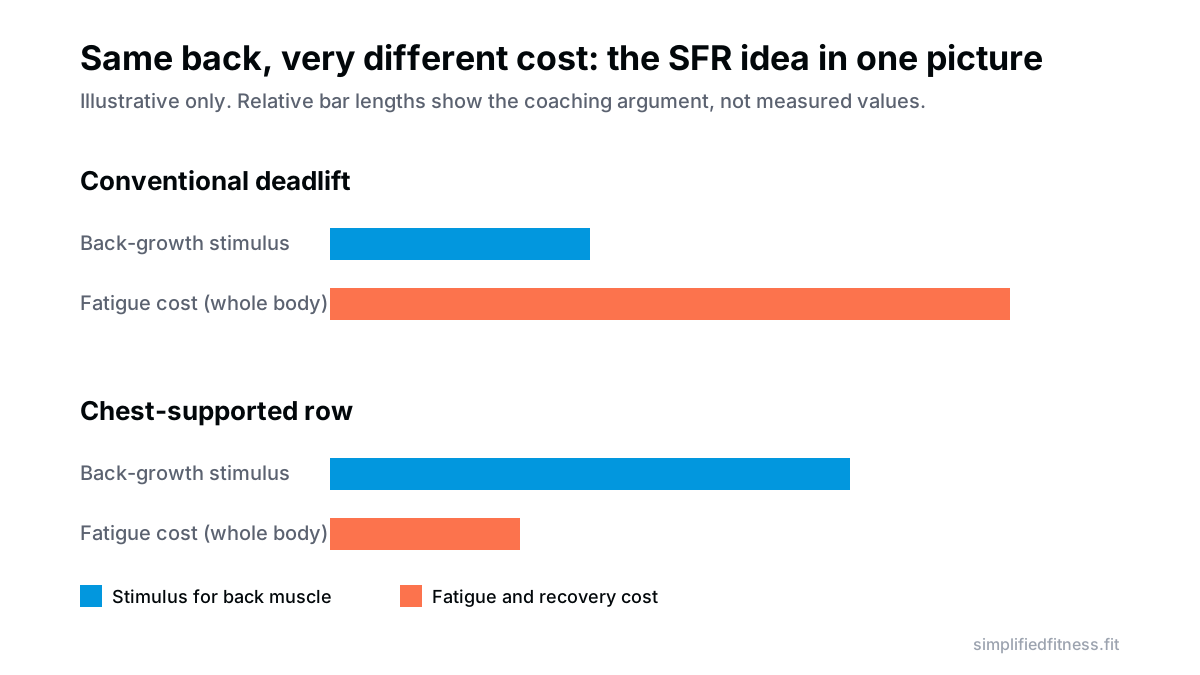
Stimulus-to-fatigue ratio (SFR) is a coaching shorthand. It asks: how much growth signal does the target muscle get compared with the total fatigue the exercise costs you (muscle damage, systemic tiredness, joint and spine stress, and the recovery you borrow from later sessions)?
An exercise with a high SFR lets you do productive sets and still train well tomorrow. A low-SFR exercise leaves you flat for the rest of the week. We explain the concept more broadly in stimulus-to-fatigue ratio and exercise selection.
One caution up front. SFR is not a number anyone has measured for the deadlift in a long growth trial. It is a reasoning tool built from what we know about muscle activation, volume and recovery. We will mark where each claim comes from.
What do conventional deadlifts actually build?
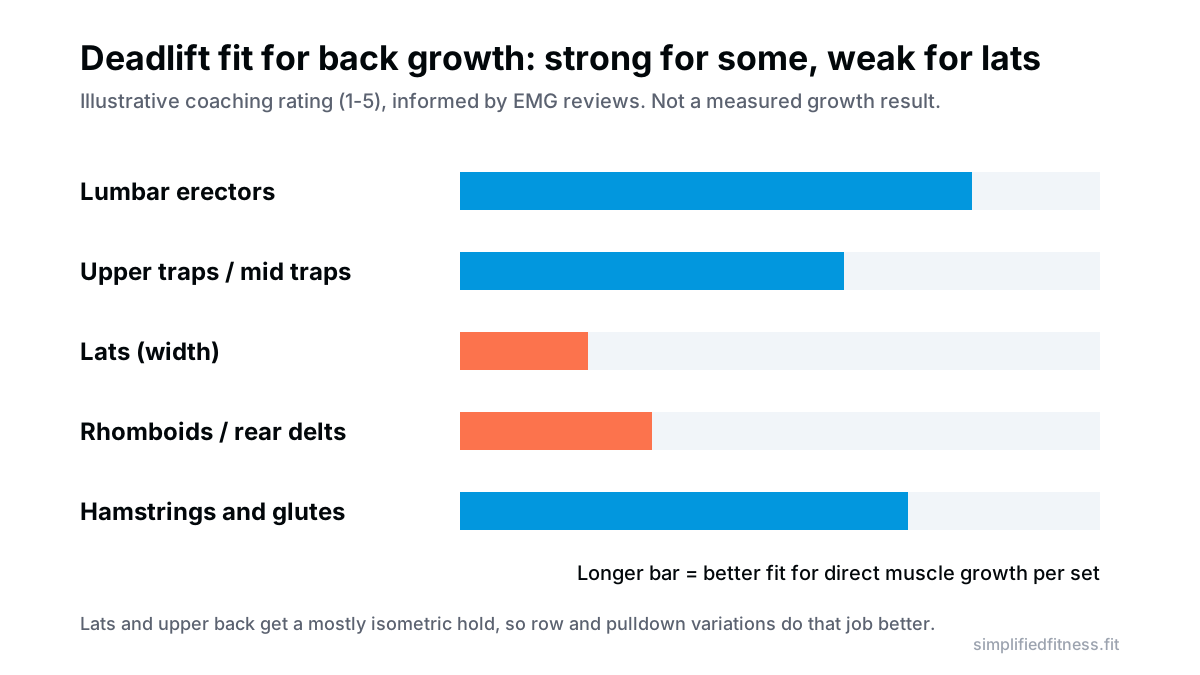
A 2020 systematic review of deadlift electromyography (EMG) studies found that the erector spinae and quadriceps showed greater activation than the gluteus maximus and biceps femoris across deadlift variations, and that semitendinosus activity was slightly greater than biceps femoris within the hamstrings (Martín-Fuentes et al., 2020). The authors also called for more consistent methods across studies, so read the comparisons loosely.
In 13 collegiate football players lifting at a 12-rep max, conventional deadlifts also drove the paraspinals, middle trapezius, hamstrings and upper trapezius, with upper trap activity higher in the lower knee-flexion range near lockout and middle trap activity higher in the deeper range (Escamilla et al., 2002). Separately, 16 subjects showed that deadlifting at 80% of 1RM produced much higher upper-lumbar erector activity than the same movement with body weight (Hamlyn et al., 2007).
So what grows? Plausibly:
- Lumbar and thoracic erectors. High activation, heavy loading, lots of time under tension in a long static hold.
- Traps. A strong isometric job holding your shoulders up and back against the bar.
- Quads, glutes and hamstrings. Real contributors, though other lifts train them more selectively.
Note the qualifier: EMG amplitude is not growth. These studies measured acute muscle activity in trained or athletic men, not months of muscle gain.
Why are deadlifts weak for lat hypertrophy?
This is the heart of the bodybuilding question. Look at what your lats do in a conventional deadlift. The arms hang straight, the bar stays in contact with your legs, and the lats work to keep the bar close and your upper back tight. That is mostly an isometric job. The lats are not going through a big stretch-to-contraction range the way they do when you pull your elbow down and back in a pulldown or row.
Here is the honest limit of the evidence. The deadlift EMG literature we found focuses on the hamstrings, glutes, quads and erectors, and does not give a clear lat-specific growth verdict. So “deadlifts are poor for lats” is a biomechanical argument and a widely shared coaching position, not a trial result. What we do have is a 2026 narrative review of lat EMG that concluded an anterior lat pulldown path was the configuration most consistently linked with greater lat activity, while noting these are acute findings and an evidence-informed starting point (Di Fonza et al., 2026).
Put simply: if width is the goal, put your best sets into the movement that trains the lats through range. Our guides on wide vs close vs neutral grip pulldowns and chest-supported rows cover how.
Is the fatigue cost really that high?
Here is where the usual story needs a fair look. The common claim is that deadlifts cause massive systemic and CNS fatigue. The evidence is more mixed than the gym talk suggests.
In a 2019 study, 12 well-trained men did 4 sets to failure at 80% of 1RM on squat, bench press and deadlift in separate weeks. Muscle-damage and soreness markers followed similar patterns, and there were no between-lift differences. Deadlift bar speed did not drop afterward, while it did fall for the squat and bench (Belcher et al., 2019). The authors concluded the deadlift did not cause greater muscle damage or longer recovery than the squat or bench in that setup.
Why might that conflict with what lifters feel? A few reasons are plausible:
- Volume and proximity to failure. Those were 4 sets in a lab, with rest time. Real gym deadlift sessions often mix heavy singles, grinding sets and back-off work.
- Spinal and grip fatigue. Muscle-damage markers may not capture the tired-back feeling that hits your next row or squat.
- Individual response. Twelve men is a small sample, and technique, leverages and sleep change the picture.
The cautious takeaway: the deadlift’s fatigue cost is probably real for many people, but it is not proven to be uniquely larger than the squat. The cleaner SFR point is not that it fatigues you more. It is that the fatigue you pay is not spent mainly on the muscle you want to grow. Pay the same fatigue on a chest-supported row and the back gets more of it. For more on how spinal load shapes recovery, see axial vs non-axial exercises.
How should you count deadlifts toward back volume?
Weekly set volume matters. A meta-regression of 15 studies found a graded dose-response, with each extra weekly set linked to about 0.37% more muscle gain, though the analysis comparing fewer than 5, 5 to 9 and 10 or more weekly sets only reached a trend (Schoenfeld et al., 2017).
The catch is that not every set counts equally for every muscle. A 2019 review argued that multi-joint lifts do not always reach a muscle fully, giving the hamstrings in squats and leg presses as an example, and that fractional counting of those sets can make sense (Schoenfeld et al., 2019). The authors still recommended starting at a 1:1 count and adjusting with judgment because the longitudinal data are limited.
Where do deadlifts fit in a bodybuilding routine?
Three simple options, depending on what you want.
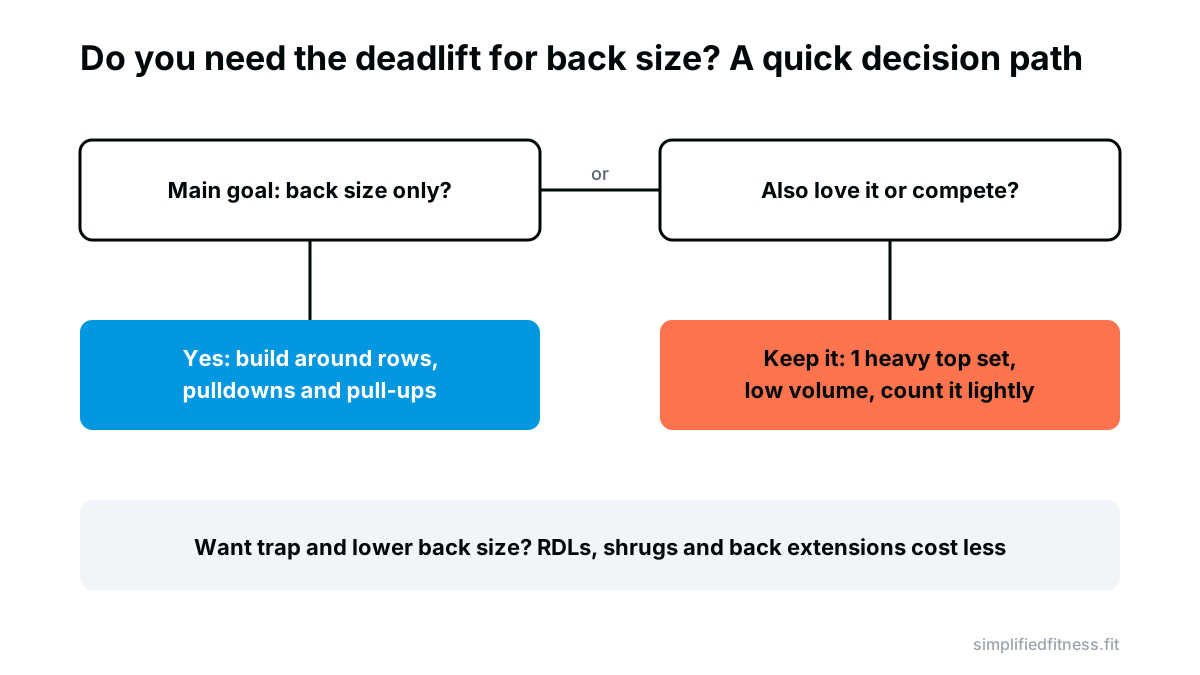
Option 1: skip them for hypertrophy. If you hate them or they leave you wrecked, build the back from rows, pulldowns and pull-ups, then cover the lower back with back extensions and RDLs. This is a completely valid plan. Our spinal erector guide and RDL guide cover the swaps.
Option 2: one heavy top set. Once a week, build up with a few warm-up sets, then take one hard set of 3-6 reps stopping 1-2 reps from failure, and move on. You get the strength practice and trap and erector work with little extra fatigue. Place it on your pull or leg day (see our pull day plan) and do your rows first if back size is the priority.
Option 3: rotate it. Run deadlifts for 4-6 weeks while your other lifts are stable, then swap them out for RDLs during high-volume phases.
What about trap size and trap bar deadlifts?
Traps are the deadlift’s best bodybuilding payoff, so it is a decent trap exercise by activation. But if big traps are a priority, direct work such as Kelso shrugs and cable variations is cheaper in fatigue per set.
What about the hex bar? In a 13-man cross-over study, the barbell deadlift produced higher biceps femoris activation than the hex bar, and erector spinae activation did not differ (Andersen et al., 2018). The hex bar is often more comfortable, but it does not appear to change the lat story, because the lats are still mostly holding.
A quick word on back safety
Not by default. A 2026 narrative review argued that trained lifters often show some lumbar flexion without clear evidence of higher injury risk, and that sudden jumps in training load seem to be a more consistent predictor of low back injury than imperfect posture (Cherni et al., 2026). It is an interpretative review, not a systematic one, so treat it as direction rather than proof. For the full injury question, see are deadlifts bad for your lower back?.
The practical read: add weight gradually, avoid jumping your deadlift volume overnight, and stop sets that feel unstable. If you get sharp, worsening or radiating pain, numbness, or leg weakness, stop and see a doctor or physiotherapist. Do not push through it.
A simple back hypertrophy template with and without deadlifts
For an intermediate lifter, a simple structure could look like this, as a starting point rather than a prescription:
- Lats: 8-12 weekly sets across pulldowns and pull-ups.
- Upper back: 6-10 weekly sets of chest-supported or cable rows.
- Traps: 4-6 sets of shrugs or deadlifts counted lightly.
- Erectors: 3-6 sets of back extensions or RDLs, or 1 heavy deadlift top set.
For a full week, see our complete back workout design. Eat enough protein and calories in a surplus or at maintenance, whether your plate is dal and paneer or eggs and chicken, because no exercise swap fixes under-eating.
Frequently Asked Questions
Are deadlifts good for back hypertrophy?
Deadlifts are good for building the lower back and give the upper back a hard isometric workload, but they are not the most efficient lat builder. The lats mainly stabilise the bar rather than shortening under load, so rows and pulldowns usually give more direct lat stimulus per set. If back size is your goal, keep deadlifts as a low-volume strength lift and put most sets into rows, pulldowns and pull-ups.
Do deadlifts build lats?
Only weakly, as far as current evidence and biomechanics suggest. The lats work to keep the bar tight to your body, a mostly static hold, and that is a very different stimulus from a full stretch and contraction. Direct lat evidence for deadlifts is thin, so treat this as a reasoned coaching view rather than a proven fact, and use pulldowns or chest-supported rows for lat size.
What muscles do conventional deadlifts work?
A 2020 systematic review found erector spinae and quadriceps activation was greater than gluteus maximus and biceps femoris activation across deadlift variations. Escamilla and colleagues also recorded trapezius, paraspinal, hip adductor and hamstring activity in the conventional deadlift. That makes it a whole-posterior-chain lift, so it is excellent for general strength but spreads its stimulus thin.
What is the stimulus-to-fatigue ratio of a deadlift?
There is no single measured number, because SFR is a coaching idea: how much growth stimulus a muscle gets compared with the fatigue the exercise costs your whole body. For back hypertrophy, the deadlift is usually judged to have a high fatigue cost and a moderate stimulus to the lats. Compare it to a chest-supported row, where more of the work lands on the target muscle for less fatigue.
Do deadlifts cause more fatigue than squats?
Not necessarily in the lab. A 2019 study of 12 well-trained men found deadlift recovery over 96 hours was similar to squat and bench press after 4 sets to failure at 80% of 1RM, and deadlift bar speed did not drop afterward. Real-world fatigue depends on your volume, proximity to failure and sleep, so judge it by how your next pull and leg session feels.
How often should I deadlift for back size?
Once a week is plenty for most lifters, and some do well with every other week. Meta-analytic evidence suggests more weekly sets tend to bring more growth, but you want those sets on exercises that stress the target muscle with less fatigue. Use deadlifts for strength practice and fill your back volume with rows and pulldowns.
How many deadlift sets count toward back volume?
A reasonable rule is to count heavy deadlift sets lightly, for example half a set toward the lats and traps. A 2019 review of limb muscles argued that a 1:1 count cannot simply be assumed for every muscle in a multi-joint lift, though it still suggested starting from 1:1 and adjusting with judgment. Treat that as a rule of thumb you adjust by how your back is growing, not as a validated ratio.
Should bodybuilders deadlift?
It is optional. If you enjoy it and it does not wreck your next sessions, one heavy set a week is fine. If it leaves you too tired to row or squat well, drop it for Romanian deadlifts, back extensions and rows, which cost less to recover from.
What can replace deadlifts for back hypertrophy?
Chest-supported rows, lat pulldowns, pull-ups and cable rows cover lats and upper back, while Romanian deadlifts and back extensions cover the erectors and hamstrings. These keep the load on the target muscle and take away much of the lower back fatigue. Pick two or three you can progress and repeat for 8 to 12 weeks.
Are deadlifts bad for your back?
Not inherently. A 2026 narrative review concluded that abrupt jumps in training load seem to predict low back injury more consistently than imperfect posture, though the relationship is probabilistic. Add weight gradually, stay stable under load, and see a doctor if you get sharp or radiating pain.
Do deadlifts make traps bigger?
They probably help. EMG work in football players showed upper trapezius activity was greater in the lower knee flexion range near lockout, and middle trapezius activity in the deeper range. This is activation, not proof of growth, so add shrugs if trap size is a priority.
Is a trap bar deadlift better for back hypertrophy?
Not clearly. In a 13-man study, the straight barbell deadlift gave higher biceps femoris activation than the hex bar, while erector activity did not differ. For lat growth the same logic applies: it is still mostly a static hold, so rows and pulldowns remain the better tool.
Sources & References
Every claim above is checked against peer-reviewed research (PubMed, U.S. National Library of Medicine) or guidance from established health bodies. How we fact-check.
- Martín-Fuentes I, et al. Electromyographic activity in deadlift exercise and its variants. A systematic review. PLoS One. 2020. PMID: 32107499
- Escamilla RF, et al. An electromyographic analysis of sumo and conventional style deadlifts. Med Sci Sports Exerc. 2002. PMID: 11932579
- Belcher DJ, et al. Time course of recovery is similar for the back squat, bench press, and deadlift in well-trained males. Appl Physiol Nutr Metab. 2019. PMID: 30779596
- Schoenfeld BJ, et al. Dose-response relationship between weekly resistance training volume and increases in muscle mass: a systematic review and meta-analysis. J Sports Sci. 2017. PMID: 27433992
- Schoenfeld BJ, et al. Calculating set-volume for the limb muscles with the performance of multi-joint exercises: implications for resistance training prescription. Sports (Basel). 2019. PMID: 31336594
- Hamlyn N, et al. Trunk muscle activation during dynamic weight-training exercises and isometric instability activities. J Strength Cond Res. 2007. PMID: 18076231
- Andersen V, et al. Electromyographic comparison of barbell deadlift, hex bar deadlift, and hip thrust exercises: a cross-over study. J Strength Cond Res. 2018. PMID: 28151780
- Di Fonza D, et al. Electromyographic analysis of latissimus dorsi activation during common resistance training exercises: a narrative review. J Funct Morphol Kinesiol. 2026. PMID: 42647355
- Cherni B, et al. Beyond the neutral spine: a narrative review and modern framework for low back injury prevention in deadlifting. Sports (Basel). 2026. PMID: 42043083

Umair Hazrami · Founder & Head Coach, Simplified Fitness
Umair Hazrami founded Simplified Fitness and the Simplified Lifter channel to cut through fitness noise. With 4+ years of consistent training and 10+ coaching clients, he writes every guide from the peer-reviewed research and links the sources so you can check them. Our editorial standards.
Educational content only, not medical advice. If you have a medical condition, are pregnant, or take medication, talk to a qualified doctor before changing your diet, supplements or training. Full disclaimer.
Keep reading
Exercise Technique
Barbell Bent-Over Rows: Spinal Load, Hamstring Fatigue and Lat Growth
Is the barbell bent over row hypertrophy gold or a fatigue generator? See what the research says about spinal load, torso angles and better rows for lat growth.
8 min read
Exercise Technique
Chest-Supported Rows: Train Your Upper Back Without Lower Back Fatigue
Chest supported row hypertrophy explained: why your lower back quits first, how T-bar, incline and seal rows fix it, and what the research says.
8 min read
Exercise Technique
Complete Back Workout Design: Balancing Vertical Pulls, Horizontal Rows, and Lumbar Recovery
A science-based back workout routine: weekly sets, how to balance pulldowns and rows, and how to protect your lower back, with a sample pull day plan.
9 min read

Exercise Technique
Dumbbell Pullover Tension Curve: Why You Feel Triceps and Chest, Not Lats
Dumbbell pullover tension curve explained: why triceps and chest burn instead of lats, what the EMG research shows, and how to fix the exercise or swap it.
8 min read