Lat Flare and Mind-Muscle Connection: How to Feel Your Lats Working
Can't feel your lats on pulldowns? Learn how to flare your lats with lat spread drills, touch cues and a straight-arm primer, plus what the research says.
TL;DR. The short answer
- To flare your lats, stand tall, put your hands on your hips and push your elbows out and slightly down without shrugging. Hold it for about 5 seconds and feel the sides of your ribcage widen.
- Lats are hard to feel mainly because you cannot see them and your biceps and forearms grab the handle first. Cues that shift your attention to the elbows and the sides of your back can help.
- Research in trained lifters shows that focusing on a muscle can raise its EMG activity at light to moderate loads (up to about 60% of 1RM), but the effect fades near heavy loads.
- In one 8-week trial of untrained men, thinking about the target muscle produced more elbow flexor growth than thinking about the lift (12.4% vs 6.9%). That is one small study, so treat it as supportive, not proof.
- Still no lat feeling after a few weeks of cues? Check your setup, lower the load, and see a physio if you have shoulder pain or numbness.
Part of our complete guide: Complete Back Training Guide: Lats vs Upper Back, Best Exercises and a Hypertrophy Workout
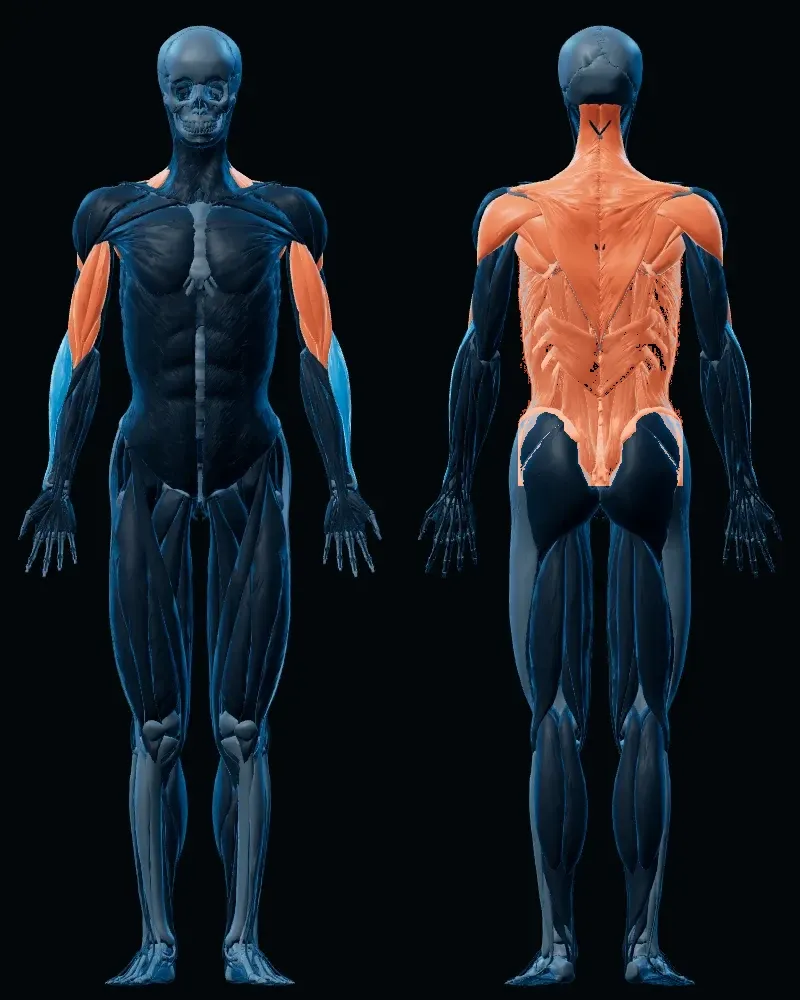
Muscles worked: pull day
Main movers: lats, upper back, rear delts, biceps and brachialis
Assisting: forearms
Table of contents
If you want to know how to flare lats, start with this: stand tall, put your hands on your hips, push your elbows out and slightly down, and feel the sides of your ribcage widen. That is a lat spread. It is a posing skill, but it is also the quickest way to find out what a lat contraction feels like.
Many lifters finish a whole back day with sore biceps and a pump in their forearms and nothing in their lats. This guide explains why that happens, which cues and drills are worth trying, and what the research on the mind-muscle connection does and does not show. It sits inside our complete back training guide.
Why can’t I feel my lats working?
It is one of the most common complaints in back training, and it is rarely a sign that something is wrong with you. A few ordinary reasons stack up.
You cannot see them. Your biceps and chest are in front of a mirror. Your lats are behind you. No visual feedback means your brain has to rely on feel alone.
The hands get there first. Every pulling movement starts at the handle. Your grip and biceps are the first things that report effort, so the sensation lands there.
The load is too heavy to control. Add weight and the body recruits whatever helps finish the rep: momentum, a lean back, a bent-elbow yank.
The pull starts in the wrong place. If the first thing you do is bend your elbows, the biceps are already doing the work.
The lats are a large muscle, and they attach from the upper arm to the spine and pelvis. For an anatomy refresher, see our functional anatomy of the back. The practical point is that their job is to pull the upper arm down and back toward your body. Any cue that makes that happen on purpose is useful.
What does the research say about the mind-muscle connection?
Be careful here, because the internet treats this as settled. It is not.
What supports it. In 2016, researchers tested 18 resistance-trained men on the bench press. When the men focused on using the pectoralis major or the triceps, muscle activity (EMG) went up at relative loads from 20-60% of 1RM, but not at 80% (Calatayud et al., 2016). An earlier study of 11 trained football players found a similar pattern: a verbal cue to use the chest raised pectoral EMG by 22% at 50% 1RM, and a triceps cue raised triceps EMG by 26%; at 80% the chest cue still shifted activity, but the triceps cue no longer did (Snyder et al., 2012). A later trial found that an internal focus might slightly (4-6%) raise pectoral or triceps activity depending on grip width, but the authors called this exploratory (Calatayud et al., 2018).
Then the growth data. In an 8-week trial, 30 untrained young men trained with either an internal focus (contract the target muscle) or an external focus (the outcome of the lift). Elbow flexor thickness rose 12.4% in the internal group and 6.9% in the external group, while quadriceps thickness changes were similar between the two groups (Schoenfeld et al., 2018).
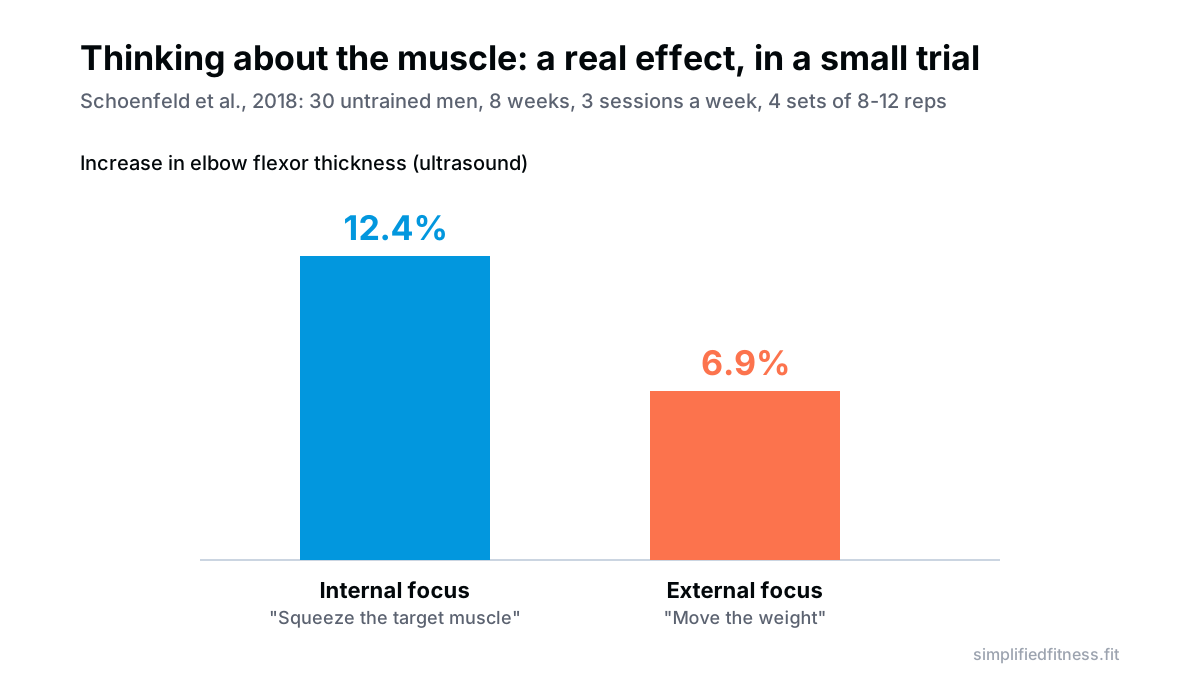
What complicates it. Every one of these studies used the bench press or arm and leg exercises, not the lats. Three of them used EMG, which tells you about electrical activity during a set, not about long-term growth. The growth trial used untrained men, 30 people is a small sample, and the advantage showed up in the arms only, not the quads. And a published commentary pointed out that focusing on a specific muscle has well-established negative effects on performance, so the benefit has to be weighed against that cost (Halperin and Vigotsky, 2016).
The strength data lean the other way. A 2021 meta-analysis of 10 studies found an external focus produced an acute strength advantage (SMD 0.34), and no significant long-term difference between internal and external focus for overall strength gains, though external focus was better for lower-body strength gains (Grgic et al., 2021).
Putting the two together, the cautious takeaway is this. Muscle-focused cues look useful on lighter and moderate sets, where the goal is to feel and load a specific muscle. When you are chasing a heavy top set, think about moving the bar. Neither side has been tested directly in lats, so this is an extrapolation.
How to flare your lats: the lat spread, step by step
The lat spread is a front or rear pose in bodybuilding. You do not need to be on stage to use it as a learning drill.
- Stand tall with your feet about shoulder width apart.
- Put your hands on your hips, thumbs pointing backward, fingers forward.
- Without shrugging, push your elbows out to the sides and slightly forward and down.
- Imagine pushing your ribcage wider, as if your armpits were being pulled away from each other.
- Hold for about 5 seconds, relax, repeat 3-4 times.
Use a mirror from the back if you can, or film yourself. Seeing the shape change gives the brain the visual feedback it normally lacks.
Does touch help? Tactile cueing for lats
Here is a simple trick that costs nothing. Ask a training partner to place two fingers on the side of your back, just below the armpit, where the lat sits along the ribcage. Then pull your elbows down toward your hips and try to push into their fingers.
I could not find a study that tests this on lat activation, so treat it as a coaching habit rather than a proven technique. Many lifters find it works because touch gives your brain a location to aim at. If you are alone, press your own fingertips into the same area while you do the lat spread.
Straight-arm pushdowns as a primer
The straight-arm cable pushdown (sometimes called a lat prayer or straight-arm pulldown) takes the elbows mostly out of the movement. Stand facing a high cable with a straight bar or rope, arms nearly straight, lean slightly forward, and sweep the bar down toward your thighs.
The lats move the arm; the biceps barely bend. Many lifters report that this makes the lat contraction obvious. Keep the load light enough that you can slow the lowering phase and keep your ribcage stable.
Do 2 sets of 12-15 before your pulldowns, and treat it as a primer. It is not a proven replacement for rows or pulldowns, and I do not know of a trial comparing straight-arm pushdowns with other lat exercises for growth.
The 5-minute lat wake-up before pulldowns
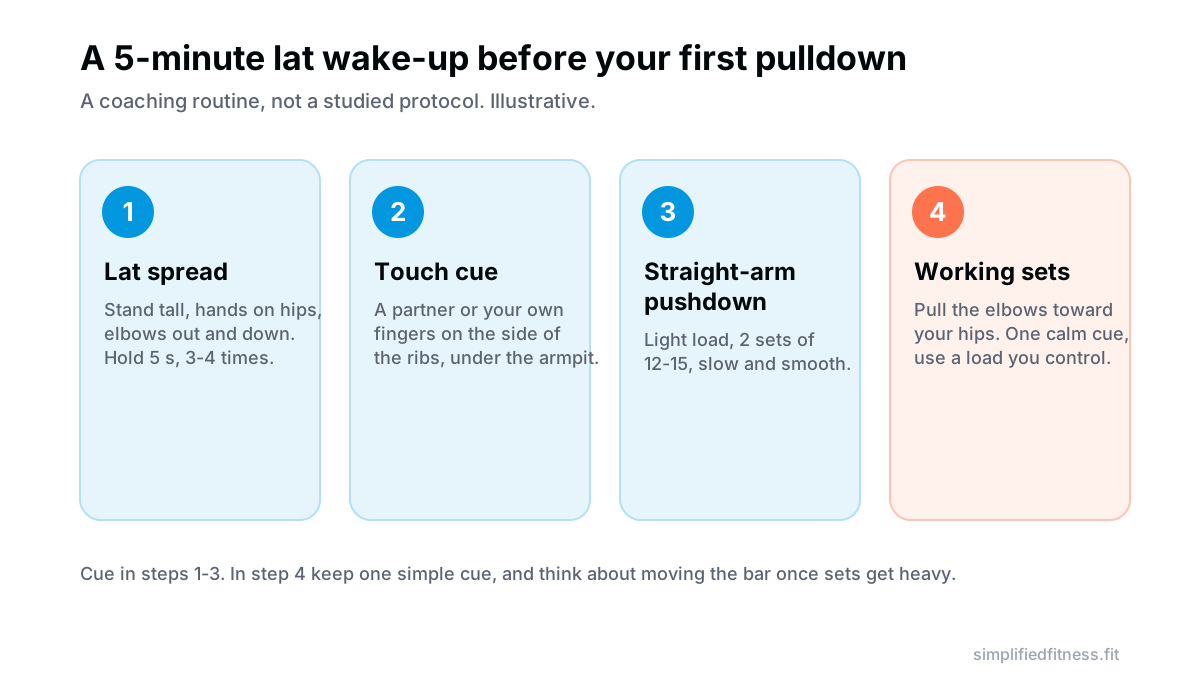
Here is how it fits together on the day:
- Lat spread, 3-4 holds of about 5 seconds.
- Touch cue, repeat the same pull-the-elbows-to-hips movement with fingers on the lat.
- Straight-arm pushdown, 2 sets of 12-15 with a light load.
- Working sets, start the pull by taking your shoulders slightly down, then drive your elbows toward your hips.
For the shoulder blade side of this, including what retraction versus depression feels like, read our guide on scapular retraction vs depression.
Fix the setup before blaming the muscle
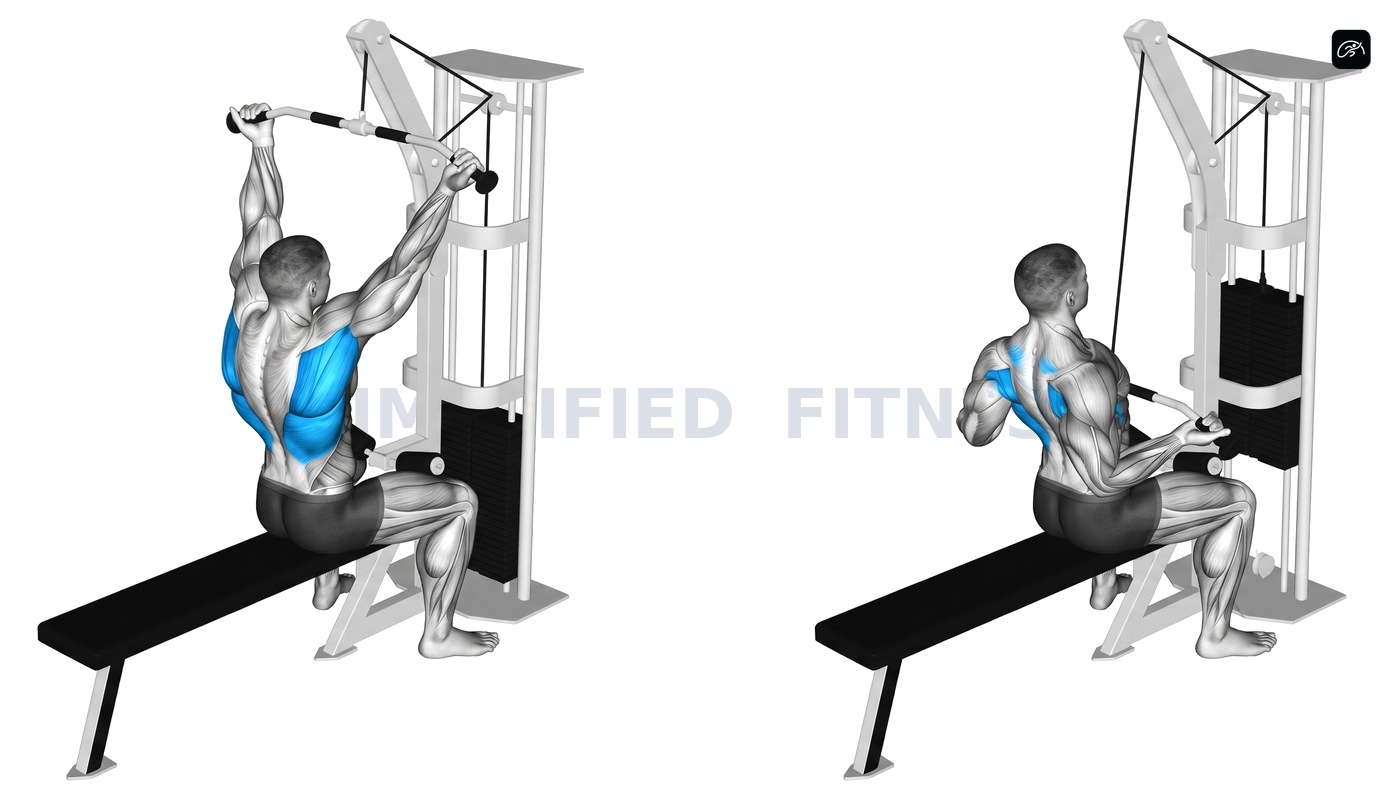
Cues cannot rescue a bad setup. A few checks that come up again and again:
- Grip. Hold the bar like a hook, not a clamp. A tight grip lights up the forearms.
- Elbow path. Think about pulling elbows down and slightly back, not hands to the bar. Our guide to arm path and elbow flare goes deeper.
- Load. If you need to lean back to finish the rep, the weight is too heavy for the feeling you are chasing.
- Tempo. Pause for a second at the bottom and lower in about 2-3 seconds.
On grip width, do not expect a wide grip to be a magic fix. In 15 men performing 6RM pulldowns, lat EMG was similar across narrow, medium and wide grips, and the authors concluded similar activation and hypertrophy can be expected with a grip 1-2 times the biacromial distance (Andersen et al., 2014). Another study on 12 men found that a pronated (overhand) grip activated the lats more than a supinated grip, whatever the width (Lusk et al., 2010). A 2026 narrative review agrees that effects of grip width were inconsistent, and that an anterior bar path (bar in front of the face) was the configuration most consistently linked with greater lat EMG, though it reflects acute EMG, not long-term growth (Di Fonza et al., 2026). Our deeper comparison is in wide vs close vs neutral grip pulldowns.
Thumbless (suicide) grip: help or hazard?
A thumbless grip, with the thumb on the same side as the fingers, can make you stop gripping the bar so hard. Some lifters find that moves the sensation from the forearms to the back.
I could not find a trial showing a thumbless grip grows lats better. The risk is real, though: if your hand slips, a loaded bar can fall. If you try it, use a machine pulldown with a fixed bar, keep the load light, and never use it with a heavy free bar over your face or chest. Lifting straps are a safer way to reduce grip dominance.
What if I still cannot feel my lats?
Give it a few weeks of consistent cueing before drawing conclusions, since learning to feel a muscle is a motor skill. If nothing changes, try these:
- Switch to a single-arm iliac pulldown, where it can be easier to see and feel the pull.
- Try a pull-up or chin-up variation with light assistance, and notice where the work lands.
- Lower the load by 20-30% and slow the tempo.
- Record a set from behind and watch your elbows.
If you notice sharp shoulder pain, tingling or numbness down the arm, or pain that wakes you up at night, stop and see a doctor or physiotherapist. A cue will not fix that, and this article cannot diagnose it.
You can also plan the weekly sets for your back with our training volume calculator, or follow our free pull day plan which already includes pulldowns and rows.
Quick reference: which cue for which job
| Goal | Cue to try | Load |
|---|---|---|
| Learn what a lat contraction feels like | Lat spread, hands on hips | Bodyweight |
| Find the location | Fingers on the side of the ribcage | Bodyweight or very light |
| Reduce biceps takeover | Straight-arm pushdown | Light |
| Feel the pull in pulldowns | Elbows to hips, loose grip | Moderate |
| Heavy strength sets | Move the bar, keep technique | Heavy |
Frequently asked questions
The FAQ section below answers the most common questions about flaring the lats, thumbless grips and when to get pain checked.
Frequently Asked Questions
How do I flare my lats?
Stand tall, place your hands on your hips and push your elbows out and slightly down, as if trying to widen your ribcage, without shrugging your shoulders. The lats connect the upper arm to the spine and pelvis, so pressing your hands into your hips and drawing the upper arms down against them tightens the lats while the shoulder blades spread. Hold for 5 seconds, repeat 3-4 times, and practise in front of a mirror.
Why can't I feel my lats working during pulldowns?
The usual reasons are poor visual feedback, a grip that is too tight, and biceps that reach fatigue before the lats do. The lats sit behind you, so you get little feedback from them, while the hands and biceps report effort first. Lower the load, think about pulling your elbows to your hips, and relax your grip.
Does a lat spread actually build lats?
There is no evidence that holding a lat spread on its own builds muscle. It is a posing skill and a way to learn what a lat contraction feels like. Use it as a 30-second warm-up cue, then do your real training with loaded pulldowns, rows and pull-ups.
Is the mind-muscle connection real?
Partly, yes. In resistance-trained men, focusing on a muscle increased its EMG activity at loads up to about 60% of 1RM in the bench press, and one 8-week trial found greater elbow flexor growth with an internal focus. The evidence is still small, mostly from untrained men or from the bench press, so use it as a tool for light and moderate sets rather than a rule.
Should I think about my lats or about moving the weight?
It depends on the goal and the load. Meta-analytic evidence shows an external focus tends to help strength and performance, while an internal focus may help you target a muscle on lighter, controlled sets. Use the muscle cue on your first warm-up sets and hypertrophy sets, and switch to the movement or the bar when the weight gets heavy.
What is a straight-arm pushdown and how does it help lat activation?
A straight-arm pushdown is a cable exercise where you keep your elbows almost straight and sweep the bar from shoulder height down to your thighs. Because the elbows barely bend, the biceps and triceps do less of the work and many lifters feel the lats more clearly. I would use it as a light primer for 2 sets of 12-15 before pulldowns, not as the centre of your back training.
Should I use a thumbless (suicide) grip on pulldowns?
A thumbless grip can help some lifters stop squeezing the bar so hard, which may let them feel the pull in the back rather than the forearms. There is no study showing it grows lats more, and it carries a real risk on free-hanging or heavy bars. If you try it, use a lat pulldown machine with the bar secured, a light load and never over your face on a loose bar.
Does grip width change lat activation?
Less than most people think. In 15 men doing 6RM pulldowns, lat EMG was similar across narrow, medium and wide grips, and another study found a pronated grip activated the lats more than a supinated one regardless of width. Pick a grip you can pull comfortably and spend your attention on the elbow path.
How long does it take to learn to feel my lats?
Most lifters notice a clearer lat sensation within a few sessions of deliberate cueing, but this varies and I am not aware of a study that times it. Learning to feel a muscle is a motor skill, so it improves with repetition. Do 3-5 minutes of cueing at the start of each back day for a few weeks and reassess.
Why do my biceps burn more than my lats on rows and pulldowns?
The biceps are smaller and cross the elbow, so on any pulling exercise they can reach fatigue first, especially if you start the pull by bending your elbows. Starting the movement by pulling your shoulder blades down and your elbows toward your hips shifts more of the work onto the lats. If the biceps still dominate, try a lighter load, a slower tempo or a straps-assisted grip.
Can I flare my lats if I have a very narrow frame or short torso?
Yes, the lat spread skill is trainable whatever your frame, although how wide it looks depends on bone structure and muscle size. The mechanism is the same: the lats pull the arm toward the trunk. Focus on feeling the contraction rather than comparing yourself to a bodybuilder on stage.
When should I see a doctor about back or shoulder pain with pulldowns?
See a doctor or physiotherapist if you have sharp shoulder pain, numbness or tingling in the arm, pain at night, or discomfort that does not settle within a week or two of backing off. These can point to a problem that a cue will not fix. This article is general education, not a diagnosis.
Sources & References
Every claim above is checked against peer-reviewed research (PubMed, U.S. National Library of Medicine) or guidance from established health bodies. How we fact-check.
- Schoenfeld BJ, et al. Differential effects of attentional focus strategies during long-term resistance training. Eur J Sport Sci. 2018. PMID: 29533715
- Calatayud J, et al. Importance of mind-muscle connection during progressive resistance training. Eur J Appl Physiol. 2016. PMID: 26700744
- Halperin I, et al. The mind-muscle connection in resistance training: friend or foe? Eur J Appl Physiol. 2016. PMID: 26896956
- Snyder BJ, et al. Effect of verbal instruction on muscle activity during the bench press exercise. J Strength Cond Res. 2012. PMID: 22076100
- Calatayud J, et al. Attentional focus and grip width influences on bench press resistance training. Percept Mot Skills. 2018. PMID: 29231125
- Grgic J, et al. Acute and long-term effects of attentional focus strategies on muscular strength: a meta-analysis. Sports (Basel). 2021. PMID: 34822352
- Andersen V, et al. Effects of grip width on muscle strength and activation in the lat pull-down. J Strength Cond Res. 2014. PMID: 24662157
- Lusk SJ, et al. Grip width and forearm orientation effects on muscle activity during the lat pull-down. J Strength Cond Res. 2010. PMID: 20543740
- Di Fonza D, et al. Electromyographic analysis of latissimus dorsi activation during common resistance training exercises: a narrative review. J Funct Morphol Kinesiol. 2026. PMID: 42647355

Umair Hazrami · Founder & Head Coach, Simplified Fitness
Umair Hazrami founded Simplified Fitness and the Simplified Lifter channel to cut through fitness noise. With 4+ years of consistent training and 10+ coaching clients, he writes every guide from the peer-reviewed research and links the sources so you can check them. Our editorial standards.
Educational content only, not medical advice. If you have a medical condition, are pregnant, or take medication, talk to a qualified doctor before changing your diet, supplements or training. Full disclaimer.
Keep reading
Exercise Technique
Barbell Bent-Over Rows: Spinal Load, Hamstring Fatigue and Lat Growth
Is the barbell bent over row hypertrophy gold or a fatigue generator? See what the research says about spinal load, torso angles and better rows for lat growth.
8 min read
Exercise Technique
Chest-Supported Rows: Train Your Upper Back Without Lower Back Fatigue
Chest supported row hypertrophy explained: why your lower back quits first, how T-bar, incline and seal rows fix it, and what the research says.
8 min read
Exercise Technique
Complete Back Workout Design: Balancing Vertical Pulls, Horizontal Rows, and Lumbar Recovery
A science-based back workout routine: weekly sets, how to balance pulldowns and rows, and how to protect your lower back, with a sample pull day plan.
9 min read

Exercise Technique
Conventional Deadlifts for Back Hypertrophy: Stimulus-to-Fatigue Ratio Analysis
Are deadlifts good for back hypertrophy? A stimulus-to-fatigue breakdown of what they build, what they miss for lats, and how to program or replace them.
8 min read