Complete Back Workout Design: Balancing Vertical Pulls, Horizontal Rows, and Lumbar Recovery
A science-based back workout routine: weekly sets, how to balance pulldowns and rows, and how to protect your lower back, with a sample pull day plan.
TL;DR. The short answer
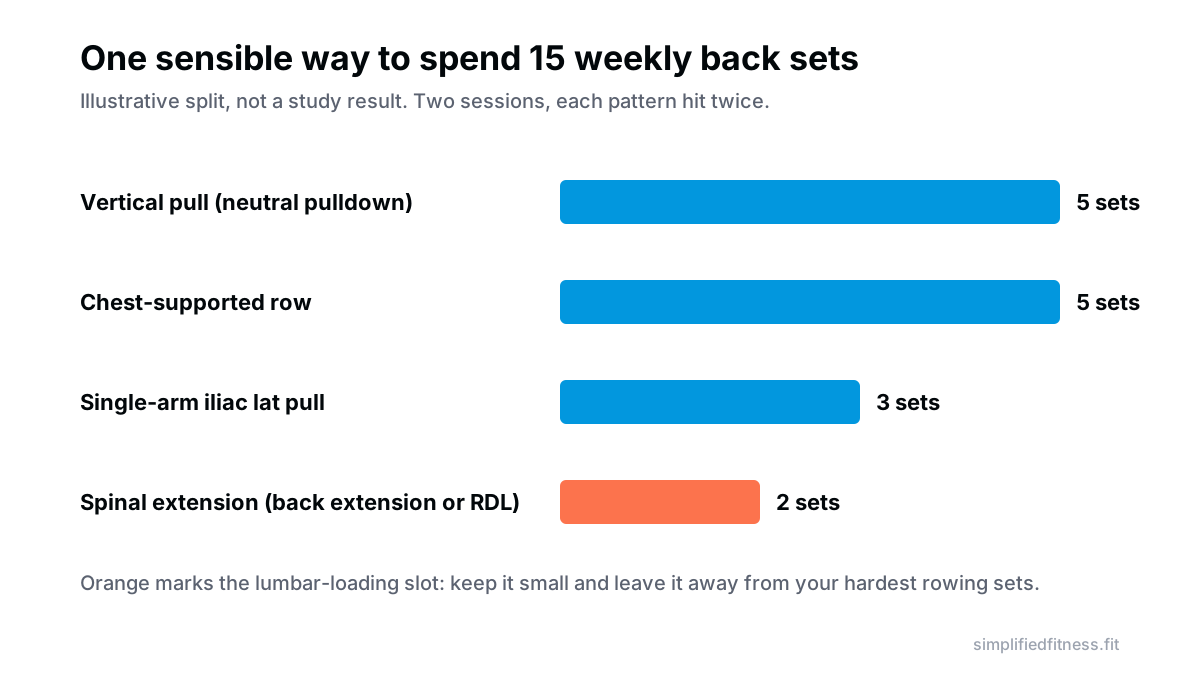
- A back workout routine built on the science covers four jobs: one vertical pull, one supported row, one single-arm lat pull, and one small spinal extension slot.
- Weekly volume is dose-dependent: a 2017 meta-analysis found more weekly sets per muscle were linked to more growth, so 10-16 direct back sets per week is a reasonable range for most lifters.
- Training each muscle, back included, at least twice a week looks better than once a week when volume is equal, based on a 2016 meta-analysis that was not back-specific.
- Rows differ a lot in lower back cost. In one small lab study the standing bent-over row loaded the lumbar spine most and the inverted row least.
- Lower back pain that radiates into the leg, causes numbness or weakness, or does not settle needs a doctor, not a new exercise.
Part of our complete guide: Complete Back Training Guide: Lats vs Upper Back, Best Exercises and a Hypertrophy Workout

Muscles worked: upper back
Main movers: traps, rhomboids, teres major, infraspinatus and teres minor
Assisting: rear delts, biceps and brachialis
Table of contents
The back workout routine science points to is simpler than most programs make it. Pick one vertical pull, one supported row, one single-arm lat movement and a small dose of spinal extension, do about 10-16 hard sets a week across two sessions, and keep your lower back from being the thing that limits you.
This article is the practical capstone of our complete back training guide. The guide covers anatomy and every exercise in depth. Here we put the pieces into a week you can actually run.
What should a complete back workout include?
Think in jobs, not in exercises. Your back is a big group of muscles (lats, mid and lower traps, rhomboids, teres major, spinal erectors) and no single movement hits all of them well.
Four jobs cover it:
- Vertical pull for lat width, such as a neutral-grip pulldown.
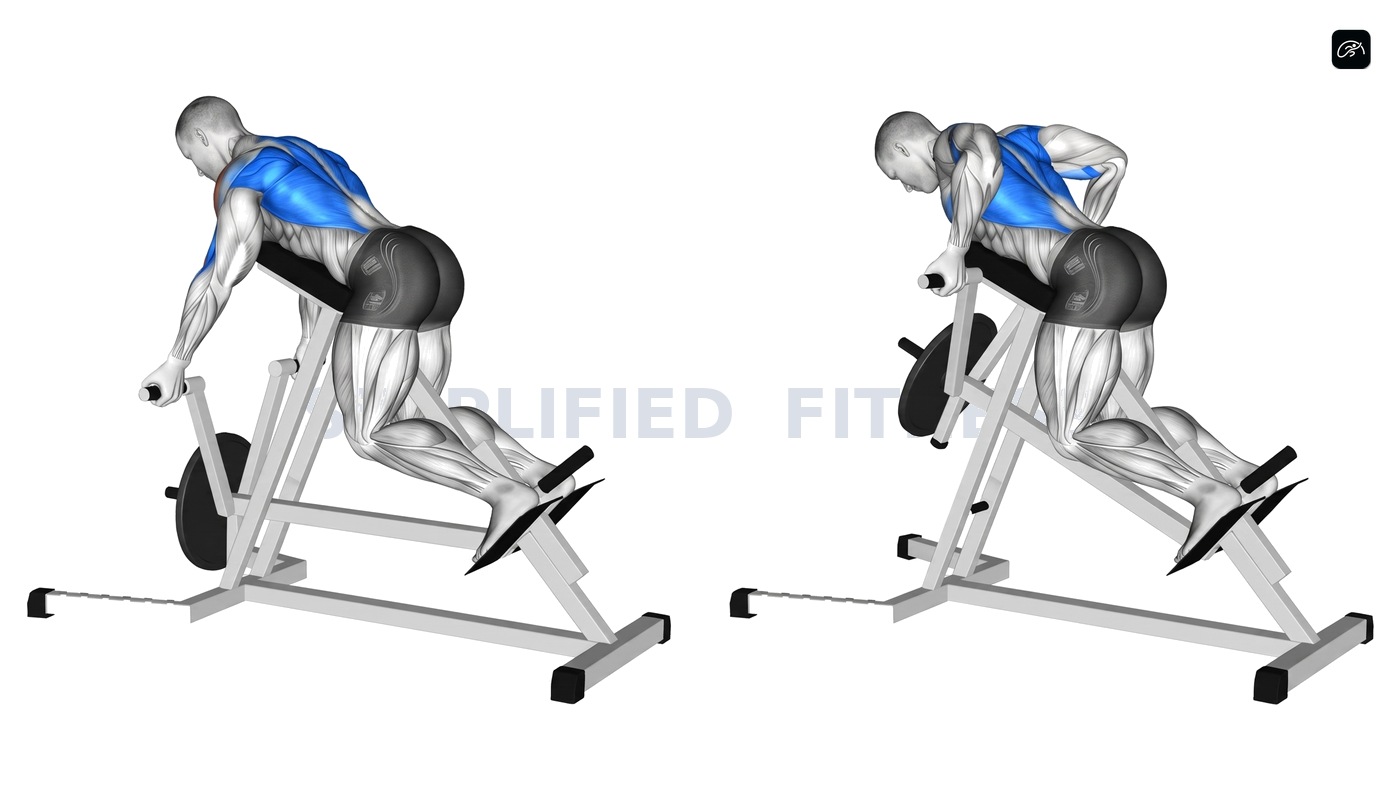
- Supported horizontal row for upper back thickness, such as a chest-supported row.
- Single-arm lat pull with a lower, more diagonal line, such as an iliac lat pulldown.
- Spinal extension in small doses, such as a back extension.
That is four exercises. Not eleven.
If you want to see the lat’s regional anatomy behind that third slot, read about single-arm iliac lat pulldowns. For the supported row, our piece on chest-supported rows for upper back hypertrophy covers setup.
How many sets per week do you need for back growth?
Volume is the biggest lever you control, and the research on it is fairly consistent in direction, if not in exact numbers.
A 2017 meta-analysis pooled 34 treatment groups from 15 studies and found a graded dose-response between weekly sets and muscle growth. Each added weekly set was associated with a small increase in effect size, equal to about 0.37% extra gain. Groups doing 10 or more sets per muscle showed a trend over lower volumes, though that three-level comparison did not reach significance (Schoenfeld et al., 2017).
A trained-lifter trial points the same way. In 27 resistance-trained men, 8 weeks of 16, 24 or 32 weekly sets per muscle group all increased muscle thickness, and 32 sets beat 16 for triceps and for the lower body (Brigatto et al., 2022). Note what it did not test: the back, and long-term recovery on a normal life schedule.
So where does 10-16 come from? It is a practical range, not a magic number. It sits above the low volumes that tend to underperform and below the point where most people with jobs, sleep debt and a hot commute stop recovering. Treat it as an estimate and adjust.
Rough guide for the week:
| Experience | Starting direct back sets/week | Add when |
|---|---|---|
| New to structured back training | 8-10 | Every set reaches 1-3 reps from failure with clean form |
| Intermediate | 10-14 | Lifts have stalled 2-3 weeks and sleep is fine |
| Advanced, recovers well | 14-16, occasionally more | Progress is steady and joints feel good |
Direct sets means sets where the back is the main target. Rows and pulldowns also hit your biceps and rear delts, so do not stack heavy volume of all three and wonder why your elbows hurt. You can count your own numbers with our training volume calculator.
Is it better to train back twice a week?
Probably yes, when volume is the same. A 2016 meta-analysis of ten studies found higher training frequency was linked to larger hypertrophy effect sizes (0.49 vs 0.30), and the authors concluded major muscle groups should be trained at least twice a week. Whether three times beats twice was left open (Schoenfeld et al., 2016).
Practical result: spread your weekly sets over two pull days. It also lets you do each set fresher, which is the quiet benefit nobody advertises.
How do you balance vertical pulls and horizontal rows?
Equal-ish. Vertical pulls load the lats with the arm moving down from overhead; rows load the lats and mid back with the elbow driving behind you. Neither replaces the other.
A simple rule: match sets between the two within one or two, then tilt toward whichever is lagging. If your lats are fine but you look flat from the side, push the row slot. If you pull like a champ on rows but your torso looks narrow from the front, add to the pulldown.
Grip is not the lever people think it is. In a 2014 study of 15 men, 6RM loads were slightly lower with a wide grip (77.3 kg) than narrow or medium (about 80 kg), and lat activation over the whole rep was similar across grips at 1, 1.5 and 2 times shoulder width (the wide grip showed more lat activity only in the lowering phase). The authors suggested similar hypertrophy should be expected (Andersen et al., 2014). A separate study of 12 men found a pronated grip activated the lats more than a supinated grip, regardless of width (Lusk et al., 2010).
These two studies are small EMG studies in healthy men over a few reps. Surface EMG shows how active a muscle is, not how much it will grow. So the cautious takeaway is: choose a grip that lets you load the movement hard without elbow or shoulder irritation, and move on. We go deeper in wide vs close and neutral grip pulldowns.
How do you protect your lower back in a back workout?
Here is the part that gets skipped. Not all rows cost the same.
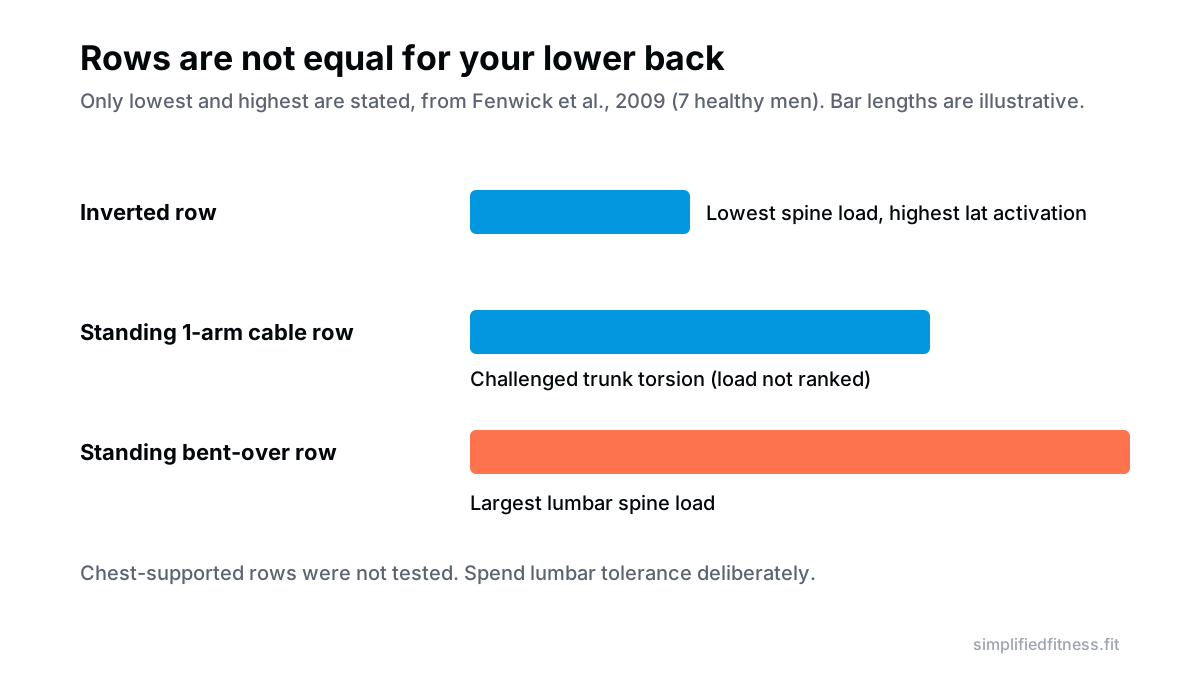
In a 2009 lab study of seven healthy men, researchers compared the inverted row, the standing bent-over row and the standing one-arm cable row. The inverted row gave the highest lat and upper back activation with lower lumbar erector activity and the lowest spine load. The standing bent-over row produced large, symmetrical activation across the back but also the largest lumbar spine load (Fenwick et al., 2009).
Seven subjects is tiny, and it measured short efforts in healthy men, so treat it as a hint about mechanics, not a verdict on injury risk. The mechanics are intuitive: when you hold a hinged position under load, your erectors work the whole set. A chest-supported row was not in this study, but the pad removes that hinge hold, which is why we use it as the main row.
What that means for design:
- Make the supported row your main horizontal pull.
- Keep any heavy hinge, such as a barbell row or deadlift, to one slot a week. Our notes on barbell bent-over rows and spinal load explain the trade-off.
- Do spinal extension after, not before, your heavy pulls.
- Stop sets with a rep or two left on lumbar-loaded work.
The most common mistake here is finishing a pull day with heavy deadlifts, barbell rows and back extensions, then wondering why your lower back is sore for four days and legs are flat the next session.
For the extension slot, see back extensions and RDLs for erector hypertrophy. If you wonder whether you need deadlifts at all, the fatigue-to-stimulus analysis of conventional deadlifts covers it.
A sample two-day back routine
Here is a layout using the four jobs. It is an example, not a prescription from a trial. Rep ranges of 6-12 on the compound lifts and 10-15 on the finishers are standard hypertrophy territory.
Pull A (width emphasis)
| Order | Exercise | Sets x reps |
|---|---|---|
| 1 | Neutral-grip pulldown | 3 x 8-12 |
| 2 | Chest-supported row | 2 x 8-12 |
| 3 | Single-arm iliac lat pulldown | 2 x 10-15 |
| 4 | Back extension | 1 x 10-15 |
Pull B (thickness emphasis)
| Order | Exercise | Sets x reps |
|---|---|---|
| 1 | Chest-supported row | 3 x 6-10 |
| 2 | Neutral-grip pulldown | 2 x 8-12 |
| 3 | Single-arm iliac lat pulldown | 1 x 10-15 |
| 4 | Back extension or RDL | 1 x 10-12 |
Total: 15 direct sets (8 on Pull A, 7 on Pull B), inside the 10-16 range. Rest 2-3 minutes between the heavy compound sets and about 90 seconds on the single-arm and extension work. For a ready-made day with arms included, use our pull day plan.
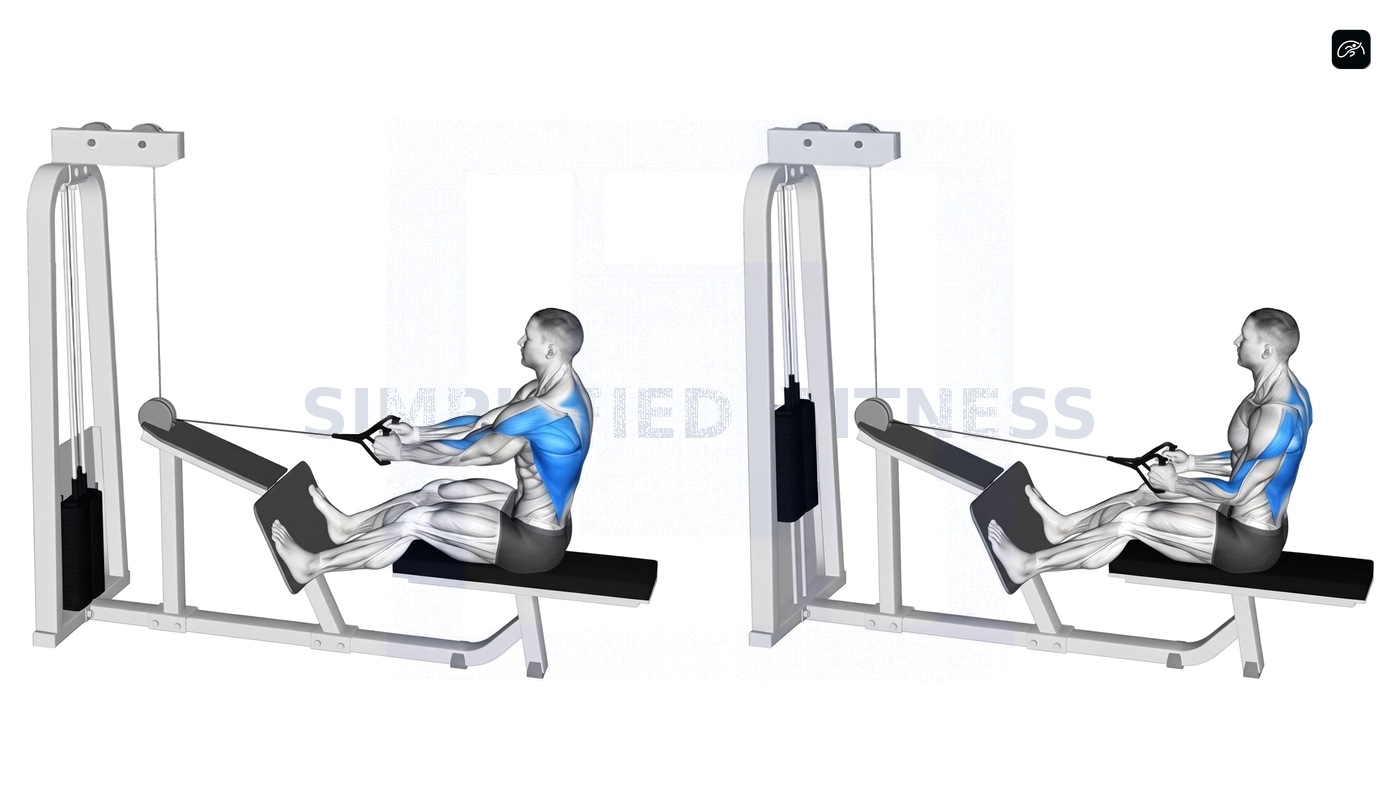
If your gym has a seated cable row but no chest-supported machine, it can fill the row slot, though it asks more of your trunk. See seated cable row attachments and elbow drive for how to set it up.
How do you manage fatigue across the week?
Fatigue is what ends good programs. A few levers, in order of ease:
- Count your sets honestly. Warm-ups do not count; failed junk sets do not help either.
- Put your two pull days apart (for example Monday and Thursday), with leg day not directly before a heavy lumbar session.
- Progress one variable at a time. Add a rep, then load, then, only if recovery is good, a set.
- Deload when needed. If strength drops for two sessions in a row, cut sets by a third for a week.
- Eat and sleep for it. Protein of about 1.6-2.2 g per kg is a common target; for a vegetarian lifter that can mean dal, paneer, curd, soya chunks and eggs spread across the day. Our diet plan shows a template.
Fatigue management is also why we keep the spinal slot small. Your erectors also work to stabilise every squat, hinge and carry, so they collect fatigue from the whole week, not just back day.
When to change the plan
Run the routine for 8-12 weeks before judging it. After that, rotate the exercise inside a slot, not the slot itself: neutral pulldown to pull-up, chest-supported row to T-bar row. The job stays the same, the stress on your joints changes a little. If you want a rotation option for the vertical slot, our comparison of pull-ups and chin-ups is a good place to start.
When to see a doctor
Normal back training soreness is a dull ache that fades in a few days. See a doctor or physiotherapist if you get pain that shoots down a leg, numbness or tingling, leg weakness, pain after a fall or a pop, or lower back pain that is getting worse over a week or two. This article is general education and cannot diagnose your back.
The short version
Four jobs, 10-16 sets, two sessions, one small spinal slot, and a supported row to protect your lower back. The research on volume and frequency is decent. The research on exercise selection is mostly small EMG and biomechanics studies, so keep your choices flexible and let your own training log decide.
Frequently Asked Questions
What is the best back workout routine?
The best routine covers each job once or twice: a vertical pull, a supported horizontal row, a single-arm lat movement and a small amount of spinal extension. Research on volume suggests more weekly sets produce more growth, so 10-16 hard sets spread over two sessions is a sound starting range. Run it for 8-12 weeks, add reps or load, and change only what stalls.
How many sets per week should I do for back?
Most lifters do well with about 10-16 direct sets per week. A 2017 meta-analysis found a graded dose-response, with each extra weekly set linked to a small extra gain in muscle size. Start near 10, add a set or two every few weeks, and stop adding when recovery or performance slips.
How often should I train back per week?
Twice a week is a good default. A 2016 meta-analysis found training a muscle twice weekly gave larger hypertrophy effect sizes than once weekly when volume was matched. Split your sets across two pull sessions instead of cramming them into one.
Should I do pulldowns or rows first?
Put the movement you most want to progress first, since fatigue builds through the session. If lat width is the priority, start with the vertical pull; if upper back thickness lags, start with the supported row. Keep that order for a block so your numbers are comparable.
Do I need both vertical and horizontal pulls?
Yes, for a complete routine. Vertical pulls load the lats through a long arm path above the shoulder, while rows train the lats and upper back with the elbow moving behind the torso. Having both gives you varied angles and keeps shoulder and elbow stress spread out.
Are barbell rows bad for your lower back?
Not inherently, but they are demanding. A 2009 study of seven healthy men found the standing bent-over row produced the largest lumbar spine load of the rows tested. Chest-supported rows were not tested, but if your lower back limits your sets, the pad takes the hinge hold off your erectors so you can train the upper back with less spinal demand.
Do I need deadlifts for a big back?
No. Deadlifts are a fine strength lift, but they are costly in fatigue, and rows, pulldowns and a back extension can cover back growth without them. If you do include them, count them in your weekly fatigue budget and trim other lower back work.
Does wide grip build a wider back?
Probably not by much. A 2014 study of 15 men found similar lat activation at 1, 1.5 and 2 times shoulder width, so grip width is a minor lever. Pick a grip you can pull hard and pain-free.
How many back exercises per workout?
Three to four is plenty for most people. Beyond that the later sets are usually done tired and with sloppy form. Choose different movement patterns and do each with real effort.
How do I stop my lower back getting sore after back day?
Keep the heaviest spinal-loading lift to one slot, use a supported row for your main horizontal pull and leave one or two reps in reserve on extension work. The mechanism is simple: less repeated spinal load means less fatigue in the erectors. If soreness lasts beyond a few days, ease off and see a professional if it persists.
Can I do back and biceps on the same day?
Yes, and it is the classic pull day for a reason. Rows and pulldowns already train the biceps hard, so biceps often need fewer direct sets. Do back first when it is the priority, then add your arm work.
Should I train to failure on back exercises?
Stopping a rep or two short of failure is a reasonable default, especially on lumbar-loaded lifts. Grip and technique often fail before the back does, and failure costs recovery. Save true failure for safer, supported movements like pulldowns.
How long does it take to see back growth?
Visible changes usually take a couple of months of consistent training, and the back is hard to see on yourself. Strength going up on the same exercises is your earlier signal. Track a few lifts over 8-12 weeks before judging the plan.
Sources & References
Every claim above is checked against peer-reviewed research (PubMed, U.S. National Library of Medicine) or guidance from established health bodies. How we fact-check.
- Schoenfeld BJ, et al. Dose-response relationship between weekly resistance training volume and increases in muscle mass: A systematic review and meta-analysis. J Sports Sci. 2017. PMID: 27433992
- Schoenfeld BJ, et al. Effects of Resistance Training Frequency on Measures of Muscle Hypertrophy: A Systematic Review and Meta-Analysis. Sports Med. 2016. PMID: 27102172
- Fenwick CM, et al. Comparison of different rowing exercises: trunk muscle activation and lumbar spine motion, load, and stiffness. J Strength Cond Res. 2009. PMID: 19620925
- Andersen V, et al. Effects of grip width on muscle strength and activation in the lat pull-down. J Strength Cond Res. 2014. PMID: 24662157
- Lusk SJ, et al. Grip width and forearm orientation effects on muscle activity during the lat pull-down. J Strength Cond Res. 2010. PMID: 20543740
- Brigatto FA, et al. High Resistance-Training Volume Enhances Muscle Thickness in Resistance-Trained Men. J Strength Cond Res. 2022. PMID: 31868813

Umair Hazrami · Founder & Head Coach, Simplified Fitness
Umair Hazrami founded Simplified Fitness and the Simplified Lifter channel to cut through fitness noise. With 4+ years of consistent training and 10+ coaching clients, he writes every guide from the peer-reviewed research and links the sources so you can check them. Our editorial standards.
Educational content only, not medical advice. If you have a medical condition, are pregnant, or take medication, talk to a qualified doctor before changing your diet, supplements or training. Full disclaimer.
Keep reading
Exercise Technique
Barbell Bent-Over Rows: Spinal Load, Hamstring Fatigue and Lat Growth
Is the barbell bent over row hypertrophy gold or a fatigue generator? See what the research says about spinal load, torso angles and better rows for lat growth.
8 min read

Exercise Technique
Chest-Supported Rows: Train Your Upper Back Without Lower Back Fatigue
Chest supported row hypertrophy explained: why your lower back quits first, how T-bar, incline and seal rows fix it, and what the research says.
8 min read

Exercise Technique
Conventional Deadlifts for Back Hypertrophy: Stimulus-to-Fatigue Ratio Analysis
Are deadlifts good for back hypertrophy? A stimulus-to-fatigue breakdown of what they build, what they miss for lats, and how to program or replace them.
8 min read
Exercise Technique
Dumbbell Pullover Tension Curve: Why You Feel Triceps and Chest, Not Lats
Dumbbell pullover tension curve explained: why triceps and chest burn instead of lats, what the EMG research shows, and how to fix the exercise or swap it.
8 min read