Dumbbell Pullover Tension Curve: Why You Feel Triceps and Chest, Not Lats
Dumbbell pullover tension curve explained: why triceps and chest burn instead of lats, what the EMG research shows, and how to fix the exercise or swap it.

TL;DR. The short answer
- The dumbbell pullover tension curve is lopsided: with straight arms the weight gives almost no resistance with the dumbbell over your shoulders and the most resistance at the bottom stretch, which is a poor match for how the lats work.
- EMG research on pullovers found the exercise emphasized the pectoralis major more than the latissimus dorsi, and a 2026 narrative review reached the same conclusion.
- Triceps burn usually comes from elbows bending and straightening during the rep, and from the long head being stretched when your arms go overhead.
- A cable pullover or a pulldown keeps tension on the lats through the arc, so for back width they are usually the better choice. This is a biomechanical inference, not a head-to-head growth trial.
- Shoulder pain or numbness during overhead loaded stretching is a reason to stop and see a doctor or physiotherapist.
Part of our complete guide: Complete Back Training Guide: Lats vs Upper Back, Best Exercises and a Hypertrophy Workout
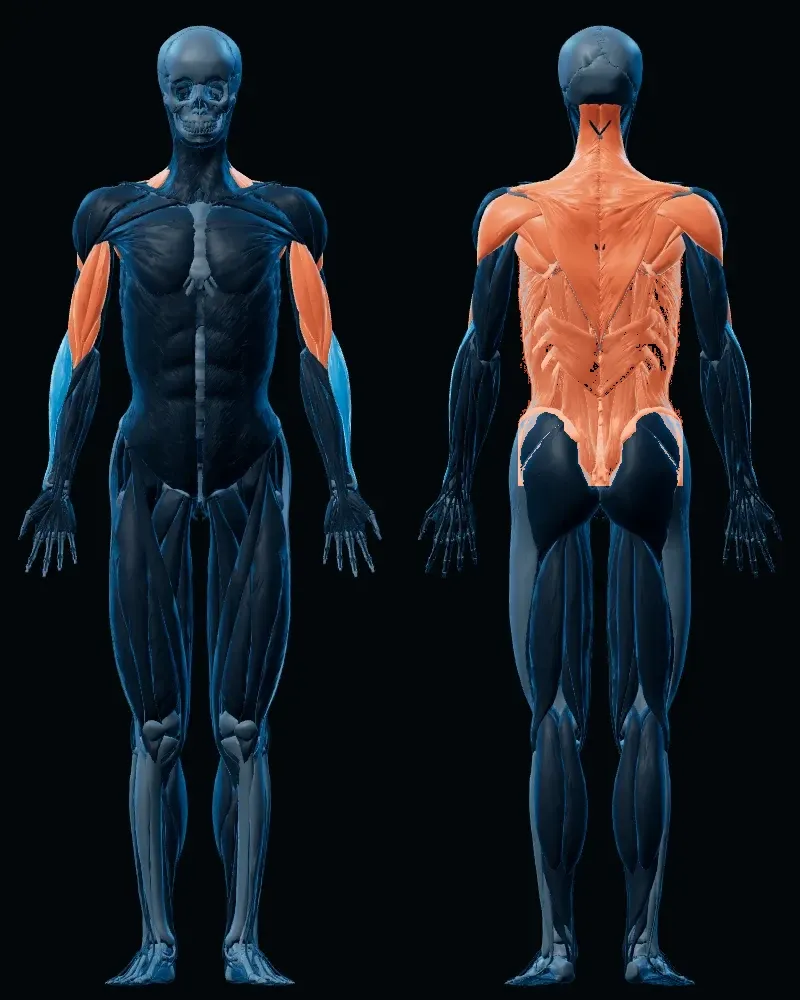
Muscles worked: pull day
Main movers: lats, upper back, rear delts, biceps and brachialis
Assisting: forearms
Table of contents
If dumbbell pullovers leave your triceps and chest burning while your lats stay quiet, you are not doing something wrong. You are running into the dumbbell pullover tension curve: a free weight that gives almost no resistance at the top, maximum resistance at the bottom stretch, and a direction of pull that suits the chest more than the lats.
This guide is part of our complete back training guide. Here we stay on one question: what the geometry of the lift does to your muscles, what the research says, and how to fix it or replace it. For the head-to-head with cables, see our companion piece on dumbbell pullovers vs cable lat pull-ins.
What is the dumbbell pullover tension curve?
A dumbbell only pulls one way: straight down. How hard it twists your shoulder depends on one thing, the horizontal distance between the dumbbell and the shoulder joint. Weight times that distance is the external torque.
Lie on a bench with straight arms and the dumbbell over your shoulders. The horizontal distance is close to zero, so the torque is close to zero. Lower the weight back behind your head and that distance grows, so the torque grows with it. Peak demand lands at the bottom, where the arms are roughly overhead.
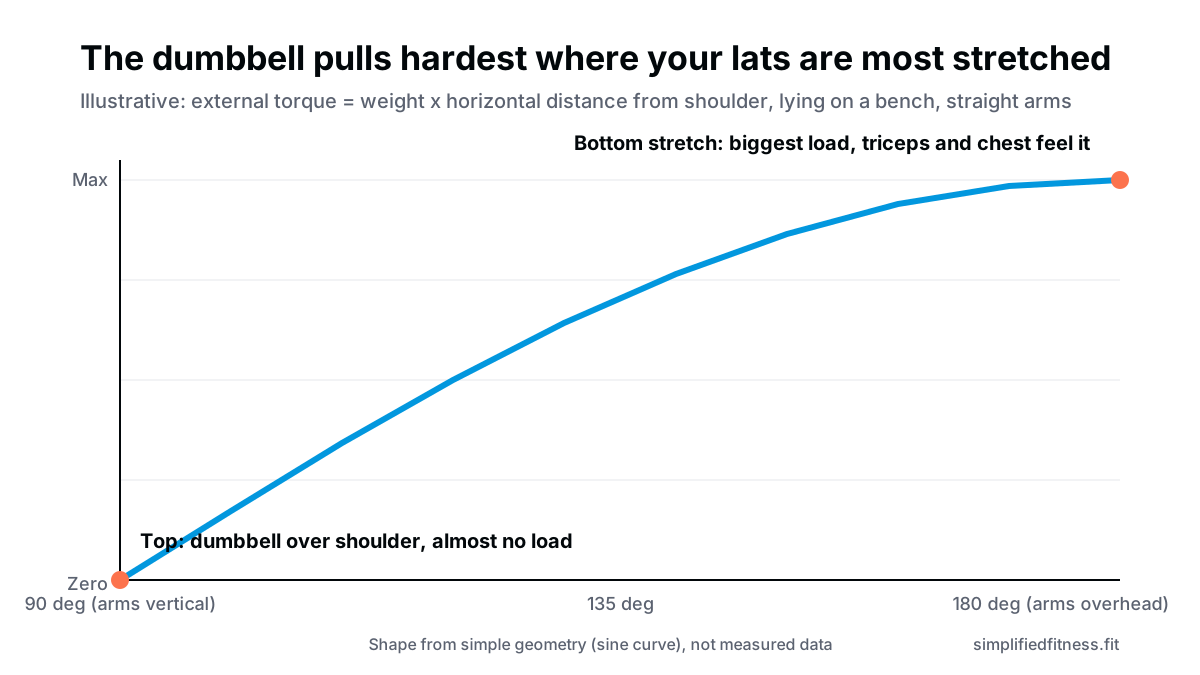
This is the part that surprises people. The exercise is hardest where you are most stretched and easiest where you are most contracted. Some lifters like that stretch-heavy profile, and there is a reasonable case for it (more on that below). But it also means the lats get a long dead zone at the top.
Why do pullovers hit the triceps and chest instead of the lats?
Three things stack up.
1. The chest is well placed for this movement. Shoulder muscle moment arms have been measured in cadavers. A 1997 tendon excursion study found the pectoralis major, latissimus dorsi and teres major all have large adductor (depressor) moment arms (Kuechle et al., 1997), and a systematic review of glenohumeral moment arms reached the same view, adding that the lats and teres major also have prominent moment arms in extension (Hik and Ackland, 2019). So the pecs and lats share the job. Which one dominates depends on the arm position and where the load pulls.
2. The EMG evidence leans toward the pecs. In a small study, 8 healthy men did one set of 10 barbell pullovers at 30% of body weight. The authors concluded the exercise emphasized the pectoralis major more than the latissimus dorsi, and that activation depended on the external force lever arm (Marchetti and Uchida, 2011). A 2026 narrative review of 23 EMG studies says the same: the pullover appeared to preferentially activate the pectoralis major rather than selectively target the lats (Di Fonza et al., 2026).
3. The triceps are doing two jobs. The long head crosses the shoulder, so it is stretched when your arms go overhead. And if your elbows bend on the way down and straighten on the way up, you have quietly built a lying triceps extension. That is the most common mistake here, and it is why the burn shows up behind your arms.
What does the research say about joint angle?
A 2022 study put 15 young resistance-trained men through maximal isometric pullovers and pulldowns at five shoulder positions (0, 45, 90, 135 and 180 degrees) and measured peak force and EMG from the pecs, lats and rear delts (Teixeira et al., 2022). Joint position significantly affected force and EMG for the muscles measured, while rating of perceived exertion did not differ. In plain terms, where your arm sits changes what you can produce and which muscles light up.
That is useful, and also limited. These were maximal isometric efforts, not a full set of dynamic reps with a dumbbell, in young trained men. It tells us angle matters. It does not tell us that one angle makes lats grow more.
Is the stretch at the bottom a good thing for lats?
This is where the pullover gets some fair credit.
A 2026 review of muscle length and exercise selection concluded that training at longer muscle lengths often looks favourable for growth, but that the benefit tends to appear when there is a relevant external torque in the lengthened position (Pedrosa et al., 2026). The dumbbell pullover does put a lot of torque in the stretched position, which is a point in its favour.
Now the other side. A Bayesian meta-analysis of 12 studies in young adults found that training at longer and shorter mean muscle lengths produced similar regional hypertrophy, with trivial differences and a caution about how small the length gaps were between conditions (Varovic et al., 2025). And a separate meta-analysis of range of motion found full range of motion beat partial range for strength and lower-limb hypertrophy, with no clear difference in muscle thickness or fascicle length overall (Pallares et al., 2021).
Why might these not line up? The studies differ in muscle, exercise and how much length actually changed. None of them tested pullovers for lat growth, and we dig into the long-length argument for lats in our dumbbell pullovers vs cable lat pull-ins piece. So a defensible take is: the deep stretch is a plus, the dead zone at the top is a minus, and the lats are not the main muscle taking the load. A cautious takeaway is to count the pullover as a stretch-focused accessory, not your core back width movement.
How do cable pullovers fix the resistance profile?
A cable pulls toward the stack, not toward the floor. Set the pulley high and stand facing it, and the line of pull stays in front of and above you through the arc. So the lats can keep working at the top, where a dumbbell goes slack.
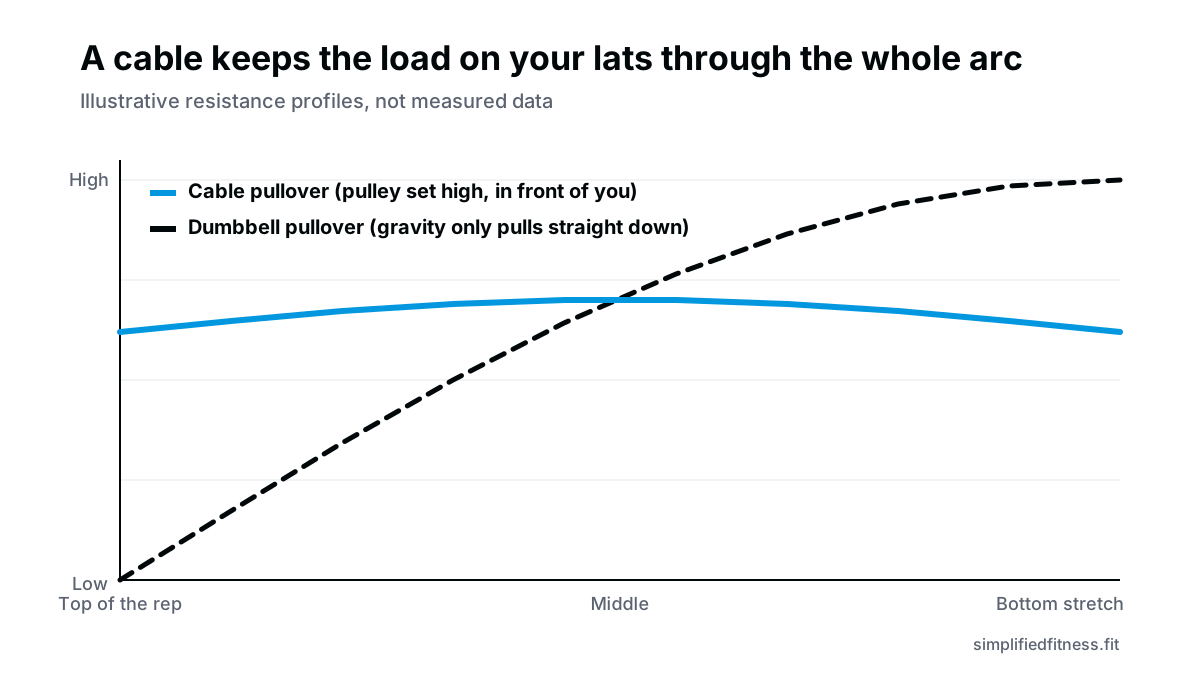
I want to be clear about the limits. I did not find a long-term trial comparing cable and dumbbell pullovers for lat growth, so this is biomechanical reasoning. It is sound reasoning, but still reasoning. Pulley height, hinge angle and the attachment all change the result, which we cover in our cable setup guide, and the broader trade-offs are in free weights vs cables vs machines.
How to do a dumbbell pullover so the lats actually work
If you like the movement and want to keep it, tighten the details.
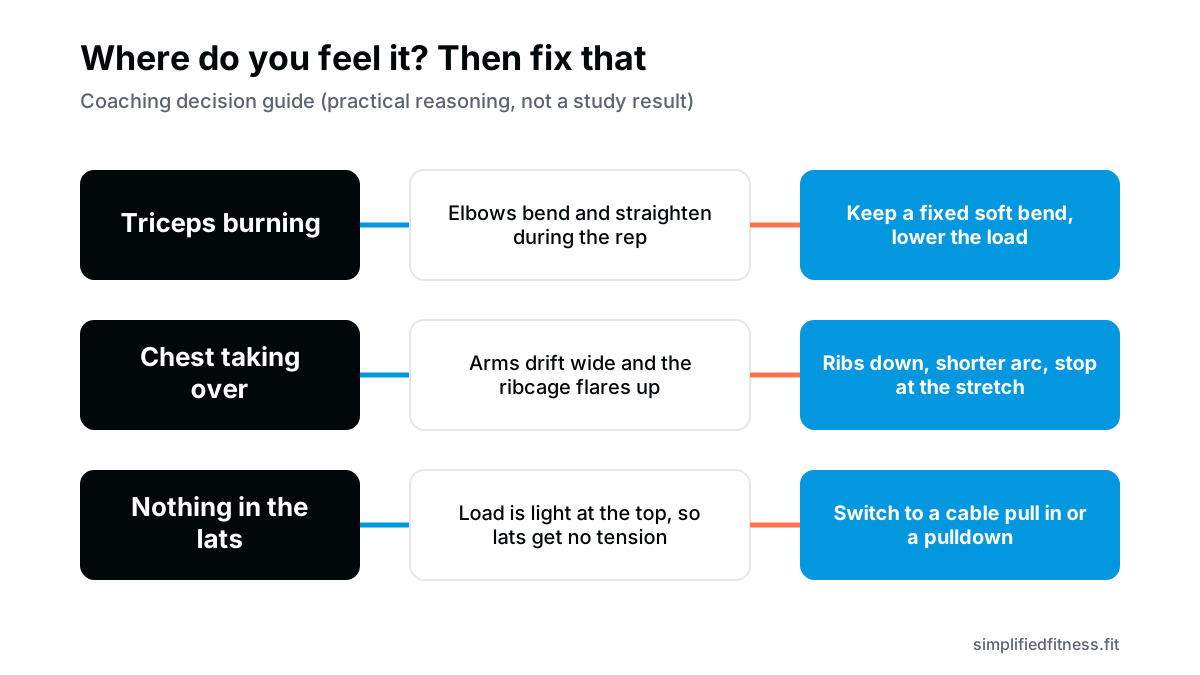
- Lock the elbows. A soft, fixed bend. No extension, no flexion during the rep.
- Use less weight. Go lighter than your chest press ego wants. The bottom is the hard part.
- Ribs down. If your ribcage flares as you stretch, you are borrowing range from your lower back.
- Shorten the arc if needed. Stop where you still control the dumbbell and your shoulders feel stable.
- Pull with the upper arm. Think elbows toward hips, not dumbbell toward ceiling.
- Pause at the stretch for a beat. Then lead the return with the lats.
Where do you feel it? A quick fix guide
What should you do instead for lat width?
If your goal is lat size, the pullover does not need to be the star. A pulldown gives a clear line of pull from overhead down toward the body, with resistance staying on the lats through most of the range.
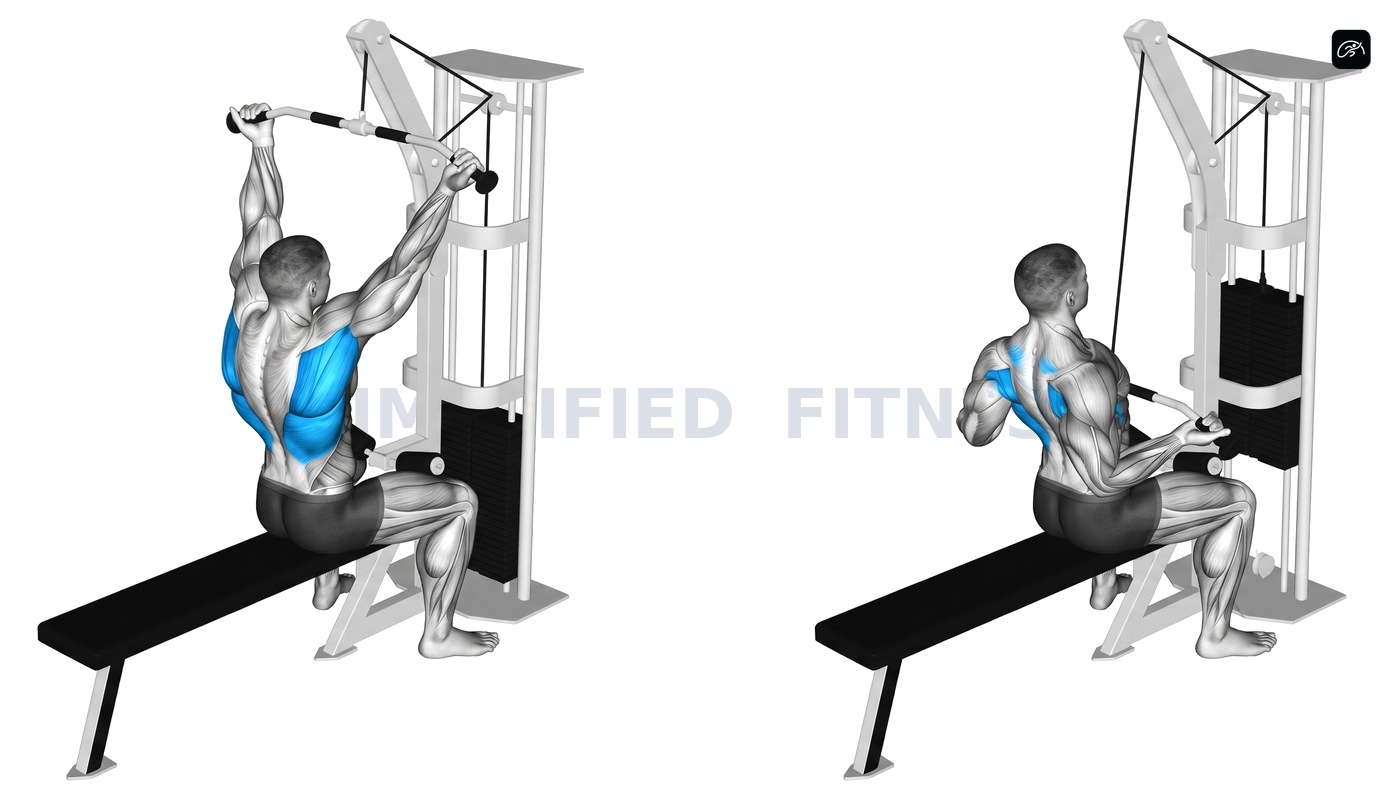
Grip and bar path matter, and we break them down in wide vs close vs neutral grip lat pulldowns. The 2026 EMG review suggests the lat pulldown with an anterior bar path was most consistently linked with higher lat EMG, while grip width effects were inconsistent (Di Fonza et al., 2026). Note that it is acute EMG, not growth.
To see why the lats respond to different regions of the back, read our piece on latissimus dorsi regional anatomy. Triceps long head curious? The overhead cable triceps extension trains it in the same stretched position on purpose.
A simple way to program it
You do not need to throw the pullover away. A reasonable plan for most people:
- Start the session with a pulldown or row variation for your hardest back sets.
- Add 2-3 sets of a cable pullover or a controlled dumbbell pullover near the end.
- Keep reps in the 10-15 range with 1-3 reps left in the tank.
- Count the sets toward chest or triceps volume if that is where you feel them.
Not sure about your weekly numbers? Try the free training volume calculator, or follow our pull day plan which already puts the pulling work in a sensible order.
The bottom line
The dumbbell pullover is not useless, it is mismatched. Gravity gives you almost nothing at the top and the most at the bottom stretch, and the research we have suggests the chest is more involved than the lats. Fix the elbows, cut the load, or swap to a cable or pulldown for the lat work.
Shoulder pain, numbness or tingling during overhead stretched positions is a reason to stop and get checked by a doctor or physiotherapist, not something to train through.
Frequently Asked Questions
Why do dumbbell pullovers hit my triceps instead of my lats?
Most often your elbows are bending and straightening, which turns the movement into a lying triceps extension. The triceps long head also crosses the shoulder, so it is stretched when your arms go overhead. Lock your elbow angle, lower the weight, and think about moving your upper arm, not your forearm.
Do dumbbell pullovers work lats or chest?
Both, but research leans toward the chest. A barbell pullover EMG study in 8 men found pectoralis major emphasized more than latissimus dorsi, and a 2026 review of lat EMG studies said the pullover seems to favour the pecs over the lats. If your goal is lat growth, treat the dumbbell version as a mixed chest and lat movement and choose cable or pulldown variations for the main work.
What is the tension curve of a dumbbell pullover?
Gravity pulls straight down, so the torque at your shoulder depends on how far the dumbbell sits horizontally from the joint. With straight arms that distance is near zero when the dumbbell is above your shoulders and grows toward the overhead stretch. In practice the load is lightest at the top and heaviest in the bottom stretch.
Is the dumbbell pullover a bad exercise?
No, it is just a poor fit if your goal is isolating the lats. It can still train the chest, serratus area and upper body through a long range, and many lifters enjoy the stretch. Use it as an accessory if you like it, and do not rely on it as your main back width exercise.
How do I feel my lats in a pullover?
Keep ribs down, elbows at a fixed soft bend, and drive the upper arm back toward your hips instead of just lifting the weight. The lat extends and adducts the shoulder, so the cue is pulling the elbows down, not pushing the dumbbell. If you still feel nothing, a cable version removes the dead zone at the top.
Are cable pullovers better than dumbbell pullovers for lats?
Probably for most people, though direct long-term comparisons are scarce. A cable keeps a pull toward the stack, so resistance can stay on the lats where a dumbbell goes slack at the top. Try a rope or straight bar set high, with your torso slightly hinged, and see where you feel it.
How heavy should a dumbbell pullover be?
Lighter than you expect. The Marchetti EMG study used only 30% of body weight for 10 reps with a barbell, and the load is greatest in the bottom stretch where shoulder control matters. Pick a weight where you can control the stretch without your ribs flaring or your elbows bending more.
Should I do pullovers across a bench or along it?
Either works, but the setup changes the feel and the shoulder angle, and no study I found shows one is better for lat growth. Across the bench lets your hips drop and increases the stretch, while along the bench is easier to control. Choose the one where your shoulders feel stable and your lower back stays quiet.
Does the pullover expand the rib cage?
There is no good evidence that pullovers permanently widen your rib cage in adults. Muscle growth, posture and body fat change how your torso looks, but bone structure does not meaningfully remodel from this exercise. Do it for the muscles it trains, not for a ribcage change.
Is the straight-arm cable pullover the same as a dumbbell pullover?
Similar joint action, different resistance. The cable pullover usually has you standing or kneeling with the line of pull in front, so the lats work against a pull that does not disappear at the top. That is why many coaches prefer it for lat tension, though the evidence is mostly biomechanical reasoning.
Can pullovers hurt my shoulders?
They can feel uncomfortable if you have limited overhead mobility or take the weight deeper than you control. Loaded stretching overhead is demanding on the shoulder, so shorten the range and drop the load if you feel pinching. Sharp pain, numbness or pain that lingers is a reason to see a doctor or physiotherapist.
How many sets of pullovers should I do?
If you keep them, 2-3 hard sets after your main pulling work is a sensible starting point. Most of your back volume should come from pulldowns, pull-ups and rows, which have clearer evidence for lat activation. Check your weekly sets with the training volume calculator.
Sources & References
Every claim above is checked against peer-reviewed research (PubMed, U.S. National Library of Medicine) or guidance from established health bodies. How we fact-check.
- Marchetti PH, et al. Effects of the pullover exercise on the pectoralis major and latissimus dorsi muscles as evaluated by EMG. J Appl Biomech. 2011. PMID: 21975179
- Teixeira LFM, et al. Differences between pullover and pulldown exercises on maximal isometric force and myoelectric activity in recreationally-trained men. Int J Exerc Sci. 2022. PMID: 35992501
- Di Fonza D, et al. Electromyographic analysis of latissimus dorsi activation during common resistance training exercises: a narrative review. J Funct Morphol Kinesiol. 2026. PMID: 42647355
- Hik F, et al. The moment arms of the muscles spanning the glenohumeral joint: a systematic review. J Anat. 2019. PMID: 30411350
- Kuechle DK, et al. Shoulder muscle moment arms during horizontal flexion and elevation. J Shoulder Elbow Surg. 1997. PMID: 9356931
- Pedrosa GF, et al. The interplay between muscle length, range of motion, and exercise selection: a review. Sports Med Int Open. 2026. PMID: 41777276
- Varovic D, et al. Does muscle length influence regional hypertrophy? A systematic review and meta-analysis. Int J Sports Med. 2025. PMID: 40570881
- Pallares JG, et al. Effects of range of motion on resistance training adaptations: a systematic review and meta-analysis. Scand J Med Sci Sports. 2021. PMID: 34170576

Umair Hazrami · Founder & Head Coach, Simplified Fitness
Umair Hazrami founded Simplified Fitness and the Simplified Lifter channel to cut through fitness noise. With 4+ years of consistent training and 10+ coaching clients, he writes every guide from the peer-reviewed research and links the sources so you can check them. Our editorial standards.
Educational content only, not medical advice. If you have a medical condition, are pregnant, or take medication, talk to a qualified doctor before changing your diet, supplements or training. Full disclaimer.
Keep reading
Exercise Technique
Barbell Bent-Over Rows: Spinal Load, Hamstring Fatigue and Lat Growth
Is the barbell bent over row hypertrophy gold or a fatigue generator? See what the research says about spinal load, torso angles and better rows for lat growth.
8 min read
Exercise Technique
Chest-Supported Rows: Train Your Upper Back Without Lower Back Fatigue
Chest supported row hypertrophy explained: why your lower back quits first, how T-bar, incline and seal rows fix it, and what the research says.
8 min read
Exercise Technique
Complete Back Workout Design: Balancing Vertical Pulls, Horizontal Rows, and Lumbar Recovery
A science-based back workout routine: weekly sets, how to balance pulldowns and rows, and how to protect your lower back, with a sample pull day plan.
9 min read

Exercise Technique
Conventional Deadlifts for Back Hypertrophy: Stimulus-to-Fatigue Ratio Analysis
Are deadlifts good for back hypertrophy? A stimulus-to-fatigue breakdown of what they build, what they miss for lats, and how to program or replace them.
8 min read