Spinal Erector Hypertrophy: 45-Degree Back Extensions vs Romanian Deadlifts
Spinal erector hypertrophy exercises compared: 45-degree back extensions, Romanian deadlifts and reverse hypers, what EMG studies show and how to load them.
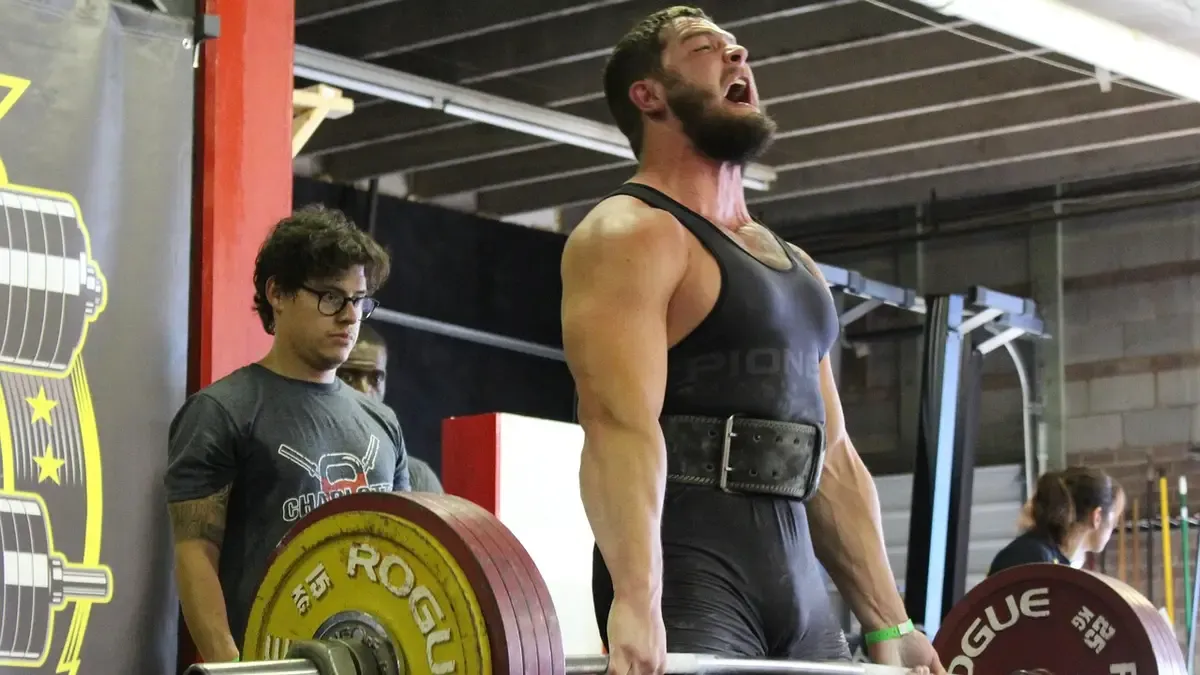
TL;DR. The short answer
- Both 45-degree back extensions and Romanian deadlifts load the spinal erectors, but they do different jobs. The RDL is mainly a hip hinge where the erectors hold your spine in place, while a back extension asks the lumbar region to move.
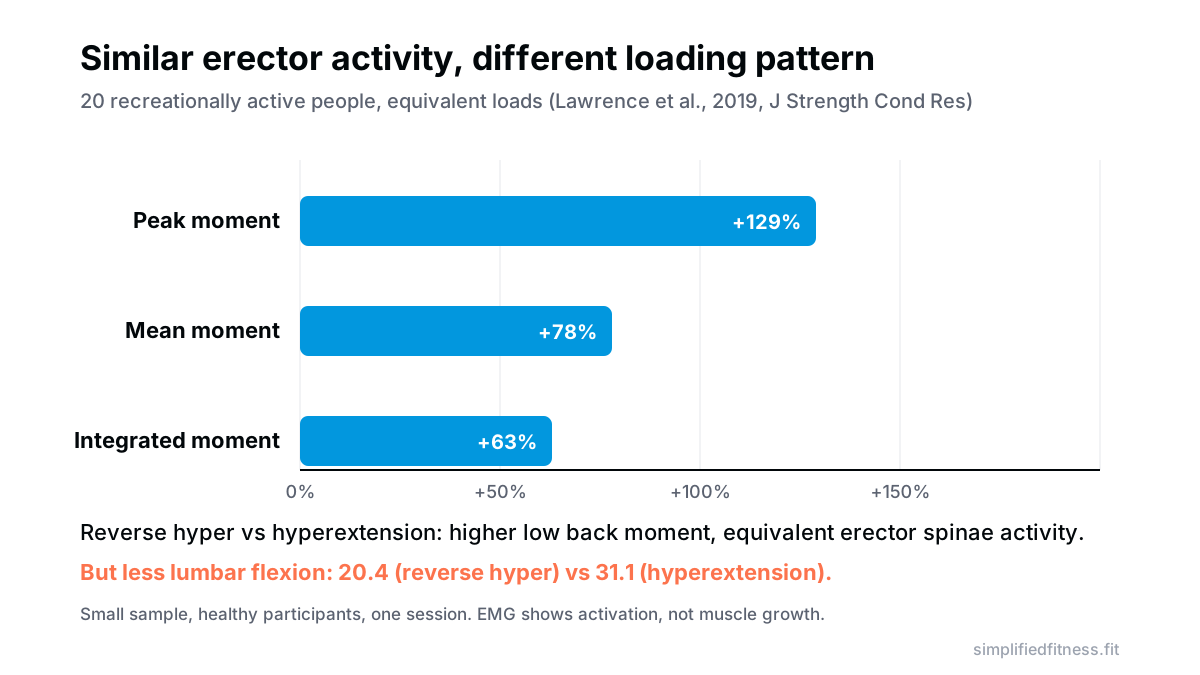
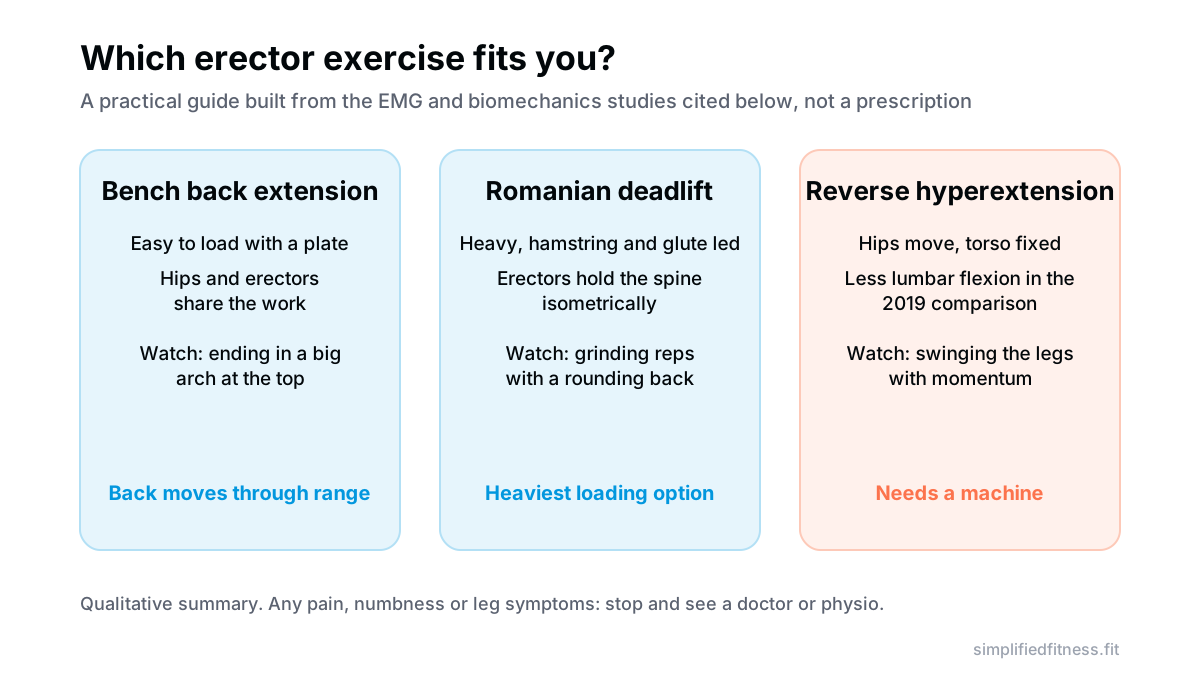
- A 2019 study found the reverse hyperextension produced similar erector spinae activity to the standard hyperextension with less lumbar flexion (20.4 vs 31.1), in 20 recreationally active people.
- EMG tells you a muscle is active, not that it will grow. A 2015 review concluded that Roman chair and free-weight exercises may be less proven for lumbar extensor adaptations than machines with pelvic restraint.
- A practical approach is one hinge (RDL) plus one extension movement, taken close to failure with controlled reps and a neutral to mildly rounded top position, not a hard arch.
- Sharp pain, numbness or pain running down a leg is a reason to stop and see a doctor or physio, not to push through.
Part of our complete guide: Complete Back Training Guide: Lats vs Upper Back, Best Exercises and a Hypertrophy Workout
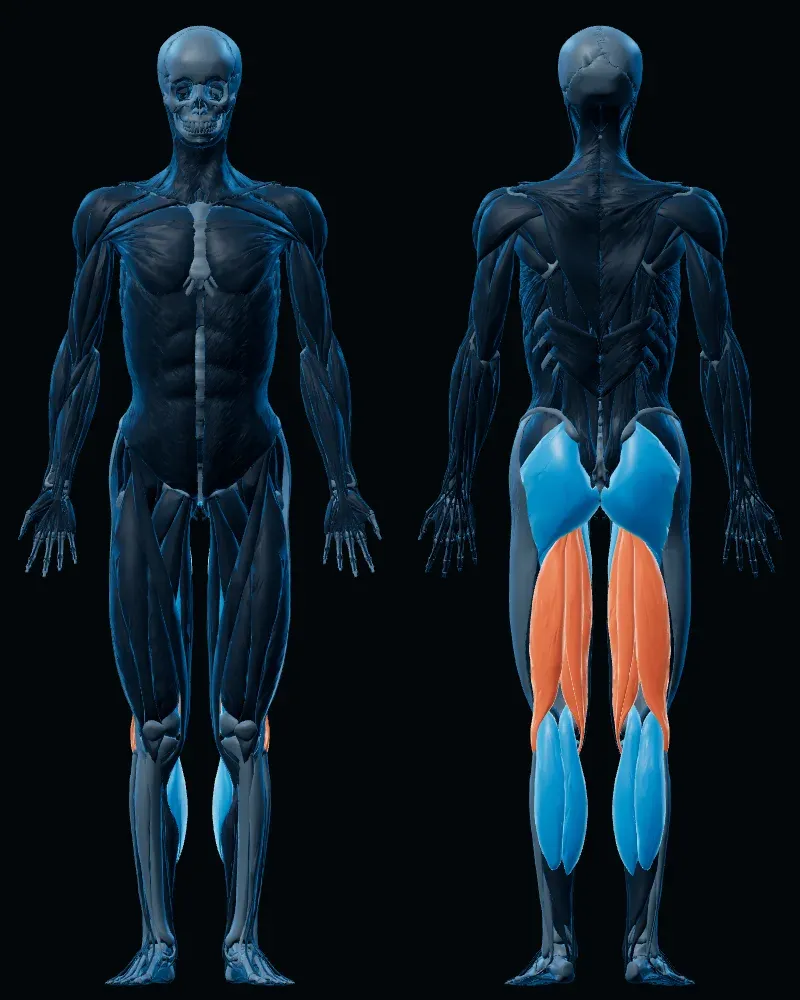
Muscles worked: hamstrings
Main movers: biceps femoris, semitendinosus and semimembranosus
Assisting: glutes, calves and adductor magnus
Table of contents
As part of our complete back training guide, here is the short answer: the best spinal erector hypertrophy exercises are the ones that load your lower back through a controlled range, and the two most common are the 45-degree back extension and the Romanian deadlift (RDL). They are not interchangeable. The RDL is mostly a hip hinge where your erectors hold your spine in place, while the back extension asks the lumbar region itself to move. This guide covers which one to pick, how to load it, and how to keep your back out of trouble.
Here is the catch up front. Almost no studies have measured actual erector growth from these exercises. What we have is muscle activation (EMG), joint loading and a few reviews. That is useful, but it is not proof, so I will flag where the evidence stops.
Which muscles are the spinal erectors?
The spinal erectors are a group of three columns running along either side of your spine: iliocostalis (outermost), longissimus (middle) and spinalis (innermost). Together they extend and resist flexion of your trunk. Underneath them sits the multifidus, which studies often measure alongside them. For the full anatomy, see our guide to the functional anatomy of the back muscles.
In the gym, they do two very different jobs:
- Isometric: hold your torso rigid while your hips and legs move. This is what happens on deadlifts, squats and rows.
- Dynamic: actually bend and extend your spine under load. This is what a back extension asks of them.
That difference is the whole story behind the RDL vs back extension question.
What does the research say about RDLs and erectors?
RDLs are a strong posterior chain exercise, but erectors are not the star. A 2020 systematic review of deadlift EMG studies found that the erector spinae and quadriceps were more activated than the gluteus maximus and biceps femoris across deadlift variations in general. For the RDL specifically, activation was lower in the erector spinae than in the biceps femoris and semitendinosus (Martin-Fuentes et al., 2020).
A study of 10 competitive bodybuilders (average 10.6 years of training) tested the RDL, a step-RDL and the stiff-leg deadlift at 80% of 1RM. Excitation of the longissimus was greater in the step-RDL, where the lifter stands on a raised surface for a longer range of motion, than in the regular RDL (Coratella et al., 2022). That is a small sample and a very specific setup, but it hints that range of motion changes the picture.
For a deeper dive on the hinge itself, see our guide to Romanian deadlifts and hip hinge mastery.
How does a 45-degree back extension compare?
The back extension lets you load the lumbar region through a range of motion instead of just holding it still. That is the appeal. The catch is that the hips also extend, so the glutes and hamstrings can take over.
A 2015 review of exercises for the lumbar extensors found that benches and Roman chair extensions, free-weight lifts and unrestrained machines all produce meaningful activation. But the training studies suggested they may be less effective for chronic adaptations than machines that restrain the pelvis and isolate lumbar movement (Steele et al., 2015). The authors suggest the compound nature of these exercises lets the hip extensors share the work.
So a 45-degree extension is not the pure erector isolation people assume. It is a hybrid of lumbar and hip work, and how much each contributes depends on how you move.
Hyperextension vs reverse hyperextension: what two small studies found
Two small studies compared the hyperextension (torso moves, legs fixed) with the reverse hyperextension (legs move, torso fixed). They agree on some points and disagree on others.
In 20 recreationally active people using equivalent loads, the reverse hyper produced a higher peak (+129%), mean (+78%) and integrated (+63%) low back moment than the hyperextension, along with greater thigh-to-trunk range of motion (76.6 vs 64.7). Yet it used less lumbar flexion (20.4 vs 31.1) and showed equivalent erector spinae activity, while the standard hyperextension produced greater integrated glute and hamstring activity. The authors concluded the reverse hyper movement profile is preferable because it gives more hip range with less angular stress (Lawrence et al., 2019).
A second study of 10 people found the reverse hyper gave higher peak EMG than the hyperextension in the erector spinae, gluteus maximus and biceps femoris (34.1-70.7% differences) and the authors called it a higher-intensity posterior chain exercise (Cuthbert et al., 2021).
So the two studies disagree on the glutes and hamstrings. Why? They used different loads, different setups and different EMG methods. Both are small, short-term and in healthy, young participants, so I would not generalise to people with a back history. The cautious takeaway is that if you have access to a reverse hyper, it is a very reasonable option. If you do not, a bench extension is still fine when done with control.
RDL vs back extension for the lower back: how they actually differ
This is where the hinge pattern and the extension pattern split.
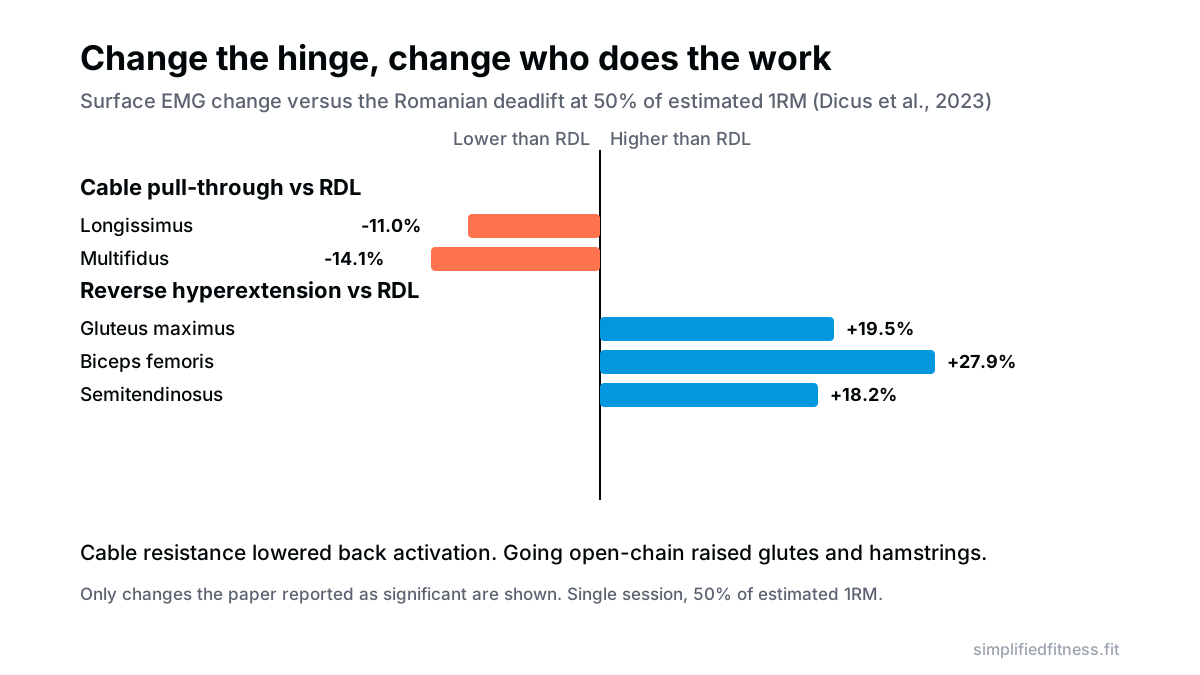
Dicus and colleagues compared three straight-legged hinges at 50% of estimated 1RM: the RDL, the reverse hyperextension and the cable pull-through. Switching from the RDL (gravity-loaded) to the cable pull-through lowered longissimus activation by 11.0% and multifidus by 14.1%. Switching from the RDL (closed-chain) to the reverse hyper raised gluteus maximus by 19.5%, biceps femoris by 27.9% and semitendinosus by 18.2% (Dicus et al., 2023).
Two practical lessons fall out of this:
- A gravity-loaded hinge like the RDL keeps the back muscles working harder than a cable version, at least at moderate loads.
- Open-chain movements shift work toward the glutes and hamstrings.
Put simply, the RDL is a legitimate erector exercise because it makes them hold a heavy position, but you will probably feel your hamstrings first. If hamstrings fatigue before your back, that is normal.
| Factor | Romanian deadlift | 45-degree back extension | Reverse hyperextension |
|---|---|---|---|
| Erector role | Mostly isometric support | Dynamic lumbar and hip work | Dynamic, torso fixed |
| Heavy loading | Easy with a barbell | Limited, plate or dumbbell | Needs a machine |
| Hamstring and glute share | High | Moderate to high | Higher than RDL (one study) |
| Main risk | Rounding under heavy load | Hard arch at the top | Swinging legs |
| Evidence for erector size | Not directly tested | Not directly tested | Not directly tested |
Can you round your back on purpose?
Short answer: a controlled, small amount of lumbar movement is not automatically dangerous, but extremes under load are a bad bet. Evidence here is limited, so I will keep this cautious.
A modelling study (combined in vivo kinematics, musculoskeletal and finite element models) compared lordotic, free and kyphotic lumbar postures while lifting with forward trunk flexion. The lordotic posture raised back muscle activity by about 14-19%, segmental compression by roughly 7.5-46.1% and shear by roughly 5.4-47.5% compared with the kyphotic one. The authors, considering fatigue and creep in repeated lifts, supported a free posture between the two extremes (Khoddam-Khorasani et al., 2020).
Two things to keep in mind. This was a model of lifting, not a hypertrophy training study. And it suggests that both a hard arch and a deep slump have costs. A neutral spine with a small amount of natural movement looks like the safest middle path.
How to load back extensions and RDLs safely
Here is a simple way to progress without testing your luck:
- Start bodyweight. Learn the movement for 2 weeks until reps are smooth.
- Add load slowly. Hold a plate or dumbbell against your chest, then increase in small steps.
- Control the lowering phase. Take 2-3 seconds down. If you drop it, the load is too heavy.
- Stop 1-3 reps before failure. Your erectors fatigue deeply, and grinding reps with a tired back is where technique slips.
- Keep reps moderate to higher. For erectors, 8-15 controlled reps is a sensible range.
For the RDL, push your hips back until you feel a hamstring stretch, keep the bar close to your legs and stand tall without leaning back. For more on how deadlifts fit your back programme, see conventional deadlifts for back hypertrophy and the full discussion in are deadlifts bad for your lower back.
How much direct lower back work do you need?
There is no dose-response research for erector hypertrophy specifically, so I will give a cautious starting point rather than a rule. Many lifters do fine with roughly 2-4 hard sets per week of direct erector work, alongside what they get from deadlifts, squats and rows.
The erectors work in almost everything you do, so they tire from lots of exercises. If your lower back is sore or stiff all week, you have probably done enough. You can add up your total weekly sets with our training volume calculator.
Where should this sit in your week? A back day works well. Our pull day plan gives an example structure, and lower back friendly leg and back workouts show how to spread the load.
Does a stronger lower back reduce pain?
Possibly, for some people. A 2025 systematic review and meta-analysis of 8 randomized trials with 381 adults with chronic nonspecific low back pain found isolated lumbar extension training reduced pain compared with true controls (ES = -0.633, p = 0.004). However, effects on disability and isometric strength were not significant, and the certainty of the evidence was very low (Trybulski et al., 2025).
So the evidence is encouraging but weak. That review covered people with chronic back pain, which is a different group from healthy lifters training for size. If you have ongoing back pain, see a doctor or physio before starting extension work.
When to stop and see a doctor
Muscle soreness is expected. These are not:
- Sharp, stabbing or catching pain in the lower back
- Pain that travels down a leg, or numbness or tingling in your legs or feet
- Pain that lasts more than a few days after training or gets worse over time
- Any weakness in a leg, or changes to bladder or bowel control (seek urgent care)
If any of these happen, stop training that movement and speak to a doctor or physio. This article is education, not a diagnosis.
A simple plan for most lifters
If you are healthy and training for size, this is a reasonable starting point:
- Hinge: RDL for 2-3 sets of 6-10 reps, once or twice a week.
- Extension: back extension or reverse hyper for 2-3 sets of 10-15 reps, once or twice a week.
- Progression: add reps first, then a small amount of weight, only when form stays clean.
Vegetarian and budget-friendly eating matters here too: if you rely on dal, paneer, curd and soya, make sure you reach roughly 1.6-2.2 g of protein per kg of body weight so your back and everything else can recover. Our diet plan gives a starting framework.
Last note: patience. The erectors adapt slowly and are hard to see. Judge progress by whether your hinge numbers rise, your back feels stronger and your pain stays away, not by the mirror.
Frequently Asked Questions
What are the best spinal erector hypertrophy exercises?
The best-supported options are back extensions (45-degree or reverse hyper), Romanian deadlifts and other hinge variations. They all produce meaningful erector activity in EMG studies, though EMG does not prove growth. Pick one hinge and one extension movement and progress them over months.
Are 45-degree back extensions or Romanian deadlifts better for lower back thickness?
Neither has been shown to be better for erector size in a direct trial, so the honest answer is that they complement each other. The RDL lets you use heavier loads while the erectors work to hold your position, and the back extension lets you train the lumbar region through a range of motion. Using both is a reasonable plan if your back tolerates them.
Do Romanian deadlifts work the erectors?
Yes, but they are not the main target. A 2020 systematic review found the erector spinae are strongly active in deadlift variations overall, but the Romanian deadlift showed lower erector activation than biceps femoris and semitendinosus. Treat the RDL as a hamstring and glute exercise that also builds back endurance and strength.
Do back extensions build the glutes or the lower back?
Both, and the balance depends on how you do them. If you drive with the hips and stay mostly straight, the glutes and hamstrings do more, while a rounded start and a lumbar-led curl-up put more focus on the back. Decide which you want and keep the movement consistent.
Is it safe to round my back on back extensions?
A small, controlled amount of lumbar movement is generally considered acceptable for healthy people, but evidence is limited. A biomechanical modelling study found a free posture between extreme lordosis and kyphosis was favoured when lifting. Avoid loaded, jerky or extreme positions, and stop if you feel pain.
Is a reverse hyperextension better than a 45-degree back extension?
It may be easier on the spine for some people. A 2019 study found the reverse hyper gave a greater low back moment, equivalent erector activity and less lumbar flexion than the hyperextension, and a 2021 study found higher EMG for the reverse hyper in the erector spinae, glutes and hamstrings. Both studies were small, so the choice mostly comes down to access and comfort.
How do I load back extensions with dumbbells?
Hold a dumbbell or plate against your chest, or cross it over your upper body, and add weight only when you can complete clean reps. Heavier loads shift more strain onto the spine, so add them gradually. Stop the set when form breaks down.
Should I hyperextend at the top of a back extension?
There is no good reason to chase it. Finishing in a straight line from head to heels still works the target muscles. A forced hard arch at the top has no proven extra benefit, and modelling work suggests extreme lumbar positions raise spinal loads.
How many sets of lower back work do I need?
There is no dedicated dose-response study for the spinal erectors in hypertrophy, so use general volume guidance. Many lifters do well with roughly 2-4 hard sets per week of direct erector work on top of deadlift and row volume. Track how your back feels the next day and adjust.
Can I train my lower back every day?
It is usually not needed. The erectors also work during squats, deadlifts and rows, so they accumulate fatigue faster than most people expect. No study sets an exact recovery window, but a day or two between hard sessions is a sensible default, and lingering stiffness or aching means you need more.
Do lumbar extension exercises help with back pain?
They can help some people. A 2025 meta-analysis of 8 randomized trials (381 people) found isolated lumbar extension training reduced pain in adults with chronic low back pain, but the certainty of the evidence was very low, and effects on disability and strength were not significant. If you have back pain, see a doctor or physio before starting.
Do I need a gym machine to train my erectors?
No. A bench back extension, a loaded RDL or a stability-assisted extension on a Roman chair will all train the area. Machines with pelvic restraint are better evidenced for isolating the lumbar extensors, but most lifters get plenty from the standard options.
How long does it take to see lower back thickness?
There are no reliable timelines for erector growth, and it is hard to see because the muscle is deep and wraps around the spine. Expect strength and endurance to improve first. Take a waist or lumbar photo every 8-12 weeks if you want a visual check.
Sources & References
Every claim above is checked against peer-reviewed research (PubMed, U.S. National Library of Medicine) or guidance from established health bodies. How we fact-check.
- Lawrence MA, et al. Biomechanical Comparison of the Reverse Hyperextension Machine and the Hyperextension Exercise. J Strength Cond Res. 2019. PMID: 30946266
- Cuthbert M, et al. Electromyographical Differences Between the Hyperextension and Reverse-Hyperextension. J Strength Cond Res. 2021. PMID: 34027916
- Dicus JR, et al. A Comparison of Muscle Recruitment Across Three Straight-Legged, Hinge-Pattern Resistance Training Exercises. Int J Exerc Sci. 2023. PMID: 37113509
- Coratella G, et al. An Electromyographic Analysis of Romanian, Step-Romanian, and Stiff-Leg Deadlift: Implication for Resistance Training. Int J Environ Res Public Health. 2022. PMID: 35162922
- Martin-Fuentes I, et al. Electromyographic activity in deadlift exercise and its variants. A systematic review. PLoS One. 2020. PMID: 32107499
- Steele J, et al. A review of the specificity of exercises designed for conditioning the lumbar extensors. Br J Sports Med. 2015. PMID: 24092889
- Trybulski R, et al. Impact of isolated lumbar extension strength training on reducing nonspecific low back pain, disability, and improving function: a systematic review and meta-analysis. Sci Rep. 2025. PMID: 39984628
- Khoddam-Khorasani P, et al. Effect of changes in the lumbar posture in lifting on trunk muscle and spinal loads: A combined in vivo, musculoskeletal, and finite element model study. J Biomech. 2020. PMID: 32147242

Umair Hazrami · Founder & Head Coach, Simplified Fitness
Umair Hazrami founded Simplified Fitness and the Simplified Lifter channel to cut through fitness noise. With 4+ years of consistent training and 10+ coaching clients, he writes every guide from the peer-reviewed research and links the sources so you can check them. Our editorial standards.
Educational content only, not medical advice. If you have a medical condition, are pregnant, or take medication, talk to a qualified doctor before changing your diet, supplements or training. Full disclaimer.
Keep reading
Exercise Technique
Barbell Bent-Over Rows: Spinal Load, Hamstring Fatigue and Lat Growth
Is the barbell bent over row hypertrophy gold or a fatigue generator? See what the research says about spinal load, torso angles and better rows for lat growth.
8 min read
Exercise Technique
Chest-Supported Rows: Train Your Upper Back Without Lower Back Fatigue
Chest supported row hypertrophy explained: why your lower back quits first, how T-bar, incline and seal rows fix it, and what the research says.
8 min read
Exercise Technique
Complete Back Workout Design: Balancing Vertical Pulls, Horizontal Rows, and Lumbar Recovery
A science-based back workout routine: weekly sets, how to balance pulldowns and rows, and how to protect your lower back, with a sample pull day plan.
9 min read

Exercise Technique
Conventional Deadlifts for Back Hypertrophy: Stimulus-to-Fatigue Ratio Analysis
Are deadlifts good for back hypertrophy? A stimulus-to-fatigue breakdown of what they build, what they miss for lats, and how to program or replace them.
8 min read