Meadows Rows and Landmine Rowing Variations: Biomechanics for Scapular Retraction
Meadows row landmine back training explained: setup, elbow path, straps, home and gym variations, plus what the research does and does not show.

TL;DR. The short answer
- The Meadows row is a staggered-stance, overhand, elbow-flared landmine row that works the mid back (rhomboids, mid and lower traps, rear delts) alongside the lats.
- We could not find a study that measured the Meadows row directly. Claims that it has a perfect 'ascending resistance curve' are unproven, so judge it by how it feels and how well you can load it.
- By simple lever geometry, the share of plate weight resisting the bar along its arc drops as the bar rises. What makes the row useful is a stable arc, heavy loading and a braced torso, not a magic curve.
- Use straps if your grip fails first, a chest-supported version if your lower back tires first, and a wedged barbell if you have no landmine post.
- Persistent back, shoulder or nerve-type pain during rows is a reason to see a doctor or physiotherapist, not to push through.
Part of our complete guide: Complete Back Training Guide: Lats vs Upper Back, Best Exercises and a Hypertrophy Workout
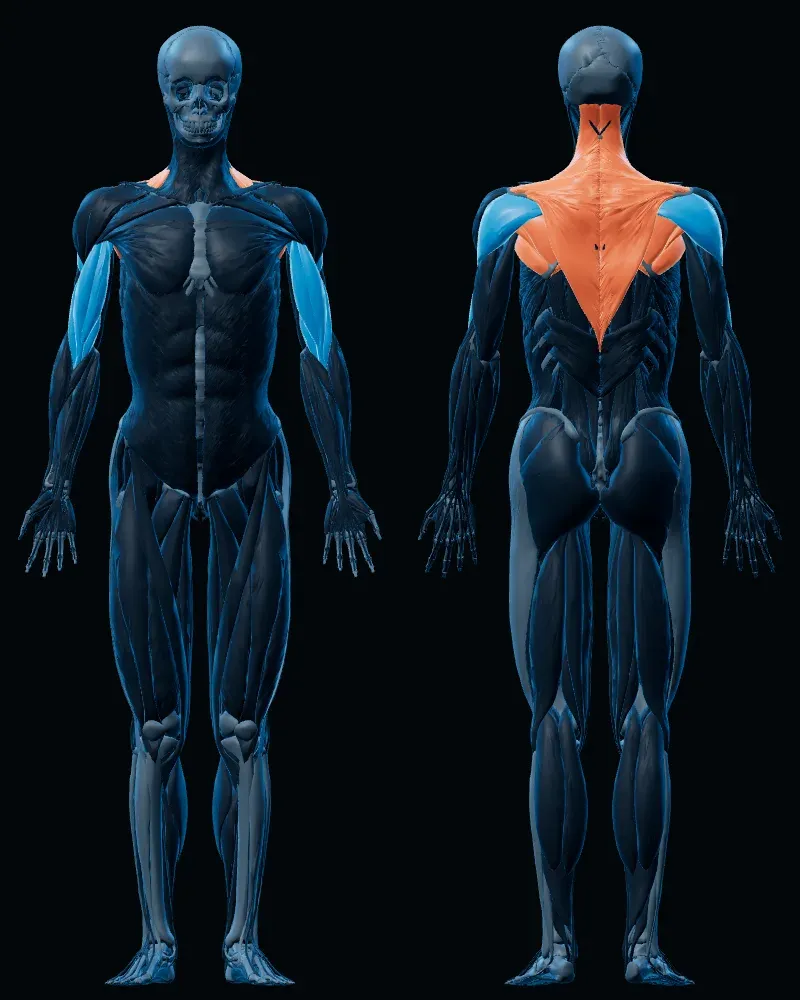
Muscles worked: upper back
Main movers: traps, rhomboids, teres major, infraspinatus and teres minor
Assisting: rear delts, biceps and brachialis
Table of contents
The Meadows row is a landmine row done side-on to the bar, with a staggered stance, an overhand grip and a flared elbow. It is a popular meadows row landmine back exercise because the fixed arc lets you pull hard with the upper back without wrestling a free barbell. Here is the catch: we could not find a single EMG or training study on this exact lift, so the glowing claims you see online are partly theory.
This guide sits inside our complete back training guide. We will cover how to set up the lift, what the biomechanics really say (and what they do not), and which variations suit a home gym or a crowded commercial floor.
What is a Meadows row, and why do lifters rate it?
The lift is named after John Meadows, a bodybuilding coach who championed it for upper back density. The standard version has you stand perpendicular to a landmine bar, hinge forward, grab the loaded end and row it up and back.
Why do lifters like it? Three practical reasons.
- The bar pivots at one end, so the path is guided. You are not balancing a barbell.
- You can brace your free hand on your thigh or a rack, which takes some stress off the lower back.
- The loaded end sits at your hip, so a heavy weight is easy to set up and easy to drop if a rep goes wrong.
None of those is a proven growth advantage. They are reasons the exercise is easy to perform well, and performing it well is what counts. If you already know the lats versus upper back elbow-flare logic, the Meadows row is one more place to apply it.
How to do a Meadows row, step by step
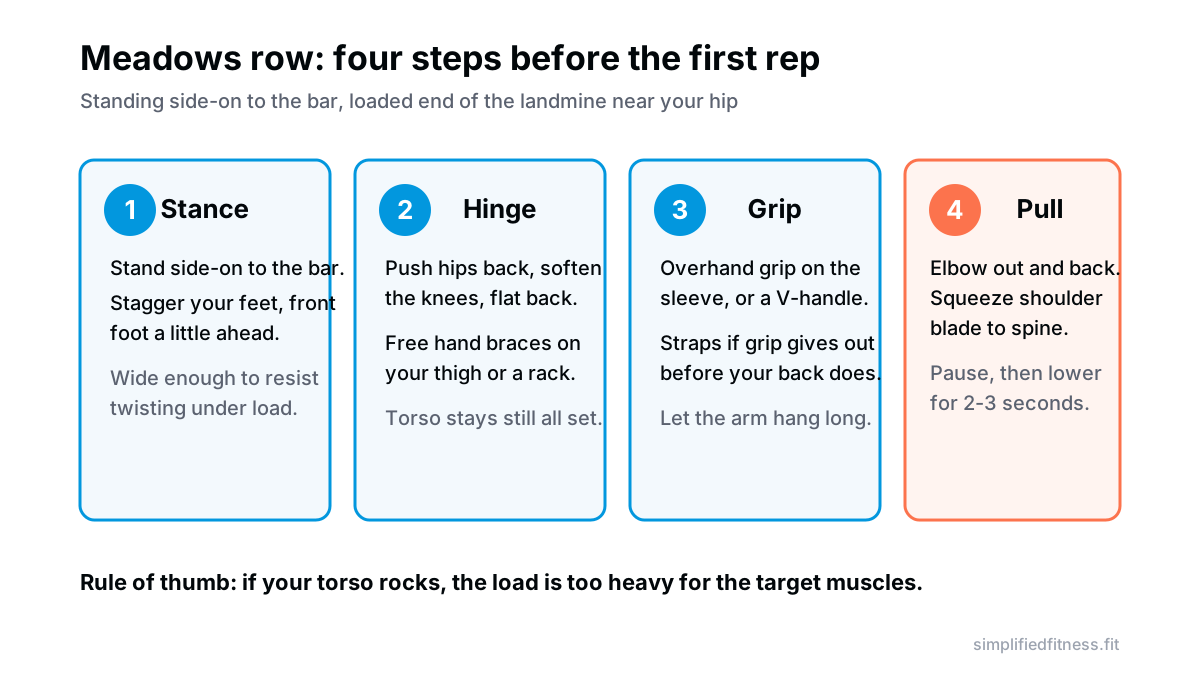
- Stance. Stand side-on to the bar with the loaded end near your front hip. Stagger your feet so the front foot is slightly ahead, which stops the bar from twisting you.
- Hinge. Push your hips back with soft knees and a flat back. Rest your free hand on your front thigh or a stable rack.
- Grip. Hold the sleeve overhand with a long arm. A V-handle under the bar gives a neutral grip if the sleeve bothers your wrist.
- Pull. Drive the elbow out and back, squeeze the shoulder blade toward your spine, pause for a beat, then lower for 2-3 seconds until the shoulder blade glides forward again.
In the gym, the most common mistake is the heave: hips shooting up and torso rotating to get the bar moving. That turns a back exercise into a momentum drill. Drop the weight 10-20% and make the reps slow enough to feel.
Which muscles does the landmine row actually train?
The target is the muscles that pull the shoulder blade back and the upper arm behind the body: rhomboids, middle and lower trapezius, rear delts and the lats, with the biceps as a helper. Your spinal erectors work isometrically to hold the hinge.
We do not have EMG data from the Meadows row itself, so we lean on related rows. In a Mayo Clinic lab study of 28 people using suspension straps, the high row and horizontal abduction row (elbow wide) pushed the upper, middle and lower trapezius and posterior deltoid above 60% of maximum voluntary contraction. In the low row, with the elbow tucked, only the middle trapezius, latissimus dorsi and posterior deltoid reached 40-60% (Youdas et al., 2021). That is a small, descriptive lab study in healthy adults, not a growth trial. It does suggest that elbow position changes what the shoulder blade muscles are asked to do.
An inverted-row study in 26 healthy adults found the posterior deltoid, lats, lower trapezius and biceps all worked at very high levels (above 61% of maximum), with the middle trapezius and upper trapezius high (Youdas et al., 2016). Again, different exercise, but it shows rows in general load this whole group.
A flared elbow is therefore a reasonable way to bias the mid back, though how much is unmeasured for the landmine. If you want the lats to lead instead, tuck the elbow. Our piece on scapular retraction versus depression explains how to feel each.
Why does retraction matter beyond looks? A review of shoulder muscle activity notes that compared with protraction, scapular retraction increases subacromial space width and improves supraspinatus force production during arm elevation, and lists rowing-type exercises among those with high shoulder muscle activity (Escamilla et al., 2009). That is a reason to row with a controlled, genuine squeeze rather than jerking.
Does the landmine have an ascending resistance curve?
You will often read that the pivoting bar creates an “ascending resistance curve” matched to the upper back retractors. It sounds neat. The evidence does not support it.
Look at the geometry. The landmine is a lever pivoting at its far end. If the load sits at your grip end, the hand travels along an arc around the pivot. The part of the plate weight that resists movement along that arc follows a cosine of the bar angle: the steeper the bar, the more of the weight is pushed into the pivot and the less is left resisting the arc. On that geometry alone, the rep gets easier as the bar rises, not harder.
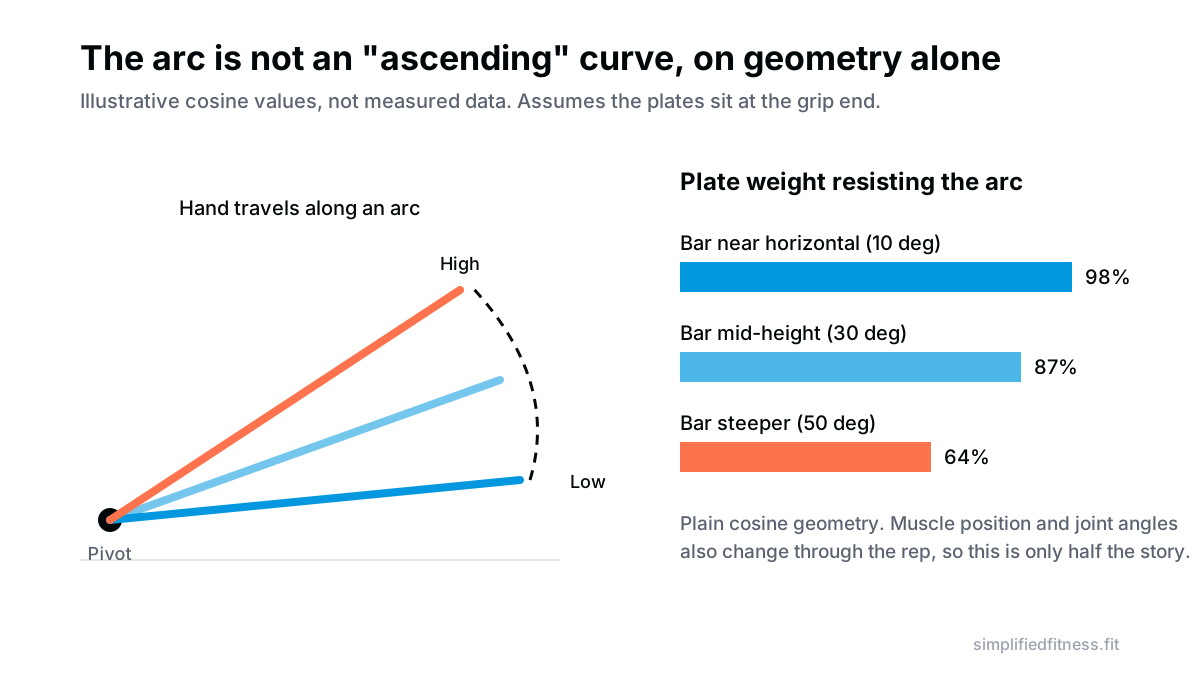
That is only half the story. Your muscles also pull from a changing mechanical position as the elbow travels, so the real demand on the retractors is not the same as the bar weight. No study has measured it for this lift. Treat the “perfect curve” line as a theory.
Does curve shape even matter? Evidence is thin. In a 20-week trial in 23 men training the leg press (a different muscle group), training with a variable resistance device produced similar strength and hypertrophy gains to constant resistance, though only the variable group improved fatigue resistance on a repetition-to-failure test (Walker et al., 2013). Whether that carries over to the upper back is unknown.
Straps, grip and the flared elbow
If your hands give up before your back does, your back never gets its real stimulus. This is a very common problem on heavy rows.
Straps are a fair fix. In a study of 16 men doing deadlift sets, straps reduced grip fatigue, lowered perceived exertion and let lifters keep higher bar velocity (Jukic et al., 2021). That was a deadlift, in young men, over a few sets, so it is indirect evidence for rows. It does support the sensible idea: when grip is the weak link, straps let the target muscle work harder. Our guide on lifting straps for back hypertrophy covers when to use and when to skip them.
A practical rule: use straps on your heaviest working sets and train grip separately, with carries or hangs, so it still improves.
On the flared elbow: it is a coaching choice. Keep the elbow in line with the shoulder blade’s path, away from the ribs, and stop pulling when the shoulder blade is fully retracted. Cranking the elbow far behind the body with an arched back does not add useful range, it just adds spine and shoulder stress.
Landmine row variations for home and commercial gyms
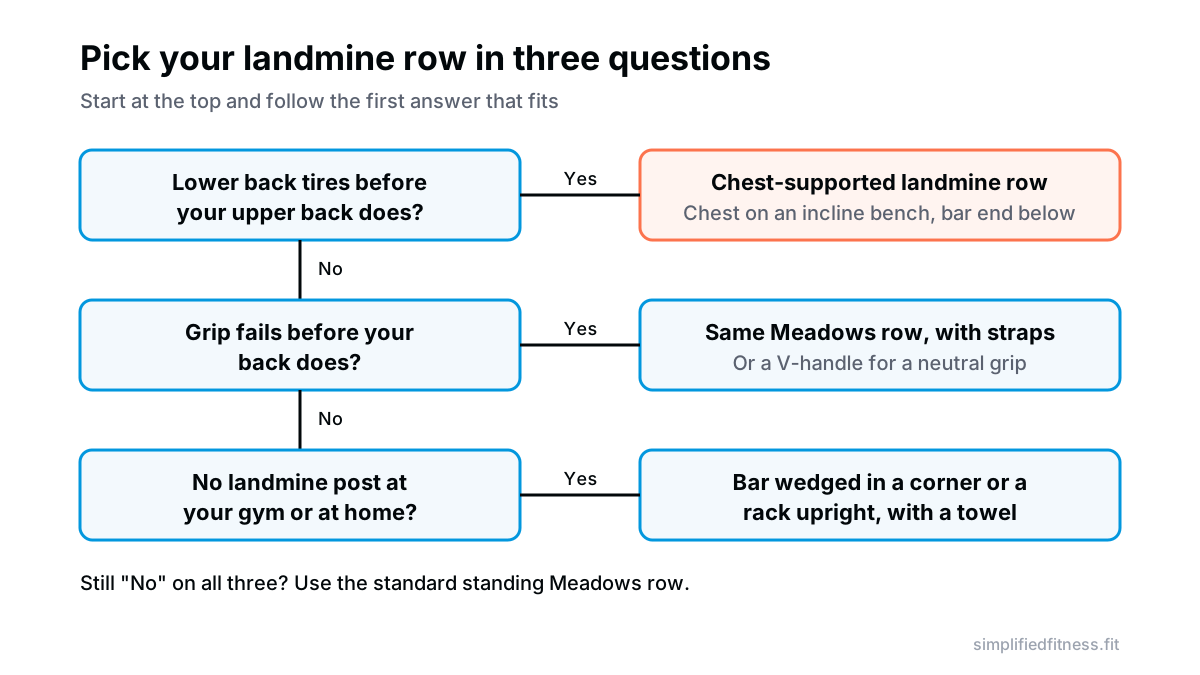
- Standard Meadows row. The version above. Best default.
- Chest-supported landmine row. Chest on an incline bench, bar end below you. It removes most of the hinge demand. See also our breakdown of chest-supported rows for upper back hypertrophy.
- Meadows row with straps or V-handle. For grip-limited sets or a neutral wrist.
- Wedged-barbell row. For home use, jam the end of a barbell into a corner or rack upright with a towel. Make sure it cannot slide, and stop if anything moves.
- Bent-over barbell row. If you have no landmine at all, a standard barbell row works, though lab work shows it produces the highest lumbar load of the rows it tested. Our barbell bent-over row guide covers the trade-offs.
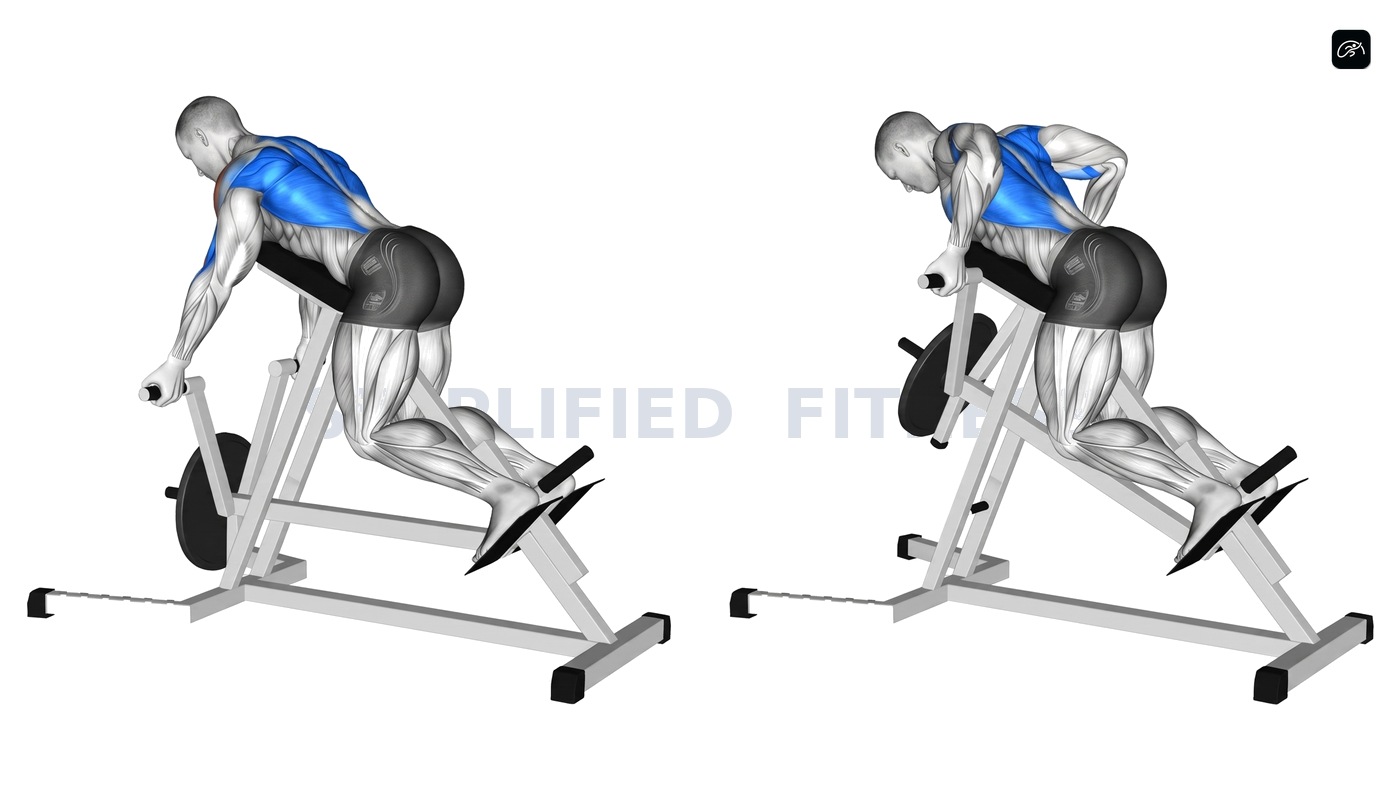
The picture shows the chest-supported T-bar row, the machine cousin of the chest-supported landmine row. If you want the standing-versus-supported comparison in detail, read our T-bar row mechanics article.
How hard is it on the lower back?
We do not know for sure, because the landmine row has not been tested in a spine load study. In a study of 7 healthy men, the standing bent-over row produced large symmetrical activation across the back and the largest lumbar spine load of the three rows tested, while the inverted row gave the lowest spine load (Fenwick et al., 2009). The landmine was not one of the tested rows, and seven men is a small sample, so be careful extrapolating.
What it tells us is general: the more your spinal erectors have to hold a hinge, the more load goes through the lumbar spine. A braced free hand and a stable stance reduce how much you wobble, and a chest-supported setup takes the hinge out almost entirely. That is reasoning from the mechanics, not a measured result for the landmine.
How to program Meadows rows
Run them as a main or second back movement. A reasonable starting point is 2-4 hard sets of 8-15 reps, stopping 1-3 reps before failure. A review of loading research concluded that hypertrophy can be achieved across a broad range of loads when sets are taken close to failure (Schoenfeld et al., 2021). Use our RIR/RPE calculator to calibrate “close to failure”.
Range of motion matters too. A meta-analysis of 16 studies found full range of motion produced larger gains than partial range for strength and lower-limb hypertrophy, with no clear difference for muscle thickness, pennation angle or fascicle length (Pallares et al., 2021). Most of that evidence is lower body, so do not over-read it for rows. A sensible default is a controlled stretch and a hard squeeze, without letting your lower back round.
Where does it fit in a week? Slot it into your pull day plan after a vertical pull, or swap it for another horizontal row. Progress by adding a rep or a small amount of load when you hit the top of your rep range with clean form.
When to see a doctor
Muscle soreness in the upper back is normal. Sharp, pinching or lingering shoulder pain, pain that runs down an arm or leg, numbness, tingling or new weakness is not. Stop the exercise and see a doctor or physiotherapist, who can find the cause. A new back problem after a heavy set is also worth getting checked rather than testing again next week.
Frequently Asked Questions
What is a Meadows row?
A Meadows row is a landmine row done side-on to the bar with a staggered stance, an overhand grip on the sleeve and a flared elbow. It is named after bodybuilding coach John Meadows, who popularised it for building the upper back. The pivoting bar gives a fixed arc, so you can concentrate on pulling the elbow back and squeezing the shoulder blade instead of balancing a free barbell.
What muscles does the Meadows row work?
It trains the lats, rhomboids, middle and lower trapezius, rear delts and the biceps, with the spinal erectors working isometrically to hold your hinge. EMG work on other rowing exercises shows high activity in the trapezius and posterior deltoid when the elbow travels out and back [(Youdas et al., 2021)](https://pubmed.ncbi.nlm.nih.gov/32940548/). A flared elbow tends to shift the emphasis toward the upper back, so keep the elbow wide and the torso still.
Is the Meadows row better than a barbell row?
Neither is proven better for muscle growth, because the two have not been compared in a direct trial. The practical difference is that the landmine fixes the path and lets you brace a hand on your thigh or a rack, which many lifters find easier on the lower back than a free barbell. Pick the one you can perform with the cleanest reps and the most honest effort.
Does the Meadows row hit the lats or the upper back?
It hits both, with the elbow path deciding the emphasis. A wider, flared elbow generally biases the rhomboids, mid traps and rear delts, while an elbow tucked close to the ribs shifts load toward the lats, though this is coaching logic rather than something measured on the landmine. Choose the elbow path that matches the muscle you want to feel working.
How do you do a Meadows row correctly?
Stand side-on to the bar, stagger your feet, hinge at the hips with a flat back, and grip the sleeve overhand with a long arm. Pull the elbow out and back, squeeze the shoulder blade towards your spine and lower under control. Keep the torso fixed for the whole set, and stop the set when it starts rocking.
Should I use straps for Meadows rows?
Straps are reasonable when your grip gives out before your back does. In a small study of 16 men doing deadlifts, straps reduced grip fatigue and perceived exertion and improved bar velocity [(Jukic et al., 2021)](https://pubmed.ncbi.nlm.nih.gov/33306977/). That was not a row study, so treat it as supporting evidence only, and keep training your grip separately.
Do landmine rows have an ascending resistance curve?
Not on the basis of bar weight alone. As the bar rises toward a steeper angle, the part of the plate weight that resists the bar moving along its arc falls, following simple cosine geometry, because the pivot takes more of the rest. Your muscles also work from a changing joint position through the rep, so the real strength demand is more complicated, and no one has measured it for the Meadows row. Treat 'ascending curve' as a theory, not a fact.
Are landmine rows safe for the lower back?
They are generally easier to control than a free barbell row, but they are not risk-free. Lab work on rowing shows the standing bent-over row produced the largest lumbar spine load of the three rows tested, and the inverted row the lowest [(Fenwick et al., 2009)](https://pubmed.ncbi.nlm.nih.gov/19620925/). If your lower back is the limit, brace your free hand or switch to a chest-supported version.
Can I do Meadows rows without a landmine attachment?
Yes. Wedge the end of a barbell into a corner of the room or a rack upright, padded with a towel so it cannot slide or mark the wall. Keep the plates on the loose end and the setup stable before you load it up. If it shifts at all, stop and use a dumbbell or cable row instead.
How many sets and reps should I do for Meadows rows?
Most lifters do well with 2-4 hard sets of 8-15 reps, stopping 1-3 reps before failure. A review of loading research suggests muscle growth can occur across a wide rep range when sets are taken close to failure [(Schoenfeld et al., 2021)](https://pubmed.ncbi.nlm.nih.gov/33671664/). Use the RIR/RPE calculator to judge how close to failure you are.
Does the Meadows row build back thickness?
It can, as a hard, well-controlled row for the upper back, but no row is uniquely magical. Muscle thickness comes from enough hard sets taken near failure, progressive loading and a full pull on the target muscles. Run Meadows rows as one of two or three back exercises each week and track your reps and loads.
Should I do Meadows rows with a full stretch at the bottom?
Yes, a controlled stretch is a sensible default. A meta-analysis found full range of motion beat partial range for strength and lower-limb growth, though results for other measures were similar [(Pallares et al., 2021)](https://pubmed.ncbi.nlm.nih.gov/34170576/). Let the shoulder blade glide forward at the bottom without rounding your lower back.
What if I feel pain in my shoulder or lower back when I row?
Sharp, pinching, radiating or lingering pain is a signal to stop, not a sign of a good set. Pain that travels down an arm or leg, numbness, tingling or weakness needs a medical check. A doctor or physiotherapist can diagnose the cause, and in the meantime a chest-supported row at a lighter load is the safer choice.
Sources & References
Every claim above is checked against peer-reviewed research (PubMed, U.S. National Library of Medicine) or guidance from established health bodies. How we fact-check.
- Fenwick CM, et al. Comparison of different rowing exercises: trunk muscle activation and lumbar spine motion, load, and stiffness. J Strength Cond Res. 2009. PMID: 19620925
- Youdas JW, et al. Activation of spinal stabilizers and shoulder complex muscles during an inverted row using a portable pull-up device and body weight resistance. J Strength Cond Res. 2016. PMID: 26422610
- Youdas JW, et al. Recruitment of shoulder complex and torso stabilizer muscles with rowing exercises using a suspension strap training system. Sports Health. 2021. PMID: 32940548
- Jukic I, et al. Ergogenic effects of lifting straps on movement velocity, grip strength, perceived exertion and grip security during the deadlift exercise. Physiol Behav. 2021. PMID: 33306977
- Pallares JG, et al. Effects of range of motion on resistance training adaptations: a systematic review and meta-analysis. Scand J Med Sci Sports. 2021. PMID: 34170576
- Walker S, et al. Variable resistance training promotes greater fatigue resistance but not hypertrophy versus constant resistance training. Eur J Appl Physiol. 2013. PMID: 23636698
- Escamilla RF, et al. Shoulder muscle activity and function in common shoulder rehabilitation exercises. Sports Med. 2009. PMID: 19769415
- Schoenfeld BJ, et al. Loading recommendations for muscle strength, hypertrophy, and local endurance: a re-examination of the repetition continuum. Sports (Basel). 2021. PMID: 33671664

Umair Hazrami · Founder & Head Coach, Simplified Fitness
Umair Hazrami founded Simplified Fitness and the Simplified Lifter channel to cut through fitness noise. With 4+ years of consistent training and 10+ coaching clients, he writes every guide from the peer-reviewed research and links the sources so you can check them. Our editorial standards.
Educational content only, not medical advice. If you have a medical condition, are pregnant, or take medication, talk to a qualified doctor before changing your diet, supplements or training. Full disclaimer.
Keep reading
Exercise Technique
Barbell Bent-Over Rows: Spinal Load, Hamstring Fatigue and Lat Growth
Is the barbell bent over row hypertrophy gold or a fatigue generator? See what the research says about spinal load, torso angles and better rows for lat growth.
8 min read
Exercise Technique
Chest-Supported Rows: Train Your Upper Back Without Lower Back Fatigue
Chest supported row hypertrophy explained: why your lower back quits first, how T-bar, incline and seal rows fix it, and what the research says.
8 min read
Exercise Technique
Complete Back Workout Design: Balancing Vertical Pulls, Horizontal Rows, and Lumbar Recovery
A science-based back workout routine: weekly sets, how to balance pulldowns and rows, and how to protect your lower back, with a sample pull day plan.
9 min read

Exercise Technique
Conventional Deadlifts for Back Hypertrophy: Stimulus-to-Fatigue Ratio Analysis
Are deadlifts good for back hypertrophy? A stimulus-to-fatigue breakdown of what they build, what they miss for lats, and how to program or replace them.
8 min read