Lats vs Upper Back: How Elbow Flare and Scapular Motion Decide Which Muscle Works
Lats vs upper back rows: why you feel traps, not lats, and how elbow path, handle finish and shoulder blade motion shift the work. Includes a 5-second audit.

TL;DR. The short answer
- Rows lean toward the lats when the elbows travel close to the ribs and the handle finishes near the hip. They lean toward the upper back when the elbows flare wide and the shoulder blades pinch together.
- The common 'under 30 degrees' versus '45 to 90 degrees' split is a coaching cue built on anatomy. No study has tested those exact angles, so treat it as a starting point.
- EMG research shows small changes from grip width, active scapular retraction and similar tweaks. A 2026 review suggests elbow position relative to the trunk may be the bigger lever.
- If you only feel traps on rows, check three things in order: elbow path, where the handle ends, and whether you shrug before you pull.
- Neither style is wrong. Upper-back rows and lat rows do different jobs, and a good back day usually includes both.
Part of our complete guide: Complete Back Training Guide: Lats vs Upper Back, Best Exercises and a Hypertrophy Workout
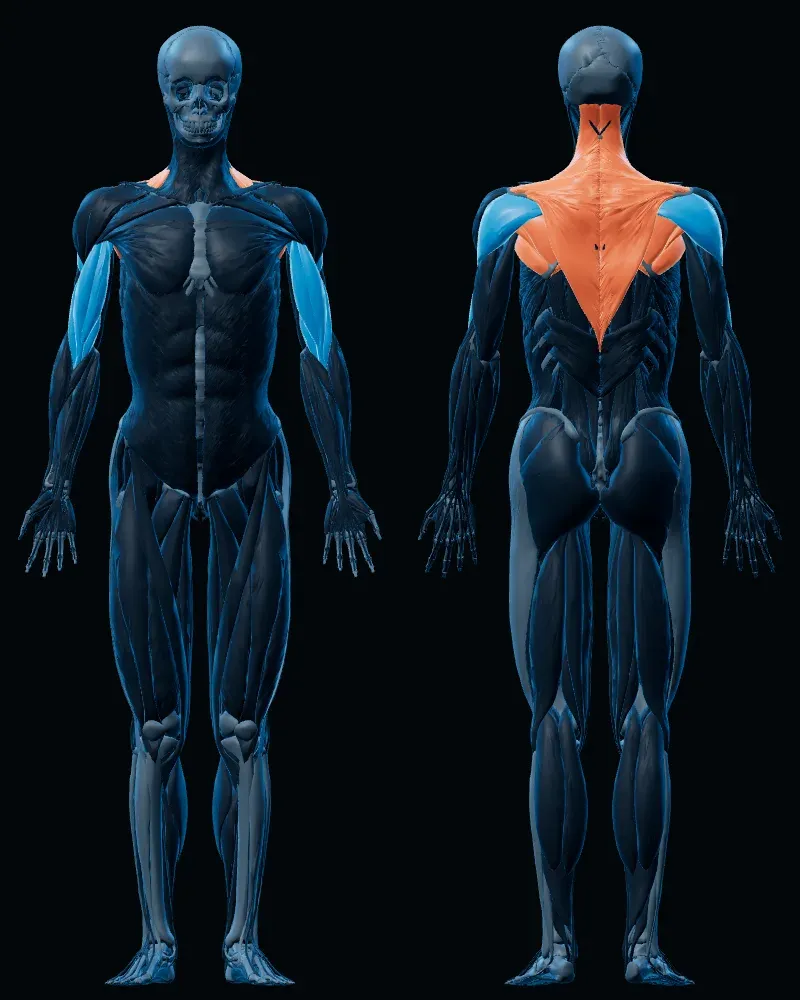
Muscles worked: upper back
Main movers: traps, rhomboids, teres major, infraspinatus and teres minor
Assisting: rear delts, biceps and brachialis
Table of contents
If you only feel your traps and the back of your shoulders when you row, your elbows are probably flared and your shoulders are probably shrugging. That arm path favours the upper back. To shift the work toward the lats, keep the elbows closer to your ribs and drive them toward your hip.
This is the most common confusion in back training, and it is why the “lats vs upper back rows” question keeps coming up. It sits inside our complete guide to back training, and here we turn it into a rule you can check in about five seconds.
One honest warning first. The exact angles you see online (tucked under 30 degrees, flared 45 to 90) are coaching cues. I could not find a study that tested those specific numbers. What the research does support is the direction of the rule, and it is also clear that small tweaks change less than most gym lore claims.
What do the lats and the upper back actually do?
The lats run from your spine and pelvis up to the front of your upper arm. According to a 2026 review of EMG studies, they produce shoulder extension, adduction and internal rotation (Di Fonza et al., 2026). In plain terms: they pull your upper arm down and back toward your body.
The upper back muscles (mid traps, rhomboids, rear delts) do a different job. They pull the shoulder blade toward the spine and swing the arm out and back. Think of a reverse fly or a face pull.
So the question for any pull is simple. Is my upper arm travelling down and back toward my hip, or out and back toward the side? The first loads the lats. The second loads the upper back.
The same review notes that the humerus-to-trunk relationship may be a key determinant of how load is spread across muscles in pulling exercises (Di Fonza et al., 2026). That is the research version of the elbow rule.
Why do I feel traps instead of lats on rows?
Three habits cause it, usually together.
- Flared elbows. The upper arm points out to the side, so the work moves to the rear delts and mid back.
- Shrugging into the pull. Shoulders rise toward your ears before the elbows move.
- Pulling to the chest. A high finish point matches a flared arm path.
In the gym, this looks like a lifter on a seated cable row leaning back, hands finishing at the sternum, elbows wide, and a burn across the back of the shoulders. It is a legitimate upper-back row. It is just not a lat row.
The elbow path rule: tucked for lats, flared for upper back
Here is the rule, stated carefully.
- Lat-leaning: the elbow travels close to the ribs, roughly under 30 degrees away from your torso, and the handle finishes near the hip or lower ribs.
- Upper-back-leaning: the elbow travels wide, roughly 45 to 90 degrees from the torso, and the handle finishes at the upper chest or face.
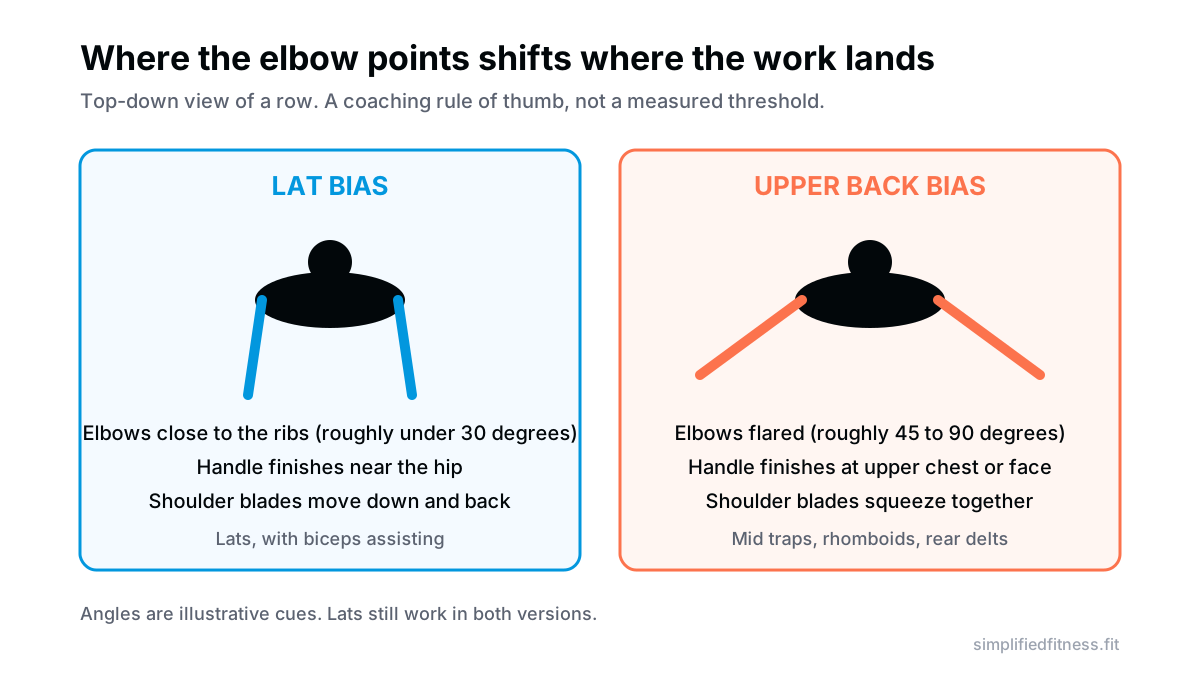
What backs this up? The review linked above found that in the seated row, a lower shoulder-abduction angle (elbows closer to the body) was associated with greater lat EMG amplitude in one study, and a narrower grip in another (Di Fonza et al., 2026). The authors are explicit that those two variables have never been tested together and that EMG amplitude is not the same as long-term growth.
Even so, the direction makes sense anatomically and lines up with the research. Use it to choose, then check how your own back feels.
Does scapular retraction vs depression change anything?
Yes, but less than most people think.
Depression means the shoulder blades move down, away from your ears. Retraction means they move toward the spine. Lat-focused pulls tend to be taught with depression first (think pulling the shoulder blades into your back pockets), while upper-back rows are taught with retraction at the finish. For a deeper dive into the cue itself, see our guide on scapular retraction vs depression and the mind-muscle connection.
The studies are a bit humbling:
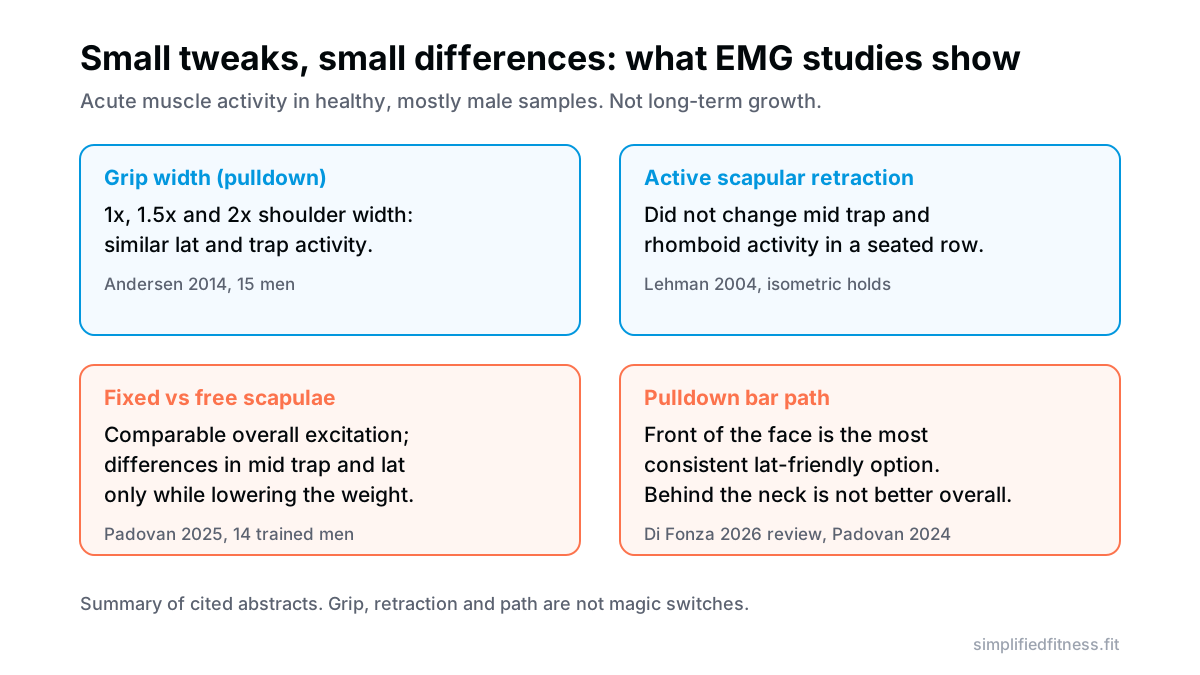
- A 2004 study compared seated rows with an actively retracted scapula and with non-retracted scapulae. Actively retracting did not change mid trap and rhomboid activity, though the seated row overall produced the highest activity in that muscle group (Lehman et al., 2004). Note it used isometric holds, not full reps.
- A 2025 study had 14 resistance-trained men perform seated rows with either a fixed or a free scapular position. Overall excitation was comparable. The fixed condition showed more posterior deltoid in the lifting phase, and more mid trap (ES 0.67) and lat (ES 0.85) activity on the return (eccentric) phase (Padovan et al., 2025). The authors conclude that scapular constraint changes how excitation is distributed more than how much there is.
The takeaway: scapular position fine-tunes the pull. Elbow path decides the broad emphasis.
Does grip width or handle choice matter?
Less than the internet suggests.
In a 2014 study, 15 men did 6-rep-max lat pulldowns with grips of one, one and a half and two times their shoulder width. Lat, trap and infraspinatus activity was similar across widths. They lifted slightly more with the narrow (80.3 kg) and medium (80 kg) grips than the wide grip (77.3 kg), and the authors concluded that similar muscle activation, and likely similar growth, can be expected across that range (Andersen et al., 2014).
A 2010 study of 12 men compared wide and narrow, pronated and supinated pulldown grips. The overhand (pronated) grip produced more lat activity than the underhand grip, regardless of width (Lusk et al., 2010). So “wide equals lats” is not well supported, while grip orientation might matter a little.
Where you pull the bar also counts. In a 2024 comparison, 14 trained men did pulldowns to the front of the face and behind the neck. The front version produced greater lat excitation as the bar came down and overall greater excitation in the prime movers, although the behind-the-neck version showed more lat activity as the bar went back up (Padovan et al., 2024). The 2026 review reaches a similar conclusion about the front path.
Practical translation: choose the handle that lets your elbows travel the way you want. If a straight bar pushes your elbows wide, try a neutral or V-handle. If you feel more lat with a close neutral grip, use it. For attachment specifics, see seated cable row attachments and elbow drive.
Do torso angle and range of motion change the target?
Somewhat, and results are mixed.
In a 2025 trial, 16 resistance-trained men did prone barbell rows through three ranges of motion at 10RM. Lat excitation was higher in the upper-half range than in the lower-half or full range (d around 0.6), and peak trapezius excitation was lower in the upper half. The authors call the overall effect medium at best and inconsistent, and conclude that range changes have limited impact on overall activation (Fischer et al., 2025).
Notice what that implies. Range of motion moves the numbers a little, and torso angle on its own has barely been tested. Keeping the trunk steady and moving the elbows consistently matters more than finding a magic angle.
For the chest-supported version, where the pad removes momentum and makes the upper back easier to feel, see our guide to chest-supported rows for upper back hypertrophy.
What about pull-ups, pulldowns and chin-ups?
Vertical pulls naturally keep the elbows in front of the torso and moving down, so they tend to look more lat-friendly.
A 2010 study of 25 people measured pull-up, chin-up and a rotating-handle variant. Lat activity was very high in all of them, with averages of 117 to 130% of a maximum isometric contraction, and no lat difference reported between the three. The chin-up produced more pectoralis major and biceps activity, while the lower trapezius was more active in the pull-up (Youdas et al., 2010).
That suggests vertical pulls are a dependable lat option, and that the lower traps also work to keep the shoulder blades down. For more on width and grip in the pulldown, see our article on wide vs close vs neutral grip lat pulldowns.
How to audit any back exercise in 5 seconds
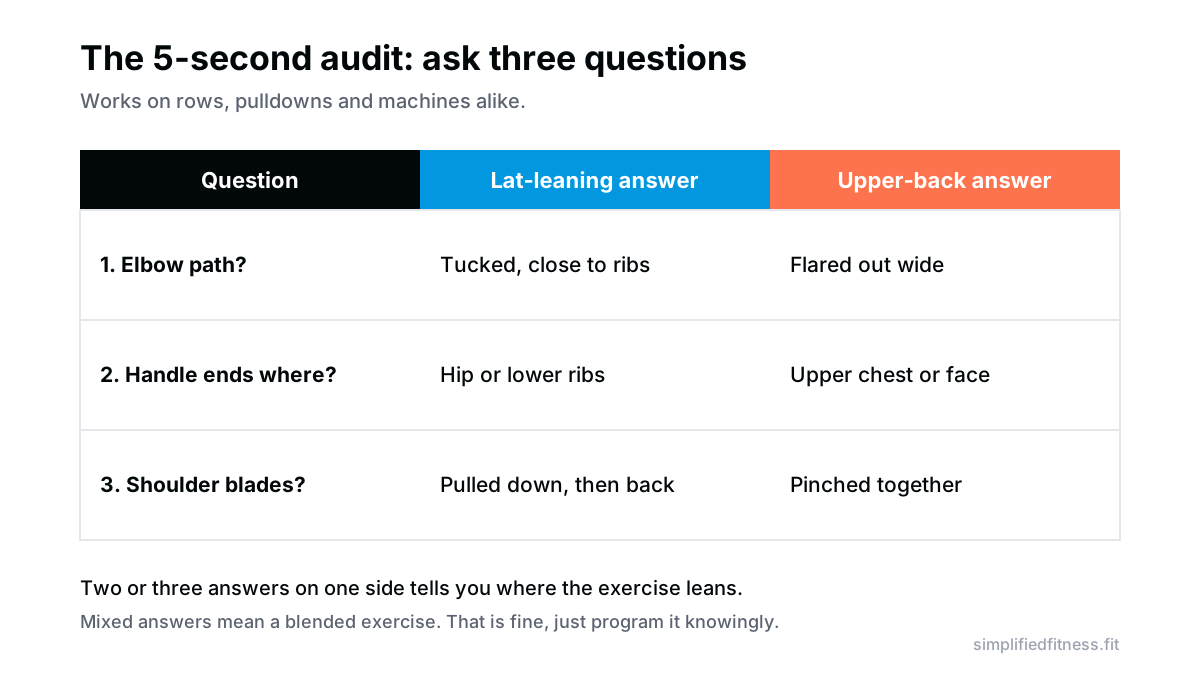
Ask three questions.
- Where does the elbow point? Close to the ribs leans lat. Out wide leans upper back.
- Where does the handle end? Hip or lower ribs leans lat. Upper chest or face leans upper back.
- What do the shoulder blades do? Down, then back leans lat. Pinched together leans upper back.
Quick examples:
- Neutral-grip seated row, elbows brushing your ribs, handle to the belly button: lat-leaning.
- Rope or wide bar row, elbows out, pull to the sternum: upper-back-leaning.
- Reverse pec dec: almost entirely upper back and rear delts.
- Close-grip lat pulldown to the upper chest: lat-leaning, with the biceps helping.
A practical way to use this in a back day
You do not need to pick a side. Use both styles on purpose.
- First lift (fresh): a lat-biased movement, such as a pulldown or tucked-elbow row, for 2-3 hard sets.
- Second lift: an upper-back row with flared elbows or a chest-supported row, for 2-3 hard sets.
- Finisher: a reverse fly or similar rear-delt movement if you want extra upper-back work.
Our pull day plan puts this kind of split into a complete session. And if you want the wider picture on choosing exercises by what they actually load, the exercise selection and biomechanics guide covers the logic. For the cue that helps you feel the lats working, see lat flare and mind-muscle connection cues.
When to see someone about it
If a flared or heavy row causes sharp pain at the front of the shoulder, tingling down the arm, or pain that lingers after training, stop that variation and speak to a doctor or physiotherapist. Do not try to diagnose it from an article, including this one.
Limits of the evidence
Most of the studies above are small, short, and used healthy young men. EMG amplitude shows how active a muscle is during a set, not how much it grows after months of training. The elbow-angle numbers in this article come from coaching practice, not a controlled trial. Treat them as a way to organise your thinking, and let your own feel and progress over a few weeks confirm what works for you.
Frequently Asked Questions
Why do I feel traps instead of lats when I row?
Usually because the elbows flare out and the shoulders shrug up before the pull starts. That position favours the upper back muscles and takes the lats out of their best working line. Tuck the elbows closer to your ribs, start the pull by moving the shoulder blades down, and finish near the hip.
How do I bias my lats on rows?
Keep the upper arm closer to the torso and aim the elbow toward your hip, not out to the side. The lats extend and adduct the shoulder, so this arm path puts them in line with the movement. Try a neutral or narrow handle, lean back slightly, and use a lighter weight until the pull feels low in your back.
What is the difference between scapular retraction and depression?
Retraction pulls the shoulder blades together toward the spine, while depression pulls them down away from your ears. Retraction is driven mainly by the mid back muscles, and depression involves the lower traps and lats helping to hold the shoulder down. Use depression to set up a lat pull and retraction to finish an upper-back row.
Should I squeeze my shoulder blades together on every row?
No. A hard squeeze at the end is useful on upper-back rows but not required on lat-focused rows. A 2004 EMG study found that actively retracting the scapula did not change mid trap and rhomboid activity in a seated row. Squeeze when your goal is the upper back, and otherwise let the shoulder blades move freely with the arm.
Is elbow flare bad for your shoulders?
Not automatically. Flared rows are common in upper-back training and many lifters do them without trouble, but wide elbows with heavy loads can irritate some shoulders. If a flared row pinches the front of your shoulder, narrow the elbow path, lower the load, or see a physiotherapist if the pain persists.
Does a wider grip hit the lats more?
Not clearly. In one study of 15 men on the lat pulldown, lat and trap activity was similar at one, one and a half and two times shoulder width. The wide grip also lifted slightly less weight, so choose the width that lets you pull with a comfortable elbow path.
Do upper back rows build lats?
They train them somewhat, but the main target shifts to the mid traps, rhomboids and rear delts. The lats still help with the pull, just with less direct emphasis. If lat size is the goal, include at least one tucked-elbow row or pulldown each week.
Which is better for a thicker back, lat rows or upper-back rows?
Both contribute, and they train different muscles. Lat movements mostly train back width, while flared rows build the upper back and rear delts. A mix of both across the week covers the whole region without needing exotic variations.
What is the 5-second audit for any back exercise?
Look at three things: where the elbow points, where the handle ends, and what the shoulder blades do. Tucked elbows, a hip finish and downward shoulder blades lean lat. Flared elbows, a chest or face finish and pinched shoulder blades lean upper back.
Why do my arms take over when I row?
The biceps assist every pulling movement, and if you grip hard and curl the handle, they can dominate the feel. Think about driving the elbow back rather than pulling the hands, and use straps or a looser grip if you want less forearm fatigue. A small drop in load often makes the back muscles easier to feel.
Does torso angle change lat versus upper back focus?
Torso angle on its own has not been well tested. The closest data is a 2025 trial on range of motion in the prone barbell row, which found only a medium, inconsistent effect on muscle excitation. Keep the same trunk angle across the set and steer with your elbows instead.
Can I train lats and upper back on the same day?
Yes, and most good back routines do. Start with a lat movement while you are fresh, then add an upper-back row or reverse fly later. Two to three hard sets of each type, trained a couple of times a week, is a sensible starting point.
Sources & References
Every claim above is checked against peer-reviewed research (PubMed, U.S. National Library of Medicine) or guidance from established health bodies. How we fact-check.
- Di Fonza D, et al. Electromyographic Analysis of Latissimus Dorsi Activation During Common Resistance Training Exercises: A Narrative Review. J Funct Morphol Kinesiol. 2026. PMID: 42647355
- Lehman GJ, et al. Variations in muscle activation levels during traditional latissimus dorsi weight training exercises: An experimental study. Dyn Med. 2004. PMID: 15228624
- Padovan R, et al. High-Density Surface Electromyography Excitation of Prime Movers Across Scapular Positions in the Seated Row. J Funct Morphol Kinesiol. 2025. PMID: 41562724
- Andersen V, et al. Effects of grip width on muscle strength and activation in the lat pull-down. J Strength Cond Res. 2014. PMID: 24662157
- Lusk SJ, et al. Grip width and forearm orientation effects on muscle activity during the lat pull-down. J Strength Cond Res. 2010. PMID: 20543740
- Padovan R, et al. High-Density Electromyography Excitation in Front vs. Back Lat Pull-Down Prime Movers. J Hum Kinet. 2024. PMID: 38689585
- Fischer J, et al. Impact of different ranges of motion in the prone barbell row on muscle excitation. J Electromyogr Kinesiol. 2025. PMID: 40513198
- Youdas JW, et al. Surface electromyographic activation patterns and elbow joint motion during a pull-up, chin-up, or perfect-pullup rotational exercise. J Strength Cond Res. 2010. PMID: 21068680

Umair Hazrami · Founder & Head Coach, Simplified Fitness
Umair Hazrami founded Simplified Fitness and the Simplified Lifter channel to cut through fitness noise. With 4+ years of consistent training and 10+ coaching clients, he writes every guide from the peer-reviewed research and links the sources so you can check them. Our editorial standards.
Educational content only, not medical advice. If you have a medical condition, are pregnant, or take medication, talk to a qualified doctor before changing your diet, supplements or training. Full disclaimer.
Keep reading
Exercise Technique
Barbell Bent-Over Rows: Spinal Load, Hamstring Fatigue and Lat Growth
Is the barbell bent over row hypertrophy gold or a fatigue generator? See what the research says about spinal load, torso angles and better rows for lat growth.
8 min read
Exercise Technique
Chest-Supported Rows: Train Your Upper Back Without Lower Back Fatigue
Chest supported row hypertrophy explained: why your lower back quits first, how T-bar, incline and seal rows fix it, and what the research says.
8 min read
Exercise Technique
Complete Back Workout Design: Balancing Vertical Pulls, Horizontal Rows, and Lumbar Recovery
A science-based back workout routine: weekly sets, how to balance pulldowns and rows, and how to protect your lower back, with a sample pull day plan.
9 min read

Exercise Technique
Conventional Deadlifts for Back Hypertrophy: Stimulus-to-Fatigue Ratio Analysis
Are deadlifts good for back hypertrophy? A stimulus-to-fatigue breakdown of what they build, what they miss for lats, and how to program or replace them.
8 min read