Single-Arm Iliac Lat Pulldowns: Cable Setup, Side Bend, and Driving the Elbow to the Hip
Learn the single arm lat pulldown for iliac lats: cable angle, side bend, elbow to hip path, rep ranges and fixes for biceps takeover, with the research linked.

TL;DR. The short answer
- The single arm lat pulldown works the lats through shoulder extension and adduction. The iliac emphasis is a coaching cue (elbow to the hip crest, ribs closing toward the pelvis), not something a trial has proven grows the low lats more.
- Set a high cable with a single handle, line it up at roughly 45 degrees in front of you, start with a slight side bend away from the working arm, and finish with the elbow tucked by your hip.
- Biceps takeover is the most common fault. Research in novice women found verbal technique instruction raised lat activity at light loads, but biceps activity did not drop, so expect a shift in emphasis rather than true isolation.
- Treat it as an accessory after a heavy pulldown or row. Sets of 8-15 slow reps, 2-4 hard sets per side, are a sensible start, since hypertrophy appears similar across a wide range of loads.
- Sharp shoulder pain, numbness or tingling down the arm are not normal training effects. Stop and see a doctor or physiotherapist.
Part of our complete guide: Complete Back Training Guide: Lats vs Upper Back, Best Exercises and a Hypertrophy Workout
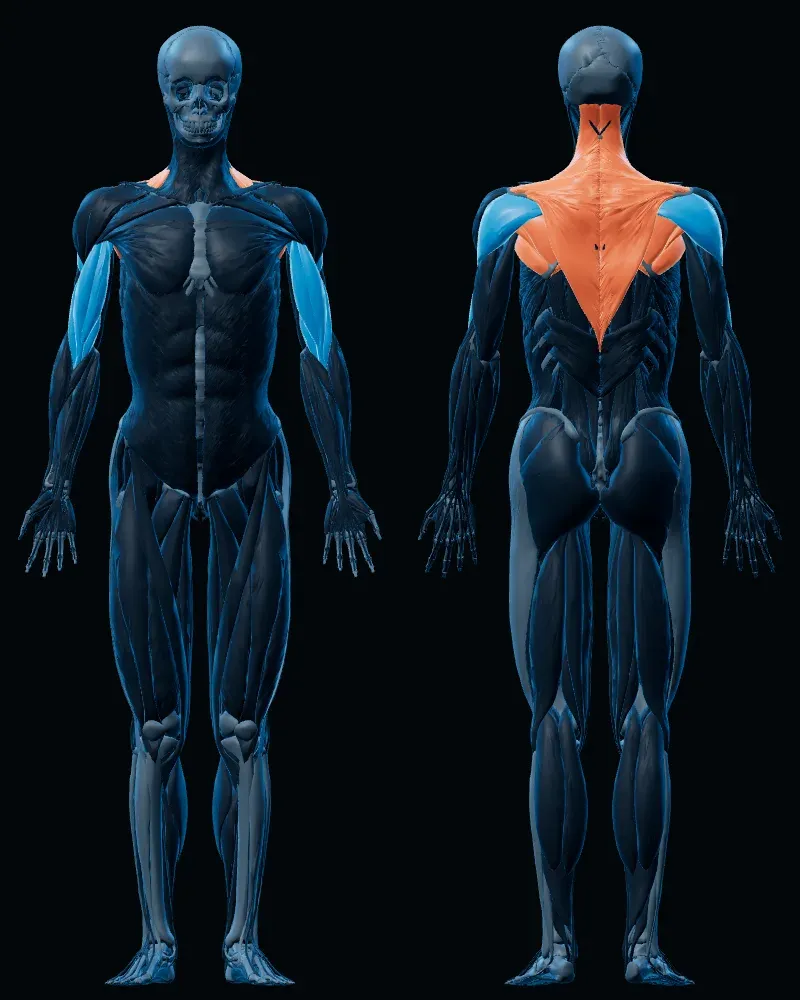
Muscles worked: upper back
Main movers: traps, rhomboids, teres major, infraspinatus and teres minor
Assisting: rear delts, biceps and brachialis
Table of contents
The single arm lat pulldown, cued so your elbow drives toward your hip, is a good way to feel the lats working, including the low fibers that attach near the pelvis. What it does not have is proof that it grows the “iliac lats” more than any other pulldown. It is a sharper cue and a better stretch, and that is a perfectly good reason to use it.
This article is the setup and execution manual. For the bigger picture of how pulldowns, rows and everything else fit together, start with the complete back training guide. For the anatomy behind the low-lat idea, see lat regional anatomy.
What is an iliac lat pulldown?
It is a one-arm cable pulldown where the elbow path runs down and slightly back toward the iliac crest, the bony shelf at the top of your hip. The lats originate partly along the pelvis and thoracolumbar region and insert on the upper arm bone, so pulling the elbow toward the hip lines up with the way those fibers run.
Is there anything special about the low fibers? Possibly. A 2026 high-density EMG study of 20 healthy adults described the lats as having two neuromuscular regions, thoracic and lumbar-pelvic-costal, that can show different activation patterns. During isometric shoulder extension the thoracic region was more active than the lumbar-pelvic-costal region at 50% of maximum effort and above (Muñoz-Garcés et al., 2026). Notice which way that cuts: in this study the upper fibers, not the low ones, did more of the shoulder extension work.
Read that carefully. It supports the idea that the lats are not one uniform sheet. It does not show that a side bend or a hip-bound elbow path will selectively grow the low fibers over months. Nobody has run that trial.
How do you set up a single arm lat pulldown?
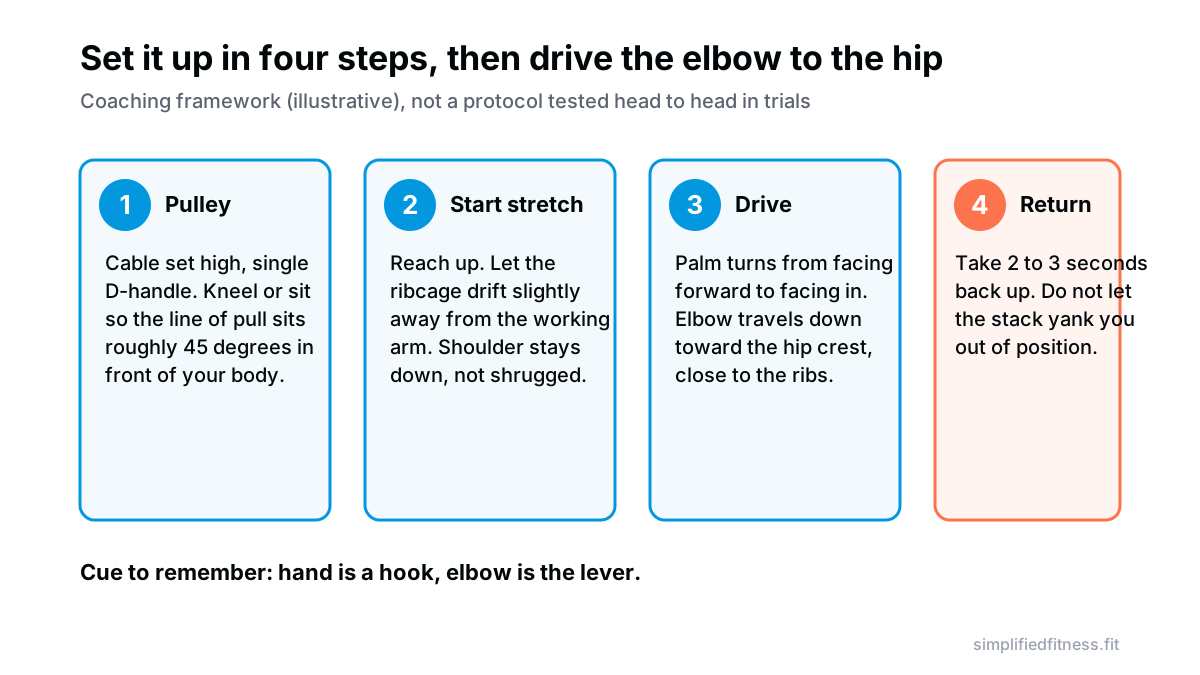
1. Pulley and handle. Set the cable high, above head height when you are seated or kneeling. Use a single D-handle. A rope or a strap works too, but a handle keeps your wrist neutral.
2. Position. Sit on a pulldown seat, or go half-kneeling with the knee on the side of your working arm down. Move so the line of the cable sits roughly 45 degrees in front of your body. That 45 is a convention, not a studied number. If your elbow bumps your ribs or you feel the cable pulling you sideways, shuffle closer or further until it runs clean.
3. Grip. Hold the handle like a hook, not a fist you are trying to crush. Thumb either wrapped or on top, whichever lets your forearm relax.
4. Brace. Ribs down, glutes tight, free hand holding the cable stack or your thigh for stability.
Half-kneeling or seated? Neither has been shown to build more muscle. Half-kneeling makes it harder to cheat with leg drive and lets you tilt a little. Seated with a thigh pad lets you load heavier. Choose the one where every rep looks the same.
How do you perform the rep: side bend, rotation and elbow to hip
Here is the movement start to finish.
Start. Reach up toward the handle. Let your ribcage tip slightly away from the working arm so you feel the lat lengthen along your side. Keep the shoulder down. If it creeps toward your ear, you are stretching your neck, not your lat.
Initiate. Before the elbow bends much, think of pulling the shoulder blade down and around your ribs. This is depression, not pinching the blades together. If that cue is new to you, our guide on scapular retraction vs depression covers it.
Drive. Let your palm rotate from facing forward to facing in as the elbow comes down. Aim the elbow at the hip pocket. As it passes your ribs, close the gap between your lower ribs and your hip on the working side with a small side bend toward the arm. That is the coaching logic behind the “iliac” name: the lat spans from arm to pelvis, so you are shortening that span.
Finish. Elbow beside or slightly behind your torso, lat tight, no torso swing. Hold for a beat.
Return. Take 2 to 3 seconds back up, controlled. This is where many people lose the stretch and let the stack yank them.
This elbow-path logic is the same rule behind how to tell lat work from upper-back work. We go through it in lats vs upper back: arm path and elbow flare.
How do you isolate the lats on a cable and stop the biceps taking over?
The most common mistake here is gripping hard and thinking about the hand. The biceps flex the elbow in every pulldown, so some involvement is normal. The question is how much, and what you can do about it.
Two studies are worth knowing. In 2009, researchers had eight women with little strength training experience do lat pulldowns at 30% of max, first with basic instructions and then after expert verbal coaching to emphasize the lats and de-emphasize the biceps. Lat EMG rose significantly after instruction. Biceps and teres major activity did not change significantly, so the authors cautioned that this probably does not represent true isolation (Snyder and Leech, 2009).
Honest takeaway: cueing can shift emphasis toward the lats, but you will not switch the biceps off. Eight novice women at a light load is also a narrow sample.
On the long-term side, a trial of 30 untrained men found that focusing on contracting the target muscle (internal focus) produced bigger gains in elbow flexor thickness (12.4% vs 6.9%) than focusing on the lift outcome over 8 weeks (Schoenfeld et al., 2018). That was measured in the arms, in beginners, so we cannot assume the same size of effect for the lats in experienced lifters. For the neural side of this, see lat flare and mind-muscle connection cues.
What this looks like in practice:
- Drop the load until you can feel the lat. Ego loads turn this into a biceps curl.
- Loosen the grip. Imagine the handle is a hook.
- Start each rep by moving the shoulder blade down, then the elbow.
- Touch your hip with the elbow, not the handle.
- Pause for a beat at the bottom.
Which fixes work for the common faults?
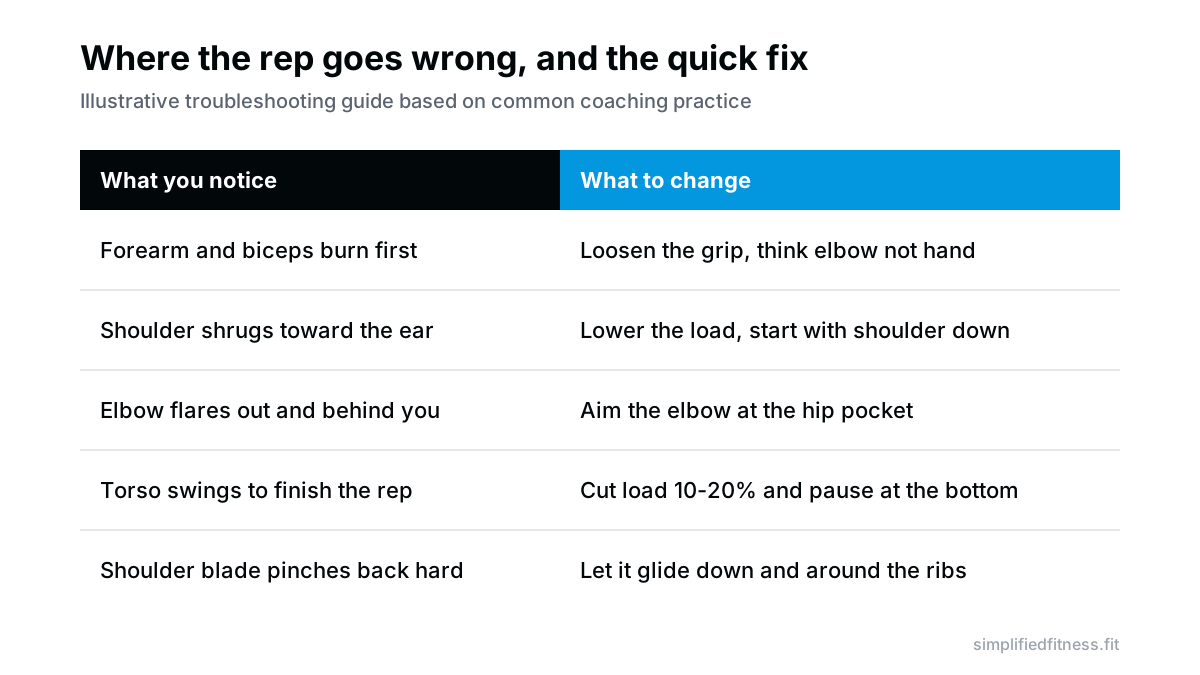
A few notes beyond the chart.
Shrugging. If the shoulder rides up at the start, the upper traps are doing a lot of the work. Cut the load and start with the shoulder set down.
Elbow flaring. Pulling the elbow out and behind you, away from the ribs, turns the movement into something closer to a rear-delt or upper-back pull. Keep the elbow in the plane of your side.
Torso swing. A tiny lean is fine. A big swing means momentum is doing the work.
Hard retraction. Pinching the shoulder blades together at the finish moves the emphasis to the mid back. Let the scapula glide down and around.
How should the resistance profile and grip be matched?
Cables give a fairly even load, which is good at the stretch where free weights often go light. The weak point is the top of the rep, where the load can drag your shoulder up and the stretch can turn into a loose, floppy bottom position. Control the top position rather than hanging off the stack.
On grip, the evidence for lat activation is less dramatic than gym lore. In 15 men doing bilateral pulldowns, narrow, medium and wide pronated grips produced similar lat EMG over the whole movement. A medium grip had some minor advantages over the others (Andersen et al., 2014). A 2026 narrative review of 23 EMG studies noted that grip width effects were inconsistent, and that an anterior bar path was the setup most consistently linked to higher lat amplitude, but these are acute EMG findings, not long-term growth outcomes (Di Fonza et al., 2026).
For a single handle, that suggests not obsessing over rotation. Use the hand position that keeps your elbow tracking toward the hip and your forearm relaxed. Our comparison of wide vs close and neutral pulldown grips goes deeper.
What rep range and how many sets work for single-arm pulldowns?
Muscle growth appears to be fairly flexible across loads. A 2017 meta-analysis of 21 studies, where all sets were taken to momentary failure, found hypertrophy was similar between lower-load (60% of 1RM or less) and higher-load training, while 1RM strength gains favored heavy loads (Schoenfeld et al., 2017).
For this lift, that means:
- Reps: 8-15 controlled reps is a sensible default. Lighter 15-20 rep sets can work if heavy single-arm pulling makes you swing.
- Sets: 2-4 hard sets per side as an accessory is a reasonable start. Your weekly total back volume matters more than any single exercise. Use the training volume calculator to sanity-check your weekly sets.
- Effort: Finish most sets with 1-3 reps in reserve, and take the last set closer to failure only if your form stays clean.
- Tempo: About 1 second up, brief pause, 2-3 seconds down.
Where does it go in a session? After your heaviest vertical pull or row, when you have done the big movements while fresh. Our pull day plan shows how accessory pulls fit around the main lifts, and the complete back workout design explains how to build the week.
Is single arm better than a two-arm pulldown?
Probably not for size alone. A 2025 meta-analysis of nine studies found no significant difference in muscle hypertrophy between unilateral and bilateral training, though it noted the literature is limited and the studies were not lat-specific. Strength followed specificity: bilateral training improved bilateral strength more, and unilateral training improved unilateral strength more (Kassiano et al., 2025).
The practical advantages of the single-arm version are mostly about execution: a bigger stretch, more room to tilt the torso, easier to feel one side at a time, and a way to notice if your left and right sides behave differently. Those are good reasons to include it. Superiority for growth is not one of them.
On range of motion, a 2020 systematic review found that full range of motion helped lower-body hypertrophy, but upper-limb evidence was limited and conflicting, and no study had examined trunk muscle growth (Schoenfeld and Grgic, 2020). So “use as much range as you can control” is sensible, but it is not a proven rule for the lats.
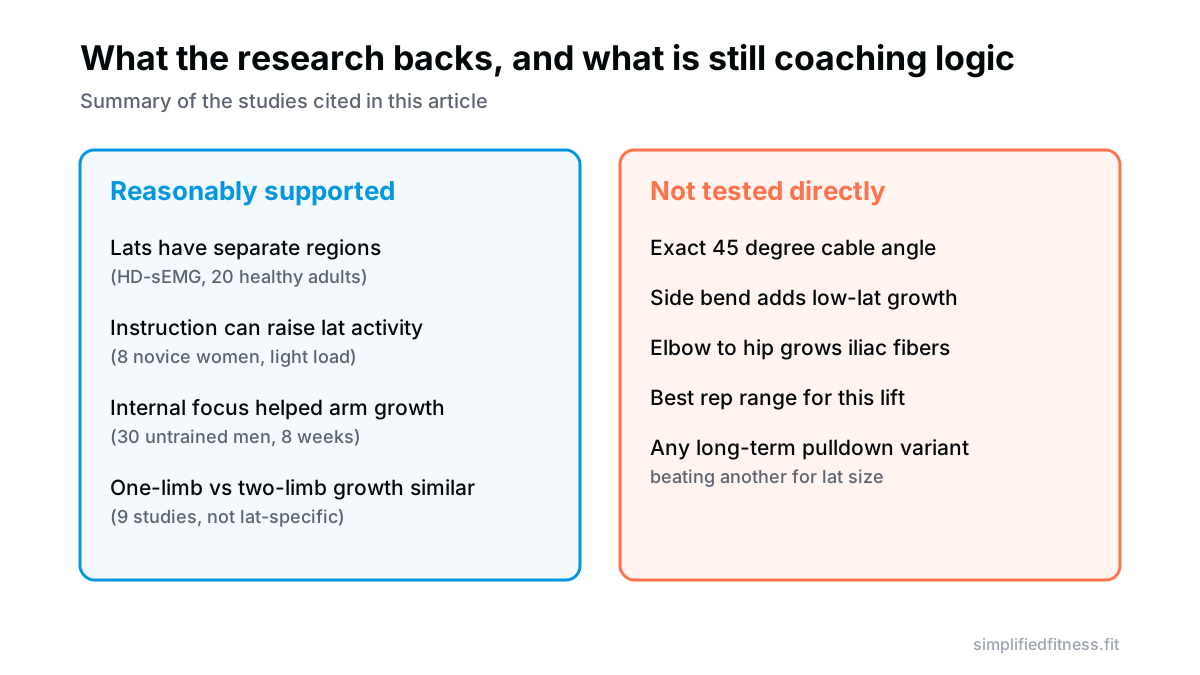
Common mistakes and a simple progression
A simple progression: pick a weight that gives you 12 clean reps, and stay there until you can do 15 with the same form. Then add a small step on the stack and drop back to 10-12. Log the weight, reps and one word about how it felt (lat, biceps, or neck). If the word is not “lat” on most reps, fix the setup before you add load.
Plenty of home gyms in India have a single pulley or none at all. A resistance band anchored high can approximate the movement, but bands get harder at the stretched end, which is the opposite of a cable. Use 12-20 reps and the same elbow-to-hip path.
When should you stop and see a doctor?
Normal training effects are a pump, dull soreness in the muscle belly, and fatigue. Not normal: sharp shoulder pain, pain that keeps going after you finish, numbness or tingling in the arm or hand, or sudden weakness. Stop pulldowns and get assessed by a doctor or physiotherapist. This article is education, not diagnosis.
If you want the lats to be one part of a balanced pulling week, our back training guide shows how to pair vertical pulls like this with rows.
Frequently Asked Questions
What is an iliac lat pulldown?
It is a single-arm cable pulldown cued so the elbow travels down toward the hip crest (the iliac crest) instead of straight down beside the head. The lats attach to the pelvis, so the cue is meant to bias the lower fibers. This emphasis is a coaching idea, so judge it by feel and by how well you can load the movement.
Does the single arm lat pulldown build the lower lats?
There is no long-term trial showing that this exact lift builds the low lats more than other pulldowns. High-density EMG work shows the lats have distinct regions that can be activated differently, which makes the idea plausible. Use it as one of several pulling movements and track whether your back actually grows.
What angle should the cable be at?
A line of pull roughly 45 degrees in front of your body is a good starting point. No study has tested that specific number, so treat it as a convention rather than a rule. Move your kneeling or seated position a few centimetres each way until you feel the lat stretching at the top and the elbow can travel to your hip without hitting your torso.
Why do I feel my biceps more than my lats?
Your elbow flexors help in every pulldown, and many people grip hard and pull with the hand. In a small study of untrained women, expert instruction increased lat activity but biceps activity did not significantly fall. Loosen your grip, lighten the load, and think about moving the elbow, not the hand.
Should I side bend during the rep?
A small amount is useful. Letting the ribcage drift slightly away from the working arm at the top lengthens the lat, and closing that gap as you pull shortens it. Keep it controlled, because a big torso swing means the load is too heavy and the back is no longer doing the work.
Is half kneeling better than seated?
Neither has been shown to build more muscle. Half kneeling gives you freedom to lean and rotate slightly and makes it harder to cheat with leg drive, while a seated setup with a thigh pad lets you use more load. Pick whichever lets you reproduce the same clean rep every set.
How many reps and sets should I do?
A sensible range is 8-15 controlled reps for 2-4 hard sets per side. A meta-analysis found hypertrophy was similar between lighter and heavier loads when sets were taken close to failure, while 1RM strength favored heavy loads. Because the stack drifts and form breaks down, many lifters find moderate reps work better for this lift than very heavy ones.
Is single arm better than a two-arm pulldown?
Not for muscle size on the evidence we have. A 2025 meta-analysis of nine studies found no significant difference in hypertrophy between unilateral and bilateral training, although it was not lat-specific. Use single arm work for its practical benefits, such as a bigger stretch, easier torso positioning and spotting left-right differences.
Should I use a full range of motion?
Generally yes, as long as you can stay in control. A systematic review found full range of motion helped lower-body growth, but evidence for the upper limbs was limited and conflicting, and no study looked at trunk muscles. Use the longest range where your shoulder blade and ribcage stay under control.
Should I squeeze my shoulder blades together?
Not hard, for a lat-focused pulldown. Pinching the blades back is a mid-back cue, so it tends to pull your attention and the movement toward the rhomboids and traps. Think about the shoulder blade gliding down and around the ribs while the elbow drives to the hip.
Does the mind-muscle connection really work for the lats?
It may help, with caveats. In one 8-week trial of 30 untrained men, an internal focus produced greater elbow flexor growth than an external focus, but that was arms, not lats, and in beginners. Try it at light to moderate loads where you can actually feel the target muscle.
Can I do this exercise with a resistance band if my gym has no cable?
You can approximate it, but the resistance profile is different. A band gets heavier as it stretches, which is the opposite of a cable's flat load. Anchor it high, use the same elbow-to-hip path, and use sets of 12-20 reps to compensate.
When should I see a doctor about shoulder pain from pulldowns?
See a doctor or physiotherapist for sharp pain, pain that persists after training, numbness, tingling, or weakness in the arm. Normal training soreness is dull, in the belly of the muscle, and fades within a few days. Stop the movement until you have been assessed.
Sources & References
Every claim above is checked against peer-reviewed research (PubMed, U.S. National Library of Medicine) or guidance from established health bodies. How we fact-check.
- Muñoz-Garcés M, et al. Regional Activation of the Latissimus Dorsi Muscle by High-Density Surface Electromyography During Isometric Shoulder and Trunk Exercises. Sports Health. 2026. PMID: 41345828
- Di Fonza D, et al. Electromyographic Analysis of Latissimus Dorsi Activation During Common Resistance Training Exercises: A Narrative Review. J Funct Morphol Kinesiol. 2026. PMID: 42647355
- Snyder BJ, Leech JR. Voluntary increase in latissimus dorsi muscle activity during the lat pull-down following expert instruction. J Strength Cond Res. 2009. PMID: 19826307
- Schoenfeld BJ, et al. Differential effects of attentional focus strategies during long-term resistance training. Eur J Sport Sci. 2018. PMID: 29533715
- Kassiano W, et al. Comparison of Muscle Growth and Dynamic Strength Adaptations Induced by Unilateral and Bilateral Resistance Training: A Systematic Review and Meta-analysis. Sports Med. 2025. PMID: 39794667
- Schoenfeld BJ, Grgic J. Effects of range of motion on muscle development during resistance training interventions: A systematic review. SAGE Open Med. 2020. PMID: 32030125
- Andersen V, et al. Effects of grip width on muscle strength and activation in the lat pull-down. J Strength Cond Res. 2014. PMID: 24662157
- Schoenfeld BJ, et al. Strength and Hypertrophy Adaptations Between Low- vs. High-Load Resistance Training: A Systematic Review and Meta-analysis. J Strength Cond Res. 2017. PMID: 28834797

Umair Hazrami · Founder & Head Coach, Simplified Fitness
Umair Hazrami founded Simplified Fitness and the Simplified Lifter channel to cut through fitness noise. With 4+ years of consistent training and 10+ coaching clients, he writes every guide from the peer-reviewed research and links the sources so you can check them. Our editorial standards.
Educational content only, not medical advice. If you have a medical condition, are pregnant, or take medication, talk to a qualified doctor before changing your diet, supplements or training. Full disclaimer.
Keep reading
Exercise Technique
Barbell Bent-Over Rows: Spinal Load, Hamstring Fatigue and Lat Growth
Is the barbell bent over row hypertrophy gold or a fatigue generator? See what the research says about spinal load, torso angles and better rows for lat growth.
8 min read
Exercise Technique
Chest-Supported Rows: Train Your Upper Back Without Lower Back Fatigue
Chest supported row hypertrophy explained: why your lower back quits first, how T-bar, incline and seal rows fix it, and what the research says.
8 min read
Exercise Technique
Complete Back Workout Design: Balancing Vertical Pulls, Horizontal Rows, and Lumbar Recovery
A science-based back workout routine: weekly sets, how to balance pulldowns and rows, and how to protect your lower back, with a sample pull day plan.
9 min read

Exercise Technique
Conventional Deadlifts for Back Hypertrophy: Stimulus-to-Fatigue Ratio Analysis
Are deadlifts good for back hypertrophy? A stimulus-to-fatigue breakdown of what they build, what they miss for lats, and how to program or replace them.
8 min read