Seated Cable Rows: V-Bar, Neutral Grip or Wide Bar? How to Choose and Drive the Elbows
Which seated cable row attachments hit your lats or upper back? V-bar, neutral grip and wide bar compared, plus elbow drive and torso cues, studies linked.

TL;DR. The short answer
- Seated cable row attachments change your elbow path more than they change which muscle does the work. Close V-bar and neutral grips suit lat and general back work, while a wide overhand bar shifts effort toward the mid-back and rear delts.
- Direct research comparing seated-row handles is thin and limited to EMG (muscle electrical activity), and grip width in the related lat pulldown changed lat activation very little. Pick the handle you can pull well with, and rotate them.
- Elbow path matters more than the handle. A narrower grip and lower shoulder-abduction angle were each linked to higher lat activity in separate studies, so keep elbows closer to your ribs for lats.
- Keep your torso nearly still. A slight hip hinge into the stretch is fine, but swinging back to finish turns a back exercise into a lower-back and momentum exercise.
- If you get sharp or radiating back pain, or numbness, stop and see a doctor or physiotherapist instead of adjusting handles.
Part of our complete guide: Complete Back Training Guide: Lats vs Upper Back, Best Exercises and a Hypertrophy Workout
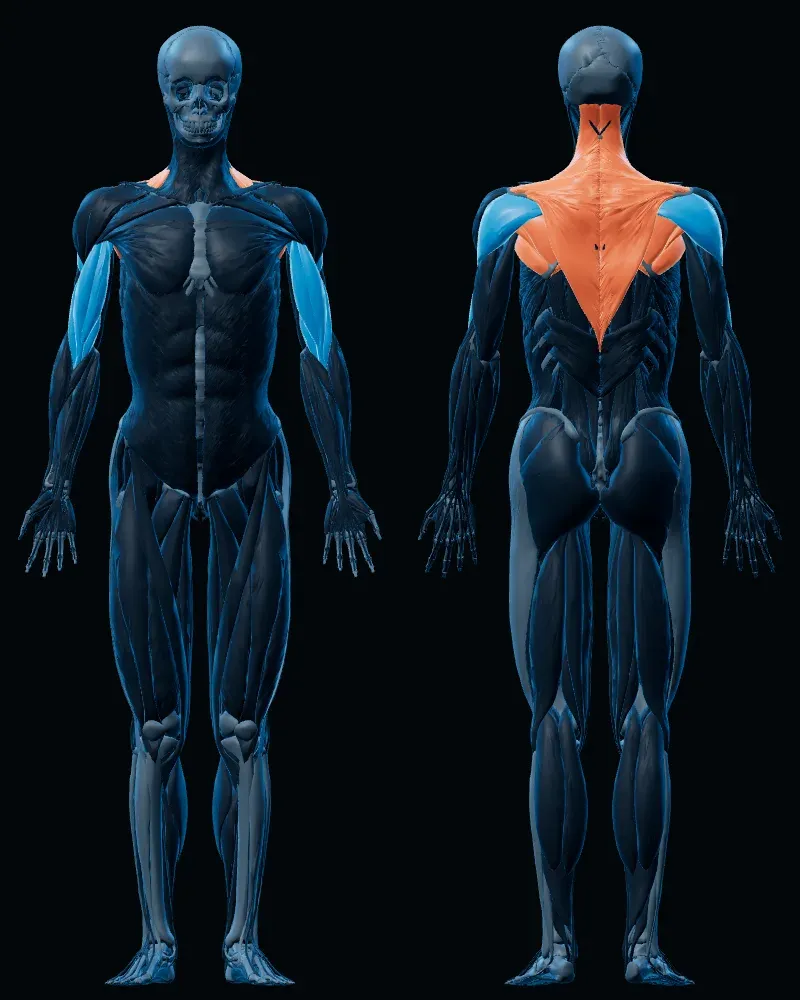
Muscles worked: upper back
Main movers: traps, rhomboids, teres major, infraspinatus and teres minor
Assisting: rear delts, biceps and brachialis
Table of contents
The best seated cable row attachment depends on where you want to feel the work, but the handle matters less than your elbow path. A close V-bar or neutral grip suits lat and general back work, and a wide overhand bar shifts more effort to the mid-back and rear delts.
That is the short answer. This article is the equipment-specific piece in our complete back training guide, so we will focus on the seated cable row machine: which handle to clip on, where the elbows go, and how much your torso should move. For the broader arm-path question across all rows, see lats vs upper back and elbow flare.
Which seated cable row attachment should you use?
Most commercial gyms have three handles near the low pulley: a close V-bar (often called a triangle), a medium neutral handle (sometimes sold as a mag grip) and a long straight or lat bar. Each one sets your hand position, and your hand position nudges your elbows.
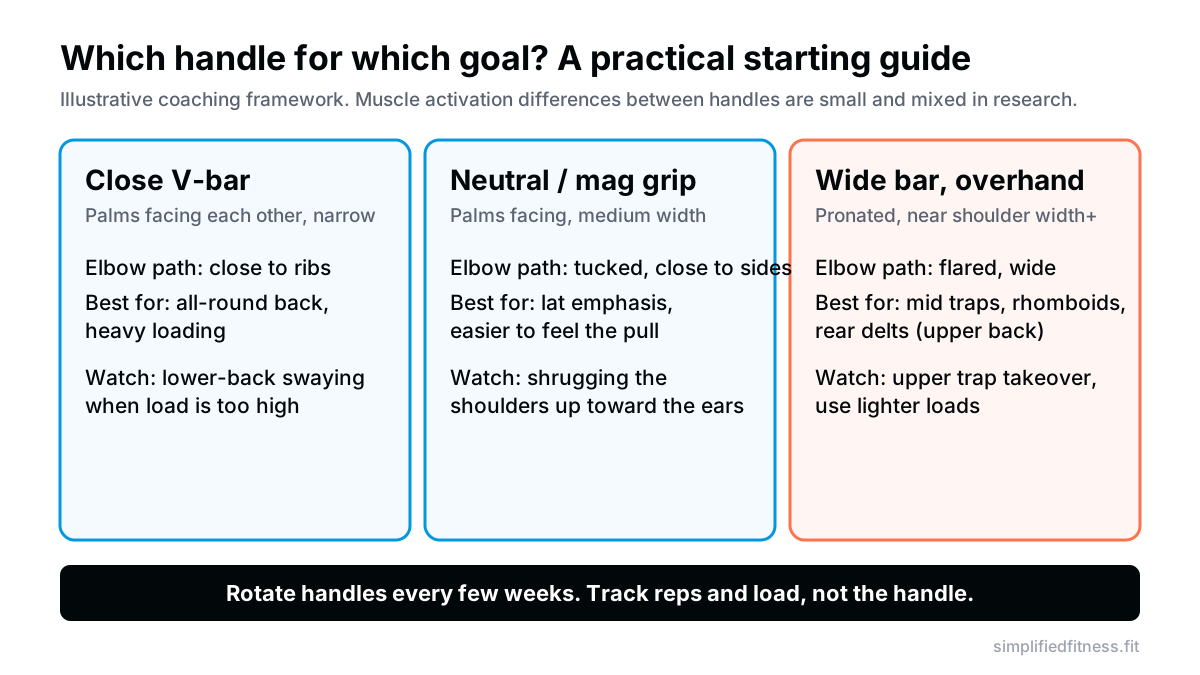
Here is the same information as a table.
| Attachment | Grip | Typical elbow path | Best used for | Watch out for |
|---|---|---|---|---|
| Close V-bar | Neutral, narrow | Close to the ribs | General back work, heavy sets | Lower-back swaying when overloaded |
| Neutral / mag grip | Neutral, medium | Tucked close to the sides | Lat emphasis | Shrugging toward the ears |
| Wide bar, overhand | Pronated | Flared out from the ribs | Mid traps, rhomboids, rear delts | Upper-trap takeover, ego loading |
The matrix is a coaching framework, not a lab result. Muscle activation research on grips is mixed, so treat it as a sensible starting point and adjust to how your own body responds.
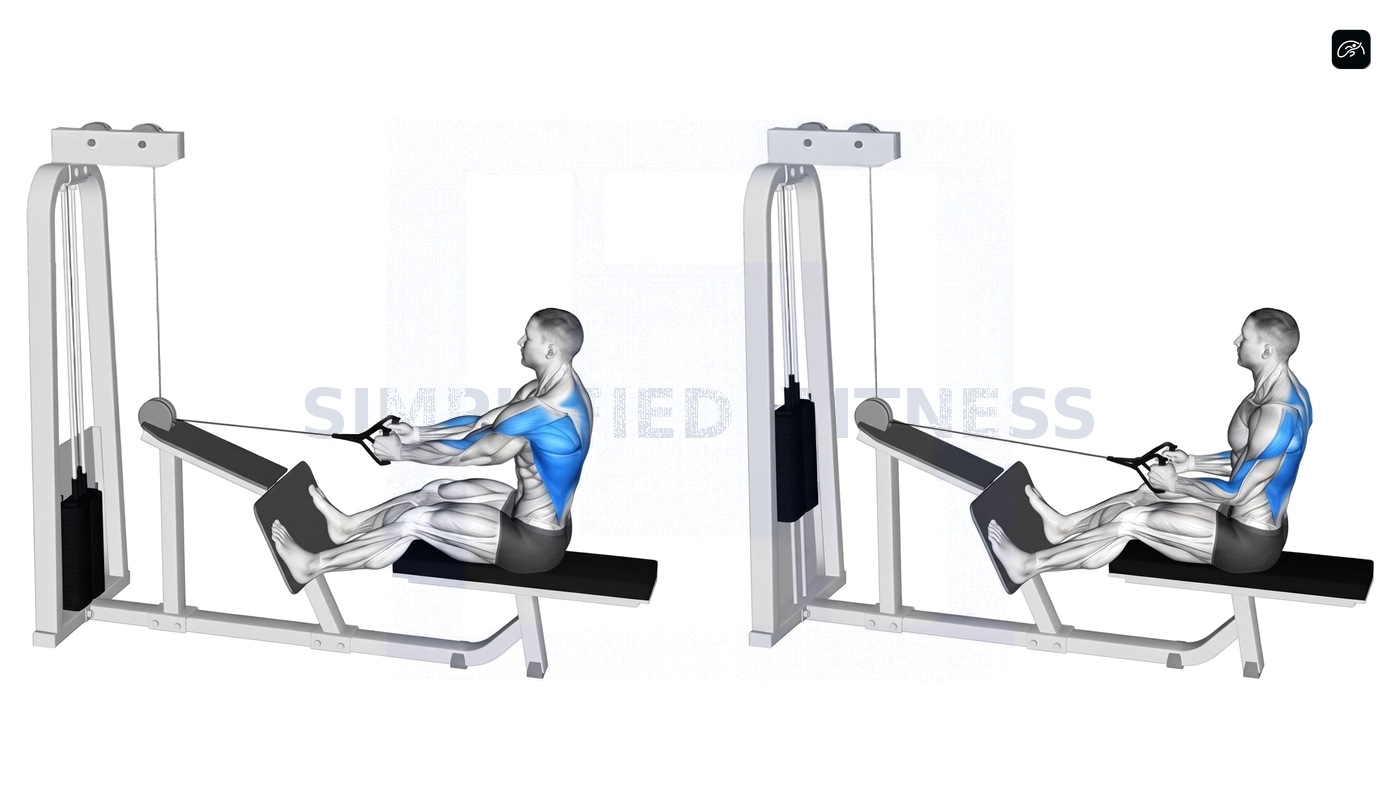
V-bar vs wide grip cable row: what does the research say?
Here is where it gets honest. Direct comparisons of seated-row handles are thin, and the best summary available is a 2026 narrative review of 23 EMG studies on the latissimus dorsi. For the seated row, it found that a narrower grip and a lower shoulder-abduction angle were each associated with greater lat activation, but in separate studies, and the authors warn they have not been tested together (Di Fonza et al., 2026). They also stress that this is acute EMG amplitude, not long-term muscle growth, and call it a starting point rather than a prescription.
That lines up with the lat pulldown, where grip width has been studied more. In 15 men doing 6-rep-max pulldowns with narrow, medium and wide pronated grips, EMG for the lats, traps and infraspinatus was similar across widths over the full movement, and the researchers suggested similar hypertrophy should follow with a grip of 1-2 times shoulder width (Andersen et al., 2014). The pulldown is a different exercise, so we cannot copy it straight across, but it is a useful reminder that handle effects are usually modest. Our guide on wide vs close vs neutral grip on lat pulldowns covers that side in detail.
So what is a fair summary? The handle seems to matter mostly because of the elbow position it encourages. A close neutral handle makes it easy to keep elbows tucked. A wide overhand bar makes it natural to flare. If you want the lats, choose the first. If you want upper-back thickness and rear delts, choose the second.
What about the mag grip?
The mag grip (a medium neutral handle) is popular because many lifters say they feel the lats more. That experience is plausible: palms facing each other lets your elbows travel closer to your body without your wrists or shoulders fighting it.
But I could not find a study that directly tests this handle against a V-bar or wide bar on a seated row. So the honest position is: it is a good tool if it helps you keep tucked elbows and a stable shoulder, and it is not a proven lat-builder on its own.
Seated cable row elbow position: the part that actually changes things
Pick any handle and the same checkpoints apply. The elbows lead, the hands follow, and the shoulder blades move with the arms.
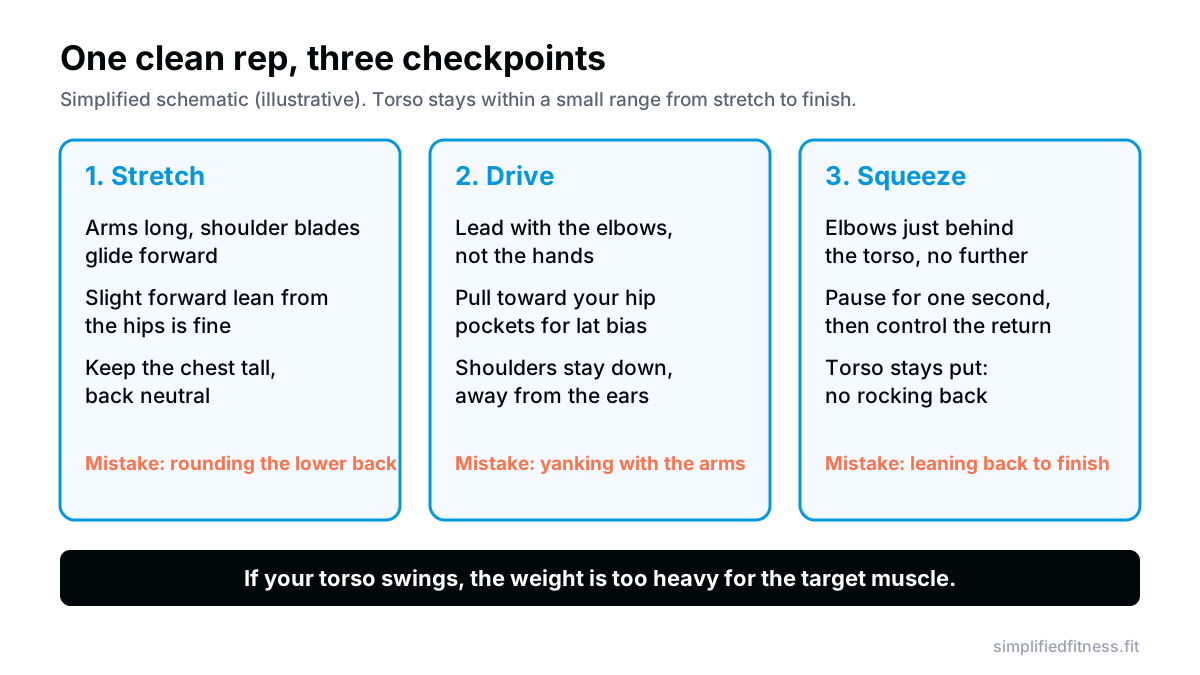
1. Stretch. Let your arms straighten and your shoulder blades glide forward. A slight forward lean from the hips is normal. Keep the lower back neutral.
2. Drive. Think elbows, not hands. For lat emphasis, pull them toward your hip pockets with the elbows fairly close to your ribs. Keep your shoulders down instead of shrugging.
3. Squeeze. Finish when your elbows pass just behind your torso. Pause briefly, then control the weight back.
Free or fixed shoulder blades?
Should your shoulder blades move freely or be held back? In a randomized crossover of 14 resistance-trained men using an 8-rep-max load, fixing the scapulae versus letting them move produced comparable overall muscle excitation. The differences were small and selective: the posterior deltoid was higher during the pull with fixed shoulder blades, and the middle trapezius and lats were higher in the lowering phase (Padovan et al., 2025). The authors concluded that scapular constraint changes the distribution of excitation more than the overall level, and that both versions are usable.
My practical take: let the shoulder blades move through a full range on most sets, and use a firmer scapular position when you want to feel one specific area. Do not obsess over it.
Range of motion matters too, though the data is not row-specific. A meta-analysis of 16 studies found full range of motion beat partial range for strength and lower-limb hypertrophy, with no clear difference in muscle thickness overall (Pallares et al., 2021). Use a full, controlled range rather than short, jerky reps, but do not expect every inch to be magic.
Torso position: slight lean or strict vertical?
This is where most seated row reps go wrong. The most common mistake here is turning the row into a rocking motion: lean forward to reach, then throw the torso back to finish. The weight moves, but your back muscles do less of the work.
A better rule: keep the torso nearly still, allow a small hinge at the hips into the stretch, and finish with your chest up instead of leaning behind the seat. If you cannot hold the position, the load is too heavy for the muscles you want to train.
On spine load, the best direct evidence is on other rows. A lab study of 7 healthy men found that the standing bent-over row produced the largest lumbar spine load compared with the inverted row and the standing one-armed cable row (Fenwick et al., 2009). It did not test the seated cable row, so we should not read too much into it. What it does suggest is that holding a bent-forward hinge under load costs your lower back more than the other rows tested. If your lower back is the limiter, a chest-supported option is worth trying, as we explain in chest-supported rows for upper-back hypertrophy, and our barbell bent-over row breakdown covers the heavier end.
Thoracic flexion in the stretch: how much is OK?
Many lifters let the upper back round slightly in the stretch to get extra range. That is a common technique, but there is little direct research on whether it helps or hurts muscle growth, so I will not claim either. The practical middle ground:
- Allow your shoulder blades to glide forward and the upper back to relax a touch.
- Keep your lower back neutral rather than collapsing into flexion.
- Stop the stretch where you feel tension in the back, not a pull in the lumbar spine.
- If it hurts, shorten the range and lower the load.
Cues that help (and how much)
Do cues like “squeeze your lats” work? A bit. In 20 participants with little or no strength training experience, a verbal instruction to focus on the back raised latissimus EMG by about 15% and cut posterior deltoid EMG by about 14% on the first repetitions, but did not change the signal in the final repetitions of a set taken to failure (Fujita et al., 2020). So cues help early, and the effect fades as fatigue sets in. Beginners were the subjects, so trained lifters may respond differently.
If your traps keep taking over on wide-grip rows, there is some early evidence the habit is coachable. In 8 men, EMG biofeedback helped reduce upper trapezius excitation by roughly 10% on a wide-grip seated row, although serratus anterior activity dropped by a similar amount (Dos Anjos et al., 2024). It was a small, non-randomized feasibility study, and we do not know if it improves growth or shoulder health. Still, “pull the elbows down and back” is a good cue.
How to program seated cable rows
You do not need to overthink it. A simple setup:
- Start your back session with a heavy row on the V-bar or neutral grip: 2-3 sets of 6-10 reps.
- Add a second row variation on a different handle (for example, the wide bar) for 2 sets of 10-15 reps.
- Take most sets close to failure with 1-3 reps in reserve. Our RIR and RPE calculator helps you judge that.
- Rotate handles every 4-6 weeks while tracking load and reps. Progress on the same handle is what counts.
Seated rows pair well with a vertical pull, so see how to fit them into a full week in our back workout design guide. If your grip gives out before your back does, read lifting straps for back hypertrophy. Want a ready-made pull session? Try the pull day plan.
When to see a doctor
Normal rowing soreness sits in the muscle and fades in a day or two. See a doctor or physiotherapist if you get sharp or radiating back pain, numbness or tingling in your legs or arms, pain that wakes you at night, or shoulder pain that persists after you reduce the load. This article is general education and cannot diagnose anything.
The bottom line
Pick the V-bar or a neutral handle when you want lats and heavy sets, and the wide overhand bar when you want mid-back and rear delts. Keep the elbows leading, the shoulders down and the torso quiet. The handle nudges your arm path, the research on differences is modest and mostly short-term EMG in young men, and consistent progressive overload on well-controlled reps is what will actually grow your back.
Frequently Asked Questions
Which attachment is best for the seated cable row?
There is no single best handle. A close V-bar or neutral grip suits most people for lat and general back work, and a wide overhand bar suits upper-back emphasis. Direct research on handles is limited and shows modest differences in muscle activation, so choose the handle that lets you keep your elbows and torso in position, and rotate through them over time.
V-bar vs wide grip cable row: which is better for lats?
A V-bar or other narrow, neutral handle is usually the better lat choice. A 2026 narrative review linked a narrower grip and a lower shoulder-abduction angle to higher latissimus EMG in separate studies, and a close grip makes tucked elbows easier. Use the V-bar for lat work and the wide bar when you want more mid-back and rear delt.
Does a wide grip seated row work the lats less?
It can shift the emphasis, but the research is not conclusive. A wide grip tends to flare the elbows away from the ribs. In an isometric pull-down study, raising the arm higher from the side was linked to less latissimus and more lower trapezius activity, which hints at, but does not prove, a similar effect in rows. Use the wide bar as an upper-back movement and do not expect it to be your main lat builder.
What is a mag grip on a cable row?
A mag grip is a neutral-grip handle with a medium width where your palms face each other. It lets many people keep the elbows tucked and feel the lats more easily. There is little direct research on this specific handle, so treat it as a practical option rather than a proven advantage.
Should my elbows stay close or flare out on seated rows?
For lat emphasis, keep your elbows closer to your ribs and pull toward your hip pockets. Flared elbows shift more work toward the mid-back, rear delts and upper traps. Choose the path that matches your goal, and stay consistent so you can track progress.
Is it OK to lean back on seated cable rows?
A small lean is normal, but swinging your torso back to finish is not. Excess lean reduces the work your back muscles do and adds momentum and lower-back stress. Lower the weight until your torso moves only slightly while the elbows do the pulling.
Should I round my upper back in the stretch?
Allow your shoulder blades to glide forward and your upper back to relax slightly, but keep the lower back neutral. Some upper-back rounding in the stretch is common in gyms, and strong evidence on its effect for muscle growth is lacking. If you feel pinching or pulling in the lower back, reduce the range and the load.
Does a free or fixed shoulder blade matter on the seated row?
It changes where the work lands more than how hard you work overall. In a 2025 study of 14 trained men, fixing the shoulder blades versus letting them move produced similar overall muscle excitation, with small differences in the middle trapezius, lats and posterior deltoid. Use a fuller shoulder blade glide for upper-back work and a firmer scapular position if you want to focus on the lats.
How do I stop my traps from taking over?
Think about pulling your elbows down and back rather than lifting your shoulders. A small study of eight men found that EMG biofeedback helped reduce upper trapezius activity by about 10% on a wide-grip row, which suggests it is a coachable skill. Lower the load, keep your shoulders away from your ears and slow the pull.
Do mind-muscle cues actually work on seated rows?
They help a little, mostly early in a set. In a study of 20 people with little training experience, a verbal cue to focus on the back raised latissimus EMG by about 15% on the first repetitions, but the effect faded later in the set. Use a short cue like elbows to hip pockets, then focus on good reps.
How many sets and reps should I do on seated rows?
A reasonable starting point is 2-4 hard sets of 8-15 reps, 1-2 times a week, as part of your total back volume. Muscle growth is possible across a wide range of loads when sets are close to failure, so choose a rep range you can control. Use our RIR and RPE calculator to judge how close each set was to failure.
Is the seated cable row bad for your lower back?
It is not inherently bad, but form decides the load on your spine. In a lab study of three rows, the standing bent-over row loaded the lumbar spine the most. The seated cable row was not tested, but sitting upright with your feet braced means you are not holding a bent-over hinge, so many people find it easier on the back. If you have back pain or a history of disc problems, check with a doctor or physiotherapist before heavy rowing.
Can I build a big back with only seated cable rows?
Seated rows are a strong base, but a complete back usually benefits from both vertical pulls and horizontal pulls. Rows train thickness and mid-back, while pulldowns and pull-ups train the lats through a different angle. Pair rows with a vertical pull in your weekly plan.
Sources & References
Every claim above is checked against peer-reviewed research (PubMed, U.S. National Library of Medicine) or guidance from established health bodies. How we fact-check.
- Di Fonza D, et al. Electromyographic Analysis of Latissimus Dorsi Activation During Common Resistance Training Exercises: A Narrative Review. J Funct Morphol Kinesiol. 2026. PMID: 42647355
- Padovan R, et al. High-Density Surface Electromyography Excitation of Prime Movers Across Scapular Positions in the Seated Row. J Funct Morphol Kinesiol. 2025. PMID: 41562724
- Fujita RA, et al. Mind-Muscle Connection: Limited Effect of Verbal Instructions on Muscle Activity in a Seated Row Exercise. Percept Mot Skills. 2020. PMID: 32448047
- Dos Anjos FV, et al. Assessing the Feasibility of EMG Biofeedback to Reduce the Upper Trapezius Muscle Excitation during a Seated Row Exercise, a Non-randomized Comparative Study. Appl Psychophysiol Biofeedback. 2024. PMID: 39177899
- Park SY, et al. Selective activation of the latissimus dorsi and the inferior fibers of trapezius at various shoulder angles during isometric pull-down exertion. J Electromyogr Kinesiol. 2013. PMID: 24064179
- Andersen V, et al. Effects of grip width on muscle strength and activation in the lat pull-down. J Strength Cond Res. 2014. PMID: 24662157
- Fenwick CM, et al. Comparison of different rowing exercises: trunk muscle activation and lumbar spine motion, load, and stiffness. J Strength Cond Res. 2009. PMID: 19620925
- Pallares JG, et al. Effects of range of motion on resistance training adaptations: A systematic review and meta-analysis. Scand J Med Sci Sports. 2021. PMID: 34170576

Umair Hazrami · Founder & Head Coach, Simplified Fitness
Umair Hazrami founded Simplified Fitness and the Simplified Lifter channel to cut through fitness noise. With 4+ years of consistent training and 10+ coaching clients, he writes every guide from the peer-reviewed research and links the sources so you can check them. Our editorial standards.
Educational content only, not medical advice. If you have a medical condition, are pregnant, or take medication, talk to a qualified doctor before changing your diet, supplements or training. Full disclaimer.
Keep reading
Exercise Technique
Barbell Bent-Over Rows: Spinal Load, Hamstring Fatigue and Lat Growth
Is the barbell bent over row hypertrophy gold or a fatigue generator? See what the research says about spinal load, torso angles and better rows for lat growth.
8 min read
Exercise Technique
Chest-Supported Rows: Train Your Upper Back Without Lower Back Fatigue
Chest supported row hypertrophy explained: why your lower back quits first, how T-bar, incline and seal rows fix it, and what the research says.
8 min read
Exercise Technique
Complete Back Workout Design: Balancing Vertical Pulls, Horizontal Rows, and Lumbar Recovery
A science-based back workout routine: weekly sets, how to balance pulldowns and rows, and how to protect your lower back, with a sample pull day plan.
9 min read

Exercise Technique
Conventional Deadlifts for Back Hypertrophy: Stimulus-to-Fatigue Ratio Analysis
Are deadlifts good for back hypertrophy? A stimulus-to-fatigue breakdown of what they build, what they miss for lats, and how to program or replace them.
8 min read