Teres Major and Minor: Anatomy, Function and How to Train Back Width
Teres major exercise guide: what the muscle under your armpit does, how it differs from teres minor, and which pulls train it, with the evidence and its limits.
TL;DR. The short answer
- The teres major is a thick, flat muscle running from the lower shoulder blade to the upper arm bone. It extends, adducts and internally rotates the arm, which is the same job as the lats.
- Because it shares the lats' job, any hard pulldown, pull-up or row loads it. No study we found measured it directly during gym lifts, so exercise-specific claims are inference.
- Teres minor is a different muscle. It is a rotator cuff muscle that rotates the arm outward, the opposite of teres major.
- Grip width has weak support as a way to target the upper lat area. In one study of 15 men, wide, medium and narrow pulldown grips gave similar lat EMG across the whole rep, and a separate study found pronated grips beat supinated ones.
- Shoulder pain, a sudden tearing feeling under the armpit or weakness in reaching overhead needs a doctor or physio, not another set.
Part of our complete guide: Complete Back Training Guide: Lats vs Upper Back, Best Exercises and a Hypertrophy Workout
Table of contents
The knot of muscle at the back edge of your armpit is the teres major. It runs from the lower shoulder blade to the upper arm bone and does the same job as your lats: it pulls the arm down and back. A good teres major exercise is therefore not a special move. It is a hard, well-loaded pulldown, pull-up or row.
That is the honest answer, and it is worth saying early because gym content often claims otherwise. This article sits inside our complete back training guide, and it covers what the muscle does, how it differs from teres minor, and what research can and cannot tell you about training it. For the wider map of lats, traps and erectors, see functional anatomy of the back muscles.
What is the teres major and where is it?
The teres major is a thick but flattened, rectangular muscle. It extends from the inferior posterior scapula (the lower, back surface of the shoulder blade) to the medial lip of the intertubercular groove of the humerus, a groove at the front of the upper arm bone (Syros and Rizzo, 2023).
In plain terms, it starts low on the shoulder blade and wraps forward to attach near where the lat tendon attaches. That is why you can feel it as a firm rope just beside the edge of the lat when you press your arm into your side.
What does the teres major do?
According to the same anatomy reference, it works synergistically with the latissimus dorsi to extend, adduct and internally rotate the humerus (Syros and Rizzo, 2023). Three words, three movements:
- Extension: swinging the arm backward, like the finish of a row.
- Adduction: pulling the arm in toward your body, like the bottom of a pulldown.
- Internal rotation: turning the arm so the thumb points inward.
This is the “upper lat synergist” idea. A synergist is a muscle that helps a prime mover do the same movement. The lats do the heavy lifting, and the teres major helps, from a position higher up and closer to the shoulder joint.
Teres major vs lats: what is actually different?
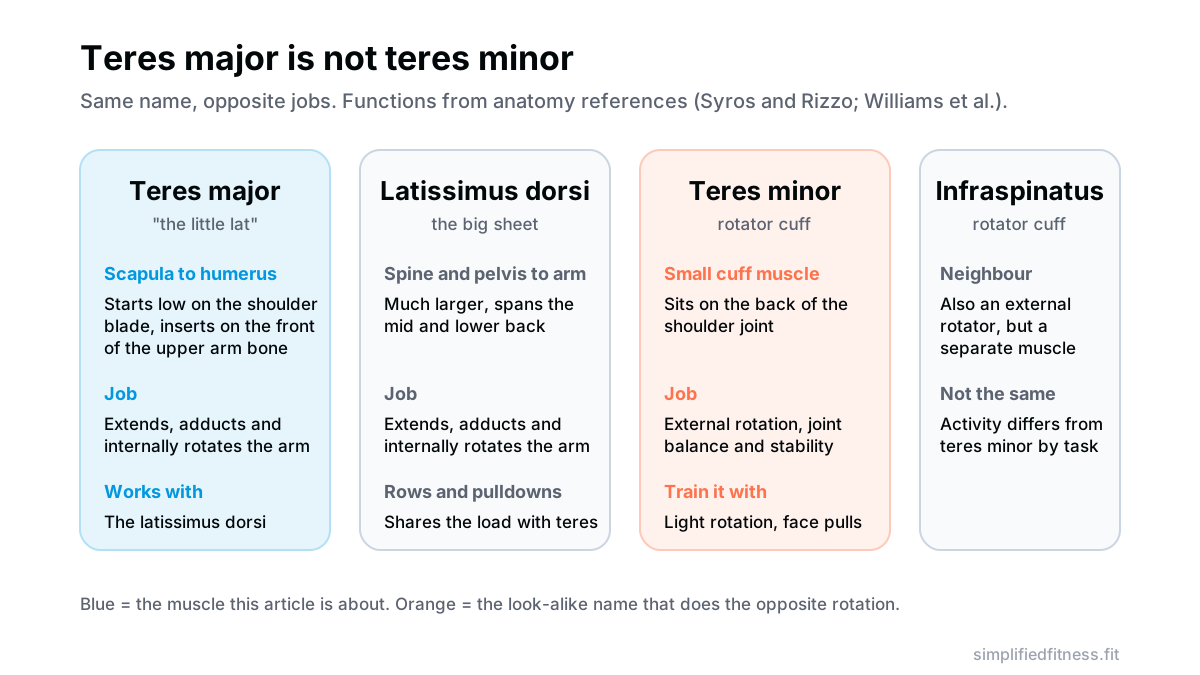
The lats are a big sheet reaching from the spine and pelvis to the arm. The teres major is a small muscle tied to the shoulder blade. Both pull the arm the same way. The practical consequence is that you cannot meaningfully split them with exercise choice. When the lats are loaded in a pulldown, the teres major is loaded too.
This is also why we do not buy the claim that one special grip or angle “hits the little lat.” Studies of pulling exercises mostly record the lats, not the teres major. The 2026 narrative review of 23 lat EMG studies, for example, concluded that an anterior bar path was the setup most consistently linked to higher lat EMG, that grip width effects were inconsistent, and that these were acute EMG readings rather than long-term training results (Di Fonza et al., 2026). Teres major was not the measured outcome.
We searched PubMed for studies measuring teres major activity during gym exercises and did not find one. So everything below about how to train it is reasoned from its anatomy and from lat research. That is a limit worth knowing.
Do wide-grip pulldowns hit the teres major more?
A popular belief says wide grips build width. The data on the lats do not support a big grip effect:
- In 15 men doing 6-rep-max pulldowns, narrow and medium grips allowed heavier loads than a wide grip, and lat, trapezius and infraspinatus EMG was similar across widths over the whole rep (the wide grip did show more lat activity in the lowering phase alone). The authors suggested similar hypertrophy should be expected with grips of 1 to 2 times the biacromial distance (shoulder-bone to shoulder-bone width) (Andersen et al., 2014).
- In 12 healthy men, a pronated (overhand) grip produced higher lat activity than a supinated (underhand) grip, whatever the width (Lusk et al., 2010).
- In 40 men with at least 5 years of lifting experience, seven pulldown variations differing in grip type, width and trunk lean showed no significant differences in lat EMG. Only the posterior deltoid differed, being higher with a wide pronated grip at 30 degrees of lean (Buonsenso et al., 2025).
Why might studies disagree with the gym folklore? EMG measures electrical activity in one short set, not muscle growth over months, and surface electrodes cannot easily pick out a small deep muscle like the teres major. None of these studies were about the teres major, and all were short-term with small samples of men.
A cautious takeaway: use an overhand grip, a width you can pull with a full range and a bar path that travels to your upper chest. For a deeper look at grip choices, read our breakdown of wide vs close vs neutral grip lat pulldowns.
Which exercises load the teres major?
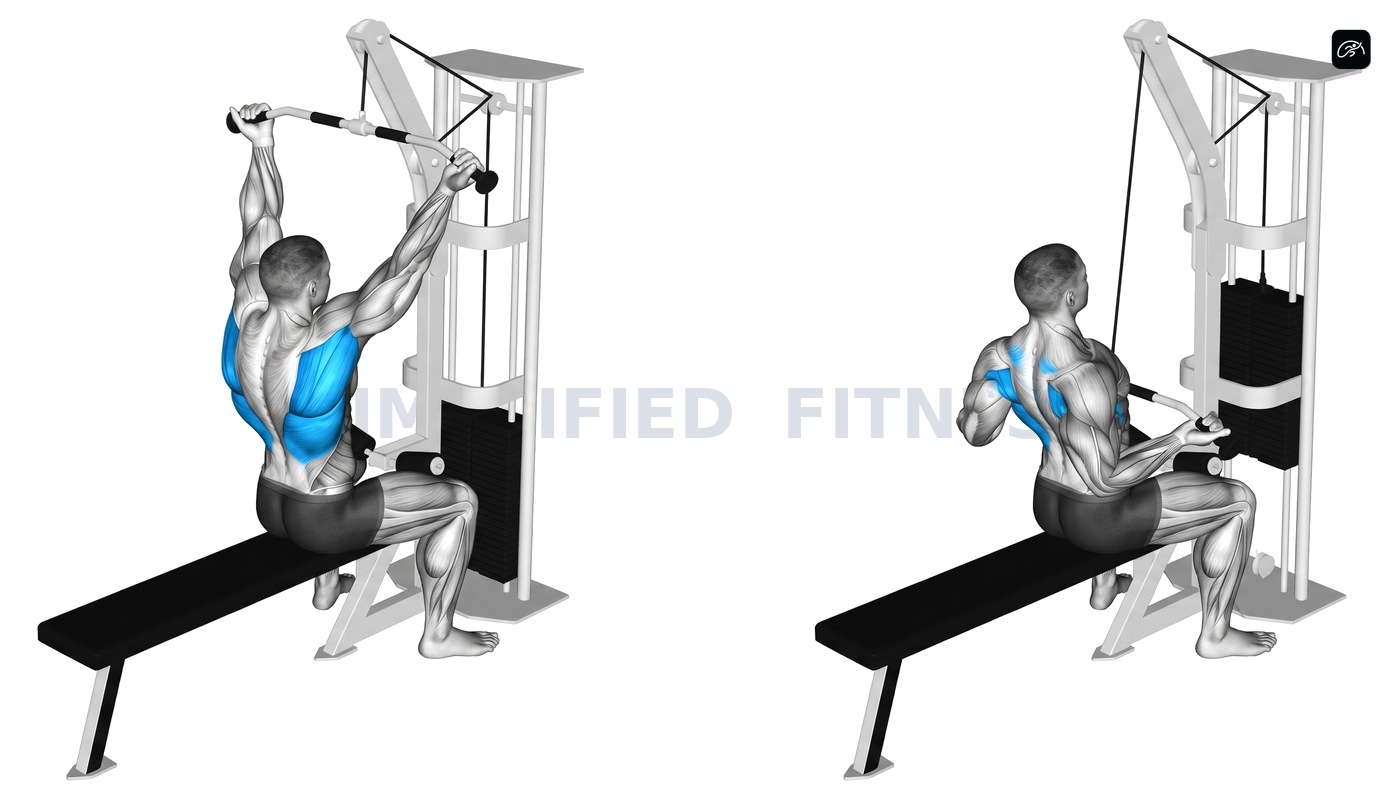
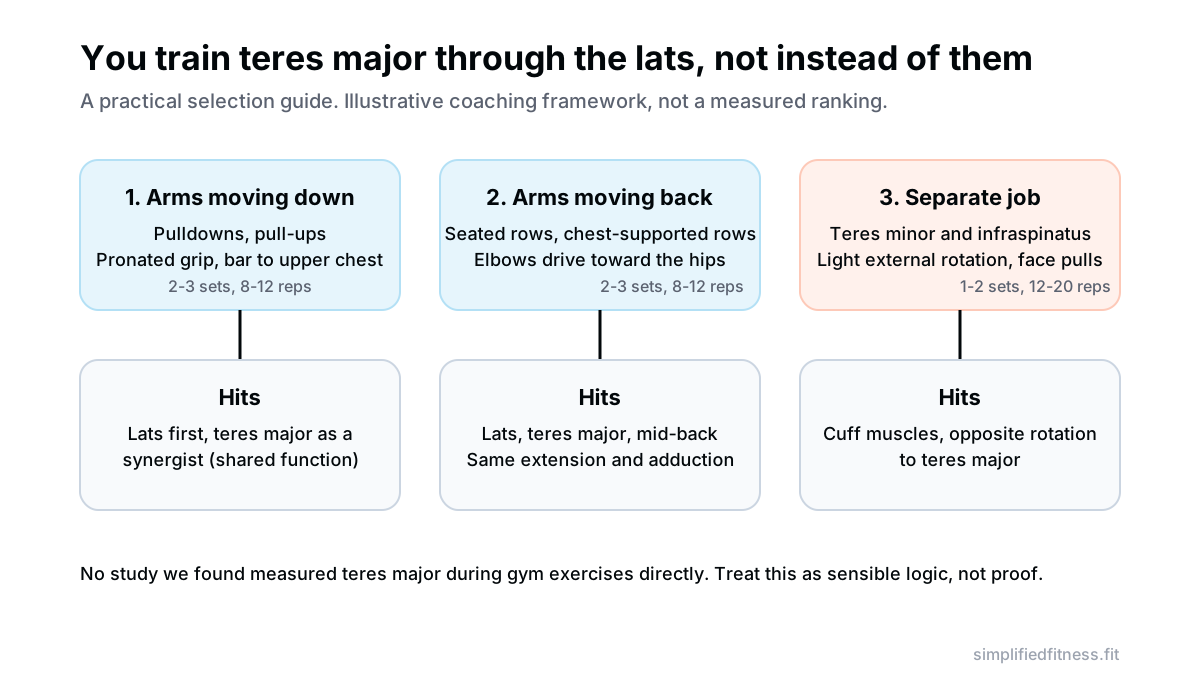
Because its job matches the lats, the usual back staples cover it. Think in two arm paths.
Arms moving down (vertical pulls). Pulldowns and pull-ups. Lead with the elbows, not the hands, and bring the bar to your upper chest while keeping your ribcage stacked. We compare overhand and underhand options in pull-ups vs chin-ups.
Arms moving back (horizontal pulls). Seated cable rows and chest-supported rows. Drive the elbows back toward your hips and pause at the end. The narrative review above also reported that a narrower grip and a lower shoulder-abduction angle were each linked to higher lat amplitude in separate seated row studies, though they were not tested together (Di Fonza et al., 2026). Our guide to seated cable row attachments and elbow drive goes into detail.
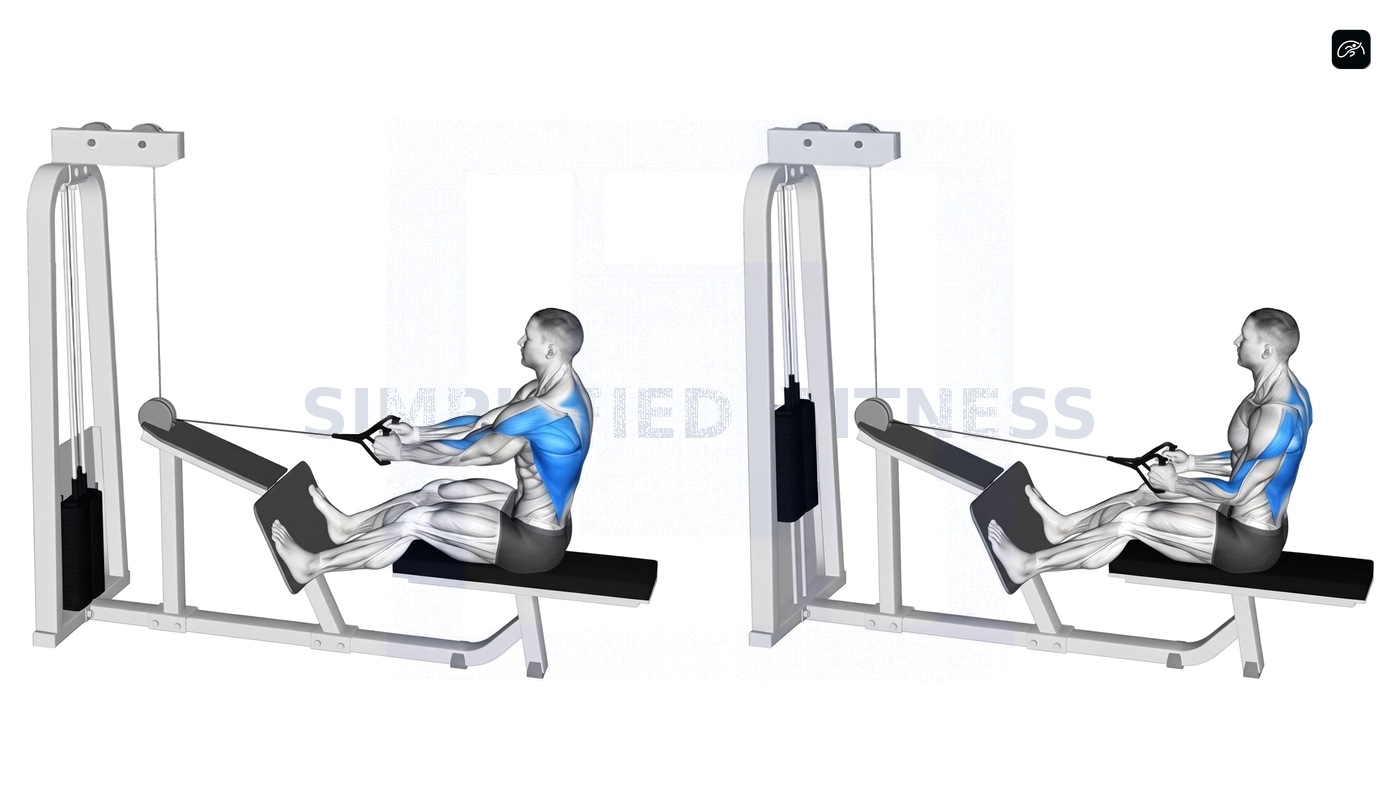
Where does arm path matter? Elbow position decides how much of the load goes to the lats versus the mid-back, which we cover in lats vs upper back and elbow flare. It is a reasonable assumption that teres major follows the lats in these movements, but it remains an assumption.
Teres minor vs infraspinatus: the other “teres”
People mix up the two teres muscles all the time. They do different things.
Teres minor is a rotator cuff muscle. A 2018 review describes it as maintaining a balanced glenohumeral (shoulder) joint, and notes it becomes the most significant external rotator when major rotator cuff pathology is present (Williams et al., 2018). That is the reverse of teres major, which rotates the arm inward.
What about infraspinatus? It is a separate cuff muscle that also rotates the arm outward, but the two do not behave identically:
- In 18 collegiate baseball players, teres minor activity was higher than infraspinatus during resisted horizontal abduction, and lower during resisted external rotation. Both rose when the arm was held at 45 degrees of external rotation (Tsuruike and Ellenbecker, 2022).
- In 10 healthy people measured with intramuscular electrodes, side-lying external rotation gave the highest teres minor activity, about 67% of maximum voluntary contraction, among seven rotation exercises. That study was a rehab-oriented, single-group design (Reinold et al., 2004).
So the practical split is simple. Pulls grow the lats and teres major. Light rotation and rear-delt work look after the cuff, including teres minor and infraspinatus. We cover the cuff side in rotator cuff strengthening for shoulder health and rear delt training.
How to program it: a simple template
You do not need a teres major day. Fold it into your normal back work.
| Goal | Movement | Sets and reps | Note |
|---|---|---|---|
| Vertical pull | Pulldown or pull-up, overhand | 2-3 x 8-12 | Elbows down, bar to upper chest |
| Horizontal pull | Seated or chest-supported row | 2-3 x 8-12 | Elbows toward hips, brief pause |
| Cuff health | Light external rotation or face pull | 1-2 x 12-20 | Easy weight, no pain |
A rough weekly target of 10-16 hard sets of back work suits many people, and you can move toward the lower or higher end by how recovery feels. That figure is a common coaching range rather than a number measured for teres major. Stop most sets with 1-3 reps in reserve, and add reps before you add weight. Our RIR and RPE calculator helps with effort, and the free pull day plan has a ready-made layout.
Common mistakes with upper back width work
- Chasing a “teres major exercise” that does not exist. Spending sets on odd angles instead of progressing pulldowns and rows.
- Letting the grip decide everything. Width matters less than whether you can complete a full range under control.
- Ignoring the cuff. If you only pull heavy, light rotation work keeps the small muscles around the joint worked too.
- Skipping the stretch at the top. A controlled full stretch between reps is part of the movement.
- Confusing shoulder pain with a tight muscle. Pain is a signal, not a cue to push harder.
If you want to see a hard pulling movement that loads the lats in a long, stretched position, try the dumbbell pullover, but note that the narrative review found the pullover appeared to preferentially load the pecs rather than selectively target the lats (Di Fonza et al., 2026).
Can the teres major get injured, and when to see a doctor
Injuries to the lats and teres major are rare. A review of case reports found they are seen in a range of sports, disproportionately in the throwing shoulder of baseball pitchers, and that isolated teres major injuries are generally treated without surgery (Donohue et al., 2017). That review also notes there is no standard of care, and it rests on case reports, which are the weakest kind of evidence.
For an ordinary lifter, the lesson is to warm up, add load gradually and avoid yanking the weight. See a doctor or physiotherapist if you notice:
- a sudden sharp pain or a pop under the armpit or at the back of the shoulder
- visible bruising or swelling in the area
- weakness lifting or rotating your arm that does not settle within a few days
- shoulder pain at night or numbness and tingling down the arm
We cannot diagnose from an article, and these signs need an in-person assessment.
Indian lifter notes
You do not need fancy equipment for this. A lat pulldown machine and a seated row station in a basic gym cover everything above. If you train at home, assisted or band pull-ups and a door-anchored band row load the same pattern at lower cost. For fuel, 1.6-2.2 g of protein per kg of body weight is a typical range for lifters, and dal, paneer, curd, soya chunks and eggs get most vegetarians there. Use the protein calculator for your own number.
The bottom line
The teres major is a real, distinct muscle that helps the lats pull the arm down and back. It will grow along with your lats if you train pulldowns, pull-ups and rows hard and progress them over time. No study we found shows a grip or exercise that targets it alone, and grip width has weak support as a lever in the lat studies we do have. Teres minor is a different muscle with the opposite job, so look after it with light rotation work instead.
Pick two vertical and two horizontal pulling movements, log your reps and add a little each week. For the complete plan, return to the complete back training guide.
Frequently Asked Questions
What muscle is the knot right under the armpit?
The bulge you can feel at the back edge of the armpit is mostly the teres major, sitting just beside the outer edge of the lat. It runs from the lower part of the shoulder blade to the front of the upper arm bone. You can feel it tense by pressing your arm firmly down into your side.
What does the teres major do?
The teres major extends, adducts and internally rotates the upper arm. It works alongside the latissimus dorsi, so it contracts whenever you pull your arm down or back against load. In practice that means every pulldown, pull-up and row involves it.
Why is the teres major called the little lat?
It earns the nickname because it does the same arm movements as the lat and sits right next to it. Anatomy references describe it as working synergistically with the latissimus dorsi. The difference is size: the lats are a huge sheet that reaches the spine and pelvis, while the teres major is a compact muscle tied to the shoulder blade.
Is there an exercise that isolates the teres major?
There is no good evidence of an exercise that isolates it. Its job overlaps the lats too closely, so heavy pulldowns, pull-ups and rows load both together. Pick lat exercises you can progress with good form and let the teres major come along with them.
Do wide-grip pulldowns work the teres major more?
This is not established. Studies on grip width measured the lats rather than the teres major, and one study of 15 men found similar lat activity across wide, medium and narrow grips over the whole rep. Choose the grip that lets you feel the pull and load it progressively, whether that is wide or not.
What is the difference between teres major and teres minor?
They share a name and a location but not a job. Teres major is a lat helper that pulls the arm down and inward, while teres minor is a small rotator cuff muscle that rotates the arm outward and stabilizes the joint. Train teres major with pulls and teres minor with light rotation or rear-delt work.
Is teres minor the same as infraspinatus?
No, they are separate rotator cuff muscles that both help rotate the arm outward. In a 2022 study of 18 baseball players, teres minor activity was higher than infraspinatus during horizontal abduction resistance, and lower during external rotation resistance. For gym purposes they are trained together by rear-delt and external rotation work.
How do I train the teres minor?
Use light external rotation and rear-delt movements rather than heavy pulling. In a 10-person EMG study, side-lying external rotation gave the highest teres minor activity of seven rotation exercises, at about 67% of maximum. Use light weights for 12-20 controlled reps and stop short of pain.
Can the teres major be injured?
Yes, but rarely. A review of case reports found injuries to the lat and teres major are rare, and seen mostly in the throwing arm of baseball pitchers. If you feel a sudden tear or pop near the back of the armpit, stop training and get it assessed.
How many sets for upper back width?
There is no teres major specific number, so use general back volume. Many lifters do well with roughly 10-16 hard sets of vertical and horizontal pulling per week, adjusted to how recovery feels. Add reps or load slowly and keep 1-3 reps in reserve on most sets.
Does the teres major make my back look wider?
It likely contributes a little, since it adds thickness at the outer edge of the back near the armpit. Overall back width depends much more on bone structure, lat size and shoulder width. We found no study measuring how much teres major growth alters physique appearance, so treat any promise of a specific look with caution.
Should I use a pronated or supinated grip for lats?
Pronated is the safer default for lat focus. In 12 men doing lat pulldowns, a pronated grip gave greater lat activity than a supinated grip regardless of width. A supinated grip brings in more biceps, so use it when you simply want a stronger pull.
Sources & References
Every claim above is checked against peer-reviewed research (PubMed, U.S. National Library of Medicine) or guidance from established health bodies. How we fact-check.
- Syros A, et al. Anatomy, Shoulder and Upper Limb, Teres Major Muscle. StatPearls. 2023. PMID: 35593812
- Williams MD, et al. Understanding the Importance of the Teres Minor for Shoulder Function: Functional Anatomy and Pathology. J Am Acad Orthop Surg. 2018. PMID: 29473831
- Tsuruike M, et al. A comparison of teres minor and infraspinatus muscle activation in the prone position. JSES Int. 2022. PMID: 35141685
- Reinold MM, et al. Electromyographic analysis of the rotator cuff and deltoid musculature during common shoulder external rotation exercises. J Orthop Sports Phys Ther. 2004. PMID: 15296366
- Lusk SJ, et al. Grip width and forearm orientation effects on muscle activity during the lat pull-down. J Strength Cond Res. 2010. PMID: 20543740
- Andersen V, et al. Effects of grip width on muscle strength and activation in the lat pull-down. J Strength Cond Res. 2014. PMID: 24662157
- Buonsenso A, et al. Electromyographic Analysis of Back Muscle Activation During Lat Pulldown Exercise: Effects of Grip Variations and Forearm Orientation. J Funct Morphol Kinesiol. 2025. PMID: 40981044
- Di Fonza D, et al. Electromyographic Analysis of Latissimus Dorsi Activation During Common Resistance Training Exercises: A Narrative Review. J Funct Morphol Kinesiol. 2026. PMID: 42647355
- Donohue BF, et al. Sports Injuries to the Latissimus Dorsi and Teres Major. Am J Sports Med. 2017. PMID: 28125914

Umair Hazrami · Founder & Head Coach, Simplified Fitness
Umair Hazrami founded Simplified Fitness and the Simplified Lifter channel to cut through fitness noise. With 4+ years of consistent training and 10+ coaching clients, he writes every guide from the peer-reviewed research and links the sources so you can check them. Our editorial standards.
Educational content only, not medical advice. If you have a medical condition, are pregnant, or take medication, talk to a qualified doctor before changing your diet, supplements or training. Full disclaimer.
Keep reading
Exercise Technique
Barbell Bent-Over Rows: Spinal Load, Hamstring Fatigue and Lat Growth
Is the barbell bent over row hypertrophy gold or a fatigue generator? See what the research says about spinal load, torso angles and better rows for lat growth.
8 min read
Exercise Technique
Chest-Supported Rows: Train Your Upper Back Without Lower Back Fatigue
Chest supported row hypertrophy explained: why your lower back quits first, how T-bar, incline and seal rows fix it, and what the research says.
8 min read
Exercise Technique
Complete Back Workout Design: Balancing Vertical Pulls, Horizontal Rows, and Lumbar Recovery
A science-based back workout routine: weekly sets, how to balance pulldowns and rows, and how to protect your lower back, with a sample pull day plan.
9 min read

Exercise Technique
Conventional Deadlifts for Back Hypertrophy: Stimulus-to-Fatigue Ratio Analysis
Are deadlifts good for back hypertrophy? A stimulus-to-fatigue breakdown of what they build, what they miss for lats, and how to program or replace them.
8 min read