Single-Arm Dumbbell Rows: Knee on Bench vs Tripod Stance, Which Is Better?
Single arm dumbbell row form for your lats: knee on the bench or tripod stance? See what each changes for stretch and stability, and how to choose.

TL;DR. The short answer
- Good single arm dumbbell row form means level hips, a long spine, a full forward reach at the bottom and an elbow that drives toward the hip, not the ceiling.
- No study has compared the knee-on-bench and tripod stances head to head. Any claim that one is clearly better for back growth goes beyond the evidence.
- The knee-on-bench stance gives a wider, steadier base. The tripod stance asks your trunk to resist twisting more, and often leaves more room for the arm to hang.
- Pick the stance where you can feel the lat stretch at the bottom and keep your torso still at the top. If your torso spins, the weight is too heavy.
- Back pain that is sharp, spreads down a leg, or comes with numbness or weakness is a reason to see a doctor or physiotherapist, not to row through it.
Part of our complete guide: Complete Back Training Guide: Lats vs Upper Back, Best Exercises and a Hypertrophy Workout
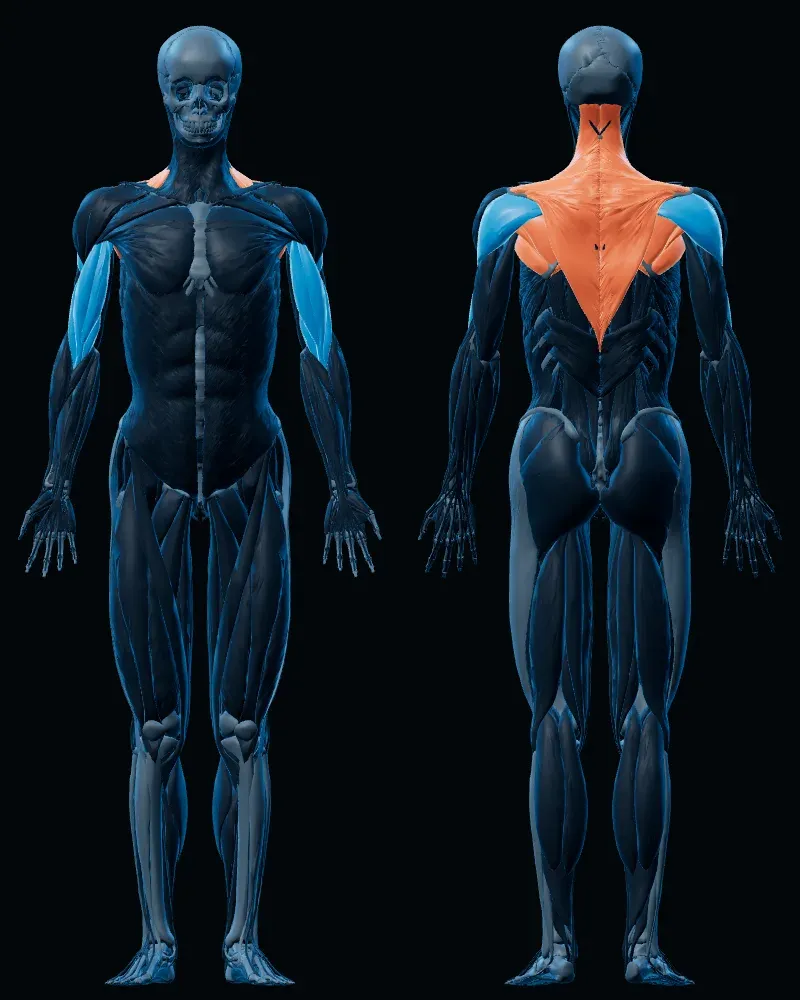
Muscles worked: upper back
Main movers: traps, rhomboids, teres major, infraspinatus and teres minor
Assisting: rear delts, biceps and brachialis
Table of contents
Good single arm dumbbell row form comes down to four things: level hips, a long spine, a full forward reach at the bottom, and an elbow that drives toward your hip. The stance you pick, knee on a bench or the staggered tripod, matters less than whether you can hold those four things for the whole set.
This guide sits inside our complete back training guide. Here we focus on one question that comes up constantly: which stance gives you the better stretch and the better pull? I will be upfront about the evidence. It is thin. Where the research ends, I will say so and tell you what coaching logic is filling the gap.
What does the research actually say about row stances?
Short answer: nobody has put the bench row and the tripod row in a lab against each other. I searched, and no trial compares them for muscle growth or for lat activation.
What we do have is related work.
A biomechanics study of 7 healthy men measured trunk and hip muscle activity and spine loading across three rows: the inverted row, the standing bent-over row and the standing one-armed cable row. The one-armed cable row challenged the torsional capabilities of the trunk, meaning the muscles that stop you twisting (Fenwick et al., 2009). The bent-over row produced the largest lumbar spine load. Surface EMG, seven men, one cable exercise. Useful, but not a dumbbell row study.
So the honest framing is this: the comparison below is reasoning from biomechanics, not a measured result. It is sensible, and you can test it on your own body in two sessions.
Knee on bench vs tripod stance: what changes?
Here is the practical difference side by side.
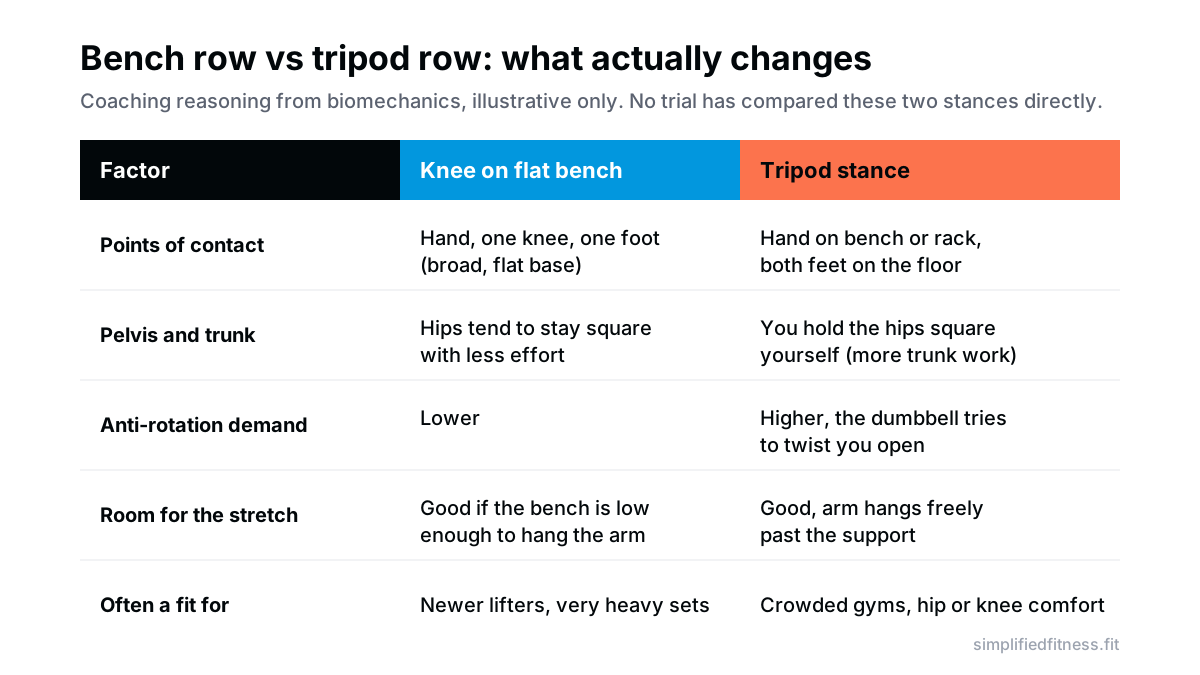
Knee on the bench. Your hand, one knee and one foot make a wide, flat base. The hips tend to stay square with less effort, which is why it suits newer lifters and very heavy sets. The catch: a tall or wide bench can block how far the arm hangs, and some people find the knee pressure or hip position uncomfortable.
Tripod stance. Both feet are on the floor and your free hand rests on a bench, incline bench or rack. You hold your own hips square, so your obliques and glutes do more of the stabilising. The dumbbell is trying to twist you open, and your trunk has to say no. Many lifters also find the arm hangs further forward because there is nothing under the chest.
Neither is a better exercise. They are two ways of sharing the load between your back and your support.
How should your pelvis and spine sit?
This is where most one-arm rows go wrong, and it is the same in both stances.
- Hips level. Imagine a glass of water on your lower back. Do not let it tip as you row.
- Spine long, not rounded. Ribs down, chest open. A rounded lower back at the bottom is a signal to shorten the range or lower the weight.
- Free arm under the shoulder. If your supporting hand is too far forward you lean on it, and if it is too far back you cannot brace.
- Head in line with the spine. Look at the floor a little ahead of your hand, not at the mirror.
The most common mistake here is rotating the torso to finish the rep. It looks like a bigger range, and it feels powerful. But the rotation is doing the work your lat should do.
One biomechanics paper on torso muscles found that no single muscle dominated spine stability across tasks, and that training patterns involving many muscles was justifiable rather than isolating a few (Kavcic et al., 2004). That is a spine-stability study in a lab, not a rowing trial. But it fits the gym reality: stability comes from the whole trunk working together, so brace like you mean it.
How do you get a big lat stretch at the bottom?
The stretch is the reason most people care about stance, so let us handle it carefully.
The idea is that muscles may grow well when trained at long lengths. A 2023 systematic review of 11 studies found that training at longer muscle lengths, through either full or partial range, tended to be favourable for muscles such as the quadriceps, biceps and triceps (Kassiano et al., 2023). The back is not on that list. A 2020 review noted that research on range of motion for the upper limbs is limited and conflicting, and that no study had yet looked at how range of motion affects growth of the trunk muscles (Schoenfeld et al., 2020).
A later trial in 30 resistance-trained people trained one arm with lengthened partials and the other with full range for 8 weeks. Growth of the elbow flexors and extensors, and lat pulldown 10-rep-max, improved similarly in both conditions. The authors concluded that trainees seeking muscle size should likely emphasise the stretched position, through either full range or lengthened partials (Wolf et al., 2025). Note what was measured: arm muscles and a pulldown test, not lat thickness in a row.
So where does that leave a row? Cautiously optimistic. Reaching into a controlled stretch is a reasonable thing to try, and the evidence does not say it is risky. It also does not say it is magic.
How to do it in either stance:
- Start with the dumbbell hanging straight below your shoulder.
- Let it drift slightly forward as your shoulder blade glides forward on your ribcage.
- Stop when you feel the lat lengthen, before your back rounds or your torso twists.
- Row from there, not from a half-height start.
If the bench is in your way, that is the practical case for the tripod. If your hips twist when you reach, that is the practical case for the bench.
How do you drive the elbow to the hip?
Elbow path decides a lot about which muscles get the work.
A 2026 narrative review of 23 EMG studies across pulling exercises suggested that the relationship between the upper arm and the trunk may be a key factor in how load is shared between muscles. In the seated row, a narrower grip and a lower shoulder-abduction angle (elbows closer to the body) were each linked with higher lat EMG in separate studies. It also stressed that EMG measures how active a muscle is during a single effort, not long-term growth (Di Fonza et al., 2026). That review did not single out the dumbbell row, so I am applying its general principle, not quoting a dumbbell result.
The coaching version: think elbow to hip, close to your ribs, if you want lats. A wide, high elbow shifts the emphasis toward the upper back and rear delts, which is fine if that is the aim. We break the difference down in upper back vs lat bias.
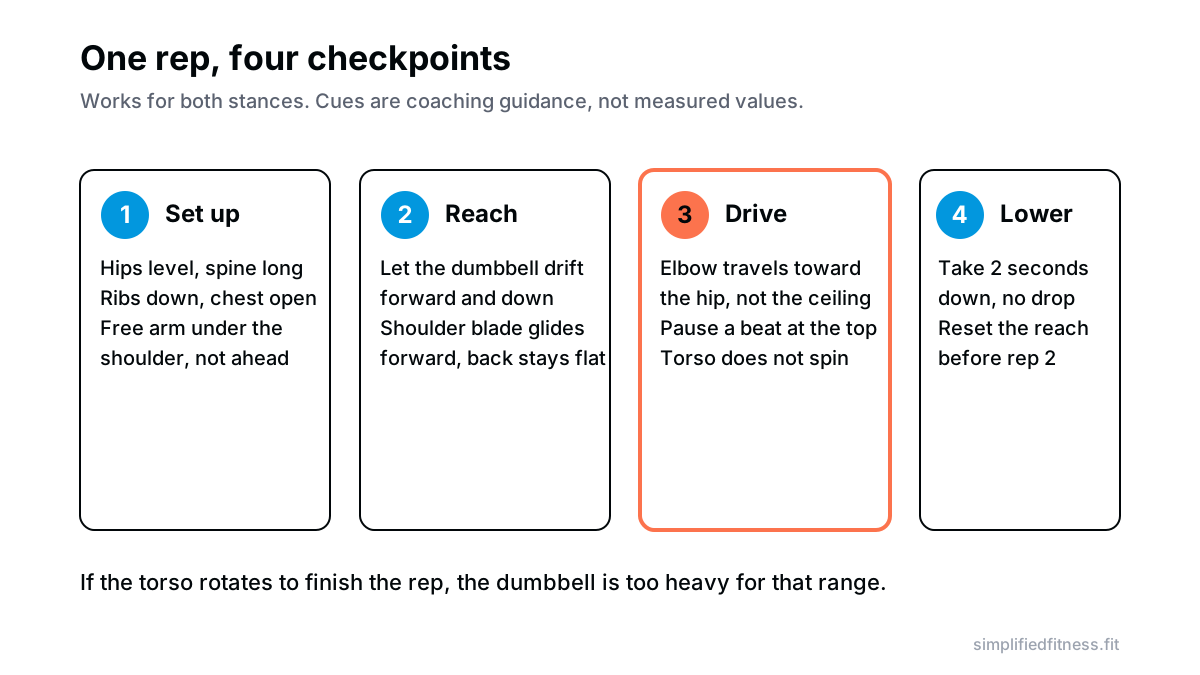
Cues that tend to work:
- Elbow, not hand. Imagine your hand is a hook.
- Elbow to back pocket. It gives the right direction.
- Pause at the top. One beat, shoulder blade back, no shrug.
- Two seconds down. Do not drop the weight.
What about heavy dumbbell rows?
Heavy rows are fine. Heavy and sloppy is the problem.
Rest matters more than most people think. In a trial of 21 resistance-trained men, 3-minute rest intervals led to greater strength gains and greater anterior thigh thickness than 1-minute rests, over 8 weeks of full-body training (Schoenfeld et al., 2016). Back muscles were not measured, and a trend for triceps did not reach significance. Still, if your heavy rows fall apart with short rests, give yourself 2-3 minutes.
On the dumbbell versus machine question: a 2023 meta-analysis of 13 studies with 1,016 participants (5 of which measured muscle size) found no difference in hypertrophy between free weights and machines in direct comparison, and concluded that the choice comes down to individual preferences and goals (Haugen et al., 2023). So a dumbbell row is not “better” than a seated row because it is free. It is better only if you do it well and you will actually do it.
Which stance should you pick?
Use this as a starting point. It is not a rule.
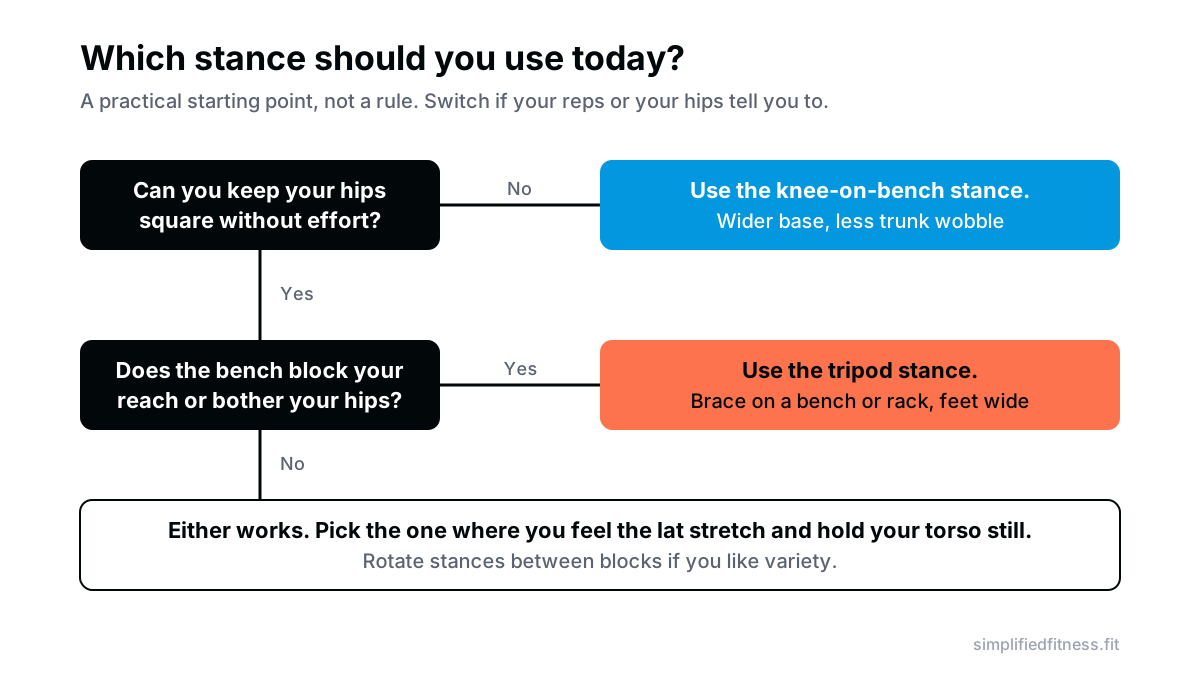
Some real-world situations:
- Packed gym, one bench. Tripod on a rack or incline bench. No knee pad needed.
- Very heavy sets. Many lifters prefer the bench because the wider base feels steadier. That is experience, not a trial result.
- Hip or knee pressure. Tripod.
- Home training. A sturdy chair or low table works as the support. Make sure it cannot slide.
- Want trunk challenge too. Tripod asks more of your anti-rotation muscles. Based on the one-armed cable row finding, that is plausible, though it was not measured for dumbbells.
How many sets and how often?
As a coaching starting point rather than a tested number, many intermediate lifters do well with roughly 10-20 hard sets per week for the whole back, split over two sessions, with 1-3 reps left in reserve. Single arm rows can fill part of that, alongside pulldowns and a chest-supported option. Use our training volume calculator to check your weekly total, or run it in a pull day plan.
A simple structure: 2-3 sets of 8-12 reps per side, with the weaker side first, and the same number of reps on both sides.
When is back pain a reason to stop?
Muscle soreness in the lats and upper back after rows is normal. Sharp pain, pain that spreads down a leg, numbness, tingling, weakness in a leg or arm, or pain that does not settle after a few days should be checked by a doctor or physiotherapist. I cannot diagnose anything from a website, and rowing through those symptoms is not toughness. It is guessing.
Related guides
If the one-arm row is not suiting you, try a chest-supported row, which takes your lower back out of the equation. If you want to understand spinal loading, see barbell bent-over rows and spinal shear. For another unilateral pull, there is the Meadows row and landmine variations, and if grip is your limiter, read about lifting straps for back training.
The bottom line
Single arm dumbbell row form is level hips, a long spine, a full reach and an elbow driven toward the hip. The bench and the tripod are two ways to do that. Neither has been shown to be superior, so choose the one that lets you feel the lat stretch and keep your torso still. Then add reps or weight slowly, rest 2-3 minutes on heavy sets, and keep the reps honest.
Frequently Asked Questions
What is the correct single arm dumbbell row form?
Keep your hips level, your spine long and your free arm under your shoulder, then row the dumbbell by driving your elbow toward your hip. At the bottom, let the dumbbell drift forward so your shoulder blade glides with it and your lat lengthens. Control the weight down for about two seconds instead of dropping it.
Is the knee on bench or the tripod stance better for single arm dumbbell rows?
Neither has been shown to be better, because no study has directly compared them. The bench gives a wider base, while the tripod asks your trunk to resist twisting more and often lets the arm hang further forward. Try both for a couple of sessions and keep the one where you feel your lat stretch and your torso stays still.
What is a tripod stance row?
It is a single arm row where both feet stay on the floor and your free hand braces on a bench, incline bench or dumbbell rack, so you stand on two feet and rest on one hand. Because there is no knee on a pad, your hips and trunk do more of the stabilising. Stagger your feet or set them wide enough that you do not tip sideways when the weight pulls you.
Do single arm dumbbell rows work the lats?
Yes, rows are a standard way to train the latissimus dorsi, which pulls the upper arm down and back. A 2026 narrative review of 23 EMG studies suggested that how the upper arm sits relative to the trunk may be a key factor in which muscles do the work, and in the seated row a lower shoulder-abduction angle went with higher lat EMG. Drive the elbow toward your hip and keep it fairly close to your ribs to keep the lat involved.
Should I let the dumbbell stretch my lat at the bottom?
Usually yes, within a range you control. Evidence from trained lifters suggests emphasising the stretched position of a muscle is a sound approach to growth, although that research measured arm muscles rather than the lats. Let the dumbbell travel forward and down until you feel a stretch, but stop before your lower back rounds or your torso twists.
Where should the dumbbell travel, up or back?
Think back and toward your hip, not straight up to your armpit. Pulling toward the hip keeps the line of pull closer to the lat fibres, while a high, flared elbow shifts work toward the upper back and rear delt. Both are useful, so choose based on what you want to train that day.
How heavy should single arm dumbbell rows be?
Heavy enough that the last couple of reps are hard, but not so heavy that your torso rotates or you jerk the weight. Many lifters do well in the 6-12 rep range with 1-3 reps left in reserve. If you have to twist or bounce to move the dumbbell, drop the load and make the reps cleaner.
Why does my lower back hurt during one arm rows?
Usually the torso is rotating, the spine is rounding at the bottom, or the weight is too heavy for your trunk control. Brace your core, keep your ribs down and shorten the range until the movement is clean. Pain that is sharp, radiates into the leg, or comes with numbness or weakness needs a doctor or physiotherapist, not more rows.
Is it okay to use a bench that is too short?
It can work, but only if your hand and knee are both well supported and the bench does not wobble. A bench that is too short forces an awkward hip position or makes you lean onto the supporting arm. If it feels unstable, switch to the tripod stance with your hand on a rack or incline bench.
How many sets and reps of single arm rows do I need?
There is no single best number. As a coaching starting point, many intermediate lifters do well with roughly 10-20 hard sets per week for the whole back, counting all rows and pulldowns, and single arm rows are one part of that. Split them across two sessions and keep a couple of reps in reserve. Use our training volume calculator to see where your weekly total sits.
Can I do single arm dumbbell rows at home with limited equipment?
Yes, a sturdy chair, a low table or the edge of a bed can all serve as the support in a tripod stance, as long as it does not slide. Heavier dumbbells matter less than controlled reps with a full reach at the bottom. Use a rucksack or a water-filled bag in place of a dumbbell if that is all you have.
Should I use straps on heavy dumbbell rows?
Straps are optional and mainly help if your grip fails before your back does. Using them does not change the movement itself, but it lets your lats get closer to the limit of the set. Train your grip separately on lighter sets if you want it to keep improving.
How long should I rest between sets of dumbbell rows?
Around 2-3 minutes is a good default for heavy rows. In a study of 21 resistance-trained men, 3-minute rests produced larger gains in strength and thigh muscle thickness than 1-minute rests, though back muscles were not measured. Use the longer rest when the weight is heavy and shorten it only when the load is light.
Sources & References
Every claim above is checked against peer-reviewed research (PubMed, U.S. National Library of Medicine) or guidance from established health bodies. How we fact-check.
- Fenwick CM, et al. Comparison of different rowing exercises: trunk muscle activation and lumbar spine motion, load, and stiffness. J Strength Cond Res. 2009. PMID: 19620925
- Di Fonza D, et al. Electromyographic Analysis of Latissimus Dorsi Activation During Common Resistance Training Exercises: A Narrative Review. J Funct Morphol Kinesiol. 2026. PMID: 42647355
- Wolf M, et al. Lengthened partial repetitions elicit similar muscular adaptations as full range of motion repetitions during resistance training in trained individuals. PeerJ. 2025. PMID: 39959841
- Schoenfeld BJ, et al. Effects of range of motion on muscle development during resistance training interventions: A systematic review. SAGE Open Med. 2020. PMID: 32030125
- Kassiano W, et al. Which ROMs Lead to Rome? A Systematic Review of the Effects of Range of Motion on Muscle Hypertrophy. J Strength Cond Res. 2023. PMID: 36662126
- Haugen ME, et al. Effect of free-weight vs. machine-based strength training on maximal strength, hypertrophy and jump performance: a systematic review and meta-analysis. BMC Sports Sci Med Rehabil. 2023. PMID: 37582807
- Kavcic N, et al. Determining the stabilizing role of individual torso muscles during rehabilitation exercises. Spine. 2004. PMID: 15167666
- Schoenfeld BJ, et al. Longer Interset Rest Periods Enhance Muscle Strength and Hypertrophy in Resistance-Trained Men. J Strength Cond Res. 2016. PMID: 26605807

Umair Hazrami · Founder & Head Coach, Simplified Fitness
Umair Hazrami founded Simplified Fitness and the Simplified Lifter channel to cut through fitness noise. With 4+ years of consistent training and 10+ coaching clients, he writes every guide from the peer-reviewed research and links the sources so you can check them. Our editorial standards.
Educational content only, not medical advice. If you have a medical condition, are pregnant, or take medication, talk to a qualified doctor before changing your diet, supplements or training. Full disclaimer.
Keep reading
Exercise Technique
Barbell Bent-Over Rows: Spinal Load, Hamstring Fatigue and Lat Growth
Is the barbell bent over row hypertrophy gold or a fatigue generator? See what the research says about spinal load, torso angles and better rows for lat growth.
8 min read
Exercise Technique
Chest-Supported Rows: Train Your Upper Back Without Lower Back Fatigue
Chest supported row hypertrophy explained: why your lower back quits first, how T-bar, incline and seal rows fix it, and what the research says.
8 min read
Exercise Technique
Complete Back Workout Design: Balancing Vertical Pulls, Horizontal Rows, and Lumbar Recovery
A science-based back workout routine: weekly sets, how to balance pulldowns and rows, and how to protect your lower back, with a sample pull day plan.
9 min read
Exercise Technique
Conventional Deadlifts for Back Hypertrophy: Stimulus-to-Fatigue Ratio Analysis
Are deadlifts good for back hypertrophy? A stimulus-to-fatigue breakdown of what they build, what they miss for lats, and how to program or replace them.
8 min read