Chest-Supported Rows: Train Your Upper Back Without Lower Back Fatigue
Chest supported row hypertrophy explained: why your lower back quits first, how T-bar, incline and seal rows fix it, and what the research says.
TL;DR. The short answer
- Chest-supported rows let your upper back be the limiting factor instead of your lower back, which is the whole point for hypertrophy.
- No study has measured chest-supported rows against barbell rows for muscle growth. The case rests on spine-load research plus the general finding that muscle size responds to hard sets, not to a specific exercise.
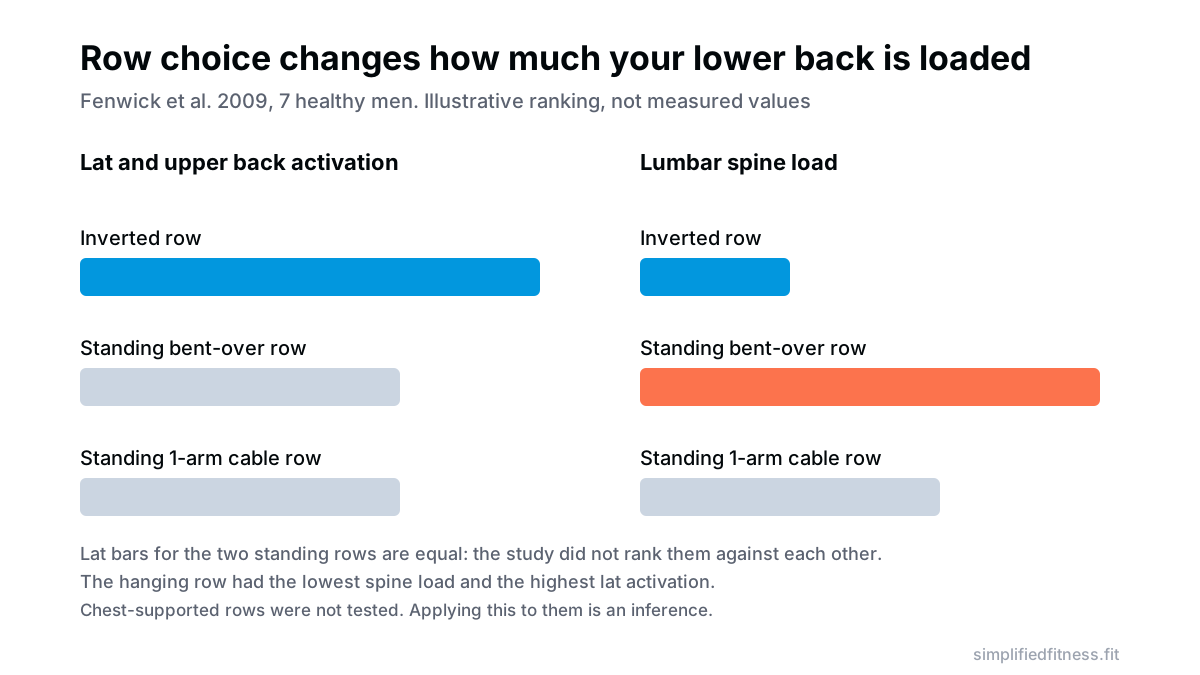
- Fenwick et al. (2009) found the standing bent-over row gave the largest lumbar load among three rows, while the inverted row gave the lowest load with the highest lat activation.
- You do not need to train to absolute failure. A meta-analysis found no evidence that going to momentary failure beats stopping a few reps short for hypertrophy.
- Sharp or radiating back pain, numbness or leg weakness is a reason to see a doctor, not to swap exercises.
Part of our complete guide: Complete Back Training Guide: Lats vs Upper Back, Best Exercises and a Hypertrophy Workout
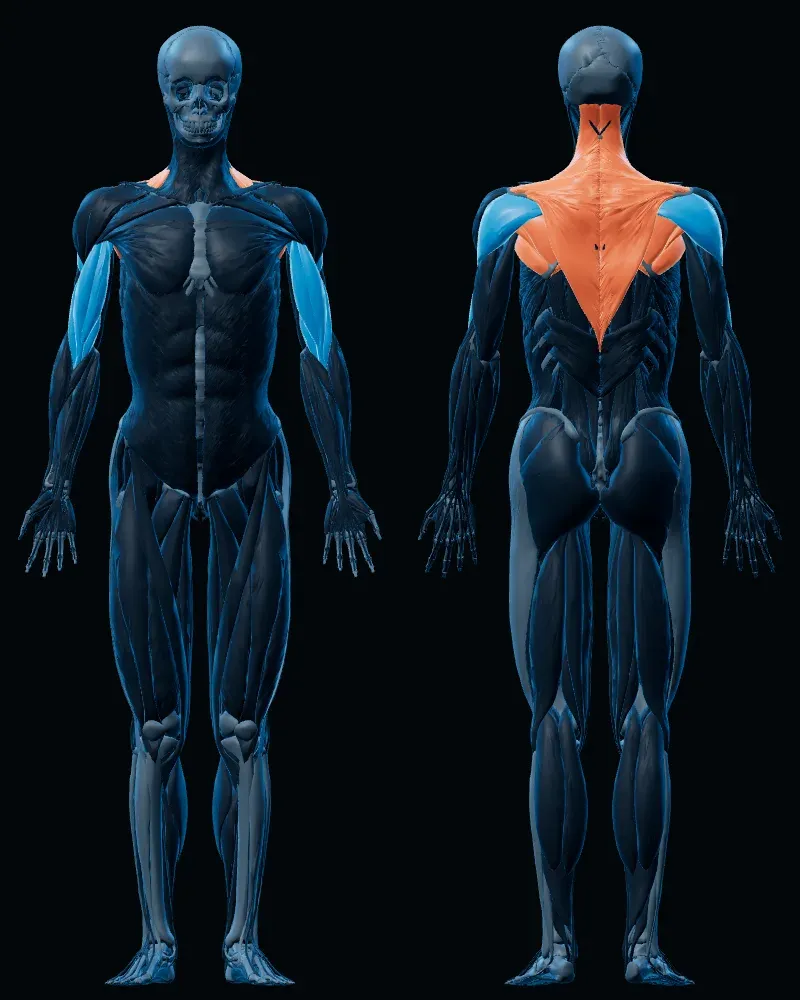
Muscles worked: upper back
Main movers: traps, rhomboids, teres major, infraspinatus and teres minor
Assisting: rear delts, biceps and brachialis
Table of contents
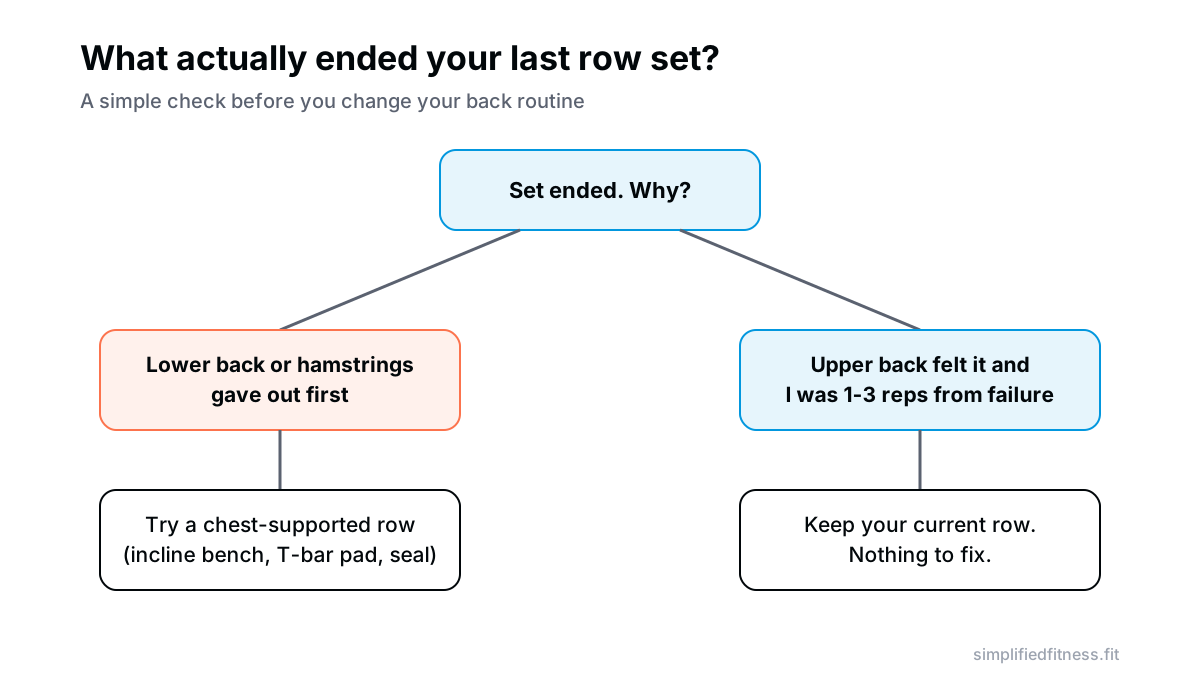
If your lower back gives out on barbell rows before your upper back feels anything, chest supported row hypertrophy training is the simplest fix. Lying on a pad takes your torso out of the job, so the set ends when your lats and upper back are tired, not when your spine is.
That is the whole idea. This guide covers the variations (incline dumbbell, machine T-bar, seal), what the research does and does not show, and how to set them up. It sits inside our complete back training guide.
Why does my lower back quit before my upper back?
A standing bent-over row asks your spinal muscles and hamstrings to hold a hinged torso against gravity for the entire set. Your arms and upper back only get what is left over.
Fenwick and colleagues measured this in 7 healthy men using surface EMG and spine tracking across three rows. The standing bent-over row produced large activation across the whole back but also the largest lumbar spine load. The inverted row gave the highest lat and upper back activation with the lowest lumbar load (Fenwick et al., 2009).
A common pattern: a lifter blames weak lats, adds more rows, and gets a sore lower back and tired hamstrings instead. The target muscle was never the limiter.
What counts as a chest-supported row?
All of these put your torso on a surface:
- Incline dumbbell row: chest down on a bench at roughly 30-45 degrees.
- Chest-supported T-bar row: chest on a pad, handles or bar loaded by plates.
- Seal row: flat, raised bench, weight hangs below you.
- Machine chest-supported rows: plate- or pin-loaded, fixed path.
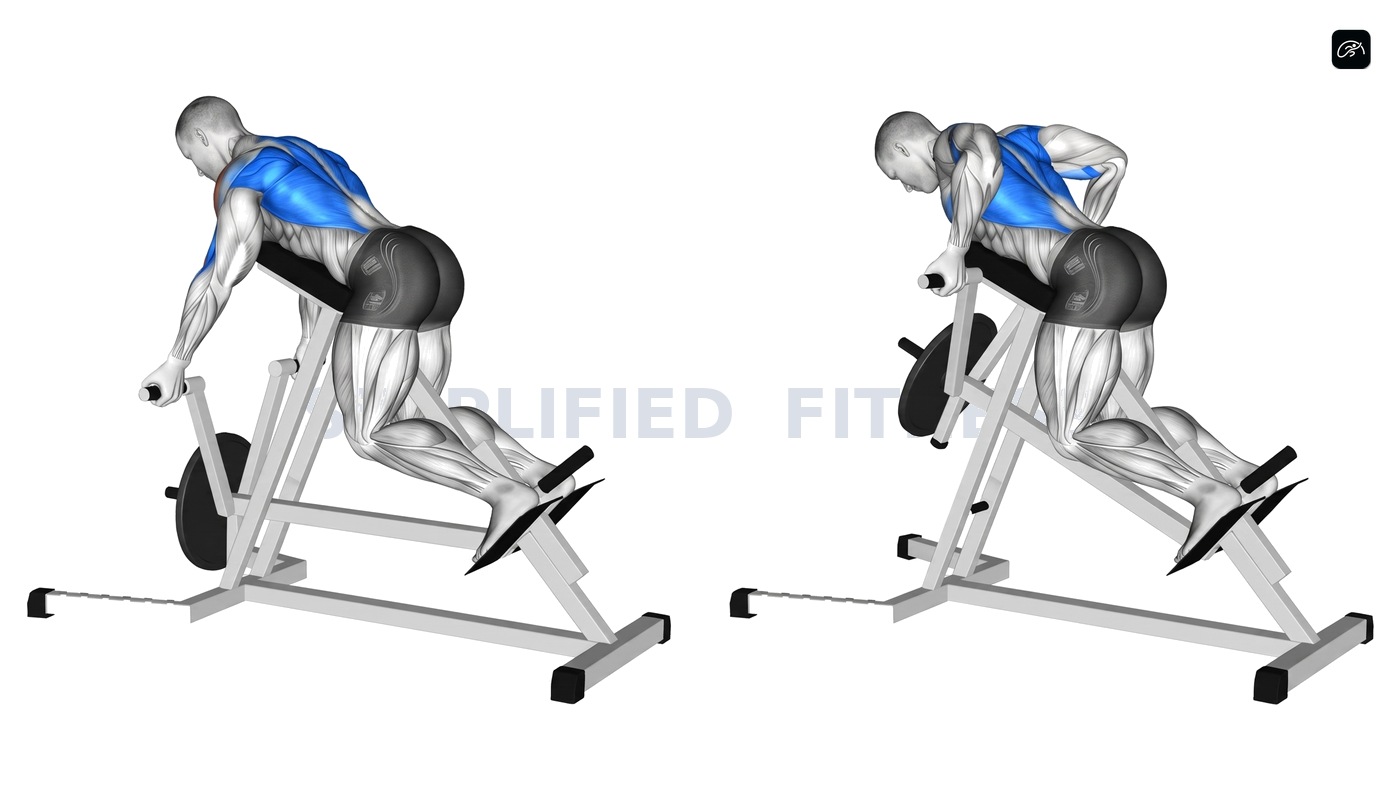
The T-bar and machine versions are the easiest to load heavy. Dumbbells win on availability and let each arm move independently. For a direct comparison with the standing T-bar, see our T-bar rows chest-supported vs standing guide.
Does the research show chest-supported rows build more muscle?
Honestly, no one has tested it head to head. There is no trial of chest-supported versus barbell rows for back muscle size that I can point to.
What we do have is indirect. First, volume: a meta-analysis of 15 studies found that more weekly sets were associated with more muscle growth, with each extra set linked to roughly 0.37% greater gains (Schoenfeld et al., 2017). If supported rows let you complete more hard sets without lumbar fatigue, that volume is useful.
Second, equipment: a meta-analysis of 13 studies found no hypertrophy difference between free weights and machines when compared directly (Haugen et al., 2023). Choosing a stable, machine-style row is not a downgrade.
Note the limits. Those hypertrophy trials mostly measured other muscles, and the free-weight versus machine finding came from 5 hypertrophy outcomes in adults aged 18-60.
Do I need to hit true failure to use “pure” upper back stimulus?
Not really. The idea that chest support lets you take the back to “true mechanical failure” is attractive but overstated.
A 2023 meta-analysis of 15 studies found a trivial advantage for training to set failure (effect size 0.19), and no advantage for momentary muscular failure versus non-failure (Refalo et al., 2023). A separate meta-analysis agreed that failure is not required, though in resistance-trained people it showed a small hypertrophy advantage (effect size 0.15) (Grgic et al., 2022).
So the studies do not fully agree. One says no failure advantage, one hints at a small one in trained lifters. A cautious takeaway: stop 1-3 reps shy on most sets, and let the last set go close to failure. Use our RIR/RPE calculator if you want a reference.
Chest-supported T-bar row vs barbell row
| Barbell row | Chest-supported T-bar or machine row | |
|---|---|---|
| Lumbar demand | High (Fenwick 2009) | Lower, inferred, not measured |
| Momentum | Easy to creep in | Hard to cheat |
| Setup | Hinge, brace, hold | Lie down, brace on pad |
| Heavy loading | Limited by spine and grip | Limited by back and grip |
| Best for | General strength, athletes | Pure back size work |
Neither is better for everyone. Strength carryover and spinal loading from barbell rows have their place, and we cover them in the barbell bent-over row guide.
How to set up an incline dumbbell row
- Set the bench to roughly 30-45 degrees. Lower angles tend to feel more like a row, higher angles more like a rear delt move.
- Lie chest down with your chest just clear of the top edge so your arms can hang.
- Plant your feet or hook them on the base. Keep your hips from lifting.
- Row toward your hip, not your armpit, for lat emphasis. Row slightly higher for more upper back and rear delts.
- Pause for a beat, then lower with control until your shoulder blades spread.
For arm path and which muscles each elbow angle favours, see lats vs upper back: arm path and elbow flare.
Scapular protraction and the stretch
At the bottom of a chest-supported row, letting your shoulder blades drift forward a little puts the back muscles on a stretch. That is a useful range, because stretched positions seem to matter.
A within-participant trial in 30 resistance-trained people compared lengthened partial reps with full range over 8 weeks. Muscle thickness and lat pulldown strength-endurance improved similarly, and the authors suggested emphasizing the stretched position, either full range or lengthened partials (Wolf et al., 2025). That study measured the elbow flexors and extensors, not the back, so apply it with caution.
A range of motion meta-analysis of 16 studies found full range beat partial for strength and lower-limb hypertrophy, with no clear difference in muscle architecture measures such as muscle thickness (Pallares et al., 2021). Mixed picture. Use a full, controlled range you can own.
Grip and handle choices
Neutral grips are usually the most comfortable and keep elbows close, which most lifters find easier on the lats. Overhand wide grips shift effort toward the upper back and rear delts. Chin-up style grips bring in the biceps more.
Evidence for grip-specific growth is thin, so rotate them. If your hands give out first, lifting straps are worth considering. For another stable option, see seated cable rows and elbow drive and single-arm dumbbell rows.
How to fit them in your week
Two back sessions per week with 3-5 hard sets of rows each lands in the 6-10 weekly set range. A simple pairing: one vertical pull and one chest-supported row per session. Check your totals with the training volume calculator, or use our pull day plan as a template.
Indian gym note: many commercial gyms have a flat bench and a T-bar, but few have a seal row bench. An adjustable incline bench and a pair of dumbbells covers it. Budget lifters training at home can prop a bench on a stable base and do the same.
Progress by adding reps first, then weight, within an 8-12 rep range.
Common mistakes on chest-supported rows
Most people who switch to supported rows still leave stimulus on the table. A few patterns show up again and again.
- Pad too high. The pad jams your sternum or shoulders and shortens your range. Adjust so your arms hang freely.
- Heaving with the hips. Lifting the hips off the pad brings the lower back back into the lift. Keep contact.
- Shrugging every rep. If your traps do the pulling, drop the weight and think “elbows to hips.”
- Chasing numbers. A heavier stack with a half rep is worse than a lighter, full-range set. Log reps and range, not just load.
- Skipping the lowering phase. Dropping the weight wastes the stretched position. Take about 2 seconds down.
None of this is exotic. It is the same discipline you would apply to any exercise, just easier to see once the lower back stops being the excuse.
Who benefits most from chest support
You will probably get the most out of it if any of these sound like you:
- Your hamstrings or lower back burn before your back does on barbell or dumbbell bent-over rows.
- You train in a hot, humid gym, and long hinged holds leave you gassed before the set is done.
- You are coming back from a break and want a stable, low-skill option.
- You want to hit a high-effort set without worrying about form breakdown.
If none of those apply and you feel your back working on barbell rows, there is no need to switch. Add a supported row only as a second movement.
When to see a doctor
Chest-supported rows are not a treatment for back pain. Sharp or radiating pain, numbness, tingling, leg weakness, or pain after an injury needs a medical assessment before you keep training around it. A physiotherapist can tell you which movements are safe.
The bottom line
Chest-supported rows remove a common bottleneck and make hard back sets easier to repeat. The evidence is indirect, and the main study cited here tested other rows. Use them when your lower back ends the set, rotate grips, stretch under control, and keep most sets 1-3 reps shy of failure. Full back structure lives in our complete back workout design guide.
Frequently Asked Questions
Are chest-supported rows better than barbell rows for back growth?
Not proven better, but often easier to load well. No trial has directly compared the two for muscle size, so this is a practical argument rather than a measured one. If your lower back or hamstrings stop a barbell row before your upper back is worked, a chest-supported row removes that limit.
Do chest-supported rows remove lower back involvement completely?
No, your spinal muscles still work isometrically to keep your torso stable against the pad. The difference is that you are not holding a hinged torso against gravity under load. Pick a pad angle you can hold comfortably and do not let your hips lift off.
What is the best row for upper back mass?
There is no single best row, because the evidence says weekly hard sets and effort matter more than the exact variation. A chest-supported T-bar or incline dumbbell row is a strong default because it is stable and easy to push close to failure. Use one or two row variations and progress them over weeks.
Is a chest-supported T-bar row better than a barbell row?
It depends on your limiter. The supported version lowers spinal demand and usually lets you do more quality reps with the back. Choose the one where your back, not your grip or lumbar spine, ends the set.
How do I do an incline dumbbell row?
Lie chest-down on an incline bench set to roughly 30 to 45 degrees, feet planted, dumbbells hanging. Row toward your hips, pause briefly, then lower until your shoulder blades spread slightly. Keep your chest on the pad and use a weight you can control for 8-12 reps.
What is a seal row?
A seal row is a barbell or dumbbell row done lying face-down on a raised bench so the weight hangs below you and never touches the floor. Your torso is fully supported, so there is almost no momentum. It is useful when you want strict reps, but you need a bench high enough for full arm extension.
Should I protract my shoulder blades at the bottom of a row?
A modest stretch, letting the shoulder blades move forward slightly, lets the back muscles start from a longer position. A 2025 trial found stretch-focused training gave similar hypertrophy whether done as full range or lengthened partials. Stretch under control and do not let your shoulders roll forward past what feels comfortable.
What grip is best on a chest-supported row?
Neutral and overhand grips both work, and the best one is the one that lets you feel your back working without your biceps or forearms giving out first. Elbow path changes emphasis slightly, but the evidence for grip-specific growth is thin. Try neutral first, then rotate grips across months.
How many sets of chest-supported rows do I need per week?
A graded relationship exists between weekly sets and muscle growth, with more sets producing more growth on average in a 2017 meta-analysis. For most lifters, spreading roughly 6-10 hard back sets across two sessions is a sensible start. Raise it only if progress stalls and recovery is fine.
Do I need to train chest-supported rows to failure?
No. A 2023 meta-analysis found no evidence that momentary failure beats stopping short of it for hypertrophy. Stop with 1-3 reps in reserve on most sets and push closer on the last set.
Can chest-supported rows help if I have lower back pain?
They may be more tolerable for some people because the torso is supported, but this is not proven for pain. Pain that is sharp, radiating, or comes with numbness or leg weakness needs a doctor or physiotherapist first. Do not train through it.
Do I need a machine, or can I do chest-supported rows with dumbbells?
Dumbbells on an incline bench work well and are available in nearly every gym. A 2023 meta-analysis found no difference in hypertrophy between free weights and machines in direct comparison. Use whichever you can load progressively and repeat consistently.
Sources & References
Every claim above is checked against peer-reviewed research (PubMed, U.S. National Library of Medicine) or guidance from established health bodies. How we fact-check.
- Fenwick CM, et al. Comparison of different rowing exercises: trunk muscle activation and lumbar spine motion, load, and stiffness. J Strength Cond Res. 2009. PMID: 19620925
- Refalo MC, et al. Influence of resistance training proximity-to-failure on skeletal muscle hypertrophy: a systematic review with meta-analysis. Sports Med. 2023. PMID: 36334240
- Grgic J, et al. Effects of resistance training performed to repetition failure or non-failure on muscular strength and hypertrophy: a systematic review and meta-analysis. J Sport Health Sci. 2022. PMID: 33497853
- Schoenfeld BJ, et al. Dose-response relationship between weekly resistance training volume and increases in muscle mass: a systematic review and meta-analysis. J Sports Sci. 2017. PMID: 27433992
- Haugen ME, et al. Effect of free-weight vs. machine-based strength training on maximal strength, hypertrophy and jump performance: a systematic review and meta-analysis. BMC Sports Sci Med Rehabil. 2023. PMID: 37582807
- Wolf M, et al. Lengthened partial repetitions elicit similar muscular adaptations as full range of motion repetitions during resistance training in trained individuals. PeerJ. 2025. PMID: 39959841
- Pallares JG, et al. Effects of range of motion on resistance training adaptations: a systematic review and meta-analysis. Scand J Med Sci Sports. 2021. PMID: 34170576

Umair Hazrami · Founder & Head Coach, Simplified Fitness
Umair Hazrami founded Simplified Fitness and the Simplified Lifter channel to cut through fitness noise. With 4+ years of consistent training and 10+ coaching clients, he writes every guide from the peer-reviewed research and links the sources so you can check them. Our editorial standards.
Educational content only, not medical advice. If you have a medical condition, are pregnant, or take medication, talk to a qualified doctor before changing your diet, supplements or training. Full disclaimer.
Keep reading
Exercise Technique
Barbell Bent-Over Rows: Spinal Load, Hamstring Fatigue and Lat Growth
Is the barbell bent over row hypertrophy gold or a fatigue generator? See what the research says about spinal load, torso angles and better rows for lat growth.
8 min read
Exercise Technique
Complete Back Workout Design: Balancing Vertical Pulls, Horizontal Rows, and Lumbar Recovery
A science-based back workout routine: weekly sets, how to balance pulldowns and rows, and how to protect your lower back, with a sample pull day plan.
9 min read

Exercise Technique
Conventional Deadlifts for Back Hypertrophy: Stimulus-to-Fatigue Ratio Analysis
Are deadlifts good for back hypertrophy? A stimulus-to-fatigue breakdown of what they build, what they miss for lats, and how to program or replace them.
8 min read
Exercise Technique
Dumbbell Pullover Tension Curve: Why You Feel Triceps and Chest, Not Lats
Dumbbell pullover tension curve explained: why triceps and chest burn instead of lats, what the EMG research shows, and how to fix the exercise or swap it.
8 min read