Latissimus Dorsi Regional Anatomy: Thoracic, Lumbar, and Iliac Fiber Recruitment
Latissimus dorsi anatomy divisions explained: thoracic, lumbar and iliac fibers, what EMG research shows, and how to train lower lats with smarter arm paths.

TL;DR. The short answer
- The lat is one big muscle with widespread attachments from the lower spine and pelvis to the upper arm. Lifters often split it into thoracic, lumbar and iliac regions, while EMG research groups it into two: thoracic and lumbar-pelvic-costal.
- Research shows the thoracic region is more active in shoulder extension at higher effort (20 healthy adults, isometric). No trial has shown that you can grow the lowest fibers on their own.
- Grip width has little consistent effect on lat activation. Bar path, elbow path and keeping your shoulders down matter more for feel, though long-term growth data are still missing.
- For a fuller lower lat, pull your elbow toward your hip crest, avoid shrugging or yanking your shoulder blades together, and train hard through a full range, 2-3 times a week.
- Waist-to-shoulder shape is partly genetic (muscle belly length and frame). If you have pain, numbness or a sudden change in strength, see a doctor or physio.
Part of our complete guide: Complete Back Training Guide: Lats vs Upper Back, Best Exercises and a Hypertrophy Workout
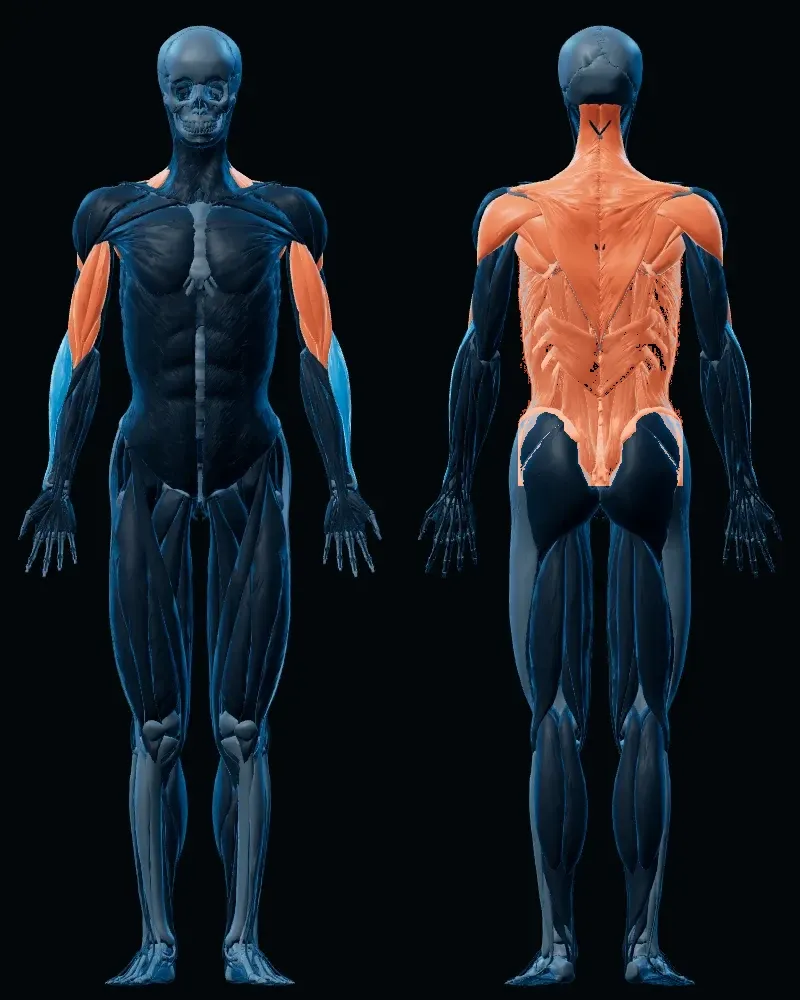
Muscles worked: pull day
Main movers: lats, upper back, rear delts, biceps and brachialis
Assisting: forearms
Table of contents
If your lats look wide up top but go flat near your waist, the latissimus dorsi anatomy divisions are worth understanding. The lat is one muscle with widespread attachments, and lifters usually describe three zones: thoracic (upper), lumbar (middle) and iliac (lowest) fibers. Research tells a slightly simpler story, but the practical fix is the same either way: pull with your elbow, keep your shoulders down, and train the whole lat hard.
This article is a cluster inside our complete back training guide. Here we stay on anatomy and recruitment. For the broader map of the back, see functional anatomy of the lats, traps and erectors.
What are the latissimus dorsi anatomy divisions?
Start with what is solid. In 12 cadavers, researchers separated the lat into regions and measured its architecture. They reported a physiological cross-sectional area of 5.6 cm2 and a normalized fascicle length of 26.4 cm, and concluded the muscle is designed to produce a moderate amount of force over a large range of lengths (Gerling et al., 2013). They note that the lat is primarily considered a shoulder muscle despite its widespread attachments at the spine, and their modelling looked at how it works across both shoulder and spine movements.
That long fascicle length is the key idea. The lat is not a short, stubby muscle. It is a broad sheet that fans from the spine and pelvis up to the upper arm.
The gym version of the map looks like this:
- Thoracic fibers (upper): attach to the thoracic spine side and sit highest on your back.
- Lumbar fibers (middle): blend through the thoracolumbar fascia and run at a steeper angle toward the arm.
- Iliac fibers (lowest): start near the hip crest and cover the longest distance.
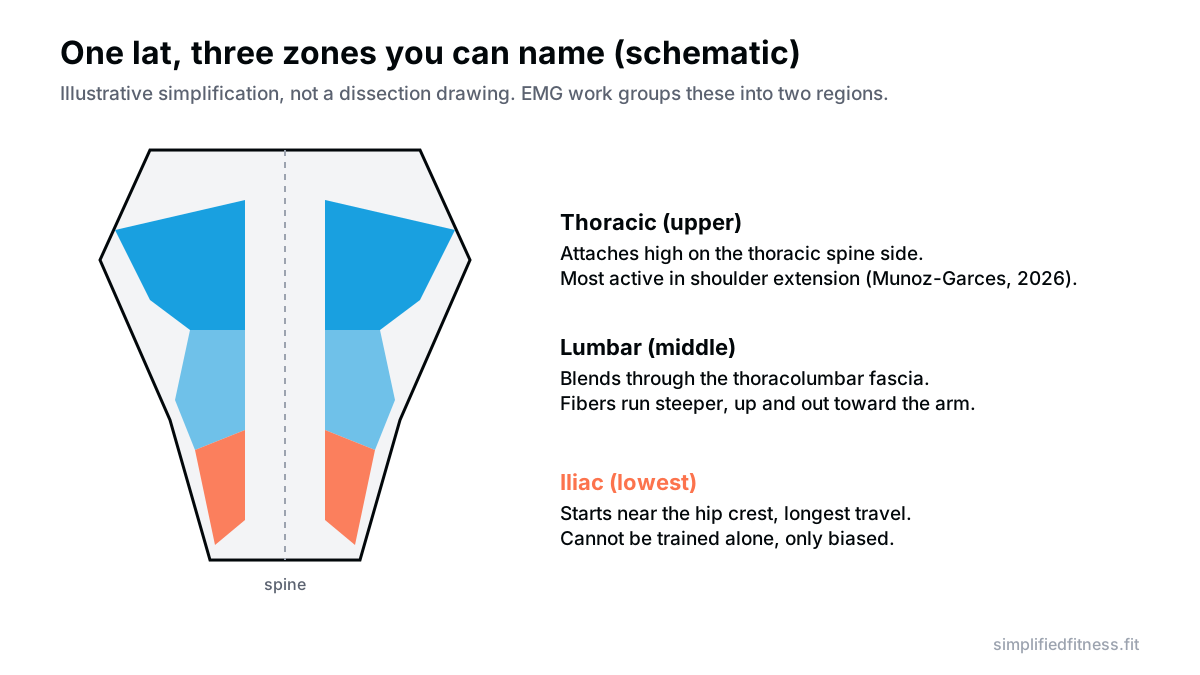
Now the honest caveat. The thoracic, lumbar and iliac split is a popular teaching model. Studies that measure muscle activity usually talk about two regions instead: thoracic and lumbar-pelvic-costal. That second label lumps your middle and lowest fibers together. So when someone says “iliac lats,” they are naming an area, not a proven independent compartment.
Do different parts of the lat really fire differently?
Partly, yes. In a descriptive study, 20 healthy adults (15 men, 5 women) did isometric shoulder extension, adduction, internal rotation and lateral trunk bending while a grid of electrodes covered the lat. During shoulder extension, the thoracic region showed higher activity than the lumbar-pelvic-costal region at 50%, 70% and 100% of maximal effort (Muñoz-Garcés et al., 2026). Shoulder extension also produced more activity than the other tasks in both regions.
Read that carefully. It was isometric, in a lab, in 20 people. It says nothing about which region grows more after months of rows.
An older line of work points the same way from a different angle. In 16 young men doing ballistic shoulder adduction, surface EMG showed uneven activity across the breadth of the pec major, deltoid and lat, which the authors took as evidence of in-parallel neuromuscular compartments (Wickham & Brown, 2012). Different slices of the muscle switched on at different times and intensities.
Put those two together and a reasonable reading is: the lat does not behave like a single uniform block. Does that mean a specific exercise will carve out your lowest fibers? No. That step has not been tested.
Why your lats may not flare near the waist
Here are the usual suspects. None of these has been ranked in research, so treat the list as a checklist rather than a diagnosis.
- Not enough hard lat work. Many people do a couple of easy sets and move on.
- Pulling with arms and traps. The load goes through biceps and shrugging shoulders instead of the lats.
- Short range of motion. Stopping the pull early, or never reaching a full stretch at the top.
- Genetics. Muscle belly length, rib cage shape and pelvis width differ between people, and some people simply have lats that look like they reach lower down the torso. We cannot fully change that.
That last one is worth sitting with. If your friend’s lats seem to hang lower, a good part of it is the frame they were born with. You can still build a bigger, denser lat. You just cannot choose the shape it takes.
What does the research say about bar path and grip?
Because people argue about grip all day, it helps to see what was actually measured.
A narrative review of 23 EMG studies found that in the lat pulldown an anterior bar path (the bar in front of the face) was the setup most consistently linked to higher lat activity, while grip width effects were inconsistent (Di Fonza et al., 2026). The authors stress that these are acute EMG amplitudes, not long-term training outcomes, and suggest the humerus-to-trunk relationship may be a key factor in how load is shared.
Grip studies themselves are mixed:
| Study | Who | What they compared | Finding |
|---|---|---|---|
| Lusk et al., 2010 | 12 healthy men | Wide vs narrow, pronated vs supinated pulldown | Pronated grip gave higher lat activity than supinated, regardless of width |
| Andersen et al., 2014 | 15 men | Narrow, medium and wide grips (1, 1.5, 2 x shoulder-bone distance) | Similar lat activation overall, 6RM load was lower with wide grip |
(Lusk et al., 2010) and (Andersen et al., 2014) look like they disagree, but they asked different questions. One compared forearm orientation, the other compared width with a pronated grip. A cautious takeaway: use a pronated grip you can pull hard with, in a width where your elbows track comfortably. Our deeper breakdown is in wide vs close vs neutral grip lat pulldown biomechanics.
How to train the lower lat fibers: the elbow-to-hip path
Now to the part you can actually use. The idea, widely taught in coaching and supported by general muscle mechanics, is that a muscle works best when you pull along the line of its fibers. The lowest lat fibers run from the hip crest up toward the arm. So a good lat rep finishes with the elbow travelling down and slightly back toward the hip crest, not straight down beside your ribs or backwards into a row.
I want to be clear about the evidence tier here. This is an informed coaching cue, grounded in anatomy, and not a trial-proven way to grow one region. Use it for feel and consistency.
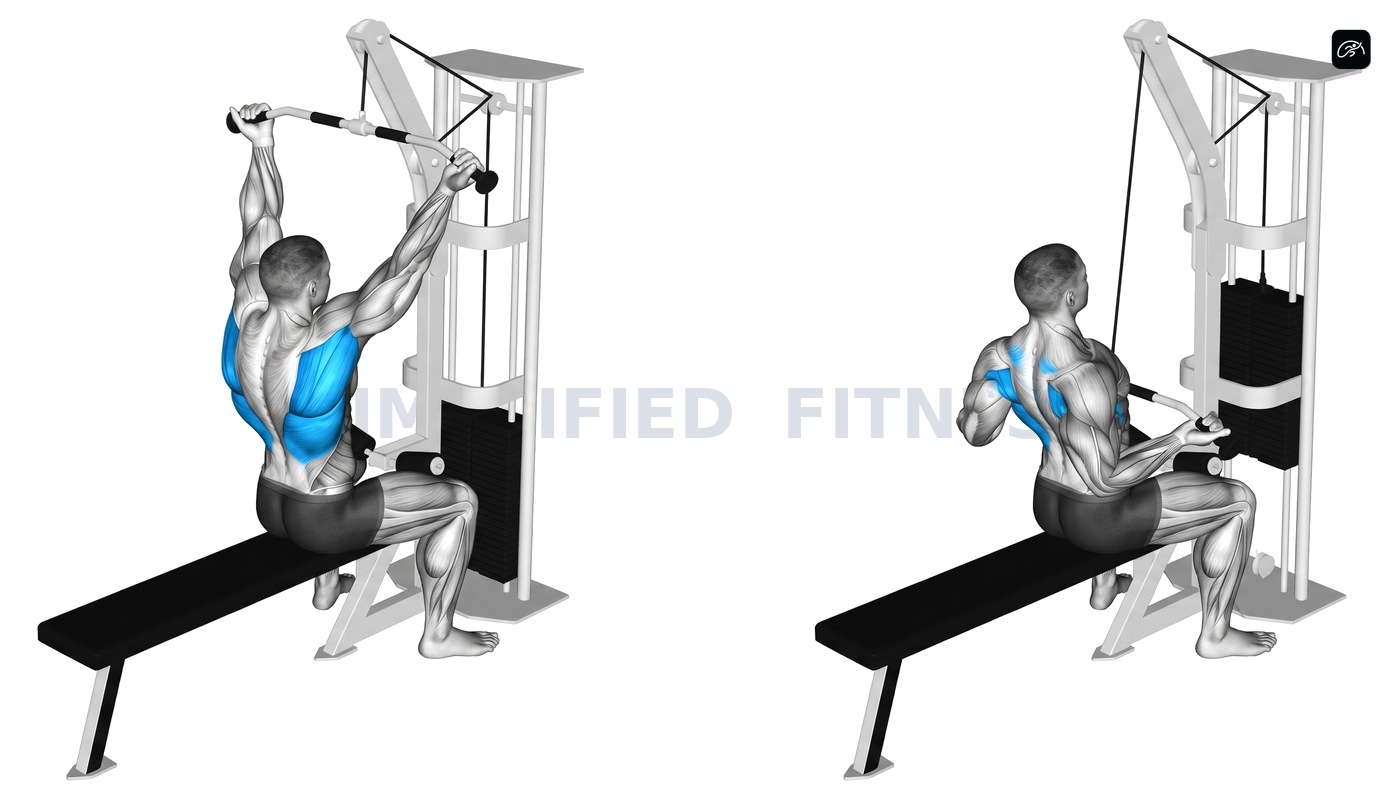
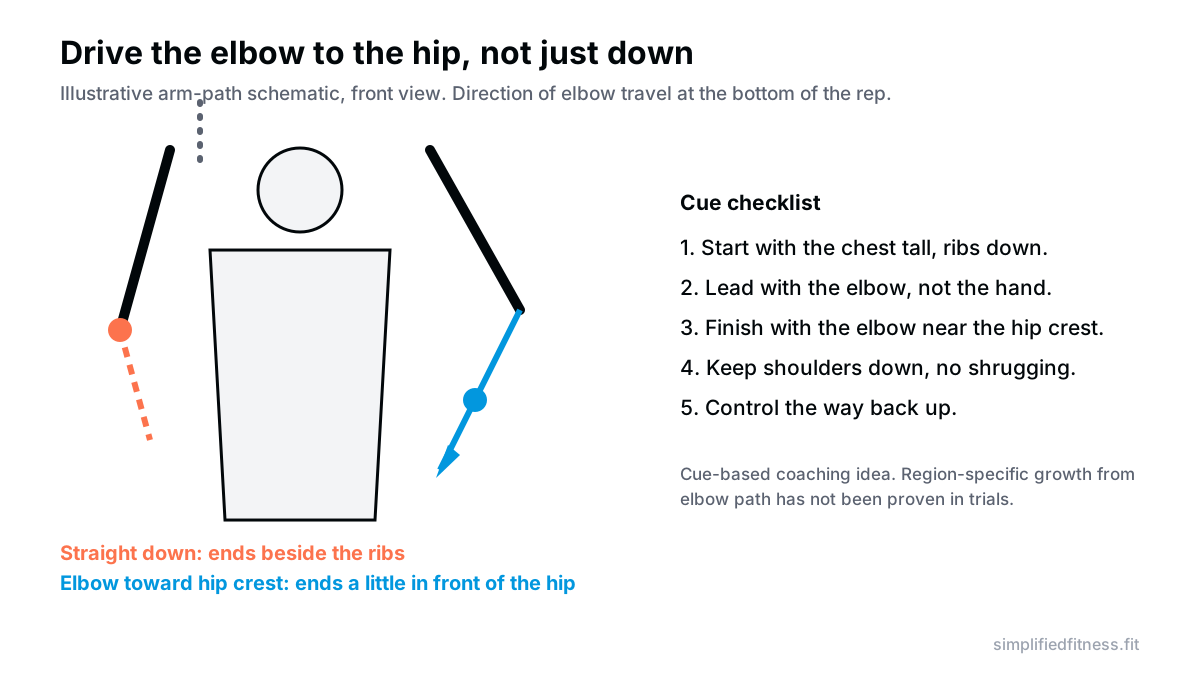
The cues, in order:
- Set up tall with ribs down, and a slight lean back only if it keeps your ribs stacked.
- Start the rep by pulling the shoulders down, not by bending your arms.
- Think “elbows to hips.” Let the hands follow.
- Stop when your elbow is near the hip crest. If you have to lean back or shrug to get there, the weight is too heavy.
- Take 2-3 seconds on the way up and let the lat lengthen.
How do I stop my traps and biceps from taking over?
One of the most common mistakes in lat training is grinding the weight up with arms and shoulders. The good news: you can improve this with instruction.
In a small study, eight women with little or no strength-training background did lat pulldowns at 30% of max, first with basic instruction and then after being told to emphasize the lat and de-emphasize the biceps. Lat activity rose significantly after the instruction, but biceps and teres major activity did not change significantly (Snyder & Leech, 2009). The authors point out that this likely does not equal true isolation of the lat.
Two takeaways. First, cues help, even for beginners. Second, do not expect to turn the biceps off, so do not chase it. We cover the mind-muscle side separately in scapular retraction vs depression and mind-muscle connection.
Eliminating upper-back retraction during lat work
Here is a pattern that kills lat tension. The rep starts, and instead of the shoulders sliding down, the shoulder blades pinch together and the traps fire. The movement turns into a mid-back row, and the lat gets less of a stretch.
What to do instead:
- Depress first, then pull. Let the shoulders move down away from your ears, then drive the elbows.
- Do not squeeze the blades together on pulldowns. Save the strong retraction for rows.
- Keep the chest tall, not flared. A big rib flare often masks low-back extension.
- Choose the load you can control. If your shoulders ride up on every rep, drop the weight.
The relationship between arm angle and which muscles take the load is covered in lats vs upper back: arm path and elbow flare.
Single-arm cable setups for lower lat emphasis
Single-arm work removes the bar, so your elbow can finish by your hip without bumping into anything. It also makes it easy to feel a left-right difference.
A simple setup:
- Set the pulley high and use a single handle, a D-handle or a rope.
- Kneel or sit, turned slightly toward the stack, with the arm reaching up and slightly out.
- Pull the shoulder down first, then bring the elbow toward the hip crest.
- Control the return, and let the arm go all the way back up under tension.
There is no study showing this beats a bar for lower-lat growth. It is a tool that makes the elbow path easy to control and the cue easy to feel. The full execution detail lives in our single-arm iliac lat pulldown cable setup.
Does regional hypertrophy exist in the lats?
It is a fair question, because the whole “lower lats” idea assumes you can grow one end of a muscle more than the other. In a meta-analysis of 12 studies in young adults, researchers compared hypertrophy at proximal, mid-belly and distal sites for training at longer versus shorter muscle lengths. The effects at all three sites were trivial and similar, and the authors concluded that training at longer or shorter mean muscle lengths produces similar hypertrophic effects, with the caveat that the length differences between conditions were small (Varovic et al., 2025).
That review was not about the lats. It covers different muscles in general. So the careful answer is: regional growth may exist, but the evidence we have shows smaller differences than gym lore suggests, and no one has tested lower-lat-specific training directly.

A practical week for fuller lats
Here is a simple, evidence-aligned framework, not a magic template.
| Day | Lat work | Notes |
|---|---|---|
| Pull A | Lat pulldown (anterior bar path), 3-4 sets of 6-12 | Elbows to hips, shoulders down |
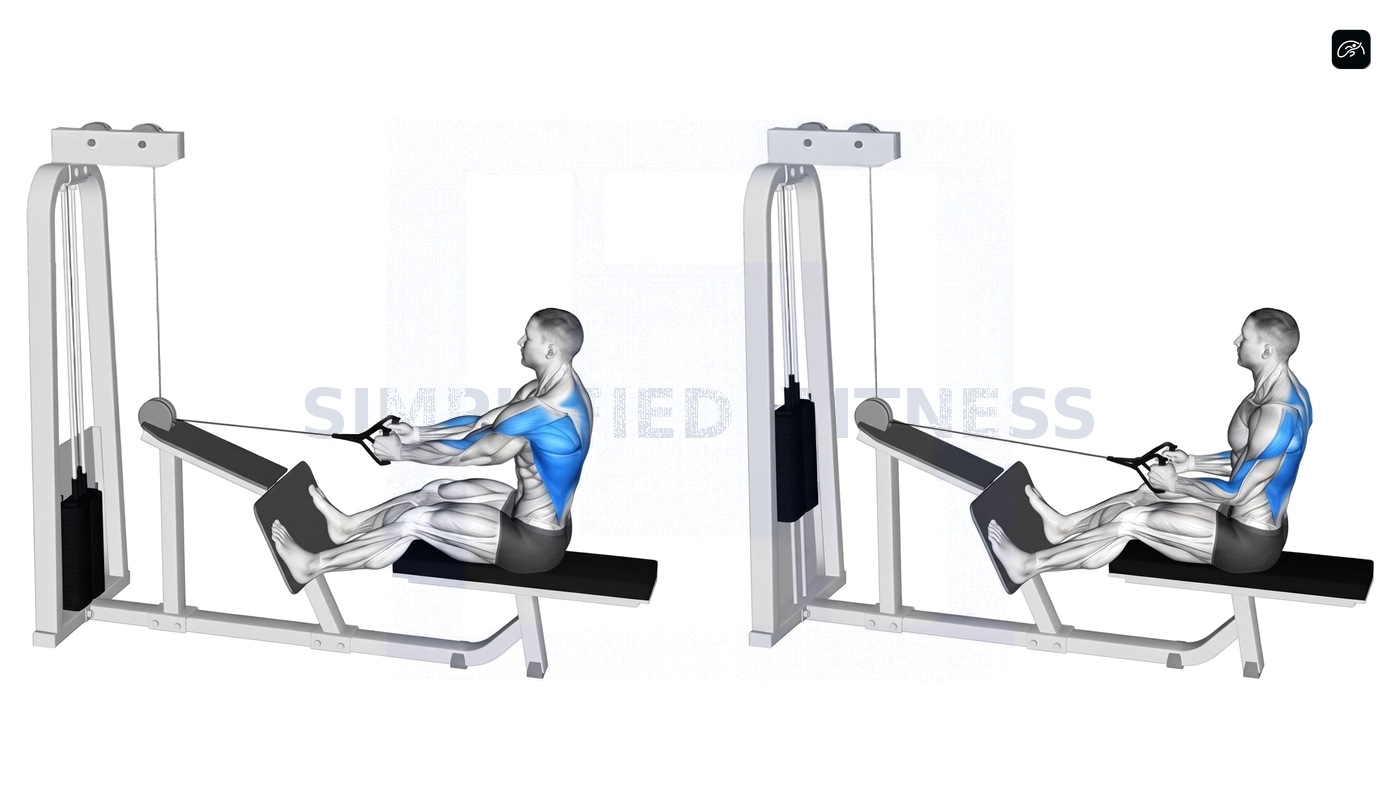
| Pull A | Neutral-grip row, 3 sets of 8-12 | Torso steady, stretch at the front |
| Pull B | Pull-up or assisted pull-up, 3 sets near failure | Full stretch at the bottom |
| Pull B | Single-arm cable pulldown, 2-3 sets of 10-15 | Elbow to hip crest, slow return |
That is roughly 10-14 hard lat-focused sets a week for many lifters, which is a sensible starting zone. You can nudge it up if you recover well. Plug it into our pull day plan and log your reps. If you are a vegetarian, make sure you get enough protein (dal, paneer, curd, soya chunks), since no cue can make up for underfeeding growth.
When to see a doctor
Lat soreness after a hard session is normal. See a doctor or physiotherapist instead if you notice:
- sharp or persistent pain in your back, side or shoulder
- numbness, tingling or weakness in an arm
- pain after a fall, pop or sudden pull
- pain that wakes you at night or does not ease with rest
These can come from the shoulder, spine or nerves, not just a tired lat.
The bottom line
The lat is one big muscle with widespread attachments and long fibers. Lifters split it into thoracic, lumbar and iliac zones, while research groups it into thoracic and lumbar-pelvic-costal regions, and the two do not fire identically in a lab. What nobody has shown is that you can grow the lowest fibers on their own.
So build the whole lat. Drive your elbow toward your hip crest, stop shrugging, use a range of motion you can control, and give it 2-3 sessions a week for months. The rest is frame and patience.
Frequently Asked Questions
What are the divisions of the latissimus dorsi?
Lifters usually describe three zones: thoracic (upper), lumbar (middle) and iliac (lowest) fibers. Researchers using electromyography describe two neuromuscular regions, thoracic and lumbar-pelvic-costal, so the three-part model is a coaching map rather than a proven split. Think of it as one muscle where different arm angles shift the load a little.
Are there really lower lats and upper lats?
The lat is a single muscle, but its parts attach to different places and do not fire identically. A 2026 study of 20 healthy adults found the thoracic region was more active than the lumbar-pelvic-costal region in isometric shoulder extension at 50% effort and above. Treat 'lower lats' as a region you can bias with technique, not a separate muscle.
How do I grow my lower lats?
Train the whole lat with hard sets of pulldowns, rows and pull-ups, and bias the lower fibers with an elbow path that finishes near your hip. No study has proven region-specific growth from elbow path, so use it as a cue rather than a guarantee. Aim for roughly 10-20 hard sets of back work per week across 2-3 sessions and track your load or reps.
What are the best lower lats exercises?
Lat pulldowns, single-arm cable pulldowns, neutral-grip rows and pull-ups all work the lat through a long path. Reviews of EMG studies suggest an anterior (in front of the face) bar path is the pulldown setup most consistently linked to higher lat activity. Pick the one you can load progressively and feel in your lats, then drive the elbow down and slightly back.
Does grip width change which part of the lats you hit?
Not in a clearly proven way. Studies on pulldown grip width found similar lat activation across grips, with a pronated grip showing higher lat activity than a supinated one in one study of 12 men. Choose the grip that lets you pull with your elbows and keep your shoulders down.
Why don't my lats flare out near my waist?
Common reasons are low lat training volume, pulling with your biceps and traps, and genetics such as muscle belly length and rib or pelvis width. Cadaver work shows the lat is built for moderate force across a long length range, and frame and muscle shape differ between people. Improve what you control, which is volume, technique and progression, and be patient for 6-12 months.
What is the iliac lat?
It is the lowest part of the lat, the fibers that start near the iliac crest (the top of your hip bone) and sweep up toward the arm. It is a coaching label, not a separate muscle, and EMG studies group it with the lumbar fibers as one region. Cue your elbow toward the hip crest to emphasize the pull line of these fibers.
Should I pull to my chest or my hips for lats?
For lat feel, think of the elbow, not the hand: drive it down and slightly back toward the hip crest. The review of lat EMG studies suggests the humerus-to-trunk relationship may be a key determinant of load distribution. Finish with your ribs down and shoulders depressed, and stop before your torso leans back to cheat.
Can I stop my traps from taking over during lat work?
Yes, largely. In a study of eight untrained women, brief verbal technique instruction increased lat activity during the lat pulldown, though biceps activity did not drop. Start each rep by pulling your shoulders down, lighten the load if your shoulders shrug, and slow the eccentric.
How often should I train lats for width?
Two to three sessions a week is a practical range for most lifters, split across vertical pulls (pulldowns, pull-ups) and rows. Hypertrophy depends mainly on hard sets and progressive overload, not on one special exercise. Use our pull day template and add a rep or a little load every week or two.
Do single-arm cable pulldowns hit the lower lats better?
They may help some lifters feel the lat, because you can angle the elbow path freely, but there is no trial showing better lower-lat growth. The advantage is practical: you can finish with the elbow close to your hip without a bar in the way. Try them as a second or third pulling movement after your main heavy pull.
Is regional hypertrophy in the lats proven?
Not for the lats specifically. A 2025 meta-analysis of 12 studies in young adults found similar regional growth at proximal, mid-belly and distal sites whether muscles were trained at longer or shorter lengths, with caution because the length differences were small. Until lat-specific trials exist, train the whole muscle hard and treat regional cues as a bonus.
When should I see a doctor about lat or back pain?
See a doctor if you have sharp or persistent pain, numbness, tingling, weakness in an arm, pain after a fall or pop, or pain at night. These signs can come from the shoulder, spine or nerves rather than a tight lat. Stop pulling heavy until you have been assessed.
Sources & References
Every claim above is checked against peer-reviewed research (PubMed, U.S. National Library of Medicine) or guidance from established health bodies. How we fact-check.
- Gerling ME, et al. Architectural analysis and predicted functional capability of the human latissimus dorsi muscle. J Anat. 2013. PMID: 23758053
- Munoz-Garces M, et al. Regional activation of the latissimus dorsi muscle by high-density surface electromyography during isometric shoulder and trunk exercises. Sports Health. 2026. PMID: 41345828
- Wickham JB, et al. The function of neuromuscular compartments in human shoulder muscles. J Neurophysiol. 2012. PMID: 21975455
- Di Fonza D, et al. Electromyographic analysis of latissimus dorsi activation during common resistance training exercises: a narrative review. J Funct Morphol Kinesiol. 2026. PMID: 42647355
- Lusk SJ, et al. Grip width and forearm orientation effects on muscle activity during the lat pull-down. J Strength Cond Res. 2010. PMID: 20543740
- Andersen V, et al. Effects of grip width on muscle strength and activation in the lat pull-down. J Strength Cond Res. 2014. PMID: 24662157
- Snyder BJ, et al. Voluntary increase in latissimus dorsi muscle activity during the lat pull-down following expert instruction. J Strength Cond Res. 2009. PMID: 19826307
- Varovic D, et al. Does muscle length influence regional hypertrophy? A systematic review and meta-analysis. Int J Sports Med. 2025. PMID: 40570881

Umair Hazrami · Founder & Head Coach, Simplified Fitness
Umair Hazrami founded Simplified Fitness and the Simplified Lifter channel to cut through fitness noise. With 4+ years of consistent training and 10+ coaching clients, he writes every guide from the peer-reviewed research and links the sources so you can check them. Our editorial standards.
Educational content only, not medical advice. If you have a medical condition, are pregnant, or take medication, talk to a qualified doctor before changing your diet, supplements or training. Full disclaimer.
Keep reading

Exercise Technique
Barbell Bent-Over Rows: Spinal Load, Hamstring Fatigue and Lat Growth
Is the barbell bent over row hypertrophy gold or a fatigue generator? See what the research says about spinal load, torso angles and better rows for lat growth.
8 min read

Exercise Technique
Chest-Supported Rows: Train Your Upper Back Without Lower Back Fatigue
Chest supported row hypertrophy explained: why your lower back quits first, how T-bar, incline and seal rows fix it, and what the research says.
8 min read
Exercise Technique
Complete Back Workout Design: Balancing Vertical Pulls, Horizontal Rows, and Lumbar Recovery
A science-based back workout routine: weekly sets, how to balance pulldowns and rows, and how to protect your lower back, with a sample pull day plan.
9 min read

Exercise Technique
Conventional Deadlifts for Back Hypertrophy: Stimulus-to-Fatigue Ratio Analysis
Are deadlifts good for back hypertrophy? A stimulus-to-fatigue breakdown of what they build, what they miss for lats, and how to program or replace them.
8 min read