Functional Anatomy of the Back: Lats, Traps, Rhomboids, Teres and Erectors
Back muscles anatomy functional guide: where lats, traps, rhomboids, teres and erectors attach, how they move, and how arm path changes your rows and pulldowns.

TL;DR. The short answer
- Think of the back as three jobs: lats pull the arm down and back, the rhomboids and mid/lower traps pull the shoulder blade toward the spine, and the erectors hold the spine upright.
- The lats run from the lower spine, pelvis and lower ribs to the front of the upper arm bone, so they work best when your elbow travels down and back toward your hip.
- Rowing with the elbow flared out to the side shifts more of the work toward the scapular retractors, though EMG studies on this are small and not always consistent.
- Grip width on the lat pulldown matters less than people think: a 2014 study of 15 men found similar lat activation across grips 1 to 2 times shoulder-bone width.
- The erectors work hard in heavy bent-over rows and deadlifts, so count them as part of your back volume and recover accordingly.
Part of our complete guide: Complete Back Training Guide: Lats vs Upper Back, Best Exercises and a Hypertrophy Workout
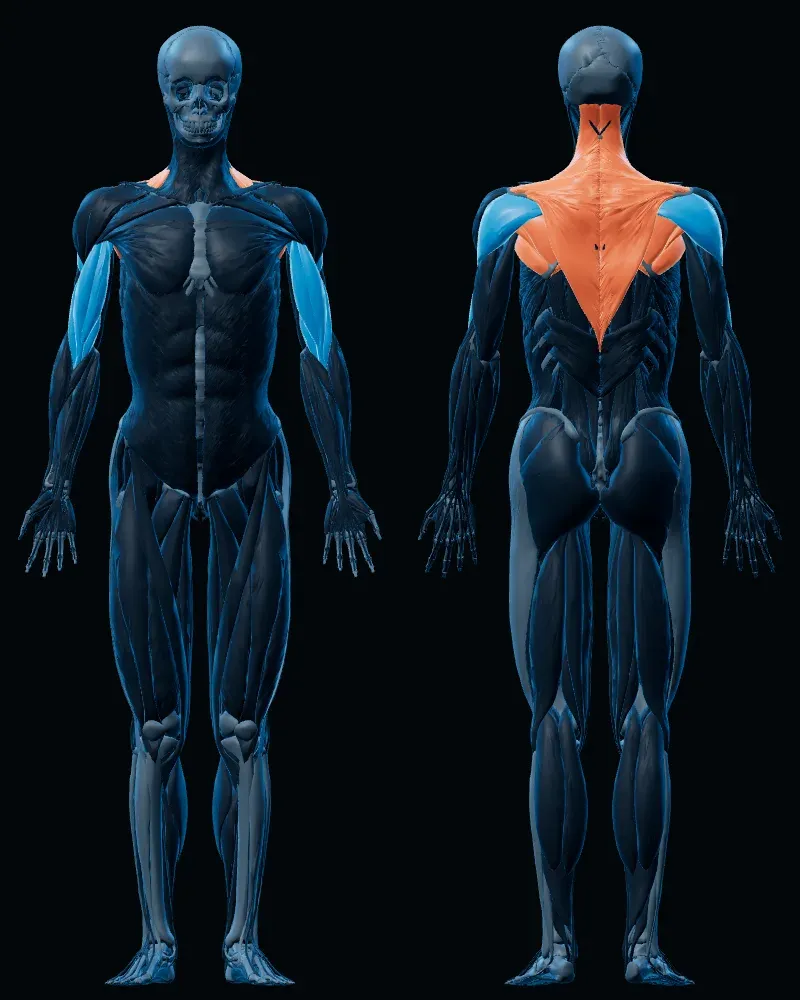
Muscles worked: upper back
Main movers: traps, rhomboids, teres major, infraspinatus and teres minor
Assisting: rear delts, biceps and brachialis
Table of contents
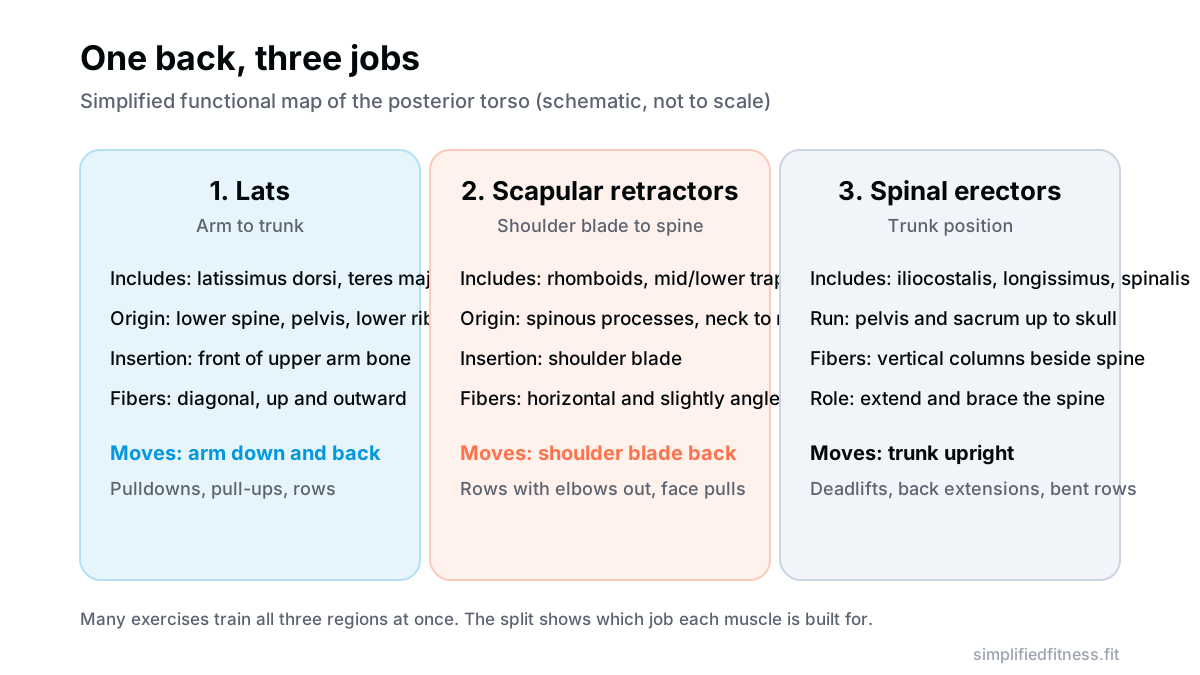
The simplest way to understand back muscles anatomy in functional terms is to split the back into three jobs. The lats pull your arm down and back, the rhomboids and middle and lower traps pull your shoulder blade toward your spine, and the erector spinae hold your spine upright. Once you know which muscle does which job, picking back exercises stops being guesswork.
This article is the anatomy map for our complete back training guide. We will cover where each muscle attaches, which way its fibers run, and how your arm path changes what a row or pulldown asks of you. The goal is practical: after reading, you should be able to look at an exercise and say which part of the back it is built for.
What are the main back muscles and what do they do?
Anatomy textbooks list dozens of muscles on the back. For training, six groups matter most.
| Muscle | Attaches (roughly) | Main job | Typical exercises |
|---|---|---|---|
| Latissimus dorsi | Lower spine, pelvis, lower ribs to front of upper arm bone | Arm down and back, toward the body | Pulldowns, pull-ups, rows |
| Teres major | Lower edge of shoulder blade to upper arm bone | Same direction as lats | Any pulldown or row |
| Upper trapezius | Skull and neck to collarbone and shoulder | Lift and rotate the shoulder blade | Shrugs, carries |
| Middle trapezius and rhomboids | Spine (neck to mid-back) to shoulder blade | Pull the shoulder blade toward the spine | Rows with flared elbows, reverse flys |
| Lower trapezius | Mid and lower thoracic spine to shoulder blade | Pull the blade down | Low-angle pulls, Y-raises |
| Erector spinae | Pelvis and sacrum up the spine to the ribs and skull | Extend and brace the spine | Deadlifts, back extensions |
The origins and insertions above are standard anatomy. I have kept them simple on purpose: the point is the direction each muscle pulls, not memorising Latin.
Latissimus dorsi: the big diagonal sheet
The lat is the widest muscle of the back. It starts from the spinous processes of the lower thoracic and lumbar vertebrae, the back of the pelvis and the lowest ribs, then sweeps up and outward to insert on the front of the upper arm bone. Most of that low attachment goes through the thoracolumbar fascia, a sheet of connective tissue across the lower back. A 2012 anatomy review notes that the superficial layer of this fascia is dominated by the aponeuroses of the latissimus dorsi and serratus posterior inferior (Willard et al., 2012).
What this means for you:
- Functionally, the lat links your arm to your pelvis. That is why it matters in pulling, climbing and even throwing.
- Its actions are shoulder extension, adduction and internal rotation. A 2026 narrative review of lat EMG studies describes it in those terms (Di Fonza et al., 2026).
- The fibers run diagonally, so the cleanest line of pull is the arm moving down and back toward the hip, not straight back at shoulder height.
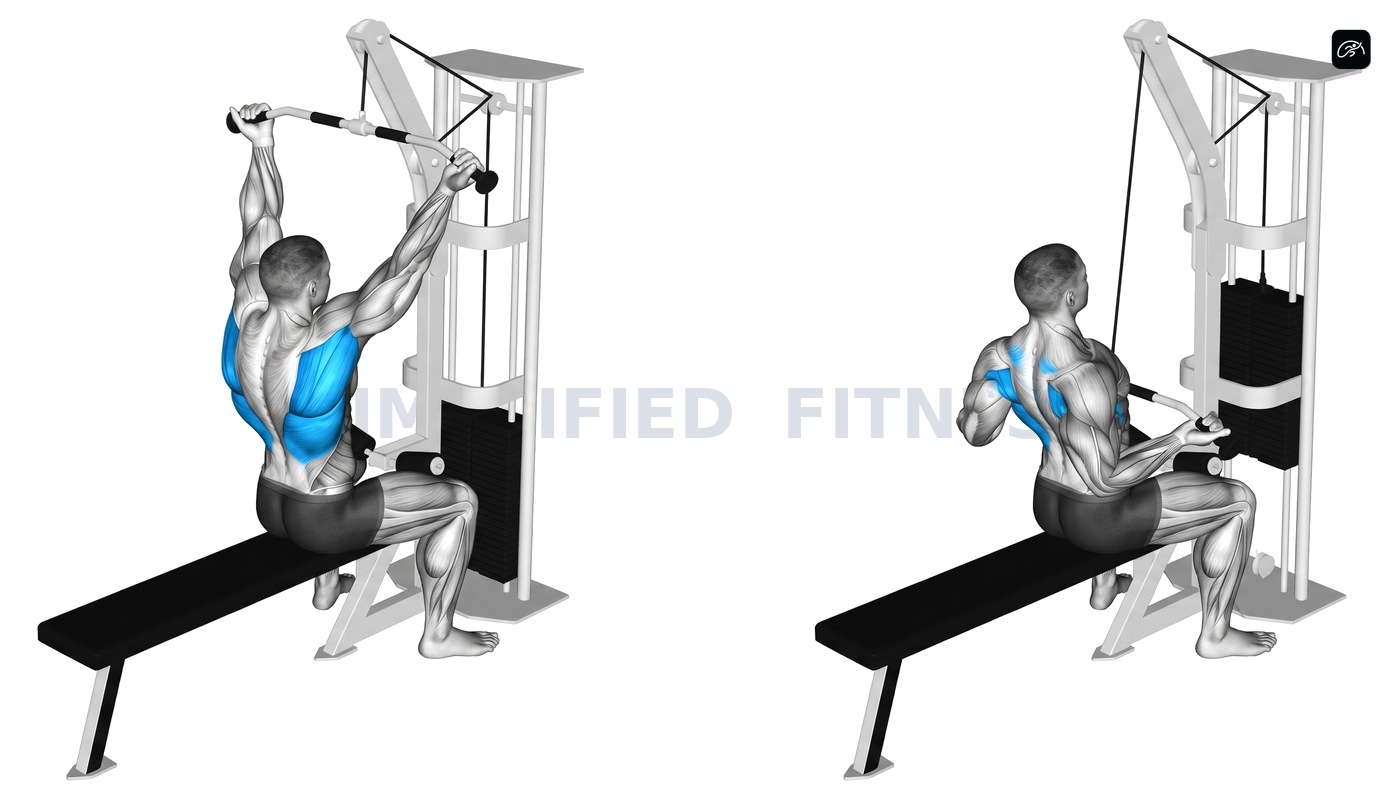
If you want the finer detail on how different parts of the lat attach, our article on regional lat anatomy goes deeper.
Teres major and minor: the small neighbours
The teres major sits right next to the lat and travels with it. It runs from the lower outer edge of the shoulder blade to the upper arm bone, so it does a similar job (pulling the arm down and back). It gets worked in almost every pulldown and row. The teres minor is different: it is a small rotator cuff muscle that rotates the arm outward, and it matters more for shoulder health than size. We cover both in teres major and minor anatomy.
Trapezius: three muscles in one
The trapezius is a big kite-shaped muscle that is better thought of as three muscles. A 2019 review describes it as a dominant stabilizer of the scapula that is divided into upper, middle and lower parts, each of which can be targeted with different exercises (Camargo and Neumann, 2019).
- Upper traps run from the skull and neck to the collarbone and shoulder. They lift the shoulder blade (shrugs, carries).
- Middle traps run horizontally from the upper thoracic spine to the shoulder blade. They pull it back toward the spine.
- Lower traps run from the mid and lower thoracic spine up to the shoulder blade, which makes them the main muscles for pulling it down.
Rhomboids: the muscle under the trap
The rhomboids sit under the trapezius, running from the spine (lower neck to mid-back) down and outward to the inner edge of the shoulder blade. They pull the shoulder blade toward the spine and help hold it flat against the ribs. In practice they work alongside the middle traps, and you cannot reliably isolate one from the other in training.
Erector spinae: the spine’s own cables
The erectors are three vertical columns of muscle on either side of the spine (iliocostalis, longissimus and spinalis). They start low on the pelvis and sacrum and run up toward the ribs and skull. Their job is to extend the spine and resist it flexing forward, so any time you hold a hinged position under load, they are working.
A 2020 systematic review of deadlift EMG reported that the erector spinae and quadriceps were more activated than the gluteus maximus and biceps femoris across deadlift variations, with the Romanian deadlift showing lower erector activation than hamstring activation (Martin-Fuentes et al., 2020). The authors also point out that methods vary between studies, so treat the comparisons as general.
How does arm path change which back muscle works?
This is where anatomy becomes useful. Because muscles pull along their fibers, the path of your elbow decides which fibers get a good line of pull.
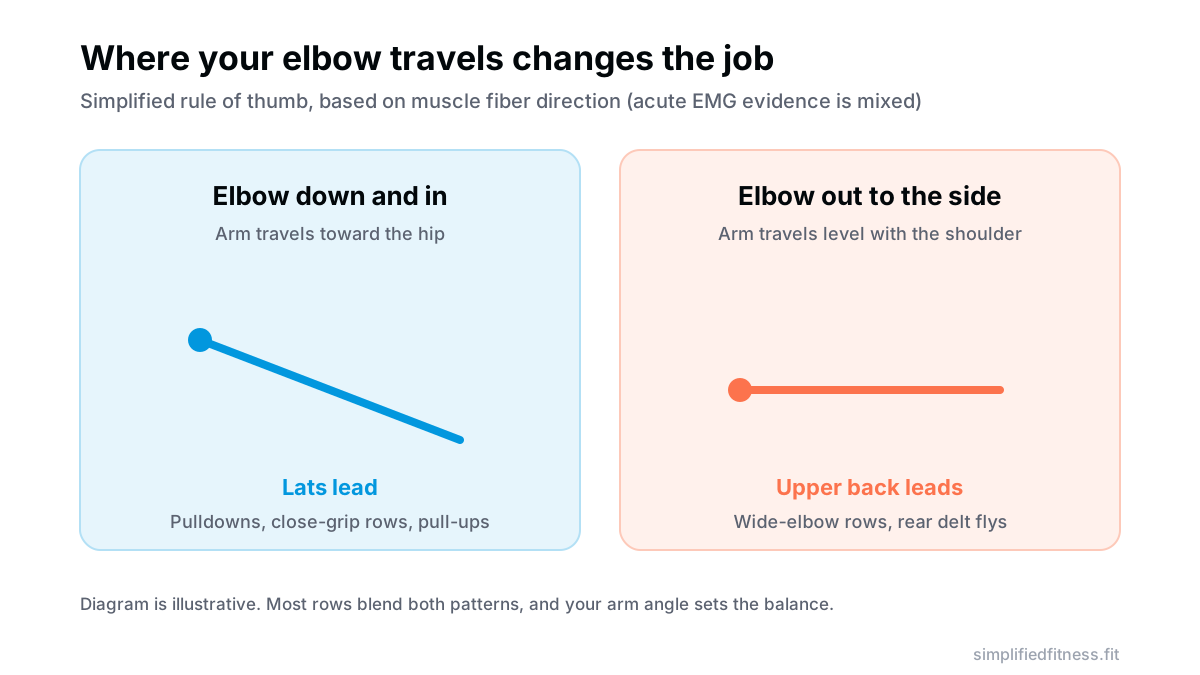
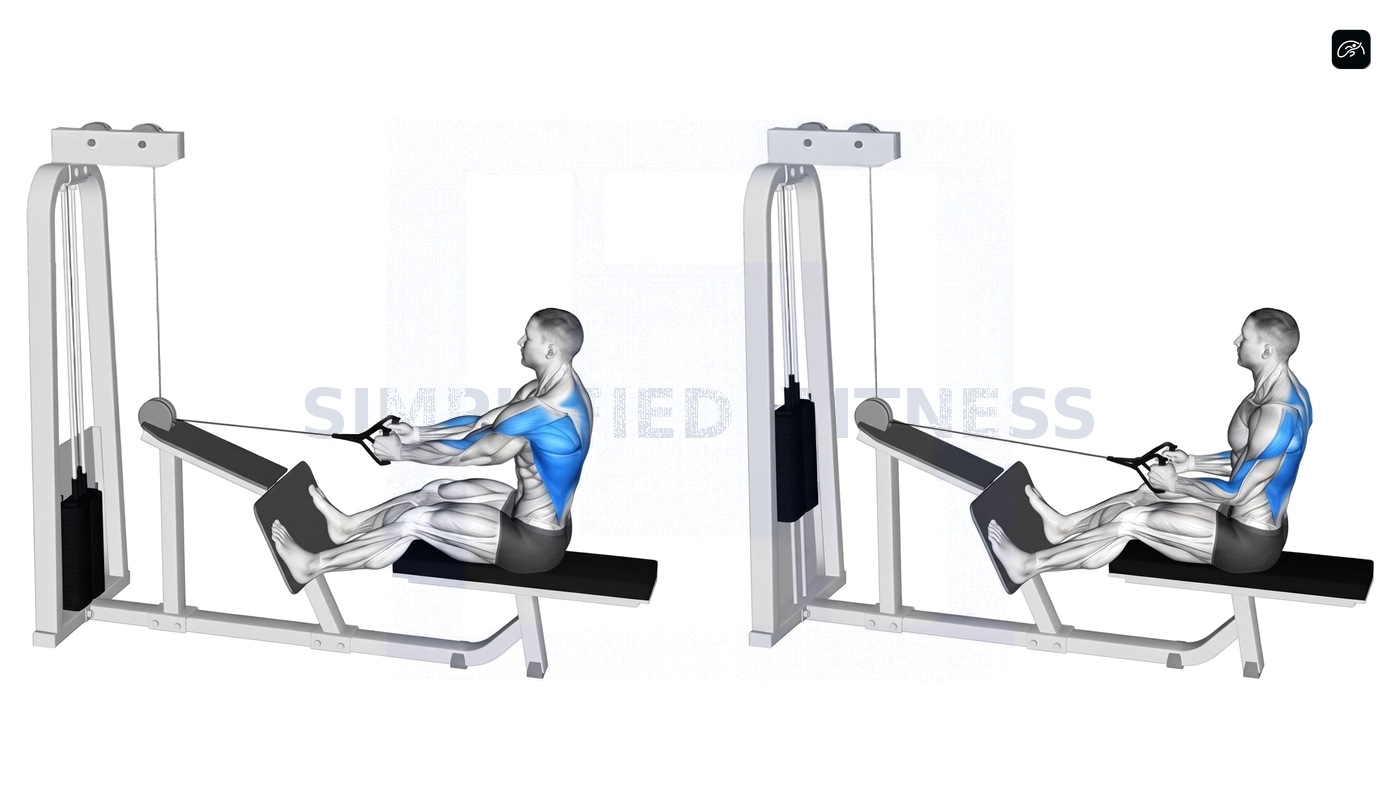
- Elbow down and toward the hip lines up with the lat’s diagonal fibers. Pulldowns, pull-ups and close-grip rows live here.
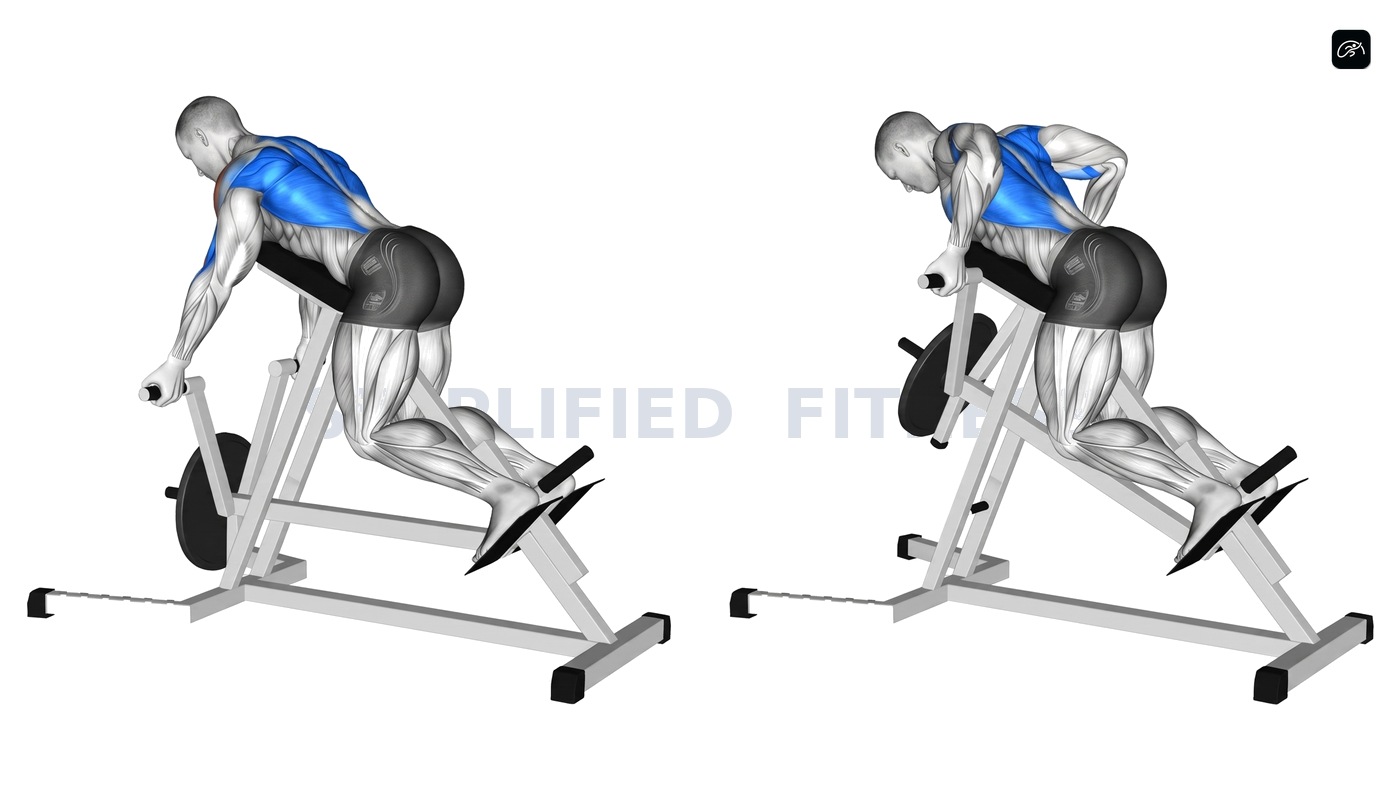
- Elbow out level with the shoulder moves the arm along a horizontal path that suits the middle traps, rhomboids and rear delts, which is why flared-elbow rows and reverse flys feel more “upper back”.
The evidence for this is suggestive, not settled. The 2026 narrative review of lat EMG found that in the seated row, a narrower grip and a lower shoulder abduction angle were each linked to higher lat activity in separate studies, but these two variables have not been tested together. It also concluded that the relationship between the upper arm and the trunk may be a key factor for how load spreads across muscles. Those are acute EMG results, not long-term growth results, and the review recommends treating them as a starting point (Di Fonza et al., 2026). Our article on lats versus upper back and elbow flare takes this further.
Does grip width change lat activation?
Less than most gym advice suggests.
Lusk and colleagues tested 12 men on four lat pulldown grips (wide or narrow, pronated or supinated) at 70% of 1RM and found the pronated (overhand) grip produced greater lat activity than the supinated grip, regardless of width (Lusk et al., 2010).
Andersen and colleagues tested 15 men at narrow, medium and wide pronated grips (1, 1.5 and 2 times shoulder-bone distance). The 6RM load was a little lower with the wide grip (about 77 kg versus 80 kg), and lat activation was similar across grips overall, with greater lat activation for wide versus narrow only in the eccentric (return) phase (Andersen et al., 2014). The authors concluded that similar hypertrophy should be expected from grip widths between 1 and 2 times shoulder-bone distance.
Why might the two studies differ a little? They used different loads, different grip definitions and small samples of young men, so findings may not carry over to everyone. The practical takeaway: pick a grip you can pull with your elbows, not your hands, and stop obsessing over centimetres. For a full comparison see wide vs close vs neutral grip pulldowns.
Which row works which muscles, and what does it cost your spine?
Different rows also load the spine differently. Fenwick and colleagues instrumented 7 healthy men to compare an inverted row, a standing bent-over row and a standing one-arm cable row. The inverted row produced the highest activation of the lats, upper back and hip extensors, with lower lumbar erector activation and the lowest spine load. The bent-over row gave large activation across the whole back but the highest lumbar load. The one-arm cable row challenged trunk twisting strength (Fenwick et al., 2009).
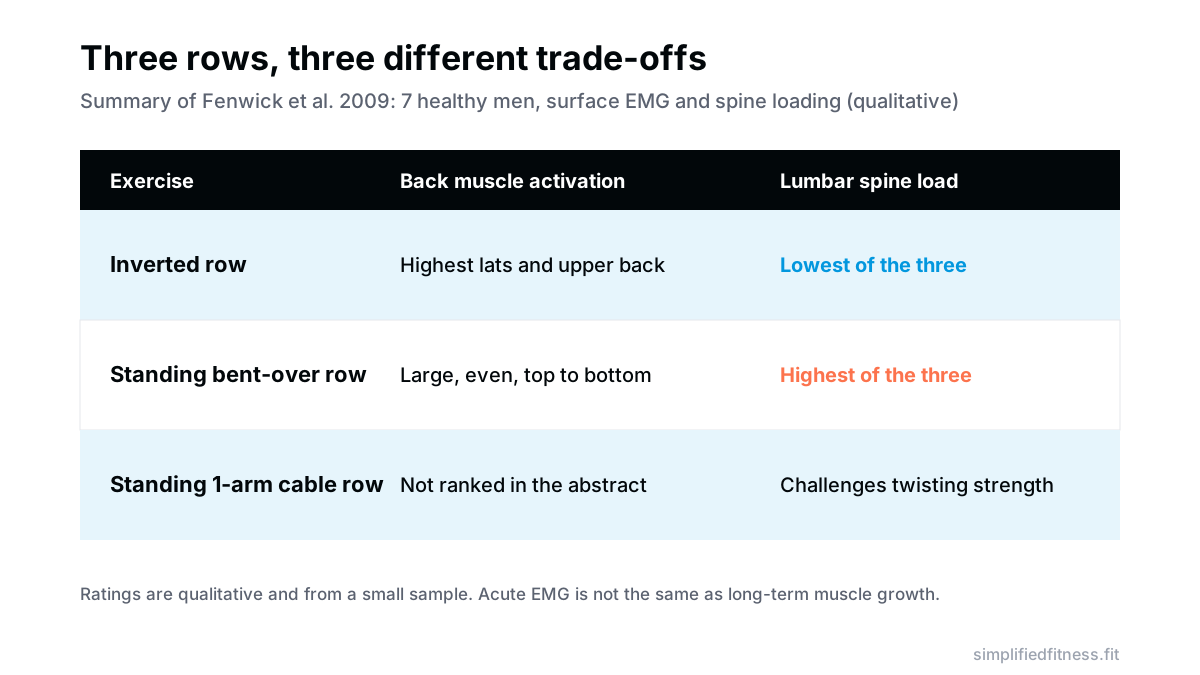
This was a small study of young, healthy men, so it cannot tell you how a given lifter should train. But it fits how most coaches already think: if your lower back is your limiting factor, use a chest-supported or inverted variation.
How to use this anatomy in your training
- Pick the job first. Want lat width? Choose pulls where the elbow travels down and back. Want the upper back? Choose pulls where the elbows travel out and the shoulder blades finish pulled back.
- Match the cue to the muscle. “Elbows to hips” for lats. “Shoulder blades together” for the retractors. For details on retraction and depression cues, see scapular retraction vs depression.
- Use both a vertical and a horizontal pull each week. They overlap, but not completely.
- Respect the spine. The erectors are working in most heavy rows and hinges, so manage total volume.
- Check for pain. Sharp, radiating or lingering pain is not a training problem to push through. See a doctor or physiotherapist.
The bottom line
The back is easier to train once you see it as three jobs: lats for pulling the arm down and back, scapular retractors for moving the shoulder blade toward the spine, and erectors for holding the spine. Your elbow path is the main control knob, and grip width matters less than it looks. Treat the EMG findings as helpful starting points, not rules, since most are acute studies in small samples of healthy young men.
Next, apply it: run our pull day plan and work out your daily protein with the protein calculator.
Frequently Asked Questions
What are the main muscles of the back?
The main muscles are the latissimus dorsi, trapezius (upper, middle and lower), rhomboids, teres major and the erector spinae. Together they pull the arm, move the shoulder blade and hold the spine. A simple way to organise them is lats, scapular retractors and spinal erectors.
What does the latissimus dorsi do?
The lats extend the shoulder (arm down and back), adduct it (arm toward the body) and rotate it inward. Their fibers run diagonally from the lower spine, pelvis and ribs up to the front of the upper arm bone. Train them with pulldowns, pull-ups and rows where your elbow travels toward your hip.
Where do the lats attach?
They attach to the spinous processes of the lower thoracic and lumbar vertebrae through the thoracolumbar fascia, the back of the pelvis, and the lower ribs. At the other end they insert on the front of the humerus. A 2012 anatomy review describes the lat aponeurosis as a main part of the superficial thoracolumbar fascia, which is why the lats link the arm to the pelvis.
What do the rhomboids do?
The rhomboids pull the shoulder blade toward the spine and help hold it against the ribcage. They sit under the trapezius between the shoulder blade and spine. Squeeze the shoulder blades back at the end of rows and keep the load light enough that you can control that squeeze.
What are the three parts of the trapezius?
The upper, middle and lower traps. A 2019 review describes the trapezius as a dominant stabilizer of the scapula, with each part contributing differently. Shrugs bias the upper fibers, rows with a flared elbow bias the middle, and low-angle pulls and Y-raises are used for the lower fibers.
What do the erector spinae do?
They extend the spine and resist forward bending, holding your torso position when you lift. They are three columns of muscle (iliocostalis, longissimus, spinalis) beside the spine. Train them with back extensions, deadlift variations and heavy bent-over rows, and do not stack all of these on one day.
What is the difference between the teres major and the lats?
The teres major is a small muscle that runs from the lower outer edge of the shoulder blade to the upper arm bone. It does a similar job to the lats (pull the arm down and back) but it is attached to the scapula, not the spine. It gets worked in almost every pulldown and row, so it rarely needs its own exercise.
Is the teres minor a back muscle I should train?
The teres minor is a small rotator cuff muscle that rotates the arm outward. It is trained indirectly by external rotation work and rear delt movements such as reverse pec dec flys. Treat it as shoulder health work, not a growth target.
Does a wider grip hit the lats more?
Not clearly. A 2014 study of 15 men found similar latissimus activation across narrow, medium and wide grips on the lat pulldown, with slightly more lat activity for the wide grip only in the eccentric (return) phase. Choose the grip that lets you pull with your elbows and feel it in your lats.
Which row is easiest on the lower back?
In a 2009 study of 7 healthy men, the inverted row loaded the lumbar spine the least among the three rows tested, while the standing bent-over row loaded it the most. A chest-supported row was not tested, but because the pad takes over the job of holding your torso, it is a reasonable way to spare the lower back too. If you have back pain, see a doctor or physiotherapist before heavy rowing.
Can I target the upper and lower lats separately?
Not in any way that has been proven. The fibers of the lats are one sheet and your arm path changes how much stretch and tension they get, but there is little solid evidence for strict upper or lower lat exercises. Use a mix of overhead pulls and rows toward the hip and let those cover the muscle.
How many back exercises do I need per session?
Most lifters do well with 2 to 4 exercises that cover a vertical pull, a horizontal pull and optionally a spinal erector hinge or extension. Fewer, better chosen movements beat a long list of overlapping ones. See our pull day plan for a worked example.
Sources & References
Every claim above is checked against peer-reviewed research (PubMed, U.S. National Library of Medicine) or guidance from established health bodies. How we fact-check.
- Fenwick CM, et al. Comparison of different rowing exercises: trunk muscle activation and lumbar spine motion, load, and stiffness. J Strength Cond Res. 2009. PMID: 19620925
- Willard FH, et al. The thoracolumbar fascia: anatomy, function and clinical considerations. J Anat. 2012. PMID: 22630613
- Camargo PR, et al. Kinesiologic considerations for targeting activation of scapulothoracic muscles - part 2: trapezius. Braz J Phys Ther. 2019. PMID: 30797676
- Lusk SJ, et al. Grip width and forearm orientation effects on muscle activity during the lat pull-down. J Strength Cond Res. 2010. PMID: 20543740
- Andersen V, et al. Effects of grip width on muscle strength and activation in the lat pull-down. J Strength Cond Res. 2014. PMID: 24662157
- Martin-Fuentes I, et al. Electromyographic activity in deadlift exercise and its variants. A systematic review. PLoS One. 2020. PMID: 32107499
- Di Fonza D, et al. Electromyographic analysis of latissimus dorsi activation during common resistance training exercises: a narrative review. J Funct Morphol Kinesiol. 2026. PMID: 42647355

Umair Hazrami · Founder & Head Coach, Simplified Fitness
Umair Hazrami founded Simplified Fitness and the Simplified Lifter channel to cut through fitness noise. With 4+ years of consistent training and 10+ coaching clients, he writes every guide from the peer-reviewed research and links the sources so you can check them. Our editorial standards.
Educational content only, not medical advice. If you have a medical condition, are pregnant, or take medication, talk to a qualified doctor before changing your diet, supplements or training. Full disclaimer.
Keep reading
Exercise Technique
Barbell Bent-Over Rows: Spinal Load, Hamstring Fatigue and Lat Growth
Is the barbell bent over row hypertrophy gold or a fatigue generator? See what the research says about spinal load, torso angles and better rows for lat growth.
8 min read
Exercise Technique
Chest-Supported Rows: Train Your Upper Back Without Lower Back Fatigue
Chest supported row hypertrophy explained: why your lower back quits first, how T-bar, incline and seal rows fix it, and what the research says.
8 min read
Exercise Technique
Complete Back Workout Design: Balancing Vertical Pulls, Horizontal Rows, and Lumbar Recovery
A science-based back workout routine: weekly sets, how to balance pulldowns and rows, and how to protect your lower back, with a sample pull day plan.
9 min read

Exercise Technique
Conventional Deadlifts for Back Hypertrophy: Stimulus-to-Fatigue Ratio Analysis
Are deadlifts good for back hypertrophy? A stimulus-to-fatigue breakdown of what they build, what they miss for lats, and how to program or replace them.
8 min read