Pull-Ups vs Chin-Ups: What the EMG Research Says About Lats and Biceps
Pull ups vs chin ups for back: what EMG studies show about lat and biceps activation, shoulder comfort, neutral grip, and how to load them for growth.
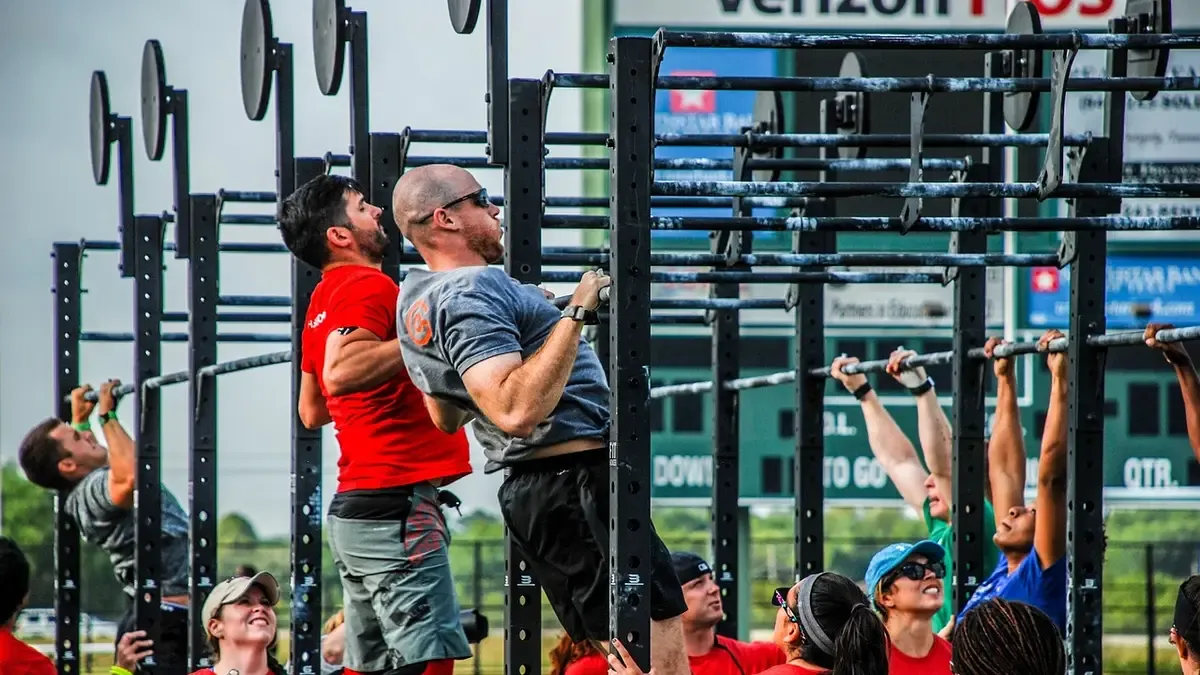
TL;DR. The short answer
- For a wider back, pull-ups and chin-ups are close to equal. In one EMG study of 25 young adults, lat activation was high in every version, and across several studies the lats look broadly similar across grips.
- Chin-ups tend to bring the biceps in more, but the evidence is mixed. One study found higher biceps activity in chin-ups, another found no meaningful grip difference.
- In one small lab study, wide and underhand pull-ups put the shoulder in positions linked with higher impingement risk. A shoulder-width overhand grip is a sensible default, and neutral handles are worth trying if your shoulders complain, though neutral grips were not tested.
- In a pull-up your body moves, not the bar. A modelling study found the arm lowers mainly because the torso rises toward the bar, so a smooth pull from a full hang matters more than forcing the shoulder blades down first.
- Once you can do 8-12 clean reps, adding small amounts of weight works, though muscle growth is possible across a wide range of loads.
Part of our complete guide: Complete Back Training Guide: Lats vs Upper Back, Best Exercises and a Hypertrophy Workout
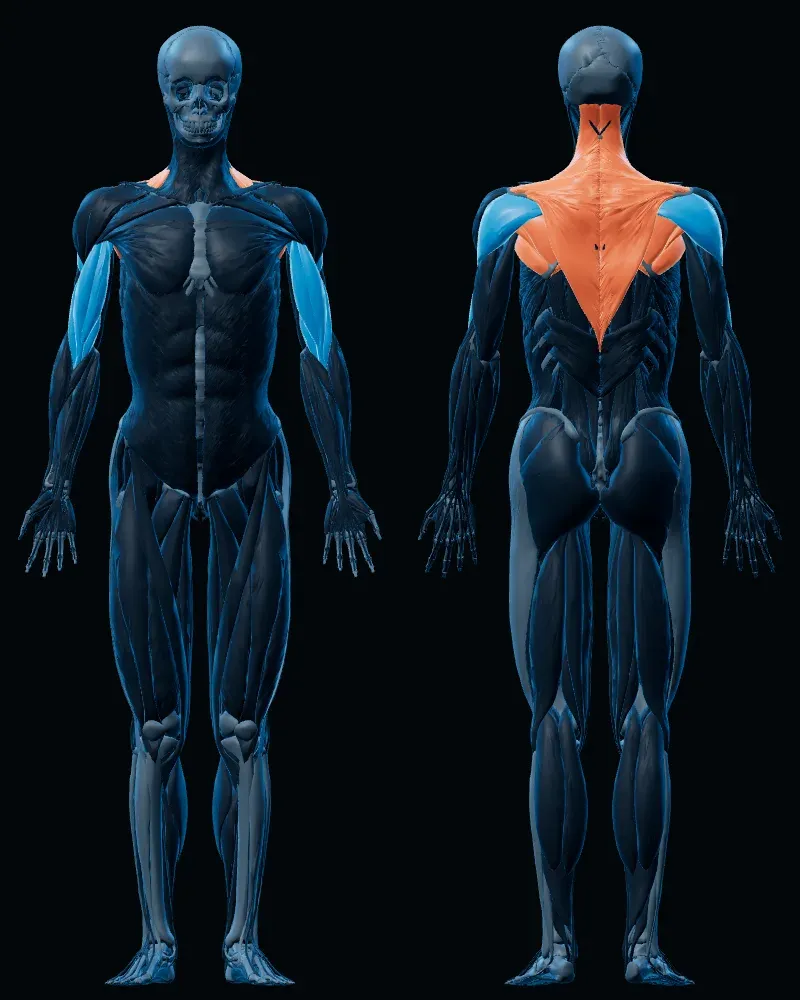
Muscles worked: upper back
Main movers: traps, rhomboids, teres major, infraspinatus and teres minor
Assisting: rear delts, biceps and brachialis
Table of contents
If you are choosing between pull ups vs chin ups for back width, the research says the lats do the heavy lifting in both. Chin-ups usually add more biceps work, but the gap is smaller and less consistent than gym lore suggests.
So the better question is not “which one wins.” It is “which grip can I load for months without my shoulders or elbows complaining?” This article is part of our complete back training guide, and it focuses on the bodyweight, closed-chain version of vertical pulling.
Pull-ups vs chin-ups: what is actually different?
Grip, mostly. A pull-up uses an overhand (pronated) grip, palms away. A chin-up uses an underhand (supinated) grip, palms toward you. A neutral grip pull-up uses parallel handles, palms facing each other.
That small change in forearm position shifts how the elbow flexors and shoulder joint share the work. It does not change the job of the lats, which is to bring your upper arm down and back toward your torso while your body moves up.
Same movement. Slightly different mechanics.
Do pull-ups and chin-ups work the lats equally?
Close, as far as surface EMG can tell.
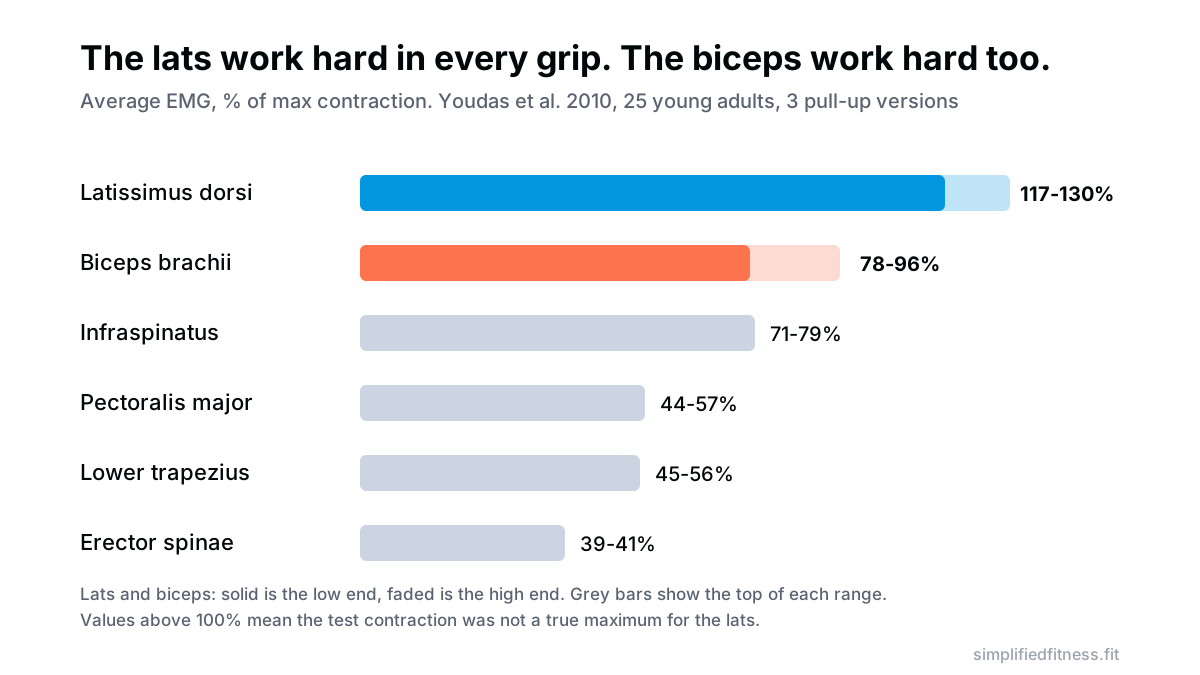
In a study of 21 men and 4 women, average lat activity ranged from 117 to 130% of a maximum test contraction across a pull-up, a chin-up and a rotating-handle version. Biceps brachii came next at 78-96% (Youdas et al., 2010). Values above 100% just mean the test contraction was not a true maximum for the lats.
A second study in 19 strength-trained males compared supinated, pronated, neutral and rope pull-ups. Overall muscle activity was similar despite the different hand positions, with one exception: the pronated grip drove the middle trapezius harder than the neutral grip (Dickie et al., 2017).
A 2026 narrative review of 23 EMG studies reached a matching conclusion: pull-up variations showed broadly similar lat activation across grips. The authors also warned that these findings reflect acute EMG amplitude, not long-term training results (Di Fonza et al., 2026).
Do chin-ups work the biceps more? Mixed evidence
Here the studies disagree, and it helps to see why.
Youdas and colleagues found significantly higher biceps brachii (and pectoralis major) activity in the chin-up than in the pull-up, while the lower trapezius was more active in the pull-up (Youdas et al., 2010).
Dickie and colleagues, using strength-trained men and peak and average EMG measures, reported that overall activity of shoulder-arm-forearm muscles was similar between grips, and the concentric (lifting) phase simply drove the biceps, brachioradialis and pecs harder than the lowering phase (Dickie et al., 2017).
A third approach, a computer model of the shoulder in 11 men, pointed the other way: front (overhand, shoulder-width) pull-ups favoured biceps brachii and brachialis, while reverse (supinated) pull-ups showed higher proportional rotator cuff activation (Urbanczyk et al., 2020). Modelled muscle force is not measured force, so treat this as a hint.
Why might they differ? Small samples, different grip widths, different tempos and different normalization methods all change the numbers. The cautious takeaway: chin-ups probably recruit the biceps and pecs a bit more for many lifters, but it is not a guaranteed large effect.
Which pull-up grip is best for lats?
The lat pulldown is the nearest cable cousin, and it gives a useful hint.
In 12 men doing wide and narrow, pronated and supinated pulldowns, the pronated grip produced greater lat activity than the supinated grip regardless of width. Biceps and middle trapezius were not influenced by grip type (Lusk et al., 2010). If you want a deeper look at the cable side of this question, see our guide to lat pulldown grip biomechanics.
Notice that pulldown results do not map one-to-one onto pull-ups. You move the bar in the pulldown. You move your body in the pull-up. Same muscles, different mechanics.
A practical default: overhand grip, about shoulder width or slightly wider, full hang at the bottom, chin over the bar at the top.
| Grip | What the research suggests | Good for |
|---|---|---|
| Pronated (overhand) | Similar lat activity to other grips; middle trapezius higher than neutral in one study | General back training |
| Supinated (chin-up) | Biceps and pecs sometimes higher; shoulder rotation extremes in one lab study | Lats plus arms, when it feels comfortable |
| Neutral (parallel handles) | Similar activity overall; often feels easier on wrists | Cranky shoulders, wrists or elbows |
| Wide pronated | Lats relatively more active in one model; impingement-linked kinematics in another | Occasional variety, not the main grip |
Scapular depression: what really happens in a pull-up
Gym cues like “pull your shoulder blades down” are popular. Here is what the data supports.
In the modelling study above, the arm lowered mainly because the torso rose toward the bar, not because the shoulder blades were forcibly pulled down while hanging still (Urbanczyk et al., 2020). The Youdas paper found a general sequence in which the lower trapezius and pectoralis major were active early in the lift and the biceps and lats finished it (Youdas et al., 2010).
So, a useful cue: start from a full hang, gently set the shoulders away from your ears, then pull the elbows toward your ribs. Avoid shrugging at the bottom and avoid a violent jerk off the floor.
For a closer look at the difference between retracting and depressing, see scapular retraction vs depression and mind-muscle connection.
Are neutral grip pull-ups safer for your shoulders?
Possibly, but we do not have long-term injury trials.
A scapular tracking study in 11 people found that wide-grip and reverse (palms facing back) pull-ups showed kinematic patterns linked with increased sub-acromial impingement risk, because they push the arm into high elevation and extreme rotation. The authors suggested that front (overhand) pull-ups, assisted if needed, deserve further study and could suit weaker lifters (Prinold and Bull, 2016).
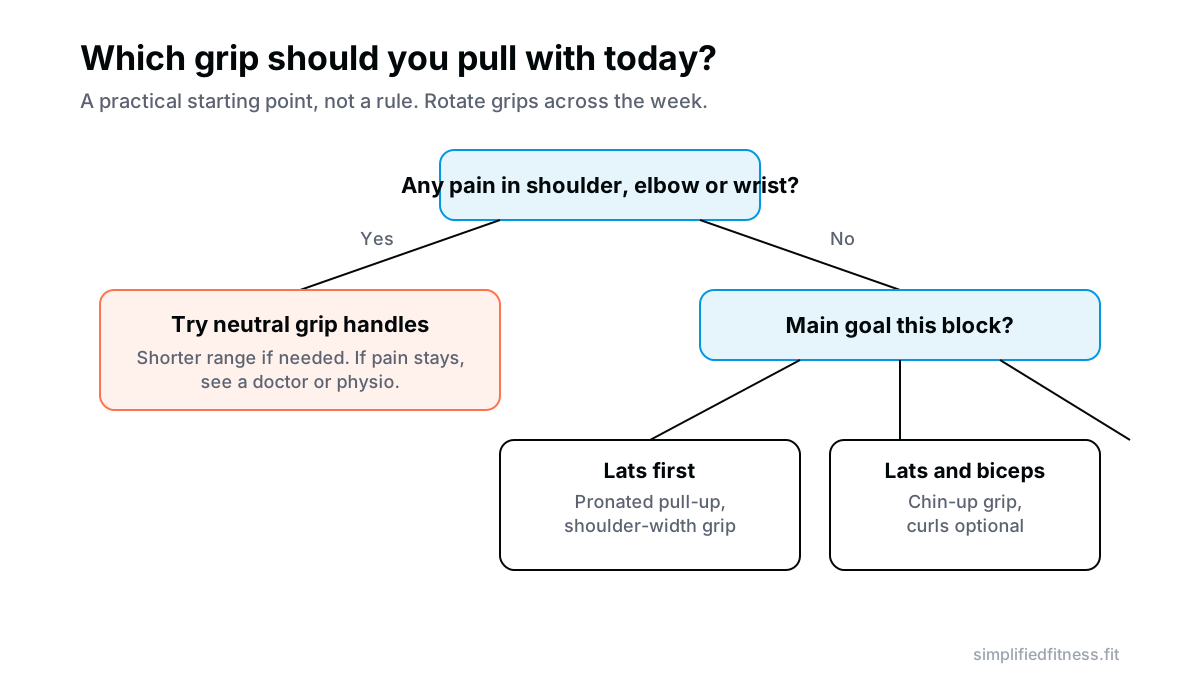
That is an observational lab study, not a trial of injuries. It does not mean chin-ups will hurt your shoulder. It does mean that if you have a history of shoulder pain, a shoulder-width overhand grip is a reasonable starting point. Neutral handles were not tested, but many lifters find them comfortable, so they are worth a try.
A reasonable test: the shoulder-friendly grip is the one you can do for 8-12 clean reps without a pinch at the front of the shoulder.
If you feel sharp or persistent pain at the shoulder, elbow or wrist, stop and see a doctor or physiotherapist. This article cannot diagnose pain. Also see distal biceps tendonitis and golfer’s elbow if the elbow is the sore spot.
How to load pull-ups and chin-ups progressively
Bodyweight is not a fixed dose. A 70 kg lifter and a 95 kg lifter do very different workloads with the same movement.
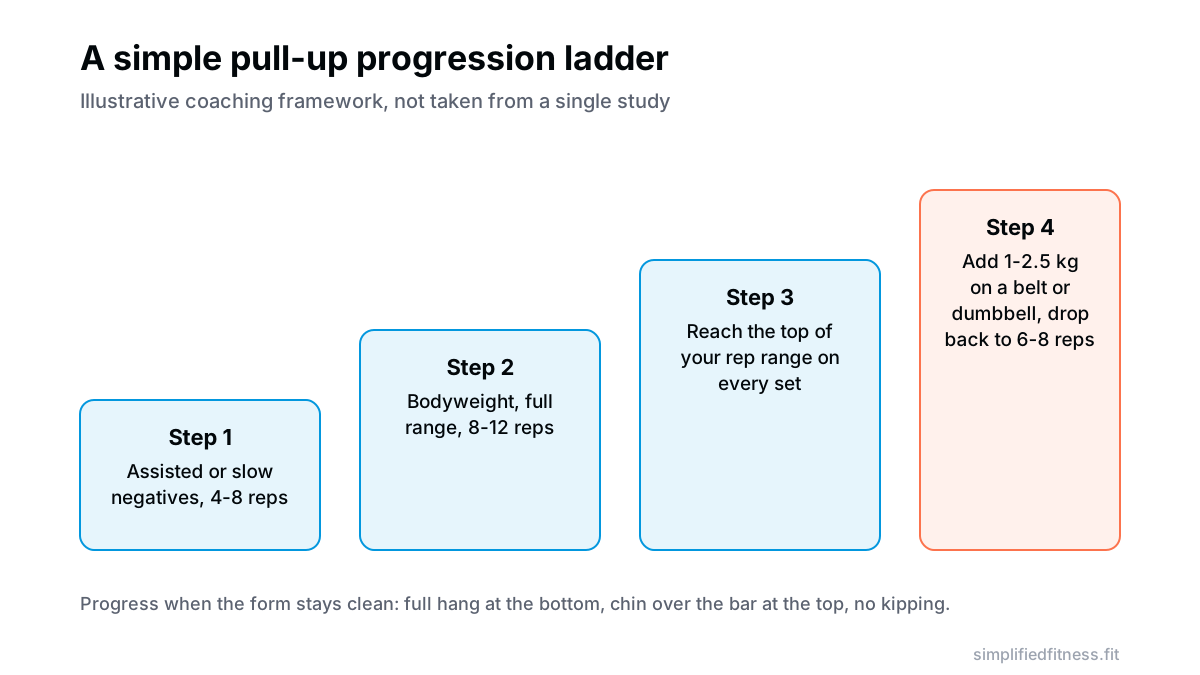
A simple ladder:
- Can you do fewer than 5 clean reps? Use assisted pull-ups or slow lowering (negatives).
- Can you do 8-12 reps with full range? Add sets or slow the tempo.
- Hit the top of your rep range on every set? Add 1-2.5 kg.
Why does a rep range matter more than a magic number? A 2021 review of loading research argues that muscle growth can be obtained across a wide spectrum of loading zones, not only the traditional “8-12 reps” band, which fits well with pull-ups where load is limited by body weight (Schoenfeld et al., 2021). Taking sets close to failure with good form is what matters.
If you want help setting effort, our RIR and RPE calculator lets you pick loads by reps in reserve. For a ready-made weekly template, the free pull day plan puts vertical pulls and rows in the same session.
The lifting straps question comes up here too. If your grip fails before your back does on weighted sets, our article on lifting straps for back hypertrophy covers when they help.
Cheap Indian gym setup notes
You do not need fancy equipment. A fixed bar, a pair of sturdy dumbbells and a dip belt (or a rucksack with books) is enough for weighted progress. If the bar in your gym is thick and knurled, expect your forearms to tire first, especially in hot, humid sessions where hands sweat. Chalk or a dry towel helps.
Protein and recovery matter as much as grip choice. If you train vegetarian, spread dal, paneer, curd and soya across the day to hit a daily target, and use our protein calculator to work out a number.
Which should you do? A simple plan
- Default: shoulder-width overhand pull-ups for lats, 2-4 sets of 6-12.
- Add: chin-ups or a neutral grip on a second day if your shoulders like them.
- Pair with: a row variation for the mid back, as outlined in the complete back training guide.
- Avoid: bouncing at the bottom, swinging for momentum and cutting range of motion.
The bottom line
Pull-ups and chin-ups both hit the lats hard. Chin-ups probably add a bit more biceps and pecs, though the studies do not fully agree. A shoulder-width overhand grip looks friendlier to the shoulder than very wide or fully reversed positions, with the caveat that the evidence comes from one small lab study. Neutral handles are a sensible option on comfort grounds, though they have not been tested the same way.
Pick the grip that you can load progressively, rotate through two or three, and keep your reps strict. The back you build over a year comes from consistency, not from one perfect handle position.
Frequently Asked Questions
Are pull-ups or chin-ups better for building a wide back?
Neither has a clear edge for the lats. EMG work in young adults has found high lat activation in pull-ups and chin-ups, and a 2026 narrative review concluded that pull-up variations show broadly similar lat activation across grips. Pick the grip you can load progressively and that feels good on your shoulders and elbows.
Do chin-ups work the biceps more than pull-ups?
Often yes, but not in every study. Youdas and colleagues found higher biceps activity in chin-ups than in pull-ups, while Dickie and colleagues found similar biceps activity across grips. A modelling study even estimated the biceps were relatively more active in the overhand front pull-up than in the chin-up, so treat the difference as small and variable.
Which pull-up grip is best for lats?
A pronated (overhand) grip at about shoulder width is a sensible default. In one lat pulldown study of 12 men, an overhand grip produced more lat activity than an underhand grip at both widths. That is a cable result, so it only loosely transfers to pull-ups.
Are neutral grip pull-ups easier on the shoulders?
Possibly, but it has not been tested directly. One lab study found wide and reverse (chin-up) grips followed kinematic patterns linked with higher sub-acromial impingement risk, while the authors suggested front (overhand, shoulder-width) pull-ups as the option worth studying further. Neutral grips were not part of that study, so if parallel handles feel better, that comfort is your best guide.
Do chin-ups make your biceps bigger?
They can contribute, because the biceps work hard in every pull-up variation. Whether chin-ups alone grow your arms as much as direct curls has not been tested directly in the studies we reviewed. Most lifters do best with chin-ups plus some curls.
Should I depress my shoulder blades during pull-ups?
Think of it as setting the shoulders down and back at the start rather than forcing a hard pinch. A modelling study found arm depression occurs mostly as your torso rises toward the bar, and lower traps are active early in the lift. A smooth shoulder-blade glide with no shrugging is a reasonable cue.
How many pull-ups should I do for back growth?
Evidence on exact numbers for pull-ups specifically is limited. A review of loading research suggests hypertrophy can happen across a wide range of loads when sets are taken near failure. A practical start is 2-4 hard sets of 6-12 reps, twice a week.
When should I add weight to pull-ups?
Add load once you can reach the top of your rep range (for example 12 reps) with full range and no swinging. Small jumps of 1-2.5 kg on a belt or held between the feet keep progress steady. Drop back to 6-8 reps with the added weight and build up again.
Are wide-grip pull-ups better for lats?
Not clearly. A modelling study estimated the lats were relatively more active in wide pull-ups, but lat pulldown studies found similar lat EMG across grip widths. Wide grips have also been linked with kinematics associated with higher impingement risk in a separate lab study.
Why do my elbows hurt after chin-ups?
Chin-ups load the biceps and the elbow flexors hard, and a sudden jump in volume is the usual reason for soreness. Cut your sets, slow the lowering phase and use a neutral grip for a few weeks. Pain that persists, or any pain with numbness or weakness, deserves a visit to a doctor or physiotherapist.
Can I build a big back with only pull-ups?
You can build a lot, especially early on, but pull-ups alone leave out horizontal rowing patterns. A balanced back plan uses vertical pulls like pull-ups plus rows. See the complete back training guide for how to combine them.
What if I cannot do a pull-up yet?
Start with assisted pull-ups, band assistance or slow lowering from the top (negatives). The mechanism is the same: you build the pulling strength that the full movement needs. Add lat pulldowns on the days you train pull-ups lightly.
Sources & References
Every claim above is checked against peer-reviewed research (PubMed, U.S. National Library of Medicine) or guidance from established health bodies. How we fact-check.
- Youdas JW, et al. Surface electromyographic activation patterns and elbow joint motion during a pull-up, chin-up, or perfect-pullup rotational exercise. J Strength Cond Res. 2010. PMID: 21068680
- Dickie JA, et al. Electromyographic analysis of muscle activation during pull-up variations. J Electromyogr Kinesiol. 2017. PMID: 28011412
- Urbanczyk CA, et al. Avoiding high-risk rotator cuff loading: muscle force during three pull-up techniques. Scand J Med Sci Sports. 2020. PMID: 32715526
- Prinold JA, et al. Scapula kinematics of pull-up techniques: avoiding impingement risk with training changes. J Sci Med Sport. 2016. PMID: 26383875
- Lusk SJ, et al. Grip width and forearm orientation effects on muscle activity during the lat pull-down. J Strength Cond Res. 2010. PMID: 20543740
- Di Fonza D, et al. Electromyographic analysis of latissimus dorsi activation during common resistance training exercises: a narrative review. J Funct Morphol Kinesiol. 2026. PMID: 42647355
- Schoenfeld BJ, et al. Loading recommendations for muscle strength, hypertrophy, and local endurance: a re-examination of the repetition continuum. Sports (Basel). 2021. PMID: 33671664

Umair Hazrami · Founder & Head Coach, Simplified Fitness
Umair Hazrami founded Simplified Fitness and the Simplified Lifter channel to cut through fitness noise. With 4+ years of consistent training and 10+ coaching clients, he writes every guide from the peer-reviewed research and links the sources so you can check them. Our editorial standards.
Educational content only, not medical advice. If you have a medical condition, are pregnant, or take medication, talk to a qualified doctor before changing your diet, supplements or training. Full disclaimer.
Keep reading
Exercise Technique
Barbell Bent-Over Rows: Spinal Load, Hamstring Fatigue and Lat Growth
Is the barbell bent over row hypertrophy gold or a fatigue generator? See what the research says about spinal load, torso angles and better rows for lat growth.
8 min read
Exercise Technique
Chest-Supported Rows: Train Your Upper Back Without Lower Back Fatigue
Chest supported row hypertrophy explained: why your lower back quits first, how T-bar, incline and seal rows fix it, and what the research says.
8 min read
Exercise Technique
Complete Back Workout Design: Balancing Vertical Pulls, Horizontal Rows, and Lumbar Recovery
A science-based back workout routine: weekly sets, how to balance pulldowns and rows, and how to protect your lower back, with a sample pull day plan.
9 min read
Exercise Technique
Conventional Deadlifts for Back Hypertrophy: Stimulus-to-Fatigue Ratio Analysis
Are deadlifts good for back hypertrophy? A stimulus-to-fatigue breakdown of what they build, what they miss for lats, and how to program or replace them.
8 min read