Close-Grip Bench Press: Triceps Loading, Wrist Spacing, and Elbow Stress
Close grip bench press triceps guide: how narrow to go, what the grip width research shows, and how to protect wrists and elbows. Setup cues included.
TL;DR. The short answer
- For most lifters, a close grip means hands roughly shoulder-width apart, not touching. Research on bench press grip width finds triceps activity rises as grip narrows, but strength and comfort drop if you go very narrow.
- Narrower grips raise elbow extension demand. In 35 strength-trained adults, narrower grips produced larger elbow joint moments and more lateral triceps activity (Mausehund et al., 2022).
- No study cited here shows that a hands-together grip causes wrist injury, so treat that as a coaching concern rather than a proven mechanism. If your wrists bend back or hurt, widen your grip a little and re-stack the bar over your forearm.
- Close-grip bench press builds triceps best as a heavy compound, then pair it with an overhead triceps extension, since one 12-week trial found the long head grew more when trained with the arm overhead.
- Sharp wrist, elbow or shoulder pain that lingers, numbness, or pain at rest is a reason to see a doctor or physiotherapist, not to push through.
Part of our complete guide: Arm Workout Science: The Complete Guide to Biceps, Triceps, Brachialis and Forearm Growth
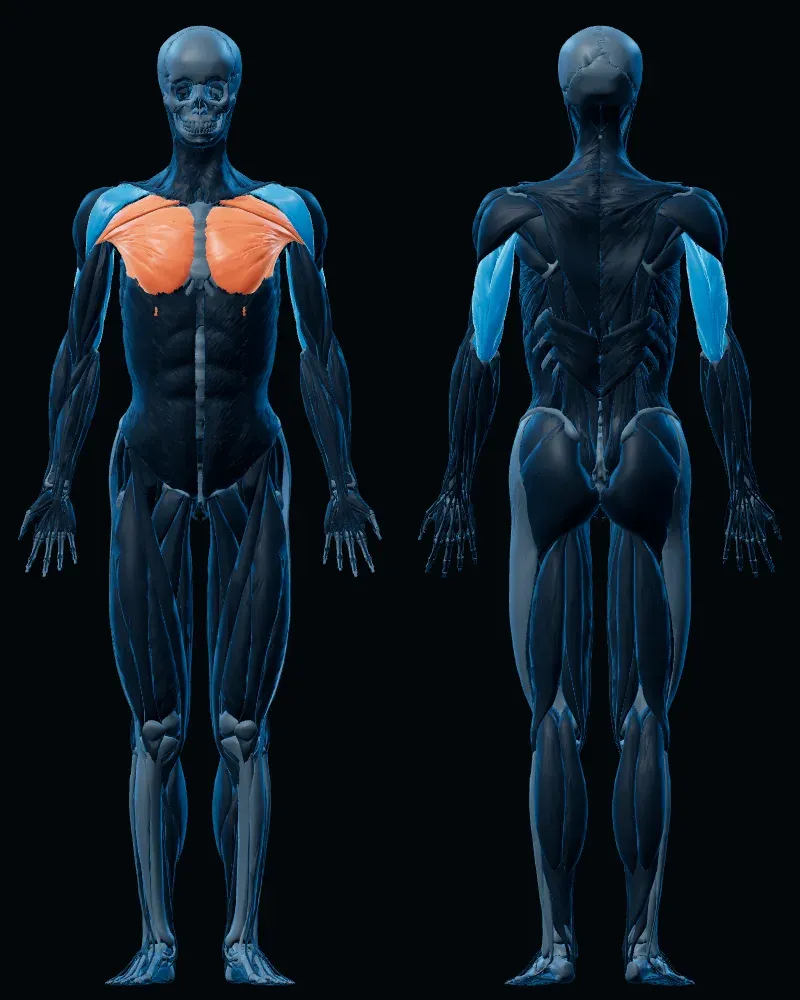
Muscles worked: chest
Main movers: pectoralis major
Assisting: front delts and triceps
Table of contents
For close grip bench press triceps work, hands about shoulder-width apart is the sweet spot for most lifters. Narrower than that adds a little more triceps demand but costs you load, and the “hands almost touching” version mostly just makes the bar feel twitchy.
This article is one of the exercise deep dives in our complete arm and forearm training guide. We will look at what grip width research actually measured, where the old advice goes beyond the evidence (especially around wrists), and how to set up so your triceps do the work.
How close should your hands be on a close grip bench press?
Start with hands roughly shoulder-width apart, both inside the smooth centre of the bar. In one study of 20 resistance-trained men, the close grip was defined as 95% of the distance between the shoulder bony points (biacromial width), which is essentially shoulder-width in practice (Lockie et al., 2017).
That same study found 1RM, lift duration and mean force were greater in the traditional bench than the close-grip bench, while peak power and velocity were higher in the close-grip version. So expect to lift less. That is normal, not a sign you are doing it wrong.
Common gym advice says “hands touching” or “index fingers on the smooth part.” Neither is a research-backed number. Think of grip width as a dial: narrower raises elbow demand, wider shifts work to the chest and shoulders. Pick the narrowest spot where your wrists and elbows still feel fine, not the narrowest spot you can physically reach.
Does close grip bench press build triceps?
It can, and it is one of the few compound lifts where the triceps do a large share of the work. The lab data lean the same direction, though the effects are modest and come from single sessions, not months of training.
- A study of 12 healthy men holding isometric bench positions found that moving from wide to narrower grips increased triceps activity (lateral head), with the author noting the changes were small (Lehman, 2005).
- In 28 men lifting 6-rep-max loads, wide grip showed lower triceps activation than medium or narrow grips (Saeterbakken et al., 2021).
- In 35 strength-trained adults doing 6-8 rep max sets, narrower grips produced larger elbow joint moments and more lateral triceps activity, while wider grips produced larger shoulder moments (Mausehund et al., 2022).
- In 14 bench-trained men, triceps medialis activity was greater with medium and narrow grips than with a wide grip (Larsen et al., 2020).
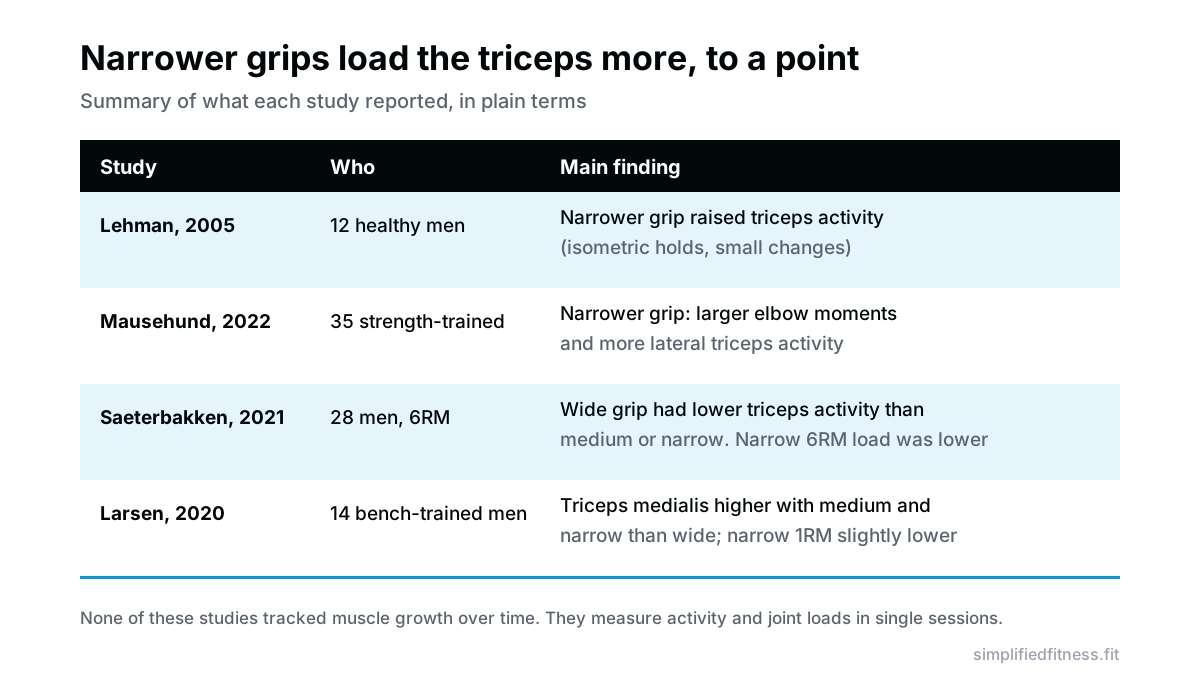
Notice the pattern in two of these studies: wide grips look worst for triceps, while medium and narrow grips look similar to each other. Not every study agrees, either. A 2023 study in 14 men found the ratio of chest to triceps activity was almost unchanged between a 40 cm and an 81 cm grip (Tanimoto et al., 2023). That is a useful clue. It suggests you do not need to go extreme to get the triceps benefit.
What does going narrower cost you?
Load and, for some lifters, comfort. In the Larsen study (averages, with a lot of variation between lifters), the 14 men benched 109.8 kg with a wide grip, 108.9 kg with a medium grip and 103.7 kg with a narrow grip at 1RM (Larsen et al., 2020). Saeterbakken and colleagues likewise found lower 6RM loads with a narrow grip than with other grips in both novice and trained men (Saeterbakken et al., 2021).
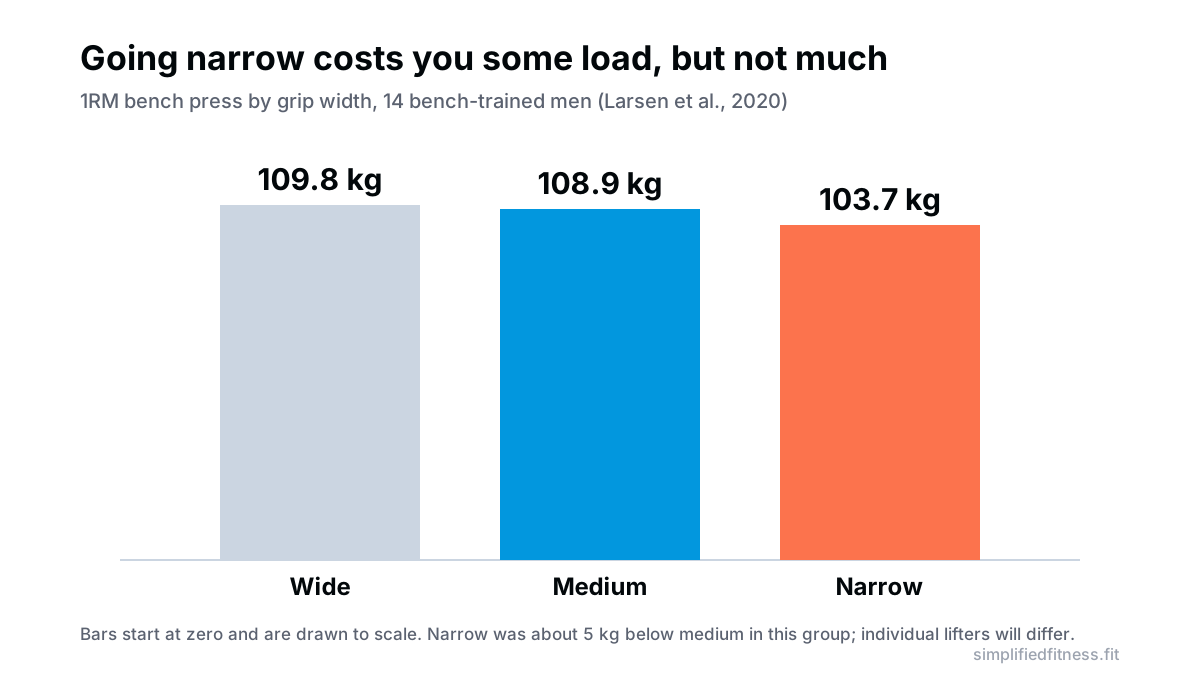
For muscle growth, a slightly lower load is not a problem if the set is hard. What matters is that you can control the movement and train close to failure, so 6-10 controlled reps is a sensible range.
Is close grip bench press bad for your wrists and elbows?
Here is where the standard advice runs ahead of the data. You will often hear that a very narrow grip “shears the wrists” and flares the elbows. I could not find a study that measured wrist shear or wrist injury in close-grip bench pressing, so I will not tell you that is proven.
What the research does show points to something more specific:
- Bar force direction changes. With a 40 cm narrow grip, the bar was pushed about 10% inward relative to vertical, versus roughly 30% outward with an 81 cm wide grip, in 14 men (Tanimoto et al., 2023). Larsen found a similar pattern, with narrow grips producing 8.5-10.1% medially directed force. Lifters do not press the bar perfectly straight up.
- Elbow joint demand rises. Narrower grips produced larger elbow joint moments (Mausehund et al., 2022). More load on a joint is not harmful on its own, but it is a reason to add weight gradually.
- Shoulders may get a break. A 2024 modelling study of 10 experienced strength athletes estimated lower acromioclavicular compression and lower glenohumeral shear force with grips narrower than 1.5 times biacromial (shoulder) width (Noteboom et al., 2024). It was a model, not an injury study.
So the honest picture is: an extremely narrow grip is probably unnecessary, and it may make the bar harder to stabilise. Wrist and elbow discomfort in the gym usually comes from technique and workload, not from one magic hand width.
Close grip bench form: a four-step setup
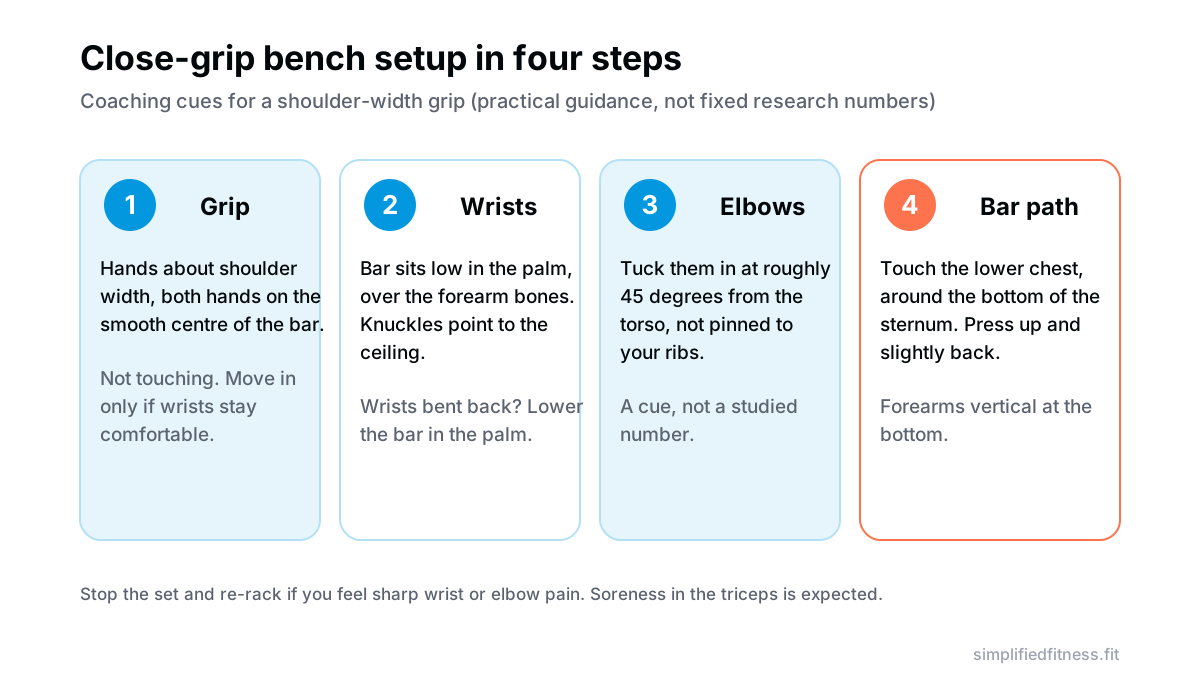
- Set your grip. Hands about shoulder-width, on the smooth centre of the bar. Wrap your thumbs around the bar.
- Stack the wrists. The bar rests low in your palm, directly over your forearm, so the wrist stays close to neutral.
- Tuck, do not pin. Bring your elbows in to roughly 45 degrees from your torso. That is a common coaching cue, not a number tested in a trial. If your elbows scrape your ribs, you are too narrow or too tight.
- Touch low and press. Lower the bar to the lower chest, around the bottom of the sternum, with forearms close to vertical. Press up and slightly back toward the rack.
Use a full but comfortable range of motion: go deep enough to feel the triceps stretch without your shoulders rolling forward.
Close grip bench press vs skull crushers
I am not aware of a head-to-head hypertrophy trial, so the choice is practical, not proven.
| Close-grip bench press | Skull crushers | |
|---|---|---|
| Joints moving | Elbow and shoulder | Mostly elbow |
| Load potential | High | Moderate |
| Wrist and elbow comfort | Depends on grip width | Often elbow-sensitive |
| Best role | Heavy first lift of the day | Higher-rep follow-up |
Do the bench first, when you are fresh and can load it. Follow with an isolation move. For setup help on that second movement, see our guide to skull crushers and elbow pain fixes.
Why add an overhead triceps move too?
The close-grip bench trains the triceps at mid to short muscle length. The long head of the triceps crosses the shoulder, so it is stretched more when your arm is overhead. In a 12-week trial of 21 adults, one arm trained elbow extensions overhead and the other in a neutral arm position; whole triceps volume rose about 19.9% overhead versus 13.9% neutral, with greater long head growth overhead (Maeo et al., 2023). That was a cable exercise in adults using one arm per condition, so it is promising rather than final.
The practical takeaway: pair your bench with an overhead movement. We cover this in overhead vs neutral triceps training for the long head, and the muscle’s structure in our functional anatomy of the triceps heads.
Close grip bench press vs dips
Dips and close-grip bench both work the elbow extensors, but they load the shoulder differently. Dips put the shoulder into a deep stretched position, and a forward lean shifts demand toward the chest. I am not citing a head-to-head trial, so I would not call either “better.” Read our breakdown of dips for triceps if you want the mechanics, and the forward-lean shoulder safety guide if dips bother your shoulders. If they do, the close-grip bench is easier to scale in small jumps.
How to programme it (and what Indian lifters should know)
A simple template: 3-4 hard sets of 6-10 reps with 1-3 reps in reserve, once or twice a week, followed by 2-3 sets of an overhead extension. Add weight in small steps. If your gym only has a worn or very rough bar, use chalk or a thin towel wrap on the hands rather than gripping harder, and keep the load honest in a hot, sweaty room where palms slip.
Triceps also work during every chest and shoulder press, so avoid stacking too much direct work. Our guide to direct vs indirect arm volume explains how to count it, and our one rep max calculator can help you pick a starting load from a rep max.
For the push-day structure that fits this lift, see the push day plan. If shoulder pain shows up on regular bench, our shoulder pain bench press fixes and bench press grip width guide for pecs and triceps are the next stops.
When to see a doctor
Soreness in the triceps the next day is normal. Sharp wrist or elbow pain during a set, pain that lasts more than a couple of weeks, swelling, numbness or tingling in your fingers, or pain at rest are not. Stop pressing and see a doctor or physiotherapist. This article is general education and cannot diagnose an injury.
Frequently Asked Questions
How close should my hands be on a close grip bench press?
Start with your hands about shoulder-width apart, both inside the smooth centre of the bar. Studies that tested a close grip often used roughly 95% of shoulder (biacromial) width, which is shoulder-width in practice. If your wrists feel fine there, you can experiment with going a little narrower, but touching hands is not required.
Does close grip bench press build triceps?
It can, and it is one of the few compound lifts that lets you load the triceps heavily. Narrower grips have produced higher triceps activity and larger elbow joint moments in several lab studies. Use it as your main heavy triceps press, then add an isolation movement for the long head.
Is a close grip bench press better than skull crushers?
Neither is clearly better, and I am not aware of a direct training study comparing them for triceps size. The close-grip bench lets you move more total load and trains the chest and shoulders too, while skull crushers isolate the elbow joint. Many lifters do the bench first when fresh, then skull crushers or overhead extensions for volume.
Is close grip bench press bad for your wrists?
Not inherently, and there is no study in this article showing it causes wrist injury. Wrist trouble usually comes from the bar sitting too high in the palm, which bends the wrist back under load. Set the bar low over the forearm, keep your knuckles pointing up, and widen your grip slightly if discomfort continues.
Should my hands touch on a close grip bench press?
No, and there is no evidence you need to. A hands-together grip tends to bend the wrists and can make the bar feel unstable. The studies cited here used shoulder-width or similar spacing, and medium and narrow grips both showed higher triceps activity than a wide grip. Keep your hands apart and judge the grip by how your wrists feel.
Where should the bar touch on a close grip bench press?
Lower the bar to the lower part of your chest, around the bottom of the sternum. This keeps the bar over your forearms at the bottom, which most lifters find the most stable spot. Practise with a light bar and have a spotter or safety arms ready.
Should I tuck my elbows on close grip bench press?
Tuck them moderately, around 45 degrees from your torso is a common coaching cue, rather than flaring wide or pinning them to your ribs. That 45 degree figure is a practical guideline and not a number proven by a trial. Bring the elbows in enough to feel your triceps working without dragging your shoulders forward.
Is close grip bench press or dips better for triceps?
Both load the elbow extensors and I know of no head-to-head hypertrophy trial, so choose on comfort and equipment. Dips load your shoulders in a deep stretched position, while the close-grip bench lets you adjust load in small jumps. If dips bother your shoulders, the close-grip bench is the easier one to scale.
How heavy should I go on close grip bench press?
Expect to lift less than on a regular grip. In one study of 20 trained men, 1RM was greater in the traditional bench than the close-grip bench (Lockie et al., 2017). Choose a load you can control for 6-10 reps with 1-3 reps left in reserve.
Can I do close grip bench press with dumbbells or on a Smith machine?
Yes, both work if the elbows and wrists feel comfortable. A dumbbell press with palms facing each other lets your wrists find a natural angle, and the Smith machine fixes the bar path which some lifters find easier. The research cited here used a barbell, so these are practical swaps rather than proven equivalents.
How often should I train close grip bench press for triceps?
Once or twice a week fits most programmes, since your triceps also work on every pressing day. Because chest and shoulder pressing already train the triceps, extra close-grip sets add up quickly. Start with 3-4 hard sets per session and raise volume only if recovery and elbow comfort stay good.
Why do my elbows hurt after close grip bench press?
Elbow soreness often comes from too much volume or load added too fast, because a narrow grip raises elbow joint demand. Back the load off, add a rep or two instead of weight, and cut the range just above the point that hurts. If the pain is sharp, lasts more than a couple of weeks or is accompanied by swelling or numbness, see a doctor or physiotherapist.
Does close grip bench press hurt the shoulders less than wide grip?
It may reduce some shoulder load. A 2024 biomechanics model in ten experienced lifters estimated lower acromioclavicular compression and lower glenohumeral shear with grips narrower than 1.5 times shoulder width (Noteboom et al., 2024). That was a modelling study in strength athletes, so treat it as a hint, and talk to a physiotherapist if you have existing shoulder pain.
Sources & References
Every claim above is checked against peer-reviewed research (PubMed, U.S. National Library of Medicine) or guidance from established health bodies. How we fact-check.
- Saeterbakken AH, et al. The Effect of Grip Width on Muscle Strength and Electromyographic Activity in Bench Press among Novice- and Resistance-Trained Men. Int J Environ Res Public Health. 2021. PMID: 34198674
- Larsen S, et al. A Biomechanical Analysis of Wide, Medium, and Narrow Grip Width Effects on Kinematics, Horizontal Kinetics, and Muscle Activity on the Sticking Region in Recreationally Trained Males During 1-RM Bench Pressing. Front Sports Act Living. 2020. PMID: 33554113
- Mausehund L, et al. Understanding Bench Press Biomechanics-The Necessity of Measuring Lateral Barbell Forces. J Strength Cond Res. 2022. PMID: 33555823
- Lehman GJ. The influence of grip width and forearm pronation/supination on upper-body myoelectric activity during the flat bench press. J Strength Cond Res. 2005. PMID: 16095407
- Tanimoto M, et al. Lateral Force and EMG Activity in Wide- and Narrow-Grip Bench Press in Various Conditions. Sports (Basel). 2023. PMID: 37624134
- Noteboom L, et al. Effects of bench press technique variations on musculoskeletal shoulder loads and potential injury risk. Front Physiol. 2024. PMID: 38974522
- Lockie RG, et al. Relationships between Mechanical Variables in the Traditional and Close-Grip Bench Press. J Hum Kinet. 2017. PMID: 29339982
- Maeo S, et al. Triceps brachii hypertrophy is substantially greater after elbow extension training performed in the overhead versus neutral arm position. Eur J Sport Sci. 2023. PMID: 35819335

Umair Hazrami · Founder & Head Coach, Simplified Fitness
Umair Hazrami founded Simplified Fitness and the Simplified Lifter channel to cut through fitness noise. With 4+ years of consistent training and 10+ coaching clients, he writes every guide from the peer-reviewed research and links the sources so you can check them. Our editorial standards.
Educational content only, not medical advice. If you have a medical condition, are pregnant, or take medication, talk to a qualified doctor before changing your diet, supplements or training. Full disclaimer.
Keep reading

Exercise Technique
Antagonist Arm Supersets: Biceps and Triceps Pairing for a Faster, Pumpier Arm Day
A biceps triceps superset workout can shorten arm day while keeping volume close to straight sets. See the research, pairing tips and a 20-minute routine.
9 min read

Exercise Technique
Barbell vs EZ-Bar Curls: Why Straight Bars Hurt the Pinky Side of Your Wrist
Barbell vs EZ bar curls for wrist pain: what EMG research says about biceps activation, forearm rotation and the carrying angle, plus fixes you can use today.
8 min read
Exercise Technique
Bayesian Cable Curls: Form, Setup and Whether They Build Bigger Biceps
Bayesian cable curl form explained step by step: pulley height, step-forward distance, elbow position, sets and reps, and what the research really shows.
8 min read
Exercise Technique
Cross-Body Cable Triceps Extensions: Setup, Form and What the Science Says
Cross body cable triceps extension explained: exact setup, what it does to your elbows and wrists, and what research says about the lateral head claim.
7 min read