Skull Crushers Elbow Pain: Fix Your Bench Angle and Elbow Flare
Skull crushers elbow pain often comes from load, tempo and arm angle, not the exercise itself. Here is what to change, what the research says, and when to stop.
TL;DR. The short answer
- Skull crushers elbow pain is often a load, tempo and angle problem. Dropping the weight, slowing the lowering phase and angling the upper arms back slightly are the first fixes to try.
- Angling the arms back or using an incline bench puts the triceps long head in a more stretched position. A 12-week MRI trial found overhead elbow extensions grew the triceps more than neutral-arm ones, with 34-39% lighter loads.
- No study has measured elbow tendon forces in skull crushers, so claims about exact shear forces and exact angles are reasoning, not proof. Treat any specific degree number as a starting point.
- An EZ-bar or neutral-grip dumbbells let your wrists and forearms rotate more naturally, which many lifters find kinder on the elbow.
- Sharp pain, swelling, a pop, weakness, or pain lasting more than about two weeks needs a doctor or physio, not another technique tweak.
Part of our complete guide: Arm Workout Science: The Complete Guide to Biceps, Triceps, Brachialis and Forearm Growth
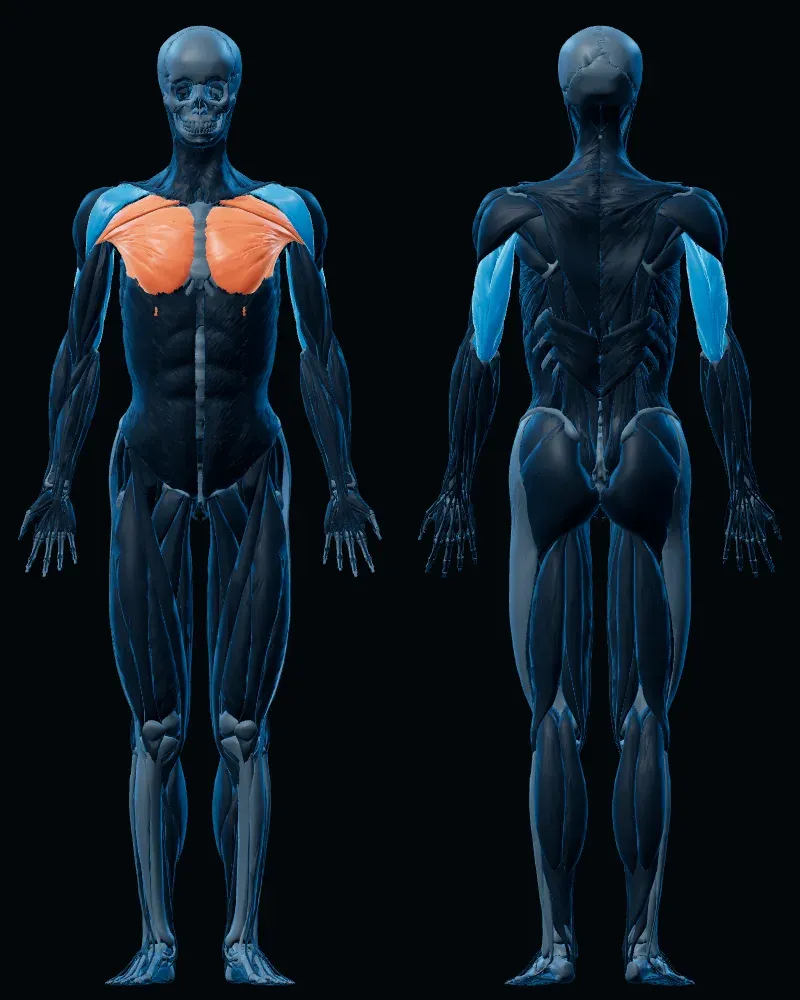
Muscles worked: chest
Main movers: pectoralis major
Assisting: front delts and triceps
Table of contents
Skull crushers elbow pain is rarely a sign that the exercise is broken. It is usually a sign that the weight, speed or arm angle is asking your elbow to do more than your triceps. The fixes are simple: lighten the load, slow the lowering phase, and angle your upper arms back instead of keeping them vertical.
It is a useful triceps builder, so it is worth saving. We cover it as part of our complete arm and forearm training guide, and here we go deep on the elbow mechanics of lying and incline extensions.
One honest note before we start. The popular explanation (a vertical upper arm creates big shear forces on the olecranon, the bony point at the back of your elbow) is a reasonable mechanical argument. I could not find a study that measured those forces in skull crushers, so I will mark what is proven and what is practical reasoning.
Why do skull crushers hurt your elbows?
Three things stack up.
1. The bottom of the rep is the hardest part. At the bottom your elbow is deeply bent, the triceps is lengthened and the bar is well out in front of the elbow, so the muscle has to work hard in a stretched position. Fast, bouncing reps load the tendon right there.
2. A vertical upper arm removes tension from the top. With the humerus (upper arm bone) pointing straight at the ceiling, the bar sits almost directly over the elbow at the top. Gravity pulls it straight down the line of the arm, so the muscle gets a rest at lockout and a stretch-and-stress combination at the bottom.
3. Volume and frequency jump faster than the tendon adapts. Lifters add a skull crusher variation to a program already full of presses and dips, then wonder why the back of the elbow is cranky.
Lying triceps extension form that is kinder on the elbow
Here is the setup I would use as a starting point.
- Bench: Flat, or the lowest incline notch.
- Upper arms: Start pointing slightly back toward the wall behind your head (roughly 20-30 degrees past vertical is a common starting suggestion, not a proven number), then keep them still.
- Lowering: Bend only at the elbows, taking about 3 seconds. Lower the bar toward the top of your head or just behind it, not to your forehead.
- Elbows: Let them stay roughly shoulder width. A little flare is normal; elbows that splay wide and drift backwards usually mean the weight is too heavy.
- Lockout: Press up and back along the same arc. Stop just short of slamming into lockout.
- Reps: 8-15, finishing with 1-3 reps left.
Why angling the arms back works: the stretch and tension argument
Putting your arms behind your torso (or lying on an incline) changes where the triceps is loaded. The long head of the triceps crosses both the shoulder and the elbow, so moving the arm overhead lengthens it. The practical benefit is that the muscle works hard at the stretched end of the rep rather than going slack at the top.
There is real trial data on this. In a 2023 study, 21 adults trained one arm with cable elbow extensions in the overhead position and the other arm in a neutral position (arm by the side). Both did 5 sets of 10 reps at 70% of one-rep max, twice a week for 12 weeks. MRI showed the overhead arm gained more muscle: +28.5% vs +19.6% in the long head, and +19.9% vs +13.9% for the whole triceps. The overhead arm used 34-39% lighter loads throughout (Maeo et al., 2023).
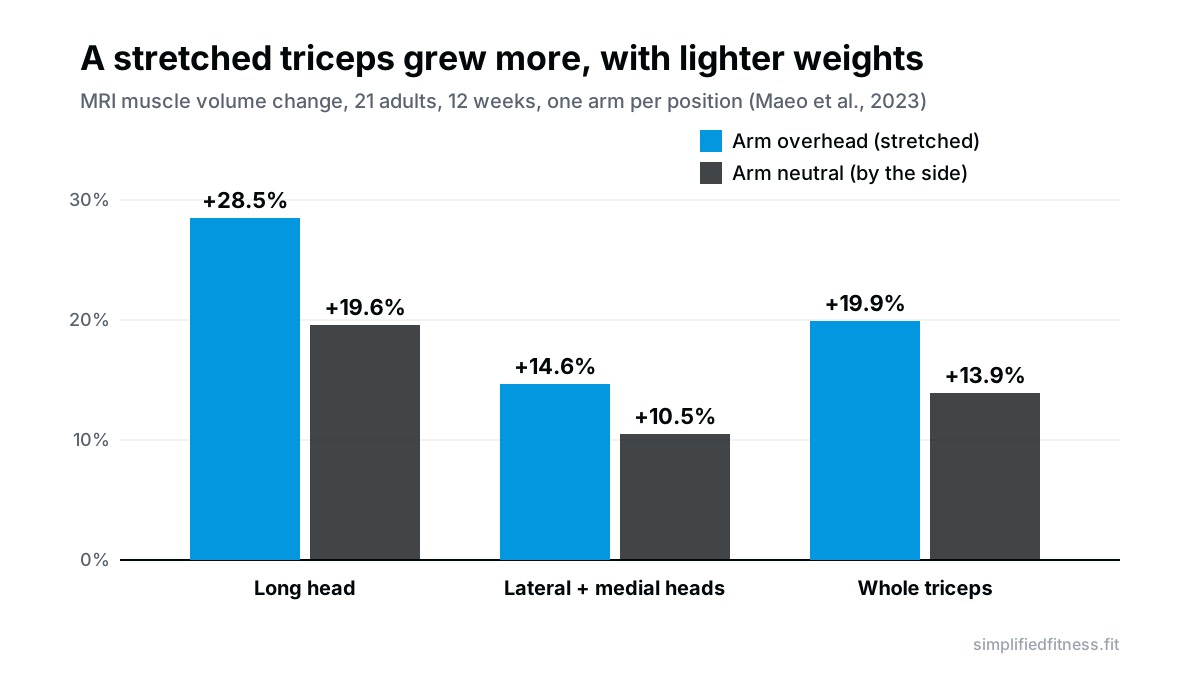
Two limits to keep in mind. First, that study used a cable machine, not a barbell lying extension, and 21 adults is a small sample. Second, it tells us about growth, not about elbow pain. The elbow-sparing claim rests on the lighter loads and joint-friendly mechanics, not on a trial that measured tendon stress. A broader narrative review also concluded that emphasising long muscle lengths is sensible for hypertrophy, while noting that specific body-position guidelines are mostly based on applied anatomy rather than direct studies (Androulakis Korakakis et al., 2023).
Which bench angle should you use for skull crushers?
Honestly, nobody has the data for an exact number. Here is how I would think about it.
| Setup | What changes | Good for | Watch for |
|---|---|---|---|
| Flat bench, arms vertical, bar to forehead | Classic version | Lifters with no pain | Elbow strain at the bottom; slack at the top |
| Flat bench, arms angled back | Tension held through the rep | First choice if elbows are touchy | Bar drifting toward your face if you go too far back |
| Slight incline (about 15-30 degrees) | Arms sit further behind torso, more long head stretch | Triceps growth and elbow comfort for many | Shoulder pinching; use lower weight |
| Overhead cable or dumbbell extension | Large stretch on long head | The only direct growth trial (cable version) | Learning curve and lighter loads |
The angles above are practical starting ranges, not research-derived. Try each for two or three weeks and judge by how your elbows feel the morning after.
EZ-bar skull crushers: grip width and wrist position
The EZ bar earns its reputation because the angled grip lets your forearms rotate a few degrees instead of being locked into a flat, palms-down position. For many lifters that means less wrist irritation and a smoother path.
- Grip width: Start with hands inside the first bend of the bar, about shoulder width or slightly narrower. Very close grips tend to feel worse on the wrists, and too wide pulls the elbows out.
- Inner vs outer grips: Use whichever lets your elbows track straight over your shoulders. There is no research ranking them for elbow pain, so go by feel.
- Straight bar: Fine if it feels fine. If your wrists or the inside of your elbows complain, swap the bar before you change anything else.
Dumbbell skull crushers with a neutral grip
Dumbbells with palms facing each other are the underrated fix. Each arm moves along its own path, so if your left elbow prefers a slightly different angle, it can have one. Lower the dumbbells to either side of your head, not to your face. Expect to use noticeably lighter weights than with a bar, because each arm stabilises on its own.
This is also the easiest version to do in a basic Indian home gym, where a flat bench and a pair of fixed dumbbells are often all you have. If you want the logic behind overhead work in more detail, see overhead cable triceps extensions for long head growth, and for how the three heads divide the work, our triceps brachii heads anatomy guide.
Controlled eccentrics: how slow and how heavy?
The lowering phase is where most elbow complaints start. A 3-second lowering phase is a practical default. A narrative review recommends rep tempos of about 2-8 seconds for hypertrophy, with more research needed on the exact eccentric duration (Androulakis Korakakis et al., 2023).
As for weight, you do not need heavy loads to grow. A review of the repetition continuum argues that muscle can be built across a wide spectrum of loads rather than only in a narrow “hypertrophy zone” (Schoenfeld et al., 2021). That is good news for a sore elbow: sets of 10-15 with a weight you control usually beat heavier, ugly sets.
One caution on range of motion. A systematic review of full versus partial range of motion found evidence favouring full range for the lower body, while upper-limb evidence was limited and conflicting (Schoenfeld & Grgic, 2020). So do not assume cutting the depth is a free pass. If the deepest part hurts, shorten it temporarily, but treat that as a stopgap rather than a long-term fix.
What to do when the elbow already hurts
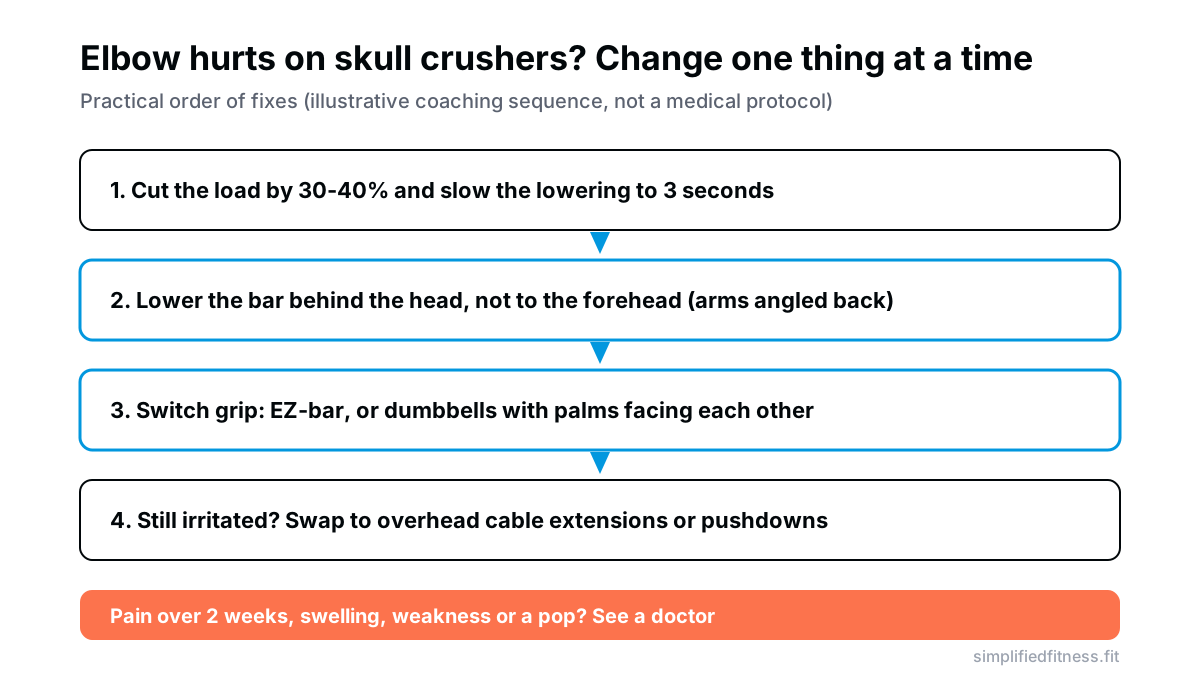
A simple sequence to try, for mild, dull irritation:
- Reduce load by 30-40% and slow the lowering to about 3 seconds.
- Angle the arms back and lower behind the head.
- Change the grip to an EZ bar or neutral dumbbells.
- Swap the exercise for overhead cable extensions or pushdowns for a few weeks. Our pushdown guide covers attachment choices.
- Cut total triceps volume temporarily, including heavy dips and close-grip pressing.
When to see a doctor
Stop skull crushers and get assessed if you have any of these:
- Sharp pain during the movement, or a sudden pop or tearing sensation
- Swelling, bruising or visible deformity at the back of the elbow
- Weakness when straightening the arm
- Numbness or tingling into the hand
- Pain that does not improve after about two weeks of the changes above, or that wakes you at night
This article is not a diagnosis. One review describes triceps tendinopathy and partial tears with intact strength as usually managed without surgery (rest, physical therapy and similar measures), with surgery considered if that fails for around six months or strength is lost (Casadei et al., 2020). Because these problems are uncommon, the pain you feel may also come from the outer or inner elbow, which has different causes. For that, read our guide to elbow tendinopathy in lifters.
How to program skull crushers without wrecking your elbows
- Frequency: One or two sessions a week is plenty, alongside your pressing.
- Sets: 2-4 hard sets, 8-15 reps, 1-3 reps left in the tank.
- Progression: Add a rep or two before adding weight, and add weight in the smallest jumps you can.
- Placement: Do them after your heavy pressing, not before, so your elbows are not fatigued before the compound lifts.
- Warm-up: Two light ramp-up sets. Our dynamic warm-up routine is a good template.
To slot them into a week, check the push day plan, and use the training volume calculator to see where your weekly triceps sets land once pressing is included.
Skull crushers can stay in your program for years if you treat load and angle as variables, not fixed rules. Start light, angle back, slow down, and let your elbow tell you what works.
Frequently Asked Questions
Why do skull crushers hurt my elbows?
Usually because the load is too heavy, the lowering phase is fast, or the elbow joint is being asked to do all the work at an awkward angle. The triceps tendon attaches at the back of the elbow, and the most stressful part of the rep is the bottom, where the bar is heavy and the muscle is lengthened. Cut the weight, lower for about 3 seconds, and try angling your upper arms back a little.
Should the bar go to my forehead or behind my head?
Behind the head is a sensible default if your elbows are sore, though no study has compared the two for elbow pain. With the upper arm vertical, the weight sits over the elbow at the top, so the triceps rests there and takes the whole load at the bottom; angling the arms back keeps tension on the muscle through more of the range. Try lowering the bar toward the top of your head or just behind it, and keep the upper arms still.
What is the best bench angle for skull crushers?
There is no proven best angle, but a flat bench with arms angled back, or a slight incline of about 15-30 degrees, are sensible places to start. A slight incline moves the arms further behind your torso, which stretches the triceps long head more, and stretched positions have shown strong triceps growth in a 2023 trial. Test one angle for two to three weeks and judge by how your elbows feel the next day.
Are skull crushers bad for your elbows?
No, not inherently. Many lifters do them for years without trouble, and tendon problems at the back of the elbow are uncommon in the medical literature. The risk rises when load, volume and speed ramp up faster than the tendon can adapt, so progress gradually and drop the exercise if pain is sharp.
Is an EZ bar better than a straight bar for skull crushers?
For most people, yes, because the angled grip lets the forearms rotate slightly instead of locking them flat. That can reduce wrist and elbow irritation, though research comparing bars for elbow pain is lacking. If an EZ bar still bothers you, try dumbbells or a cable.
Can I do dumbbell skull crushers instead?
Yes. Dumbbells with palms facing each other let each arm find its own path, which often feels better on the joints. Each arm has to stabilise on its own, so start noticeably lighter than your bar weight and build up from there.
How heavy should skull crushers be?
Lighter than your ego wants. Research suggests muscle growth can occur across a wide spread of loads, so you do not need to grind heavy singles to grow your triceps. Aim for 8-15 reps with 1-3 reps left in the tank, and use a weight you can lower under control.
What is a good alternative to skull crushers if my elbow hurts?
Overhead cable or dumbbell triceps extensions are the best swap, because they also train the long head in a stretched position. In a 2023 MRI study, overhead cable extensions grew the triceps more than neutral-arm extensions despite using lighter loads. If those hurt too, use pushdowns for a few weeks and get the elbow checked.
How many sets of skull crushers should I do?
Two to four hard sets once or twice a week is a sensible range for most lifters, on top of the triceps work you already get from pressing. More sets will not fix a sore elbow and can make it worse. Add sets only after you can do the current number pain-free for a few weeks.
Should I warm up before skull crushers?
Yes, a couple of light ramp-up sets help. Your elbows are loaded heavily in every pressing movement beforehand, so do 1-2 sets at about 40-50% of your working weight before the first real set. Pay attention to any pinch in the first few reps and stop if it is sharp.
Is triceps tendonitis common in lifters?
True triceps tendon problems are described in the literature as uncommon, and reviews note limited evidence on them. Elbow pain from lifting is often at the sides of the elbow or in other structures, so the cause may not be the triceps tendon at all. That is exactly why persistent pain deserves a proper assessment rather than guesswork.
How long does elbow pain from skull crushers take to heal?
Mild irritation often settles within a couple of weeks once you cut the aggravating load and change the movement. Reviews of triceps tendon problems describe conservative management with rest and physical therapy, and surgery only being considered if that fails for around six months or strength is lost. If pain is not improving after two weeks of changes, book an assessment.
Can I do skull crushers with a bench in my home gym?
Yes, a flat or adjustable bench and a light EZ bar or dumbbells are all you need. Many Indian home gyms have only a flat bench and a fixed set of dumbbells, which works fine with a neutral grip. Set the bench at the lowest incline notch if you have one.
Sources & References
Every claim above is checked against peer-reviewed research (PubMed, U.S. National Library of Medicine) or guidance from established health bodies. How we fact-check.
- Maeo S, et al. Triceps brachii hypertrophy is substantially greater after elbow extension training performed in the overhead versus neutral arm position. Eur J Sport Sci. 2023. PMID: 35819335
- Schoenfeld BJ, Grgic J. Effects of range of motion on muscle development during resistance training interventions: A systematic review. SAGE Open Med. 2020. PMID: 32030125
- Schoenfeld BJ, et al. Loading Recommendations for Muscle Strength, Hypertrophy, and Local Endurance: A Re-Examination of the Repetition Continuum. Sports (Basel). 2021. PMID: 33671664
- Androulakis Korakakis P, et al. Optimizing Resistance Training Technique to Maximize Muscle Hypertrophy: A Narrative Review. J Funct Morphol Kinesiol. 2023. PMID: 38249086
- Casadei K, et al. Triceps Tendon Injuries. Curr Sports Med Rep. 2020. PMID: 32925376
- Donaldson O, et al. Tendinopathies Around the Elbow Part 2: Medial Elbow, Distal Biceps and Triceps Tendinopathies. Shoulder Elbow. 2014. PMID: 27582910

Umair Hazrami · Founder & Head Coach, Simplified Fitness
Umair Hazrami founded Simplified Fitness and the Simplified Lifter channel to cut through fitness noise. With 4+ years of consistent training and 10+ coaching clients, he writes every guide from the peer-reviewed research and links the sources so you can check them. Our editorial standards.
Educational content only, not medical advice. If you have a medical condition, are pregnant, or take medication, talk to a qualified doctor before changing your diet, supplements or training. Full disclaimer.
Keep reading

Exercise Technique
Antagonist Arm Supersets: Biceps and Triceps Pairing for a Faster, Pumpier Arm Day
A biceps triceps superset workout can shorten arm day while keeping volume close to straight sets. See the research, pairing tips and a 20-minute routine.
9 min read
Exercise Technique
Barbell vs EZ-Bar Curls: Why Straight Bars Hurt the Pinky Side of Your Wrist
Barbell vs EZ bar curls for wrist pain: what EMG research says about biceps activation, forearm rotation and the carrying angle, plus fixes you can use today.
8 min read
Exercise Technique
Bayesian Cable Curls: Form, Setup and Whether They Build Bigger Biceps
Bayesian cable curl form explained step by step: pulley height, step-forward distance, elbow position, sets and reps, and what the research really shows.
8 min read
Exercise Technique
Close-Grip Bench Press: Triceps Loading, Wrist Spacing, and Elbow Stress
Close grip bench press triceps guide: how narrow to go, what the grip width research shows, and how to protect wrists and elbows. Setup cues included.
8 min read