Triceps Pushdowns: Straight Bar vs V-Bar vs Dual Rope Biomechanics
Triceps pushdown attachments comparison: straight bar vs V-bar vs rope. See what research says, which one suits your wrists, and how to set up each rep.
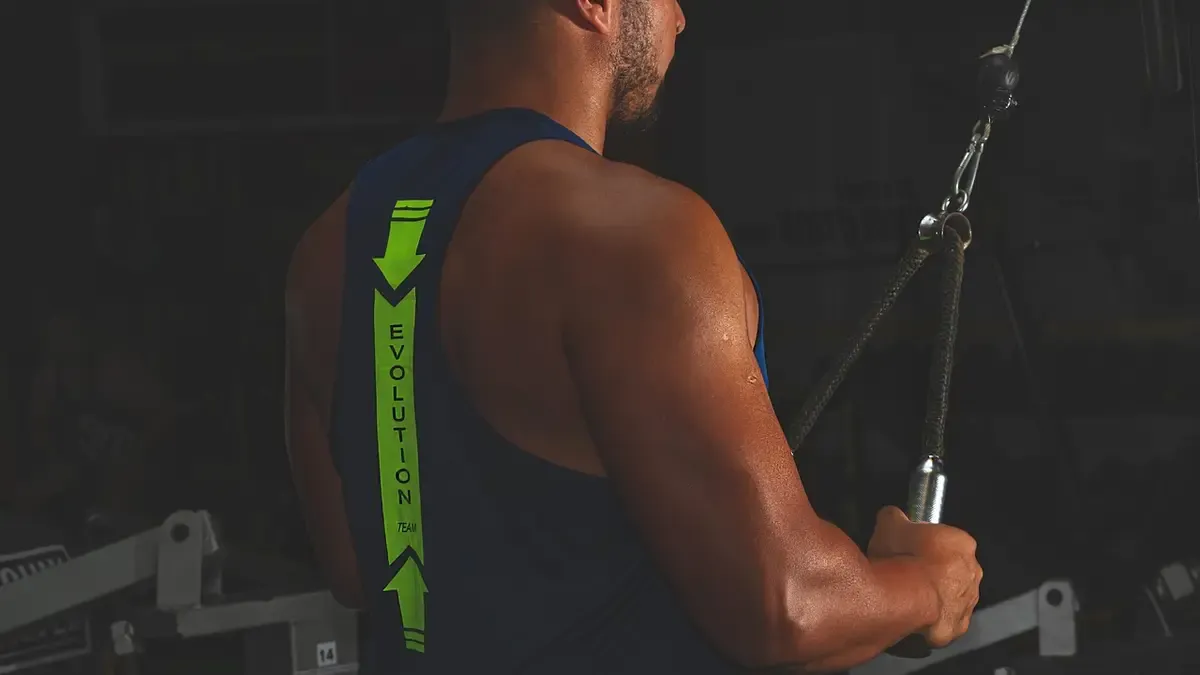
TL;DR. The short answer
- No study shows that one pushdown attachment grows more triceps than another. In a cable pushdown study, triceps muscle activity did not differ across handle types.
- Straight bar and V-bar let you load heavier and track progress easily. Dual rope lets the hands split apart, which many lifters find kinder on the wrists.
- Good form matters more than the handle: elbows pinned beside the ribs, a slight forward lean, shoulders down, and a controlled return to about 90 degrees.
- Pushdowns keep the arm at your side. In one 12-week trial, overhead cable extensions grew the long head, and the triceps overall, more than neutral-arm extensions, so pair pushdowns with an overhead movement.
- Pick the attachment that feels comfortable, rotate if you like, and judge progress by reps and load over weeks, not by the handle.
Part of our complete guide: Arm Workout Science: The Complete Guide to Biceps, Triceps, Brachialis and Forearm Growth
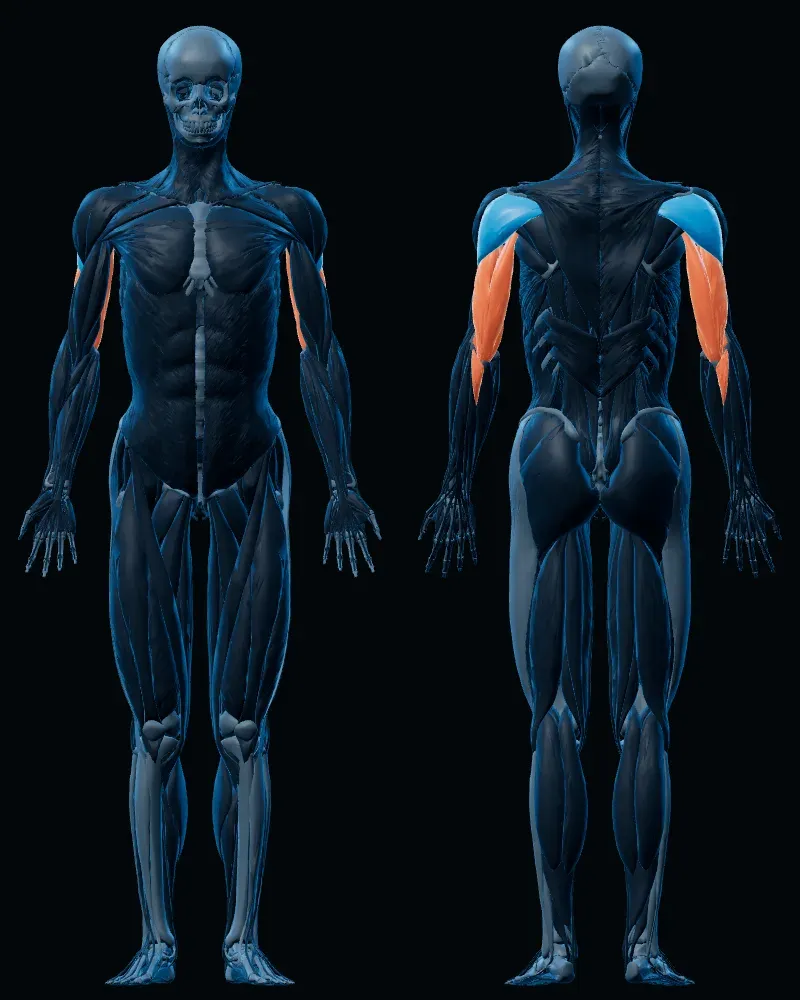
Muscles worked: triceps
Main movers: all three heads of the triceps
Assisting: rear delts
Table of contents
Every gym has the same argument at the cable stack: straight bar, V-bar or rope. Here is the honest triceps pushdown attachments comparison. Research has not shown that any one attachment builds more triceps, so the best choice is the one you can load, control and repeat without wrist or elbow irritation.
This guide sits inside our complete arm and forearm training guide. It covers how each attachment changes your hands and loading, what the evidence does and does not say, and the form checks that matter far more than the handle.
Does the attachment change how much triceps you grow?
Probably very little. The cleanest direct test I could find looked at a standing cable pushdown from 90 degrees to full extension and compared a standard handle with two ball handles. Triceps activity (long and lateral heads) did not differ across the handle conditions (Rendos et al., 2016). What did change was the activity of some forearm muscles.
That is a useful clue, with limits. The study did not compare a straight bar to a V-bar or rope, and EMG shows muscle activity, not long-term growth. So the fair reading is this: the triceps are doing the elbow extension either way, and the handle mostly changes the wrist, forearm and how much weight you can hold.
Triceps pushdown attachments comparison: bar vs V-bar vs rope
Since growth is not the deciding factor, the real differences are practical: how heavy you can go, what your wrists feel, and where your hands end up.
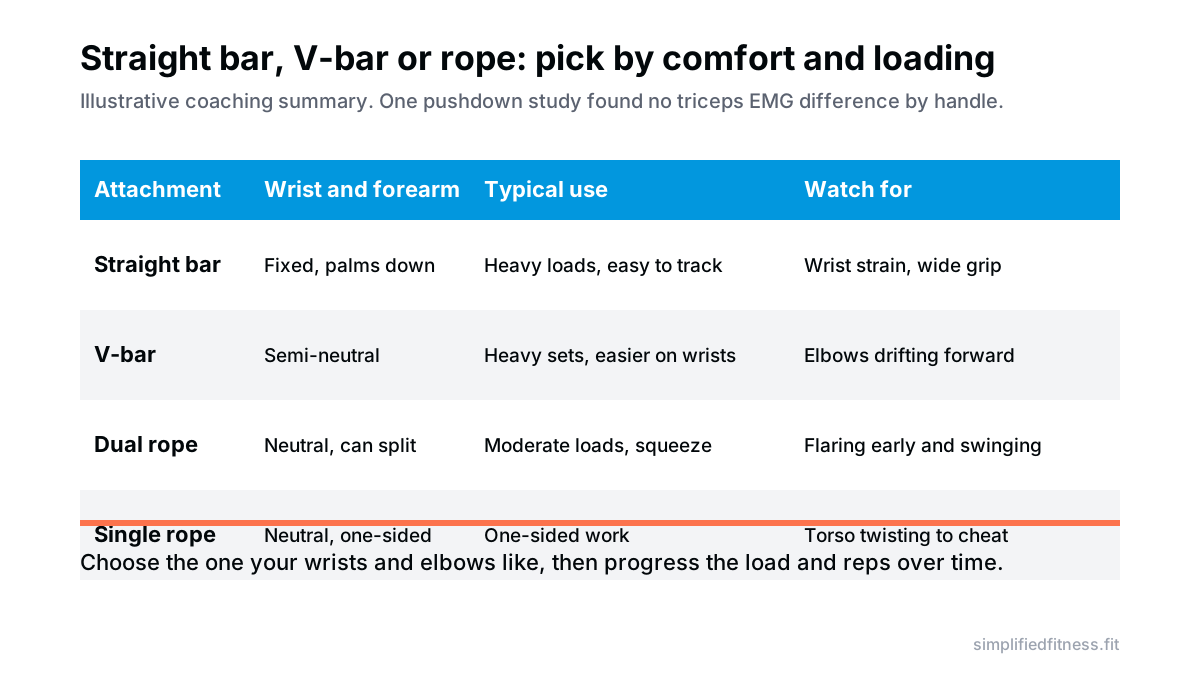
Straight bar
The straight bar is the simplest to load and the easiest to track. Your forearms sit palms-down and fixed, so a good, stable base lets you push heavier sets. The trade-off is that the fixed grip can bother wrists and elbows in some lifters, especially on a wide or very heavy grip.
V-bar
The angled bar sits between palms-down and neutral. For many lifters that small change reduces forearm twisting and makes heavy sets feel smoother. It is a sensible default if the straight bar annoys your wrists.
Dual rope
The two ends of a rope can separate. At the bottom of the rep, you can spread your hands and let them travel past your thighs, which lets the elbow finish its extension without the bar hitting your legs. This is a mechanical and comfort argument, not a trial result. Ropes also tend to limit the load, so the rope suits moderate weights and controlled squeezes.
The common mistake here is flaring the hands wide at the start and swinging the weight down. Spread at the bottom, not the top.
Single rope or one-hand handle
Holding one rope in one hand pulls the forearm into a twisted position, and the torso tends to twist with it. It is useful for one-sided work if you can keep the shoulder still. If you cannot, use a dual rope with both hands.
How to do a triceps pushdown with good form
Form fixes matter more than the handle. These are coaching cues, built on sound mechanics rather than a single study.
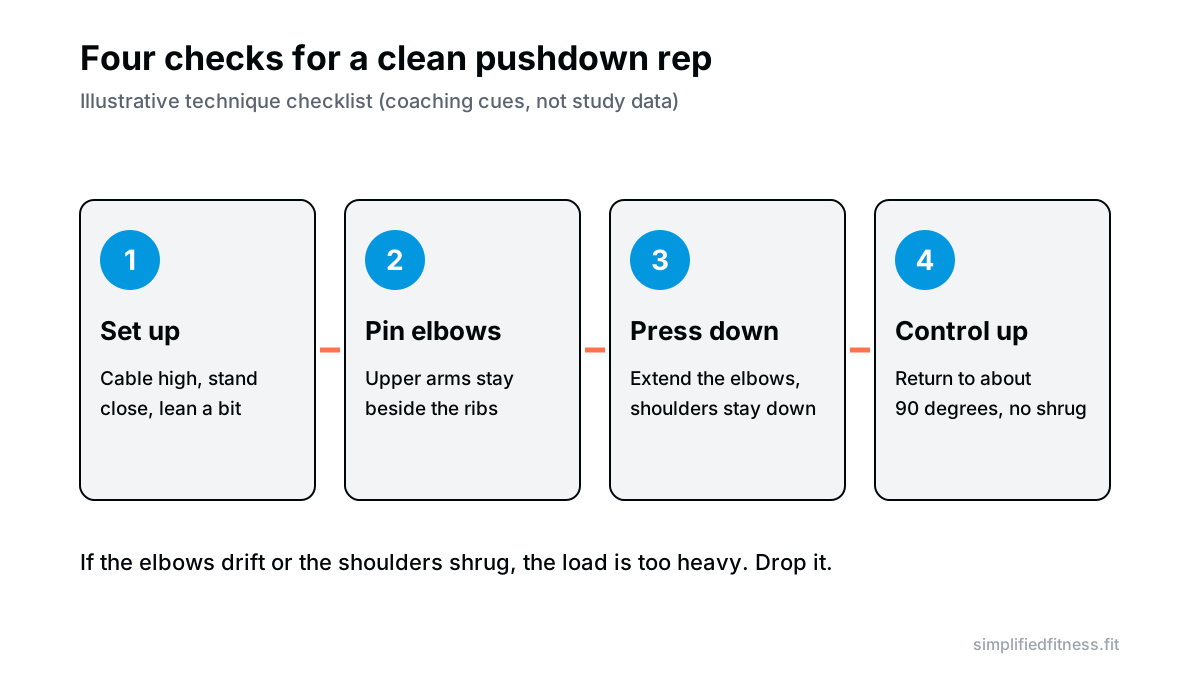
- Set the cable high and stand close. Lean slightly forward from the hips, roughly 10-20 degrees, so the cable line matches your forearms.
- Pin the elbows. Keep your upper arms beside your ribs. If they swing forward, the chest and shoulders start pressing and the triceps do less of the job.
- Keep the shoulders down. Shrugging up as you push is the usual sign the weight is too heavy.
- Return to about 90 degrees. Let the handle come back under control. Do not let it yank your hands up past your elbows.
- Finish with control. Squeeze the lockout without slamming it, and keep your wrists straight.
What about lockout and range of motion?
You do not have to chase the last degree of lockout. In a set of dumbbell elbow extensions, muscle activity during the lifting phase was higher in the initial and middle parts of the range than in the final part (21 resistance-trained men) (Alves et al., 2018). That was a different exercise at a light load (40% of a maximal isometric effort), so it is only a hint for pushdowns.
On growth, the research is mixed. A review of range of motion trials noted that for triceps, a partial range in the middle part of the movement produced more growth than a full range, with a large effect size of 1.21. The authors concluded that training at longer muscle lengths, through either partial or full range, seems to favor some muscles including the triceps (Kassiano et al., 2023). A separate review judged the upper-limb evidence limited and conflicting (Schoenfeld and Grgic, 2020).
The practical takeaway is modest. Use a range that your elbows tolerate, finish every rep cleanly and do not worry about a perfect lockout.
Why pushdowns do not fully train the long head
With your arm at your side, the long head of the triceps (which crosses the shoulder) is not stretched much. Moving the arm overhead lengthens it. That matters for growth.
In a 2023 trial, 21 adults trained one arm overhead and the other in a neutral position using cable elbow extensions, 5 sets of 10 reps, twice a week for 12 weeks. MRI showed long head volume rose 28.5% overhead versus 19.6% neutral, and whole triceps volume rose 19.9% versus 13.9%. This happened even though the overhead arm used lower weights (Maeo et al., 2023).
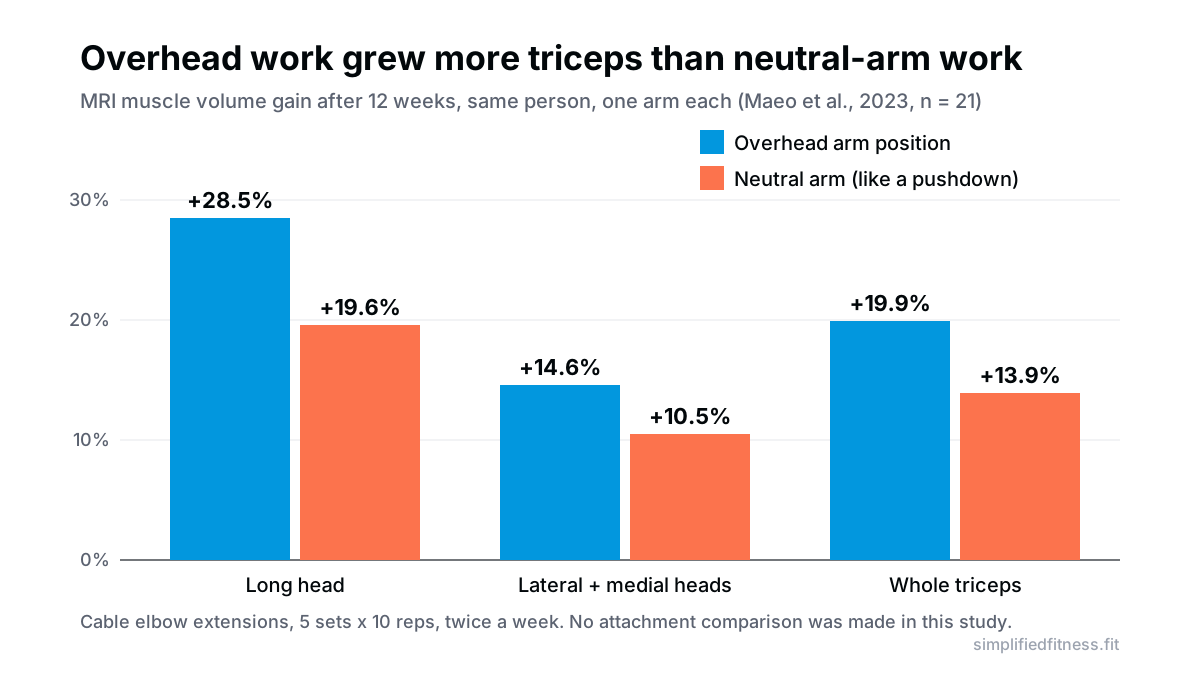
Be careful with the conclusions. This is a single trial in 21 adults, over 12 weeks, with one arm per condition. It is good evidence about arm position, but it did not test pushdown attachments. Note that the overhead arm also grew the lateral and medial heads more (14.6% vs 10.5%), so the advantage was not limited to the long head. For the full picture, read our guide to triceps brachii functional anatomy and the detailed overhead cable extensions versus pushdowns comparison.
Heavy or light, bar or rope: how to progress
Loading matters less than people think. A 2021 review argued that muscle growth can occur across a wide range of loads, with sets taken close to failure (Schoenfeld et al., 2021). So a bar for heavier sets and a rope for lighter sets can both work.
Volume matters too. A meta-analysis of 15 studies found a graded relationship between weekly sets and muscle growth, with each extra set linked to about 0.37% more gain (Schoenfeld et al., 2017). A larger 2026 meta-regression of 67 studies found the same upward trend but with diminishing returns (Pelland et al., 2026). Recovery is individual, so treat it as a trend, not a target.
A simple, low-fuss plan:
- 2-4 hard sets of pushdowns per session, 8-15 reps, 1-3 reps from failure
- 1 overhead extension per week (cable or dumbbell)
- Add reps first, then add load once you reach the top of the range
- Weekly direct triceps total of roughly 6-10 sets, adjusting for recovery
To fit this into your week, use our training volume calculator and see how many direct and indirect sets you are already getting in direct vs indirect arm volume. If your cable setup is awkward, cable setup mastery covers pulley heights and angles. Looking for a push session to slot pushdowns into? Try our free push day plan.
Common pushdown mistakes
- Elbows drifting forward. The chest and shoulders take over. Lower the weight.
- Shoulder shrugging. A sign the load is beyond what your triceps can move cleanly.
- Rocking the torso. Body English turns the set into a swing, and the stack does the work.
- Bouncing out of the bottom. Control the return so the triceps stay under tension.
- Ignoring wrist or elbow pain. If a handle bothers you, change the handle, not your pain tolerance.
When elbow pain means something is wrong
Mild muscle burn is expected. Sharp pain at the inside or outside of the elbow, pain that lingers after training, or numbness and tingling in the hand is not. Stop the exercise and see a doctor or physiotherapist if it persists. Our guide to elbow tendinopathy and lifting covers common causes and training adjustments, but it does not replace a diagnosis.
Bottom line
There is no proven winner among straight bar, V-bar and rope pushdown attachments. Choose by comfort, loading and wrist feel. Pin your elbows, keep your shoulders down and control the return. Then add an overhead extension, since arm position has trial evidence behind it and handle choice does not.
Frequently Asked Questions
Which attachment is best for triceps pushdowns?
There is no evidence that any one attachment is best for muscle growth. In a standing pushdown study, triceps activity did not differ across the handle types tested. Choose the one that feels smooth on your wrists and elbows, and progress it consistently.
Is a rope or a straight bar better for triceps?
Neither has been shown to build more triceps. A straight bar usually lets you use more weight, while a rope lets your hands separate at the bottom, which some lifters find more comfortable. Use the one you can control for 8-15 clean reps and add load or reps over time.
Is the V-bar better than a straight bar for pushdowns?
It is not proven to be better, but it is often easier on the wrists. The angled grip sits between palms-down and neutral, so less forearm rotation is needed. If a straight bar bothers your wrists, switching to a V-bar is a reasonable first fix.
Do triceps pushdowns work the long head?
Only partly. With your arms at your sides, the long head is not stretched much, and a 2023 trial found overhead cable extensions grew the long head about 1.5 times more than neutral-arm extensions. In that trial the overhead arm also grew the lateral and medial heads a bit more, so keep pushdowns as a convenient, heavy option and add an overhead extension alongside them.
How far forward should I lean on a pushdown?
A slight lean of roughly 10-20 degrees is a common coaching cue, though it is not a research-derived number. It lets the cable line up with your forearms and stops the weight from pulling you backward. Lean from the hips, keep your spine neutral, and stop if you notice yourself rocking.
Should my elbows stay pinned during pushdowns?
Mostly yes. Letting the elbows drift forward turns the lift into a chest and shoulder press, which takes work away from the triceps. Keep your upper arms beside your ribs, and if they drift, lower the weight.
Why do my wrists hurt on triceps pushdowns?
Wrist pain is often a grip angle or load problem, not a triceps problem. A fixed straight bar locks the forearms palms-down, so a V-bar or rope can reduce the strain. If pain is sharp, lingers after training, or comes with numbness, stop and see a doctor or physiotherapist.
Can I lock out fully on triceps pushdowns?
Yes, a full lockout is fine if your elbows feel comfortable. In a related EMG study of dumbbell extensions, muscle activity during the lifting phase was lower in the final part of the range than earlier, so the very last degrees may add less than people think. Finish each rep under control and do not slam into the lockout.
How many sets of triceps pushdowns should I do?
Most people do well with 2-4 hard sets per session, counted within a weekly triceps total of about 6-10 direct sets. A meta-analysis found more weekly sets were linked to more muscle growth, and later work suggests the extra gain per set gets smaller at high volumes. Stop each set 1-3 reps short of failure and adjust based on recovery.
Why does the single rope pushdown feel awkward?
A single rope held in one hand pulls the forearm toward a twisted, inward-rotated position, and the torso often twists to compensate. That is a coaching observation rather than a study result. Use it for one-sided work only if you can keep the shoulder still, or use a dual rope with both hands.
Do I need to lift heavy for triceps pushdowns?
No. A 2021 review argued that muscle growth can occur across a wide range of loads when sets are taken close to failure. Heavier bar work is convenient for tracking progress, while moderate loads on a rope are fine if your form stays clean.
Are triceps pushdowns enough for big triceps?
Usually not on their own. Pushdowns are a convenient way to load the triceps heavily, but in a 12-week trial overhead cable extensions grew more triceps, especially the long head. A simple pairing is one pushdown variation plus one overhead cable or dumbbell extension each week.
Sources & References
Every claim above is checked against peer-reviewed research (PubMed, U.S. National Library of Medicine) or guidance from established health bodies. How we fact-check.
- Rendos NK, et al. Differences in muscle activity during cable resistance training are influenced by variations in handle types. J Strength Cond Res. 2016. PMID: 26694502
- Maeo S, et al. Triceps brachii hypertrophy is substantially greater after elbow extension training performed in the overhead versus neutral arm position. Eur J Sport Sci. 2023. PMID: 35819335
- Kassiano W, et al. Which ROMs lead to Rome? A systematic review of the effects of range of motion on muscle hypertrophy. J Strength Cond Res. 2023. PMID: 36662126
- Schoenfeld BJ, et al. Effects of range of motion on muscle development during resistance training interventions: a systematic review. SAGE Open Med. 2020. PMID: 32030125
- Alves D, et al. Effect of shoulder position on triceps brachii heads activity in dumbbell elbow extension exercises. J Sports Med Phys Fitness. 2018. PMID: 28677940
- Schoenfeld BJ, et al. Dose-response relationship between weekly resistance training volume and increases in muscle mass: a systematic review and meta-analysis. J Sports Sci. 2017. PMID: 27433992
- Pelland JC, et al. The resistance training dose response: meta-regressions exploring the effects of weekly volume and frequency on muscle hypertrophy and strength gains. Sports Med. 2026. PMID: 41343037
- Schoenfeld BJ, et al. Loading recommendations for muscle strength, hypertrophy, and local endurance: a re-examination of the repetition continuum. Sports (Basel). 2021. PMID: 33671664

Umair Hazrami · Founder & Head Coach, Simplified Fitness
Umair Hazrami founded Simplified Fitness and the Simplified Lifter channel to cut through fitness noise. With 4+ years of consistent training and 10+ coaching clients, he writes every guide from the peer-reviewed research and links the sources so you can check them. Our editorial standards.
Educational content only, not medical advice. If you have a medical condition, are pregnant, or take medication, talk to a qualified doctor before changing your diet, supplements or training. Full disclaimer.
Keep reading
Exercise Technique
Antagonist Arm Supersets: Biceps and Triceps Pairing for a Faster, Pumpier Arm Day
A biceps triceps superset workout can shorten arm day while keeping volume close to straight sets. See the research, pairing tips and a 20-minute routine.
9 min read
Exercise Technique
Barbell vs EZ-Bar Curls: Why Straight Bars Hurt the Pinky Side of Your Wrist
Barbell vs EZ bar curls for wrist pain: what EMG research says about biceps activation, forearm rotation and the carrying angle, plus fixes you can use today.
8 min read
Exercise Technique
Bayesian Cable Curls: Form, Setup and Whether They Build Bigger Biceps
Bayesian cable curl form explained step by step: pulley height, step-forward distance, elbow position, sets and reps, and what the research really shows.
8 min read
Exercise Technique
Close-Grip Bench Press: Triceps Loading, Wrist Spacing, and Elbow Stress
Close grip bench press triceps guide: how narrow to go, what the grip width research shows, and how to protect wrists and elbows. Setup cues included.
8 min read