Direct vs Indirect Arm Volume: How Many Isolation Sets Do Arms Need After Compounds?
Direct vs indirect arm volume explained: how rows and presses count toward biceps and triceps, and how many curls and pushdowns you may still need each week.
TL;DR. The short answer
- Heavy rows, pulldowns and presses do train your arms. Recent meta-regression work suggests counting each of those compound sets as roughly half a set for the elbow muscle involved (0.5 sets), not zero and not a full set.
- A practical starting point for natural lifters is about 6-10 direct curl and pushdown sets per arm muscle per week, on top of your compounds. This is a coaching rule of thumb, not a number any single trial has proven.
- Total weekly volume still matters. Meta-analyses find more sets generally mean more growth, with diminishing returns, and one review found triceps responded better to higher volume than biceps did.
- Adding isolation work to compounds did not produce extra arm growth in two small trials (untrained men and trained men), so direct sets are not mandatory for everyone.
- More arm sets are not automatically better. If your elbows ache or your curls and pushdowns are not improving, trim sets and see a clinician if pain persists.
Part of our complete guide: Arm Workout Science: The Complete Guide to Biceps, Triceps, Brachialis and Forearm Growth
Table of contents
You finish a heavy pull day, your biceps are already warm and a bit pumped, and then you wonder whether another 12 sets of curls is useful or just ego. That is the question behind direct vs indirect arm volume.
Short answer: rows, pulldowns and presses do train your arms, but probably not as much as a set of curls or pushdowns. Counting each compound set as about half a direct set is the best-supported shortcut right now, and many natural lifters land around 6-10 direct sets per arm muscle per week on top of that. For where this fits in a full arm plan, see our complete arm and forearm training guide.
What is the difference between direct and indirect arm volume?
Direct volume is a set where the arm muscle is the target: a curl for biceps, a pushdown for triceps.
Indirect volume is work the arm does while another muscle is the target. Your biceps flex the elbow on every row and pulldown. Your triceps extend the elbow on every bench press and shoulder press. Same muscle, different job.
The question is how to count it. Some lifters count indirect work as zero, which is why they pile on 20 curl sets. Others count it as a full set, which is how they end up doing no arm work and wondering why their sleeves feel loose. Neither extreme matches the research well.
Do rows and presses count as arm volume? The 0.5 rule
A 2026 meta-regression in Sports Medicine tackled this directly (Pelland et al., 2026). The authors pooled 67 studies with 2,058 participants and labelled every set as direct or indirect. Then they tested different ways of counting indirect sets: as 1 (total), 0.5 (fractional) or 0 (direct only). The fractional method had the strongest relative evidence, so it became the main model.
That is where the “0.5” comes from. It is a statistical convention that fit the pooled data best, not a measurement of exactly how much your biceps grow from a row. It also came from many muscles and mostly young participants (average age about 25), so treat it as a sensible estimate rather than a law.
Here is the same idea in gym terms:
- 12 hard sets of rows and pulldowns in a week → about 6 “biceps sets”
- 10 hard sets of bench, incline and shoulder press → about 5 “triceps sets”
- Then you add direct work on top
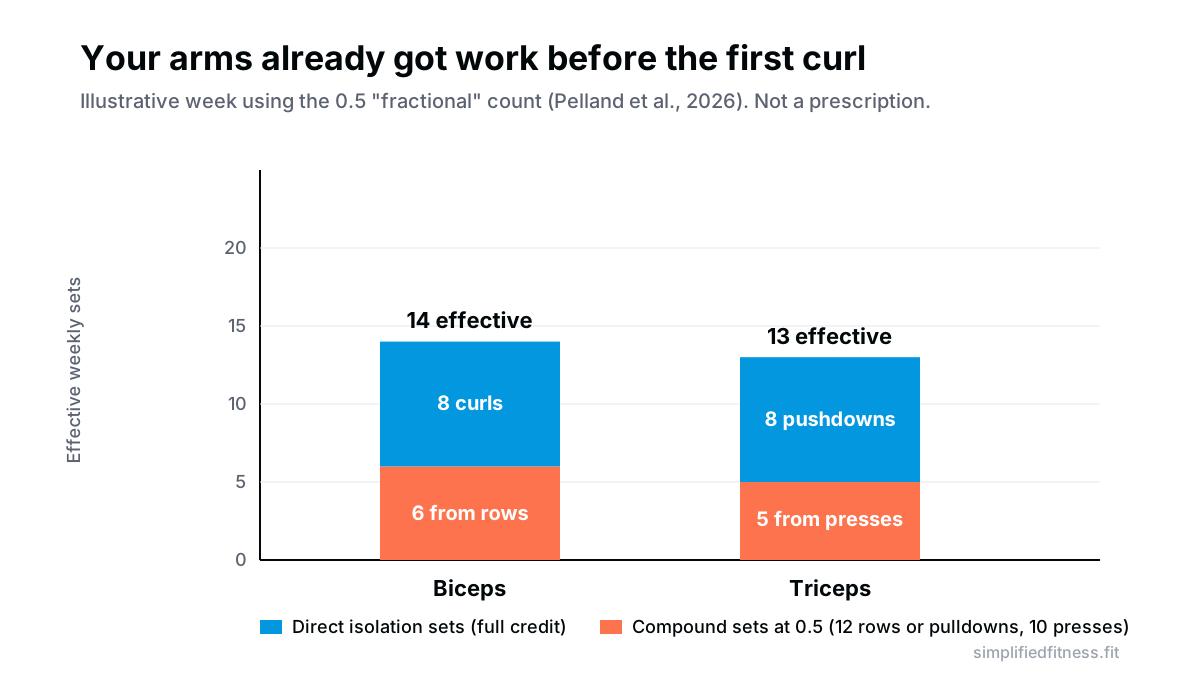
The numbers in the figure are illustrative. They show the math, not a prescription.
Is volume the only thing that matters?
More sets generally mean more growth, up to a point. A 2017 meta-regression of 15 studies found each additional weekly set was associated with about 0.37% more muscle gain (Schoenfeld et al., 2017). The Pelland analysis found the same direction, with diminishing returns for hypertrophy too.
Diminishing returns is the part people skip. The first sets you add give you the most. The tenth extra set gives you very little and costs you the same recovery.
The 2026 ACSM position stand, an overview of 137 systematic reviews, concluded that muscle hypertrophy was enhanced by higher volumes (10 or more sets per week), while many other training variables did not consistently change outcomes (Currier et al., 2026). That is a whole-muscle guideline, not an arm-specific one.
So how many sets for arms per week?
The brief version most coaches use: 6-10 direct sets per arm muscle per week on top of heavy compounds. Let me be straight about what that number is. It is a practical starting range built from the volume literature and the fractional count. No trial has randomised lifters to “7 vs 9 direct curl sets” and proven a winner.
Two studies show how much room there is around that range:
- Baz-Valle et al. (2022) reviewed trials in trained young men. They found no difference between moderate (12-20 weekly sets) and high volume (more than 20) for the biceps. For the triceps, higher volume was better (p = 0.01). The authors suggested 12-20 weekly sets per muscle group as a range for young trained men (Baz-Valle et al., 2022). That review covered only six studies in the quantitative analysis, so hold it loosely.
- Brigatto et al. (2022) randomised 27 trained men to 16, 24 or 32 weekly sets per muscle group for 8 weeks. All three groups grew biceps and triceps thickness. Triceps growth was greater at 32 weekly sets than at 16 (Brigatto et al., 2022). The abstract does not report a significant biceps difference between those volumes.
These sets were counted per muscle group in a program, not “6-10 direct arm sets.” Here is the mismatch: the research talks about total weekly sets, while the gym question is how many curls to add. The fractional count bridges it. Your 14 effective biceps sets in Figure 1 sit inside that 12-20 range, which is why 6-10 direct sets is a sensible start.
Do I even need isolation work after heavy compounds?
Possibly less than the fitness industry says. Two small trials tested exactly this.
In untrained young men, 29 participants trained for 10 weeks with either lat pulldown and bench press only, or the same lifts plus elbow flexion and extension. Elbow flexor thickness rose 6.5% versus 7.04%, with no difference between groups (Gentil et al., 2013).
In trained men, 20 lifters with at least 2 years of experience did 8 weeks of multi-joint work with or without single-joint work. Arm circumference and 1RM changed similarly in both groups, with no significant differences (de Franca et al., 2015).
A review of 23 studies reached a similar conclusion for the upper limbs: no extra benefit from adding single-joint exercises to a multi-joint program (Gentil et al., 2017). It also noted that one study found single-joint exercise caused more fatigue and soreness.
Now the caveats, because they matter. The trials were short, small and used mostly average training programs. The trained-men study had 10 people per group. Most lifters also want arms to grow faster than “good enough.” Isolation work remains a low-fatigue way to add targeted volume without more heavy compounds, which is why most of us still program curls and pushdowns.
How to set your own direct arm sets (four steps)
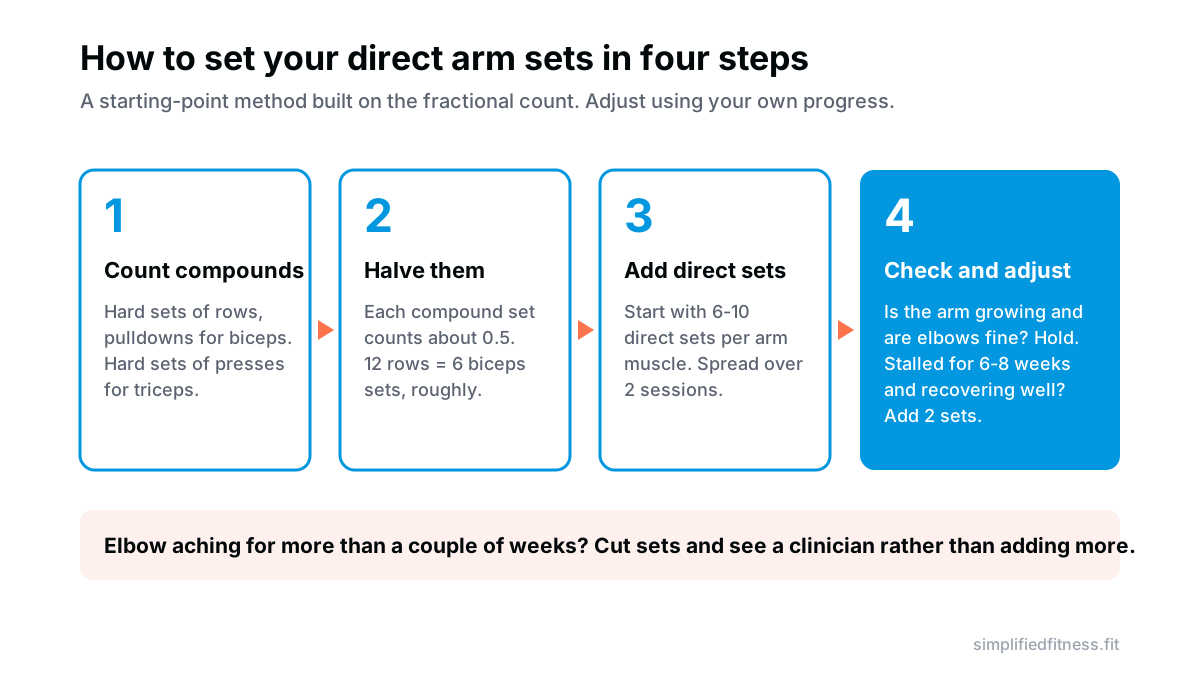
Step 1: count your hard compound sets. Only sets taken close to failure count. Warm-ups and sets where you stopped far from hard effort do not.
Step 2: halve them. 12 rows and pulldowns become about 6 biceps sets. 10 presses become about 5 triceps sets.
Step 3: add direct sets. Start with 6-10 per arm muscle. If your compound count is already high, 6 is plenty. If you only do one pressing day and one pulling day, 8-10 is more reasonable.
Step 4: check and adjust. If your arm measurements and curl or pushdown numbers are climbing and elbows feel fine, hold. If progress stalls for 6-8 weeks, add 2 sets and watch recovery. If your elbows complain, take sets away.
For help tracking the weekly total, our free training volume calculator makes the counting easier.
What does a week look like on a push/pull split?
Here is one illustrative layout. It is a template, not a rule.
| Day | Compounds | Direct arm sets | Effective sets added |
|---|---|---|---|
| Pull day | 12 sets rows and pulldowns | 5 curls | 6 + 5 = 11 biceps |
| Push day | 10 sets presses | 5 pushdowns or extensions | 5 + 5 = 10 triceps |
| Optional arm finisher (on legs day or a second pull) | None | 3 curls, 3 extensions | 3 each |
That gets you about 8 direct sets per arm muscle and 14 or 13 total effective sets. For the actual sessions, our pull day and push day plans show how compounds and isolation fit together.
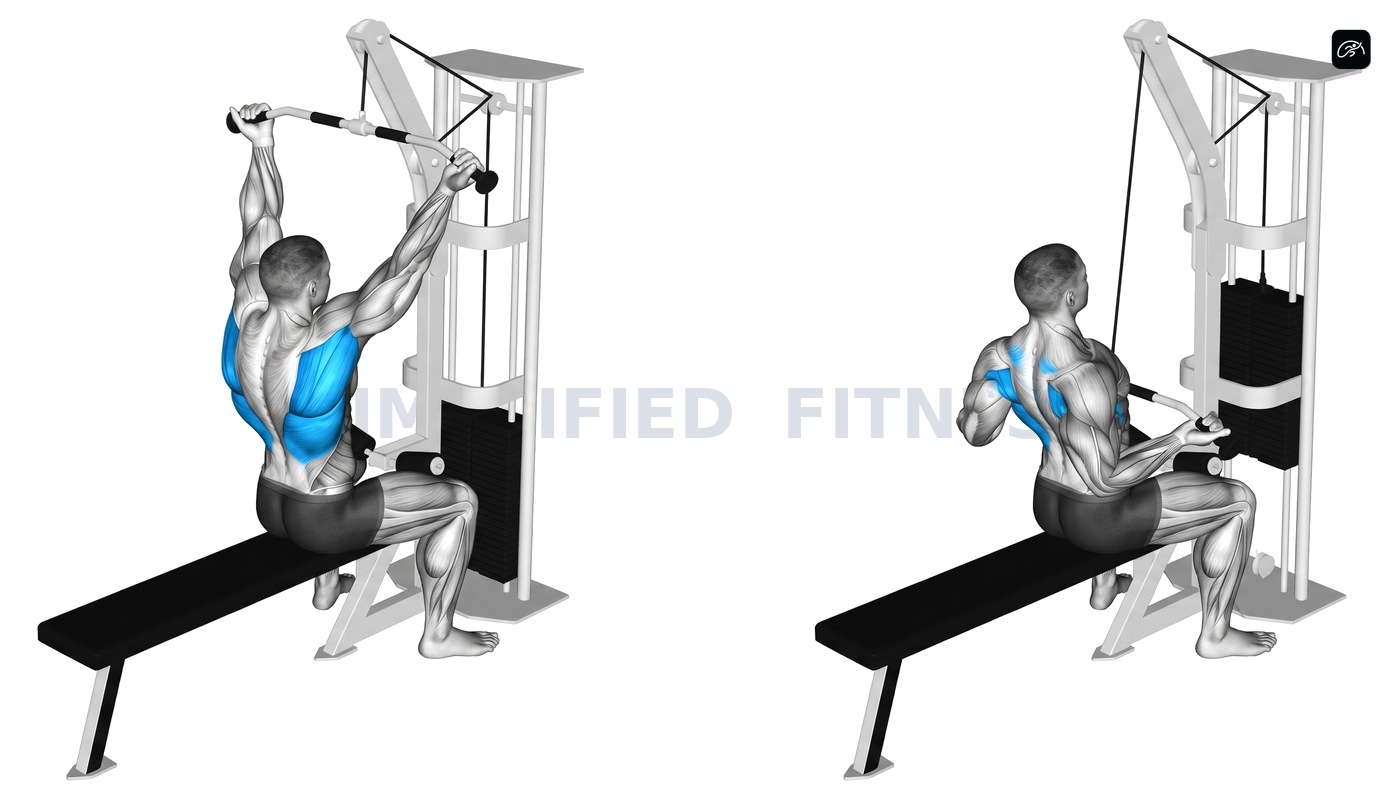
Compounds like this wide-grip pulldown are what give your biceps their indirect credit.
How many biceps sets after pull day?
If your pull day already contains 10-12 hard sets of back work, you may only need 3-5 curl sets that day. The biceps are tired from pulling, so extra heavy sets late in the session tend to be sloppy. Put the rest of your direct biceps work on another day.
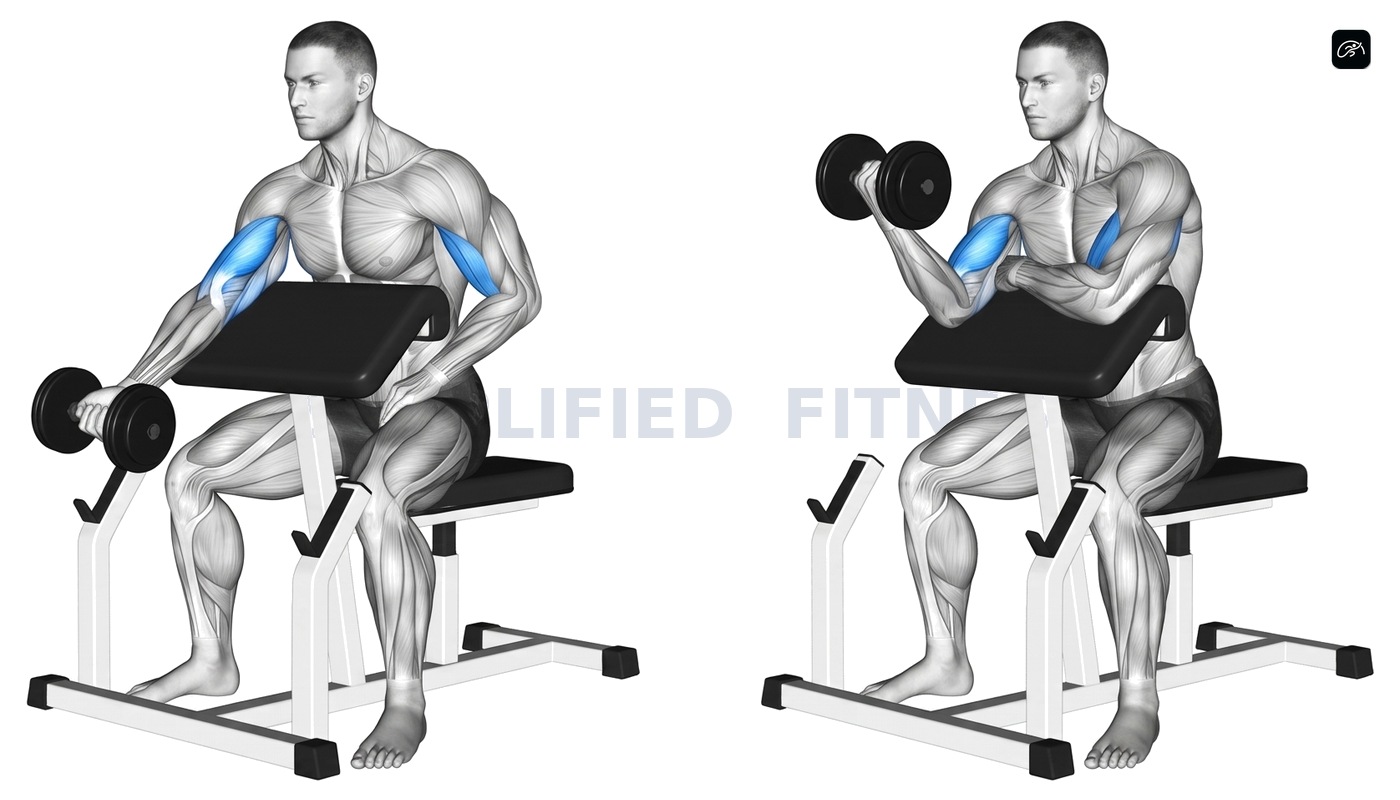
Choice of curl matters less than people think. A stretched-position curl, a preacher curl or a cable curl all count as direct sets. Pick one or two you can perform well. Our guide to preacher curls for distal biceps growth covers one useful option, and hammer curls for brachialis and arm thickness covers another.
Triceps volume for natural lifters
The Baz-Valle review and the Brigatto trial both pointed toward triceps responding to higher volume. Neither is proof that your triceps need more than your biceps do. They are a reason to check before you assume.
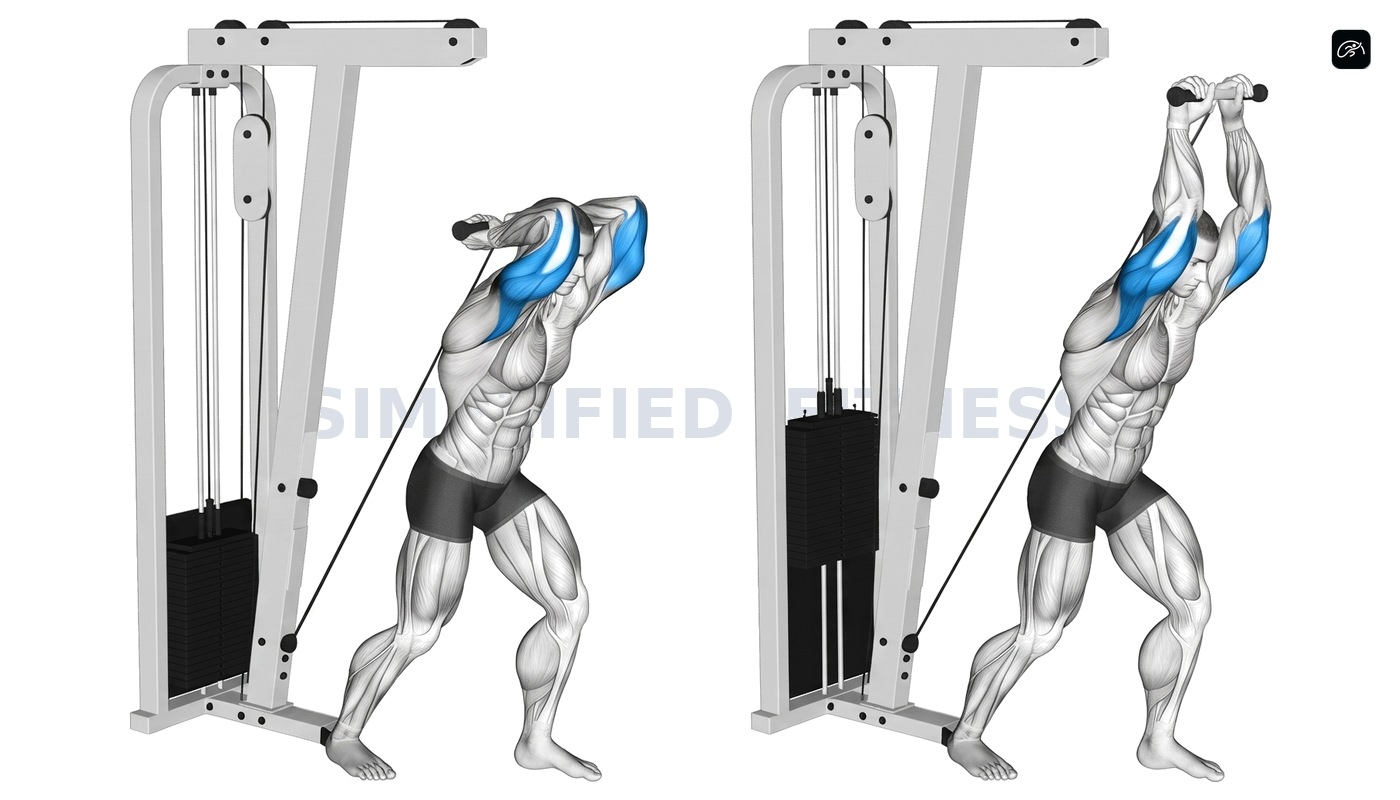
In practice, many lifters who press twice a week can get away with 6-8 direct sets. If your triceps are lagging, add a long-head movement such as the overhead extension, covered in overhead cable triceps extensions for long-head growth.
What is junk arm volume, and how do you avoid it?
Junk volume is any set that adds fatigue but not a real growth signal. For arms it often looks like this:
- Curls done at the end of a long session when you are exhausted and swinging the weight
- Sets stopped far from failure just to “hit the number”
- Five different curl variations that are all basically the same angle
- Extra sets added every few weeks without checking whether the last ones worked
The cure is boring. Fewer, harder sets with good form, and enough tracking to notice if they are working. Our article on junk volume and diminishing returns goes deeper, and the fractional set counting guide covers the same math across other muscles.
How do you manage elbow recovery with high arm volume?
Curls and pushdowns are high-repetition elbow work. Add heavy rows and presses and your elbow joints and tendons see a lot of loading in one week.
I do not have a study that gives an exact elbow “volume limit,” and I will not invent one. What a coach would suggest in general:
- Raise arm sets gradually, by 2 sets at a time, not 8 at once
- Spread direct sets over at least two days
- Keep at least one full rest day for the arms between harder sessions where you can
- If your elbows ache, change the grip, angle or exercise before you give up on the volume
Here is the part to take seriously. Mild stiffness that fades within a day is common after a new routine. Pain that lingers, sharp pain, swelling, numbness or a loss of grip strength is a reason to cut back and see a doctor or physiotherapist. Do not train through it hoping it fades, and do not use this article to diagnose yourself. If your pain sits on the inner or outer elbow, our guide on distal biceps tendonitis and golfer’s elbow explains common patterns, though it is no replacement for a clinician.
Do vegetarian lifters in India need different arm volume?
No, the set math does not change. Your arm muscle responds to training stimulus, and your food supports recovery. A vegetarian diet built on dal, paneer, curd, soya and eggs (if you eat them) can support the same training volume, provided your total protein and calories are adequate. In a hot climate, long sessions with high volume also bring heat fatigue, which is one more reason to keep arm work short and sharp.
Putting it together
Count your compounds at about 0.5. Add 6-10 direct sets per arm muscle per week, split across two sessions. Give it 6-8 weeks and look at your lifts, your measurements and your elbows. Add 2 sets if you stall and recover well. Remove sets if your elbows complain.
That is it. No 30-set arm day.
For the wider plan, including forearms, grip and exercise selection, head back to the complete arm and forearm training guide. If you want to pair biceps and triceps work to save time, see antagonist arm supersets.
Frequently Asked Questions
How many sets for arms per week?
A reasonable starting point is about 6-10 direct sets per arm muscle (biceps and triceps) per week, on top of your rows, pulldowns and presses. Meta-analyses show more weekly sets tend to produce more growth with diminishing returns, but no trial has proven one exact arm number. Start in that range, track your arm measurements and lifts for 6-8 weeks, then adjust.
Do rows and pulldowns work your biceps?
Yes. Rows and pulldowns involve elbow flexion, so the biceps and brachialis work hard even though the back is the target. A 2026 meta-regression found that counting such indirect sets as about half a set fit hypertrophy data best. Treat 10 hard sets of rows as roughly 5 sets of biceps work, then decide what direct work is left.
Do presses work your triceps enough?
Presses give your triceps real work, but how much growth that produces varies from person to person. Elbow extension drives every pressing rep, which is why the 0.5 fractional count is used. If your triceps are a weak point, add 6-10 direct pushdown or extension sets and see whether they respond.
Do I need isolation exercises for big arms?
Not always. Two small trials, one in untrained men and one in trained men, found no extra arm growth when curls and extensions were added to compound-only programs, though both were short (8-10 weeks) with small groups. Isolation work is still an easy way to add targeted volume without the fatigue of more heavy compounds, so most lifters who care about arm size include some.
How many bicep sets after pull day?
If your pull day already has 10-12 hard sets of rows and pulldowns, you may only need 3-5 curl sets that day to reach a decent total. Count the compounds at about 0.5, add your curls, and aim for a weekly effective total in a moderate range. Put the rest of your direct sets on a second day instead of stacking everything after back work.
How many triceps sets do natural lifters need?
Many natural lifters do well with 6-10 direct triceps sets per week plus their pressing. One systematic review found higher weekly volume was better for triceps size, while biceps showed no clear difference between moderate and high volume. Triceps may therefore tolerate and reward a little more total work, as long as your elbows stay comfortable.
Can too many arm sets hurt progress?
Yes, past a point extra sets add fatigue faster than they add growth. Dose-response work consistently shows diminishing returns, and curls and extensions load the elbow joint and tendons repeatedly. If your reps are dropping or your elbows feel sore from session to session, cut sets back by a third and see if performance rebounds.
Is 20 sets of arms per week too much?
It depends on whether you are counting direct sets or total effective sets. A 2022 review suggested 12-20 weekly sets per muscle group for young trained men, and that figure refers to total sets per muscle group, not isolation sets alone. Twenty direct sets plus heavy rows and presses is a lot for most people's elbows, so build up slowly and watch recovery.
Should I train arms on their own day?
You do not need to. Spreading direct sets across two or three sessions keeps each session shorter and each set higher quality, which is usually better than one long arm day. A simple version is a few curls after pull work and a few pushdowns after push work.
Do direct sets matter more for beginners or advanced lifters?
Beginners often grow their arms well from compounds alone, as the untrained-men trial showed. The trial in men with 2+ years of training also found no extra benefit from adding isolation work over 8 weeks, so the evidence does not prove advanced lifters need it either. Many coaches still add targeted volume once compound progress slows, but that is practice, not proof, so use your own measurements as the guide.
What rep range should I use for curls and pushdowns?
Moderate reps, roughly 8-15 per set, work well for arm isolation because the load stays manageable on the elbows. Hypertrophy research broadly shows muscle can grow across a wide load range as long as sets are taken close to failure. Pick a range you can do with controlled form and add reps or weight over time.
How do I know my arm volume is right?
Look at trends over 6-8 weeks, not single workouts. If your curls and pushdowns are going up in reps or load, your arm measurements are creeping up, and your elbows feel fine, your volume is working. If all three are flat, add 2 direct sets; if your elbows ache, remove some.
What if my elbows hurt when I do curls or pushdowns?
Mild soreness that fades within a day is normal, but pain that lingers, sharp pain, swelling, numbness or weakness is not. Reduce arm volume, avoid pushing through it, and see a doctor or physiotherapist if it lasts more than a couple of weeks. Only a clinician can tell you what is going on.
Sources & References
Every claim above is checked against peer-reviewed research (PubMed, U.S. National Library of Medicine) or guidance from established health bodies. How we fact-check.
- Pelland JC, et al. The Resistance Training Dose Response: Meta-Regressions Exploring the Effects of Weekly Volume and Frequency on Muscle Hypertrophy and Strength Gains. Sports Med. 2026. PMID: 41343037
- Schoenfeld BJ, et al. Dose-response relationship between weekly resistance training volume and increases in muscle mass: A systematic review and meta-analysis. J Sports Sci. 2017. PMID: 27433992
- Baz-Valle E, et al. A Systematic Review of The Effects of Different Resistance Training Volumes on Muscle Hypertrophy. J Hum Kinet. 2022. PMID: 35291645
- Brigatto FA, et al. High Resistance-Training Volume Enhances Muscle Thickness in Resistance-Trained Men. J Strength Cond Res. 2022. PMID: 31868813
- Gentil P, et al. A Review of the Acute Effects and Long-Term Adaptations of Single- and Multi-Joint Exercises during Resistance Training. Sports Med. 2017. PMID: 27677913
- de Franca HS, et al. The effects of adding single-joint exercises to a multi-joint exercise resistance training program on upper body muscle strength and size in trained men. Appl Physiol Nutr Metab. 2015. PMID: 26244600
- Gentil P, et al. Effect of adding single-joint exercises to a multi-joint exercise resistance-training program on strength and hypertrophy in untrained subjects. Appl Physiol Nutr Metab. 2013. PMID: 23537028
- Currier BS, et al. American College of Sports Medicine Position Stand. Resistance Training Prescription for Muscle Function, Hypertrophy, and Physical Performance in Healthy Adults: An Overview of Reviews. Med Sci Sports Exerc. 2026. PMID: 41843416

Umair Hazrami · Founder & Head Coach, Simplified Fitness
Umair Hazrami founded Simplified Fitness and the Simplified Lifter channel to cut through fitness noise. With 4+ years of consistent training and 10+ coaching clients, he writes every guide from the peer-reviewed research and links the sources so you can check them. Our editorial standards.
Educational content only, not medical advice. If you have a medical condition, are pregnant, or take medication, talk to a qualified doctor before changing your diet, supplements or training. Full disclaimer.
Keep reading

Exercise Technique
Antagonist Arm Supersets: Biceps and Triceps Pairing for a Faster, Pumpier Arm Day
A biceps triceps superset workout can shorten arm day while keeping volume close to straight sets. See the research, pairing tips and a 20-minute routine.
9 min read

Exercise Technique
Barbell vs EZ-Bar Curls: Why Straight Bars Hurt the Pinky Side of Your Wrist
Barbell vs EZ bar curls for wrist pain: what EMG research says about biceps activation, forearm rotation and the carrying angle, plus fixes you can use today.
8 min read
Exercise Technique
Bayesian Cable Curls: Form, Setup and Whether They Build Bigger Biceps
Bayesian cable curl form explained step by step: pulley height, step-forward distance, elbow position, sets and reps, and what the research really shows.
8 min read
Exercise Technique
Close-Grip Bench Press: Triceps Loading, Wrist Spacing, and Elbow Stress
Close grip bench press triceps guide: how narrow to go, what the grip width research shows, and how to protect wrists and elbows. Setup cues included.
8 min read